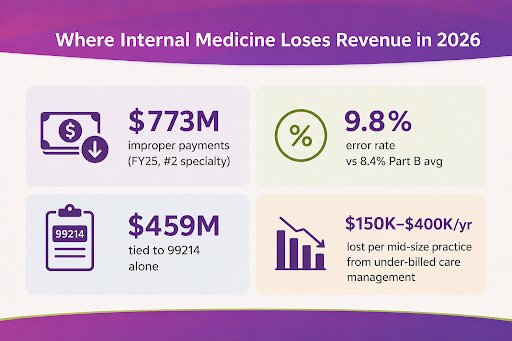
Internal medicine operates at one of the highest-volume and highest-risk points in the Medicare Part B system, and the numbers reflect it. According to CMS, internal medicine accounted for more than $773 million in improper payments in FY 2025, ranking second only to clinical laboratories. The specialty recorded a 9.8% error rate, exceeding the Part B average of 8.4%.
The year before, internal medicine posted an even higher error rate of 14.2%, representing 3.5% of all improper Part B payments. These errors are not compliance issues, but they directly impact reimbursement and profitability.
In internal medicine, three issues account for a large share of missed revenue: defaulting to 99213 when 99214 is supported, failing to bill eligible care management services, and incorrect use of modifier 25 on same-day procedure visits. Notably, CPT 99214 generated $459 million in improper payments in FY 2025, largely due to documentation that did not support the reported service level.

The 2026 CPT code set creates both new opportunities and greater compliance risk for internists. This 2026 internal medicine CPT codes guide covers the code families that matter most, including E/M services, care management, preventive care, in-office procedures, modifiers, and Medicare G-codes. It also covers documentation requirements, billing rules, and 2026 updates that directly affect reimbursement.
Evaluation and Management (E/M) Codes for Internal Medicine
E/M codes form the largest revenue category in internal medicine, accounting for 60–75% of total CPT volume in most practices. The 2021 AMA E/M guidelines apply to office and outpatient services. The 2023 update extended the same framework to hospital, observation, consultation, nursing facility, home, and emergency department services.
Office/Outpatient: New Patients (99202–99205)
The 99202–99205 range covers new patient office and outpatient visits. Code selection depends on either medical decision making (MDM) or total time on the date of the encounter.
| Code | MDM Level | Typical Time (2026) |
|---|---|---|
| 99202 | Straightforward | 15–29 minutes |
| 99203 | Low | 30–44 minutes |
| 99204 | Moderate | 45–59 minutes |
| 99205 | High | 60–74 minutes |
A new patient is one who has not received professional services from the physician or another physician of the exact same specialty and subspecialty in the same group within the past 3 years.
Office/Outpatient: Established Patients (99211–99215)
The 99211–99215 range covers established patient visits. Code 99211 applies to clinical staff visits that do not require physician presence and account for fewer than 2% of internal medicine encounters.
| Code | MDM Level | Typical Time (2026) |
|---|---|---|
| 99211 | N/A (nurse visit) | 5 minutes |
| 99212 | Straightforward | 10–19 minutes |
| 99213 | Low | 20–29 minutes |
| 99214 | Moderate | 30–39 minutes |
| 99215 | High | 40–54 minutes |
The 99213 vs 99214 Decision
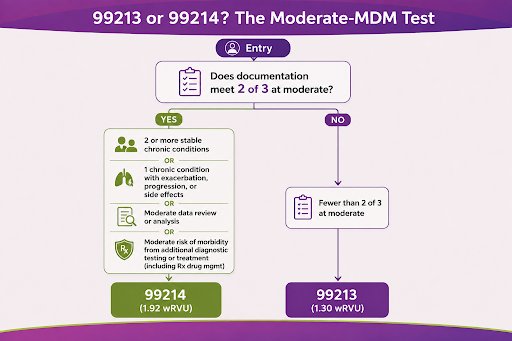
99214 requires moderate medical decision making (MDM), which is met when two of three MDM elements reach the moderate level. Common qualifying scenarios for E/M code 99214 include managing two or more stable chronic conditions, a chronic condition with exacerbation, moderate data review, or moderate risk. Notably, prescription drug management alone qualifies as moderate risk and satisfies one of the three required MDM elements.
99213 example: Stable hypertension follow-up, no medication change, blood pressure within target range.
99214 example: Diabetic patient with hypertension, A1C trending up, medication dose adjustment, review of home glucose log.
99215 example: Decompensated heart failure with new pulmonary symptoms, hospitalization considered, multiple medication adjustments.
Hospital Inpatient and Observation (99221–99239)
The 99221–99223 codes cover initial hospital or observation care. The 99231–99233 codes cover subsequent hospital care. Discharge day management uses 99238 (30 minutes or less) and 99239 (more than 30 minutes).
Consultations (99242–99245, 99252–99255)
The 99242–99245 codes cover outpatient consultations. The 99252–99255 codes cover inpatient consultations. Medicare does not reimburse consultation codes; Medicare claims convert to standard E/M codes. Commercial payers reimburse consultations when documentation supports the request, reason, and report (the “3 R’s”).
Prolonged Services (99417, G2212)
Code 99417 adds 15-minute increments to 99205 or 99215 when total time exceeds the upper bound of the base code. Commercial payers accept 99417. CMS requires G2212 for Medicare prolonged office or outpatient E/M.
Time-Based vs MDM-Based Coding
Time-based coding counts total time on the date of the encounter, including chart review, documentation, ordering, counseling, care coordination, and communication with other professionals. MDM-based coding counts problems addressed, data reviewed and analyzed, and the risk of complications. Either method satisfies code selection, with the higher-paying method winning when both methods are documented.
Care Management CPT Codes
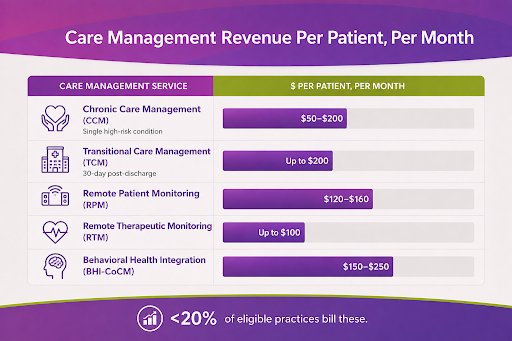
Care management codes generate $50–$200 per patient per month in incremental revenue. Fewer than 20% of eligible internal medicine practices bill these codes, despite 60–70% of Medicare patients meeting eligibility criteria. The under-billing pattern costs an average mid-size internal medicine practice $150,000–$400,000 per year.
Chronic Care Management (CCM)
CCM codes apply to patients with 2 or more chronic conditions expected to last 12+ months or until death.
- 99490: Non-complex CCM, 20 minutes of clinical staff time per calendar month.
- 99439: Add-on for each additional 20 minutes (maximum 2 units per month).
- 99487: Complex CCM, 60 minutes per month, moderate or high MDM.
- 99489: Complex CCM add-on, each additional 30 minutes.
CCM requires documented patient consent, a comprehensive care plan in the medical record, and 24/7 access to a clinician. Chronic care management cannot be billed in the same calendar month as TCM for the same patient.
Principal Care Management (PCM)
PCM applies to patients with a single high-risk chronic condition expected to last 3+ months.
- 99424: PCM by physician, first 30 minutes per month.
- 99425: PCM by physician, each additional 30 minutes.
- 99426: PCM by clinical staff, first 30 minutes.
- 99427: PCM by clinical staff, each additional 30 minutes.
PCM fits patients with single complex conditions like advanced CKD, CHF, or COPD where CCM’s 2-condition threshold does not apply.
Transitional Care Management (TCM)
TCM covers the 30-day period after discharge from inpatient hospital, observation, partial hospitalization, or skilled nursing facility.
- 99495: Moderate MDM, face-to-face visit within 14 days of discharge.
- 99496: High MDM, face-to-face visit within 7 days of discharge.
TCM requires interactive contact (phone, electronic, or in-person) within 2 business days of discharge. The face-to-face visit is bundled into the TCM code and cannot be billed separately. TCM and CCM cannot overlap in the same 30-day period.
Advance Care Planning (ACP)
- 99497: ACP, first 30 minutes.
- 99498: Each additional 30 minutes.
ACP covers voluntary discussions of advance directives. Advanced Care Planning pairs with the Annual Wellness Visit (AWV) at no patient cost-share when modifier 33 is appended. ACP documentation must record the voluntary nature of the discussion and the topics covered.
Behavioral Health Integration (BHI)
- 99484: General BHI, 20 minutes of clinical staff time per month.
- 99492: Initial Collaborative Care Model (CoCM), 70 minutes in first calendar month.
- 99493: Subsequent CoCM, 60 minutes per month.
- 99494: CoCM add-on, each additional 30 minutes.
CoCM requires a behavioral health care manager and a psychiatric consultant. Internal medicine practices generate $150–$250 per CoCM patient per month when staffing the model correctly.
Remote Patient Monitoring (RPM)
- 99453: Initial setup and patient education, one-time per episode.
- 99454: Device supply with daily recordings (requires 16+ days of readings in a 30-day period).
- 99457: First 20 minutes of clinical management time per month.
- 99458: Each additional 20 minutes of management time.
Internal medicine RPM use cases include hypertension, diabetes, congestive heart failure, COPD, and post-discharge monitoring. RPM revenue averages $120–$160 per patient per month.
Remote Therapeutic Monitoring (RTM)
- 98975: Initial setup and patient education.
- 98976: Device supply, respiratory system.
- 98977: Device supply, musculoskeletal system.
- 98980: First 20 minutes of management time.
- 98981: Each additional 20 minutes.
RTM covers non-physiological data and supports patient adherence and therapy response monitoring.
Annual Wellness Visit and Welcome to Medicare
- G0438: Initial AWV, first visit only.
- G0439: Subsequent AWV, billed annually after the initial.
- G0402: Welcome to Medicare visit, within first 12 months of Part B enrollment.
AWV codes generate $130–$180 per visit and pair with E/M and ACP codes on the same date when documented as separately identifiable services.
Preventive Medicine CPT Codes
Preventive medicine services apply to commercial payers and Medicaid populations. Medicare patients receive preventive care through the AWV G-codes instead of 99381–99397.
New Patient Preventive Visits (99381–99387)
- 99385: Preventive visit, ages 18–39.
- 99386: Preventive visit, ages 40–64.
- 99387: Preventive visit, ages 65+.
Established Patient Preventive Visits (99391–99397)
- 99395: Preventive visit, ages 18–39.
- 99396: Preventive visit, ages 40–64.
- 99397: Preventive visit, ages 65+.
Counseling and Risk-Factor Reduction
- 99401–99404: Individual preventive counseling, 15–60 minutes.
- 99406: Tobacco cessation counseling, 3–10 minutes.
- 99407: Tobacco cessation counseling, more than 10 minutes.
- 99408: Alcohol/substance abuse screening, 15–30 minutes.
- 99409: Alcohol/substance abuse screening, more than 30 minutes.
Medicare Preventive G-Codes
- G0442: Annual alcohol misuse screening, 15 minutes.
- G0443: Brief alcohol misuse counseling, 15 minutes.
- G0444: Annual depression screening, 15 minutes.
- G0446: Intensive behavioral therapy for cardiovascular disease.
- G0447: Face-to-face behavioral counseling for obesity, 15 minutes.
- G0473: Group behavioral counseling for obesity, 30 minutes.
Immunization Administration
- 90471: Immunization administration, first vaccine.
- 90472: Each additional vaccine.
- G0008: Influenza vaccine administration (Medicare).
- G0009: Pneumococcal vaccine administration (Medicare).
- G0010: Hepatitis B vaccine administration (Medicare).
Vaccine product codes bill separately from administration codes.
Procedural CPT Codes in Internal Medicine
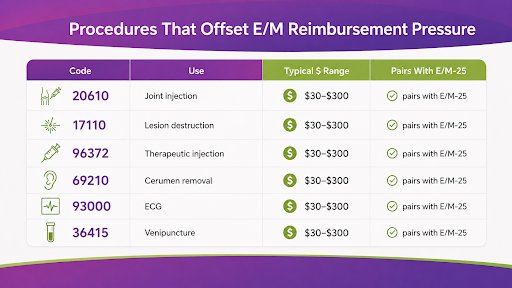
Internal medicine procedures generate $30–$300 per service and offset reimbursement compression on E/M codes. Procedure billing requires documentation of indication, technique, findings, and post-procedure status.
Cardiac Diagnostics
- 93000: Electrocardiogram, complete with interpretation and report.
- 93005: ECG, tracing only.
- 93010: ECG, interpretation and report only.
- 93224–93227: Holter monitoring, 48 hours or less.
- 93306: Echocardiogram, complete with Doppler.
Pulmonary Diagnostics
- 94010: Spirometry.
- 94060: Bronchodilator responsiveness, spirometry pre- and post-bronchodilator.
- 94640: Pressurized inhalation treatment for airway obstruction.
- 94760: Pulse oximetry, single determination.
- 94761: Pulse oximetry, multiple determinations.
Diagnostic and Therapeutic Procedures
- 17110: Destruction of benign lesions, up to 14 lesions.
- 17111: Destruction of benign lesions, 15 or more lesions.
- 20605: Arthrocentesis, intermediate joint (wrist, elbow, ankle).
- 20610: Arthrocentesis, major joint (shoulder, hip, knee).
- 20611: Arthrocentesis with ultrasound guidance.
- 36415: Venipuncture for specimen collection.
- 36416: Capillary blood specimen.
- 51701: Insertion of non-indwelling bladder catheter.
- 51702: Insertion of temporary indwelling bladder catheter.
- 69210: Removal of impacted cerumen, one or both ears.
- 11055–11057: Paring or cutting of benign hyperkeratotic lesions.
Injections and Infusions
- 96372: Therapeutic, prophylactic, or diagnostic injection (subcutaneous or intramuscular).
- 96374: Intravenous push, single drug.
- 96365: Intravenous infusion for therapy, initial up to 1 hour.
- 96366: Each additional hour of IV infusion.
In-Office Laboratory (CLIA-Waived)
- 81002: Urinalysis, dipstick, non-automated, without microscopy.
- 81003: Urinalysis, dipstick, automated, without microscopy.
- 82947: Glucose, quantitative blood.
- 82962: Glucose, blood by glucose monitoring device.
- 85018: Hemoglobin.
- 87880: Streptococcus group A rapid antigen test.
- 87804: Influenza rapid antigen test.
Additional Diagnostic Codes
- 11102: Tangential biopsy of skin, single lesion.
- 11104: Punch biopsy of skin, single lesion.
- 11106: Incisional biopsy of skin, single lesion.
- 93015: Cardiovascular stress test, global service.
- 93016: Cardiovascular stress test, physician supervision only.
- 93017: Cardiovascular stress test, tracing only.
- 93018: Cardiovascular stress test, interpretation and report only.
- 92551: Pure tone audiometry screening.
- 92552: Pure tone audiometry, air only.
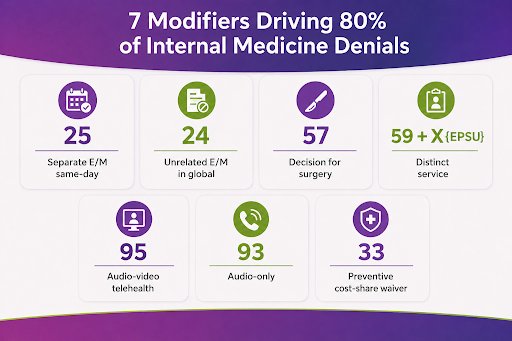
Modifiers Every Internal Medicine Coder Must Apply
Modifiers determine whether a claim pays in full, pays at reduced rate, or is denied. The 7 modifiers below drive 80%+ of internal medicine modifier-related denials.
Modifier 25: Significant, Separately Identifiable E/M
Modifier 25 appends to an E/M code when the physician provides an E/M service that goes beyond the work inherent in a same-day procedure or preventive service.
Required pairings in internal medicine:
- 99213-25 with 20610 (joint injection same day).
- 99214-25 with 17110 (lesion destruction same day).
- 99213-25 with G0439 (problem-focused E/M with subsequent AWV).
- 99214-25 with 96372 (E/M plus therapeutic injection).
Documentation must show a separately identifiable assessment and plan. Plus, modifier 25 ranks as the top audit target for commercial and Medicare contractor reviews.
Modifier 24: Unrelated E/M During Postoperative Period
Modifier 24 applies when an internist sees a patient for a condition unrelated to a recent surgery during the surgeon’s global period (10 or 90 days). The diagnosis code on the E/M claim must differ from the surgical diagnosis.
Modifier 57: Decision for Surgery
Modifier 57 applies to E/M services that result in the decision to perform major surgery (90-day global period). Also, modifier 57 distinguishes the decision-making visit from the bundled pre-operative work.
Modifier 59 and X-Modifiers
Modifier 59 indicates a distinct procedural service. CMS prefers the X-modifiers introduced in 2015:
- XE: Separate encounter on same date.
- XS: Separate structure or organ.
- XP: Separate practitioner.
- XU: Unusual non-overlapping service.
Internal medicine applications include separate lesion removals, distinct anatomic sites, and unbundling NCCI edit pairs when clinically supported.
Modifier 95: Synchronous Telehealth (Audio-Video)
Modifier 95 appends to E/M codes delivered via synchronous audio-video communication. Moreover, modifier 95 pairs with place of service (POS) codes:
- POS 02: Telehealth provided in location other than the patient’s home.
- POS 10: Telehealth provided in the patient’s home.
Modifier 93: Synchronous Audio-Only Telehealth
Modifier 93 covers established patient services delivered by audio-only (telephone) communication when video is unavailable or the patient declines video. Audio-only services apply to a limited subset of E/M and behavioral health codes.
Modifier 33: Preventive Services
Modifier 33 waives patient cost-share for ACA-mandated preventive services. Internal medicine uses modifier 33 for ACP (99497) when delivered alongside the AWV.
Same-Day CPT Code Pairing Rules
Same-day pairing rules determine which combinations bill together and which trigger denials. Five pairing patterns generate the majority of internal medicine reimbursement opportunities.
AWV Plus Problem-Oriented E/M
The AWV (G0438 or G0439) bills with a problem-oriented E/M code (99213 or 99214) on the same date when the physician addresses a condition outside the AWV scope. Modifier 25 appends to the E/M code. Documentation must separate the AWV checklist work from the problem-focused assessment and plan.
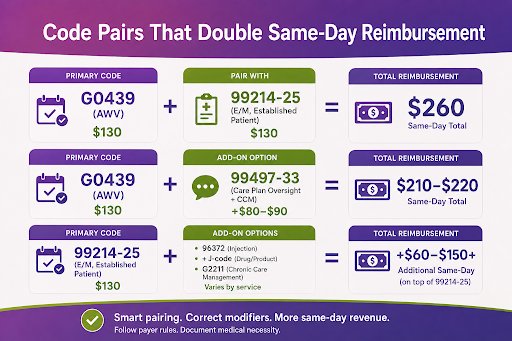
Reimbursement impact: Pairing G0439 ($130) with 99214-25 ($130) yields $260, compared with $130 for either code alone.
Preventive Visit Plus Sick E/M
For commercial patients, 99396 or 99397 bills with 99213-25 or 99214-25 when the visit shifts from prevention to active problem management. Patient cost-share applies to the E/M portion. Documentation must distinguish the preventive screening from the problem-oriented work.
AWV Plus ACP
99497 with modifier 33 pairs with G0438 or G0439 at no patient cost-share. Without modifier 33, the patient owes a copay for the ACP portion. The pairing yields an additional $80–$90 per AWV.
E/M Plus Minor Procedure
99213-25 or 99214-25 pairs with same-day procedures including 20610, 17110, 96372, and 69210. The E/M documentation must show assessment and decision-making beyond the pre-procedure evaluation.
G2211 Plus E/M (2026 Rules)
The G2211 add-on code bills with office or outpatient E/M codes (99202–99215) when the visit represents ongoing longitudinal care for a single serious or complex condition. Starting in 2025, CMS allows G2211 alongside E/M services with modifier 25 when the same-day service is an AWV, Medicare Part B preventive service, or vaccine administration. G2211 does not pair with E/M-25 in other procedural contexts.
2026 CPT and Reimbursement Updates Affecting Internal Medicine
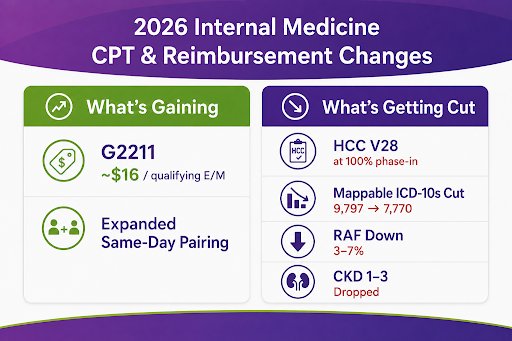
The 2026 Medicare Physician Fee Schedule, CPT code set updates, and HCC model transitions reshape internal medicine reimbursement.
G2211: Visit Complexity Add-On
G2211 reimburses approximately $16 per qualifying E/M claim. Also, G2211 applies when the physician serves as the continuing focal point for the patient’s longitudinal care or as the ongoing professional for a single serious or complex condition.
G2211 qualifies for:
- Diabetes follow-up with stable established patient.
- Hypertension management visits.
- CHF management visits.
- COPD follow-up.
- CKD progression monitoring.
G2211 does not qualify when:
- The visit is one-off without expected continuity.
- The physician is not the longitudinal care provider.
- The patient is a hospital-based encounter outside the longitudinal relationship.
CMS-HCC V28 Risk Adjustment
The CMS-HCC V28 model reaches 100% phase-in for 2026. V28 reduces the number of mappable ICD-10 codes from 9,797 (V24) to 7,770 and restructures HCC categories. Internal medicine practices in value-based contracts see RAF score reductions of 3–7% on average from the V28 transition.
V28 impact areas for internal medicine:
- Diabetes: HCC categories simplified, complications must be documented specifically.
- CKD: stages 4 and 5 retain HCC value, stages 1–3 removed.
- Vascular disease: peripheral artery disease codes restructured.
- Major depression: HCC value reduced for recurrent forms.
Telehealth Coding 2026
Medicare telehealth flexibilities for non-behavioral health services follow the 2026 statutory framework. Audio-only services (modifier 93) remain payable for established patients in defined contexts. Behavioral health telehealth retains expanded coverage, including originating site in the patient’s home.
Updated and New 2026 CPT Codes
The 2026 CPT code set adds codes for digital therapeutics, expanded RTM categories, and new immunization administration codes. Deleted codes include legacy telehealth modifiers no longer accepted by CMS or major commercial payers.
2026 Medicare Conversion Factor
The 2026 Medicare conversion factor adjusts physician payment per RVU. Internal medicine specialty-level reimbursement reflects the conversion factor multiplied by total RVUs (work + practice expense + malpractice) for each code.
Work RVU Reference for Top Internal Medicine CPT Codes
The work RVU drives the largest component of physician reimbursement. The 12 highest-volume internal medicine codes carry these work RVUs:
| CPT Code | Description | Work RVU (2026) |
|---|---|---|
| 99202 | New patient, straightforward | 0.93 |
| 99203 | New patient, low MDM | 1.60 |
| 99204 | New patient, moderate MDM | 2.60 |
| 99205 | New patient, high MDM | 3.50 |
| 99212 | Established, straightforward | 0.70 |
| 99213 | Established, low MDM | 1.30 |
| 99214 | Established, moderate MDM | 1.92 |
| 99215 | Established, high MDM | 2.80 |
| 99490 | CCM, 20 minutes | 0.61 |
| 99495 | TCM, moderate MDM | 2.36 |
| 99496 | TCM, high MDM | 3.10 |
| G2211 | Visit complexity add-on | 0.33 |
Documentation Standards by CPT Code Family
Documentation defends the CPT code selection during audit. Each code family carries specific documentation requirements, which are critical to correct internal medicine billing workflow.
Documentation for E/M Codes
E/M documentation must support either MDM or total time. MDM documentation captures the problems addressed (number and complexity), the data reviewed (tests, records, independent interpretation), and the risk of complications (including prescription drug management). Time documentation captures total minutes spent on the date of the encounter with a breakdown of activities.
Documentation for Care Management Codes
CCM, PCM, TCM, and BHI documentation requires written or verbal patient consent (recorded in the chart), a comprehensive care plan accessible to all care team members, time logs by date showing the cumulative minutes per calendar month, and a 24/7 access statement for CCM and PCM.
Documentation for Procedures
Procedure notes include the indication, technique, findings, and post-procedure status. Code 20611 requires explicit documentation that ultrasound guidance was used and that an image was retained. Code 17110 requires documentation of the number, location, and type of lesions destroyed.
Documentation for Modifier 25
Modifier 25 documentation shows two distinct assessment and plan sections, one for the E/M and one for the procedure or preventive service. The chief complaint and history of present illness should clearly establish the E/M work as separate from the procedural work.
Common CPT-Related Denials in Internal Medicine
- CCM and TCM overlap: Both codes billed in the same 30-day period for the same patient.
- Modifier 25 without supporting documentation: Single assessment and plan covering both the E/M and the procedure.
- G2211 with modifier 25 outside allowed contexts: G2211 paired with E/M-25 plus a procedure other than AWV, preventive, or vaccine.
- 99214 without MDM support: Documentation supports only 99213-level MDM or time.
- AWV billed within 12 months of prior AWV: Frequency limitation denial.
- 96372 without specific J-code: Injection administration billed without the drug HCPCS code.
- Telehealth POS and modifier mismatch: POS 10 billed without modifier 95 or 93.
- NCCI edit pair violations: Bundled code combinations billed without supporting modifiers.
Coding Accuracy Best Practices for Internal Medicine
Internal medicine practices maintain coding accuracy through six operational disciplines. These best practices help reduce claim denials, support compliance with payer requirements, and ensure that documentation accurately reflects the complexity and scope of patient care. Choosing an internal medicine billing provider that consistently adheres to these processes improves reimbursement accuracy while minimizing audit and revenue cycle risks.
Code at the Level the Documentation Supports
Code selection follows documentation, not workflow defaults. Practices defaulting to 99213 CPT code because “the system is set that way” lose 25–40% of the 99214 revenue their MDM supports.
Build a CCM and TCM Enrollment Engine
Care management revenue compounds with enrolled patient volume. Practices reaching 30%+ CCM enrollment of their eligible Medicare panel add $200,000+ in annual revenue. The workflow requires care coordinator staffing, documented consent, and EHR templates for monthly time tracking.
Audit Modifier 25 Quarterly
Modifier 25 audits compare the percentage of E/M claims with modifier 25 against peer benchmarks. Internal medicine national benchmarks fall between 15–25%. Practices above 35% draw payer scrutiny. Practices below 10% likely under-bill modifier 25.
Track Top 20 Codes Monthly
The top 20 CPT codes account for 80%+ of internal medicine revenue. Monthly tracking of code volume, denial rate, and reimbursement per code surfaces under-coding patterns and payer-specific issues before they compound.
Reconcile Documentation Against Code Submitted
Coding quality assurance compares 5–10% of claims monthly against documentation. The QA review catches MDM under-coding, missing modifiers, and procedure documentation gaps.
Stay Current on Annual CPT and MPFS Changes
CPT updates publish each October for the following calendar year. The Medicare Physician Fee Schedule final rule publishes each November. Internal medicine practices update fee schedules, code descriptions, and EHR templates by January 1 of each year.
Frequently Asked Questions
What Is the Most Common CPT Code in Internal Medicine?
99213 ranks as the most billed CPT code in internal medicine, representing 35–45% of E/M volume in most practices. 99214 ranks second at 25–35%, with under-coding patterns suggesting 99214 should reach 40–50% of volume in most internal medicine panels.
Can an Internist Bill an AWV and a Regular Office Visit on the Same Day?
An internist bills G0438 or G0439 with 99213-25 or 99214-25 on the same date when the visit addresses a condition outside the AWV scope. The AWV portion has no patient cost-share. The E/M portion applies standard cost-sharing.
What Is the Difference Between 99213 and 99214?
99214 requires moderate MDM versus low MDM for 99213. Moderate MDM means 2 of 3 elements: 2+ stable chronic conditions or 1 chronic with exacerbation, moderate data complexity, or moderate risk, including prescription drug management. 99214 also requires 30–39 minutes of total time on the encounter date when billed by time.
When Does G2211 Apply?
G2211 applies when the internist serves as the continuing focal point for a patient’s longitudinal care or as the ongoing professional for a single serious or complex condition. G2211 adds approximately $16 per qualifying E/M claim.
What Is the CPT Code for Chronic Care Management?
99490 codes non-complex chronic care management for 20 minutes per calendar month. 99487 codes complex CCM for 60 minutes per month. Both require 2+ chronic conditions expected to last 12+ months.
Can an Internist Bill 99214 and 96372 on the Same Day?
99214-25 bills with 96372 on the same date when the E/M addresses a condition beyond the injection itself. Modifier 25 appends to 99214. The injection must include a specific J-code for the drug administered. Documentation must show separate work for the E/M and the injection to bill procedure code 96372 alongside.
What Modifier Do I Use for Telehealth?
Modifier 95 applies to synchronous audio-video telehealth. Modifier 93 applies to synchronous audio-only telehealth. POS 10 indicates the patient is at home. POS 02 indicates the patient is at a location other than home.
How Often Can G0439 Be Billed?
G0439 bills once every 12 months after the initial AWV (G0438). Medicare requires at least 11 full months between AWVs. Claims submitted before the 12-month interval generate frequency limitation denials.