Neurology HCPCS codes are HCPCS Level II codes that report the drugs, biologicals, supplies, and equipment used in neurologic care. These codes sit next to CPT procedure codes on every claim. Neurology practices depend on them for high-dollar injectable and infused therapies.
The Healthcare Common Procedure Coding System (HCPCS) has two levels. Level I is CPT, which describes physician work. Level II is the alphanumeric set that covers products like onabotulinumtoxinA, natalizumab, and nusinersen. Both levels must align on the claim for payment.
This guide covers the codes and rules that matter most in neurology billing. It walks through the main J-codes for botulinum toxins, MS infusions, and spinal muscular atrophy drugs. It shows how to calculate HCPCS drug units without triggering a unit-mismatch denial. It breaks down the JW and JZ modifiers, the NDC requirement, and CPT-to-HCPCS pairing logic. It also identifies the DME and supply codes neurology practices bill outside the office visit.
Every code and rule below reflects 2026 billing guidance from CMS, MAC policy, and manufacturer coding sheets. Because ASP and billing units shift every quarter, many practices lean on dedicated neurology billing services to verify each drug’s current billing unit and ASP against the quarterly CMS file before submission.
What Are Neurology HCPCS Codes?
Neurology HCPCS codes are the HCPCS Level II codes a neurology practice reports for drugs, biologicals, durable medical equipment, and supplies. HCPCS Level II codes are alphanumeric, starting with a single letter followed by four digits. The letter signals the code family, such as J for drugs.
The Centers for Medicare and Medicaid Services (CMS) maintains HCPCS Level II. The American Medical Association maintains CPT, which is HCPCS Level I. Neurology claims almost always carry codes from both systems on the same date of service.
Three facts define how neurology uses these codes:
- HCPCS Level II reports the product, such as the toxin, the biologic, or the electrode.
- CPT reports the work, such as the chemodenervation, the infusion, or the office visit.
- A clean claim links both to an ICD-10-CM diagnosis that proves medical necessity.
A common error is treating HCPCS codes as interchangeable with CPT codes. The two systems answer different questions on the claim. One names the drug. The other names the service that delivered it.
This reference isolates the HCPCS layer but sits inside a wider neurology billing guide that spans procedure coding, documentation, and denial management end to end. Use this page for the drug line and use the parent guide when you need the full claim lifecycle in one place.
How Do HCPCS Level II Codes Differ From CPT Codes in Neurology?
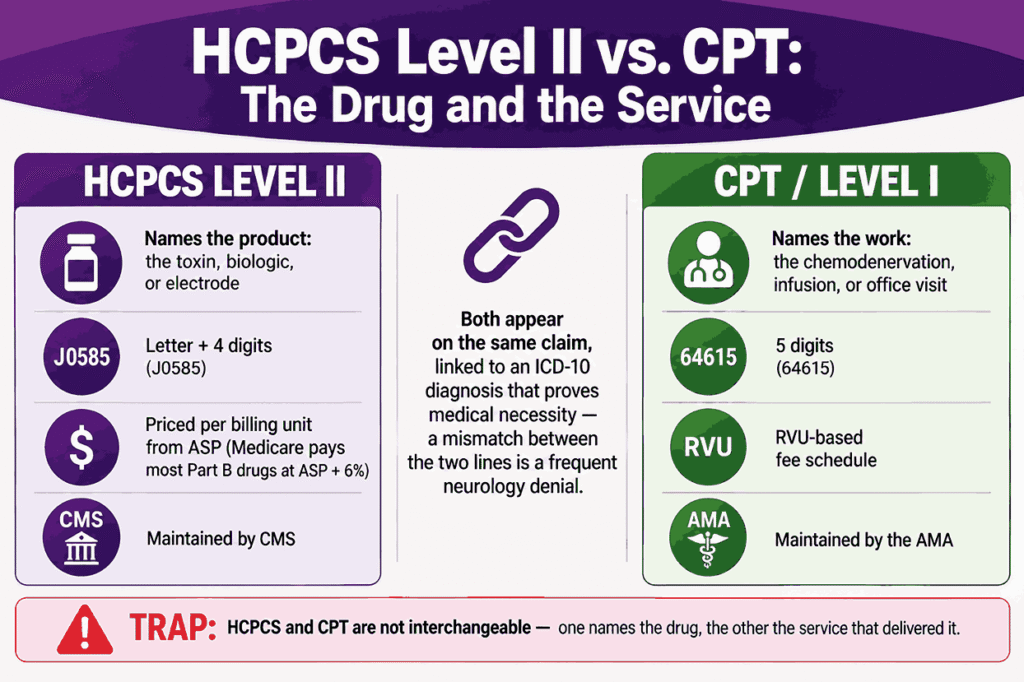
HCPCS Level II codes name the drug or device, while CPT codes name the procedure that delivered it. A Botox migraine claim shows this split clearly. CPT 64615 reports the injection work. HCPCS J0585 reports the onabotulinumtoxinA itself.
The two codes carry different payment logic. CPT procedure codes pay a fixed fee based on relative value units. HCPCS drug codes pay per billing unit, priced from the Average Sales Price (ASP). Medicare pays most Part B drugs at ASP plus 6 percent.
The table below maps the two systems across four billing dimensions:
| Dimension | HCPCS Level II (drug) | CPT (procedure) |
|---|---|---|
| What it reports | The drug, biologic, or supply | The physician service |
| Code format | Letter + 4 digits (J0585) | 5 digits (64615) |
| Pricing basis | ASP per billing unit | RVU-based fee schedule |
| Maintained by | CMS | American Medical Association |
Both codes appear on the same claim for a single encounter. The drug line and the procedure line must agree on units, diagnosis, and date. A mismatch between the two lines is a frequent denial source in neurology.
Which HCPCS Code Ranges Do Neurology Practices Use Most?
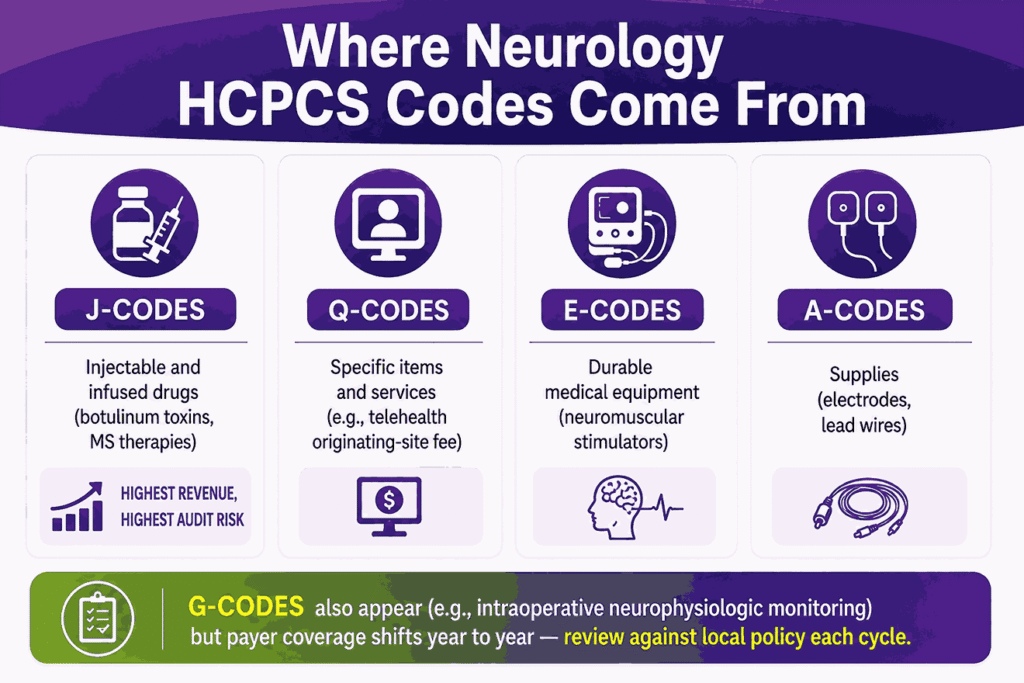
Neurology practices bill from four HCPCS Level II ranges most often: J-codes, Q-codes, E-codes, and A-codes. J-codes carry the highest revenue and the highest audit risk because they cover injectable and infused drugs.
The four ranges map to distinct neurology functions:
- J-codes report injectable and infused drugs, such as botulinum toxins and MS therapies.
- Q-codes report specific items and services, such as the telehealth originating-site fee.
- E-codes report durable medical equipment, such as neuromuscular stimulators.
- A-codes report supplies, such as electrodes and lead wires.
G-codes also appear in neurology, though payer policy varies year to year. G-codes report defined services like intraoperative neurophysiologic monitoring. Review G-code coverage against local policy each billing cycle because assignments shift.
What Are the Main HCPCS J-Codes for Neurology Drugs?
The main neurology J-codes cover four drug groups: botulinum toxins, MS and neuroinflammatory infusions, spinal muscular atrophy therapy, and immune globulin. Each J-code carries its own billing unit, and the unit rarely equals one milligram or one vial.
Injectable drugs are the highest-revenue and highest-risk service in neurology billing. A single ocrelizumab claim can exceed the value of dozens of office visits. A unit error on that claim delays a four-figure payment.
The table below lists the neurology J-codes billed most often, with the billing unit for each:
| HCPCS Code | Drug (Brand) | Billing Unit | Common Neurology Use |
|---|---|---|---|
| J0585 | onabotulinumtoxinA (Botox) | 1 unit | Chronic migraine, dystonia, spasticity |
| J0586 | abobotulinumtoxinA (Dysport) | 5 units | Cervical dystonia, limb spasticity |
| J0587 | rimabotulinumtoxinB (Myobloc) | 100 units | Cervical dystonia |
| J0588 | incobotulinumtoxinA (Xeomin) | 1 unit | Dystonia, spasticity, sialorrhea |
| J2323 | natalizumab (Tysabri) | 1 mg | Relapsing multiple sclerosis |
| Q5134 | natalizumab-sztn (Tyruko) | 1 mg | Relapsing MS (biosimilar) |
| J2350 | ocrelizumab (Ocrevus) | 1 mg | Relapsing and primary progressive MS |
| J2351 | ocrelizumab + hyaluronidase (Ocrevus Zunovo) | 1 mg | Multiple sclerosis (subcutaneous) |
| J1300 | eculizumab (Soliris) | 10 mg | NMOSD, myasthenia gravis |
| J2326 | nusinersen (Spinraza) | 0.1 mg | Spinal muscular atrophy |
The billing unit is the single most important field on each row. Two toxins in this table (Botox and Dysport) share a therapeutic class but use different unit ratios. The next sections break each group down by unit math and pairing rules.
Which Botulinum Toxin J-Codes Do Neurologists Bill?
Neurologists bill four botulinum toxin J-codes: J0585, J0586, J0587, and J0588. The four toxins are not interchangeable, and each code uses its own billing unit. Billing the wrong code for the administered product produces incorrect claim math in both directions.
The unit difference between Botox and Dysport drives most toxin denials. J0585 (Botox) is billed per 1 unit. J0586 (Dysport) is billed per 5 units. A 300-unit Dysport dose bills as 60 units on the claim, not 300.
Keep these rules in view when coding toxin claims:
- Match the code to the vial. Confirm the product name against the J-code before submission.
- Maintain separate templates for each toxin to prevent cross-code errors.
- Bill the exact administered units, then account for waste on a second line.
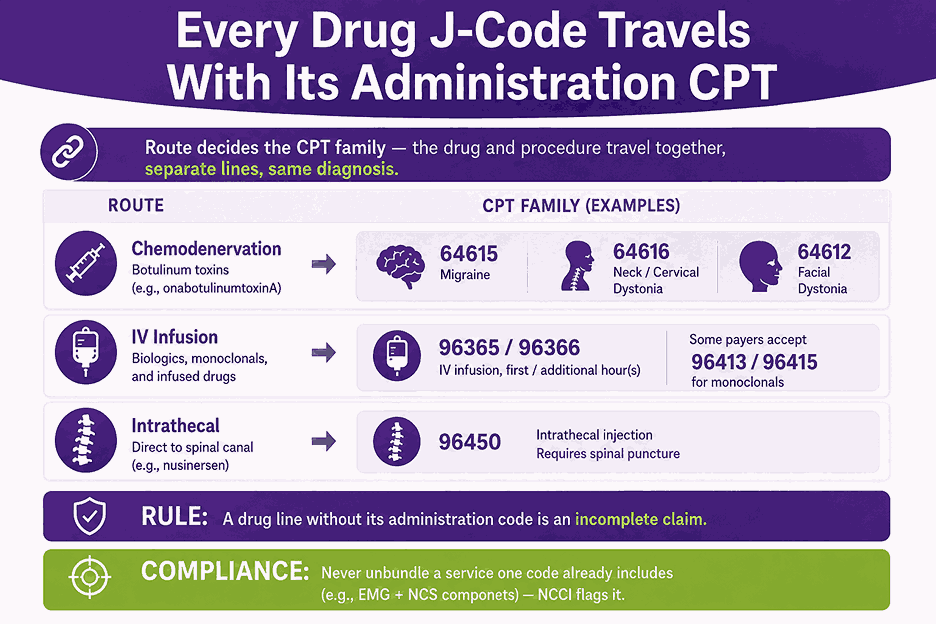
Botulinum toxin claims also require the correct chemodenervation CPT code. Chronic migraine pairs with 64615. Cervical dystonia neck muscles pair with 64616. Facial muscles pair with 64612. The drug code and the procedure code both appear, on separate lines.
Which J-Codes Cover MS and Neuroinflammatory Infusions?
Neurology infusion practices bill several J-codes for MS and neuroinflammatory disease: J2323, Q5134, J2350, J2351, J1300, and the immune globulin family. These drugs treat relapsing MS, primary progressive MS, NMOSD, and autoimmune neuropathies. Each carries prior-authorization requirements from most payers.
Natalizumab (J2323, Tysabri) is billed per 1 mg, so a 300 mg dose bills as 300 units. The biosimilar Tyruko uses Q5134, also per 1 mg. The codes are not interchangeable, so bill based on the product the patient actually received.
The table below maps the main infusion codes to dose and diagnosis logic:
| HCPCS Code | Drug | Standard Dose | Unit Math | Primary Diagnosis |
|---|---|---|---|---|
| J2323 | Natalizumab | 300 mg every 4 weeks | 300 units | G35 (MS) |
| J2350 | Ocrelizumab | 600 mg every 6 months | 600 units | G35 (MS) |
| J1300 | Eculizumab | Per label, 10 mg unit | Dose ÷ 10 | NMOSD, MG |
| J1459+ | IVIG (per 500 mg) | Weight-based | Dose ÷ 500 | CIDP, MMN, MG |
Immune globulin (IVIG) uses several brand-specific J-codes billed per 500 mg, including J1459, J1561, J1568, J1569, and J1572. Confirm the exact code for the administered brand, because IVIG products are not cross-billable. In practice, brand substitution without a code change is a top IVIG denial cause.
Infusion drug lines also need the administration CPT codes. Standard IV infusion uses 96365 and 96366. Some payers accept chemotherapy administration codes 96413 and 96415 for monoclonal antibodies. Check payer policy before selecting the administration code.
How Is Nusinersen (J2326) Billed for Spinal Muscular Atrophy?
Nusinersen is billed with HCPCS code J2326, defined as injection, nusinersen, 0.1 mg. A standard 12 mg dose bills as 120 units, because the code unit is 0.1 mg. The unit math is the most common source of J2326 denials.
Nusinersen (Spinraza) is delivered intrathecally, so it pairs with a specific procedure code. Per MAC guidance, J2326 is billed with CPT 96450, chemotherapy administration into the central nervous system requiring spinal puncture. Both codes appear on the same date of service.
The J2326 claim has three moving parts:
- The drug: J2326 at 120 units for a 12 mg dose.
- The administration: CPT 96450 for the intrathecal delivery.
- The diagnosis: the specific SMA ICD-10-CM code the patient carries.
FDA labeling sets the loading and maintenance schedule for nusinersen. The label lists loading doses followed by a maintenance dose every 4 months. Bill the units that match the administered dose, and document the schedule position in the record.
How Are HCPCS Drug Units Calculated in Neurology Billing?
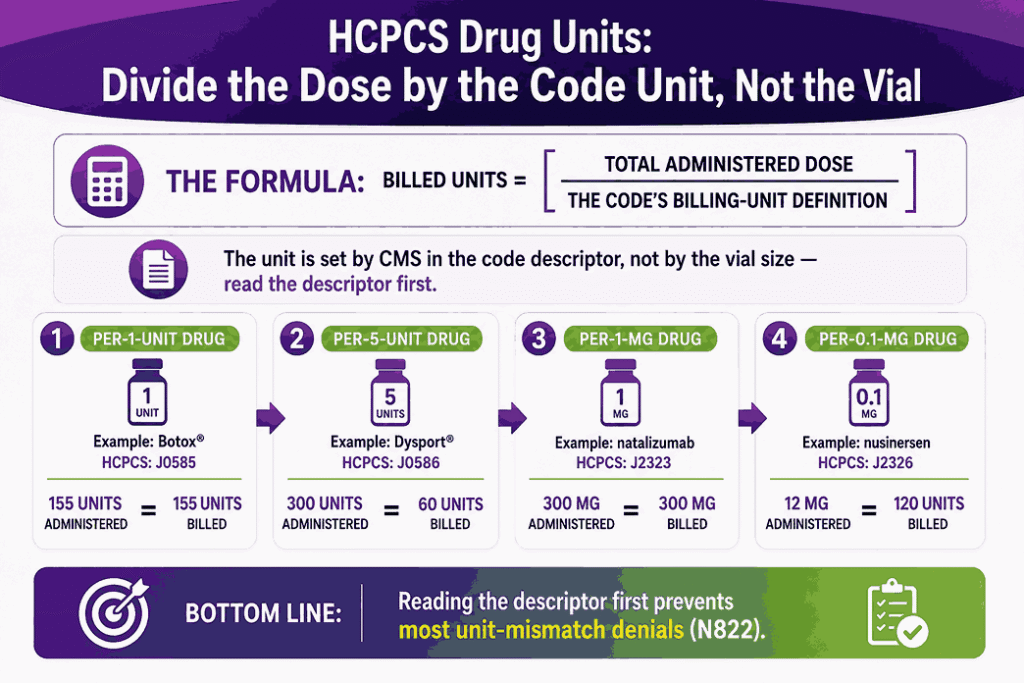
HCPCS drug units are calculated by dividing the administered dose by the code’s billing-unit definition. The billing unit is set by CMS in the code descriptor, not by the vial size. Reading the descriptor first prevents most unit-mismatch denials.
The formula is direct: billed units equal total dose divided by the code unit. For a drug defined per 1 mg, a 300 mg dose bills as 300 units. For a drug defined per 0.1 mg, a 12 mg dose bills as 120 units.
The worked examples below show the math for four common neurology drugs:
| Drug (Code) | Code Unit | Administered Dose | Billed Units |
|---|---|---|---|
| Botox (J0585) | 1 unit | 155 units (PREEMPT) | 155 |
| Dysport (J0586) | 5 units | 300 units | 60 |
| Natalizumab (J2323) | 1 mg | 300 mg | 300 |
| Nusinersen (J2326) | 0.1 mg | 12 mg | 120 |
The Botox chronic migraine claim shows why waste matters. The PREEMPT protocol uses 155 units across 31 injection sites. Botox ships in a 200-unit single-dose vial. The claim reports 155 units administered and 45 units discarded.
The discarded amount is billed and documented, not written off. Medicare reimburses the unused portion of a single-dose vial when the record supports the waste. The next section covers the modifier that reports that waste.
Which Modifiers Apply to Neurology HCPCS Claims?
Neurology HCPCS claims use six core modifiers: JW, JZ, 25, 59, 50, and the LT/RT pair. The JW and JZ modifiers apply to drug lines. The others apply to the procedure or E/M lines that accompany the drug.
Modifier selection is a compliance control, not a formality. A missing JW or JZ modifier returns a single-dose drug line as unprocessable. A missing modifier 25 on a same-day E/M service triggers a bundling denial.
The table below defines each modifier and its neurology use:
| Modifier | Meaning | When to Use in Neurology |
|---|---|---|
| JW | Drug amount discarded | Report waste from a single-dose vial on a separate line |
| JZ | No drug discarded | Attest full single-dose vial was administered |
| 25 | Separate, significant E/M | Same-day office visit distinct from the injection |
| 59 | Distinct procedural service | Override an NCCI edit for a separate site or session |
| 50 | Bilateral procedure | Bilateral chemodenervation in a hospital outpatient setting |
| LT / RT | Left / right side | Report laterality, often in an ASC setting |
Neurology drug claims also require the National Drug Code (NDC). The NDC identifies the specific vial, product, and package the payer reimburses. Many payers reject a drug line that reports HCPCS units without the matching NDC and NDC unit qualifier.
When Do You Append the JW or JZ Modifier?
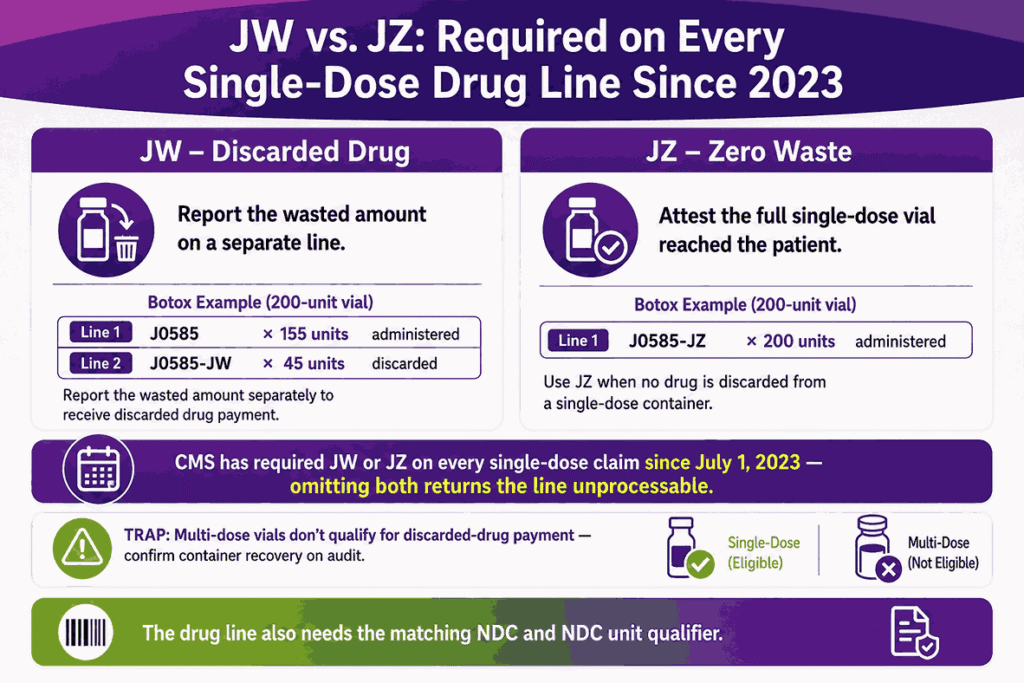
Append JW when a single-dose container has discarded drug, and append JZ when it has none. CMS has required one of these two modifiers on every single-dose drug claim since July 1, 2023. Omitting both modifiers returns the line as unprocessable.
The two modifiers are mutually exclusive on a given administration. JW reports the wasted amount on a second claim line. JZ attests that the full vial reached the patient with zero waste.
The Botox migraine claim shows the JW pattern in practice:
- Line 1: J0585 x 155 units administered
- Line 2: J0585-JW x 45 units discarded
- Documentation: administered and wasted amounts, plus the NDC and lot
Multi-dose vials do not qualify for discarded-drug payment. The JW and JZ rules apply only to single-dose containers and single-use packages. Confirm the container type before applying either modifier, because the wrong choice invites recovery on audit.
How Do You Pair a Drug J-Code With Its CPT Procedure Code?
Pair each drug J-code with the CPT code that describes how the drug was delivered. The drug and the procedure travel together on the claim, on separate lines, under the same diagnosis. A drug line without its administration code is an incomplete claim.
The pairing depends on the delivery route: injection, chemodenervation, IV infusion, or intrathecal puncture. Each route has a distinct CPT family. The correct pair prevents both underpayment and bundling denials.
The table below maps common neurology drugs to their CPT partners:
| Drug (HCPCS) | Delivery | Paired CPT | Notes |
|---|---|---|---|
| Botox (J0585) | Chemodenervation, migraine | 64615 | Do not add 64612/64616 for same session |
| Botox (J0585) | Chemodenervation, neck | 64616 | Cervical dystonia |
| Ocrelizumab (J2350) | IV infusion | 96365 / 96413 | Payer decides which family |
| Natalizumab (J2323) | IV infusion | 96365 / 96366 | REMS documentation required |
| Nusinersen (J2326) | Intrathecal | 96450 | Requires spinal puncture |
Never unbundle a service that a single code already includes. An EMG study, for example, may include needle EMG and nerve conduction components under one code family. Splitting a bundled service into separate codes is a compliance risk flagged by NCCI edits.
Every drug line on a neurology claim travels with a procedure line, and the procedure side has its own denial patterns around EEG, EMG, and chemodenervation coding. This HCPCS guide covers the drug half of that claim; a companion neurology CPT codes reference covers the work half. Read the two together whenever a claim carries both a J-code and an administration or study code.
What HCPCS Codes Cover Neurology DME and Supplies?
Neurology bills DME and supply codes from the E-code, A-code, and Q-code ranges. These codes cover stimulators, electrodes, monitoring services, and the telehealth originating-site fee. Payers apply strict medical-necessity and documentation rules to each.
DME claims often need the KX modifier to confirm that coverage criteria are met. Supply codes are typically billed per unit or per month. Both require an order in the record signed by the treating provider.
The table below lists neurology DME, supply, and service codes billed outside the office visit:
| HCPCS Code | Item / Service | Category | Neurology Use |
|---|---|---|---|
| E0720 / E0730 | TENS unit (2-lead / 4-lead) | DME | Chronic neuropathic pain |
| E0745 | Neuromuscular stimulator | DME | Muscle re-education, spasticity |
| A4556 / A4557 | Electrodes / lead wires | Supply | TENS and stimulation supplies |
| A4595 | TENS supply allowance | Supply | Monthly electrode and battery supply |
| G0453 | Intraoperative neuro monitoring | Service | Continuous IONM, per 15 minutes |
| Q3014 | Telehealth originating site fee | Service | Tele-neurology facility fee |
Intraoperative neurophysiologic monitoring (IONM) uses G0453, billed per 15 minutes of continuous monitoring. Tele-neurology programs bill Q3014 for the originating-site facility fee when the patient is at a qualifying location. Both codes carry setting and time rules that payers audit.
Why Do Neurology HCPCS Claims Get Denied?
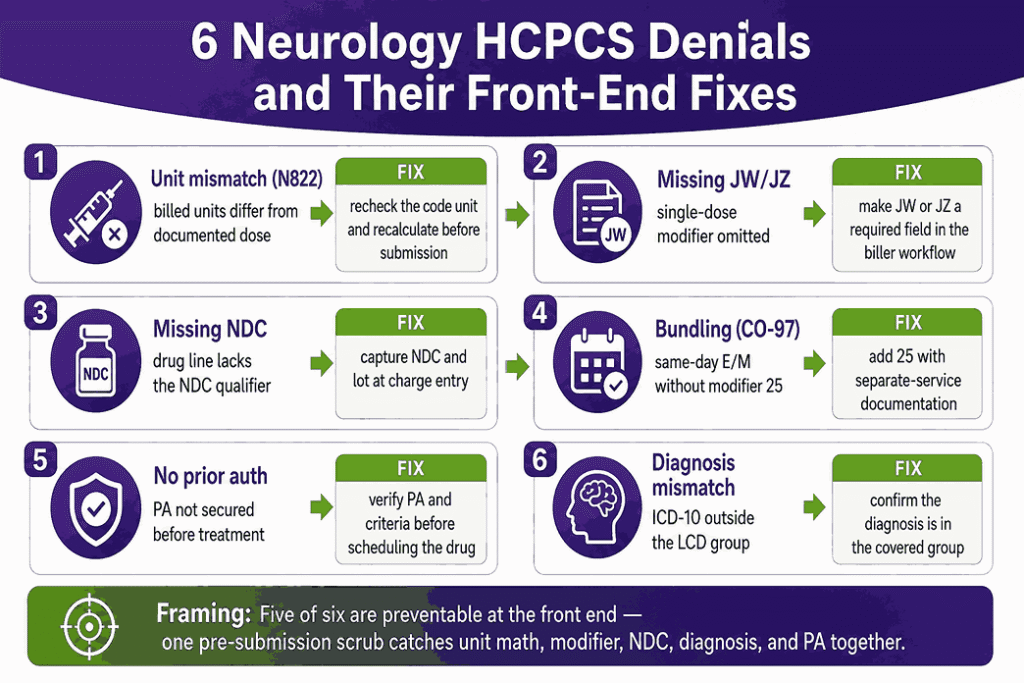
Neurology HCPCS claims get denied for six recurring reasons: unit mismatch, missing modifier, missing NDC, drug-procedure bundling, prior-authorization gaps, and diagnosis mismatch. Five of the six are preventable at the front end, before the claim leaves the practice.
Diagnosis mismatch is the quietest of the six denial reasons and the easiest to prevent. A drug line only pays when the ICD-10-CM code proving medical necessity falls inside the payer’s covered group under the LCD. Before the claim goes out, confirm the diagnosis against a current neurology ICD codes list mapped to each high-dollar drug, so the J-code, the CPT code, and the diagnosis all point to the same clinical picture.
Drug claims carry the largest dollar value and the highest denial rate in neurology. A single denied ocrelizumab or IVIG claim ties up a four-figure payment. Front-end validation returns that money faster than any appeal.
The table below maps each denial reason to its root cause and fix:
| Denial Reason | Root Cause | Fix |
|---|---|---|
| Unit mismatch (N822) | Billed units differ from documented dose | Recheck code unit; recalculate before submission |
| Missing JW/JZ | Single-dose modifier omitted | Make JW or JZ a required field in the biller workflow |
| Missing NDC | Drug line lacks NDC qualifier | Capture NDC and lot at charge entry |
| Bundling (CO-97) | Same-day E/M without modifier 25 | Add modifier 25 with separate-service documentation |
| No prior auth | PA not secured before treatment | Verify PA and criteria before scheduling the drug |
| Diagnosis mismatch | ICD-10 outside the LCD group | Confirm the diagnosis is in the covered group |
Prior authorization drives many high-dollar neurology denials. Botox chronic migraine, MS infusions, and IVIG almost always require PA. Most payers also require documented clinical response, such as a 50 percent reduction in headache days, before approving continued cycles.
A pre-submission check catches most of these errors in one pass. Validate the unit math, the modifier, the NDC, the diagnosis group, and the PA status together. Running these checks before submission raises first-pass acceptance and shortens the payment cycle.
How Can Neurology Practices Reduce HCPCS Denials at Scale?
Neurology practices reduce HCPCS denials by moving validation to the front end and standardizing high-dollar drug workflows. The pattern is consistent across botulinum toxin, infusion, and intrathecal claims. Catch the error before submission, not after the remittance.
Four front-end controls close most of the denial gap:
- Drug-specific templates that lock the correct J-code, unit ratio, and modifier
- A charge-entry NDC and lot capture step for every buy-and-bill drug
- A PA tracker that flags criteria and response documentation before each cycle
- A pre-submission scrub that checks unit math, modifier, NDC, and diagnosis group
Front-end controls only hold if they live where the charge is captured, not in a separate spreadsheet. Drug-specific templates, NDC and lot capture, and unit-ratio locks all belong inside the practice’s charge-entry workflow. Configuring these validations directly in your EMR for neurology turns each control into a required field, which is what stops unit-mismatch and missing-NDC errors before the claim is ever built.

Frequently Asked Questions (FAQs)
Are neurology HCPCS codes the same as CPT codes?
No. Neurology HCPCS Level II codes report drugs and supplies, while CPT codes report physician work. Both appear on the same claim. CPT is technically HCPCS Level I, and Level II is the alphanumeric drug and supply set.
How many units of J0585 are billed for chronic migraine?
A standard Botox chronic migraine claim reports 155 units of J0585 across the 31-site PREEMPT protocol. A 200-unit single-dose vial leaves 45 units of waste, reported on a separate line with the JW modifier.
Is the JZ modifier required on all neurology drug claims?
The JZ or JW modifier is required on every single-dose container claim since July 1, 2023. Use JZ when no drug is discarded. Use JW to report the discarded amount on a second line.
Does Medicare cover Botox for chronic migraine?
Medicare covers Botox for chronic migraine when the record shows 15 or more headache days per month and failed preventive therapy. Medicare Part B does not require pre-authorization, though most Medicare Advantage plans do.
Which CPT code pairs with nusinersen (J2326)?
Nusinersen (J2326) pairs with CPT 96450, the intrathecal chemotherapy administration code. The drug is delivered by spinal puncture, so both codes appear on the same date of service.