Neurosurgery medical billing remains one of the most complex, high-risk revenue cycles in American healthcare. Every craniotomy, spinal fusion, and shunt placement carries high-dollar claims under constant, intense payer scrutiny. MGMA reports average initial claim denial rates reached 11.8% across United States medical practices.
Surgical specialties run higher still, driven by complex bundling edits, modifiers, and prior authorization gaps. The American Medical Association found physicians spend roughly thirteen hours every week handling prior authorizations. CMS finalized the CMS-0057-F rule, mandating faster electronic prior authorization decisions from all impacted payers.
This guide explains the complete neurosurgery billing services, step by step, for United States practices. You will learn neurosurgery modifiers, global periods, denials, and proven revenue recovery strategies.

What Is Neurosurgery Medical Billing?
Neurosurgery medical billing is the specialized process of coding, submitting, and collecting payment for neurosurgical services. It covers cranial, spinal, and peripheral nerve procedures, including craniotomy, spinal fusion, and discectomy surgery.
Neurosurgery billing translates complex operative reports into accurate CPT and ICD-10-CM codes for insurance payers. This billing process also applies correct modifiers, global period rules, and detailed medical necessity documentation. Certified neurosurgery coders strictly follow AAPC, AANS, CNS, and CMS official coding compliance standards nationwide.
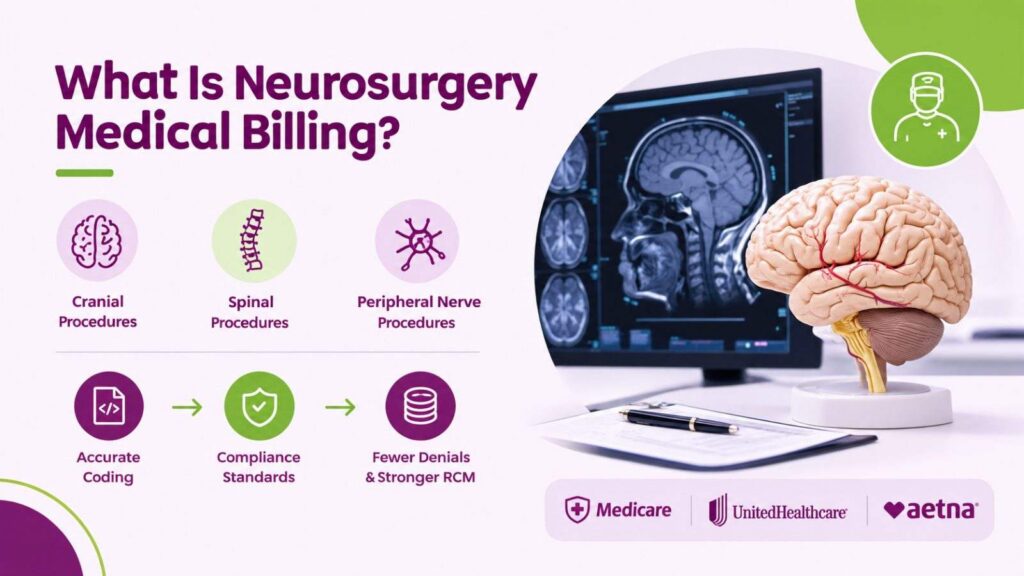
Accurate neurosurgery billing directly reduces claim denials and strengthens revenue cycle management for every practice. Payers including Medicare, UnitedHealthcare, and Aetna routinely audit these complex, high-value surgical claims nationwide each year.
What Makes Neurosurgery Billing Different From Other Specialties?
Neurosurgery billing carries unique complexity compared to most other medical and surgical specialties combined. High-dollar claims, procedural complexity, and strict documentation requirements all increase administrative and financial risk significantly.
Why Is Documentation Burden So High?
Every neurosurgery claim depends entirely on detailed, accurate operative report documentation from the surgeon. Coders must extract anatomical site, surgical approach, and instrumentation details precisely from notes.
Missing medical necessity language often triggers automatic denials, even when treatment was clinically appropriate. Multi-level spinal procedures require additional documentation supporting each separately billed vertebral segment involved.
Why Do Payers Scrutinize These Claims Closely?
Payers apply intense scrutiny because neurosurgical procedures generate exceptionally high reimbursement amounts consistently. Commercial insurers and CMS both enforce strict NCCI edits and bundling edits regularly.
Surgical specialties historically show denial rate benchmarks running several points above primary care. Modifier misuse, particularly around co-surgery and global periods, invites frequent, detailed payer review.
How Does Billing Differ by Site of Service?
Neurosurgery billing differs sharply between inpatient, outpatient hospital, and ambulatory surgical center settings. Facility versus non-facility distinctions determine whether professional billing or hospital billing rules apply.
Technical component and professional component splits affect reimbursement for imaging and neuromonitoring services. Place of service codes, paired with modifiers 26 and TC, must always match documentation exactly.
What Is the Neurosurgery Billing Process?
The neurosurgery billing process follows nine sequential steps from registration through final patient collections. Each step directly affects clean claim rate, days in AR, and net collection rate.
Missing one step early often causes denials, underpayments, or delayed reimbursement later downstream. Following this structured revenue cycle management workflow helps practices reduce neurosurgery claim denials significantly:
Step 1: Patient Registration and Insurance Intake
Patient registration captures demographics, referring provider NPI, and primary and secondary insurance details. Coordination of benefits must be confirmed accurately before any surgical scheduling begins formally.
Front-end revenue cycle errors at intake commonly cause downstream neurosurgery billing and coding failures. Practices increasingly use digital intake tools to reduce manual data entry mistakes.
Step 2: Insurance Eligibility Verification
Real-time eligibility verification confirms active coverage, plan type, and surgical benefit limits beforehand. Staff must verify deductible, copay, coinsurance, and out-of-pocket maximum amounts precisely.
Eligibility should always be re-verified closer to the scheduled neurosurgery procedure date. Subscriber ID mismatches and unnoticed policy termination remain leading causes of denials.
Step 3: Prior Authorization
Prior authorization confirms medical necessity before payers approve elective spine or cranial surgery. Authorization requests reference LCD and NCD criteria alongside documented conservative treatment history.
CMS-0057-F now requires faster electronic prior authorization decisions from impacted payers nationwide. Expired or missing authorization numbers remain a frequent, preventable neurosurgery denial cause.
Step 4: Charge Capture From the Operative Report
Charge capture gathers every billable detail directly from the surgeon’s operative note. This includes surgical approach, anatomical site, vertebral levels, and instrumentation or implants used.
Charge lag between surgery and documentation handoff commonly delays accurate neurosurgery reimbursement. EHR-to-billing integration helps route these operative details to coders quickly and accurately.
Step 5: Coding for Neurosurgery Billing
Coding translates captured operative details into standardized CPT, ICD-10-CM, and modifier codes. Global period rules and IONM codes are applied at this stage based on procedure type. Undercoding and unbundling errors most often originate here, not during charge capture.
CPT Coding for Neurosurgery
CPT codes identify the exact surgical procedure performed, from craniotomy through spinal fusion. Add-on codes for microscopy or instrumentation must be linked correctly to primary procedures. For a complete code-by-code breakdown, read the neurosurgery CPT code guide.
ICD-10 Coding for Neurosurgery
ICD-10-CM codes document the diagnosis supporting medical necessity for each surgical procedure. Mismatched diagnosis-to-procedure pairings remain a common, avoidable cause of claim denials. For diagnosis-specific code pairings, see this neurosurgery ICD-10 code guide.
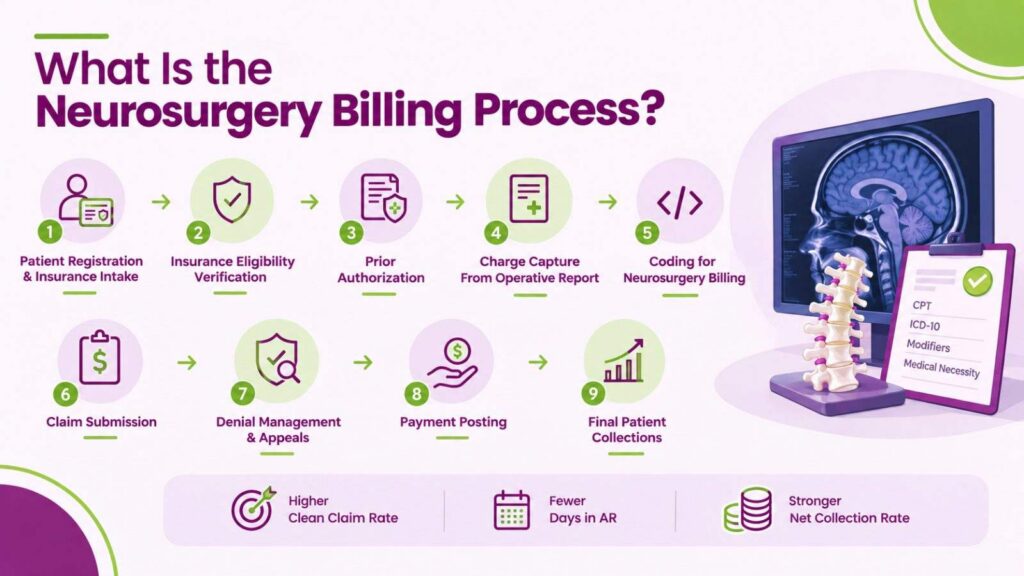
Step 6: Claims Submission
Clean claims are submitted electronically via the 837P transaction through an approved clearinghouse. CMS-1500 forms require accurate NPI, place of service, and modifier information. Claim scrubbing software catches errors before submission, improving first-pass acceptance rate significantly.
Payers enforce timely filing limits, making prompt neurosurgery claims submission absolutely essential. Rejections differ from denials, since rejected claims never enter payer adjudication systems.
Step 7: Denial Management
Denial management begins by categorizing denial reason codes like CARC 97 bundling. Common triggers include missing authorization, modifier misuse, and medical necessity documentation gaps.
NCCI edits frequently cause bundling denials on multi-level spinal fusion claims. Practices should maintain a denial log and dashboard tracking recurring denial patterns. Appeals follow strict deadlines through redetermination, reconsideration, and eventual ALJ hearing stages.
Step 8: AR Management
Accounts receivable management tracks unpaid neurosurgery claims across defined AR aging buckets. Standard buckets include 0–30, 31–60, 61–90, and over ninety days. High-dollar claims stuck beyond sixty days need immediate escalation and payer follow-up.
Days in AR remain a core KPI for measuring collection efficiency. Practices should apply a clear write-off policy for uncollectible contractual adjustments. Escalation thresholds help staff prioritize aging claims before bad debt increases.
Step 9: Payment Posting and Reconciliation
Payment posting matches ERA 835 files or paper EOBs against submitted charges. CAS reason codes explain adjustments, denials, or partial payments on each line. Line-item posting catches underpayments against the contracted fee schedule quickly.
RVU and conversion factor changes can silently reduce expected reimbursement amounts. Multiple procedure payment reduction rules often apply to same-session spinal procedures. Secondary billing and Medicare Secondary Payer rules require careful coordination afterward.
Step 10: Patient Billing and Collections
Patient billing begins once insurance payment and contractual adjustments are fully posted. Statements should clearly show patient responsibility, including deductible and coinsurance amounts.
Good Faith Estimate requirements under the No Surprises Act apply to elective surgery. Balance billing protections limit what practices may charge for certain services. Offering flexible payment plans through a patient portal improves overall collection rates.
How Does the Tele-Neurosurgery Billing Process Work?
Tele-neurosurgery billing follows the same core revenue cycle as in-person visits, with a few telehealth-specific rules layered on top. Getting these details wrong is one of the fastest ways to trigger a denial on an otherwise clean claim. Here’s how the workflow differs from in-person billing:
| Step | In-Person Billing | Tele-Neurosurgery Billing |
|---|---|---|
| Patient Consent | Standard registration consent | Separate telehealth consent required before the visit |
| Place of Service | POS 11 (office) or POS 22 (outpatient) | POS 02 (telehealth, patient at home) or POS 10 (telehealth, other location) |
| Visit Modality | N/A | Synchronous audio-video preferred; audio-only allowed only under specific payer rules |
| Modifier | Rarely needed | Modifier 95 appended to confirm real-time telehealth delivery |
| Provider Location | Single-state licensure | Cross-state telehealth requires licensure in the patient’s state |
| Global Period Interaction | Post-op visits bundled normally | Virtual post-op follow-up still counts against the global period |
Key Billing Rules to Apply:
Virtual Pre-op Consult: Confirms surgical candidacy remotely; billable as a standard E/M with modifier 95 and correct POS.
- Virtual Post-op Follow-up: Still falls inside the global surgical package for major spine and cranial procedures, so it isn’t separately billable unless modifier 24 documents an unrelated issue.
- Medicare Telehealth Policy: Follows CMS-published eligible service lists, which change annually and must be checked before billing.
- Commercial Telehealth Policy: Varies by payer, as some commercial plans reimburse audio-only visits, others require synchronous audio-video only.
- State Licensure: A neurosurgeon must hold an active license in the state where the patient is physically located at the time of the visit.
What RCM KPIs Should Every Neurosurgery Practice Track?
Tracking key performance indicators helps neurosurgery practices identify revenue leaks before they compound. These metrics reveal exactly where the billing process is breaking down operationally.
Consistent KPI tracking supports stronger revenue cycle management across every neurosurgery billing workflow. Practices that monitor these numbers monthly catch denial trends before they worsen.
| KPI | What It Measures | Why It Matters for Neurosurgery |
|---|---|---|
| Clean Claim Rate | Percentage of claims accepted on first submission | High-dollar spine and cranial claims amplify the cost of rework |
| Denial Rate | Percentage of claims denied by payers | Surgical specialties historically run above general denial rate benchmarks |
| Days in AR | Average time to collect payment after billing | Long global periods can artificially inflate this number |
| Net Collection Rate | Actual reimbursement versus allowed contracted amounts | Reveals underpayments hidden inside complex fee schedules |
| First-pass Resolution Rate | Claims resolved without appeal or resubmission | Reflects coding, modifier, and documentation accuracy upfront |
| Cost to Collect | Administrative expense per dollar collected | High-touch prior authorization work raises this cost significantly |
| Charge Lag Days | Time between surgery date and charge submission | Delayed operative report coding directly increases charge lag |
| Prior Authorization Turnaround Time | Time from request to payer decision | CMS-0057-F now pushes payers toward faster electronic decisions |
What Are Healthy Benchmarks for These KPIs?
Top-performing practices consistently maintain a clean claim rate above 95%. Denial rates should stay below ten percent industry-wide for healthy practices. Days in AR under forty days indicate strong accounts receivable management overall.
A net collection rate above ninety-six percent suggests minimal underpayment or write-off leakage. Regularly benchmarking against MGMA and HFMA data helps validate practice performance realistically.
Should You Keep Neurosurgery Billing In-House or Outsource It?
The right choice depends on practice size, denial trends, and available in-house coding expertise. Practices with steady surgical volume can sometimes sustain in-house billing successfully.
Rising denial rates, climbing days in AR, and frequent modifier errors on co-surgery or global period claims are clear signs in-house billing is underperforming. Staff spending excessive hours on prior authorization, alongside high coder turnover, further signals an overwhelmed internal team.
If outsourcing looks like the better fit, the right neurosurgery billing partner should hold verifiable certifications and specialty experience. Practices comparing outsourcing options can review the best neurosurgery billing companies to evaluate specialty expertise, coding accuracy, denial management, and EHR compatibility.
What Are the Most Common Neurosurgery Billing Challenges?
Neurosurgery practices face recurring billing obstacles that directly reduce collections and slow reimbursement timelines. Understanding these challenges helps practices target fixes where revenue leakage actually happens most.
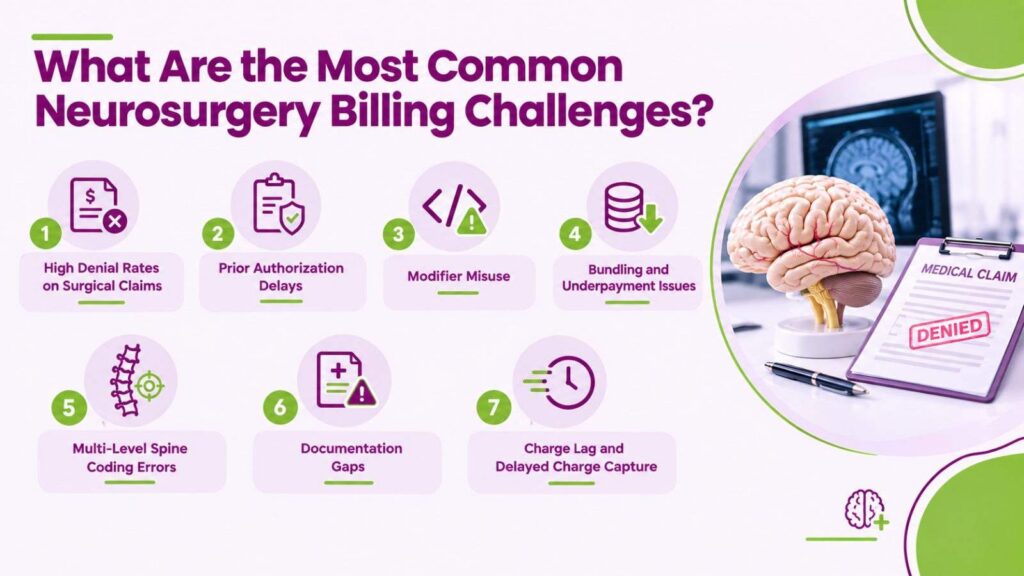
- High Denial Rates on Surgical Claims: Surgical specialties consistently exceed general denial rate benchmarks due to procedural complexity. Bundling denials, NCCI edits, and medical necessity gaps drive most rejections.
- Prior Authorization Delays: Elective spine and cranial procedures frequently stall waiting on payer authorization decisions. Expired authorizations before surgery day remain a common, preventable revenue disruption.
- Modifier Misuse: Incorrect application of modifiers 22, 58, 62, or 78 triggers frequent claim denials. Co-surgery and global period modifiers cause the most recurring coding confusion.
- Bundling and Underpayment Issues: NCCI edits and multiple procedure payment reduction rules often reduce expected reimbursement unexpectedly. Underpayments frequently hide inside contracted fee schedules without proper line-item review.
- Multi-Level Spine Coding Errors: Spinal fusion and instrumentation claims require precise coding for each vertebral level involved. Missing level-specific documentation often causes partial denials on multi-level procedures.
- Documentation Gaps: Incomplete operative notes frequently fail to support medical necessity for complex neurosurgical procedures. Missing anatomical site or surgical approach details commonly trigger avoidable claim denials.
- Charge Lag and Delayed Charge Capture: Delayed coding after surgery increases charge lag and slows overall reimbursement timelines. EHR-to-billing integration gaps often cause charges to post inconsistently or late.
How Can Neurosurgery Practices Streamline Billing and Increase Revenue?
Neurosurgery practices can strengthen collections by fixing recurring breakdowns across the entire billing workflow. Targeted operational changes reduce denials, shorten AR cycles, and increase overall reimbursement consistently.
Invest in Certified Neurosurgery Coders
Certified coders holding CPC or COSC credentials reduce modifier and coding errors significantly. Accurate charge capture from operative reports directly improves clean claim rate outcomes.
Automate Eligibility and Prior Authorization
Real-time eligibility verification and electronic prior authorization reduce delays before scheduled surgery. CMS-0057-F adoption pushes payers toward faster, standardized authorization decision timelines nationwide.
Strengthen EHR-to-Billing Integration
Tight EHR-to-billing integration through platforms like Epic reduces charge lag significantly. Faster charge capture after surgery accelerates claims submission and overall reimbursement timing.
Use Claim Scrubbing Technology
AI claim scrubbing catches modifier errors, bundling conflicts, and missing documentation before submission. This directly improves first-pass acceptance rate and reduces costly claim rework.
Build a Structured Denial Management Workflow
Maintaining a denial log helps identify recurring NCCI edits and authorization-related denial patterns. Timely appeals through redetermination and reconsideration recover revenue otherwise permanently lost.
Track KPIs Monthly
Monitoring clean claim rate, denial rate, and days in AR reveals problems early. Benchmarking against MGMA and HFMA data keeps performance realistic and measurable.
Consider Outsourcing Complex Billing Functions
Outsourced medical billing lowers the cost to collect through specialized neurosurgery coding expertise. This frees internal staff to focus on patient care and scheduling.
Frequently Asked Questions
Which CPT Codes are Most Commonly Used in Neurosurgery Billing?
Neurosurgery billing commonly relies on CPT codes 61510, 63030, and 22612 for major spinal surgery procedures. These codes cover craniotomy, lumbar discectomy, and spinal fusion procedures across nearly all commercial payers nationwide.
Why Do Neurosurgery Claims Get Denied Even with Correct Codes?
Correct CPT and ICD-10 codes still get denied without sufficient supporting medical necessity documentation attached properly. Missing prior authorization, incorrect modifier usage, or NCCI bundling edits still frequently cause unexpected denials too.
What Should You Look for in a Neurosurgery Billing Partner?
Look for certified coders holding CPC or COSC credentials specific to surgery. Confirm the partner, like Transcure, demonstrates verified HIPAA compliance backed by a signed BAA. Strong EHR compatibility with platforms like Epic or athenahealth matters significantly. A dedicated account manager ensures accountability instead of anonymous, rotating support staff.
Can Neurosurgery Post-op Follow-up Visits be Billed as Telehealth?
Post-operative neurosurgery follow-up visits can often be billed correctly using approved telehealth service codes nationwide now. However, these visits still count against the surgery’s global period unless modifier 24 applies correctly instead.