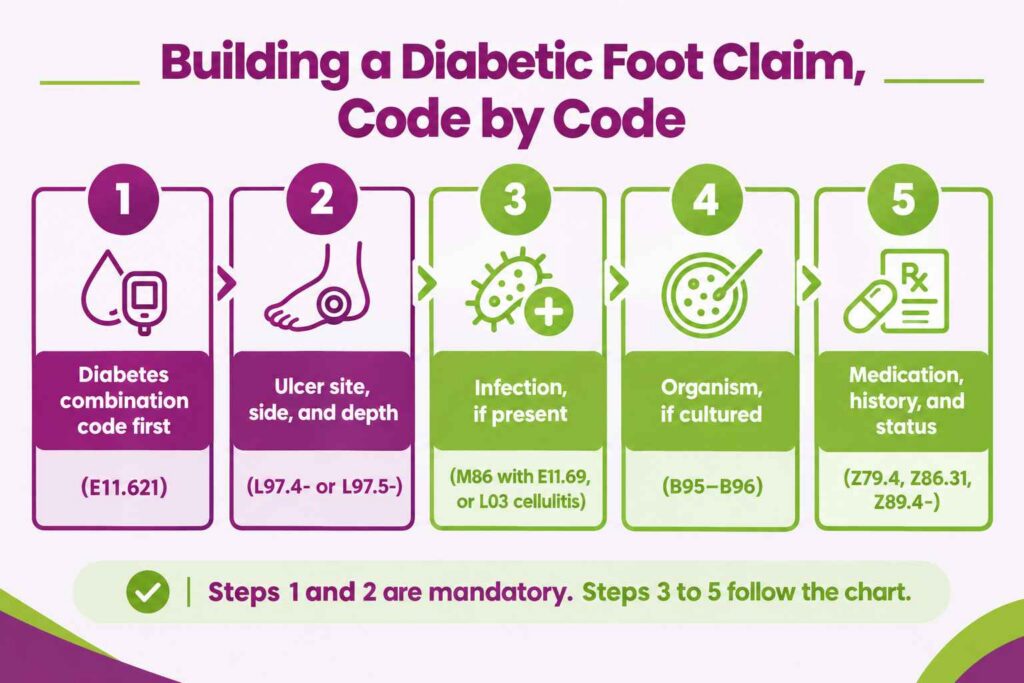
The ICD-10 code for a diabetic foot ulcer is E11.621, type 2 diabetes mellitus with foot ulcer. It sequences first, with an L97.4- or L97.5- code for site, side, and depth. E11.621 carries no laterality, so the L97 code records the side. A diabetic foot infection adds an infection code. ICD-10-CM presumes the diabetes link for osteomyelitis but not for cellulitis.
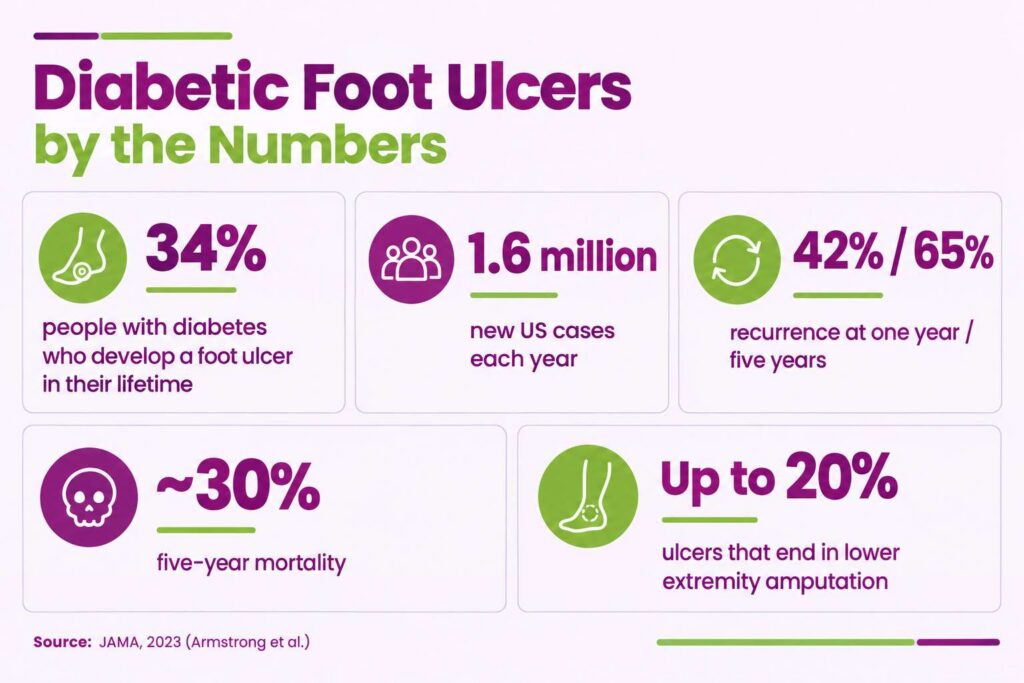
Diabetic foot ulcers are among the most serious complications in podiatry. A 2023 JAMA review led by David Armstrong found that up to 34% of people with diabetes develop one. About 1.6 million new US cases occur each year. The ICD-10 code for a diabetic foot ulcer is E11.621, paired with an L97 code.
The same review reports recurrence of 42% at one year and 65% at five years, with five-year mortality near 30%. Up to 20% of these ulcers end in lower extremity amputation. That recurring, multi-visit care is why podiatry billing services treat this pairing as a high-risk code set.
This guide covers the diabetic foot ulcer ICD-10 codes, L97 depth codes, infection coding, CPT pairings, HCCs, and denials. Every code reflects the FY2027 ICD-10-CM set, effective October 1, 2026.
What Is the ICD-10 Code for a Diabetic Foot Ulcer?
The ICD-10 code for a diabetic foot ulcer is E11.621, type 2 diabetes mellitus with foot ulcer, reported with an L97.4- or L97.5- code. The tabular requires the L97 code to identify the ulcer site.
E11.621 sequences first. ICD-10-CM presumes the diabetes and foot ulcer link through its “with” convention. The provider does not need to state it. Each diabetes type carries its own foot ulcer code.
| Code | Description |
|---|---|
| E11.621 | Type 2 diabetes mellitus with foot ulcer |
| E10.621 | Type 1 diabetes mellitus with foot ulcer |
| E08.621 | Diabetes mellitus due to underlying condition with foot ulcer |
| E09.621 | Drug or chemical induced diabetes mellitus with foot ulcer |
| E13.621 | Other specified diabetes mellitus with foot ulcer |
When the note does not name the diabetes type, coding guidelines default to type 2 and E11.621.
Why Does a Diabetic Foot Ulcer Need Two Codes?
A diabetic foot ulcer needs two codes because E11.621 names the complication, while the L97 code names the site and depth. E11.621 alone is incomplete coding. An L97 code alone misses the combination code, and L97 carries a matching instruction to code the diabetes first.
Does E11.621 Specify the Foot or the Side?
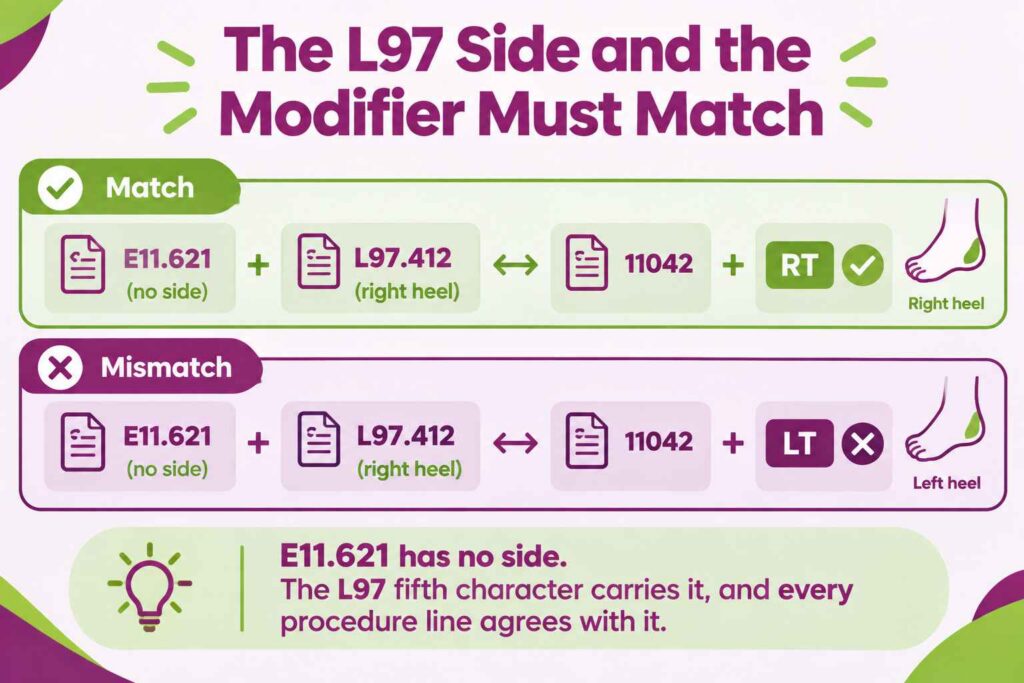
No, E11.621 carries no site or laterality, so the L97 code supplies both. The L97 fifth character records the side: 0 for unspecified, 1 for right, and 2 for left.
What Is the Difference Between E11.621 and E11.622?
E11.621 reports a diabetic foot ulcer, and E11.622, type 2 diabetes mellitus with other skin ulcer, reports a diabetic ulcer anywhere else. The diabetic ulcer ICD-10 codes therefore split by site, not by side.
E11.622 pairs with the matching site code, such as L97.2- for the calf or L97.3- for the ankle. Ulcers beyond the lower limb use L98.4- instead. The two codes never mean right and left foot, a misreading that still circulates.
Is There an ICD-10 Code for “Diabetic Foot” Without an Ulcer?
No single code exists for “diabetic foot.” The claim codes the documented complication instead. Diabetic polyneuropathy uses E11.42, and unspecified diabetic neuropathy uses E11.40. Peripheral angiopathy without gangrene uses E11.51, and Charcot joint uses E11.610, diabetic neuropathic arthropathy.
How Do the L97.4- and L97.5- Codes Work?
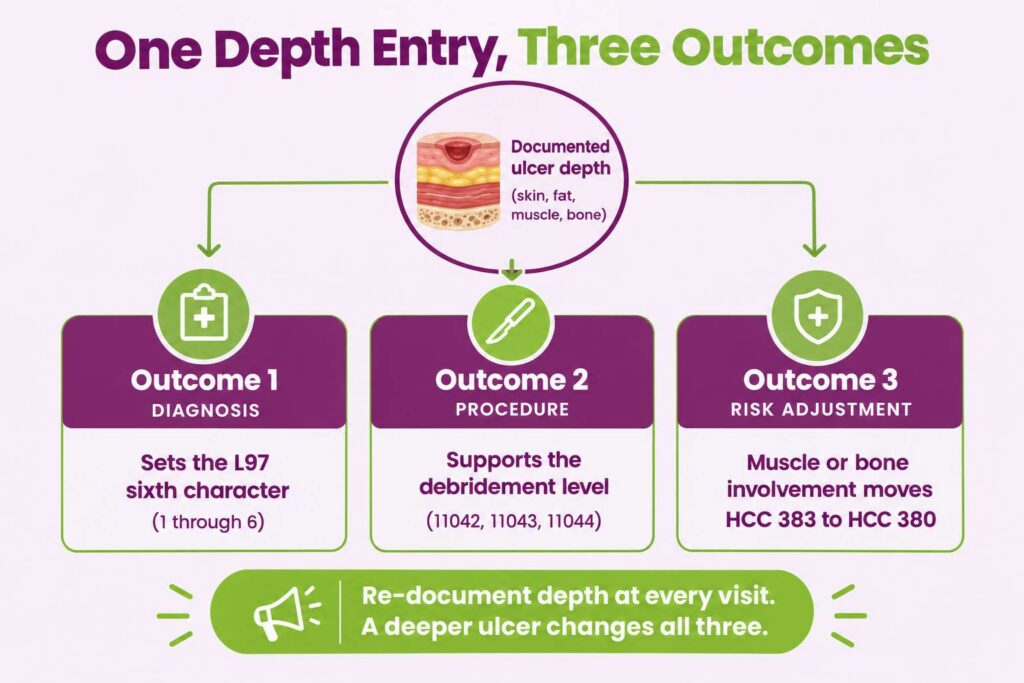
L97.4- covers ulcers of the heel and midfoot, and L97.5- covers every other part of the foot, including the toes. Each code builds from site, side in the fifth character, and depth in the sixth. Depth drives the debridement code, the HCC category, and medical necessity.
The sixth character carries eight severity values.
| Sixth Character | Severity |
|---|---|
| 1 | Limited to breakdown of skin |
| 2 | With fat layer exposed |
| 3 | With necrosis of muscle |
| 4 | With necrosis of bone |
| 5 | With muscle involvement without evidence of necrosis |
| 6 | With bone involvement without evidence of necrosis |
| 8 | With other specified severity |
| 9 | With unspecified severity |
Character 9 applies only when the note records no depth. Ulcers without a diabetes link start with a different cause code, which fall under the foot ulcer ICD-10 codes.
What Is the ICD-10 Code for a Diabetic Heel Ulcer?
A right diabetic heel ulcer codes to E11.621 with L97.41-, and a left heel ulcer to E11.621 with L97.42-. A right heel ulcer with fat layer exposed reports E11.621 and L97.412.
What Is the ICD-10 Code for a Diabetic Toe Ulcer?
A diabetic toe ulcer codes to E11.621 with L97.51- for the right foot or L97.52- for the left. The toes have no L97 subcategory of their own and fall under “other part of foot.”
What Is the Difference Between “Muscle Involvement” and “Necrosis of Muscle”?
Involvement means the ulcer reaches the tissue, and necrosis means the tissue is dead. Characters 5 and 6 report involvement, while 3 and 4 report necrosis. The note must state which applies, since it changes the L97 code.
How Do You Code Multiple Diabetic Foot Ulcers?
Multiple diabetic foot ulcers report one E11.621 and one L97 code per ulcer site. Ulcers on both feet report the right and left L97 codes, since no bilateral L97 code exists.
Is a Diabetic Pressure Ulcer Coded With L97 or L89?
Etiology decides. A diabetic ulcer takes L97, and a pressure ulcer takes L89, even when the patient has diabetes. A pressure-related heel ulcer in a bedbound diabetic patient codes to L89.6-. When the note omits the cause, the provider is queried.
Is a Diabetic Foot Wound Coded the Same as an Ulcer?
A chronic diabetic foot wound codes as an ulcer, but an acute traumatic wound does not. A non-healing wound documented as an ulcer reports E11.621 and L97. An acute injury reports an S91.3- open wound code, with diabetes coded separately.
How Do You Code a Diabetic Foot Infection?
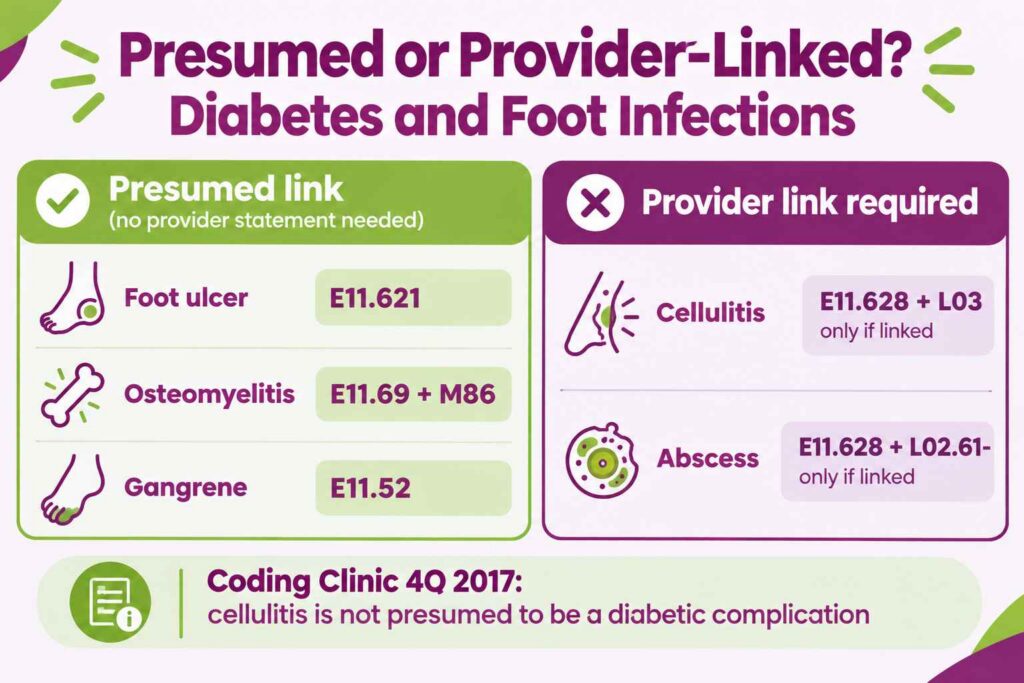
A diabetic foot infection codes the ulcer pair plus a code for the infection, and the diabetes link depends on the infection type. ICD-10-CM presumes it for osteomyelitis and gangrene but not for cellulitis or abscess.
| Infection | Code Stack | Diabetes Link |
|---|---|---|
| Osteomyelitis | E11.69 + M86 code, with the ulcer pair | Presumed |
| Gangrene | E11.52, with the ulcer pair | Presumed |
| Cellulitis | L03.115 or L03.116 (toe: L03.031 or L03.032), with the ulcer pair | Requires provider linkage |
| Abscess | L02.611 or L02.612, with the ulcer pair | Requires provider linkage |
The diabetic foot infection ICD-10 code set therefore varies by chart, and linkage is confirmed before adding E11.628.
How Do You Code Cellulitis in a Diabetic Foot?
Cellulitis of the foot codes to L03.115 for the right lower limb or L03.116 for the left, and toe cellulitis codes to L03.031 or L03.032. AHA Coding Clinic, Fourth Quarter 2017, found no presumed link between diabetes and cellulitis.
When the provider documents cellulitis as a diabetic skin complication, E11.628, type 2 diabetes with other skin complications, joins the claim. Without that statement, cellulitis reports alongside the ulcer pair alone.
How Do You Code Diabetic Foot Osteomyelitis?
Diabetic foot osteomyelitis codes to E11.69, type 2 diabetes with other specified complication, plus the M86 code. An index revision effective October 1, 2016, presumes the link. Acute foot osteomyelitis codes to M86.17-, and chronic to M86.67-. Outside diabetes, standard osteomyelitis ICD-10 codes are selected by acuity and site alone, with no E11.69 in front.
How Do You Code a Diabetic Foot Abscess?
A diabetic foot abscess codes to L02.61-, cutaneous abscess of foot. L02.611 reports the right foot, L02.612 the left, and L02.619 an unspecified foot. The linkage rule matches cellulitis, so E11.628 needs the provider’s stated link.
How Is Diabetic Gangrene Coded?
Diabetic gangrene codes to E11.52, type 2 diabetes with diabetic peripheral angiopathy with gangrene. E11.52 includes the gangrene, so no separate gangrene code applies. With an ulcer present, E11.52 reports alongside E11.621 and the L97 code.
Do You Code the Organism on a Diabetic Foot Infection?
Yes, when a culture identifies the organism, a B95 through B96 code reports it after the infection code. MRSA reports B95.62, and methicillin-susceptible Staphylococcus aureus reports B95.61.
Which Secondary Codes Belong on a Diabetic Foot Claim?
Medication, history, and status codes complete a diabetic foot claim.
Which Medication Codes Apply?
Long-term insulin use reports Z79.4, oral hypoglycemic use Z79.84, and injectable non-insulin antidiabetic use Z79.85. Insulin use alone does not indicate type 1 diabetes.
How Do You Code a Healed Diabetic Foot Ulcer?
A healed diabetic foot ulcer codes to Z86.31, personal history of diabetic foot ulcer. Once the ulcer closes, E11.621 and the L97 code stop applying, and no aftercare Z code replaces them. Z86.31 cannot serve as a principal diagnosis.
How Do You Report a Prior Amputation?
A prior toe or foot amputation is reported with a Z89.4- acquired absence code by site and side, such as Z89.411 for the right great toe. The status code documents limb risk for at-risk foot care.
How Does Diabetic Foot Ulcer Coding Affect HCC Risk Adjustment?
E11.621 maps to two CMS-HCC V28 categories, and the L97 depth character decides whether a higher ulcer category applies. The CY2027 Rate Announcement kept the current V28 model in place, so these mappings govern Medicare Advantage risk scores through payment year 2027.
| Code Group | V28 HCC | Description |
|---|---|---|
| E11.621, E11.622 | HCC 37 and HCC 383 | Diabetes with chronic complications; chronic ulcer not specified as through to bone or muscle |
| L97 sixth characters 1, 2, 8, 9 | HCC 383 | Chronic ulcer of skin, except pressure, not specified as through to bone or muscle |
| L97 sixth characters 3 through 6 | HCC 380 | Chronic ulcer of skin, except pressure, through to bone or muscle |
HCC 380 supersedes HCC 383 in the V28 hierarchy, so depth documentation is a risk adjustment issue, not only a coding one. Each encounter supports the diagnosis through MEAT criteria: monitor, evaluate, assess, or treat.
What Documentation Supports a Diabetic Foot Ulcer Claim?
Documentation supports the claim when it records the diabetes type, the ulcer’s site, side, size, and depth, and any infection with its link to diabetes.
What Must the Wound Note Contain?
The wound note contains seven elements for a clean diabetic foot ulcer claim.
- Diabetes type: type 1, type 2, or another specified form
- Site and side: heel, midfoot, toe, or other part of the foot, and which foot
- Measurements: length, width, and depth at each visit
- Deepest tissue: skin, fat, muscle, or bone, with or without necrosis
- Wound bed: tissue type, drainage, and odor
- Infection: clinical signs and the provider’s stated link to diabetes
- Circulation and sensation: pulses, vascular studies, and neuropathy status
Wagner or University of Texas grades support the note but do not replace the depth wording the L97 code requires. Depth is re-documented at every visit, since a deepening ulcer changes both the code and the HCC.
Which CPT Codes Pair With Diabetic Foot Ulcer ICD-10 Codes?
Debridement, offloading, advanced wound therapy, and skin substitute codes carry most diabetic foot ulcer claims. Each podiatry CPT code in this group carries its own depth, size, or product rule that the ulcer diagnosis must support.
How Does Ulcer Depth Select the Debridement Code?
Surgical debridement codes by the deepest tissue removed: 11042 for subcutaneous tissue, 11043 for muscle or fascia, and 11044 for bone. Each covers the first 20 sq cm, with add-on codes for each additional 20 sq cm.
| Code | Deepest Tissue Removed | Add-On (Each Additional 20 sq cm) |
|---|---|---|
| 11042 | Subcutaneous tissue | 11045 |
| 11043 | Muscle or fascia | 11046 |
| 11044 | Bone | 11047 |
| 97597 | Selective debridement, first 20 sq cm | 97598 |
The debrided depth, not the ulcer depth, selects the CPT code, so the two can differ. Selective debridement never bills with 11042 through 11047 on the same wound on the same day.
Which Offloading and Advanced Wound Therapy Codes Apply?
Total contact casting and negative pressure wound therapy are the most common adjuncts to debridement.
- 29445: application of a rigid total contact leg cast
- 97605 and 97606: negative pressure wound therapy with durable equipment
- 97607 and 97608: negative pressure wound therapy with disposable equipment
- 99183 and G0277: hyperbaric oxygen, covered by Medicare NCD 20.29 for Wagner grade III or higher ulcers after 30 days of failed standard care
How Are Skin Substitutes Billed for Diabetic Foot Ulcers?
Skin substitute application on the foot reports 15275 and 15276 for wounds up to 100 sq cm, and 15277 and 15278 for larger wounds. The CY2026 fee schedule pays most products as incident-to supplies at $127.14 per sq cm. The CY2027 proposed rule would extend that rate to non-sheet products. Opting for a dedicated wound care billing support helps track these product-level rules for every payer.
Which HCPCS Codes Cover Diabetic Shoes and At-Risk Foot Care?
Therapeutic shoes and inserts bill through the A5500 series. Loss of protective sensation care bills through G0245, G0246, and G0247, with evaluations covered every six months. Shoe and insert claims need a statement from the MD or DO managing the diabetes, a rule shared by every A5500-series podiatry HCPCS code.
Which Modifiers Apply to Diabetic Foot Claims?
RT, LT, the T digit modifiers, 25, and XS carry most diabetic foot claims. The procedure side must agree with the L97 fifth character.
- RT and LT: mark the treated foot and must match the L97 side
- T1 through TA: identify the specific toe
- Modifier 25: reports a separate, significant E/M service on a debridement day
- XS: reports debridement of a separate wound or structure
The CY2027 proposed rule would cut payment for an E/M billed the same day as a global procedure. Modifier 25 claims face added scrutiny.
What Are the Most Common Diabetic Foot Ulcer Coding Denials, and How Do You Prevent Them?
Five denial patterns account for most rejected diabetic foot ulcer claims.
Why Do Claims Deny When E11.621 Reports Without an L97 Code?
Claims deny because the tabular makes the L97 code mandatory with E11.621. A scrubber rule blocking E11.621 without an L97.4- or L97.5- code stops this denial before submission.
Why Does an Unspecified Depth Character Cause Problems?
Sixth character 9 leaves debridement without a documented depth to justify it and misses HCC 380 when the ulcer reaches muscle or bone. Templates requiring a depth entry prevent both.
Why Do Debridement Depth and Ulcer Depth Mismatches Trigger Review?
A bone-level debridement code paired with a skin-level ulcer code signals a documentation gap. Without support for both depths, the mismatch reads as upcoding.
Why Is Adding E11.628 for Unlinked Cellulitis a Compliance Risk?
E11.628 requires the provider to link the cellulitis to diabetes. Adding it on presumption contradicts Coding Clinic guidance and overstates the complication record.
How Do Payer Rules Differ on Diabetic Foot Ulcer Care?
Payers agree on the coding pair but differ on documentation, authorization, and advanced therapy coverage.
| Payer | Common Position |
|---|---|
| Medicare MACs | Wound care LCDs require measurements and documented progress for serial debridement |
| BCBS plans | Skin substitute coverage follows plan medical policy product lists |
| UnitedHealthcare | Prior authorization commonly required for skin substitutes and NPWT |
| Aetna | Advanced therapies require documented failure of standard wound care |
Serial debridement and product-level coverage rules make these claims hard to keep clean. Many practices route them through a specialized podiatry billing company to manage depth audits and appeals.
What Changed in the FY2027 ICD-10-CM Update for Diabetic Foot Coding?
The FY2027 update, effective October 1, 2026, left E11.621 and the L97 ulcer codes unchanged. The endocrine chapter added only postprocedural hypoglycemia codes.
Were E11.621 or the L97 Codes Revised for FY2027?
No. E11.621, E11.622, E11.628, E11.69, E11.52, and the L97.4- and L97.5- codes carried no change. M86.8X- other osteomyelitis now takes laterality, adding M86.8X71, M86.8X72, and M86.8X79 for the ankle and foot. Elsewhere in the podiatry ICD-10 codes, FY2027 moved plantar fasciitis from M72.2 to the laterality-specific M67.A0- family.
What 2027 Workflows Do Practices Confirm?
Practices confirm four workflows for the 2027 cycle, because EHR pick-lists can trail the annual release of new ICD-10 codes.
- Wound templates require the L97 depth character at every visit
- Claim scrubbers block E11.621 submitted without an L97 code
- Osteomyelitis pick-lists carry the new M86.8X- laterality codes
- Cellulitis and abscess entries prompt for the provider’s diabetes link
Frequently Asked Questions About Diabetic Foot Ulcer ICD-10 Coding
What Is the ICD-10 Code for a Diabetic Foot Ulcer?
The ICD-10 code for a diabetic foot ulcer is E11.621, reported with an L97.4- or L97.5- code. The L97 code carries the site, side, and depth.
What Is the ICD-10 Code for a Diabetic Foot Infection?
It codes the ulcer pair plus the infection, such as L03.115 or L03.116 for cellulitis or an M86 code for osteomyelitis. Osteomyelitis is presumed linked to diabetes, while cellulitis needs the provider’s stated link.
Does E11.621 Mean Left or Right Foot?
No, E11.621 has no laterality. The L97 fifth character records the side.
What Is the ICD-10 Code for a Diabetic Ulcer of the Right Foot?
A diabetic ulcer of the right foot codes to E11.621 with L97.51- for the forefoot or toes, or L97.41- for the heel and midfoot. The left foot uses L97.52- or L97.42-.
What Is the ICD-10 Code for a Diabetic Ulcer of the Ankle?
A diabetic ankle ulcer codes to E11.622 with an L97.3- code. E11.621 applies to the foot only.
Can You Bill 97597 and 11042 on the Same Diabetic Foot Ulcer?
No, not on the same wound on the same day. The claim reports the deepest debridement performed.
What Is the ICD-10 Code for a Healed Diabetic Foot Ulcer?
A healed diabetic foot ulcer codes to Z86.31, personal history of diabetic foot ulcer. E11.621 and the L97 code stop applying once the ulcer closes.
Does a Diabetic Foot Ulcer Affect HCC Risk Adjustment?
Yes, E11.621 maps to HCC 37 and HCC 383. Ulcers through to muscle or bone map to HCC 380, which supersedes HCC 383.