Psychiatry ICD-10 codes are the diagnostic codes that justify every psychiatric claim. They sit in Chapter 5 of the ICD-10-CM code set, covering codes F01 through F99. Each code tells a payer what the patient has and how severe it is.
The Centers for Medicare & Medicaid Services (CMS) maintains the U.S. version, called ICD-10-CM. Psychiatrists pair each diagnosis code with a service code to build a payable claim. Accuracy at this step decides whether the claim pays or denies.
This guide covers the common code families across depression, anxiety, bipolar, psychotic, ADHD, dementia, sleep, and substance use. It also covers the DSM-5-TR crosswalk, FY2026 updates, CPT pairing, HCC risk adjustment, and denial prevention.
ICD-10-CM vs DSM-5-TR vs CPT in Psychiatry
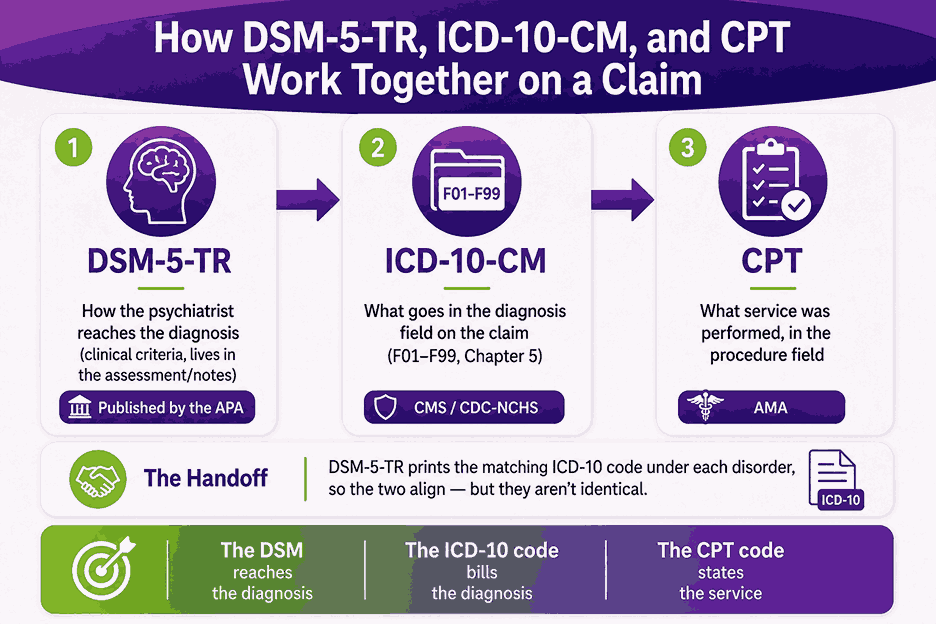
Three code systems shape psychiatric billing, and each one plays a distinct role. Clinicians confuse them often, which creates coding errors and downstream denials. The table below separates what each system does and where it appears.
| System | Publisher | Purpose | Where it appears |
|---|---|---|---|
| ICD-10-CM | CMS / CDC-NCHS | Diagnosis classification | Diagnosis field on the claim |
| DSM-5-TR | American Psychiatric Association | Clinical diagnostic criteria | Clinical assessment and notes |
| CPT | American Medical Association (AMA) | Service or procedure billed | Procedure field on the claim |
The DSM-5-TR is how a psychiatrist reaches a diagnosis. The ICD-10 code is what goes on the insurance claim. The DSM-5-TR lists the matching ICD-10 code under each disorder, so both systems work together.
Psychiatric diagnoses live mostly in Chapter 5 of ICD-10-CM. That chapter runs from F01 to F99 and covers mental, behavioral, and neurodevelopmental disorders. A second set, the Z-codes, captures psychosocial context that shapes a patient’s care.
The F-Code Chapter at a Glance: 11 Blocks
The F-chapter is organized into eleven blocks, each grouped by condition type. Knowing the block ranges speeds up code selection and reduces lookup time. When ICD-10 replaced ICD-9, the psychiatric code count grew from roughly 290 codes to over 1,500.
That jump is not bureaucratic excess. It reflects the specificity payers now expect on every behavioral health claim. The table below maps each block to its range and an example code.
| Block | Category | Example code |
|---|---|---|
| F01–F09 | Mental disorders due to physiological conditions | F03.90 Dementia, unspecified |
| F10–F19 | Substance use and substance-induced disorders | F10.20 Alcohol dependence, uncomplicated |
| F20–F29 | Schizophrenia and psychotic disorders | F20.9 Schizophrenia, unspecified |
| F30–F39 | Mood (affective) disorders | F32.9 Major depressive disorder, single episode |
| F40–F48 | Anxiety, stress-related, somatoform | F41.1 Generalized anxiety disorder |
| F50–F59 | Eating, sleep, and behavioral syndromes | F50.00 Anorexia nervosa, unspecified |
| F60–F69 | Personality and adult behavior disorders | F60.3 Borderline personality disorder |
| F70–F79 | Intellectual disabilities | F70 Mild intellectual disability |
| F80–F89 | Developmental disorders | F84.0 Autistic disorder |
| F90–F98 | Childhood-onset behavioral disorders | F90.0 ADHD, predominantly inattentive |
| F99 | Unspecified mental disorder | F99 Mental disorder, not otherwise specified |
Most F-codes require at least four characters to be billable. A three-character stub such as F32 will trigger a rejection. Payers expect coding to the highest level the documentation supports.
Most Common Psychiatry ICD-10 Codes by Category
Some codes appear far more than others in psychiatric practice. Grouping them by clinical cluster makes selection faster and lowers the error rate in the psychiatry billing workflow. Each cluster below carries its own documentation demands and denial traps.
Depression (F32 and F33)
Depression codes split by episode pattern and severity. F32 covers a single episode, and F33 covers recurrent major depressive disorder. F32.9 remains the most commonly billed depression code across U.S. practices.
| Code | Description | Documentation note | Denial trap |
|---|---|---|---|
| F32.0 | MDD, single episode, mild | State severity in the note | Missing severity qualifier |
| F32.9 | MDD, single episode, unspecified | Use only when type is unclear | Overused as a catch-all |
| F32.A | Depression, unspecified | Symptoms below full MDD criteria | Confused with F32.9 |
| F33.1 | Recurrent MDD, moderate | Document prior episodes | Coded as single when recurrent |
CMS added F32.A to reduce reliance on F32.9 as a catch-all. Use it when symptoms do not yet meet full MDD criteria. Reserve F32.9 for cases where the episode type is genuinely unclear.
A worked example clarifies the split. A note reading “recurrent depression, moderate, no psychotic features” maps to F33.1. Coding that same note as F32.9 undercodes the diagnosis and risks a denial.
Anxiety Disorders (F40 to F42)
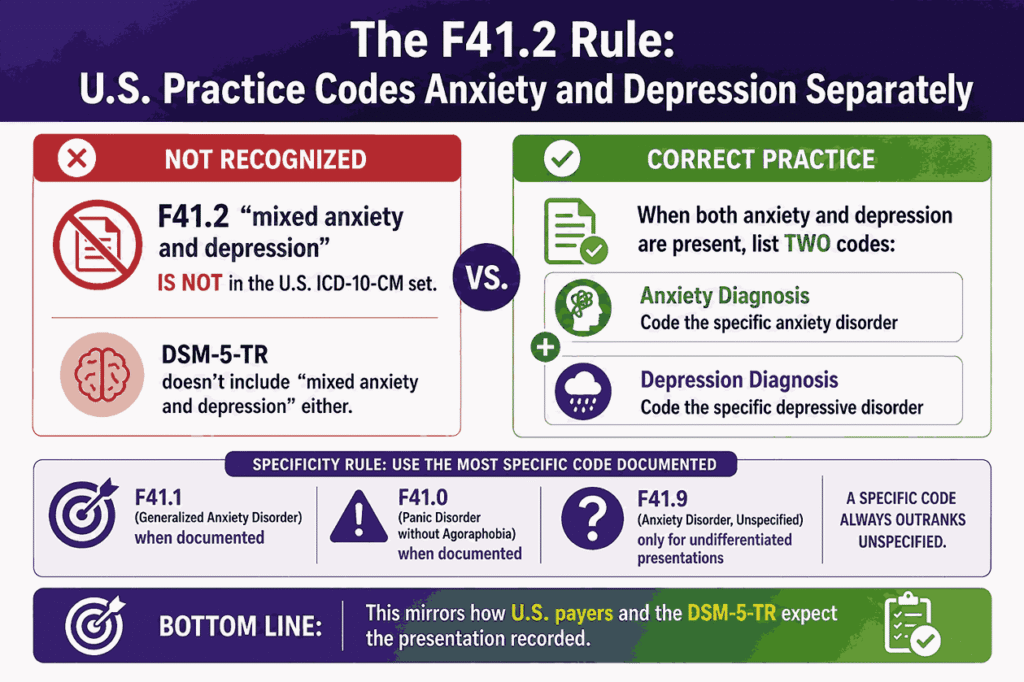
Anxiety diagnoses sit in the F40 to F42 range. F41.9 is the most billed anxiety code, but it should yield to a specific code when documented. Specific diagnoses always outrank the unspecified option.
- F41.1 Generalized anxiety disorder, the preferred code when GAD is documented
- F41.0 Panic disorder without agoraphobia
- F41.9 Anxiety disorder, unspecified, for undifferentiated presentations
- F42.2 Mixed obsessional thoughts and acts
Note one U.S.-specific rule. The ICD-10-CM code set does not recognize F41.2, mixed anxiety and depression. American practice codes anxiety and depression as separate diagnoses instead.
When both conditions are present, list two codes rather than forcing one. Code the anxiety diagnosis and the depression diagnosis separately on the claim. This mirrors how U.S. payers and the DSM-5-TR expect the presentation recorded.
Trauma and Adjustment Disorders (F43)
The F43 block covers acute stress, PTSD, and adjustment disorders. These diagnoses hinge on a documented stressor and a symptom timeline. Coders should tie the code to the event and duration recorded in the note.
| Code | Description |
|---|---|
| F43.10 | Post-traumatic stress disorder, unspecified |
| F43.20 | Adjustment disorder, unspecified |
| F43.21 | Adjustment disorder with depressed mood |
| F43.22 | Adjustment disorder with anxiety |
| F43.23 | Adjustment disorder with mixed anxiety and depressed mood |
Bipolar Disorder (F31)
Bipolar disorder codes sit in the F31 category and carry heavy claim volume. Each code names the current episode type and its severity. The unspecified code F31.9 should yield when the episode is documented.
| Code | Description | Documentation note |
|---|---|---|
| F31.0 | Bipolar, current episode hypomanic | Note hypomanic features |
| F31.1x | Bipolar, current episode manic without psychosis | State severity |
| F31.2 | Bipolar, current episode manic with psychosis | Note psychotic features |
| F31.3x | Bipolar, current episode depressed, mild or moderate | State severity level |
| F31.9 | Bipolar disorder, unspecified | Use only when episode is unclear |
Bipolar coding rewards episode precision. A manic episode with psychotic features codes differently than one without. Capture the current episode at each visit, since the code changes as the illness cycles.
Schizophrenia and Psychotic Disorders (F20 to F29)
Schizophrenia and related psychotic disorders all use the F20 to F29 range. These codes describe how patients think, perceive, and interpret reality. Accurate coding here supports both reimbursement and the higher acuity of these cases.
| Code | Description |
|---|---|
| F20.9 | Schizophrenia, unspecified |
| F21 | Schizotypal disorder |
| F22 | Delusional disorder |
| F25.0 | Schizoaffective disorder, bipolar type |
| F25.1 | Schizoaffective disorder, depressive type |
| F29 | Unspecified psychosis not due to a substance |
Schizoaffective disorder codes trip up many coders. F25 requires both mood and psychotic features in the record. Distinguish it clearly from bipolar with psychosis, which stays in the F31 category.
ADHD and Neurodevelopmental Disorders (F84, F90)
ADHD is one of the highest-volume psychiatric diagnoses in coding. The F90 codes split by presentation type, and documentation must match the subtype. Autism spectrum disorder sits nearby in the F84 developmental block.
| Code | Description |
|---|---|
| F90.0 | ADHD, predominantly inattentive presentation |
| F90.1 | ADHD, predominantly hyperactive presentation |
| F90.2 | ADHD, combined presentation |
| F90.9 | ADHD, unspecified type |
| F84.0 | Autistic disorder |
| F91.x | Conduct disorders in the F90–F98 childhood block |
Pediatric psychiatry claims often deny on ADHD subtype mismatches. The note must state whether the presentation is inattentive, hyperactive, or combined. F90.9 signals that the subtype was not documented at the visit.
Obsessive-Compulsive Disorder (F42)
Obsessive-compulsive disorder moved out of the anxiety block in current coding. The F42 category now stands on its own with distinct subtypes. Hoarding disorder gained its own code within this family.
- F42.2 Mixed obsessional thoughts and acts
- F42.3 Hoarding disorder
- F42.4 Excoriation (skin-picking) disorder
- F42.9 Obsessive-compulsive disorder, unspecified
Substance Use Disorders (F10 to F19)
Substance use coding runs from F10 to F19 by substance class. These codes demand careful documentation of use, dependence, and remission status. Coders should record the most clinically accurate condition rather than defaulting to unspecified.
The F19.20 code for other psychoactive substance dependence signals vague documentation when overused. High rates of unspecified substance codes flag a documentation quality problem worth reviewing.
Remission status changes the code and the risk picture. A patient in early remission gets a different fifth character than one in sustained remission. Document the remission timeline clearly so the code matches the clinical reality.
- Use the substance class and pattern documented, not a generic default
- Record remission status when the patient meets the criteria
- Avoid F19 codes when the specific substance is known
Alcohol use disorder is the highest-volume substance code family in psychiatry. The F10 codes split by use, abuse, and dependence, then by complication. The table below shows the common alcohol codes and their triggers.
| Code | Description | Documentation note |
|---|---|---|
| F10.10 | Alcohol abuse, uncomplicated | Note abuse without dependence |
| F10.20 | Alcohol dependence, uncomplicated | Confirm dependence criteria |
| F10.21 | Alcohol dependence, in remission | Record remission status |
| F10.239 | Alcohol dependence with withdrawal, unspecified | Note active withdrawal |
The abuse-versus-dependence line is the frequent error point. Payers expect the record to support the exact tier billed. Code withdrawal only when the documentation describes active withdrawal signs.
DSM-5-TR to ICD-10-CM Crosswalk
Most psychiatric documentation flows DSM-first. The clinician reaches a DSM-5-TR diagnosis, then a matching ICD-10-CM code goes on the claim. The DSM-5-TR prints the corresponding ICD-10 code under each disorder to support this handoff.
The two systems align, but they are not identical. A few ICD-10 codes have no clean DSM equivalent and exist only for coding purposes. Coders should treat these as claim destinations, not clinical diagnoses.
- F32.A Depression, unspecified, for documentation below full MDD criteria
- F43.8x Other stress-response codes with no direct DSM match
- F99 Mental disorder not otherwise specified, a last-resort code
The safest setup carries the crosswalk inside the electronic health record (EHR). The system links each confirmed diagnosis to its billable code automatically. That removes the risk of a coder relying on memory at claim time.
Dementia and Organic Mental Disorders (F01 to F09)
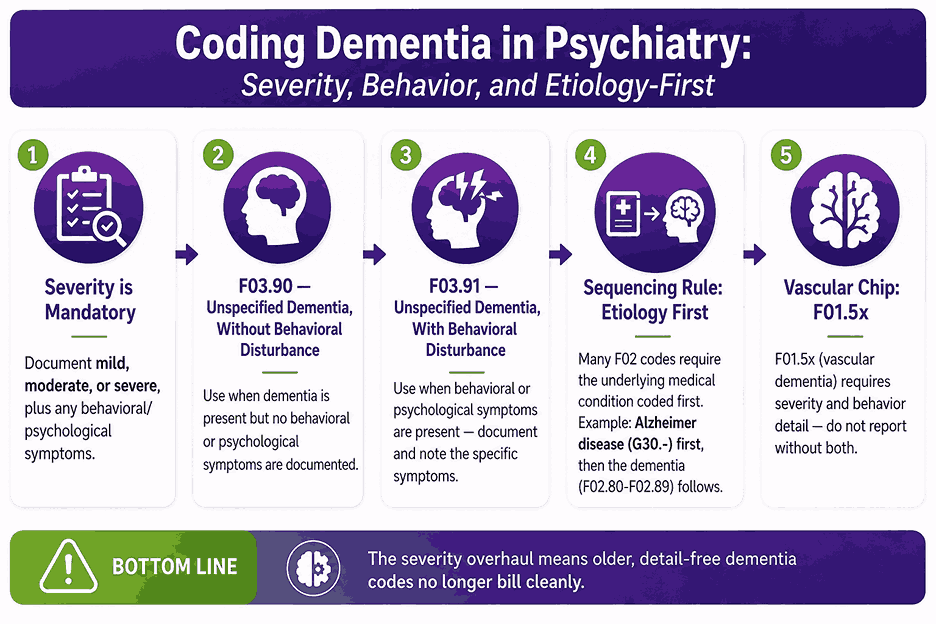
The F01 to F09 block covers mental disorders due to known physiological conditions. Dementia codes carry high search and claim volume in psychiatric and geriatric practice. Current coding requires severity and behavioral detail that older codes did not.
The dementia severity overhaul changed how these codes work. Providers must document severity as mild, moderate, or severe. They must also record any behavioral or psychological symptoms present.
| Code | Description | Documentation note |
|---|---|---|
| F01.5x | Vascular dementia, with severity and behavior detail | State severity and symptoms |
| F02.8x | Dementia in other diseases classified elsewhere | Code the underlying disease first |
| F03.90 | Unspecified dementia, without behavioral disturbance | Use when type is unclear |
| F03.91 | Unspecified dementia, with behavioral disturbance | Note the behavioral symptoms |
| F06.x | Other mental disorders due to physiological condition | Link to the physical cause |
Sequencing matters in this block. Many F02 codes require the underlying medical condition coded first. Alzheimer disease, for example, gets its G30 code before the dementia code follows.
Sleep-Wake Disorders in Psychiatry (F51)
Insomnia and related sleep disorders draw steady search volume from clinicians. The F51 codes cover nonorganic sleep-wake conditions seen in psychiatric care. These often accompany a mood or anxiety diagnosis on the same claim.
- F51.01 Primary insomnia
- F51.02 Adjustment insomnia, tied to a stressor
- F51.04 Psychophysiologic insomnia
- F51.11 Primary hypersomnia
- F51.5 Nightmare disorder
Sleep codes need a cause distinction to bill cleanly. A sleep disorder rooted in a physical condition uses a different chapter code. Reserve the F51 codes for sleep problems that are not due to a substance or general medical cause.
When insomnia is secondary to depression, sequence the depression code as primary. The insomnia code then supports the clinical picture without displacing the main diagnosis. This mirrors the sequencing logic payers apply across psychiatric claims.
Documentation Requirements That Drive Specificity
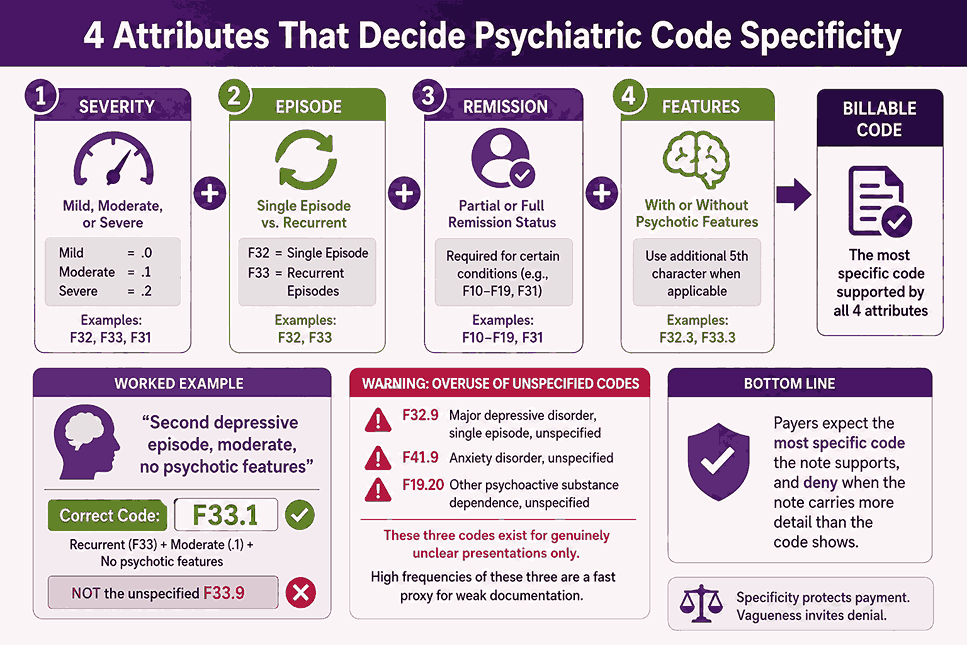
Specificity is where psychiatric claims are won or lost. Payers do not just prefer the most specific code available. They expect it, and they deny claims when the note supports more detail than the code shows. That is why, when looking for a dedicated psychiatry billing provider, you will want them to have codes with deep experience in psychiatry coding.
Four attributes drive specificity across most psychiatric codes. The table below shows what each attribute requires in the clinical note. Miss one, and the code drops to an unspecified variant that invites review.
| Attribute | What the note must show | Applies to |
|---|---|---|
| Severity | Mild, moderate, or severe | F32, F33, F31 |
| Episode | Single or recurrent | F32 vs F33 |
| Remission | Partial or full remission status | F10–F19, F31 |
| Features | With or without psychotic features | F32.3, F33.3 |
A common mistake here is treating unspecified codes as a shortcut for a rushed note. F32.9, F41.9, and F19.20 exist for genuinely unclear presentations only. High frequencies of these three codes are a fast proxy for weak documentation.
Consider a concrete case. A psychiatrist documents a second depressive episode, moderate severity, with no psychotic features. The specific code is F33.1, recurrent MDD moderate, not the unspecified F33.9.
That single character of specificity affects both payment and risk adjustment. A clean, specific code moves through the payer edits without a manual review. A vague code invites a request for records and delays the payment.
In practice, the fix is a weekly chart-review block. Thirty minutes each week surfaces the codes a clinician over-relies on. It also reveals the specific codes that documentation could easily support instead.
FY2026 ICD-10-CM Updates for Psychiatry
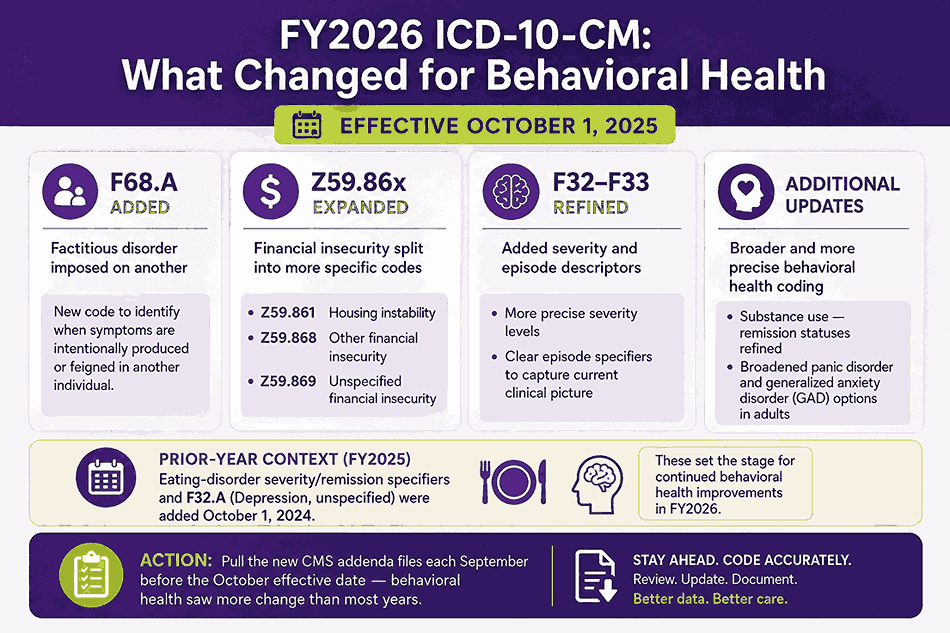
The ICD-10-CM code set updates every October 1 with the federal fiscal year. The FY2026 set took effect on October 1, 2025, and applies to claims in the 2026 reporting year. Behavioral health saw more change than most years.
Practices that have not reviewed the FY2026 changes carry avoidable denial risk. The table below summarizes the updates that matter most for psychiatry. CMS publishes each year’s addenda files in summer, listing only what changed.
| Change | Detail | Effective |
|---|---|---|
| F68.A added | Factitious disorder imposed on another | Oct 1, 2025 |
| Z59.86x expanded | Financial insecurity split into Z59.861, Z59.868, Z59.869 | Oct 1, 2025 |
| F32–F33 refined | Added severity and episode descriptors | Oct 1, 2025 |
| Eating disorders | Severity and remission specifiers added | Oct 1, 2024 (FY2025) |
| F32.A added | Depression, unspecified | Oct 1, 2024 (FY2025) |
The FY2026 update also refined substance use remission statuses. It broadened anxiety disorder options for panic disorder and generalized anxiety in adults. Each September, pull the new addenda files from CMS before the October effective date.
Pairing ICD-10 with CPT Codes for Psychiatric Services
An ICD-10 code alone does not create a payable claim. It states why the service was medically necessary, and a CPT code states what service happened. Psychiatry uses a small, repeatable set of CPT codes.
The table below lists the CPT codes psychiatrists bill most often. Prescriber workflows lean on evaluation, medication management, and psychotherapy add-ons. Descriptions here summarize each service in plain terms.
| CPT | Service | Notes |
|---|---|---|
| 90792 | Psychiatric diagnostic evaluation with medical services | Prescriber intake |
| 90833 | Psychotherapy 30 min, add-on to E/M | Pair with an E/M code |
| 90836 | Psychotherapy 45 min, add-on to E/M | Pair with an E/M code |
| 90832 | Psychotherapy, 30 minutes | Standalone therapy |
| 90834 | Psychotherapy, 45 minutes | Standalone therapy |
| 90837 | Psychotherapy, 60 minutes | Higher documentation bar |
| 90839 | Psychotherapy for crisis, first 60 minutes | 90840 for each added 30 min |
Telehealth adds modifier and place-of-service rules on top of the CPT code. For synchronous audio-video sessions, append the -95 modifier to the CPT code. Use place-of-service 02 when the patient is away from home and 10 when at home.
Audio-only sessions take the -93 modifier instead. Medicare fee-for-service identifies telehealth mainly by the place-of-service code rather than the modifier. Always check each payer’s specific rule before submitting.
Z-Codes and Social Determinants in Psychiatry
Z-codes capture the psychosocial context around a psychiatric diagnosis. They record circumstances that shape a patient’s health and care needs. In value-based programs, this context carries real reporting and quality weight.
The FY2026 update expanded the financial-insecurity codes, a strong example of this shift. Psychiatry teams should add relevant Z-codes alongside the primary diagnosis, not in place of it. The list below shows codes worth capturing.
- Z59.861 / Z59.868 / Z59.869 Financial insecurity variants
- Z63.0 Relationship problems affecting the patient
- Z65.8 Other specified problems related to psychosocial circumstances
- Z91.14 Patient non-adherence to medication regimen
These codes rarely change reimbursement on a single claim. Their value grows in population health and value-based contracts. For a deeper breakdown of social determinant coding, see our guide on behavioral health Z-codes.
HCC Risk Adjustment and Psychiatric Diagnoses
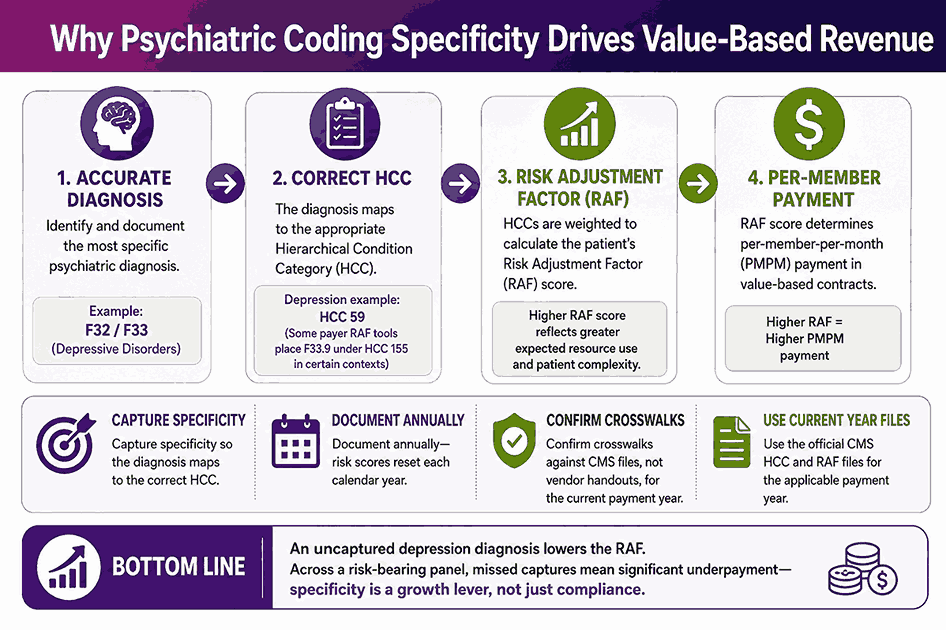
Risk adjustment turns diagnosis coding into a revenue lever for value-based contracts. Hierarchical Condition Categories (HCC) group diagnoses that predict future cost. Accurate psychiatric coding feeds the Risk Adjustment Factor (RAF) that drives payment.
Depression coding is a clear example of this link. F32 and F33 depression codes map to HCC 59 in the CMS model. Some payer RAF tools place F33.9 under HCC 155 in certain contexts.
The practical rule for RCM teams is straightforward. Confirm the CMS official crosswalk for the current payment year before relying on any RAF tool. This matters most for Accountable Care Organizations (ACOs), health systems, and risk-bearing psychiatric groups.
- Capture specificity so the diagnosis maps to the correct HCC
- Document annually because risk scores reset each calendar year
- Confirm crosswalks against CMS files rather than vendor handouts
The revenue effect compounds across a psychiatric panel. An uncaptured depression diagnosis lowers the RAF and the per-member payment. Across a risk-bearing panel, missed captures translate into significant underpayment each year.
This is why coding specificity is a growth lever, not just a compliance task. Clean psychiatric diagnosis capture protects both fee-for-service payment and value-based revenue. RCM teams that own this data see the gap that clinical teams often miss.
Why Psychiatry Claims Get Denied and How to Prevent It
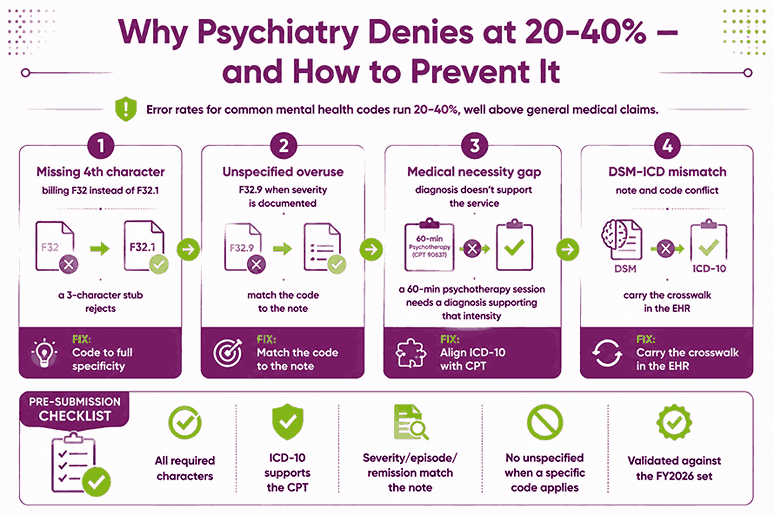
Psychiatric claims deny at higher rates than general medical claims. Error rates for common mental health codes range from 20 percent to 40 percent. Overlapping symptoms, comorbidities, and subjective assessments all raise the risk.
These errors cost providers millions in delayed and lost revenue each year. Most denials trace back to a short list of fixable causes. The table below pairs each cause with a prevention step.
| Denial cause | What it looks like | Prevention |
|---|---|---|
| Missing 4th character | Billing F32 instead of F32.1 | Code to full specificity |
| Unspecified overuse | F32.9 when severity is documented | Match code to the note |
| Medical necessity gap | Diagnosis does not support the service | Align ICD-10 with CPT |
| DSM–ICD mismatch | Note and code conflict | Carry the crosswalk in the EHR |
Claim adjustment reason codes (CARC) and remark codes (RARC) point to the specific defect. A CARC 16 signals missing or incorrect information on the claim. A CARC 11 signals a diagnosis inconsistent with the procedure billed.
Diagnosis sequencing causes a quieter set of denials. The primary diagnosis must be the main reason for the encounter. Secondary diagnoses and Z-codes support that primary code without displacing it.
Medical necessity remains the largest single driver of psychiatric denials. The diagnosis code must justify the level of service billed on the same claim. A 60-minute psychotherapy session needs a diagnosis that supports that intensity.
A short pre-submission checklist prevents most of these denials. Run it before any psychiatric claim leaves the practice.
- Confirm the code has all required characters
- Verify the ICD-10 code supports the CPT service
- Check that severity, episode, and remission match the note
- Rule out an unspecified code when a specific one applies
- Validate the code against the current FY2026 code set
Frequently Asked Questions
What Is the Difference Between F32 and F33 in ICD-10?
F32 represents a single major depressive episode. F33 represents recurrent major depressive disorder with two or more episodes. Document prior episodes to support the recurrent code.
Is There an ICD-10 Code for Therapy?
No single code exists for therapy itself. Clinicians code the patient’s condition, such as F32.0 or F41.1, to justify the service. That diagnosis code pairs with a CPT code to bill the session.
Why Is F41.2 Not Used in U.S. Practice?
The ICD-10-CM and DSM-5 do not include F41.2, mixed anxiety and depression. American practice codes anxiety and depression as two separate diagnoses instead.
What Is the Most Commonly Billed Depression Code?
F32.9, major depressive disorder single episode unspecified, is the most billed depression code. Use F33 codes for recurrent episodes and always document severity.
Can A Behavioral Health Code Be a Primary Diagnosis on a Medical Visit?
Yes, when the psychiatric condition is the main reason for the encounter. Payer rules vary, so confirm sequencing requirements for each plan.
For a full lookup version of these codes, download our psychiatry ICD-10 cheat sheet and pin it beside your workstation.