
Medical billing reimbursement refers to the process by which healthcare providers receive payment from insurers, government programs, or patients for services provided. It ensures that medical services are financially covered based on eligibility, medical necessity, and payer policies. The reimbursement process typically starts with patient registration and insurance verification, followed by medical coding of services, claim submission to the payer, adjudication (review and approval or denial), and finally payment or denial resolution.
There are several types of reimbursement models, including fee-for-service, bundled payments, capitation, and value-based reimbursement. Each model determines how providers are paid for care delivered.
The key benefits of medical billing reimbursement include ensuring financial stability for healthcare providers, improving access to structured healthcare financing, and enabling more transparent and standardized payment systems across the healthcare industry.

What Is Medical Billing Reimbursement?
Medical billing reimbursement is the process through which healthcare providers receive payment for the services they deliver to patients. These payments typically come from insurance companies, government programs, or directly from patients, depending on coverage and responsibility.
It involves submitting a claim that details the services provided, supported by accurate medical codes. The payer then reviews the claim based on policy rules, medical necessity, and coverage terms before approving, reducing, or denying the payment.
How Does Medical Billing Reimbursement Work?
Medical billing reimbursement works by converting healthcare services into standardized claims. These claims are reviewed, processed, and paid by insurers or patients based on coverage rules and medical necessity.
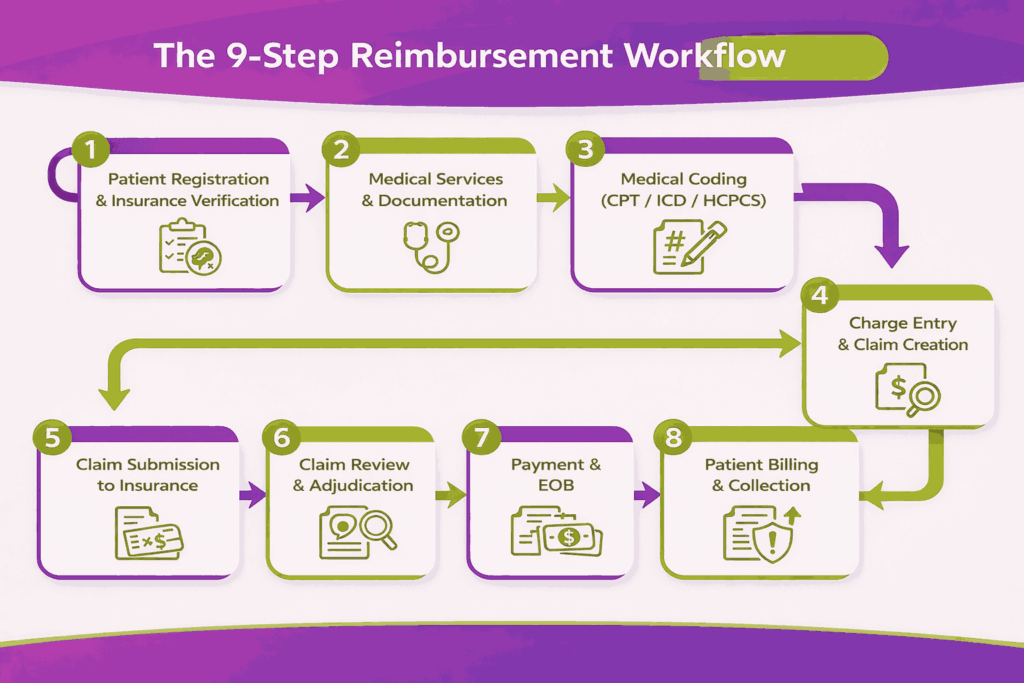
- Patient Registration and Insurance Verification
- Medical Services and Documentation
- Medical Coding
- Charge Entry and Claim Creation
- Claim Submission to Insurance
- Claim Review and Adjudication
- Payment and Explanation of Benefits (EOB)
- Patient Billing and Payment Collection
- Denial Management and Appeals
1. Patient Registration and Insurance Verification
This is the first step in the medical billing reimbursement process, where healthcare providers collect essential patient information such as name, date of birth, contact details, and insurance data to create an accurate patient record.
Billing staff then verify the patient’s insurance coverage by checking eligibility, benefits, and policy-specific details before any services are delivered. This helps confirm what services are covered and what costs the patient may be responsible for. In some cases, certain procedures require prior authorization from the insurance company.
This step ensures that necessary approvals are obtained in advance, helping prevent claim denials later in the billing process.
2. Medical Services and Documentation
Healthcare providers document every patient encounter, including diagnoses, procedures, treatments, and medications. This record serves as the official proof of the care and services delivered during the visit.
Accurate and detailed documentation is essential because it allows medical coders to assign the correct codes for billing and ensures that claims submitted to insurance companies are valid and complete. Without proper documentation, claims may be delayed or denied.
This step also supports regulatory compliance and protects healthcare providers during audits by maintaining a clear and verifiable record of patient care.
3. Medical Coding
Medical coders review the patient’s clinical documentation and convert diagnoses, procedures, and services into standardized codes such as CPT, ICD, and HCPCS. These codes represent exactly what was performed during the patient visit in a format that insurance companies can process.
Accurate coding is critical for submitting correct insurance claims and ensuring proper reimbursement. It also helps maintain compliance with healthcare regulations and payer requirements. Errors in coding can result in claim denials, delayed payments, or compliance issues, making precision in this step essential for a smooth reimbursement process.
4. Charge Entry and Claim Creation
During this stage, the assigned CPT, ICD, and HCPCS codes are entered into the billing software or practice management system. This process converts the coded medical services into a structured insurance claim ready for submission.
Billing staff ensure that all key details are accurate, including service charges, patient demographics, provider information, and insurance data. Careful verification at this step is important to avoid errors that could lead to claim rejections, delays, or payment issues.
5. Claim Submission to Insurance
Claims are submitted either electronically through clearinghouses or practice management systems, or manually using paper forms such as the CMS-1500. This step formally starts the reimbursement process with the insurance payer.
Each insurance company has specific submission rules, required data fields, and formatting standards. Following these requirements correctly helps reduce claim denials and ensures faster and more efficient claim processing.
6. Claim Review and Adjudication
Insurance companies review submitted claims to confirm patient eligibility, coverage, and the accuracy of codes, charges, and supporting documentation. This step ensures that only valid and covered medical services are eligible for reimbursement.
After the review, the payer may approve the claim in full, issue a partial payment based on contract terms, or deny the claim if there are errors, missing information, or non-covered services. The outcome directly affects provider reimbursement and may require further follow-up or correction.
7. Payment and Explanation of Benefits (EOB)
Once payments are received from insurance companies or patients, the billing team posts them to the appropriate patient accounts in the billing system. This ensures that account balances remain accurate and financial records are properly maintained.
Payment posting also involves reviewing and interpreting the Explanation of Benefits (EOB). Billing staff applies contractual adjustments, records copays and deductibles, and accounts for partial payments or denied amounts. Accurate posting is essential for correct financial reporting and helps identify any remaining balances that require follow-up.
8. Patient Billing and Payment Collection
After insurance payments are posted, the billing staff generates patient statements to communicate any remaining balances. This ensures patients clearly understand what they owe and helps maintain steady revenue flow for the provider.
Patient billing may also include setting up payment plans, collecting copays or self-pay amounts, and offering financial counseling to help patients manage their healthcare expenses. Effective handling of this step reduces bad debt and improves overall patient satisfaction.
9. Denial Management and Appeals
Billing staff review denied claims to identify the reason for rejection, collect the necessary supporting documentation, and submit corrections or appeals to the insurance payer to recover payment.
Denial management also involves analyzing denial trends, training staff on common errors, updating billing and coding practices, and implementing preventive measures. These actions help reduce future denials and ensure faster, more accurate reimbursement.
What Are The Types Of Medical Billing Reimbursement?
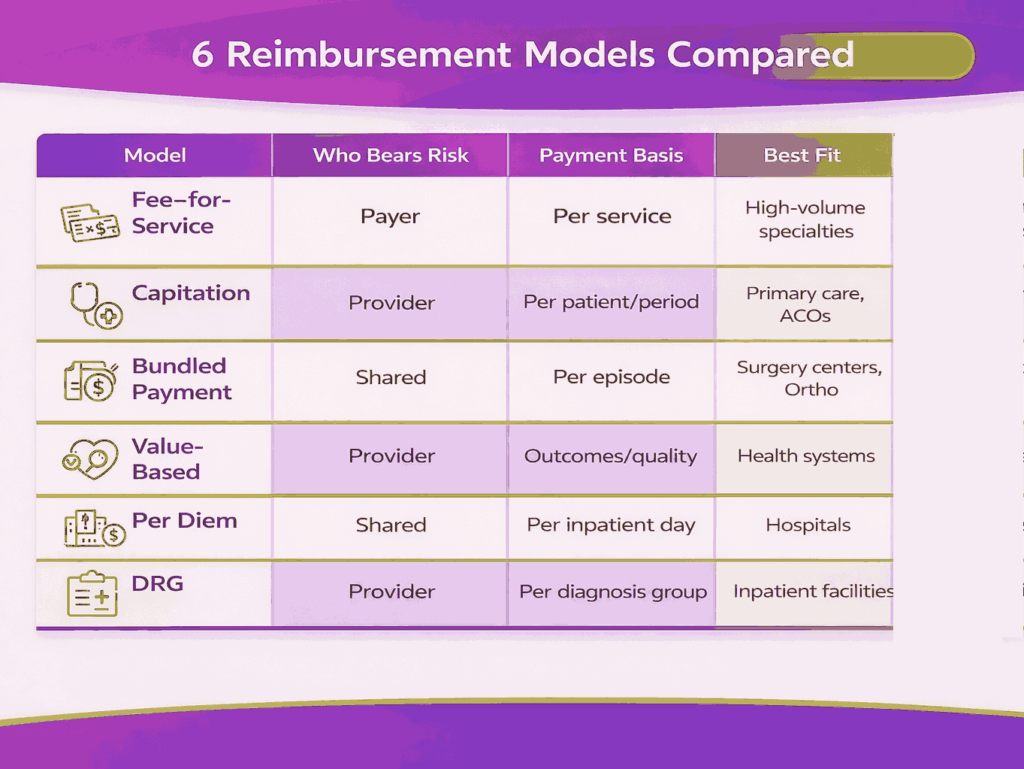
Medical billing reimbursement is structured through different payment models that determine how healthcare providers are paid for services. The most common types include fee-for-service, capitation, bundled payments, value-based reimbursement, per diem payments, and diagnosis-related group (DRG) systems. Each model defines payment based on services rendered, patient population, episode of care, or quality outcomes.
Fee-for-Service (FFS) Reimbursement
Providers are paid separately for each service or procedure performed. Payment is based on the volume of services delivered.
Fee-for-Service (FFS) reimbursement is a payment model where healthcare providers are paid separately for each individual service, procedure, or visit they perform. Under this model, reimbursement is based on the quantity of services delivered rather than overall patient outcomes. This means every test, consultation, or procedure is billed and paid individually.
Accurate and detailed documentation is essential in FFS because payment depends on proper coding and billing for each service provided. As this model rewards service volume, precise record-keeping is critical to ensure full reimbursement and maintain compliance with payer rules.
Capitation Payment Model
Providers receive a fixed amount per patient over a set period, regardless of how many services the patient uses.
Capitation is a reimbursement model where healthcare providers receive a fixed, pre-determined payment for each enrolled patient over a specific period, regardless of how many services the patient uses. Under this system, financial risk shifts partly to the provider because payment does not change based on service volume.
This encourages more efficient care delivery, preventive care, and better overall management of the patient population. Providers are incentivized to control costs while still maintaining quality outcomes, focusing more on long-term health rather than individual service frequency.
Bundled Payment System
A single combined payment is made for all services related to a specific treatment or procedure within a defined episode of care.
A bundled payment system is a reimbursement model where healthcare providers receive a single, consolidated payment for all services related to a specific condition, procedure, or episode of care. This model encourages providers to manage patient care comprehensively by coordinating across departments and specialists.
It also reduces unnecessary services and promotes more efficient care delivery and workflow optimization. Accurate documentation and coding are essential to ensure correct reimbursement and to properly track patient outcomes within the bundled care episode.
Value-Based Reimbursement
Payments are tied to patient outcomes and quality of care rather than the number of services provided.
Value-Based Reimbursement is a payment model where healthcare providers are reimbursed based on the quality of care delivered, patient health outcomes, and overall effectiveness rather than the volume of services provided. This model encourages providers to focus on preventive care, care coordination, and improving patient satisfaction.
It shifts attention from quantity to quality, rewarding better health outcomes. Accurate documentation, precise coding, and consistent performance tracking are essential to demonstrate compliance with quality benchmarks and ensure proper reimbursement.
Per Diem Payment Method
Providers are paid a fixed amount for each day a patient receives care, often used in hospital settings.
Per Diem Payment Method is a reimbursement model where hospitals receive a fixed payment for each day a patient is admitted, regardless of the specific services or procedures provided on that day. This approach simplifies billing for inpatient stays by reducing administrative complexity and providing more predictable revenue for hospitals.
It also helps standardize payment across varying levels of daily care. Accurate documentation of admission and discharge dates is essential to ensure correct reimbursement and avoid payment discrepancies.
Diagnosis-Related Group (DRG) Payment System
Patients are categorized into groups based on diagnosis and treatment, and hospitals are paid a fixed rate per group.
Diagnosis-Related Group (DRG) Payment System is a reimbursement model where hospitals receive a fixed, predetermined payment for treating patients within a specific diagnosis category, regardless of the actual cost of care provided.
This model encourages efficiency in inpatient care by standardizing payments across hospitals and reducing variations in costs. It also requires accurate coding and documentation of diagnoses, procedures, and length of stay to ensure correct reimbursement.
What Are The Benefits Of Medical Billing Reimbursement?
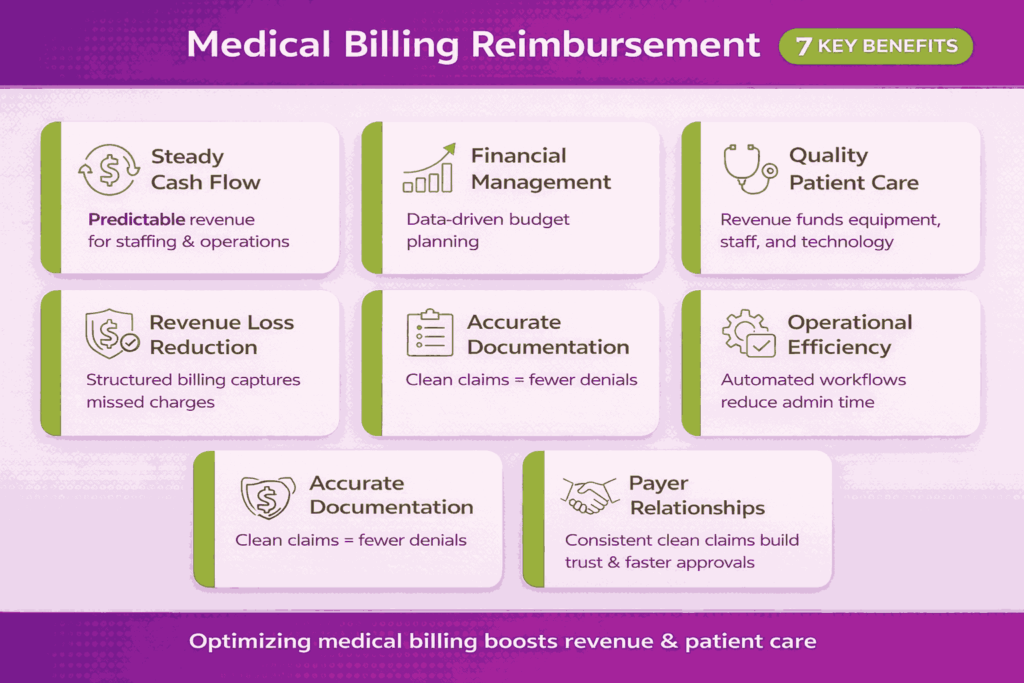
Medical billing reimbursement systems ensure that healthcare providers are fairly compensated for services while maintaining financial and operational stability. These models help streamline revenue cycles, reduce losses, and promote better healthcare delivery.
Ensures Steady Cash Flow
Provides consistent and predictable revenue for healthcare organizations.
Cash flow refers to the movement of money into a healthcare practice through payments received for services provided. Accurate medical billing and coding ensure that healthcare providers receive timely and correct payments from insurers and patients which prevents disruptions in cash flow and financial gaps.
Consistent reimbursement allows healthcare organizations to forecast revenue more effectively, allocate resources properly, and plan for staffing, equipment, and operational expenses.
Improves Financial Management
Helps providers plan budgets and manage operational costs more effectively.
Financial management refers to the process of tracking, analyzing, and controlling a healthcare organization’s income, expenses, and overall financial performance. Precise billing records give healthcare practices a clear view of revenue streams and service costs, helping them monitor income and expenses more effectively.
Reliable financial data from billing and coding also enables providers to forecast future revenue, identify areas of overspending, and implement cost-control strategies, which improves operational efficiency and overall profitability.
Supports Quality Patient Care
Encourages better treatment outcomes, especially in value-based models.
Patient care refers to the services and support provided by healthcare professionals to diagnose, treat, and manage patients’ health conditions effectively. Timely and accurate reimbursements ensure that healthcare providers have the financial resources needed to improve clinical services, maintain facilities, and expand care offerings for patients.
Reliable revenue from billing and coding also supports hiring skilled medical staff, investing in advanced equipment, and implementing technology solutions that enhance both patient outcomes and operational efficiency.
Reduces Revenue Loss
Minimizes unpaid services through structured billing and reimbursement processes.
Revenue loss refers to the financial loss that occurs when healthcare providers fail to bill, code, or collect payments correctly for services that have been provided. Accurate coding and billing ensure that all services are properly documented and submitted for reimbursement, reducing the risk of missed charges, underpayments, or overlooked claims.
This improves overall revenue capture by ensuring providers are fully reimbursed for the care they deliver and minimizing avoidable financial leakage.
Encourages Accurate Documentation and Coding
Promotes proper clinical documentation to ensure correct claim submission and payment.
Documentation and coding refer to the process of recording patient care details and converting them into standardized billing codes for insurance claims. Accurate, detailed medical records enable coders and billers to submit claims that accurately reflect the services provided.
Clear documentation also reduces errors, supports compliance, and helps avoid claim denials or payment delays.
Enhances Operational Efficiency
Streamlines billing workflows and reduces administrative delays.
Operational efficiency refers to the ability of a healthcare organization to complete billing, coding, and administrative tasks with minimal waste of time, effort, and resources. Efficient billing and coding processes reduce manual work, eliminate repetitive tasks, and allow staff to focus on higher-value revenue cycle activities.
Streamlined workflows also speed up claim creation and submission, reduce data entry and coding errors, and improve coordination between billing, coding, and clinical teams, resulting in smoother overall operations.
Strengthens Relationships with Insurance Providers
Improves trust and collaboration between healthcare providers and payers through standardized processes.
Submitting clean, accurate, and timely claims helps build trust with insurance providers by showing consistency, professionalism, and reliability in the billing process. Strong relationships with payers lead to faster claim approvals, fewer disputes, and smoother resolution of billing issues when they arise.
It also supports better collaboration during contract negotiations and helps ensure more efficient and predictable reimbursement processes over time.
What Are The Potential Challenges In Medical Billing Reimbursement?
Medical billing reimbursement involves several operational and regulatory challenges that can impact cash flow, accuracy, and efficiency. Common issues include claim denials, coding errors, delayed payments, complex insurance requirements, frequent regulatory updates, documentation gaps, patient payment collection difficulties, and compliance risks. These challenges often require strong billing processes and continuous monitoring to ensure timely and accurate reimbursement.
Claim Denials and Rejections
Claims may be denied or rejected due to missing information, incorrect coding, eligibility issues, or non-covered services, leading to delayed or lost revenue.
Claim rejections and claim denials are two different outcomes in the reimbursement process. Rejections occur at the initial processing stage when a claim is not accepted due to formatting issues, missing fields, or submission errors. Denials, on the other hand, happen after a claim has been processed but is partially or fully unpaid due to medical necessity, eligibility, or policy-related reasons.
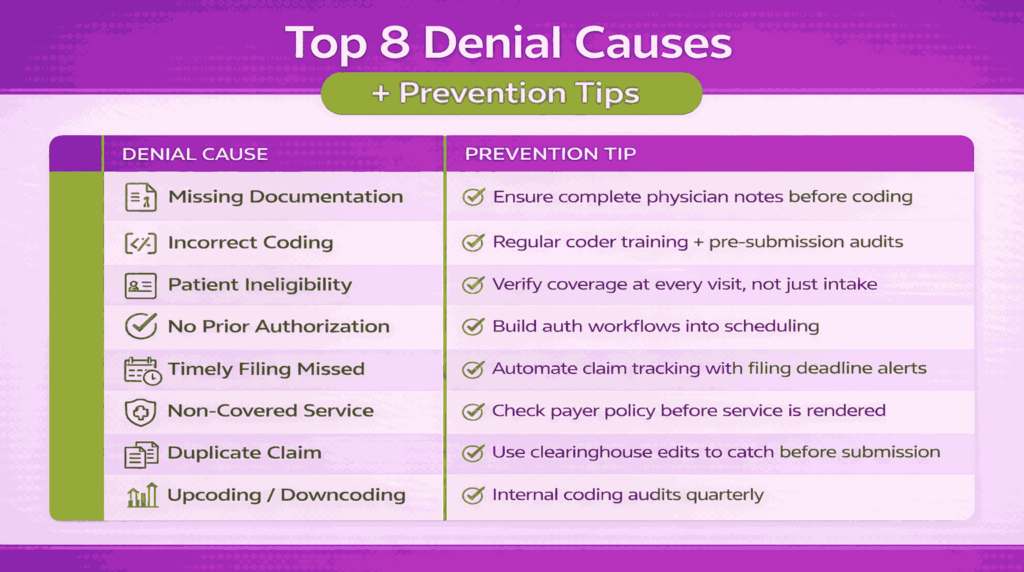
Common causes of claim denials include missing or incomplete documentation, patient ineligibility, incorrect coding, and lack of prior authorization for services performed. Denied claims require additional time and effort from billing staff to investigate, correct errors, and resubmit the claim, which increases administrative workload and delays revenue collection.
Overall, claim denials can disrupt cash flow, slow down reimbursements, and reduce total revenue, making proactive denial management and accurate claim submission essential for financial stability.
Coding Errors and Inaccuracies
Incorrect use of medical codes can result in claim rejections, underpayments, or compliance issues, making accurate coding essential for reimbursement.
Medical coders convert diagnoses, procedures, and services into standardized codes that form the basis of insurance claims and determine reimbursement amounts. Coding errors often occur due to human mistakes, use of outdated or invalid codes, or incomplete and unclear clinical documentation from providers.
These inaccuracies can lead to claim denials, delayed payments, compliance violations, and even audits, which negatively impact both revenue and regulatory standing. Accurate and detailed clinical documentation is essential for ensuring coders assign the correct codes, supporting precise billing and timely reimbursement.
Delayed Payments
Slow claim processing or payer delays can disrupt cash flow and create financial pressure on healthcare providers.
Delayed payments occur when insurance claims take longer than expected to process and reimburse, slowing down cash flow for healthcare providers. Common causes of delays include extended claim review cycles, incomplete or inaccurate documentation, payer backlogs, and reliance on manual billing workflows.
These delays can create cash flow challenges, reduce revenue stability, and place financial pressure on healthcare organizations. Prolonged reimbursement timelines can also disrupt budgeting, delay investments in equipment or technology, and impact staffing and payroll planning.
Complex Insurance Policies
Different payers have varying rules, coverage limits, and requirements, making claim submission and compliance more difficult.
Insurance policies differ significantly in covered services, billing rules, and reimbursement structures, making accurate billing more challenging for healthcare providers. Each payer type, including commercial insurers, Medicare, Medicaid, and managed care organizations, has its own requirements, payment methods, and documentation standards.
Complex plan details such as coverage limits, patient cost-sharing responsibilities, and prior authorization rules can create confusion and increase the risk of claim denials. To manage this complexity, billing staff must continuously monitor changes in payer guidelines and regulations, which increases workload and requires ongoing training to ensure accurate reimbursement.
Frequent Regulatory Changes
Ongoing updates in healthcare laws, coding standards, and payer policies require constant adaptation to avoid errors and penalties.
Healthcare laws, billing rules, and payer guidelines change regularly, requiring providers to stay updated to ensure compliance and accurate reimbursement. Frequent updates to ICD, CPT, and HCPCS codes, along with insurer-specific policy changes, require ongoing adjustments in billing practices to prevent claim denials and errors.
Billing staff must continuously monitor regulatory updates and payer communications to ensure that all claims meet current standards and requirements. Implementing these changes across systems, workflows, and staff training increases operational workload but is necessary to avoid compliance issues, penalties, and revenue loss.
Incomplete or Incorrect Documentation
Missing or unclear clinical documentation can prevent proper coding and lead to claim denials or reduced reimbursement.
Accurate and complete medical documentation is essential for coders to assign correct codes and for billers to submit claims that properly reflect the services provided. Common issues include missing patient demographics, incomplete treatment notes, and unclear or vague physician documentation, all of which can lead to claim delays or denials.
Poor documentation increases the risk of coding errors, claim rejections, and audits, which negatively impact both revenue and compliance. Since coders depend heavily on physician notes to determine accurate codes, incomplete or ambiguous records can directly compromise billing accuracy and delay reimbursement.
Patient Payment Responsibilities
Collecting copays, deductibles, and self-pay amounts can be challenging and may result in delayed or uncollected revenue.
Rising deductibles, copayments, and coinsurance have shifted a larger share of healthcare costs to patients, making timely collection more difficult for providers. Collecting self-pay balances, copays, and remaining patient dues often delays revenue and increases administrative workload for billing teams.
Many patients also find medical bills and insurance coverage confusing, which leads to more inquiries, payment disputes, and slower payments. Unpaid patient balances can create revenue gaps, disrupt cash flow, and require additional follow-up efforts such as collections or financial counseling to reduce financial losses.
Compliance and Fraud Prevention Issues
Strict regulatory requirements require accurate billing practices to avoid audits, penalties, and potential fraud allegations.
Healthcare providers must follow federal and state regulations, including HIPAA and CMS guidelines, to ensure accurate, legal, and compliant billing practices. Any intentional or unintentional misreporting of services can lead to serious legal and financial consequences, making accurate coding and documentation essential.
Non-compliance can result in penalties, increased audits, delayed reimbursements, and damage to provider’s reputation and patient trust. To reduce these risks, organizations implement internal audits, staff training, and monitoring systems to detect errors early, prevent fraud, and maintain compliance with regulatory standards.
What Are The Tips To Improve Medical Billing Reimbursement?
Tips to Improve Medical Billing Reimbursement include strategies that enhance accuracy, reduce claim denials, and speed up payment cycles. Understanding medical billing helps providers implement these improvements more effectively across the entire revenue cycle.
- Accurate Medical Coding
Ensure correct use of CPT, ICD, and HCPCS codes to prevent errors and claim rejections. - Verify Patient Insurance Information
Confirm eligibility, coverage details, and policy requirements before services are provided. - Ensure Complete and Accurate Documentation
Maintain detailed clinical records to support correct coding and claim submission. - Submit Claims Promptly
File claims on time to avoid delays in reimbursement and improve cash flow. - Monitor and Follow Up on Claims
Track claim status regularly and follow up on pending or unpaid claims. - Reduce Claim Denials
Identify common denial reasons and fix errors before claim submission. - Stay Updated with Payer Policies and Regulations
Keep up with changes in insurance rules, coding updates, and compliance requirements. - Use Medical Billing Software
Automate billing processes to improve accuracy, efficiency, and claim tracking. - Train Billing and Coding Staff
Provide ongoing training to ensure staff stay updated on coding standards and payer rules. - Conduct Regular Audits
Perform internal audits to identify errors, improve processes, and ensure compliance.
A clear grasp of how medical billing works ensures continuous improvement in the revenue cycle and helps maintain consistent reimbursement performance.
Why Is Medical Billing Reimbursement Necessary?
Medical billing reimbursement is necessary to ensure healthcare providers are paid accurately and on time for the services they deliver, supporting the financial stability and operational sustainability of medical practices and facilities. It helps cover essential operational costs such as staff salaries, medical equipment, utilities, and clinical supplies, enabling healthcare organizations to function efficiently.
Reimbursement also creates a structured link between healthcare services and insurance payments, ensuring providers receive fair compensation for patient care. Consistent and reliable reimbursement allows hospitals and clinics to maintain uninterrupted patient services without financial disruptions. It also integrates patient care with insurance approvals and claims processing, ensuring smoother and more organized financial workflows.
Additionally, insurance reimbursement reduces the financial burden on patients by lowering direct out-of-pocket costs for medical services. Overall, standardized reimbursement systems streamline transactions between providers and payers, improving efficiency across the healthcare revenue cycle.
What Are The Rules For Medical Bill Reimbursement?
Rules for medical bill reimbursement are:
- Valid Medical Documentation
Claims must be supported by complete and accurate clinical records that justify the services provided. - Accurate Coding and Billing
Correct use of CPT, ICD, and HCPCS codes is required to ensure proper claim processing and reimbursement. - Timely Claim Submission
Claims must be submitted within the payer’s defined filing deadlines to avoid rejection or denial. - Covered Medical Services
Only services included under the patient’s insurance plan are eligible for reimbursement. - Pre-Authorization Requirements
Certain procedures require prior approval from the insurer before services are performed. - Compliance with Insurance Policies
Claims must follow specific payer rules, formats, and billing guidelines. - Patient Eligibility Verification
Insurance coverage and patient eligibility must be confirmed before services are rendered. - Proper Claim Review and Processing
Claims must be checked for accuracy and completeness before submission to reduce errors and rejections. - Deductibles and Copayments
Patient financial responsibilities must be correctly calculated and collected as per policy terms. - Fraud and Compliance Regulations
All billing practices must comply with legal and regulatory standards to prevent fraud and ensure ethical reimbursement.
What Is The Time Limit For Medical Bill Reimbursement?
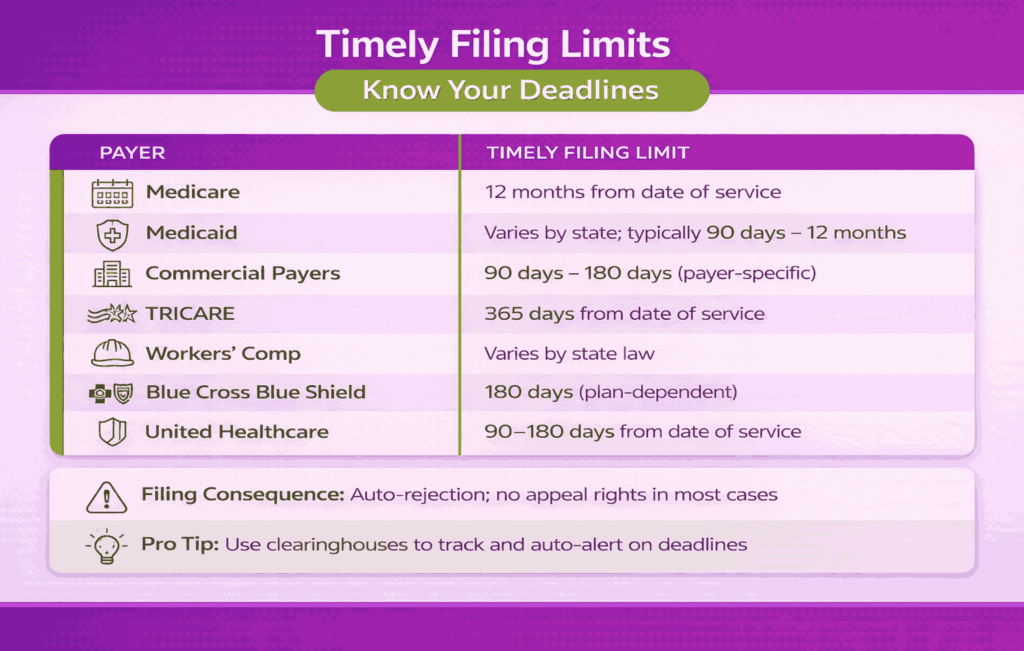
Medical bill reimbursement deadlines refer to the maximum time period within which healthcare providers must submit claims to insurance companies or government payers in order to receive payment for services rendered. These deadlines are also known as “timely filing limits.”
Most insurance companies and government health programs set specific submission windows, which typically range from 90 days to 1 year from the date of service, depending on the payer and plan type. Some government programs may allow longer or shorter periods based on policy guidelines.
Missing these deadlines can result in automatic claim rejection, meaning the provider loses the right to be reimbursed for those services, even if the claim is otherwise valid.
To avoid this, providers must ensure proper documentation, coding accuracy, and timely claim submission, often using electronic billing systems and clearinghouses to track and submit claims before the cutoff date.