AdvancedMD and Epic Systems Corporation serve different halves of the outpatient market. AdvancedMD runs independent practices between 2 and 50 providers. Epic Systems Corporation, the Verona, Wisconsin vendor behind 43.7% of United States acute care hospitals, reaches independent groups only through two specific programs.
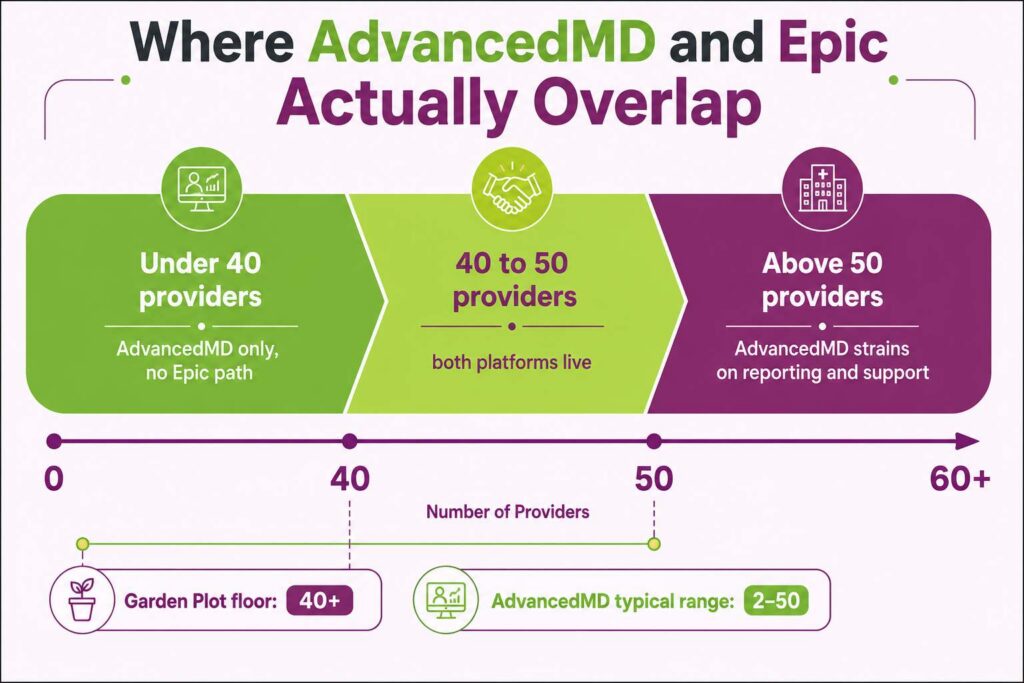
The comparison becomes real inside a narrow band. Below 40 providers, Epic remains out of reach without a hospital sponsor. Above 50, AdvancedMD strains on reporting and support.

This guide covers practice size, pricing structure, and billing mechanics across both platforms, then covers what a migration does to collections.
What Is AdvancedMD?
AdvancedMD is a cloud-based practice management and EHR platform built for independent outpatient practices in the United States. The platform runs on AWS with no on-premise hardware. AdvancedMD combines practice management, clinical documentation, patient engagement, and payments under one login.
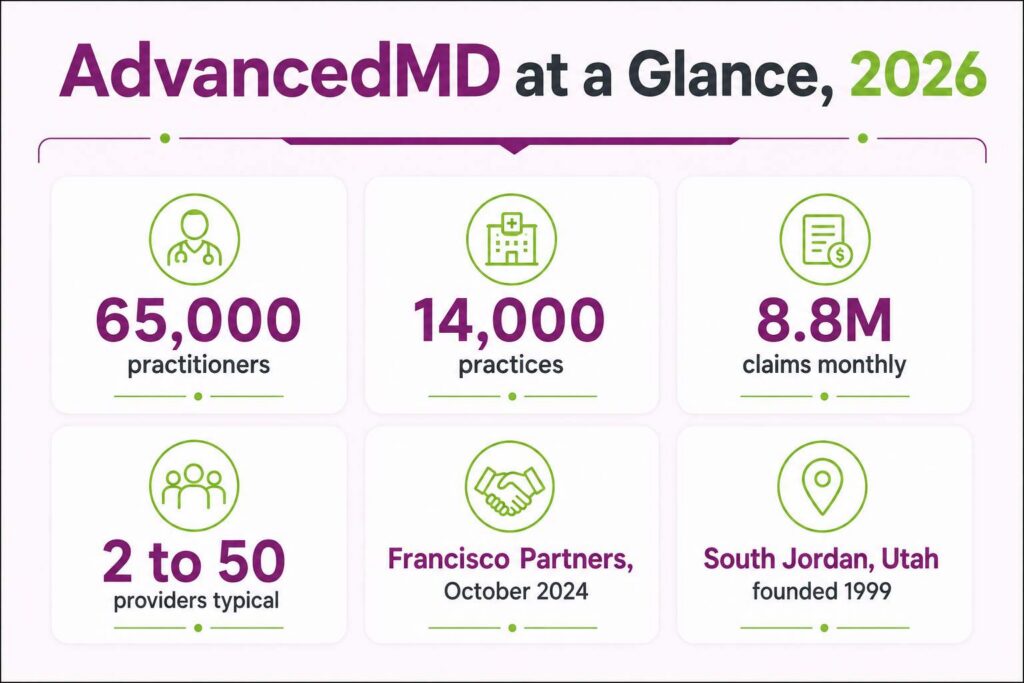
According to AdvancedMD, the platform serves 65,000 practitioners across 14,000 practices and 900 independent billing companies. Those practices process 8.8 million insurance claims each month.
Who Owns AdvancedMD?
Francisco Partners owns AdvancedMD. The firm acquired the company from Global Payments for $1.125 billion in a deal announced on 30 October 2024. Amanda Sharp serves as chief executive officer.
AdvancedMD has changed hands five times since 2008. Francisco Partners held the company from 2008 to 2011, followed by ADP, Marlin Equity Partners, and Global Payments. AdvancedMD started as Perfect Practice. AdvancedMD started in 1999 and operates from South Jordan, Utah.
Is AdvancedMD Still Owned by ADP?
No, ADP sold AdvancedMD to Marlin Equity Partners, which sold to Global Payments in 2018. Francisco Partners has owned AdvancedMD since October 2024. Several published software directories still list ADP or Global Payments as the current owner.
Which Practice Types Run on AdvancedMD?
AdvancedMD supports six organizational structures across independent outpatient care:
- Solo practitioners and single-physician clinics
- Small to mid-sized group practices between 2 and 50 providers
- Management Services Organizations and Independent Physician Associations
- Accountable Care Organizations
- Medical billing companies using the Central Billing Office model
- Practices moving from in-house to outsourced billing without an EHR change
The platform ships templates for more than 20 specialties, including cardiology, neurology, behavioral health, OB/GYN, podiatry, and physical therapy. AdvancedMD holds ONC and Drummond certification.
What Practice Size Does AdvancedMD Serve?
AdvancedMD serves 2 to 50 providers as its typical deployment range. The platform handles solo practices at the low end and multi-location specialty groups at the high end.
Practice size drives the Epic question more than any feature gap. A 12-provider group does not evaluate Epic, because no Epic path exists at that size. A 45-provider group receives Community Connect offers from local health systems.
How Does AdvancedMD Scale Across Multiple Locations?
AdvancedMD scales through Multi-location Management and the Central Billing Office module. Central Billing Office consolidates billing across providers and sites into one back-office view.
More than 900 billing companies operate multiple client databases through Central Billing Office single sign-on. Multi-site groups use the same mechanism internally, working every location from one login rather than separate instances.
Where Does AdvancedMD Reach Its Ceiling?
AdvancedMD reaches its ceiling on reporting granularity and support responsiveness, not on feature coverage. Standard reports lack payer-level detail for contract analysis. Provider-level KPIs require workarounds.
Standard accounts receive no dedicated account manager. Larger groups compensate by pulling raw data through ODBC or the Data Warehouse option, both of which require SQL skills most billing teams lack in-house.
Can a 60-Provider Group Run on AdvancedMD?
Partially, AdvancedMD supports 60 providers technically through Multi-location Management and Central Billing Office. Reporting depth and support response become the binding constraints at that scale. Groups above 50 providers typically supplement AdvancedMD reporting with external analysis tools.
How Does AdvancedMD Pricing Work?
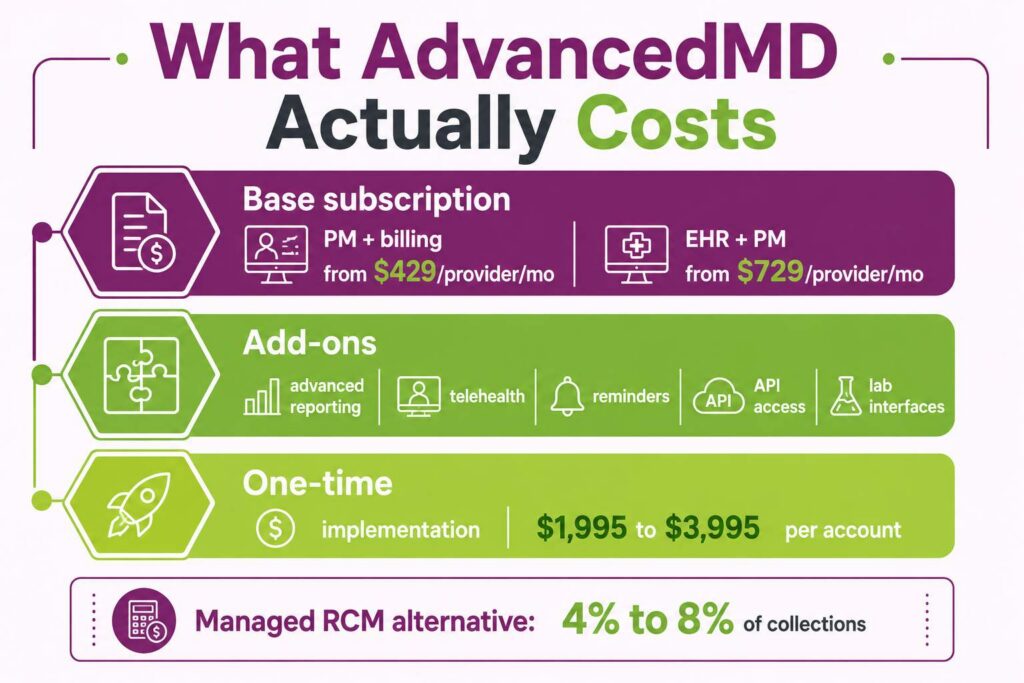
AdvancedMD publishes pricing on a modular, per-provider, per-month subscription model. Practice management with billing software starts at $429 per provider per month. EHR plus practice management starts at $729. AdvancedMD Now, a month-to-month tier for mental health practices, runs $130 per provider.
The AdvancedMD managed RCM service costs 4% to 8% of monthly collections and includes the full software suite.
What Sits Outside the Base Subscription?
Several capabilities buyers assume are standard carry separate line items. Add-ons include advanced reporting, appointment reminders, telehealth, patient engagement, API access, and lab interfaces. Electronic faxing bills per transmission.
Implementation and training fees have historically run $1,995 to $3,995 per account. A three-physician practice with four support staff faces $20,000 to $65,000 in first-year implementation cost. Feature audits usually happen after go-live, which produces budget surprises at first renewal, so a module-by-module breakdown of AdvancedMD features is worth running before signing.
Does AdvancedMD Publish Pricing?
Yes, AdvancedMD lists tier pricing publicly and quotes module costs during the sales process. Buyers still confirm line items against a specific quote, because packaging changes by contract and practice size. This transparency marks the clearest commercial difference between AdvancedMD and Epic.
How Does Billing Work in AdvancedMD?
AdvancedMD billing runs inside the Practice Management module, which connects charge capture, scrubbing, submission, posting, and collections in one database. Charges generate from finalized clinical notes rather than through separate charge entry.
Six modules carry the revenue cycle: Claims Management, eEligibility, Electronic Remittance Advice, A/R Control Center, Central Billing Office, and Period Close Automation. Stage-level detail sits in our AdvancedMD billing workflow.
How Does ClaimInspector Screen Claims Before Submission?
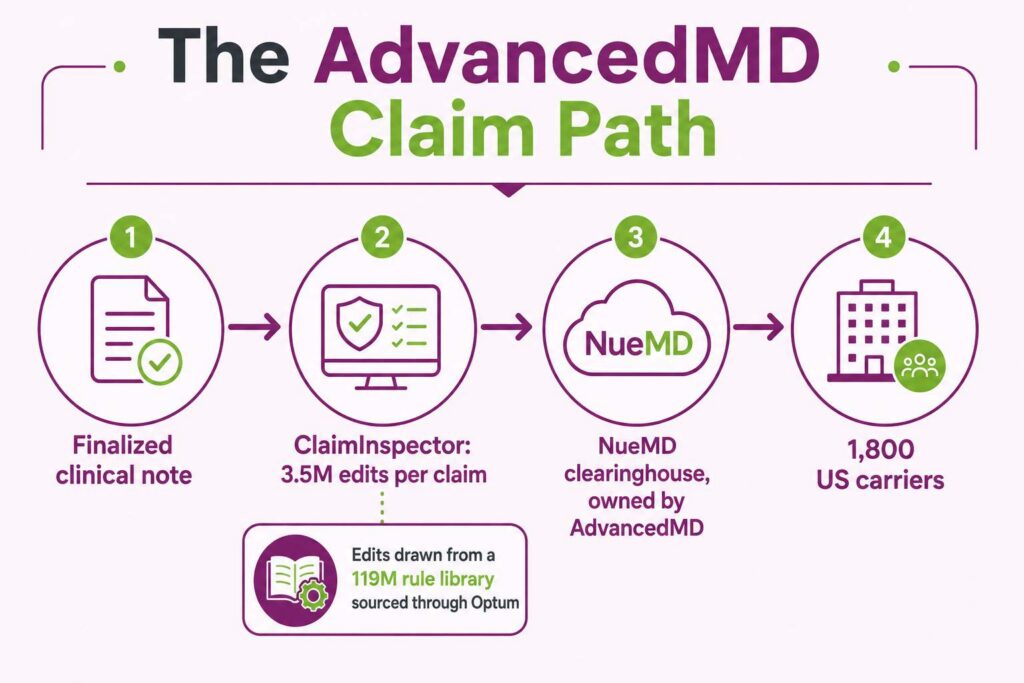
ClaimInspector applies approximately 3.5 million edits to each claim before submission. Those edits draw from a knowledge base of 119 million government and third-party rules that AdvancedMD sources through Optum.
Published reviews frequently conflate the two figures. The 119 million number describes the total rule library. The 3.5 million number describes edits applied per claim. Each edit is individually controlled, so generic rule sets release payer-specific denials into the clearinghouse.
Why Does AdvancedMD Own Its Clearinghouse?
AdvancedMD owns a proprietary clearinghouse acquired from NueMD in 2018, connected directly to 1,800 United States carriers. Rejection feedback returns into Practice Management in near real time.
Clearinghouse ownership separates AdvancedMD from most platforms in the independent practice segment. Epic routes claims through third parties including Waystar, Change Healthcare, Trizetto, and Availity. One vendor controls the AdvancedMD path end to end. Two or more vendors control the Epic path.
How Does AdvancedMD Route Denials and Aging?
AdvancedMD routes denials through intelligent queues with root cause categorization. Workflow triggers separate missing-information denials from medical necessity denials. Payer-specific appeal templates auto-populate patient and claim data.
The A/R Control Center organizes aging by payer, provider, and location. Billing teams work aging buckets rather than individual claim lists. Period Close Automation handles month-end reconciliation.
Does AdvancedMD Include Coding Support?
No, AdvancedMD supplies coding tools, specialty templates, and CCI edits, but assigns no coders. Practices staff coding in-house, buy the AdvancedMD RCM service, or contract a third-party billing company. Template depth varies by specialty, and thin templates produce coding gaps that surface later as denials.
What Is Epic Systems Corporation?
Epic Systems Corporation is a privately held enterprise EHR vendor headquartered in Verona, Wisconsin. Also, Epic serves health systems, hospitals, multi-specialty groups, federally qualified health centers, and academic medical centers.
Epic builds clinical, revenue cycle, and patient engagement software on a single database called Chronicles. Resolute handles revenue cycle. MyChart handles patient access. Care Everywhere handles record exchange between organizations.
How Large Is Epic’s Market Position in 2026?
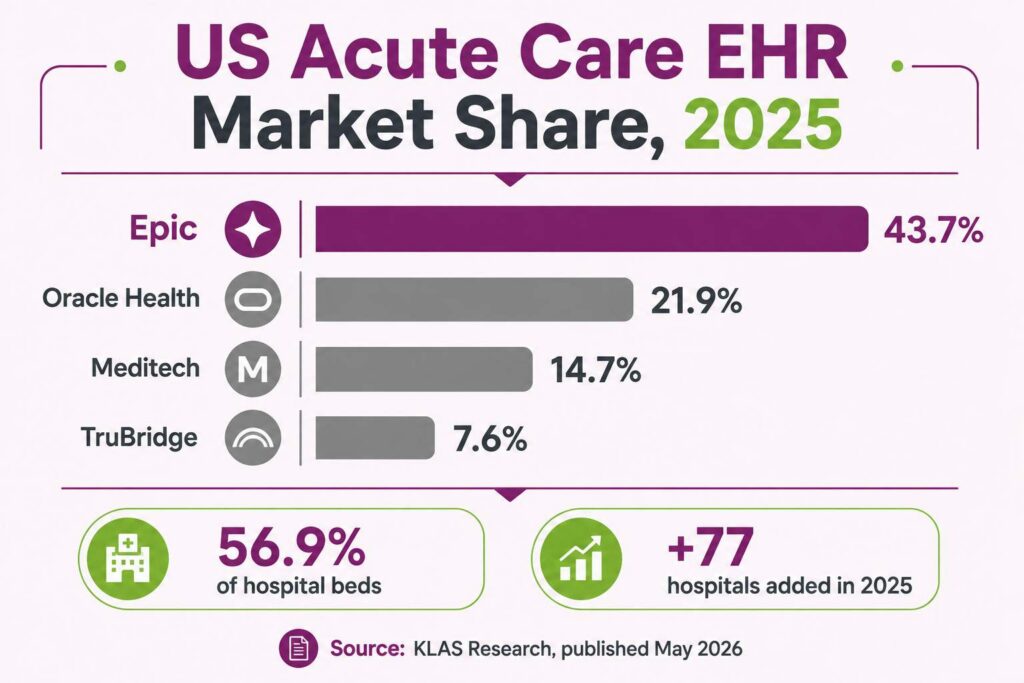
Epic Systems Corporation held 43.7% of United States acute care hospitals and 56.9% of hospital beds during 2025, according to KLAS Research data published in May 2026.
Epic added 77 hospitals and 18,679 beds in 2025, and gained a net 568 hospitals between 2021 and 2025. Oracle Health placed second at 21.9% of hospitals, followed by Meditech at 14.7%. Two large health systems made enterprise-wide EHR decisions in 2025, and both selected Epic.
Which Organizations Run on Epic?
Epic runs across five organization types: multi-hospital health systems, standalone community hospitals, academic medical centers, federally qualified health centers, and large multi-specialty physician groups.
Independent practices reach Epic through Community Connect or Garden Plot rather than direct enterprise deployment. Both programs carry eligibility conditions covered in the next section.
Did Epic’s Market Share Change in 2025?
Yes, Epic acute care market share rose from 42.3% in 2024 to 43.7% in 2025. Epic was the only vendor selected in decisions involving more than three multispecialty hospitals. Oracle Health recorded its third consecutive year of net losses, shedding 56 hospitals and 14,676 beds.
What Practice Size Does Epic Serve?
Epic serves organizations from large physician groups upward, with two dedicated programs extending access below enterprise scale. Community Connect operates through a host health system. Garden Plot operates directly with Epic and requires more than 40 providers.
Neither program removes the size floor. Both establish one.
What Is Epic Community Connect?
Community Connect is a program where a host health system extends its existing Epic instance to a smaller partner organization. Epic launched the program in 2007. Approximately 40,000 providers access Epic through Community Connect.
The host system manages infrastructure, configuration, and support. The partner practice operates inside the host’s Epic environment and shares a patient record with the host’s hospitals. Epic recommends Community Connect over Garden Plot for independent groups, specifically because the shared record improves continuity with local hospitals.
What Is Epic Garden Plot?
Garden Plot is Epic’s hosted software-as-a-service deployment for independent medical groups with more than 40 providers. Epic manages hosting, support, configuration, and update rollout directly.
Garden Plot requires no host health system. Practices work with Epic rather than through a hospital intermediary. Configuration flexibility sits between Community Connect and a dedicated enterprise deployment. Epic positions Garden Plot as the path when Community Connect is unavailable, not as the default.
How Do Community Connect and Garden Plot Differ?
The table below compares the three Epic deployment paths against AdvancedMD across five decision factors:
| Factor | AdvancedMD | Community Connect | Garden Plot | Enterprise Epic |
|---|---|---|---|---|
| Sponsor required | None | Host health system | None | None |
| Provider floor | None | Set by host | More than 40 | Enterprise scale |
| Configuration control | Practice | Host system | Epic, limited practice input | Practice |
| Update management | AdvancedMD | Host system | Epic | Internal IT team |
| Billing module | Practice Management | Host’s Resolute | Resolute | Resolute PB, HB, SBO |
Configuration control separates the two Epic programs most sharply. Community Connect places platform decisions with a hospital. Garden Plot places them with Epic.
Is Epic Available to Independent Practices?
Yes, Independent practices access Epic through Community Connect or Garden Plot. Community Connect carries no published provider minimum but depends on a willing host system. Garden Plot requires more than 40 providers. Practices below both thresholds have no Epic path.
Does Community Connect Create a Conflict With a Competing Health System?
Yes, the sponsoring health system controls configuration, support, and platform direction for the connected practice. That system frequently competes for the same patients in the same market. Physician-owned groups weigh this governance exposure against the referral and interoperability gains. Garden Plot exists partly to resolve this conflict.
How Does Epic Pricing Work?
Epic prices through negotiated contracts with no published list rates. Cost varies by organization size, module selection, hosting model, training scope, and integration count.
Why Does Epic Not Publish List Pricing?
Epic does not publish pricing because every deployment is scoped individually. Module selection, provider count, hosting model, and interface count all move the total. No standard configuration exists to price.
Dollar ranges circulating in software directories carry no vendor attribution. Those figures come from third-party estimates rather than from Epic. Practices comparing total cost of ownership obtain a scoped quote rather than working from published ranges.
What Drives Epic Implementation Cost?
Epic implementation cost tracks five variables: physician licensing count, module scope, hosting model, integration volume, and customization depth.
Customization depth carries the longest tail. Every custom build requires maintenance through each upgrade cycle. Organizations that over-customize in year one absorb that cost on every subsequent Epic release. Sticking to standard workflows during the first year keeps both implementation and maintenance cost down.
Can a Practice Get an Epic Quote Without a Sales Process?
No, Epic scopes pricing through a discovery and sales process covering provider count, specialties, modules, and hosting. Community Connect pricing runs through the host health system rather than through Epic. Practices comparing platforms budget several weeks for the quote cycle alone.
How Does Billing Work in Epic Resolute?
Epic billing runs through Resolute, the revenue cycle module sitting inside the same Chronicles database as the clinical record. Clinical actions feed charges directly into Resolute with no interface between systems.
Resolute divides into three components rather than operating as one module. Full architecture and KPI benchmarks sit in the Resolute architecture and billing guide.
How Do Resolute PB, HB, and SBO Divide Billing Work?
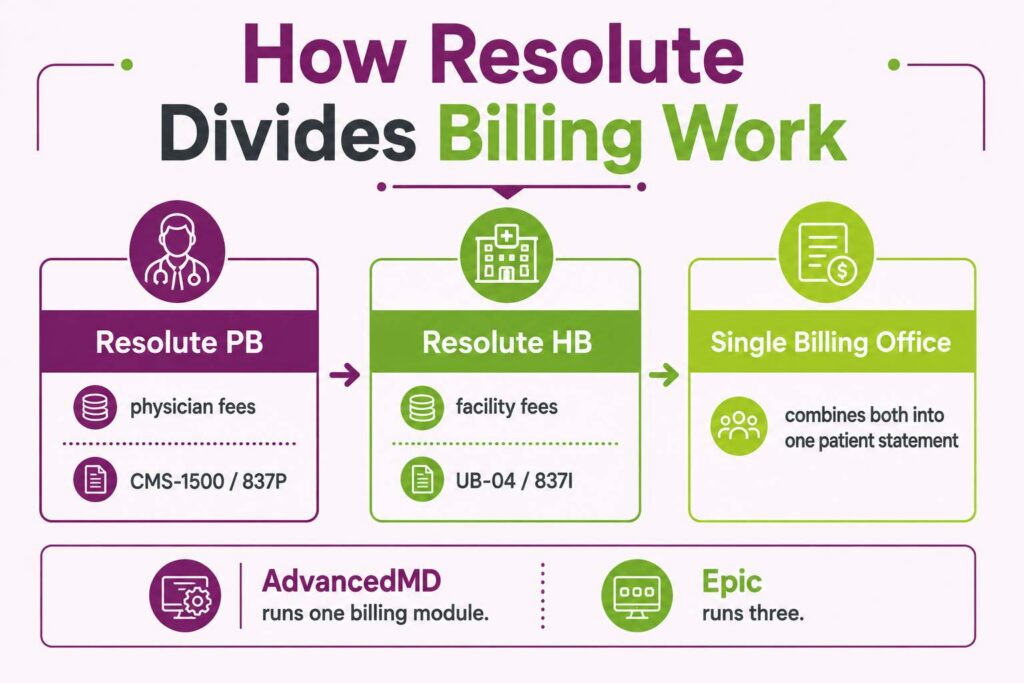
Resolute splits into Professional Billing, Hospital Billing, and the Single Billing Office. As for Resolute Professional Billing, it processes physician claims on the CMS-1500 and 837P format. Resolute Hospital Billing processes facility claims on the UB-04 and 837I format. Single Billing Office unifies patient statements across both.
This three-way split is the structural difference from AdvancedMD. AdvancedMD runs one billing module with one account structure. Epic runs separate modules with separate account structures and separate analyst certification tracks. Groups moving from AdvancedMD inherit that complexity along with the capability.
How Does the Charge Router Screen Claims?
The Charge Router validates every charge against rule libraries before submission. Rule categories cover NCCI procedure pairs, medically unlikely edits, Local and National Coverage Determinations, payer modifier rules, bundling logic, place-of-service validation, and diagnosis-to-procedure linkage.
Certified Resolute analysts build and maintain those libraries. Payer policy changes require constant updates. A stale rule library raises denial rates within 30 days.
How Do Epic Work Queues Route Denials?
Epic routes denials into work queues sorted by denial reason code, payer, and dollar threshold. Prioritization logic escalates high-dollar denials to AR specialists.
The operating model differs from AdvancedMD. AdvancedMD organizes AR by aging bucket across payer, provider, and location. Epic organizes work by queue assignment tied to staff role. Billing teams moving between the two platforms relearn where work lives, not just how the screens look.
Does Epic Resolute Replace a Billing Team?
No, Resolute routes work to staff rather than performing it. Every work queue requires a trained biller. Resolute-certified analysts maintain the rule libraries. Certification training runs 4 to 6 weeks plus a project phase, and hiring a certified analyst takes 6 to 12 months in tight markets.
Where Do AdvancedMD and Epic Overlap, and Where Do They Diverge?
AdvancedMD and Epic overlap on core revenue cycle capability and diverge on scale, governance, and network access. Both platforms capture charges from clinical documentation, scrub claims before submission, post remittances automatically, and route denials into work lists.
The divergence sits in what surrounds the billing engine.
What Do Both Platforms Do Equally Well?
Both platforms deliver five identical revenue cycle functions: eligibility verification, documentation-driven charge capture, pre-submission claim scrubbing, electronic remittance posting, and denial queue routing.
AdvancedMD and Epic, both hold ONC certification. Both support specialty templates, patient portals, and reporting layers. A practice running either platform competently reaches comparable clean claim rates. Configuration quality separates outcomes more than platform choice does, a pattern visible across the EHR platform guides covering each system individually.
How Does Claim Scrubbing Differ Between ClaimInspector and the Charge Router?
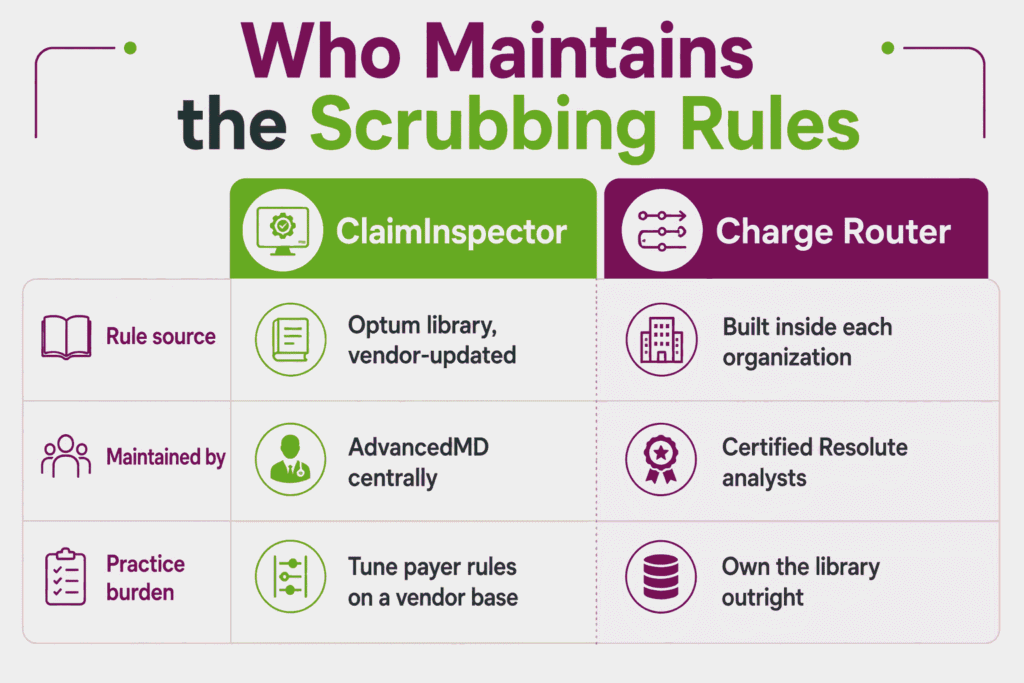
ClaimInspector and the Charge Router perform the same function through different maintenance models. ClaimInspector draws edits from an Optum-sourced library that AdvancedMD updates centrally. The Charge Router draws from rule libraries that certified analysts build and maintain inside each Epic organization.
That difference decides who carries the maintenance burden. AdvancedMD practices tune payer-specific rules on top of a vendor-maintained base. Epic organizations own the rule library outright and staff the expertise to keep it current. Neither model prevents denials without configuration work against real payer mix.
How Does Interoperability Differ Between the Two Platforms?
Epic delivers interoperability through Care Everywhere, a network that exchanges records across every Epic organization plus external partners. AdvancedMD delivers interoperability through HL7 and FHIR endpoints, health information exchange links, and an open API layer.
The functional gap is network membership rather than technical capability. AdvancedMD connects to organizations a practice integrates with individually. Epic connects a practice to every Epic site by default. In markets where the dominant health system runs Epic, that default matters more than any API specification.
Do Referral Relationships Drive the Platform Decision?
Yes, Groups move to Epic to stop referral leakage to health-system-affiliated competitors and to qualify for value-based contracts, not because Epic documents care better.
Practices outside the local Epic network lose referral volume to practices inside it. Shared records reduce friction for referring physicians. Value-based contracts frequently require data exchange that fragmented systems cannot support. These pressures build as a group grows and its referral base concentrates around one health system.
At What Practice Size Does the Comparison Become Real?
The comparison becomes real between 40 and 50 providers. Garden Plot requires more than 40 providers. AdvancedMD runs comfortably to 50. Inside that 10-provider band, both platforms are live options.
The table below maps the platform decision across four practice profiles:
| Practice Profile | Likely Platform | Deployment Path | Primary Billing Risk |
|---|---|---|---|
| Under 40 providers, independent | AdvancedMD | Direct subscription | Under-configured ClaimInspector rules |
| 40 to 50 providers, independent | Contested | Garden Plot or AdvancedMD | Migration AR loss if the group moves |
| Any size, health-system affiliated | Epic | Community Connect | Host controls configuration and roadmap |
| Hospital-owned | Epic | Enterprise Resolute | PB and HB split complexity |
Below 40 providers the decision does not exist, because no Epic path is available. Above 50, the question shifts from whether Epic is reachable to whether the migration cost is worth the network access.
What Happens to Revenue Cycle Performance After Migrating From AdvancedMD to Epic?
Collections drop during an Epic go-live before recovering. The decline traces to four operational causes: charge lag, coding throughput loss, unfamiliar work queue routing, and payer enrollment gaps.
Epic billing benchmarks set the recovery target: clean claim rate above 95%, days in accounts receivable below 35, denial rate below 5%, and charge lag below 3 days. Migrating practices measure against those numbers rather than against pre-migration performance.
Why Do Collections Drop After an Epic Go-Live?
Collections drop because charge velocity falls faster than claim volume. Providers documenting in an unfamiliar system close encounters more slowly. Open encounters block charge release. Coding queries pause charges until resolved.
Billing staff relearn where work sits. AdvancedMD aging buckets become Epic work queues with different prioritization logic. Throughput recovers as staff build queue familiarity, but the gap between charge date and submission date widens first.
What Does Not Migrate Cleanly?
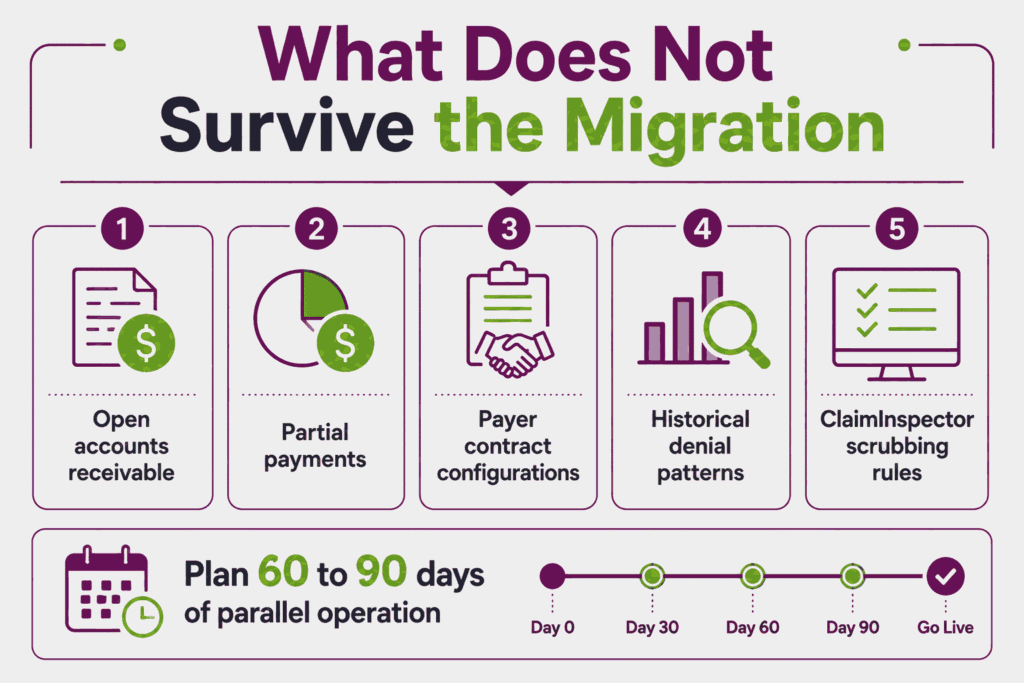
Five categories resist clean migration: open accounts receivable, partial payments, payer contract configurations, historical denial patterns, and ClaimInspector scrubbing rules.
Scrubbing rules do not transfer at all. ClaimInspector logic and Charge Router logic use different architectures, so every payer-specific edit gets rebuilt from scratch inside Epic. Practices that spent years tuning ClaimInspector against their payer mix start that work over.
How Do Practices Protect AR Through a Platform Change?
Practices protect AR by running legacy accounts receivable to closure in the old system rather than migrating balances. Plan for 60 to 90 days of parallel operation when switching platforms. Those legacy claims still need working through that window, and AdvancedMD claims and AR management continues inside Practice Management until the balances close.
Three additional controls limit exposure:
- Freeze customization scope during year one to reduce build and maintenance load
- Complete payer enrollment and credentialing before go-live, not during
- Staff or contract Resolute-certified coverage ahead of the transition, given the 6 to 12 month hiring timeline
How Does Transcure Support Billing on AdvancedMD and Epic?
Certified billers work inside the platform a practice already runs, under a signed business associate agreement per 45 CFR §164.502(e). No EHR change is required, and no data leaves the practice’s system.
Scrubbing configuration follows the platform. Default ClaimInspector rules get rebuilt against actual payer mix inside AdvancedMD. Resolute editing rules get rebuilt inside the Charge Router for Epic organizations. Both platforms release preventable denials when running generic rule sets, and both respond to the same correction.
Denial and AR work follows the same split. AAPC-certified billers work aging buckets in AdvancedMD Practice Management and work queues in Resolute, identifying root causes by CARC and RARC code in both. Coverage spans 40-plus specialties across 1,100 certified coders, with certified billers inside the system within 14 days. Resolute billing support covers PB, HB, and Single Billing Office configurations.
During a platform migration, legacy accounts receivable stays worked in the outgoing system while new claims process in the incoming one. That separation is what keeps the go-live dip from becoming permanent write-off.
Should a Practice Change EHR and Billing Vendor in the Same Quarter?
No, changing both at once removes the baseline needed to diagnose what went wrong. Collections drop during any Epic go-live. A simultaneous billing vendor change makes the cause unattributable between platform unfamiliarity and service quality.
Practices separate the two changes by at least two quarters. Stabilize billing performance on the existing platform first, then migrate. Reversing that order leaves no clean comparison point when denial rates move.
Frequently Asked Questions About AdvancedMD and Epic
Is AdvancedMD or Epic Better for a 30-Provider Practice?
AdvancedMD as Epic Garden Plot requires more than 40 providers, and Community Connect depends on a willing host health system. A 30-provider independent group has no direct Epic path.
Can a Practice Run Epic without a Hospital Affiliation?
Yes, through Epic Garden Plot, which requires more than 40 providers and no host system. Epic manages hosting, support, and updates directly under a software-as-a-service model.
How Much Does Epic Cost Compared to AdvancedMD?
AdvancedMD publishes tier pricing starting at $429 per provider per month. Epic does not publish list pricing and scopes each contract individually. Direct cost comparison requires a scoped Epic quote.
Does AdvancedMD Integrate with Epic?
AdvancedMD exchanges data with Epic organizations through HL7 and FHIR endpoints and health information exchange connections. AdvancedMD does not join the Care Everywhere network, which operates between Epic organizations.
What Is the Difference Between Epic Community Connect and Garden Plot?
Community Connect extends a host health system’s Epic instance to a partner practice, with the host controlling configuration. Garden Plot is hosted by Epic directly, requires more than 40 providers, and needs no host system.
How Long Does an AdvancedMD to Epic Migration Take?
Plan for 60 to 90 days of parallel operation between systems. Full Epic implementation timelines depend on module scope, provider count, and customization depth, and run considerably longer than the data overlap period.
Which Platform has Better Claim Scrubbing?
Neither scrubs better by default. ClaimInspector applies 3.5 million edits per claim from a centrally maintained Optum library. The Charge Router applies rule libraries each Epic organization maintains internally. Configuration quality determines outcomes on both.