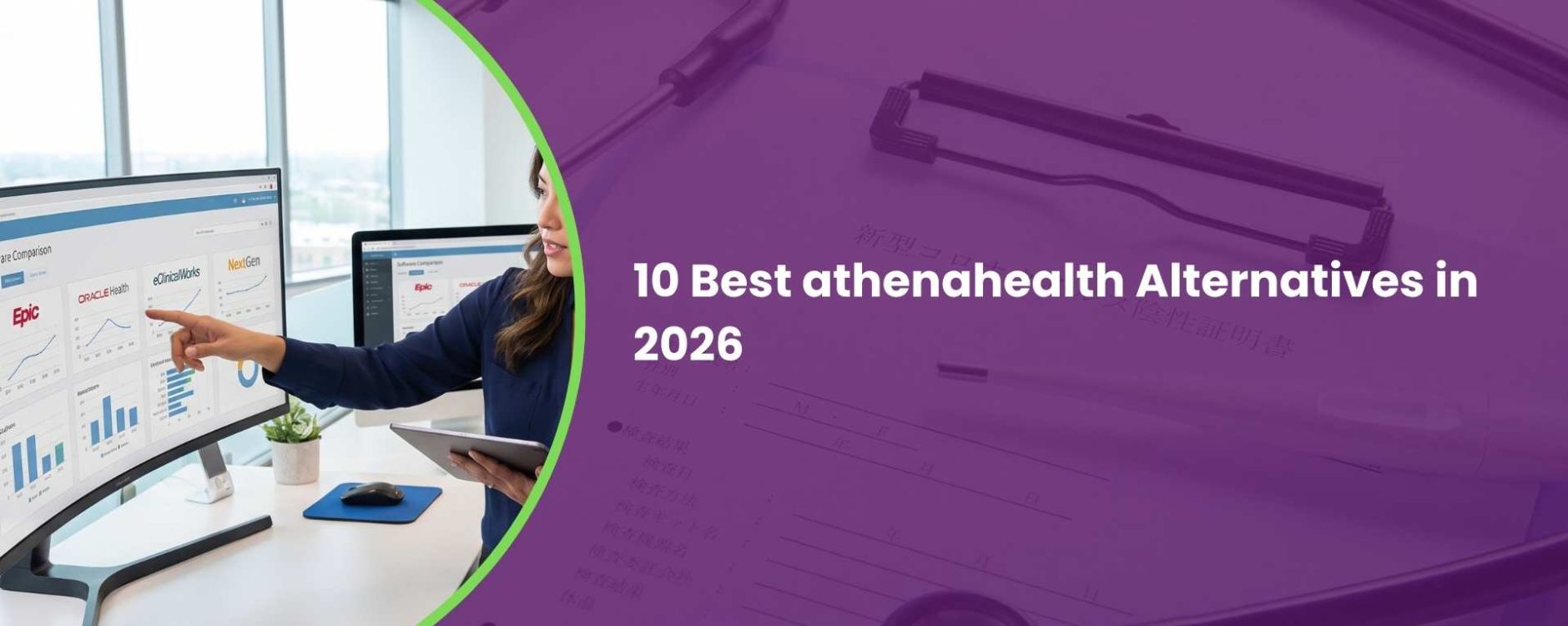
Summary: “The best athenahealth alternatives include Epic and Oracle Health for large hospitals, eClinicalWorks and NextGen Healthcare for multi-specialty ambulatory groups, and Tebra, PrognoCIS, and Practice Fusion for small practices. Each offers a different pricing model and specialty depth than athenahealth’s percentage-of-collections structure.”
athenahealth remains one of the most widely used cloud-based EHR platforms in the U.S., but its percentage-of-collections pricing model and managed-network approach doesn’t fit every practice. Some organizations outgrow its ambulatory-first design; others want more control over their billing staff, or a lower-cost system with fewer bundled services they don’t use.
Whether you’re a hospital system evaluating enterprise platforms or a solo practitioner looking for a lighter, more affordable EHR, this guide compares the top athenahealth alternatives on price, specialty fit, and best-use case. If you’re planning a switch, it’s also worth thinking ahead about EMR billing services support so your revenue cycle doesn’t stall during the transition.

Here’s a quick side-by-side look at all 10 alternatives before the detailed breakdowns below.
| EMR/EHR | Best For | Pricing |
|---|---|---|
| Epic | Large hospitals, health systems, academic medical centers (200+ beds) | Custom quote |
| Oracle Health (Cerner) | Mid-size to large hospitals, government/VA health systems | Custom quote |
| eClinicalWorks | Multi-specialty ambulatory practices, small to large | $499/provider/month — EHR only. $599/provider/month — EHR + Practice Management. RCM as a Service: 2.9% of practice collections. |
| NextGen Healthcare | Multi-specialty groups managing value-based care metrics | Custom quote |
| Allscripts/Veradigm | Ambulatory practices needing structured documentation | Custom quote |
| AdvancedMD | Independent and mid-sized practices wanting EHR + billing | $429–$1,070/provider/month for medical specialties, depending on configuration. Mental health starts at $130/provider/month. RCM: 4–8% of collections. |
| CareCloud | Practices wanting EHR, PM, and billing under one vendor | Custom quote |
| Tebra (formerly Kareo) | Independent and small private practices | $49–$799/provider/month, depending on product/provider type/volume. Full bundles: Physician $599–$799/month; non-physician $399–$449/month; therapist $225–$299/month. |
| PrognoCIS | Small to mid-sized multi-specialty practices | Custom quote |
| Practice Fusion | Solo practitioners and small primary care practices | Starting at $199/provider/month, with a required annual commitment. |

Epic is the dominant EHR for large hospitals and health systems, commanding roughly 41% of the U.S. acute-care hospital market. It offers deep interoperability through its Care Everywhere network, comprehensive specialty modules, and enterprise-grade analytics.
Unlike athenahealth’s managed, subscription-style model, Epic is built for organizations with dedicated IT teams and multi-year implementation timelines. Its scale suits 200+ bed hospitals and academic medical centers rather than independent practices. Ambient documentation tools and its Penny RCM assistant are increasingly embedded across hundreds of live health systems today.
Key Highlights
- 41%+ U.S. acute-care hospital market share
- Care Everywhere interoperability network
- Ambient AI documentation (Nuance DAX, Abridge)
- Penny AI assistant for RCM
2. Oracle Health (Cerner)

Oracle Health, formerly Cerner, holds roughly 22% of the U.S. hospital EHR market and remains a leading choice for mid-size to large hospitals and government health systems, including the VA. Since Oracle’s acquisition, the platform has moved toward cloud infrastructure and introduced the Oracle Health Clinical AI Agent to cut documentation time.
It’s praised for interoperability, scalability, and reporting depth, though some users find the interface complex compared to athenahealth’s more streamlined ambulatory design. Oracle Health suits organizations needing enterprise-grade data management without Epic’s price tag.
Key Highlights
- 22% U.S. hospital EHR market share
- Oracle Health Clinical AI Agent
- Strong interoperability and reporting depth
- VA and government health system adoption
3. eClinicalWorks

eClinicalWorks is a cloud-based EHR and practice management platform supporting 40+ specialties, making it one of the most direct athenahealth alternatives for multi-specialty ambulatory practices. It bundles its Sunoh.ai ambient scribe and healow Genie patient engagement tools directly into the platform, reducing the need for third-party add-ons.
Practices moving off athenahealth often cite eClinicalWorks’ lower total cost and broader specialty template library. Its clearinghouse and billing modules integrate directly with revenue cycle workflows, though some users report a steeper learning curve than athenahealth’s guided setup.
Key Highlights
- 40+ specialty templates
- Sunoh.ai ambient scribe built in
- healow Genie patient engagement
- Integrated clearinghouse
4. NextGen Healthcare

NextGen Healthcare targets multi-specialty ambulatory practices with a subscription-based EHR and practice management suite. It offers configurable specialty content, population health tools, and value-based care reporting that appeal to groups managing MIPS and quality metrics.
Compared to athenahealth’s percentage-of-collections pricing, NextGen’s flat subscription model gives practices more predictable costs as revenue grows. The platform integrates with NextGen’s own RCM services or third-party billing partners, and its Mirth interoperability engine supports HL7/FHIR data exchange for practices coordinating care across systems.
Key Highlights
- Configurable specialty content
- Population health & MIPS reporting tools
- Mirth interoperability engine (HL7/FHIR)
- Flat subscription pricing
5. Allscripts/Veradigm

Allscripts, now largely operating under the Veradigm brand, provides EHR and practice management tools with strengths in discharge planning, documentation integrity, and quality reporting. It’s used across ambulatory practices and hospital-affiliated clinics that need structured clinical workflows without Epic-level complexity.
Veradigm’s acquisition history means practices sometimes inherit a patchwork of modules, so implementation scope varies more than with newer, single-platform competitors. For practices leaving athenahealth for stronger clinical documentation controls and payer network integrations, Veradigm is a common ambulatory-to-mid-size alternative worth evaluating.
Key Highlights
- Strong discharge planning & documentation integrity tools
- Quality and value-based care reporting
- Established payer network integrations
- Broad specialty coverage
6. AdvancedMD

AdvancedMD combines cloud-based EHR, practice management, and billing under one vendor, targeting independent and mid-sized practices that want a single system rather than stitching together separate tools. Founded in 1999, it offers specialty-specific workflows, patient engagement tools, and real-time A/R dashboards.
Compared to athenahealth’s managed-service model, AdvancedMD gives practices more direct control over billing staff and workflows while still offering optional outsourced RCM. Its AdvancedInsight analytics and telemedicine suite round out a platform built for practices that want EHR and billing under a single roof.
Key Highlights
- EHR + PM + billing in one platform
- AdvancedInsight analytics dashboards
- Built-in telemedicine suite
- Founded 1999, established track record
7. CareCloud

CareCloud delivers an all-in-one cloud platform combining EHR, practice management, and outsourced billing across 70+ specialties. Its cirrusAI Notes automates clinical documentation, reportedly saving providers close to 20% of daily charting time, while an AI-powered billing engine flags claim errors before submission.
Practices switching from athenahealth often choose CareCloud to consolidate billing, EHR, and PM under a single vendor rather than managing separate systems. CareCloud’s interoperability layer (CareCloud Connector) supports data exchange with other systems for practices with existing referral networks.
Key Highlights
- cirrusAI Notes (AI documentation)
- AI-powered claim scrubbing
- 70+ specialties supported
- CareCloud Connector interoperability
8. Tebra (formerly Kareo)

Tebra, formed from the Kareo and PatientPop merger, is built specifically for independent private practices that want EHR, billing, scheduling, and patient engagement in one system. Its AI Note Assist generates clinical notes from voice or text, and its integrated reputation management tools help smaller practices attract patients, something athenahealth doesn’t directly offer.
Pricing tiers range broadly depending on claim volume and feature set, with a lower-volume plan for practices processing under 100 claims a month. Tebra suits solo and small group practices prioritizing an all-in-one, practice-growth-focused platform.
Key Highlights
- AI Note Assist for clinical documentation
- Built-in reputation management & marketing tools
- Low-volume plan for smaller claim counts
- All-in-one EHR + billing + scheduling
9. PrognoCIS

PrognoCIS is a customizable, cloud-based EHR and practice management platform aimed at practices across multiple specialties who find enterprise systems like Epic or Cerner overly complex. Its PrognoAI features assist with real-time documentation and patient history summaries, and built-in revenue cycle tools include prior authorization tracking.
Pricing starts lower than several enterprise-focused competitors, making it accessible for small to mid-sized practices. Compared to athenahealth, PrognoCIS gives practices more template customization control, though its RCM services, when used, are billed as a percentage of collections rather than a flat subscription.
Key Highlights
- PrognoAI real-time documentation assist
- Customizable specialty templates
- Integrated telemedicine & patient portal
- Prior authorization tracking built in
10. Practice Fusion

Practice Fusion is a budget-focused, cloud-based EHR aimed at small primary care practices that want a straightforward system without extensive IT overhead. It offers a free, ad-supported tier alongside paid plans, making it one of the more accessible athenahealth alternatives for solo practitioners and very small clinics.
The interface is simple by design, though practices needing advanced specialty templates or deep analytics may find its feature set thinner than athenahealth’s. Customer support response times are a common complaint among reviewers, worth weighing against its lower cost.
Key Highlights
- Free, ad-supported tier available
- Simple, low-overhead interface
- No-install, fully cloud-based setup
- Budget-friendly for solo/small practices
Who Handles Medical Billing When You Switch Away From athenahealth?
Choosing a new EMR is only half the decision. Whichever platform you land on, someone still has to code, submit, and follow up on claims inside it, and that’s where many practices get stuck mid-transition. Athenahealth bundles its own managed billing service into its pricing. Switching to Epic, eClinicalWorks, NextGen, or any other alternative on this list means deciding whether to build an in-house billing team around the new system or bring in a dedicated EMR billing services partner who already works inside it.
Transcure offers medical billing support across every EMR named in this list, including Epic, Oracle Health (Cerner), eClinicalWorks, NextGen, Allscripts/Veradigm, AdvancedMD, CareCloud, Tebra, PrognoCIS, and Practice Fusion, along with athenahealth billing services for practices that decide to stay put. Its billers work directly inside your existing system rather than requiring a data migration, so a practice midway through evaluating a new EMR doesn’t have to pause billing operations.
Frequently Asked Questions
What is the best athenahealth alternative for a small practice?
For small and solo practices, Tebra, PrognoCIS, and Practice Fusion are the most commonly chosen athenahealth alternatives, largely because of lower entry pricing and simpler implementation than enterprise systems like Epic or Oracle Health.
Will switching EMRs disrupt my current medical billing?
It can, if your billing team or vendor only knows your old system. Most disruption happens when claims-in-progress get stuck during the handoff. An EMR billing company partner that already supports your new EMR can prevent that gap by working inside the new system from day one.
Do I need to switch medical billing companies if I switch EMRs?
Not necessarily, but it’s worth checking first. Some billing companies are tied to a single EMR or clearinghouse and can’t follow you to a new system. Others, including Transcure, support 40+ EMR platforms, so the same billing team can continue working inside whichever system you choose.
How much does it cost to switch from athenahealth to another EMR?
Costs vary enormously by scale: a small practice moving to a subscription-based system like Tebra or PrognoCIS might spend a few thousand dollars on data migration and training. On the other hand, a hospital system moving to Epic or Oracle Health can spend well into six or seven figures on implementation alone.
Which EMR is best for large hospitals versus small practices?
Epic and Oracle Health (Cerner) dominate the large hospital and health system market due to their scale and interoperability. For small to mid-sized practices, subscription-based platforms like eClinicalWorks, AdvancedMD, CareCloud, Tebra, and PrognoCIS offer a better fit without enterprise-level implementation costs.