CareCloud EMR is a cloud-based electronic health record and practice management platform built for ambulatory medical groups. It is sold by CareCloud, Inc. (Nasdaq: CCLD), a healthcare IT company serving more than 40,000 providers.
The platform covers clinical charting, scheduling, patient engagement, and revenue cycle management in one system. CareCloud sells it two ways. You can license the software and run billing in-house, or hand the full revenue cycle to CareCloud Concierge.
Most published reviews of CareCloud still describe the product as it looked several years ago. They miss the cirrusAI suite, the current pricing structure, and the questions that matter during vendor selection.
This guide covers the full feature set, the AI tools, reported pricing, specialty fit, and security posture. It also compares CareCloud to athenahealth, AdvancedMD, and eClinicalWorks.
Key Takeaways
- CareCloud is an EHR, not just an EMR, and markets itself under both terms.
- Third-party sources report pricing between $349 and $649 per provider per month.
- CareCloud Concierge charges 3% to 7% of monthly collections instead of a per-seat fee.
- The cirrusAI suite adds ambient documentation, appeal letter drafting, and front-desk call handling.
- Live support runs Monday through Friday, which affects practices with weekend hours.
What Is CareCloud EMR?
CareCloud EMR is cloud-hosted software that stores patient charts, manages appointments, and processes medical claims. Providers access it through a browser or mobile app without local servers.
The company describes the product as an EHR. Buyers search for it as an EMR. Both terms point to the same platform.
EMR vs EHR: which label is correct
An EMR holds records inside one practice. An EHR shares data across organizations through standards-based interfaces. CareCloud supports external data exchange, so it qualifies as an EHR.
| Term | Scope | CareCloud fit |
|---|---|---|
| EMR | Single-practice digital chart | Yes, covers this baseline |
| EHR | Cross-organization record sharing | Yes, supports HL7 and FHIR exchange |
| PM | Scheduling, eligibility, billing | Yes, bundled in the same platform |
| RCM | End-to-end claims and collections | Yes, via Concierge service |
Product naming and history
CareCloud has renamed products several times, which makes older reviews confusing. The clinical module was branded CareCloud Charts. The practice management side was CareCloud Central.
- CareCloud Charts is the legacy name for the clinical documentation module.
- CareCloud Central is the legacy name for the practice management module.
- CareCloud Breeze is the patient experience and intake product.
- CareCloud Live is the HIPAA-compliant telehealth tool.
- CareCloud Concierge is the outsourced revenue cycle service.
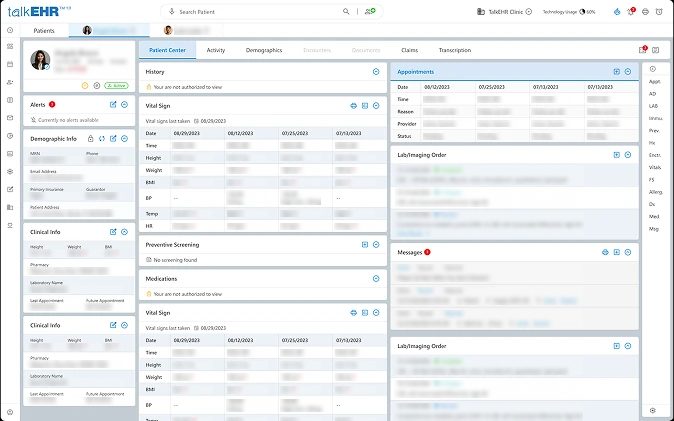
- talkEHR is a legacy product from MTBC, the company CareCloud grew out of.
CareCloud EMR Core Clinical Features
Clinical features sit inside the patient chart. Nothing here requires a separate login or a bolt-on vendor, which is the main argument for a single-platform buy.
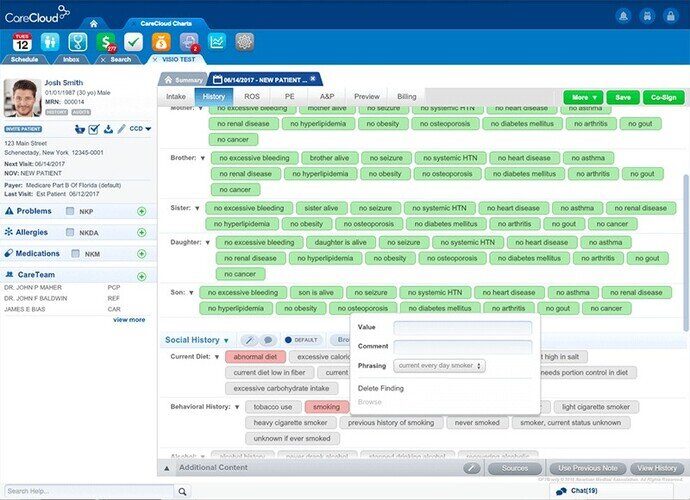
Documentation runs on configurable templates. Practices can build note formats by specialty, by visit type, or by individual provider preference.
Charting and clinical templates
Templates ship pre-built for common specialties and can be edited without developer help. Reviewers on Capterra call out template flexibility as a reason they picked the system.
- Note templates by specialty, visit type, and provider
- Structured fields that feed coding and quality reporting
- Problem lists, medication lists, and allergy records
- Vitals capture with growth charts for pediatric practices
- Mobile chart access for rounding and after-hours review
E-prescribing and medication management
CareCloud connects to Surescripts for electronic prescribing. Providers send prescriptions from inside the chart and pull medication history from the pharmacy network.
The system checks new prescriptions against current medications and documented allergies. Controlled substance prescribing runs through EPCS with identity verification.
Lab ordering and results
Providers order labs from the chart using preconfigured order sets. Results route back through HL7 interfaces and attach to the correct encounter.
A common gap in practice is unmatched results. When a lab interface is not built correctly, results land in a holding queue instead of the chart. Ask about interface build fees before signing.
Practice Management and Front-Office Features
The front office runs on the same database as the chart. Registration data entered at check-in flows straight into the claim, which reduces rekeying errors.
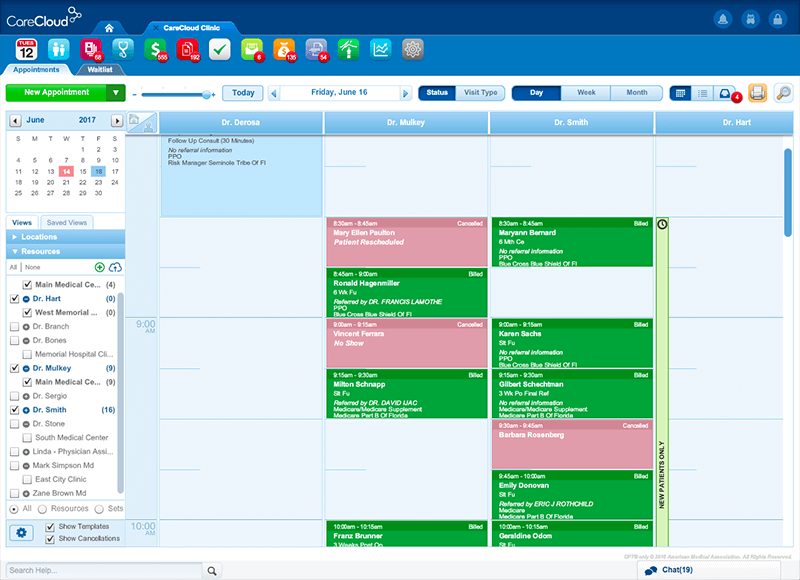
Scheduling is the feature reviewers praise most often. The calendar supports drag-and-drop moves and color coding by provider, location, or visit type.
Scheduling and check-in
- Color-coded calendar with multi-provider and multi-location views
- Drag-and-drop appointment moves and recurring visit setup
- Waitlist and recall management for follow-up appointments
- Digital check-in through Breeze on a tablet or patient phone
- Automated reminders by text, email, and voice
Eligibility and benefits verification
Real-time eligibility checks run against payer systems before the visit. Staff see coverage status, copay amounts, and deductible balances.
Front-end eligibility failure is the single largest preventable denial category in most practices. Running batch checks 48 hours before the schedule catches coverage terminations early.
Revenue Cycle Management Features
This is where CareCloud competes hardest. The company started as a billing organization, and the RCM tooling reflects that history.
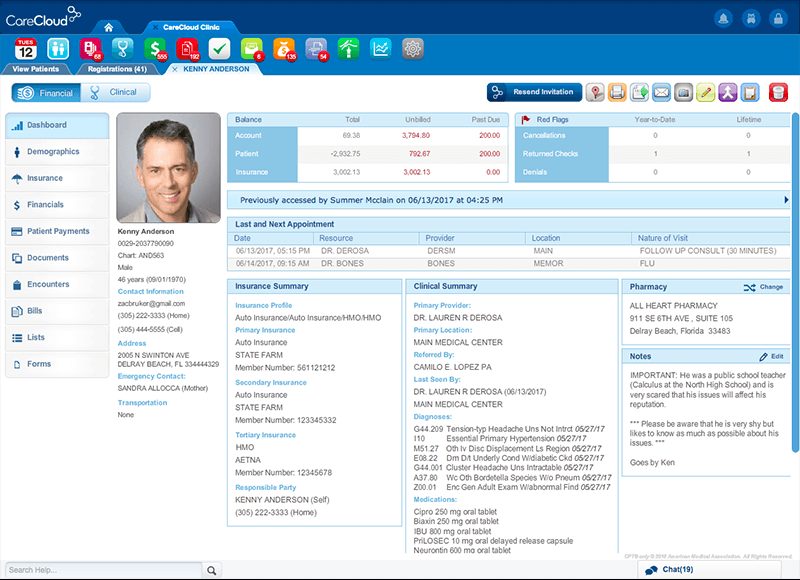
Claims move through a scrubbing engine before submission. Edits check for missing modifiers, invalid code pairs, and payer-specific formatting rules.
Claims and clearinghouse handling
A frequent buyer question is whether CareCloud acts as a clearinghouse. It routes claims through clearinghouse partners rather than operating as a standalone clearinghouse for outside customers.
| Function | What CareCloud does | What to verify |
|---|---|---|
| Claim scrubbing | Pre-submission edits and payer rules | Edit library update frequency |
| Submission | 837 files through partner clearinghouse | Included volume vs per-claim fee |
| Remittance | 835 ERA posting, EFT reconciliation | Auto-post match rate |
| Rejections | Front-end rejection work queues | Who works the queue, you or CareCloud |
| Appeals | Letter generation and tracking | Appeal success reporting |
Denial management and appeals
Denials route into work queues by reason code and payer. Staff can sort by dollar value to work high-recovery claims first.
The appeals workflow tracks submission dates and payer response deadlines. Missing a payer appeal window is a permanent write-off, so deadline tracking carries real dollar value.
Reporting and analytics
Dashboards cover charges, collections, days in accounts receivable, and provider productivity. Reviewers flag reporting flexibility as a weak spot compared to purpose-built business intelligence tools.
- Net collection rate by payer and provider
- Days in A/R with aging buckets
- First-pass claim acceptance rate
- Denial rate by reason code
- Charge lag between date of service and submission
The cirrusAI Suite: CareCloud’s AI Layer
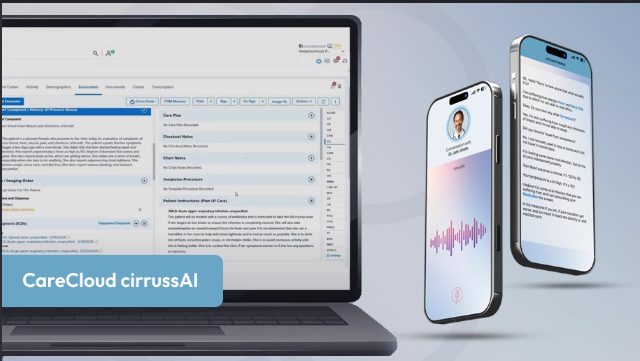
cirrusAI is the generative AI suite built on Google Cloud Vertex AI. It launched in late 2023 and expanded through 2025 and 2026.
Most review sites have not updated their CareCloud pages to cover these tools. That gap matters, because the AI layer is now the company’s stated differentiator against athenahealth and eClinicalWorks.
What each cirrusAI tool does
| Tool | Function | Primary user |
|---|---|---|
| cirrusAI Notes | Captures patient-provider conversation and drafts the clinical note into the EHR | Providers |
| cirrusAI Appeals | Drafts payer-specific appeal letters from claim details and denial reason | Billing staff |
| cirrusAI Voice | Voice-driven interaction with the record | Providers |
| cirrusAI Guide | Surfaces evidence-based suggestions and automates data entry | Providers |
| cirrusAI Chat | Answers staff questions about EHR workflows in plain language | Front office and new hires |
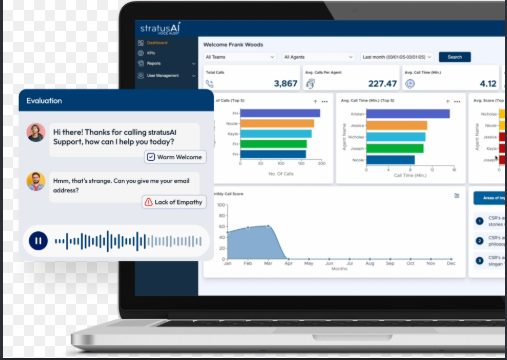
| stratusAI Desk Agent | Handles inbound calls, scheduling, and chart updates | Front desk |
Ambient documentation with cirrusAI Notes
cirrusAI Notes records the visit conversation and produces a draft note. CareCloud states the tool saves roughly 20% of provider time per day, a vendor-reported figure worth testing during a pilot.
Draft quality varies by specialty and accent. Run a two-week pilot with your highest-volume provider before rolling it out across the group.
Appeals automation and revenue recovery
cirrusAI Appeals reads the claim, the denial reason, and the payer, then drafts a letter for a human to review and send. For practices sitting on unworked denials, this changes the economics of low-dollar appeals.
A $180 denied claim usually costs more to appeal manually than it recovers. Cutting drafting time to minutes moves those claims back into scope.
Where human review is still required
AI-generated documentation carries compliance exposure. The note supports the code, and the code supports the claim.
- Providers must read and edit every AI-drafted note before signing
- Coding staff should audit a sample of AI-assisted encounters monthly
- Appeal letters need a human check for payer-specific policy citations
- Document your AI review policy before an audit asks for it
- Confirm the vendor agreement covers AI outputs under the existing BAA
Patient Engagement: Breeze and CareCloud Live
Breeze handles the patient-facing side. Patients complete intake forms, view balances, pay bills, and book appointments from a phone.
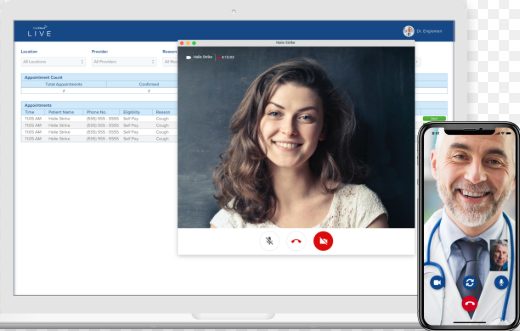
CareCloud Live adds HIPAA-compliant video visits that link back to the chart. Notes and billing codes stay in the same encounter record.
What patient engagement covers
- Digital intake and consent forms completed before arrival
- Online self-scheduling with rules by visit type
- Appointment reminders by text, email, and voice
- Card-on-file and payment plan options
- Secure messaging between patient and practice
- Remote patient monitoring and chronic care management programs
Practices running Breeze report fewer no-shows and faster check-in. The financial case rests on point-of-service collection, since balances collected at the desk cost far less than balances chased after the visit.
Interfaces and Interoperability
Interoperability decides whether CareCloud can join a health system, an ACO, or a regional health information exchange. Small practices skip this question. Larger buyers cannot.
CareCloud supports HL7 v2 interfaces for labs, radiology, and immunization registries. It also exposes FHIR APIs required under federal certification rules.
Standards and connected systems
| Standard or partner | Purpose |
|---|---|
| HL7 v2 | Lab, radiology, and ADT message exchange |
| FHIR R4 APIs | Patient-facing and third-party app access |
| USCDI | Required data elements for certified exchange |
| Surescripts | E-prescribing and medication history |
| C-CDA | Summary of care documents for referrals |
| Immunization registries | State-level reporting |
CareCloud also connects with third-party clinical systems including ICANotes, Praxis EMR, Sevocity, CodoniX, MD Logic, TeleVox, and Vital Interaction. Confirm which connections are standard and which carry a build fee.
Certification and information blocking
Ask for current ONC Health IT certification details in writing. Certification under the HTI-1 rule affects your MIPS reporting and your exposure under the information blocking provisions of the Cures Act.
CareCloud EMR Pricing
CareCloud does not publish pricing. Figures below come from third-party software directories and are subject to change, so treat them as a negotiation baseline rather than a quote.
Two pricing models exist, and they are not variations of the same thing. One is a software subscription. The other is a percentage of what you collect.
Reported pricing structure
| Model | Reported cost | What it covers |
|---|---|---|
| Per-provider subscription | $349 to $649 per provider per month | EHR, practice management, e-prescribing, charting |
| CareCloud Complete | Around $629 per provider per month | Full platform with customization and task management |
| CareCloud Concierge | 3% to 7% of monthly collections | Platform plus outsourced billing team |
| Setup and onboarding | $1,000 and up | Data migration, configuration, training |
Source: pricing reported by FindEMR, Software Finder, and Jotform. CareCloud directs buyers to sales for a quote.
Costs that sit outside the subscription
- Interface build fees for each lab, hospital, or third-party connection
- Per-claim clearinghouse charges above an included volume
- Custom report development
- Additional training sessions after go-live
- Data extraction fees if you later leave the platform
Per-seat versus percent of collections
The right model depends on collections per provider and on whether you already employ billing staff. Run the math before the demo, not after.
Consider a three-provider group collecting $1.5 million a year. Software-only pricing at $629 per provider costs roughly $22,600 annually. Add 1.5 billing FTEs at a loaded $48,000 each and the total reaches about $94,600, or 6.3% of collections.
Concierge at 5% of the same collections costs $75,000 and includes the billing team. At that volume the service model wins.
| Annual collections | Software plus in-house billing | Concierge at 5% | Better model |
|---|---|---|---|
| $750,000 | ~$70,000 (9.3%) | $37,500 | Concierge |
| $1.5 million | ~$94,600 (6.3%) | $75,000 | Concierge |
| $4 million | ~$204,000 (5.1%) | $200,000 | Close, depends on rate |
| $8 million | ~$340,000 (4.3%) | $400,000 | In-house |
Figures are illustrative. The crossover usually sits between $3 million and $5 million in collections, and it moves depending on your negotiated Concierge percentage.
CareCloud by Specialty
Directory listings describe CareCloud as multi-specialty and stop there. That answer is useless during selection, because specialty workflow is where EHR deals succeed or fail.
Template depth, prior authorization volume, and coding complexity vary sharply across specialties. Test your own top ten CPT codes during the demo.
| Specialty | Main workflow demand | What to test in the demo |
|---|---|---|
| Pain Management | High prior auth volume, injection coding | Auth tracking, modifier logic for bilateral procedures |
| Nephrology | Dialysis rounding, monthly capitation billing | MCP code handling, facility rounding lists |
| Psychiatry | Time-based E/M, sensitive note handling | Note segmentation, 90837 time documentation |
| Cardiology | Device and diagnostic result interfaces | Echo and Holter result routing into the chart |
| OBGYN | Global obstetric packages | Global period tracking, antepartum visit counts |
| Orthopaedics and ASCs | Surgical case posting, implant logging | Op note templates, facility versus professional split |
| Primary Care | Volume throughput, quality measures | MIPS reporting, chronic care management workflows |
Surgery centers and hospital-affiliated groups need to ask a harder question. Facility billing and professional billing follow different rules, and a platform built for ambulatory professional claims may not cover both cleanly.
If your group runs both sides, ask the vendor to demonstrate a real facility claim end to end. For a deeper breakdown of specialty billing rules, see our specialty billing service guides.
Onboarding, Data Migration, and Go-Live
Switching EHRs is a cash flow event before it is a technology event. Every practice underestimates this.
Claims slow during the transition. Staff work at reduced speed for weeks. Plan the cash runway before you plan the training calendar.
Typical rollout timeline
- Discovery and configuration runs two to four weeks and covers templates, fee schedules, and user roles.
- Data migration runs three to six weeks depending on chart volume and source system.
- Interface build runs in parallel and often becomes the critical path for lab connections.
- Training runs one to two weeks before go-live, with role-based sessions.
- Go-live and stabilization runs four to eight weeks with added vendor support.
Migrating from another platform
Chart conversion is the part vendors describe vaguely. Discrete data migration moves structured fields such as problems, medications, allergies, and immunizations. PDF conversion moves a flat image of the old chart.
- Discrete migration costs more and takes longer, but keeps data searchable
- PDF migration is faster and cheaper, but breaks reporting and quality measures
- Open accounts receivable usually stays in the legacy system until worked down
- Running parallel systems for 30 to 60 days is standard practice
- Confirm who owns the legacy data archive and for how long
Expect a temporary rise in days in A/R during the first 60 days. Budget for a 10% to 20% dip in monthly collections during the stabilization window.
Security, HIPAA, and Vendor Risk
Any EHR vendor holds protected health information on your behalf. That makes vendor security part of your own compliance posture, not just theirs.
CareCloud disclosed a data security incident that generated significant public attention. Search interest in that event remains high, which tells you buyers are asking about it during selection.
Security questions to ask any EHR vendor
- What does the Business Associate Agreement cover, and what does it exclude?
- Where is protected health information stored and processed geographically?
- Does any offshore team access production PHI, and under what controls?
- Is there a current SOC 2 Type II report available under NDA?
- What is the documented breach notification timeline?
- How are role-based permissions and audit logs configured by default?
Evaluating incident history fairly
A past security incident is not automatically disqualifying. Large healthcare IT vendors have all faced attacks, and response quality matters more than incident count.
Ask what changed after the event. Look for specific controls added, not general reassurance. Request the current penetration test summary and the remediation timeline.
CareCloud Pros and Cons
The pattern across G2, Capterra, SoftwareAdvice, and practitioner forums is consistent. Users like the billing side and the scheduling interface. They complain about support responsiveness and reporting limits.
| Strengths | Weaknesses |
|---|---|
| Billing and claims workflow praised by RCM users | Live support runs weekday business hours only |
| Scheduling calendar rated highly for daily use | Reporting flexibility trails dedicated BI tools |
| Single platform reduces vendor count | Parts of the interface feel dated to new users |
| Template customization without developer help | Learning curve across the full feature set |
| Concierge removes billing staffing burden | Pricing opacity slows the evaluation process |
The support model deserves attention from an RCM standpoint. If your billing team works weekends and the vendor does not, a Friday system issue can add three days to your A/R clock.
Who should not choose CareCloud
- Practices needing 24/7 live vendor support for weekend or urgent care operations
- Groups whose reporting requirements demand complex custom analytics
- Single-provider practices where a lighter, lower-cost platform fits better
- Hospital-owned groups already standardized on Epic or Oracle Health
- Organizations that require published, fixed pricing before entering procurement
CareCloud vs Alternatives
Most CareCloud shortlists include athenahealth, AdvancedMD, and eClinicalWorks. Each one competes on a different axis.
| Platform | Pricing model | RCM service | AI tooling | Best fit |
|---|---|---|---|---|
| CareCloud | Per provider or % of collections | Concierge, full outsourcing | cirrusAI suite, stratusAI Desk Agent | Small to mid-size groups wanting one vendor |
| athenahealth | % of collections | athenaOne RCM | Ambient notes and coding tools | Groups prioritizing payer rules engine |
| AdvancedMD | Per provider, modular | Available as add-on service | Limited AI feature set | Practices wanting modular purchasing |
| eClinicalWorks | Per provider | RCM available | Ambient documentation | Larger multi-specialty groups |
| Tebra | Per provider | Billing services available | Light AI features | Small independent practices |
| NextGen | Per provider, enterprise tiers | RCM available | Ambient documentation | Specialty-heavy mid-market groups |
CareCloud versus AdvancedMD
AdvancedMD sells modules separately, which appeals to practices that already have a billing vendor. CareCloud pushes toward the full platform.
The comparison usually comes down to whether you want to keep billing in-house. Practices choosing to outsource lean toward CareCloud Concierge. Practices keeping control lean toward AdvancedMD.
When switching EHRs is not the answer
Many practices blame the EHR for problems that live in the billing process. A denial rate of 12% rarely improves because the chart interface changed.
Before running a replacement project, audit the revenue cycle itself. Look at front-end eligibility failure, coding accuracy, charge lag, and unworked denials.
If those numbers explain your revenue gap, outsourcing the billing layer solves the problem faster and cheaper than a platform migration. Replacing the EHR costs months of productivity. Fixing the revenue cycle does not.
Frequently Asked Questions
Is CareCloud an EMR or an EHR?
CareCloud is an EHR. It stores patient records and supports data exchange with outside organizations through HL7 and FHIR standards. The company markets it under both labels because buyers search for both.
How much does CareCloud EMR cost per month?
Third-party sources report $349 to $649 per provider per month for the software. CareCloud Concierge instead charges 3% to 7% of monthly collections. Setup costs start around $1,000 and scale with practice size.
Is CareCloud a clearinghouse?
No. CareCloud submits claims through clearinghouse partners as part of its billing workflow. It does not operate as a standalone clearinghouse for practices using other software.
How does CareCloud work?
Practices access the platform through a browser or mobile app. Patient data entered at scheduling and check-in flows into the chart, then into the claim. Billing runs either in-house or through the Concierge service.
Who owns CareCloud?
CareCloud, Inc. is a publicly traded company listed on Nasdaq under CCLD. It was previously known as MTBC before rebranding under the CareCloud name.
Is CareCloud good for small practices?
Capterra data shows most CareCloud reviewers come from small organizations. Single-provider practices sometimes find lighter platforms a better cost match. Groups of three or more providers get more value from the bundled model.
Does CareCloud support telehealth?
Yes. CareCloud Live provides HIPAA-compliant video visits linked to the patient chart. Documentation and billing codes stay inside the same encounter record.
What is cirrusAI?
cirrusAI is CareCloud’s generative AI suite built on Google Cloud Vertex AI. It includes ambient clinical documentation, appeal letter drafting, in-EHR staff assistance, and clinical decision support.
Next Step
Platform selection and revenue performance are related but separate problems. A feature list will not tell you whether your denials are a software issue or a process issue.
If your collections are underperforming on CareCloud or any other platform, start with a revenue cycle audit. Measure first, then decide whether the fix is configuration, staffing, or a new system.