Medical billing begins long before claim submission. It starts within the EMR, where accurate documentation directly determines reimbursement. In fact, about 95% of U.S. office-based physicians had adopted EHR systems by 2024, highlighting how essential they are to the revenue cycle. With hundreds of platforms available, choosing the right one can significantly impact billing efficiency.
Veradigm, formerly Allscripts Healthcare Solutions, is one such widely used EMR, supporting over 180,000 physicians across thousands of healthcare organizations. If your practice is using or considering Veradigm, this guide will walk you through everything from features and implementation to daily workflows. It also explains how experienced billing partners like Transcure can help optimize billing, reduce denials, and improve reimbursement using this EHR.

From Allscripts to Veradigm: A Rebrand With Expanded Capabilities
Veradigm was originally known as Allscripts Healthcare Solutions. Allscripts EMR built its reputation over decades as a provider of EHR software, practice management tools, and clinical decision support systems for physician practices across the United States. In 2023, Allscripts’ name changed to Veradigm. This was a broader shift in its mission from traditional EHR software toward becoming a full-spectrum healthcare data and technology company.
Veradigm expanded its focus to include healthcare data analytics, life sciences solutions, and interoperability infrastructure. Moreover, it retains the core EHR and practice management capabilities that Allscripts EHR users were familiar with. For practices already using the platform, the transition brought updated interfaces, stronger data integration tools, and a more unified approach to clinical and administrative workflows.
Allscripts vs. Veradigm: What Changed
Here’s a side-by-side comparison highlighting how Allscripts Healthcare Solutions evolved into Veradigm and what has changed across key capabilities:
| Feature / Capability | Allscripts (Legacy) | Veradigm (Current) |
|---|---|---|
| Brand Name | Allscripts Healthcare Solutions | Veradigm Inc. |
| Primary Focus | EHR and practice management software | EHR, data analytics, life sciences, and interoperability |
| Data Analytics | Basic reporting within EHR | Advanced analytics platform for clinical and business insights |
| Life Sciences Integration | Not a core offering | Dedicated life sciences data solutions for research and pharma |
| Interoperability | Limited HL7 and basic data exchange | Robust FHIR-based data sharing and nationwide network access |
| Cloud Infrastructure | Partial cloud support | Cloud-first architecture with improved scalability |
| Patient Engagement Tools | Basic patient portal | Enhanced patient engagement and telehealth integrations |
| Revenue Cycle Management | Separate billing modules | More tightly integrated RCM and EHR workflows |
| API Access | Limited third-party API support | Open API framework for broader third-party integrations |
| User Experience | Legacy interface with older UX patterns | Modernized interface with updated navigation and workflows |
What Is Veradigm EMR?
Before learning about the features and workflows, it’s important to understand what Veradigm EHR actually is and how it functions in a real-world clinical setting.
Veradigm EMR Explained
Veradigm EMR is an ambulatory electronic health record system that provides clinical documentation, scheduling, ePrescribing, order management, and reporting within a single platform. It is designed for outpatient and physician practice settings and is built to support the complete patient encounter from check-in to checkout. The system is ONC-certified and qualifies for use in programs such as MIPS (Merit-based Incentive Payment System).
The platform gives providers structured tools for documenting patient visits using templates and supports clinical decision-making through integrated alerts and order sets. It also connects with external systems, including pharmacies, labs, imaging centers, and other EHRs, through health information exchange networks.
Who Uses Veradigm EHR?
Veradigm EHR is used primarily by:
- Primary care physicians and family medicine practices
- Specialty practices including internal medicine, cardiology, orthopedics, and more
- Multi-provider group practices and clinics
- Federally qualified health centers (FQHCs)
- Academic medical practices affiliated with health systems
It is ideal for practices needing integration where documentation flows directly into coding, billing, and reporting without manual data entry.
How Does It Fit Into Daily Practice Operations?
Veradigm EHR sits at the center of a practice’s daily operations. Front desk staff use it to schedule appointments, verify patient demographics, and manage check-ins. Clinical staff use it to document encounters, review patient histories, enter orders, and send prescriptions.
Providers use it to review labs and imaging results, make clinical decisions, and close out visits with coded diagnoses and charges. Billing staff or external billing partners use the documented data to generate claims and submit them to payers.
What are the Key Features of Veradigm EMR?
Now that you understand how Veradigm EHR functions within a practice, let’s explore the core features that improve its clinical efficiency, workflow automation, and billing integration.
One-Click Templates for Documentation
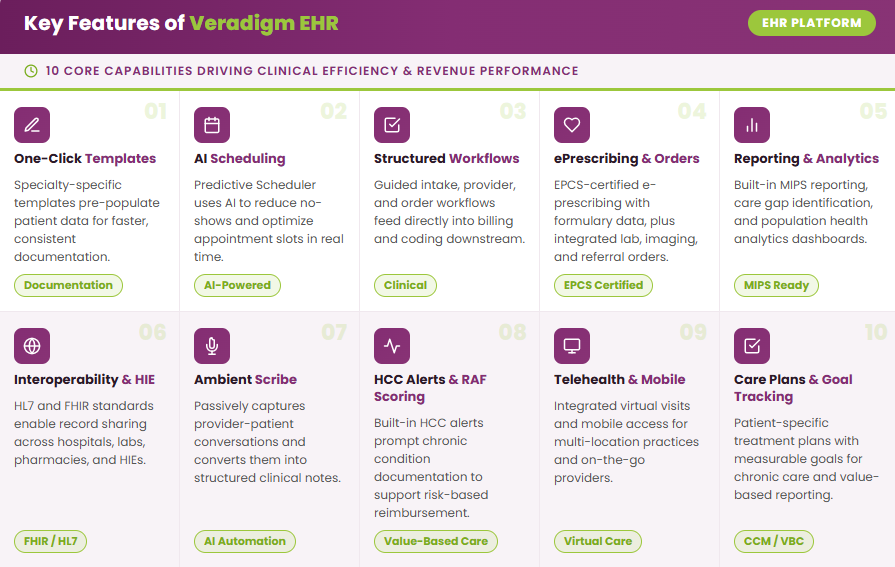
Veradigm EHR includes intelligent documentation tools to speed up provider workflows. One-click templates allow physicians to populate patient information from previous visits, recurring conditions, or commonly used note structures with minimal manual entry. This helps improve documentation consistency and saves time during high-volume clinic sessions.
In addition, the system offers specialty-specific templates tailored to different fields such as primary care, cardiology, and orthopedics. This feature enables providers to document encounters more accurately while aligning with specialty-specific coding and clinical requirements.
Scheduling and Appointment Management
Veradigm EHR offers advanced scheduling capabilities powered by AI-driven tools like Predictive Scheduler. The system uses predictive analytics to forecast patient demand, reduce no-shows, and automatically optimize appointment slots. It prioritizes high-need patients, adjusts schedules in real time, and ensures providers maintain balanced workloads.
Automated reminders and patient communication tools help reduce no-shows. The system also tracks patient arrival status and links appointment data directly to the clinical workflow, so providers know exactly who is in the queue.
Clinical Workflows
Veradigm EHR is built around structured clinical workflows that guide care teams through each phase of a patient visit. Intake workflows capture vitals and the reason for the visit. Provider workflows move through history, examination, assessment, and plan. Order workflows manage lab requisitions, imaging orders, and referrals. Each workflow step produces documentation that feeds into the patient record and supports downstream billing and coding.
The system includes clinical decision support tools such as drug interaction alerts, clinical guidelines, and preventive care reminders that appear within the workflow without disrupting documentation.
ePrescribing and Order Management
Veradigm EHR is certified for electronic prescribing, including controlled substances (EPCS). Providers can send prescriptions directly to pharmacies from within the patient chart, review medication histories, and receive formulary information based on the patient’s insurance. The order management module supports lab orders, imaging orders, referrals, and in-office procedure orders, all of which are tracked and documented within the patient record.
Reporting and Analytics
The platform includes built-in reporting tools that allow practice administrators to track clinical quality measures, patient volumes, appointment patterns, and financial performance metrics. Reports can be generated for MIPS reporting, care gap identification, and internal performance review. Veradigm’s expanded analytics capabilities, developed as part of the rebrand from Allscripts, allow for more sophisticated data analysis and population health management.
Interoperability and Data Sharing
Veradigm EHR supports data exchange through HL7 and FHIR standards. This allows practices to share patient records with hospitals, specialists, labs, pharmacies, and other EHR systems. The platform connects to health information exchanges (HIEs) and supports Care Everywhere functionality, allowing providers to pull in records from external sources directly into the patient chart. This is important for practices managing complex patients who receive care across multiple settings.
Ambient Scribe and Automated Note Capture
A major feature highlighted on Veradigm’s website is its ambient scribe functionality. This tool passively captures provider-patient conversations during visits and converts them into structured clinical notes directly within the EHR. By automating note-taking, it significantly reduces provider documentation burden and helps clinicians spend more time with patients rather than entering data manually.
HCC Alerts and Risk Scoring
Veradigm EHR provides built-in Hierarchical Condition Category (HCC) alerts and RAF risk scoring tools that support accurate risk adjustment documentation. Providers receive timely reminders to document chronic conditions that affect reimbursement under value-based care and Medicare Advantage models. These alerts help ensure complete diagnosis capture, support coding accuracy, and improve risk-based reimbursement opportunities.
Integrated Telehealth and Mobile Access
The platform also includes integrated telehealth functionality to let practices conduct secure virtual visits directly within the workflow. This improves patient access and supports continuity of care for follow-ups and chronic disease management.
Additionally, Veradigm EHR offers mobile access so providers can review schedules, check messages, and refill prescriptions on the go. This is especially useful for multi-location practices and physicians managing patient care outside the office.
Care Plans and Goal Tracking
Another important feature is care plan and goal management. Providers can create patient-specific treatment plans, define measurable care goals, and track progress over time within the chart. This is particularly valuable for chronic care management, preventive care, and value-based reporting initiatives.
How to Get Started With Veradigm EHR?
Setting up Veradigm EHR involves a structured implementation process. Most practices work with a Veradigm implementation team or a certified partner to complete the setup. Here is a step-by-step breakdown of what that process looks like for a new user.
Step 1: Set Up Your Account and Access
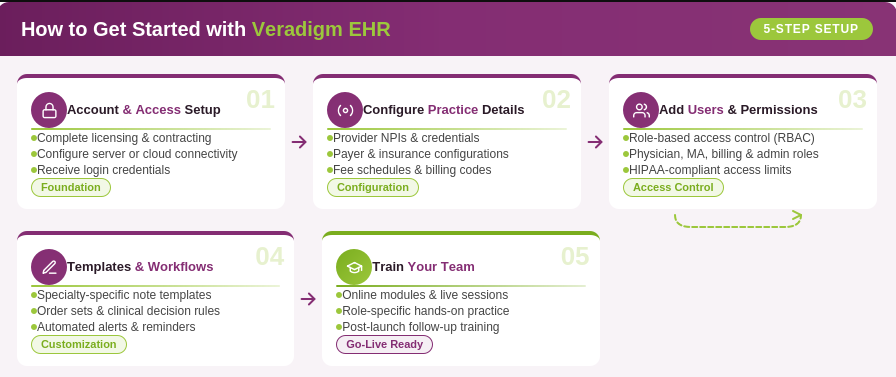
The first step is establishing your practice’s account with Veradigm. This involves completing the licensing and contracting process, setting up your organization’s profile, and receiving login credentials. Your implementation team will provision the system and ensure that the technical environment, including server access or cloud connectivity, is properly configured before any clinical use begins.
Step 2: Configure Practice Details
Once access is established, the next step is configuring your practice settings. This includes:
- Practice name, address, and contact information
- Provider NPI numbers and credentials
- Payer and insurance configurations
- Facility and location settings for multi-site practices
- Fee schedules and billing codes relevant to your specialty
Step 3: Add Users and Permissions
Each staff member who will use the system needs a user account with appropriate role-based access permissions. Veradigm EHR supports role-based access control, which means you can configure exactly what each user can see and do within the system. Common roles include:
- Physician or advanced practice provider with full clinical access
- Medical assistant with intake and vitals documentation access
- Front office staff with scheduling and demographics access
- Billing staff with charge review and claim submission access
- Practice administrator with full administrative access
Limiting access to only what each role requires is both a compliance requirement under HIPAA and a practical safeguard against documentation errors.
Step 4: Set Up Templates and Workflows
Veradigm Allscripts EHR allows practices to create and customize documentation templates for common visit types and specialties. Setting up these templates before going live reduces the time providers spend on documentation and ensures that notes capture all required data elements for coding and billing. Your implementation team can help you import existing templates or build new ones based on your specialty’s requirements.
Workflow configuration also includes setting up order sets, clinical decision support rules, and any automated reminders or alerts relevant to your patient population.
Step 5: Train Your Team
Training is one of the most important steps in a successful EHR implementation. Veradigm provides training resources, including online modules, live training sessions, and documentation guides.
However, practices that provide vendor-provided training with hands-on practice sessions consistently report faster adoption and fewer post-launch errors. Plan for training to take place before go-live and schedule follow-up sessions after staff have used the system with real patients.
What is the Everyday Workflow in Veradigm EHR?
The everyday workflow in Veradigm EHR follows a structured process that connects pre-visit preparation, in-visit clinical documentation, and post-visit billing to ensure efficient patient care and accurate reimbursement.
Before the Patient Visit
Preparation for each patient encounter begins before the patient arrives. Front office staff confirm appointments, verify insurance eligibility, and update patient demographics in the system. Clinical staff reviews the patient’s chart for outstanding care gaps, pending lab results, or medication refill requests. Any prior authorizations needed for today’s visit are confirmed and documented.
During the Patient Visit
At check-in, front desk staff confirm the patient’s identity, collect any outstanding balances or copays, and update contact and insurance information. Medical assistants record vitals, confirm medications, and document the reason for the visit. The provider then opens the patient chart and works through the clinical encounter.
During the encounter, the provider reviews the patient’s history, performs and documents the examination, makes clinical decisions, and enters orders for labs, imaging, or medications. The visit note is completed using templates, and diagnoses are assigned using ICD-10 codes.
Procedure codes (CPT codes) are attached to the encounter based on what was performed during the visit. If ePrescribing is needed, prescriptions are sent directly to the pharmacy from within the chart.
After the Patient Visit
After the provider closes the encounter, the visit moves into the billing workflow. Charges are reviewed, codes are confirmed, and any missing information is flagged before the claim is submitted. Clinical staff process follow-up orders, referral letters, and patient instructions. If the practice uses an external billing service like Transcure, the documented encounter data is routed to the billing team for claim generation and submission.
How Veradigm EMR Connects to Medical Billing?
In Veradigm, every step, from capturing patient encounters to generating insurance claims, flows through an integrated system that connects clinical care directly with billing operations. Below is a basic workflow:
Clinical Documentation in Veradigm EHR
Providers record patient encounter details in Veradigm EHR, including diagnoses, procedures, medications, and visit complexity. The system uses structured templates to ensure documentation is complete and billing-ready.
Structured Data Creation
This clinical documentation is automatically organized into structured data, becoming the official source record for coding and billing processes.
Medical Coding
Based on the documented encounter, coding specialists or billing teams assign appropriate ICD-10 (diagnosis) and CPT (procedure) codes within or alongside the Veradigm system.
Charge Entry Creation
The coded services are converted into billable charges through Veradigm’s integrated billing or revenue cycle module.
Claim Generation
A complete insurance claim is generated using patient details, provider information, and finalized medical codes directly linked to the EHR encounter.
Claim Review and Scrubbing
The billing team reviews and validates claims within the Veradigm workflow to identify errors, missing data, or payer-specific issues before submission.
Electronic Claim Submission
Once approved, the claim is transmitted electronically through a clearinghouse to the insurance payer for processing.
Payment and Follow-up
The payer either approves payment or issues a denial. The billing team then manages payment posting, corrections, resubmissions, or appeals as needed within the system.
Veradigm Billing Services
Beyond the EHR, Veradigm offers its own Revenue Cycle Services, a comprehensive end-to-end RCM solution that manages everything from coding and billing to claims and denial management. Their HIPAA-compliant solution integrates seamlessly with existing EHR and practice management systems. Plus, they use AI-powered automation and analytics to identify denial trends and deliver real-time insights.
What are the Common Billing Challenges Linked to Veradigm EHR Usage?
The following table highlights key challenges within the Veradigm EHR workflows and how they can directly affect billing accuracy and overall revenue performance.
| Challenge | Cause | Impact on Revenue |
|---|---|---|
| Learning Curve for New Users | System contains more functionality than any individual role needs, with no role-specific onboarding by default | Slower workflows, increased errors, and delayed billing during the adjustment period |
| Workflow Disruptions During Implementation | Go-live transition forces providers and staff to relearn daily tasks within a new system | Reduced appointment volumes, slower note completion, and temporary revenue loss |
| Documentation Errors | Providers selecting incorrect templates, wrong visit codes, or failing to complete required fields before closing encounters | Billing errors downstream, claim rejections, and compliance exposure |
| Billing and Coding Mistakes | Disconnect between clinical documentation and billing logic for providers new to the system | Encounters closed without diagnosis codes, incorrect procedure codes, and missing medical necessity documentation |
| Staff Training Gaps | One-time go-live training that does not account for staff turnover, system updates, or evolving payer requirements | Poor long-term adoption, recurring workflow errors, and inconsistent billing quality |
| Incomplete Clinical Documentation | Template-driven notes lacking specificity or missing required fields | Undercoding, claim denials, and compliance risk |
| E/M Level Miscapture | Difficulty documenting visit complexity accurately within EHR workflows | Lost revenue from undercoding or audit exposure from overcoding |
| Charge Capture Delays | Workflow misconfigurations causing lag between encounter completion and charge posting | Delayed claim submission and slower cash flow |
| EHR to Billing System Sync Failures | Mapping errors when clinical data transfers to third-party PM or billing platforms | Incorrect claims, rework costs, and increased days in AR |
| Payer Rule Mismatches | Payer-specific edits not embedded in EHR claim scrubbing logic | Higher first-pass rejection rates and reimbursement delays |
| Unstructured Note Entry | Providers bypassing structured data fields with free-text workarounds | Uncapturable codes, coder inefficiency, and revenue leakage |
| Poor Denial Visibility | Limited real-time AR and denial analytics within the native EHR | Inability to identify patterns, leading to recurring denials |
| Low Staff Adoption of Billing Features | Underutilization of EHR tools designed to support coding accuracy | Inconsistent documentation quality and higher claim error rates |
| Siloed Clinical and Billing Teams | Lack of integrated workflows between EHR documentation and RCM processes | Slow denial resolution and increased administrative overhead |
How Transcure Helps With Allscripts (Veradigm) EHR Billing?
Transcure is a full-service medical billing company with direct experience supporting practices that use Veradigm EHR. We handle the complete revenue cycle management process, from charge review and claim submission through payment posting, denial management, and financial reporting. For practices using Veradigm EHR, we work within the system’s existing workflows to maximize reimbursement while reducing the administrative burden on your clinical team.
Transcure’s Veradigm EHR Billing Support
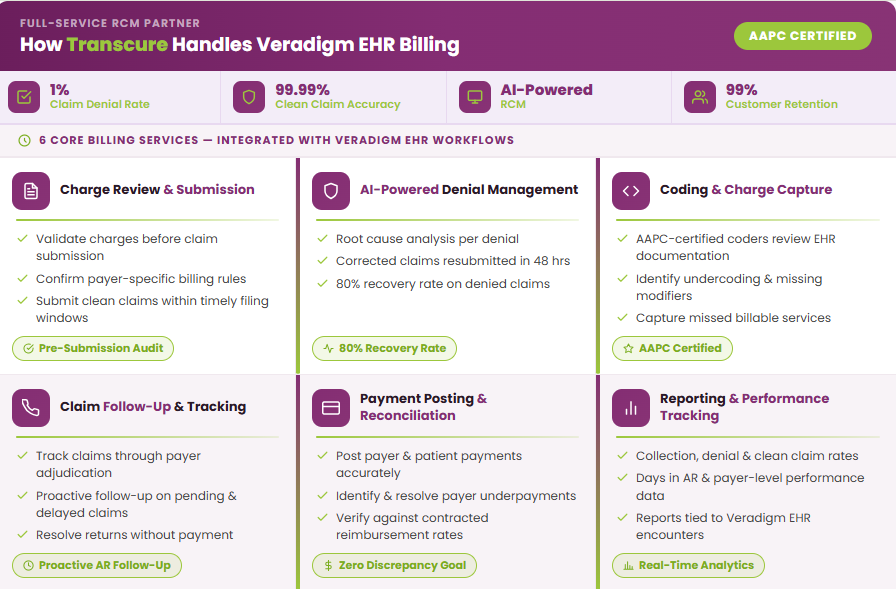
Our AAPC-certified billing team is trained on the Veradigm EHR environment and understands how clinical documentation maps to billing codes within the platform. We review charges before claims submission, catch documentation gaps before they become denials, and work with your providers to close coding and documentation issues at the source.
Claim Submission and Follow-Up
Transcure manages the end-to-end claim submission process using the data captured in Veradigm EHR. We validate charges, confirm payer-specific billing rules, and submit clean claims within timely filing windows. After submission, our team tracks each claim through the payer’s adjudication process and follows up proactively on any claims that are pending, delayed, or returned without payment.
Denial Management
Claim denials are one of the most common revenue leaks in any medical practice. Transcure’s AI-powered denial management process identifies the root cause of each denial and submits corrected claims within 48 hours to recover 80% of initially denied claims. We appeal eligible denials with supporting documentation and track outcomes to identify patterns that can be prevented in future claims.
Coding Support and Charge Capture
Our certified coders review encounter documentation from Veradigm EHR and ensure that the codes assigned accurately reflect the services provided. We identify undercoded visits, missing modifiers, and unbundling opportunities that result in 99.99% clean claim accuracy. We also work with practices to improve charge capture by identifying services that are consistently being missed in the billing workflow.
Payment Posting and Reconciliation
Transcure posts all payer payments and patient payments to the appropriate accounts within the revenue cycle workflow. We reconcile payments against submitted claims and identify any underpayments from contracted payers. Every payment posted is verified against expected reimbursement rates, and discrepancies are investigated and resolved.
Reporting and Performance Tracking
We provide practices with regular financial performance reports that include collection rates, denial rates, days in accounts receivable, clean claim rates, and payer-specific performance data. These reports are built from the billing activity tied to Veradigm EHR encounters and give practice administrators a clear picture of their revenue.
What are the Best Practices for Getting Better Results?
To maximize the benefits of Veradigm-based billing, practices should follow a set of proven best practices that strengthen both clinical documentation and revenue cycle workflows.
Keep Documentation Consistent
Consistency in documentation is the single most important factor in billing accuracy. When providers document encounters the same way every time, using consistent templates and coding conventions, the process becomes more structured and predictable.
This makes it much easier for billing staff and external billing partners to review and submit clean claims. Inconsistent documentation creates confusion that leads to coding errors and claim denials.
Train Staff Regularly
Plan for quarterly or semi-annual training updates for all staff roles. Use these sessions to address recurring errors identified in claim reviews, cover new system features or payer policy changes, and reinforce correct documentation workflows. New hires should receive role-specific onboarding training before they have independent access to the system.
Use Standardized Templates
Build and use visit-type-specific templates that capture all required data elements for accurate coding. Templates should prompt providers to document the clinical information needed to support the E&M level being billed and the medical necessity for ordered services. They should also capture any risk factors that affect treatment decisions. Review and update templates regularly based on coding feedback and payer requirements.
Review Billing Data Often
Practice administrators should review key billing metrics at least monthly. Metrics to track include clean claim rate, denial rate, days in accounts receivable, collection rate by payer, and charge lag. Identifying negative trends early allows you to address root causes before they compound into significant revenue loss.
Work With an Experienced Billing Partner
For many practices, without a dedicated in-house billing team, partnering with professional medical billing companies is the most efficient path to optimized revenue cycle performance. A billing partner like Transcure with direct experience in Veradigm EHR understands the system’s workflows and can identify platform-specific billing issues.
Frequently Asked Questions
How Long Does it Take to Fully Implement Veradigm EHR?
A full Veradigm EHR implementation typically takes around 3 to 6 months for small to mid-sized practices, while larger or multi-specialty organizations may take 6 to 12 months or more, depending on complexity. The timeline usually includes planning, system configuration, data migration, template setup, and staff training.
Is Veradigm EHR Cloud-based or On-premise?
Veradigm EHR is primarily a cloud-based system, meaning it can be accessed securely through the internet using a web browser without requiring local server infrastructure. However, it also offers flexible deployment options, so some larger organizations may still use hosted or on-premise configurations depending on their IT setup and compliance needs.
Can Veradigm EHR Help with Compliance Reporting?
Yes, Veradigm EHR supports compliance reporting through its built-in analytics and quality reporting tools. It helps practices meet major regulatory requirements such as MIPS and other value-based care programs by tracking clinical quality measures, identifying care gaps, and generating required performance reports. The system also enables providers to monitor patient outcomes throughout the year, stay compliant with CMS guidelines, and submit accurate data through approved reporting channels.
Why Should Practices Outsource Veradigm Billing Services Instead of Managing Billing In-house?
Practices should outsource Veradigm billing services because specialized billing partners reduce errors, improve claim accuracy, and accelerate reimbursements. Managing billing in-house requires continuous expertise in coding updates, payer rules, and Veradigm-specific workflows, which can strain internal teams and lead to revenue leakage. Outsourcing allows providers to focus on patient care while experts handle the revenue cycle more efficiently and consistently.
What is Allscripts?
Allscripts Healthcare Solutions was a U.S.-based healthcare technology company known for providing electronic health record (EHR), practice management, and revenue cycle management software to physician practices and hospitals. It was widely used to support clinical documentation, scheduling, ePrescribing, and billing workflows before rebranding as Veradigm in 2023.
Are Veradigm and Allscripts the Same?
Veradigm and Allscripts are essentially the same company, but under different stages of branding. Allscripts Healthcare Solutions rebranded as Veradigm in 2023 to reflect its shift from a traditional EHR vendor to a broader healthcare data and technology company. While the core EHR and practice management systems remain the same, Veradigm now also focuses on analytics, interoperability, and life sciences solutions.
When did Allscripts Become Veradigm?
Allscripts officially rebranded as Veradigm on January 1, 2023. The change reflected its shift from a traditional EHR vendor to a broader healthcare data and technology company.