Medical coding converts clinical documentation into standardized codes, while medical billing uses those codes to create, submit, and manage claims for reimbursement. Coding focuses on accuracy and compliance with coding systems such as CPT, ICD-10-CM, and HCPCS. Billing focuses on claim generation, submission to payers, payment posting, and follow-up on unpaid or denied claims.
Medical coders review physician notes, operative reports, and lab results to assign correct codes that reflect diagnoses and procedures. For example, ICD-10-CM code E11.9 is used for Type 2 diabetes mellitus without complications, and CPT code 99214 is used for an established patient office visit of moderate complexity.
Medical billers use these codes to prepare claims (CMS-1500 or UB-04 forms), verify patient eligibility, submit claims to insurance companies, and track reimbursement. They also handle claim rejections, denials, and patient billing after insurance processing.
Coding and billing are connected steps within the revenue cycle. The process starts with patient registration and documentation, followed by coding of services, then claim creation and submission. After submission, billing includes payment posting from remittance advice (ERA/EOB), denial management, and patient collections until the account is fully resolved.

What is Medical Billing?
Medical billing is the process of creating, submitting, and managing healthcare claims to receive payment for services provided. It converts coded medical services into financial transactions between providers, payers, and patients.
Medical billing fits into the revenue cycle after medical coding and connects patient care to reimbursement. Once services are documented and coded, billing generates claims, submits them to insurance payers, and tracks them through adjudication until payment is received and posted.
The core steps in medical billing include claim generation using coded data, claim submission to payers (via CMS-1500 or UB-04 forms), and follow-up on claim status. Billers also handle denial management, payment posting from ERA/EOBs, and patient billing for remaining balances.
The purpose of medical billing is to ensure accurate and timely reimbursement for healthcare services. Its operational role is critical because it directly impacts cash flow, reduces revenue leakage, and maintains compliance with payer and regulatory requirements.
What is Medical Coding?
Medical coding is the process of translating clinical documentation into standardized codes that represent diagnoses, procedures, and services. These codes are assigned using classification systems such as ICD-10-CM, CPT, and HCPCS.
Medical coding plays a foundational role in the revenue cycle by preparing accurate data for claim creation and insurance processing. After a patient appointment is documented, coders assign codes that billers later use to generate and submit claims to payers.
The core step in medical coding is reviewing medical records such as physician notes, operative reports, and lab results, and assigning appropriate codes based on the documented services. For example, ICD-10-CM code J06.9 represents an acute upper respiratory infection, and CPT code 93000 represents a routine electrocardiogram.
The purpose of medical coding is to ensure claims are accurate, complete, and compliant before submission. Coding must follow regulatory standards, including HIPAA code set requirements and CMS guidelines, to avoid errors, denials, or audits.
Medical coding is directly linked to medical billing because accurate codes are required to create valid claims. Any coding error can lead to claim rejection, denial, or incorrect reimbursement during the billing process.
What are the Key Difference between Medical Billing and Medical Coding?
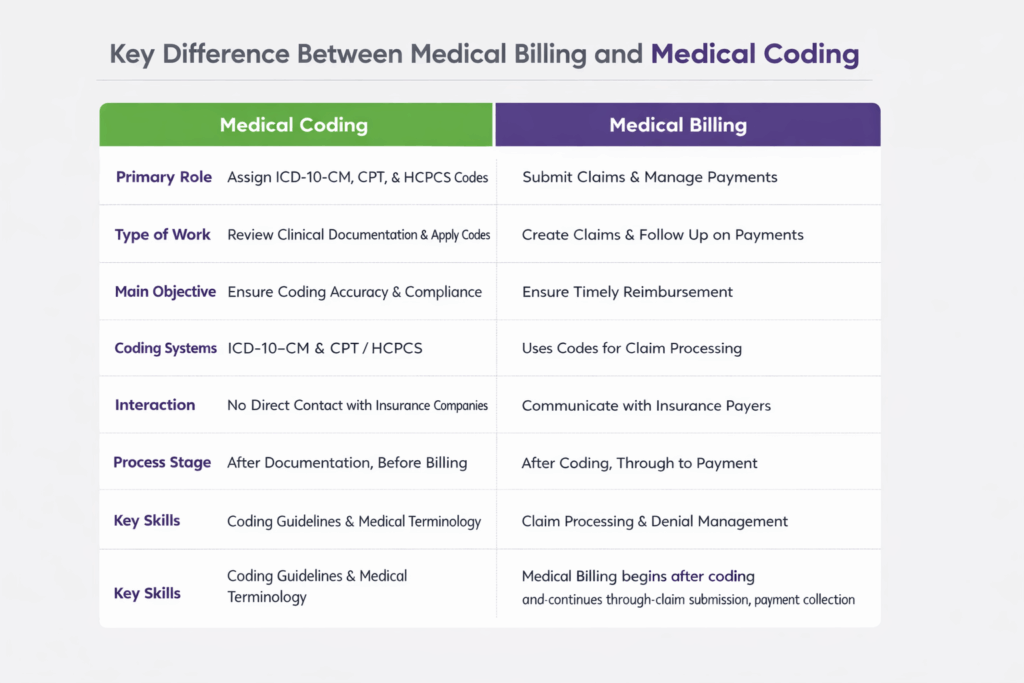
The key difference between medical billing and medical coding is that coding focuses on translating clinical documentation into standardized codes, while billing uses those codes to submit claims and collect payment.
Medical coding’s primary role is to assign accurate ICD-10-CM, CPT, and HCPCS codes from medical records. Medical billing’s primary role is to create claims, submit them to payers, and manage reimbursement.
The type of work in coding involves reviewing clinical documentation and applying the correct codes. The type of work in billing involves claim generation, submission, payment posting, and denial follow-up.
The main objective of coding is to ensure accuracy and compliance in code assignment. The main objective of billing is to ensure timely and correct reimbursement.
Coding systems used in medical coding include ICD-10-CM for diagnoses and CPT/HCPCS for procedures and services. Medical billing does not assign codes but uses these codes to process claims.
Medical coders do not directly interact with insurance companies. Medical billers communicate with insurance payers to submit claims, resolve denials, and track payments.
In the revenue cycle, medical coding occurs after patient documentation and before claim creation. Medical billing begins after coding and continues through claim submission, adjudication, and payment collection.
Key skills required for coding include attention to detail, knowledge of coding guidelines, and understanding of medical terminology. Key skills required for billing include knowledge of claim processes, payer rules, denial management, and communication with insurance companies.
Primary Role
The primary role of medical coders is to translate clinical documentation into standardized codes, while the primary role of medical billers is to create and submit claims for reimbursement.
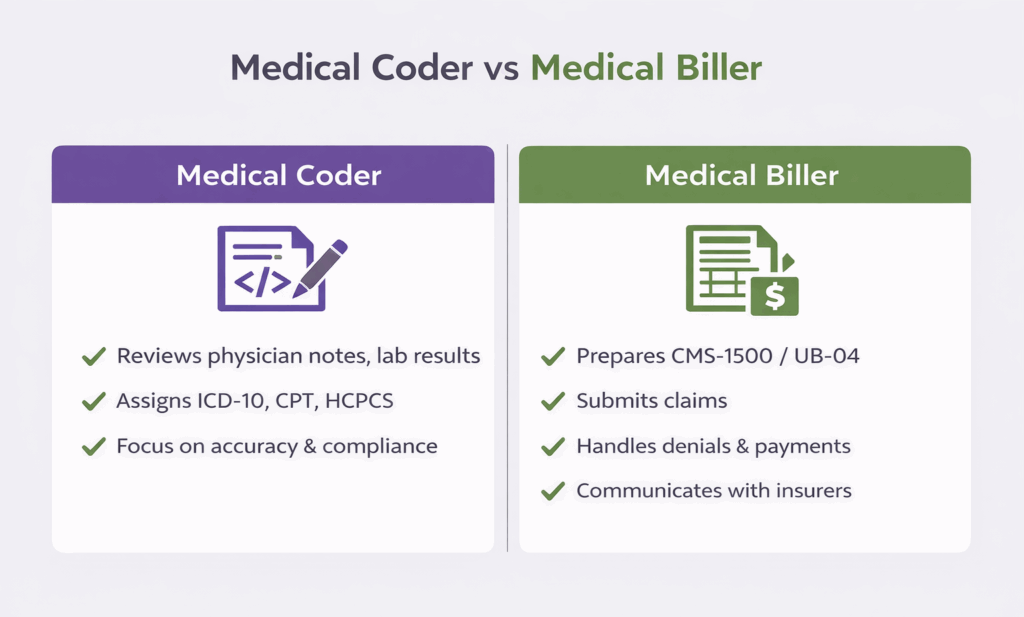
Medical coders review physician notes, operative reports, and diagnostic results to assign accurate ICD-10-CM codes, along with CPT and HCPCS codes that reflect the services provided. Their responsibility is to ensure coding accuracy and compliance with official guidelines.
Medical billers use these assigned codes to generate claims, submit them to insurance payers, and track them through the reimbursement process. Their responsibility is to ensure claims are processed correctly and payments are received.
The functional distinction is that coding focuses on interpreting medical documentation into coded data, while billing focuses on using that coded data for payment processing and revenue collection.
Type of Work
The type of work in medical coding is analytical and focused on documentation review, while the type of work in medical billing is administrative and focused on claim processing and payment tracking.
Medical coders perform data analysis by reviewing clinical documentation such as physician notes, operative reports, and lab results to assign accurate ICD-10-CM, as well as CPT codes and HCPCS codes. Their work requires the interpretation of medical records and the application of coding guidelines.
Medical billers perform administrative tasks such as claim preparation, claim submission, payment tracking, and patient billing. They also manage insurance follow-ups, handle denials, and post payments based on ERA/EOB data.
The workload difference is that coding is primarily analytical and detail-focused, while billing is primarily administrative and process-driven, with ongoing interaction in the reimbursement cycle.
Main Objective
The main objective of medical coding is to accurately represent clinical services using standardized codes, while the main objective of medical billing is to ensure providers receive payment for those services.
Medical coding focuses on assigning correct ICD-10-CM, CPT, and HCPCS codes that reflect the documented diagnoses and procedures. This ensures the clinical data is complete, precise, and compliant with coding guidelines.
Medical billing focuses on using these codes to generate claims, submit them to payers, and secure timely reimbursement. It ensures that services provided are translated into actual revenue.
The relationship is that accurate coding directly impacts billing outcomes. Incorrect or incomplete codes can lead to claim rejections, denials, or underpayment during the billing process.
Coding Systems Used
Medical coding uses standardized coding systems to represent diagnoses, procedures, and services, while medical billing relies on these codes to prepare and submit claims for reimbursement.
Medical coders assign codes using systems such as ICD-10-CM for diagnoses, CPT for medical procedures, and HCPCS Level II for supplies and services. These coding systems ensure that clinical services are converted into a universally recognized format.
Medical billers do not assign codes but use the codes provided by coders to create claims, complete forms such as CMS-1500 or UB-04, and submit them to insurance companies for payment.
Standardized coding frameworks ensure consistent communication between healthcare providers, insurance payers, and regulatory bodies. This consistency enables accurate claim processing, proper reimbursement, and reliable healthcare data reporting.
Interaction with Insurance Companies
Medical billers directly interact with insurance companies, while medical coders typically do not have direct communication with payers.
Medical billers submit claims to insurance providers, verify claim status, respond to payer requests, and handle payment-related inquiries. They are responsible for communicating with insurers to resolve issues that affect reimbursement.
Medical coders usually work internally with clinical documentation and do not contact insurance companies. However, their code accuracy directly affects how payers process claims.
Medical billers are also responsible for following up on denied or delayed claims, correcting claim issues, managing appeals, and ensuring that providers receive proper and timely reimbursement.
Place in the Revenue Cycle
Medical coding occurs before medical billing in the revenue cycle, as coders must first convert clinical documentation into standardized codes that billers use for claim creation.
The typical workflow follows this sequence: patient visit → clinical documentation → medical coding → claim generation → billing submission → insurance adjudication → payment posting and reimbursement.
Medical coders assign ICD-10-CM, CPT, and HCPCS codes based on documented services, which are then used by medical billers to prepare and submit claims to insurance companies.
Close coordination between coders and billers ensures claims are accurate and complete. This reduces errors, minimizes denials, and improves the likelihood of timely reimbursement.
Key Skills Required
Medical coding requires analytical and detail-oriented skills, while medical billing requires communication and process management skills.
Medical coders need strong attention to detail, in-depth knowledge of medical terminology, and the ability to accurately assign ICD-10-CM, CPT, and HCPCS codes based on clinical documentation. Their work depends on precision and adherence to coding guidelines.
Medical billers need strong communication skills, an understanding of claim processing workflows, and knowledge of financial and payer requirements. They handle claim submissions, follow-ups, payment posting, and patient billing.
The key difference is that coding relies more on analytical accuracy and documentation interpretation, while billing relies more on interpersonal communication and administrative handling of the reimbursement process.
How Do Medical Billing and Medical Coding Work Together in Healthcare?
Medical billing and medical coding work together in healthcare by converting clinical services into standardized codes and managing them through a medical billing process to ensure accurate reimbursement. Coding translates clinical documentation into ICD-10-CM, CPT, and HCPCS codes, while billing uses those codes to generate claims and track payments.
- Converting Medical Services into Codes – Coders assign codes based on patient documentation, ensuring diagnoses and procedures are represented accurately.
- Preparing the Medical Claim – Billers use these codes to prepare claims, completing forms such as CMS-1500 or UB-04 for submission to insurance payers.
- Submitting Claims to Insurance Companies – Claims are sent electronically or via paper, with billers verifying that coding and documentation meet payer requirements.
- Verifying and Processing Payments – Payments are posted into the medical billing system, which centralizes tracking, posting, and reconciliation.
- Managing Claim Denials and Follow-Ups – Billers handle denials or delayed claims, collaborating with coders if documentation or coding errors contributed to the issue.
- Ensuring Compliance and Accuracy – Coders and billers ensure claims comply with HIPAA, CMS, and payer rules to minimize errors and optimize reimbursement.
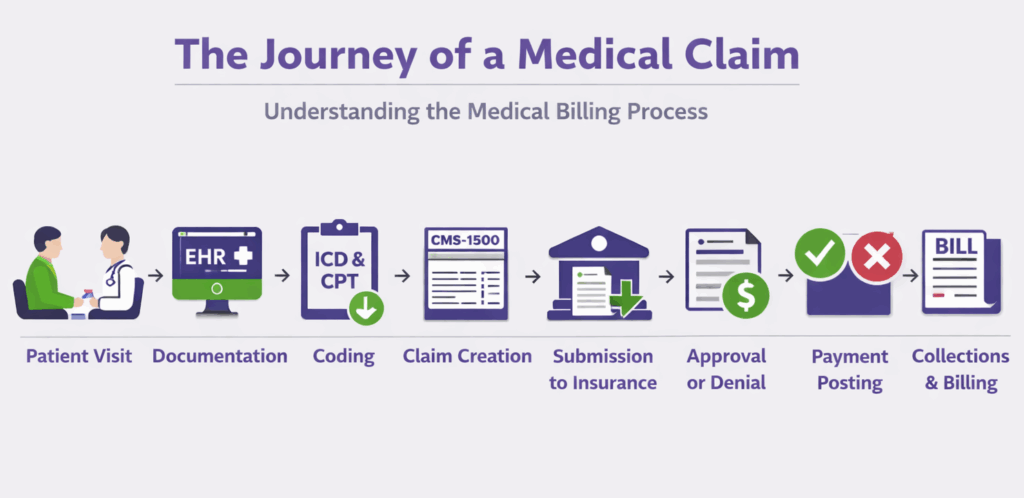
By linking accurate coding with efficient billing through a medical billing system, healthcare practices can reduce claim errors, improve cash flow, and maintain compliance, bridging clinical services directly to revenue collection.
What Is The Importance Of Medical Billing And Medical Coding?
Medical billing and medical coding are essential for ensuring healthcare providers receive accurate and timely reimbursement, supporting the financial sustainability of healthcare organizations.
The medical coding process converts diagnoses, treatments, and procedures into standardized ICD-10-CM, CPT, and HCPCS codes, enabling consistent, organized clinical documentation. This accurate coding forms the foundation for correct claim creation.
Billing and coding support the entire financial workflow, from patient registration and service documentation to claim submission and payment collection. Standardized coding and billing procedures allow providers to submit claims correctly to insurance companies, reducing errors and denials.
Proper billing and coding practices ensure compliance with HIPAA, CMS guidelines, and other healthcare regulations, minimizing the risk of fraud, penalties, or audits.
Effective billing and coding processes also improve healthcare facility performance by reducing billing errors, minimizing claim denials, and streamlining financial operations, ultimately enhancing revenue cycle efficiency.
What Are Common Challenges In Medical Billing And Coding?
Incorrect assignment of diagnosis or procedure codes can occur due to misinterpretation of medical records or a lack of updated coding knowledge.
Coding standards, payer policies, and healthcare regulations are regularly updated, requiring coders and billers to stay informed and continuously adapt.
Insurance companies may reject claims due to incorrect codes, incomplete information, or services not covered under a patient’s insurance plan. Different payers have varying rules, reimbursement structures, and documentation requirements, which complicates the billing process.
Missing or unclear details in medical records make it difficult for coders to assign accurate codes and for billers to submit proper claims. A large volume of patient records and claims often creates pressure to maintain speed and accuracy.
Miscommunication between physicians, coders, and billing staff can lead to errors or delays in claim processing. Problems with electronic health records (EHR), billing software, or system integrations can also disrupt workflows and cause processing delays.