
CPT code 99214 is an evaluation and management code used to report an office or outpatient visit for an established patient that requires either moderate-complexity medical decision making or 30–39 minutes of total time on the date of the encounter. Procedure code 99214 is one of the most frequently billed codes across primary care and specialty practices.
Part of E/M codes, this code is used for established patients managing chronic conditions, new problems with moderate risk, or visits involving prescription drug management. Under the 2021 AMA E/M guidelines, code 99214 CPT may be selected based on either the level of medical decision making (MDM) or total time.
The history and physical exam are no longer used to determine the code level, though they must remain medically appropriate to the visit. High 99214 utilization draws payer scrutiny, which is why many practices route E/M coding review through professional medical billing services.
What Is the Description of CPT Code 99214?
99214 CPT code description as defined by the AMA is: “Office or other outpatient visit for the evaluation and management of an established patient, which requires a medically appropriate history and/or examination and moderate level of medical decision making. When using total time on the date of the encounter for code selection, 30-39 minutes of total time is spent on the date of the encounter.”
99214 CPT code applies only to established patients. The ones defined as patients who have received professional services from the physician or another physician of the same specialty in the same group practice within the past three years. New patient visits of comparable complexity are reported under CPT code 99204.
What Are the Two Pathways to Qualify for CPT Code 99214: MDM vs. Total Time?
Per the 2021 AMA E/M guidelines, CPT code 99214 may be selected using either of two independent pathways:
- Medical Decision Making (MDM) Pathway: The visit qualifies for procedure code 99214 when the overall MDM level reaches “moderate” complexity, based on the three MDM elements (problems addressed, data reviewed, and risk). History and examination are performed as medically appropriate, but do not determine the code level.
- Total Time Pathway: The visit qualifies for CPT code 99214 when the physician or qualified health care professional spends 30–39 minutes of total time on the date of the encounter, regardless of the MDM level. Total time includes both face-to-face and non-face-to-face time personally spent by the billing provider on the date of the encounter, including review of records prior to the visit, obtaining history, examination, counseling, ordering tests, documenting in the EHR, and care coordination.
Only one pathway needs to be met. A visit with extensive time spent but lower MDM complexity may still qualify for code 99214 CPT under the time pathway, and vice versa.
What Are the Three Elements of Medical Decision Making for CPT Code 99214?
Moderate MDM supporting CPT code 99214 is determined by meeting or exceeding the moderate level in at least two of the following three elements:
- Number and Complexity of Problems Addressed: Typically reflects one or more chronic illnesses with exacerbation, progression, or side effects of treatment; two or more stable chronic illnesses; an undiagnosed new problem with uncertain prognosis; or an acute illness with systemic symptoms
- Amount and/or Complexity of Data Reviewed and Analyzed: Includes ordering or reviewing multiple unique tests, independent interpretation of a test performed by another provider, or discussion of management or test interpretation with an external physician or other qualified source
- Risk of Complications, Morbidity, or Mortality of Patient Management: Typically reflects prescription drug management, a decision regarding minor surgery with identified patient or procedure risk factors, or a decision regarding elective major surgery without identified risk factors
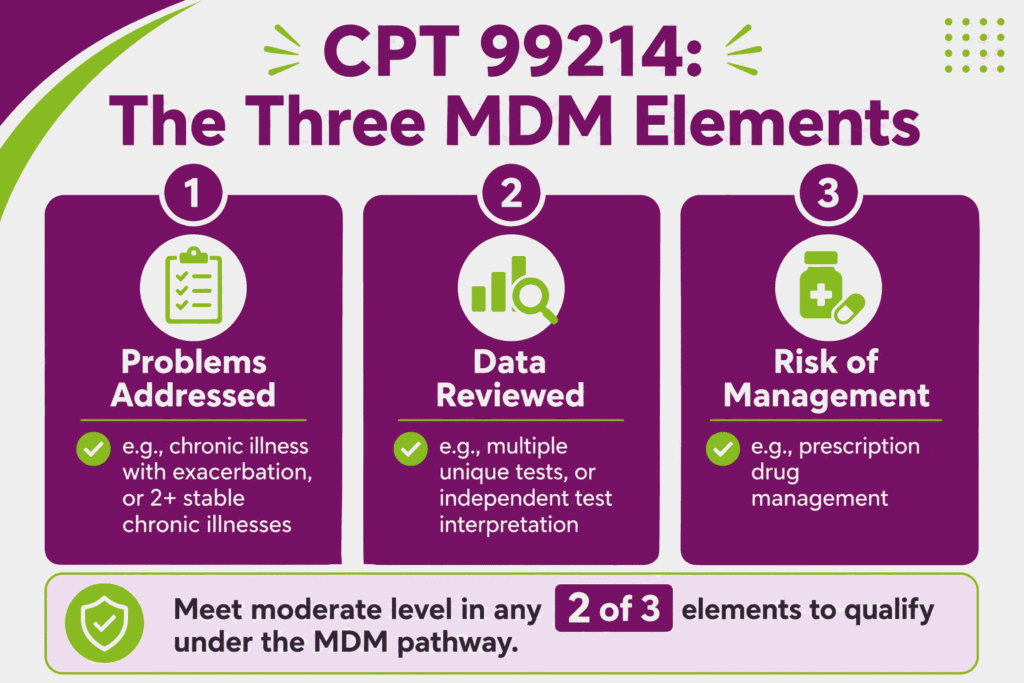
Meeting moderate-level criteria in at least two of the three elements supports CPT code 99214 under the MDM pathway.
How Much Total Time is Required for CPT Code 99214 Under the Time-Based Pathway?
Under the time-based pathway, CPT code 99214 requires 30–39 minutes of total time spent by the billing physician or qualified health care professional on the date of the encounter. This is a defined band as visits totaling 20–29 minutes fall to the code CPT 99213, while visits totaling 40–54 minutes qualify for the CPT 99215 code.
Total time must be personally performed by the billing provider and clearly documented, including a notation of the total minutes spent and a description of the activities performed (e.g., chart review, counseling, order entry, documentation). Time spent by clinical staff is not counted toward the billing provider’s total time for procedure code 99214.
How Does CPT Code 99214 Differ From CPT 99213 and 99215?
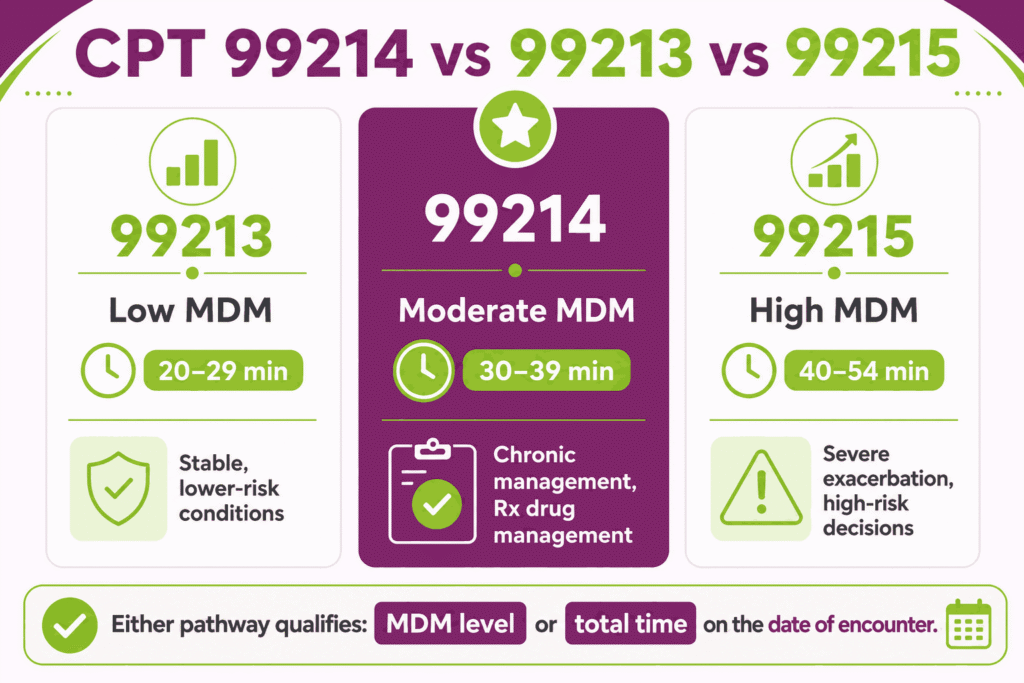
These three established patient E/M codes are distinguished by MDM level and total time:
- CPT Code 99213: Low-complexity MDM or 20–29 minutes total time. Used for established patients with stable, lower-risk conditions
- CPT Code 99214: Moderate-complexity MDM or 30–39 minutes total time. Used for established patients with one or more chronic conditions requiring management, moderate-risk new problems, or prescription drug management
- CPT Code 99215: High-complexity MDM or 40–54 minutes total time. Used for established patients with severe exacerbations, high-risk conditions, or decisions involving significant risk to life or bodily function
The defining distinction between the 99214 CPT code and the 99215 procedure code is the risk and complexity of management decisions. For example, initiating or adjusting one chronic medication generally supports moderate complexity (99214), whereas drug therapy requiring intensive monitoring for toxicity, or a condition posing a threat to life or bodily function, supports high complexity (99215).
Can CPT 99214 Be Billed by Non-Physician Practitioners Under Incident-To Rules?
Yes, CPT code 99214 may be billed by non-physician practitioners (NPPs), including nurse practitioners and physician assistants. They can do it either under their own NPI at the standard NPP payment rate (typically 85% of the physician fee schedule for Medicare), or under “incident-to” billing rules at 100% of the physician rate when all incident-to requirements are met.
Incident-to billing for procedure code 99214 requires that the service be furnished as part of a course of treatment initiated by the supervising physician. The supervising physician must be physically present in the office suite (though not necessarily in the room) at the time the service is rendered. Lastly, the visit must not involve a new problem requiring independent physician evaluation. When incident-to requirements are not met, CPT code 99214 must be billed under the NPP’s own NPI.
What Are the Telehealth Billing Rules for CPT Code 99214?
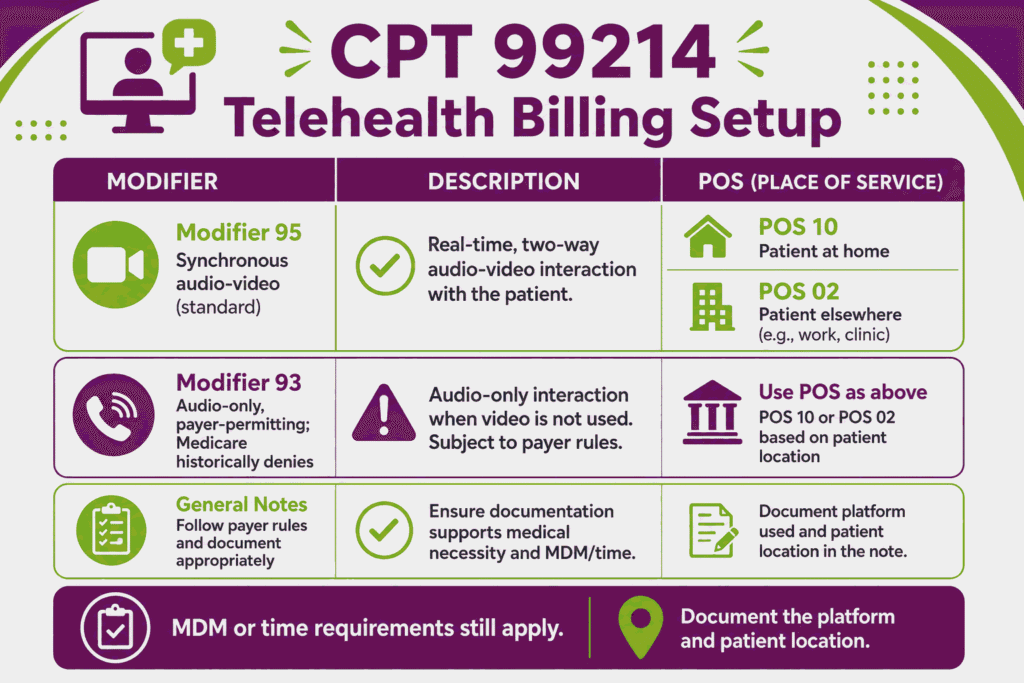
CPT code 99214 remains on the Medicare telehealth services list and may be billed for visits delivered via real-time, interactive audio-video technology. Per CMS and current 2026 telehealth billing guidance:
- Modifier 95 is appended to CPT code 99214 to indicate the service was delivered via synchronous audio-video telecommunications technology
- Place of Service 10 is used when the patient is located in their home at the time of the telehealth visit; Place of Service 02 is used when the patient is located somewhere other than home
- Audio-only visits require modifier 93, where the payer permits audio-only billing for the 99214 CPT code. Medicare has historically not adopted audio-only E/M billing for established patient office visits and may deny claims billed this way; verify current MAC policy before billing audio-only
- The visit must still meet either the MDM or total-time requirement for CPT code 99214, regardless of delivery modality, and documentation must reflect the technology platform used and confirm the encounter was conducted via live audio-video communication
Telehealth policy for E/M codes changes frequently year to year based on Congressional extensions of Medicare telehealth flexibilities. So, providers should verify current-year telehealth eligibility for procedure code 99214 with their MAC before billing.
What are the Modifiers for CPT Code 99214?
CPT 99214 code can be reported with specific modifiers to indicate special circumstances or services performed. Common modifiers include 25, 24, 95, FS, and GQ.
Modifier 25: Significant, Separately Identifiable E/M on Same Day as Procedure
Modifier 25 is appended to CPT code 99214 when a significant, separately identifiable E/M service is performed on the same day as a minor procedure by the same provider. The E/M service must address a problem or complexity beyond the routine pre- and post-procedure work bundled into the procedure code. Append modifier 25 to 99214 CPT code and ensure documentation clearly distinguishes the E/M work from the procedure-related work.
Modifier 24: Unrelated E/M During Post-Op Global Period
Modifier 24 is appended to CPT code 99214 when the established patient visit is unrelated to a prior surgical procedure and occurs during that procedure’s postoperative global period. Append modifier 24 and document that the condition addressed during the visit is clinically unrelated to the surgery, to support separate reimbursement for procedure code 99214 despite the active global period.
Modifier 95: Synchronous Telehealth Service
Modifier 95 is appended to CPT code 99214 to indicate the visit was conducted via real-time, interactive audio and video telecommunications technology. Modifier 95 is currently the most widely accepted telehealth modifier across Medicare and commercial payers for code 99214 CPT delivered via live video visit, paired with the appropriate POS code (02 or 10).
Modifier FS: Split or Shared E/M Visit
Modifier FS is appended to CPT code 99214 when the visit is performed as a split (or shared) E/M service between a physician and a non-physician practitioner in a facility setting, where both providers from the same group jointly perform the visit. Modifier FS identifies that the substantive portion of the visit, defined by CMS as either more than half of the total time or the performance of the MDM, was performed by the billing practitioner. Append modifier FS to procedure code 99214 when billing a split/shared visit in an institutional setting.
Modifier GQ: Asynchronous Telehealth Service
Modifier GQ is appended to CPT code 99214 to indicate the service was delivered via an asynchronous (store-and-forward) telecommunications system, an interaction in which information is transmitted for review at a later time rather than in real time. Modifier GQ has historically been limited to use under federal telemedicine demonstration programs in Alaska and Hawaii. Providers outside these programs should verify with their MAC whether modifier GQ is applicable before appending it to the 99214 CPT code, as most payers require synchronous (modifier 95) telehealth for established patient E/M visits.
Which Documents Are Required For CPT Code 99214?
Documentation for CPT code 99214 must support either the MDM pathway or the total-time pathway, and must reflect medically appropriate history and examination.
Required documents checklist:
- Chief complaint and history of present illness relevant to the visit
- Medically appropriate review of systems and physical examination findings
- Documentation of the number and status of problems addressed at the visit (e.g., chronic conditions with exacerbation, new problems with uncertain prognosis)
- Documentation of data reviewed, such as labs ordered or reviewed, imaging reviewed, independent interpretation of tests, or discussion with external providers
- Documentation of risk, like medication management decisions, dosage changes, and rationale for treatment decisions
- Assessment and plan reflecting the medical decision-making for each problem addressed
- If billing under the time pathway: total time spent on the date of encounter, with a description of activities performed
- If telehealth: documentation of the technology platform used, patient location, and confirmation of synchronous audio-video communication
- If split/shared visit: documentation identifying which provider performed the substantive portion of the visit
What is the Cost of CPT Code 99214?
The cost of CPT code 99214 varies by place of service, payer, geographic location, and whether the billing provider is a Qualifying APM Participant (QP).
RVUs & Medicare Payment
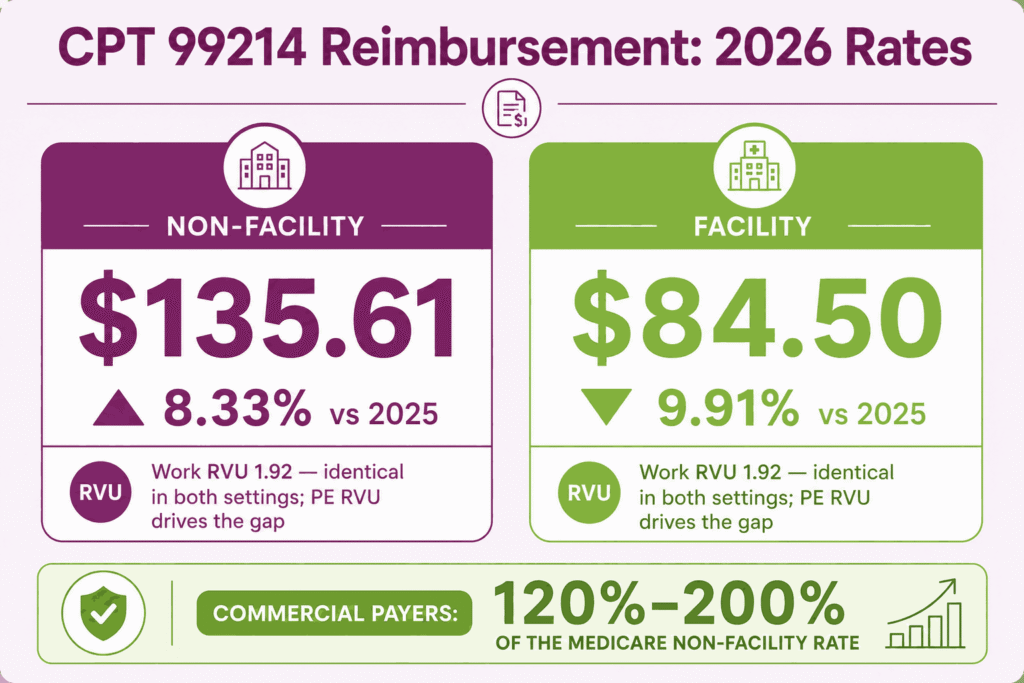
CPT code 99214 carries a work RVU of 1.92 for CY 2026. In the non-facility (office) setting, the total RVU is 4.06 (1.92 work + 2.00 practice expense + 0.14 malpractice), yielding a Medicare national average payment of $135.61 using the CY 2026 non-QP conversion factor of $33.4009, or $136.29 using the QP conversion factor of $33.5675. This represents an 8.33% increase from the 2025 non-facility rate of $125.18, driven by CMS-1832-F’s increase to non-facility PE RVUs for office visit codes.
In the facility setting (hospital outpatient, etc.), CPT code 99214 has a Medicare national average payment of $84.50 for CY 2026. This is a 9.91% reduction from the 2025 facility rate of $93.80, reflecting the CY 2026 indirect PE methodology change that reduces facility-based PE RVU allocations. The work RVU of 1.92 is identical across both settings; the payment difference is driven entirely by the practice expense RVU component.
Commercial Payers
Commercial payers commonly use the Medicare physician fee schedule rate for CPT code 99214 as a benchmark, typically reimbursing at 120% to 200% of the Medicare non-facility rate. This depends on the contract, network status, and geographic market. Major commercial payers, including BCBS, UnitedHealthcare, Aetna, and Cigna, each set their own fee schedules for the 99214 CPT code, and rates can vary significantly.
Place-of-Service & Geographic Adjustments
CPT code 99214 carries substantially different payment rates by place of service, $135.61 non-facility versus $84.50 facility for CY 2026. This is driven entirely by the practice expense RVU component, since the work RVU (1.92) and malpractice RVU are identical across settings. GPCIs adjust all three RVU components by locality. For example, the same procedure code 99214 pays approximately $121.38 in rural Iowa (lower GPCI) versus $145.67 in Manhattan (higher GPCI), roughly a 20% geographic variation.
Telehealth visits billed with modifier 95 and POS 02 or 10 are generally paid at the non-facility rate under the current Medicare telehealth payment policy. Though providers should confirm this with their MAC, as telehealth payment policy is subject to periodic change.
What Are Example Clinical Scenarios or Use Cases for CPT Code 99214?
99214 CPT code applies to established patient visits involving moderate-complexity medical decision making or 30–39 minutes of total time, commonly involving chronic disease management, prescription drug management, or new problems with moderate risk.
Scenario 1: Uncontrolled Hypertension Follow-Up With Medication Adjustment
ICD-10: I10 (Essential hypertension)
An established patient returns for follow-up of hypertension, with home blood pressure logs showing readings consistently above goal despite current therapy. The physician reviews the blood pressure log (data reviewed), addresses one chronic illness with exacerbation (problem addressed), and increases the dosage of an antihypertensive medication, discussing potential side effects with the patient (prescription drug management — risk). This meets moderate MDM in at least two of three elements, supporting CPT code 99214.
Scenario 2: Type 2 Diabetes Management With Lab Review and Treatment Change
ICD-10: E11.9 (Type 2 diabetes mellitus without complications)
An established patient with type 2 diabetes presents for a routine follow-up. The physician reviews recent A1C and lipid panel results (data reviewed), addresses a chronic illness with stable but suboptimal control (problem addressed), and adjusts the patient’s metformin dosage while discussing the addition of a second agent (prescription drug management — risk). The combination of data review and medication management supports moderate MDM, and procedure code 99214 is reported.
Scenario 3: COPD Exacerbation Requiring Multiple Clinical Interventions
ICD-10: J44.1 (Chronic obstructive pulmonary disease with acute exacerbation)
An established patient with COPD presents with increased dyspnea and productive cough. The physician addresses an acute illness with systemic symptoms (problem addressed), orders a chest X-ray and reviews prior pulmonary function test results (data reviewed), and prescribes a course of oral corticosteroids and adjusts the patient’s inhaler regimen (prescription drug management — risk). This visit meets moderate MDM across all three elements, supporting CPT code 99214.
Scenario 4: Telehealth Visit for Chronic Depression With Prescription Management
ICD-10: F33.1 (Major depressive disorder, recurrent, moderate)
An established patient with recurrent major depressive disorder is seen via a real-time audio-video telehealth visit from home. The physician reviews the patient’s symptom diary and PHQ-9 score (data reviewed), addresses the chronic condition with ongoing symptoms (problem addressed), and adjusts the antidepressant dosage based on side-effect reports (prescription drug management — risk). CPT code 99214 is reported with modifier 95 and Place of Service 10, with documentation confirming the synchronous audio-video platform used and the patient’s home location.
What Are the CPT Code 99214 Rules To Ensure Successful Reimbursement?
Follow CMS and payer rules for bundling, frequency, split/shared billing, and audit risk management. Meeting these rules reduces denials and supports defensible coding for the 99214 CPT code.
Bundling / NCCI / Same-Day Procedure Rules
CPT code 99214 may be billed alongside a minor procedure on the same date only when a significant, separately identifiable E/M service is performed and modifier 25 is appended. If the E/M work is limited to the routine pre- and post-procedure assessment bundled into the procedure code, procedure code 99214 must not be separately reported.
NCCI edits will bundle CPT code 99214 with same-day procedures absent modifier 25 and supporting documentation demonstrating a distinct, medically necessary E/M service beyond the procedure’s inherent evaluation component.
Units, MUEs & E/M Frequency Rules
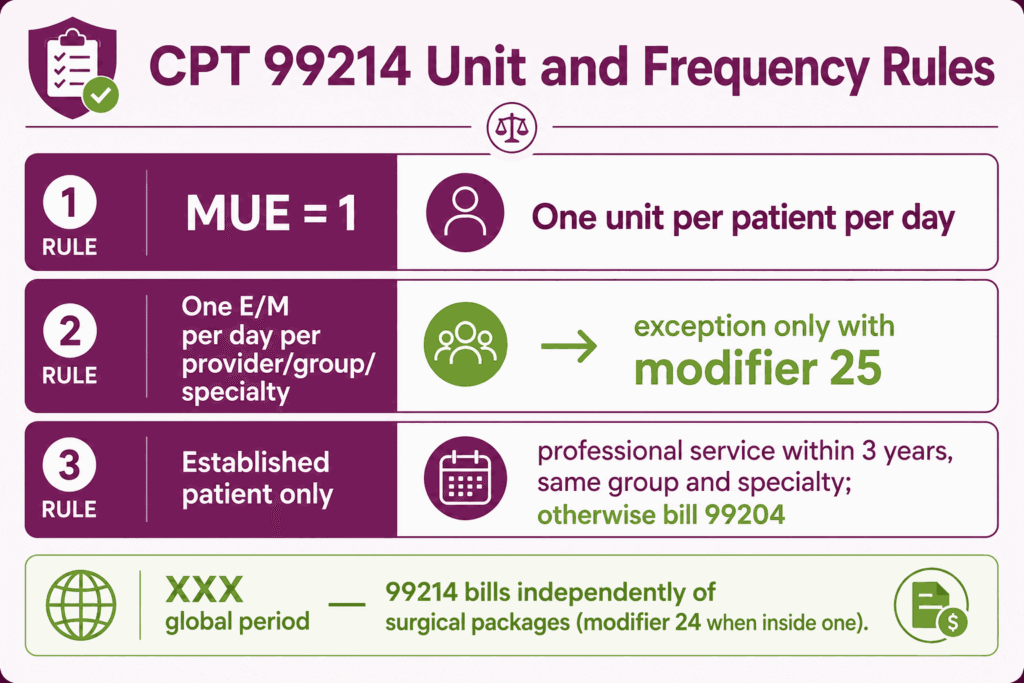
CPT code 99214 is billed as one unit per patient per day, as Medicare’s MUE for this code is 1. Per CMS policy:
- Only one E/M visit per patient per day may be billed by the same provider or group/specialty, except when modifier 25 supports a separately identifiable second E/M or procedure
- CPT code 99214 carries a 0-day global period (XXX). There is no global surgical package associated with this code, and it may be billed independently of any procedure’s global period using modifier 24 when applicable.
- Established patient status must be verified. The patient must have received a professional service from the same physician or a physician of the same specialty in the same group within the past three years; otherwise, the appropriate new patient code (99204) applies
Split/Shared Visit Rules and Teaching Physician Requirements
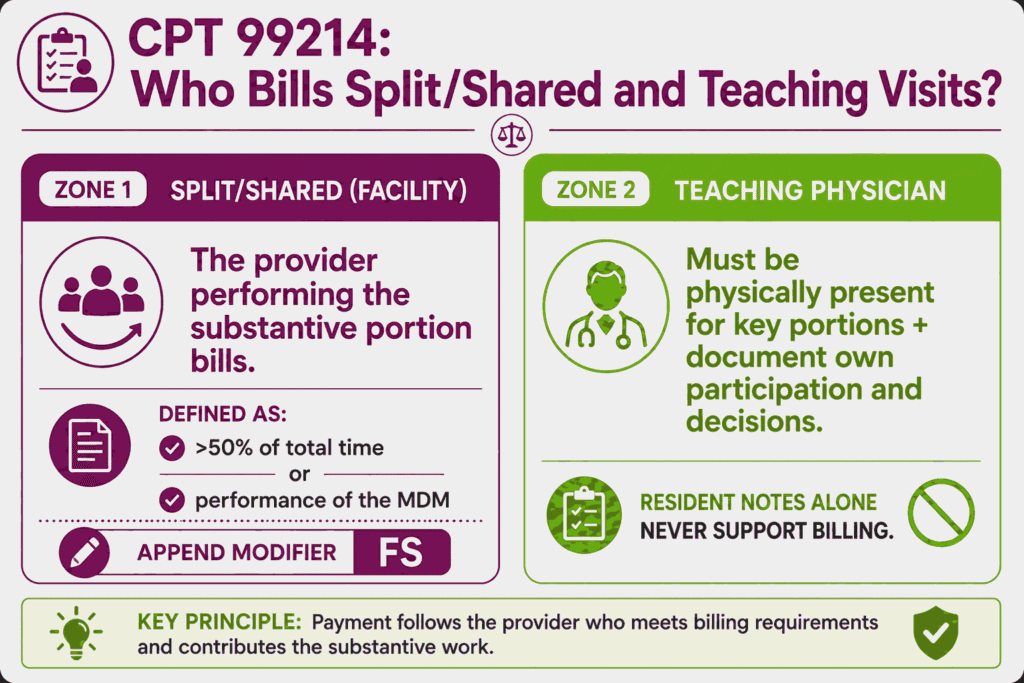
When CPT code 99214 is performed as a split (or shared) visit between a physician and a non-physician practitioner in a facility setting, CMS requires that the “substantive portion” of the visit be used to determine which provider bills the service. This substantive portion is defined as either more than half of the total time spent or the performance of the medical decision-making.
Modifier FS is appended to identify the visit as split/shared. The billing provider (physician or NPP) must be identified based on who performed the substantive portion, and documentation must clearly attribute the relevant time or MDM components to that provider.
For teaching physician settings, CPT code 99214 billed under a resident’s involvement requires the teaching physician to be physically present for the key portions of the service and to document their own participation, findings, and management decisions. A resident’s documentation alone, even if thorough, does not support billing under the teaching physician’s NPI without the required attestation.
Audit Risk and Documentation Integrity for High-Volume 99214 Billers
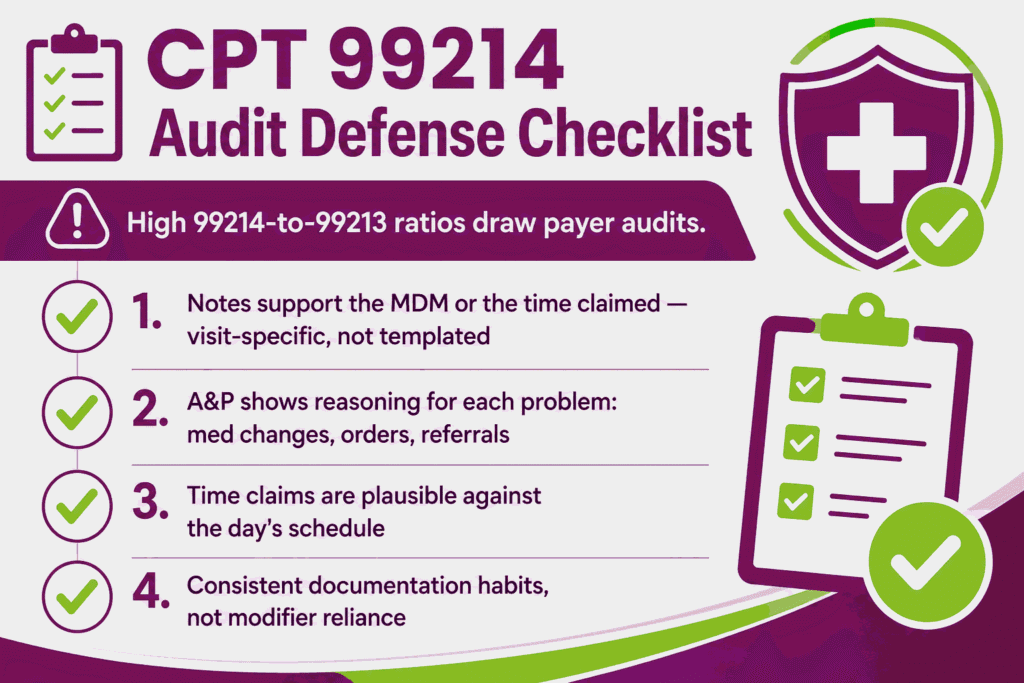
CPT code 99214 is one of the most heavily audited E/M codes due to its high utilization across primary care and specialty practices. Providers and practices with a high percentage of E/M visits billed at the 99214 level relative to 99213 and 99212 face elevated audit risk from Medicare contractors and commercial payers. To support audit defense for procedure code 99214:
- Documentation must independently support either the MDM elements or the total time claimed. Templated or auto-populated EHR notes that do not reflect visit-specific clinical reasoning are a common audit finding
- The assessment and plan must reflect the actual decision-making process for each problem addressed, including the rationale for medication changes, test orders, or referrals
- When billing under the time pathway, the total time documented must be plausible relative to the visit’s complexity and the provider’s typical daily schedule
- Consistent, defensible documentation practices, rather than reliance on a single modifier or coding habit, are the most effective protection against downcoding or recoupment during payer audits
Top Reasons For Denials Specific To 99214 & Quick Remedies
- Insufficient MDM Documentation to Support Moderate Complexity: Prevent by ensuring the assessment and plan documents at least two of the three MDM elements at the moderate level, problem complexity, data reviewed, and risk, with specific clinical detail rather than generic statements.
- Time-Based Billing Without Adequate Time Documentation: Prevent by documenting the total minutes spent on the date of the encounter, along with a description of the activities performed, when billing under the 30–39 minute time pathway.
- Telehealth Claims Rejected for POS/Modifier Mismatch: Prevent by confirming modifier 95 is paired with the correct POS code (10 for patient at home, 02 for other locations) and that the documentation confirms synchronous audio-video technology was used.
- New Patient Billed as Established (or Vice Versa): Prevent by verifying the three-year lookback for prior professional services with the same physician or same-specialty physician in the same group before selecting 99214 CPT code over a new patient code.
What Stops Providers From Simply Always Billing 99214 for Established Patient Visits?
The level of medical decision-making or time documented on the date of service. Billing 99214 for a visit that only supports 99213 is upcoding, and billing it when 99215 is warranted means leaving reimbursement on the table. This is precisely why understanding how CPT codes are assigned matters, as the code is not a choice but a reflection of what the documentation actually supports.