
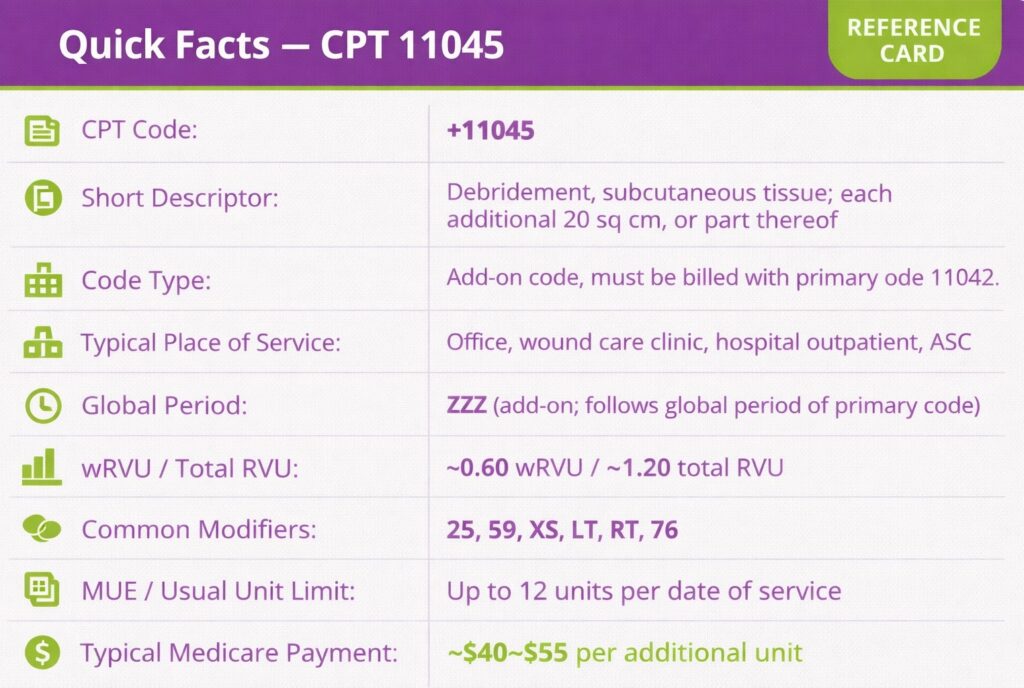
CPT code 11045 is an add-on code used to report debridement of subcutaneous tissue (including epidermis and dermis, if performed) for each additional 20 square centimeters, or part thereof, beyond the first 20 sq cm covered by the primary code. It is reported in conjunction with CPT code 11042 and cannot be billed as a standalone service. When it comes to podiatry billing services, 11045 applies in outpatient, office, and facility-based settings where wound size exceeds the base threshold and requires extended subcutaneous tissue removal during the same encounter.
What Is the Description of CPT Code 11045?
CPT code 11045 is defined by the AMA as: “Debridement, subcutaneous tissue (includes epidermis and dermis, if performed); each additional 20 sq cm, or part thereof (List separately in addition to code for primary procedure).”
This add-on code captures the incremental work performed when subcutaneous debridement extends beyond the initial 20 sq cm reported under CPT 11042. Each unit of 11045 represents one additional 20 sq cm increment, or any portion thereof, of subcutaneous tissue debrided during the same session. Code selection is driven by the deepest tissue layer actually removed, not the deepest layer exposed.
How Is Surface Area Measured and Units Calculated for CPT Code 11045?
Surface area is calculated by measuring the total wound dimensions, length multiplied by width, in square centimeters. The deepest layer of tissue debrided across the entire wound surface determines the applicable code family. For subcutaneous debridement, CPT 11042 covers the first 20 sq cm. CPT 11045 code is then reported for each additional 20 sq cm, or part thereof.
How Does CPT Code 11045 Relate to Primary Code 11042?
The code CPT 11045 is an add-on code and is only reportable when CPT code 11042 has also been billed for the same encounter. Both of these CPT codes for podiatry are part of the wound care & debridement section. CPT 11042 covers subcutaneous debridement of the first 20 sq cm; 11045 extends that reporting for each additional 20 sq cm increment. Without 11042 on the claim, 11045 will be denied outright. The two codes share the same depth classification and must reflect the same wound or combined wound surface when multiple same-depth wounds are aggregated per session.
What Are the Modifiers for CPT Code 11045?
11045 CPT code can be reported with specific modifiers to reflect distinct procedural circumstances, anatomical site, or service repetition.
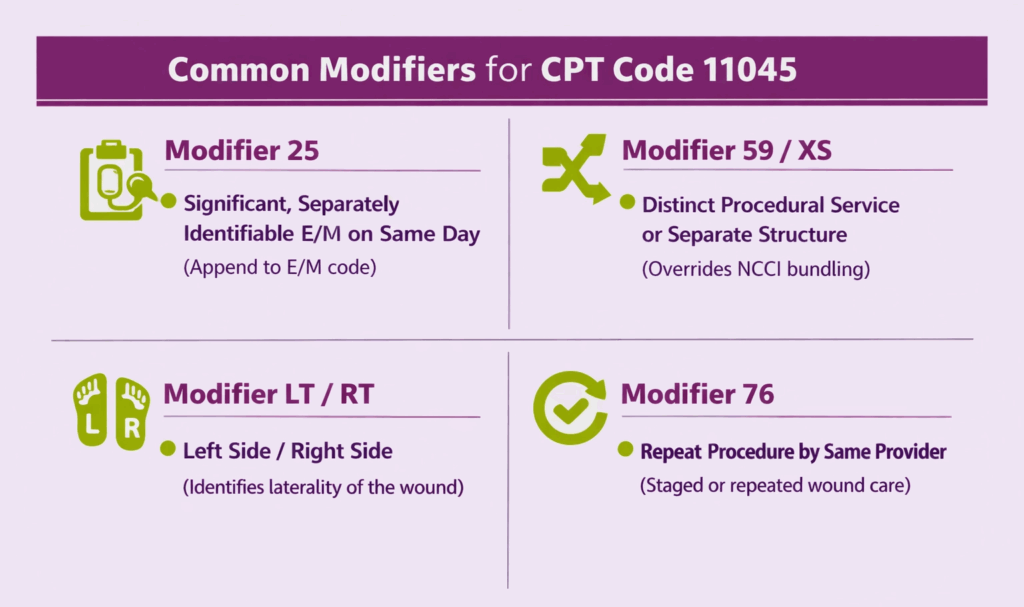
Modifier 25: Significant, Separately Identifiable E/M on Same Day
Modifier 25 is appended to the E/M code, not to 11045, when a significant and separately identifiable evaluation and management service is performed on the same day as the debridement. Document that the E/M addressed a problem or decision separate from the debridement itself.
Modifier 59: Distinct Procedural Service
Modifier 59 is used when code CPT 11045 is performed as a distinct service from another procedure billed on the same date, overriding NCCI bundling edits where applicable. Documentation must confirm the services were separate in site, depth, or clinical indication.
Modifier XS: Separate Structure
Modifier XS is a more specific alternative to modifier 59, used when debridement is performed on a separate anatomical structure on the same date. It signals that the service involved a different body site rather than simply a different procedure. Use modifier XS when the payer accepts the X-modifier subset and documentation identifies distinct wound locations.
Modifier LT/RT: Left Side / Right Side
Modifiers LT and RT are used to identify the laterality of the wound when debridement is performed on an extremity or other bilateral anatomical site. Apply when payer policy or claim submission requirements specify laterality for wound care services. Accurate laterality reporting reduces processing delays on claims involving multiple limb wounds.
Modifier 76: Repeat Procedure by Same Provider
Modifier 76 is used when the same provider performs the same debridement procedure on the same patient on the same date, typically in a staged or repeated wound care session. Document the clinical reason for repetition and confirm the payer accepts modifier 76 for wound care codes prior to submission.
Which Documents Are Required For CPT Code 11045?
Documentation for 11045 CPT code must support medical necessity, confirm the depth of tissue debrided, and justify the reported surface area beyond the initial 20 sq cm.
Required documents checklist:
- Wound assessment with total surface area documented in sq cm (length × width per wound)
- Confirmation of tissue depth debrided, specifically that the subcutaneous tissue was reached and removed
- Description of devitalized, necrotic, or infected tissue necessitating debridement
- Identification of each wound location and laterality, where applicable
- Calculation of the total combined surface area when multiple same-depth wounds are aggregated
- Operative or procedure note documenting the method of debridement (sharp excision, surgical instrument)
- Pre- and post-debridement wound measurements when available
- Diagnosis codes supporting medical necessity (e.g., diabetic ulcer, pressure injury, post-traumatic wound)
- Provider signature with date and time of service
- Accurate place-of-service designation
What Is the Cost of CPT Code 11045?
The cost of CPT 11045 code varies by the number of units billed, payer, place of service, and geographic location.
RVUs & Medicare Payment Per Unit
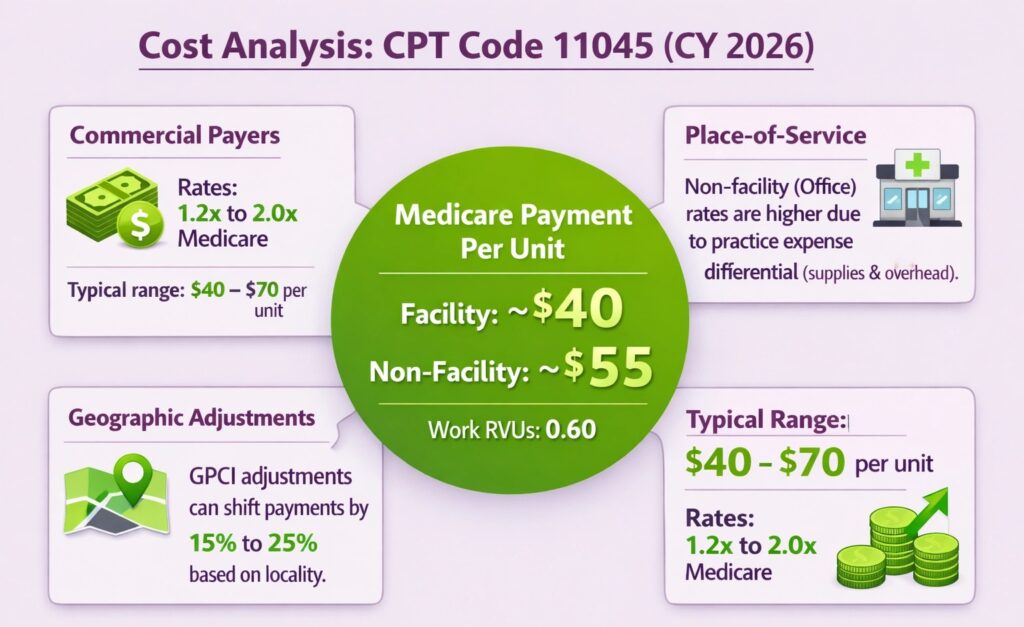
11045 code CPT carries approximately 0.60 work RVUs per unit. For CY-2026, the national Medicare facility payment is approximately $40 per unit, and the non-facility payment is approximately $55 per unit, reflecting the updated conversion factor of $33.40 and the –2.5% efficiency adjustment applied to surgical codes.
Commercial Payers
Commercial payers reimburse CPT 11045 at negotiated rates that generally range from 1.2× to 2.0× Medicare rates, depending on the contract and network status. Allowed amounts per unit typically range from $40 to $70 for non-facility settings among major commercial payers.
Place-of-Service & Geographic Adjustments
Non-facility (office) rates are higher than facility rates for podiatry code11045 due to the practice expense differential. The non-facility rate accounts for supplies, instruments, and overhead absorbed by the provider’s office. Facility rates apply when debridement is performed in a hospital outpatient department or ambulatory surgical center, where the facility separately bills for equipment and supply costs.
GPCI adjustments apply to all three RVU components, work, practice expense, and malpractice, and can increase or decrease per-unit payment by 15 to 25 percent depending on locality.
What Are Example Clinical Scenarios or Use Cases for CPT Code 11045?
CPT code 11045 applies whenever subcutaneous debridement extends beyond the first 20 sq cm covered by CPT 11042 during the same encounter.
Scenario 1: Diabetic Foot Ulcer Exceeding 20 sq cm
ICD-10: E11.621 (Type 2 diabetes mellitus with foot ulcer)
A patient with poorly controlled Type 2 diabetes presents with a non-healing plantar foot ulcer measuring 46 sq cm with necrotic subcutaneous tissue. The provider performs sharp debridement to the subcutaneous layer across the entire wound surface. CPT 11042 is reported for the first 20 sq cm, and CPT 11045 is reported for 2 additional units, one for the next 20 sq cm and one for the remaining 6 sq cm.
Scenario 2: Pressure Ulcer with Extensive Necrotic Subcutaneous Tissue
ICD-10: L89.313 (Pressure ulcer of right buttock, stage 3)
An elderly patient presents with a stage 3 pressure ulcer on the right buttock measuring 55 sq cm with significant necrotic subcutaneous tissue requiring surgical removal. Debridement is performed to the subcutaneous layer across the full wound surface. CPT 11042 is billed for the initial 20 sq cm, and CPT 11045 is reported for 2 additional units.
Scenario 3: Post-Traumatic Wound Requiring Multi-Site Debridement
ICD-10: S81.802A (Unspecified open wound of left lower leg, initial encounter)
A patient presents following a traumatic injury with two open wounds on the left lower leg, one measuring 22 sq cm and a second measuring 18 sq cm. Both were debrided to the subcutaneous level during the same session. The provider combines the surface areas (40 sq cm total), reports CPT 11042 for the first 20 sq cm, and adds one unit of procedure code11045 for the remaining 20 sq cm.
What Are the CPT Code 11045 Rules To Ensure Successful Reimbursement?
Follow payer and policy rules for documentation, coding, bundling, units, and add-on code relationships. Meeting these rules reduces denials and ensures correct payment.
Bundling / NCCI / Same-Day Procedure Rules
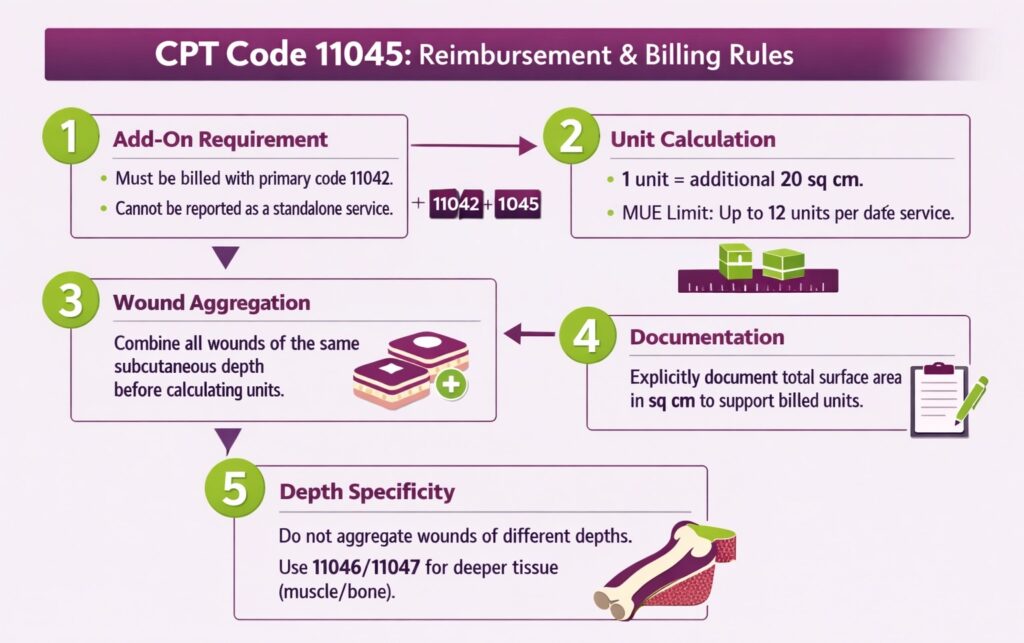
CPT 11045 is an add-on code and, by definition, cannot be reported without the primary code CPT 11042 on the same claim. If 11042 is absent or denied, 11045 will be automatically denied as a standalone service. When debridement involves deeper tissue levels, muscle (11043) or bone (11044), in addition to subcutaneous tissue, the correct add-on code for those deeper levels is 11046 or 11047, respectively, not 11045.
Units, MUEs & Add-On Code Billing Rules
CPT 11045 is billed in units, with each unit representing one additional 20 sq cm increment or part thereof. CMS sets a Medically Unlikely Edit (MUE) for CPT 11045 at up to 12 units per date of service per provider.
- Combine all wounds debrided to the same subcutaneous depth in the same session before calculating units. Do not bill separate 11042 + 11045 sets for each individual wound of the same depth.
- Wounds of different tissue depths are billed under their respective base codes and corresponding add-on codes. Do not aggregate wounds of different depths into a single 11042 + 11045 claim.
- Document the total surface area in sq cm explicitly in the procedure note to support the number of units billed. Payers will audit unit counts against documented measurements.
Top Reasons For Denials Specific To 11045 & Quick Remedies
- Missing Primary Code 11042: Prevent by always submitting 11045 as a line item paired with 11042 on the same claim date. 11045 cannot stand alone.
- Incorrect Tissue Depth Classification: Prevent by confirming the provider’s note specifies that subcutaneous tissue was reached and debrided. Epidermis/dermis-only debridement does not support 11042 or 11045.
- Incorrect Aggregation of Multi-Depth Wounds: Prevent by coding each tissue depth level separately and applying the correct add-on code (11045 for subcutaneous, 11046 for muscle/fascia) rather than consolidating all wounds under 11045.
- MUE Exceeded Without Documentation: Prevent by ensuring total documented surface area mathematically supports the number of units billed and that procedure notes reflect the full wound scope before submission.
Is CPT Code 11045 Considered a Standalone Code or Part of a Broader Coding System?
CPT 11045 is a standalone add-on code, but it exists within a much larger classification structure. Understanding what medical CPT codes are at a foundational level helps clarify why debridement is broken into separate codes by depth and tissue type. Each one represents a distinct, billable service rather than a variation of the same procedure.