CPT code 33208 reports the insertion or replacement of a permanent dual-chamber pacemaker system, with transvenous electrodes placed in both the right atrium and the right ventricle. The code covers the generator and both leads as one service.
CPT 33208 answers to a National Coverage Determination, and that changes how the claim behaves. Medicare returns every pacemaker claim without modifier KX as unprocessable, before any medical review even begins.
That administrative gate, plus the NCD’s covered-indication list and its exclusions, drives most revenue loss on this code. Many cardiology and electrophysiology groups route device claims through dedicated cardiology billing services to manage them.
What Is the Description of CPT Code 33208?
The 33208 CPT code description as defined by the AMA is: “Insertion of new or replacement of permanent pacemaker with transvenous electrode(s); atrial and ventricular.”
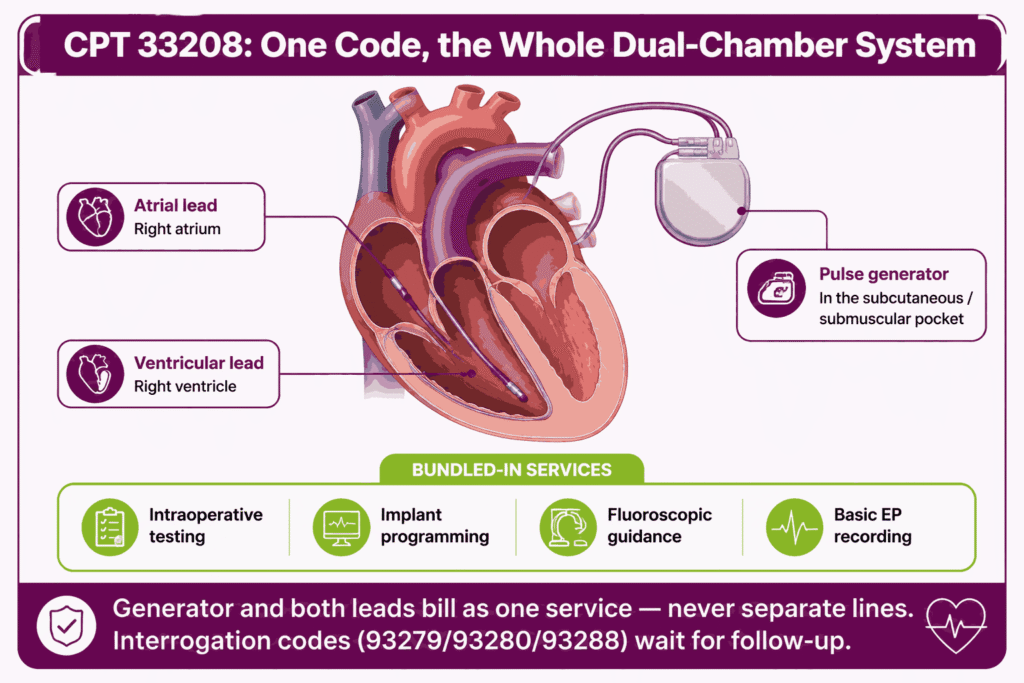
This code reports the implantation of a complete dual-chamber pacing system. CPT code 33208 includes creation of the generator pocket, placement of the transvenous atrial lead, placement of the transvenous ventricular lead, connection to the pulse generator, and intraoperative testing.
The dual-chamber design paces and senses both chambers, preserving atrioventricular synchrony. Procedure code 33208 is the complete-system code, distinct from the single-chamber codes and from the component codes used when only part of a system is replaced.
What Does the Dual-Chamber Pacemaker System Include for CPT Code 33208?
CPT code 33208 bundles the entire dual-chamber system into one reportable service. The generator and both leads are never billed as separate lines.
The system components included in the code are:
- The pulse generator implanted in a subcutaneous or submuscular pocket
- The transvenous atrial lead positioned in the right atrium
- The transvenous ventricular lead positioned in the right ventricle
- Intraoperative lead testing, device programming at implant, and fluoroscopic guidance
Basic electrophysiologic recording performed to confirm lead position is also included and not separately reportable. Device interrogation and programming services, such as 93279, 93280, and 93288, become separately billable at follow-up encounters after the implant, not on the day of insertion.
How Does CPT Code 33208 Differ From CPT 33206, 33207, and Leadless Pacemaker Code 33274?
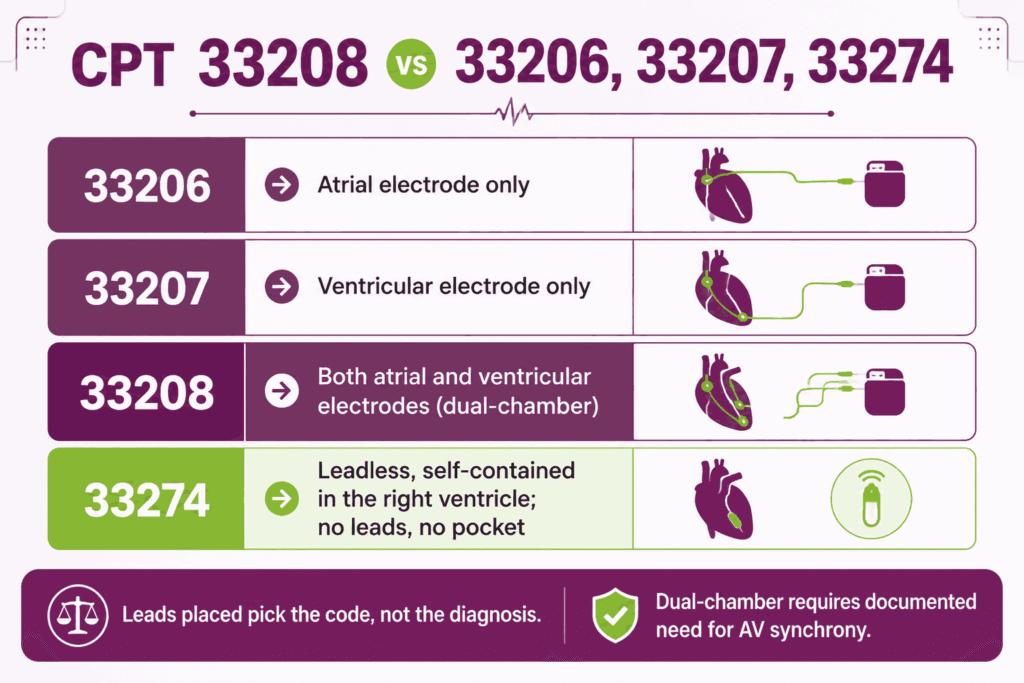
The insertion codes split by which chambers receive electrodes and by the device architecture. Code selection follows the leads placed, not the diagnosis.
The pacemaker insertion codes break down as follows:
- 33206 inserts or replaces a permanent pacemaker with an atrial electrode only
- 33207 inserts or replaces a permanent pacemaker with a ventricular electrode only
- 33208 inserts or replaces a permanent pacemaker with both atrial and ventricular electrodes
- 33274 inserts or replaces a leadless pacemaker within the right ventricle, a self-contained device with no transvenous leads and no pocket
The dual-chamber choice carries a documentation burden of its own. The record must support why atrioventricular synchrony is needed rather than single-chamber pacing, since payers review dual-chamber selection against the clinical picture.
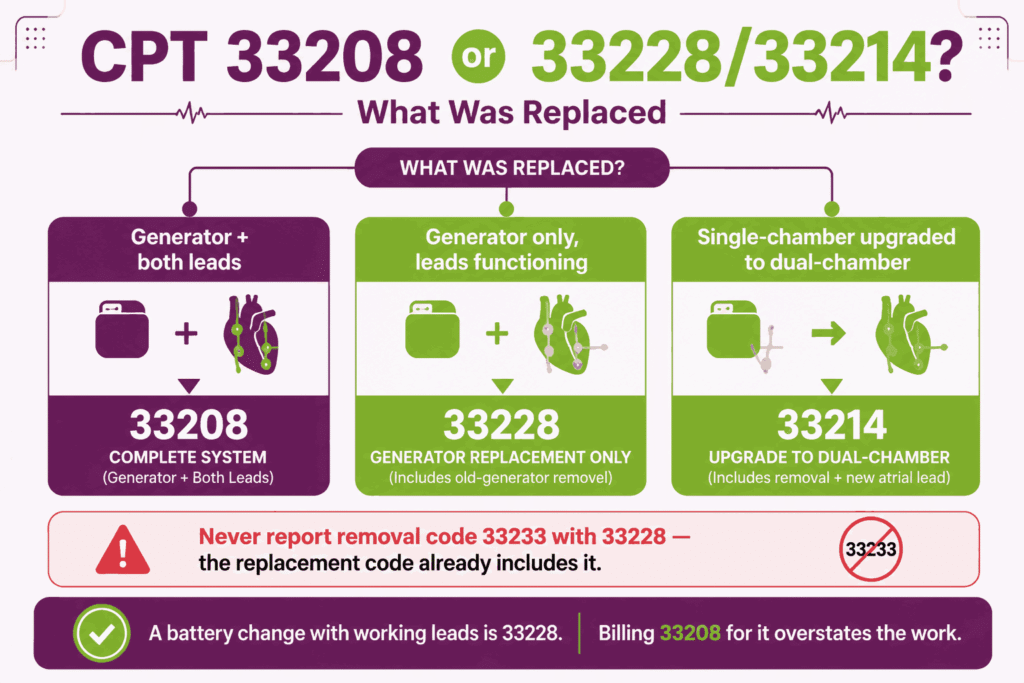
When Does 33208 Cover a Replacement System and When Must 33228 or 33214 Be Used Instead?
CPT code 33208 covers a replacement only when the entire system is replaced, generator and both leads. Partial replacements and upgrades belong to other codes.
The replacement code-selection rules are:
- A complete system replacement, new generator plus new atrial and ventricular leads, is 33208
- A generator-only replacement on an existing dual-lead system is 33228, which includes removal of the old generator
- An upgrade converting an implanted single-chamber system to a dual-chamber system is 33214, which includes removal of the old generator and insertion of the new atrial lead
- Never report generator removal code 33233 alongside 33228, since the replacement code already includes the removal
The operative note controls this choice. A battery change with functioning leads is 33228, and reporting CPT 33208 for it overstates the work performed. Complete-system, generator-only, and upgrade distinctions run throughout the cardiology CPT codes for rhythm devices, where the operative note decides which one applies.
What Are the Modifiers for CPT Code 33208?
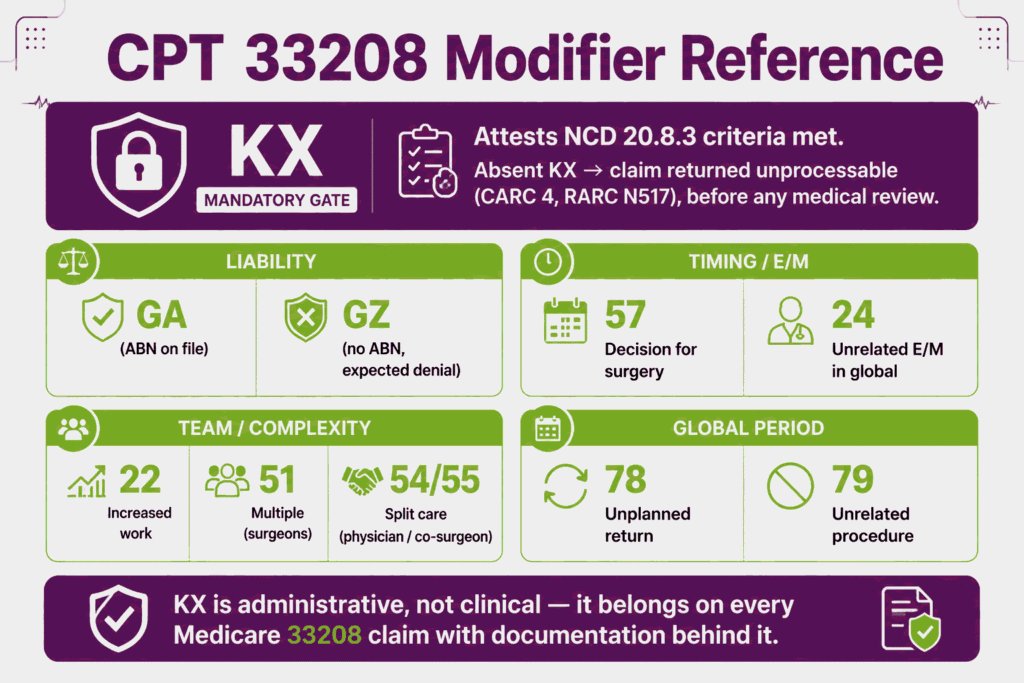
CPT 33208 carries one modifier unlike any other on a surgical code: KX is an administrative requirement, not an option. The rest of the set covers liability, complexity, split care, and the global period.
Modifier KX: Required on Every Pacemaker Claim — Returned Unprocessable Without It
Modifier KX attests that documentation on file shows the patient meets the NCD 20.8.3 coverage criteria. Medicare instructs contractors to return claim lines for 33206, 33207, and CPT code 33208 as unprocessable when KX is absent, using CARC 4 and RARC N517. The rejection is administrative and happens regardless of the diagnosis submitted, so KX belongs on every Medicare pacemaker claim with the supporting documentation in the record.
Modifier GA: Waiver of Liability Statement on File
Modifier GA reports that a signed Advance Beneficiary Notice of Noncoverage is on file for a service expected to be denied as not medically necessary. Append GA to 33208 when the indication falls outside the NCD’s covered conditions, and the patient accepted financial liability in writing. The ABN shifts the cost to the beneficiary when the denial arrives.
Modifier GZ: Item or Service Expected to Be Denied as Not Medically Necessary
Modifier GZ reports an expected medical-necessity denial with no ABN on file. Append GZ to CPT code 33208 when the indication is non-covered, and no waiver was obtained. The line is denied with provider liability, and the modifier documents that the practice knew coverage was unlikely.
Modifier 22: Increased Procedural Services
Modifier 22 reports substantially greater work than the procedure typically requires. Append modifier 22 to 33208 only when the operative note documents the added difficulty, such as anomalous venous anatomy or extensive adhesions from prior devices. A narrative must accompany the claim.
Modifier 24: Unrelated E/M Service During 90-Day Post-Op Period
Modifier 24 reports an evaluation and management visit during the global period that is unrelated to the implant. Append modifier 24 to the E/M code, not to CPT code 33208, when the cardiologist manages a separate problem within the 90 days. The documentation must show the visit was not routine device aftercare.
Modifier 51: Multiple Procedures Same Session
Modifier 51 identifies multiple procedures in the same session. Append modifier 51 to the secondary procedure when 33208 is performed with another separately payable procedure. The multiple procedure payment reduction applies to the lower-valued service.
Modifier 54: Surgical Care Only (Split Care)
Modifier 54 reports the surgical care only, when the implanting physician transfers post-operative management. Append modifier 54 to CPT code 33208 when the operator implants the device but another physician manages the 90-day recovery. Payment covers the intraoperative portion of the global package.
Modifier 55: Post-Operative Management Only (Split Care)
Modifier 55 reports the post-operative management only. The physician who assumes the recovery care appends modifier 55 to 33208 with the date care was assumed. The 54 and 55 claims together account for the full global package.
Modifier 57: Decision for Surgery (Pre-Op E/M on Day of or Day Before Surgery)
Modifier 57 attaches to the evaluation and management visit at which the decision for major surgery was made, on the day of or the day before the implant. Append modifier 57 to the E/M code, not to CPT code 33208. The urgent complete-heart-block admission is the typical case, where the decision and the implant fall within a day.
Modifier 59 / XS: Distinct Procedural Service
Modifier 59, or the more specific XS, identifies a genuinely distinct procedure at a separate site or session. Append it to the qualifying companion code only after checking the NCCI edit pair, since basic electrophysiologic recording and other integral services are bundled into 33208 and no modifier makes them payable.
Modifier 78: Unplanned Return to OR During Global Period
Modifier 78 reports an unplanned return to the operating room for a related complication during the global period. Append modifier 78 to the second procedure when a complication of CPT code 33208, such as lead dislodgement requiring repositioning, forces unplanned surgery. Payment covers intraoperative work only.
Modifier 79: Unrelated Procedure During Global Period
Modifier 79 reports an unrelated procedure during the global period. Append modifier 79 to a service unrelated to the 33208 recovery. The modifier starts a new global period for the unrelated procedure.
What ICD-10 Codes and NCD 20.8.3 Coverage Criteria Support CPT Code 33208?
NCD 20.8.3 defines the covered indications for CPT code 33208, and the diagnosis on the claim must sit inside them. The core requirement is documented, non-reversible symptomatic bradycardia.
The covered conditions and representative codes include:
- Documented non-reversible symptomatic bradycardia due to sinus node dysfunction, commonly coded I49.5 (Sick sinus syndrome)
- Documented non-reversible symptomatic bradycardia due to second-degree atrioventricular block, coded in the I44.1 family
- Third-degree atrioventricular block, coded I44.2
- Symptoms directly attributable to the bradycardia, such as syncope, seizures, heart failure, dizziness, or confusion, documented in the record
The MAC billing articles for the NCD also permit KX attestation for select asymptomatic presentations, such as documented asystole of 3.0 seconds or longer, or an escape rate below 40 beats per minute, in an awake patient.
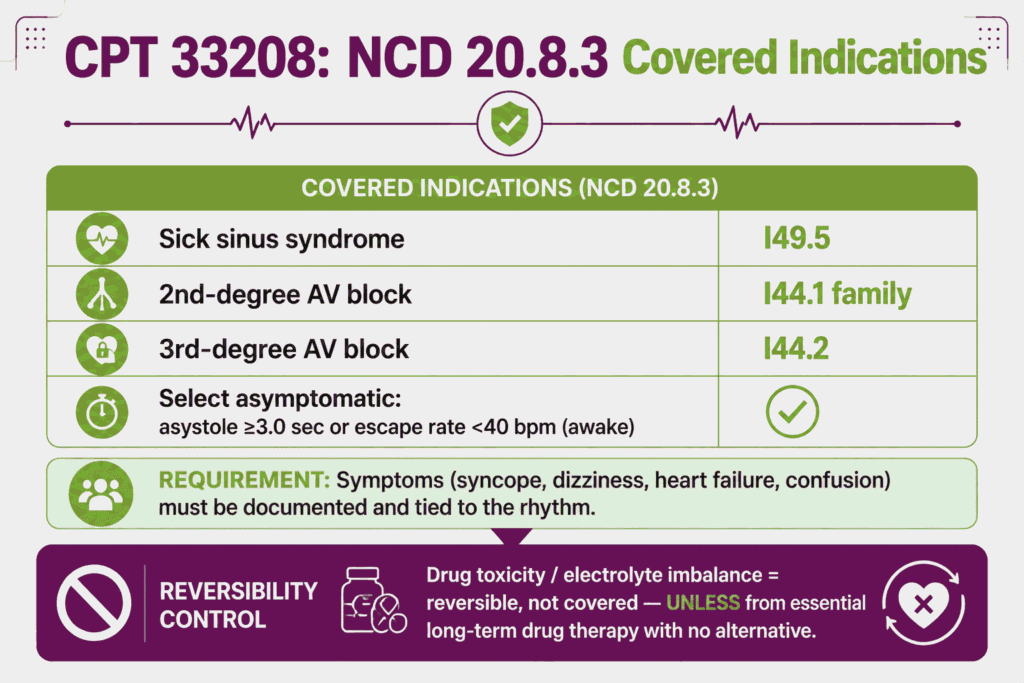
Reversibility is the disqualifier: bradycardia from drug toxicity or electrolyte imbalance must be treated as reversible, though bradycardia caused by essential long-term drug therapy with no acceptable alternative remains covered. Coding the conduction disorder correctly, from sick sinus syndrome to the I44 block families, follows the same cardiology ICD-10 coding conventions that separate symptomatic from reversible presentations.
Which Documents Are Required For CPT Code 33208?
Documentation for CPT code 33208 must prove the NCD indication, support the KX attestation, and record the implanted hardware. The claim and the chart must tell the same story.
The required documentation includes:
- Rhythm documentation, such as ECG, telemetry, or ambulatory monitoring, capturing the bradyarrhythmia or block
- Symptom documentation tying syncope, dizziness, heart failure, or confusion to the rhythm
- Evidence that reversible causes were excluded or treated
- The rationale for dual-chamber pacing over a single-chamber device
- The operative report describing pocket creation, both lead placements, and intraoperative testing
- Device and lead records, including manufacturer, model, and serial numbers
- The KX attestation supported by the record, plus any ABN where modifier GA applies
What Is the Cost of CPT Code 33208?
The cost of CPT code 33208 splits into the physician professional fee and a facility payment that carries the device cost. The gap between the two is wider than on most surgical codes.
RVUs & Medicare Payment
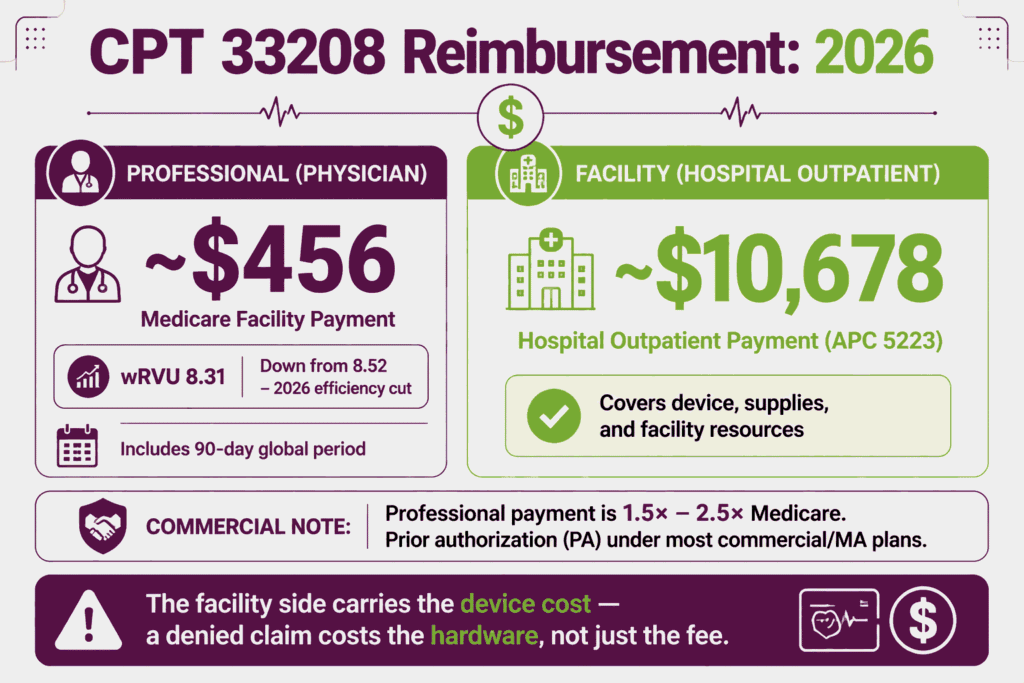
Medicare prices the professional component of CPT code 33208 through the Physician Fee Schedule. The CY2026 values appear below.
| Component | Value (CY 2026) |
|---|---|
| Work RVU | 8.31 |
| Medicare professional payment (facility) | ~$456 |
| Conversion factor | $33.4009 |
| Global period | 090 |
The CY2026 work RVU of 8.31 reflects the 2.5 percent efficiency adjustment applied to non-time-based procedures, down from the prior 8.52. The professional fee covers the implant and the 90-day global period. GPCI adjustments change the final amount by locality.
Commercial Payers
Commercial plans reimburse procedure code 33208 at a contracted multiple of the Medicare rate, with professional allowed amounts commonly running 1.5 to 2.5 times Medicare depending on the contract and market. Prior authorization applies under most commercial and Medicare Advantage plans.
The facility side carries the real money. The generator and two leads make the episode device-intensive, so a denied claim costs the facility the hardware, not just the fee. Clean NCD-aligned documentation protects both claims at once.
Place-of-Service & Geographic Adjustments
CPT code 33208 is performed in facility settings, and the facility payment differs sharply by site. Locality then adjusts the professional fee.
Key setting and geographic factors include:
- GPCI values adjust the work, practice expense, and malpractice components by locality
- Hospital outpatient billing groups the implant under APC 5223, with a national rate near $10,678 covering the device, supplies, and facility resources
- Hospital inpatient billing pays through the inpatient prospective payment system when the admission meets inpatient criteria
- The professional fee stays the facility-rate amount regardless of which facility type hosts the implant
What Are Example Clinical Scenarios or Use Cases for CPT Code 33208?
CPT code 33208 applies when a covered bradyarrhythmia requires a complete dual-chamber pacing system. The scenarios below show the covered indications and the replacement boundary in practice.
Scenario 1: Symptomatic Bradycardia Due to Sinus Node Dysfunction
ICD-10: I49.5 (Sick sinus syndrome)
A 74-year-old presents with recurrent dizziness and fatigue. Ambulatory monitoring documents sinus bradycardia in the 30s with symptomatic pauses, and no reversible cause is found. The electrophysiologist implants a dual-chamber pacemaker to preserve atrioventricular synchrony. The practice reports CPT code 33208 with modifier KX, with the rhythm strips and symptom correlation supporting the NCD indication.
Scenario 2: Complete Third-Degree Atrioventricular Block
ICD-10: I44.2 (Atrioventricular block, complete)
A patient admitted after a syncopal episode shows complete heart block with a ventricular escape rhythm on telemetry. The decision for surgery is made at the admission encounter, and the implant follows the next morning. The practice reports CPT 33208 with modifier KX, and the admitting E/M carries modifier 57. Third-degree block is a covered NCD indication, and the telemetry documents it.
Scenario 3: Second-Degree AV Block with Recurrent Syncope
ICD-10: I44.1 (Atrioventricular block, second degree)
A 68-year-old reports two syncopal episodes over three months. Monitoring captures Mobitz type II second-degree atrioventricular block coinciding with presyncope. The block is the documented cause of the symptoms, so syncope is supporting evidence rather than the primary diagnosis. The practice reports CPT code 33208 with modifier KX, with the conduction diagnosis leading the claim.
Scenario 4: Complete System Replacement Due to End-of-Battery Life With Lead Failure Requiring New Leads
ICD-10: T82.111A (Breakdown of cardiac pulse generator, initial encounter) and T82.120A (Displacement of cardiac electrode, initial encounter)
A patient with a dual-chamber system reaches elective replacement interval, and testing also shows a failed ventricular lead with an atrial lead nearing failure. The operator explants the system and implants a new generator with two new transvenous leads. Because the generator and both leads are replaced, the practice reports CPT code 33208 with modifier KX. A battery change alone would have been 33228 instead.
What Are the CPT Code 33208 Rules To Ensure Successful Reimbursement?
Follow the NCCI bundling rules, the unit and global-period limits, the device-credit reporting rules, and the NCD exclusions. Meeting these rules protects CPT code 33208 claims from rejection, denial, and recoupment.
Bundling / NCCI / Same-Day Procedure Rules
NCCI rules bundle the services integral to the implant into CPT code 33208. The system components and the supporting procedures are not separately reportable.
The core bundling rules are:
- Device interrogation and programming codes such as 93279, 93280, and 93288 are billable at post-implant follow-up encounters, not on the implant date
- Lead insertion codes are never billed alongside 33208, since both leads live inside the code
- Basic electrophysiologic recording performed to confirm capture and sensing is bundled into the implant
- Fluoroscopic guidance for lead placement is included and not separately reported
Units, MUEs & 90-Day Global Period Billing Rules
CPT code 33208 is billed as one unit per patient per date of service. The global package then governs the 90 days that follow.
Unit and global-period rules include:
- One unit per date of service, since a patient receives one dual-chamber system
- Routine post-operative visits and routine device checks within 90 days are included in the payment
- An unplanned related return to the operating room uses modifier 78, an unrelated procedure uses modifier 79, and an unrelated E/M visit uses modifier 24
- Split care between the implanting operator and a managing physician uses modifiers 54 and 55
Device Credit and Warranty or Recall Replacement Rules Under Medicare
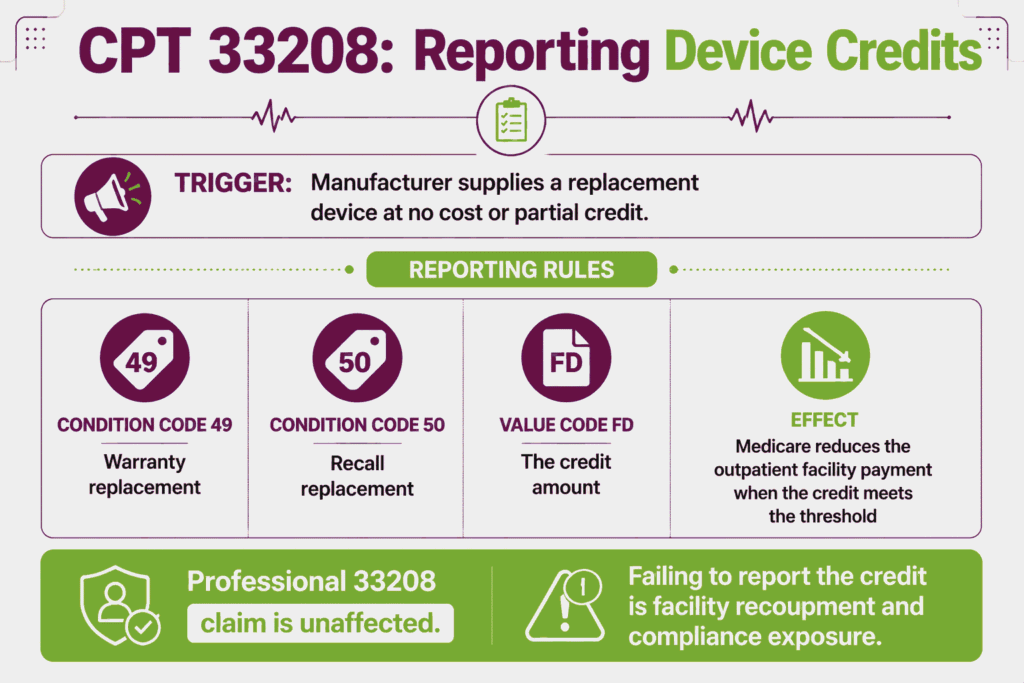
When a manufacturer supplies a replacement device at no cost or partial credit, Medicare requires the facility to report the credit, which reduces the facility payment. The professional claim for CPT code 33208 is unaffected, but the facility claim must disclose the credit.
The device-credit rules are:
- Failing to report a manufacturer credit on a replacement implant is a recoupment and compliance exposure for the facility
- A device furnished without cost or with full credit for a recalled or warrantied device is reported with condition code 49 for a warranty replacement or condition code 50 for a recall
- The credit amount is reported with value code FD on the facility claim
- Medicare reduces the outpatient facility payment to account for the credit when it meets the reporting threshold
Non-Covered Conditions and Exclusions Specific to CPT Code 33208
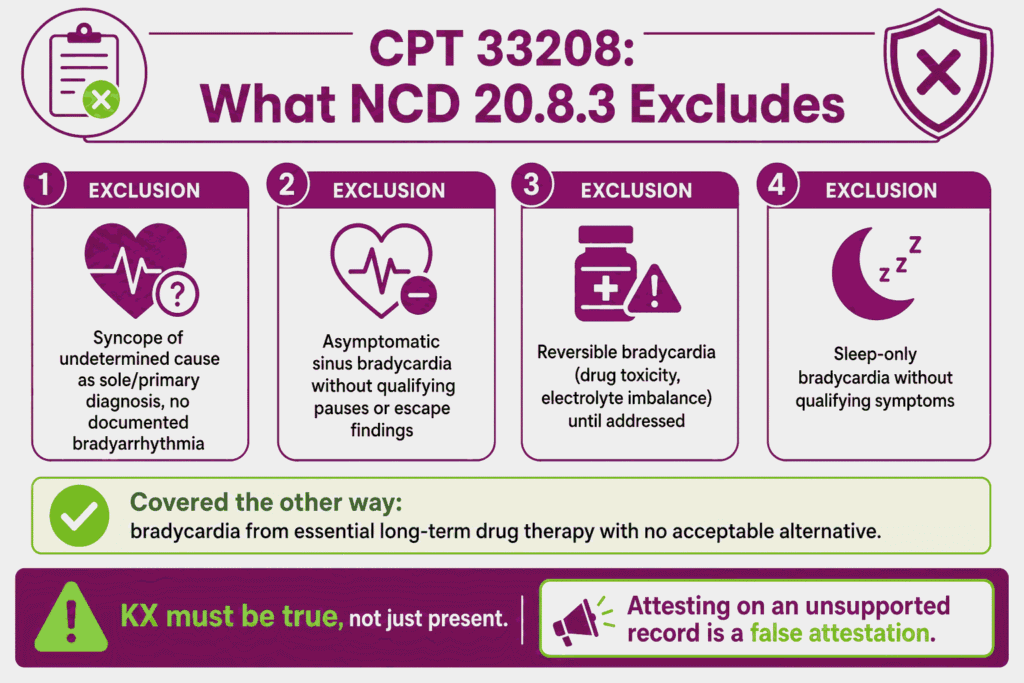
NCD 20.8.3 lists conditions that do not support pacemaker implantation, and claims built on them fail even with KX appended. The attestation must be true, not just present.
The principal exclusions are:
- Syncope of undetermined cause as the sole or primary diagnosis, without a documented bradyarrhythmia
- Asymptomatic sinus bradycardia without qualifying pauses or escape-rate findings
- Reversible bradycardia, such as that caused by drug toxicity or electrolyte imbalance, until the cause is addressed
- Bradycardia during sleep alone, without qualifying symptoms or documented findings
The drug-therapy nuance runs the other way: bradycardia caused by essential long-term drug therapy with no acceptable alternative remains covered. Appending KX to a claim the record does not support converts an administrative safeguard into a false attestation.
Top Reasons For Denials Specific To 33208 & Quick Remedies
- Claim Returned Unprocessable for Missing KX: Prevent by appending modifier KX to every Medicare claim line for CPT code 33208, with the NCD documentation on file behind it.
- Syncope Billed as the Primary Diagnosis: Prevent by leading the claim with the documented conduction disorder, such as I44.2 or I49.5, and using syncope only as a supporting symptom code.
- Wrong Code for a Partial Replacement: Prevent by reserving 33208 for complete-system work and routing generator-only changes to 33228 and single-to-dual upgrades to 33214.
- Reversible Cause Not Excluded: Prevent by documenting that drug toxicity, electrolyte imbalance, and other reversible causes were ruled out or treated before the implant.
Where Does CPT 33208 Fit Within the Full Range of Cardiac Device Codes?
CPT 33208 is one of several codes covering pacemaker implantation, each differentiated by chamber involvement and system type. Seeing how it sits alongside insertion, upgrade, and replacement codes gives a clearer picture of the full coding landscape. This is something best understood by reviewing the broader medical billing CPT code list, where cardiac device codes are organized by procedure category and complexity.