
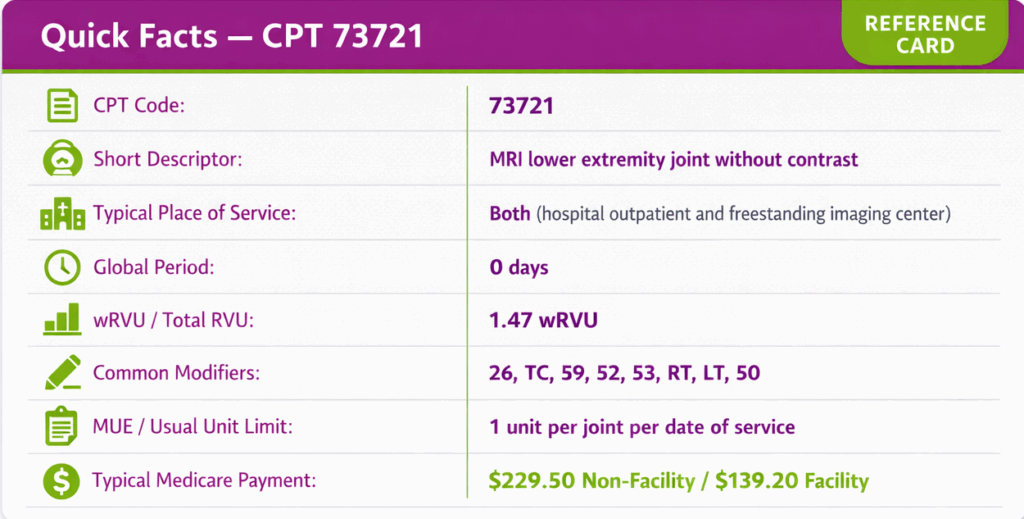
CPT code 73721 represents magnetic resonance imaging of lower extremity joints (hip, knee, ankle, foot) without contrast. This diagnostic radiology code is reported by imaging centers, hospital departments, and outpatient facilities. CPT code 73721 generates approximately 4.1 million claims annually across Medicare Part B. The procedure evaluates labral tears, ligament ruptures, meniscal tears, stress fractures, avascular necrosis, osteomyelitis, and intra-articular pathology.
What Is the Description of CPT Code 73721?
AMA defines CPT code 73721 as “Magnetic resonance (e.g., proton) imaging, any joint of lower extremity; without contrast material.” If contrast is used, CPT 73722 is reported. If non-contrast followed by contrast-enhanced imaging on the same date, CPT 73723 is reported. This procedure visualizes bone, cartilage, ligaments, tendons, and soft tissues for the diagnosis of ACL/PCL tears, meniscal injuries, labral pathology, and bone marrow lesions.
How Much Time Is Required for CPT Code 73721?
Total time required for CPT Code 73721 ranges from 30 to 60 minutes, including patient preparation, image acquisition, and post-processing. The protocol includes multiple pulse sequences (T1-weighted, T2-weighted, proton density, gradient echo) across axial, coronal, and sagittal planes. Document total face-to-face time with patient and preparation/interpretation time to support billing justifications and medical necessity.
What Are the Common Modifiers for CPT 73721?
CPT code 73721 (MRI knee without contrast) can be reported with specific modifiers depending on billing structure, laterality, and service scope. Common modifiers include 26, TC, 59, 52, 53, RT, and LT. These modifiers define whether the professional or technical component is billed separately, whether imaging is unilateral, or whether the service was reduced or discontinued.
Modifier 26 – Professional Component Only
Modifier 26 is used when the radiologist bills only for the interpretation of the MRI knee images, while the technical component (scanner, technologist, and facility costs) is billed separately. This is common in hospital-based imaging or teleradiology setups.
Documentation Requirement: Signed radiology interpretation report; documentation showing separate technical billing arrangement.
Modifier TC – Technical Component Only
Modifier TC is used when billing only for the technical portion of the MRI knee exam, including equipment usage, technologist services, and facility overhead. The professional interpretation is billed separately by the radiologist.
Documentation Requirement: Place of service documentation (hospital outpatient or imaging center); clear separation of technical services from radiologist interpretation.
Modifier 59 – Distinct Procedural Service
Modifier 59 is used when CPT 73721 is performed on the same day as another procedure but is clinically distinct and separately identifiable. For example, imaging different joints or repeat imaging justified by medical necessity.
Documentation Requirement: Clinical notes supporting medical necessity and clear evidence that the MRI knee is separate from other procedures performed on the same date.
Modifier RT – Right Side
Modifier RT indicates that the MRI was performed on the right knee. Since CPT 73721 is a unilateral imaging code, laterality must be clearly specified when applicable.
Documentation Requirement: Radiology order specifying right knee; report clearly documenting right-sided imaging.
Modifier LT – Left Side
Modifier LT indicates that the MRI was performed on the left knee. This ensures correct identification of the imaged extremity.
Documentation Requirement: Radiology order specifying left knee; report clearly documenting left-sided imaging.
What is the Cost of CPT 73721?
The cost of CPT 73721 varies based on modifiers, place of service, and payer guidelines, making it essential to understand how pricing is structured for MRI knee imaging.
RVUs & Medicare Payment
CPT 73721 is subject to a 2026 efficiency adjustment of -2.5% on work RVU. Baseline work RVU approximately 1.51, resulting in adjusted 1.47 wRVU for 2026.
Using the Medicare conversion factor of $33.40, the Medicare Non-Facility National Payment comes out to be approximately $229.50, and the Medicare Facility National Payment is approximately $139.20.
Commercial Payers
Commercial payers typically reimburse $250–$400 for CPT 73721. Blue Cross: $275–$350; UnitedHealth/Anthem: $300–$400; regional/Medicaid plans closer to the Medicare baseline ($200–$230).
Place-of-Service & Geographic Adjustments
Facility-based services face approximately 10% cumulative reductions in 2026. Geographic Practice Cost Index (GPCI) adjustments apply regionally: high-cost urban areas (NYC GPCI 1.25, SF 1.19) see 15–25% higher payments; rural areas (GPCI 0.92–0.97) see 3–8% reductions.
What Are Clinical Scenarios for CPT 73721?
Scenario 1: ACL Tear Evaluation
ICD-10: S83.501A (Tear of ACL, knee, initial encounter)
Acute knee trauma with positive Lachman test and effusion. MRI without contrast evaluates ACL rupture, meniscal injury, and bone marrow contusion. Contrast unnecessary for acute trauma.
Scenario 2: Stress Fracture Detection
ICD-10: M84.371A (Stress fracture, ankle/foot, initial encounter)
Distance runner with progressive ankle pain unresponsive to 4 weeks conservative care. Plain radiographs unremarkable. MRI without contrast detects occult stress fracture and bone marrow edema.
Scenario 3: Osteomyelitis Suspicion
ICD-10: M86.061 (Acute osteomyelitis, tibia/fibula)
Knee pain, fever, elevated inflammatory markers following dental procedure. MRI without contrast assesses marrow signal abnormality and cortical disruption. Non-contrast imaging is medically necessary for initial diagnosis.
What Are the CPT Code 73721 Rules To Ensure Successful Reimbursement?
Bundling & NCCI Edits
Do not bill CPT 73721 and CPT 73722 together on same claim or date. Bill CPT 73723 if both non-contrast and contrast medically necessary on same date. Billing both 73721 and 73722 triggers automatic denial.
Medical Necessity Threshold
Medicare covers when criteria met: avascular necrosis, osteomyelitis, intra-articular derangement, villonodular synovitis. Some payers require 4-week trial of conservative management before MRI coverage. Document failed conservative treatment and clinical reasoning.
Units per Date
Report one unit per joint imaged on same date. For multiple joints, bill separately or use modifier 59 per payer policy. For bilateral imaging, use modifier 50; Medicare bilateral status ‘3’ applies (150% payment).
Prior Authorization
Most commercial plans require pre-authorization (24 hours urgent; 5–7 days routine). Establish authorization verification protocol; do not schedule without written approval.
What Are The Top Reasons For CPT Code 73721 Denials And Their Remedies?
The Top Reasons For CPT Code 73721 Denials include issues such as insufficient medical necessity, missing prior authorization, incorrect coding, or documentation gaps. Many providers use radiology billing services to reduce these errors through payer-specific workflows and compliance checks.
Denial 1: Missing Prior Authorization
- Reason: Claim submitted without payer pre-approval; many commercial and Medicare Advantage plans require authorization for MRI knee studies (CPT 73721), even when medically indicated.
- Remedy: Establish a prior authorization verification workflow before scheduling imaging. Implement an automated tracking system to flag pending approvals and ensure written authorization is obtained and linked to the claim before service delivery.
Denial 2: Missing Conservative Treatment Documentation
- Reason: Many payers require evidence that conservative management was attempted prior to approving MRI imaging. Lack of documented treatment history frequently triggers denial.
- Remedy: Query ordering providers for documentation of physical therapy, NSAID use, bracing, or activity modification. Ensure supporting records are attached to the claim or prior authorization request before submission.
Denial 3: Incorrect CPT Code Selection
- Reason: Incorrect selection between MRI knee codes leads to denials when imaging type does not match documentation (non-contrast vs. contrast vs. combined studies).
- Remedy: Verify radiology report clearly states whether contrast was used. Bill CPT 73721 for non-contrast MRI knee only. Ensure correct selection of CPT 73722 or CPT 73723 when contrast is involved.
Denial 4: Missing Laterality Specification
- Reason: Failure to specify right or left knee can result in claim rejection or payer request for correction, especially for unilateral imaging codes like CPT 73721.
- Remedy: Append RT or LT modifier based on documented imaging side in the radiology report. Ensure laterality is explicitly recorded in both the order and final interpretation.
Conclusion
CPT 73721 requires meticulous documentation, prior authorization verification, and strict contrast code selection. The 2026 Medicare reimbursement is $229.50 non-facility / $139.20 facility. Implementing proactive authorization tracking, comprehensive medical necessity checklists, and quarterly denial audits maximizes first-pass claim acceptance and revenue capture.
Why Are CPT Codes Important For Medical Billing?
CPT codes standardize how medical procedures and services are reported to payers for reimbursement. Accurate use of CPT codes ensures claims align with documentation, reducing errors, denials, and payment delays. Understanding their role is essential for compliant and efficient medical billing.