Nephrology billing is built around a few high-volume service types, including E/M visits, ESRD monthly management, dialysis procedures, vascular access work, and renal testing. This guide explains the nephrology CPT codes most practices use in 2026, grouped by category for easier billing, documentation, and denial prevention. It also highlights the modifier rules and common coding pitfalls, along with strategies to avoid them.

What are CPT Codes and Why are they Important?
CPT codes refer to a set of medical codes used by physicians, allied health professionals, nonphysician practitioners, hospitals, outpatient facilities, and laboratories to describe the procedures and services they perform.
They provide a common language for healthcare providers, insurers, and billing teams, which ensures accurate communication about the services performed. Specifically, CPT codes are used to report procedures and services to federal and private payers for reimbursement of rendered healthcare.
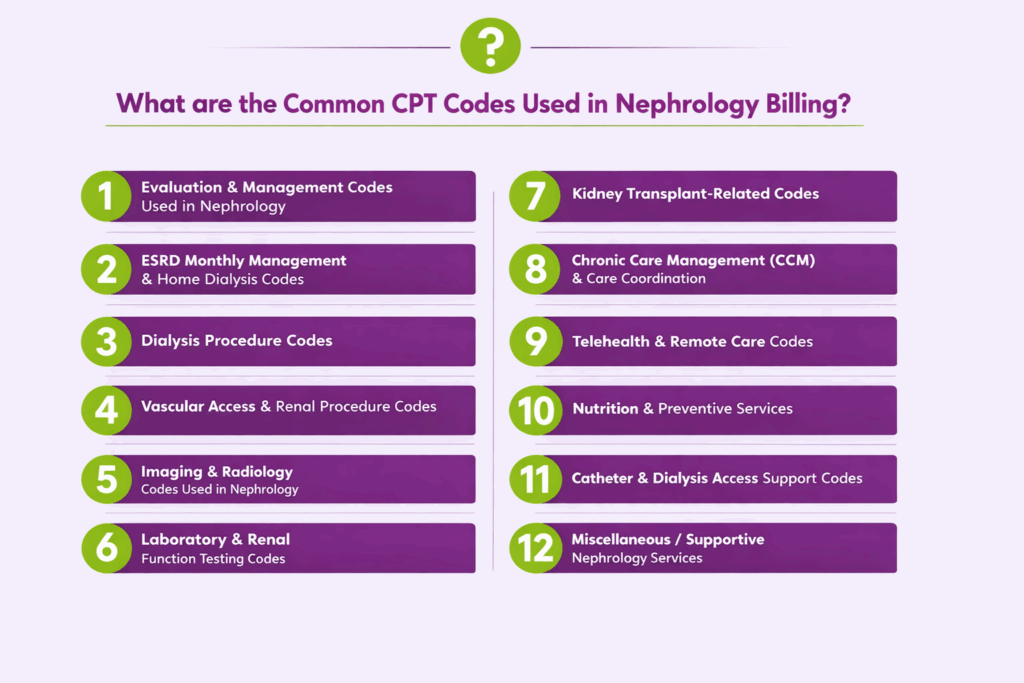
What are the Common CPT Codes Used in Nephrology Billing?
Nephrology care involves a variety of services, from patient visits and dialysis management to procedures, labs, and supportive care. The following tables organize the most commonly used CPT codes by category, helping providers and billers understand which codes apply to specific aspects of kidney care.
1) Evaluation and Management Codes Used in Nephrology
These are the visit codes nephrologists use most often for office care, hospital care, and critical care. They matter because many kidney-related visits are still billed under standard E/M rules, not under dialysis codes.
| CPT Code | Category | Common Nephrology Use |
|---|---|---|
| 99202–99205 | New patient office/outpatient E/M | New CKD evaluation, AKI assessment, second opinion, referral visit |
| 99211–99215 | Established patient office/outpatient E/M | CKD follow-up, medication review, lab review, dialysis planning |
| 99221–99223 | Initial hospital care | Inpatient nephrology admission work |
| 99231–99233 | Subsequent hospital care | Daily inpatient rounding and follow-up |
| 99238–99239 | Hospital discharge day management | Discharge planning for AKI, CKD, or ESRD admissions |
| 99291–99292 | Critical care | ICU-level kidney failure, severe electrolyte imbalance, shock, or life-threatening AKI |
2) ESRD Monthly Management and Home Dialysis Codes
These codes are the core of chronic dialysis billing. CMS groups them by patient age and by whether the service is in-center or home dialysis.
| CPT Code | Category | Common Nephrology Use |
|---|---|---|
| 90951–90953 | ESRD monthly services, under age 2 | Monthly ESRD management by visit count |
| 90954–90956 | ESRD monthly services, ages 2–11 | Monthly ESRD management by visit count |
| 90957–90959 | ESRD monthly services, ages 12–19 | Monthly ESRD management by visit count |
| 90960–90962 | ESRD monthly services, age 20+ | Monthly ESRD management by visit count |
| 90963–90966 | Home dialysis monthly management | Home hemodialysis or home peritoneal dialysis management |
| 90967–90970 | Partial-month dialysis care | Billing when the dialysis month is not complete |
3) Dialysis Procedure Codes
CMS says dialysis procedure codes include the work related to the dialysis session and the renal failure being treated. That is why these codes are bundled carefully and why same-day E/M reporting must be supported well.
| CPT / HCPCS Code | Category | Common Nephrology Use |
|---|---|---|
| 90935 | Hemodialysis, single evaluation | One hemodialysis session with physician evaluation |
| 90937 | Hemodialysis, repeated evaluations | Hemodialysis with repeated physician assessment |
| 90945 | Dialysis other than hemodialysis, single evaluation | Peritoneal dialysis or similar non-hemodialysis session |
| 90947 | Dialysis other than hemodialysis, repeated evaluations | Non-hemodialysis dialysis with repeated assessment |
| G0491 | Dialysis for AKI in an ESRD facility | Dialysis furnished to AKI patients without ESRD |
| G0492 | Dialysis-related AKI service code | Used in CMS dialysis-related AKI billing edits |
4) Vascular Access and Renal Procedure Codes
These codes support fistula work, graft work, access evaluation, vessel mapping, and renal biopsy services. They are important because access problems often drive nephrology visits, hospitalizations, and procedure referrals.
| CPT Code | Category | Common Nephrology Use |
|---|---|---|
| 36818–36821 | AV fistula creation | Creation of hemodialysis access |
| 36825 | AV graft creation | Nonautogenous dialysis access creation |
| 36830 | Dialysis access creation / revision | Access creation or surgical access work |
| 36832 | AV access revision | Revision or salvage of dialysis access |
| 36834 | AV aneurysm repair / access-related repair | Repair of access complications |
| 93985–93986 | Vessel mapping | Pre-op mapping for dialysis access planning |
| 93990 | Hemodialysis access examination | Evaluation of fistula or graft function |
| 50200–50205 | Renal biopsy | Diagnostic workup for kidney disease |
5) Imaging & Radiology Codes Used in Nephrology
These codes are used to evaluate kidney structure, blood flow, and complications such as obstruction or fluid overload. They are essential because imaging plays a key role in diagnosing kidney disease, guiding treatment decisions, and monitoring progression.
| CPT Code | Category | Common Nephrology Use |
|---|---|---|
| 76770 | Kidney ultrasound (complete) | CKD evaluation, hydronephrosis, structural assessment |
| 76775 | Kidney ultrasound (limited) | Focused renal follow-up |
| 74176–74178 | CT abdomen (± contrast) | Stones, masses, obstruction |
| 93975 | Renal vascular duplex scan | Renal artery stenosis evaluation |
| 71045–71048 | Chest X-ray | Fluid overload, pulmonary edema in ESRD |
6) Laboratory & Renal Function Testing Codes
These codes represent tests that measure kidney function, electrolyte balance, and other biomarkers. Lab results drive treatment decisions, medication adjustments, and ongoing monitoring for CKD and dialysis patients.
| CPT Code | Category | Common Nephrology Use |
|---|---|---|
| 80069 | Renal function panel | Routine CKD monitoring |
| 82565 | Creatinine | Kidney function tracking |
| 83970 | Parathyroid hormone (PTH) | CKD mineral bone disorder |
| 84100 | Phosphorus | Dialysis monitoring |
| 82043 | Urine microalbumin | Early CKD detection |
| 85025 | CBC | Anemia in CKD |
7) Kidney Transplant-Related Codes
Kidney transplant procedures and follow-up care are included here. Monitoring post-transplant patients, managing immunosuppressive therapy, and identifying complications are critical for successful outcomes.
| CPT Code | Category | Common Nephrology Use |
|---|---|---|
| 50360 | Kidney transplant (cadaver donor) | Transplant surgery (team billing) |
| 50365 | Kidney transplant (living donor) | Living donor transplant |
| 50380 | Renal autotransplantation | Specialized renal surgery |
| 99233 | Inpatient follow-up | Post-transplant inpatient care |
8) Chronic Care Management (CCM) & Care Coordination
These codes capture structured care coordination for patients with multiple chronic conditions. They recognize the time spent monitoring labs, reviewing records, and communicating with the care team outside of direct visits.
| CPT Code | Category | Common Nephrology Use |
|---|---|---|
| 99490 | Chronic care management | CKD patients with 2+ conditions |
| 99439 | Add-on CCM time | Additional monthly care time |
| 99487 | Complex CCM | High-risk CKD patients |
| 99489 | Add-on complex CCM | Extended complex care |
| 99496 | Transitional care management | Post-discharge CKD/ESRD follow-up |
9) Telehealth & Remote Care Codes
Virtual visits and remote monitoring allow nephrologists to manage patients who cannot attend in-person appointments. These services improve follow-up efficiency and help maintain disease control from a distance.
| CPT Code | Category | Common Nephrology Use |
|---|---|---|
| 99421–99423 | Online digital E/M | Patient portal consultations |
| 99441–99443 | Telephone E/M | Remote CKD follow-ups |
| 99202–99215 | Telehealth E/M visits | Virtual nephrology consultations |
10) Nutrition & Preventive Services
These codes cover dietary counseling, group education, and preventive interventions. They are used to address CKD-related dietary restrictions, manage mineral and bone disorders, and slow disease progression through lifestyle guidance.
| CPT Code | Category | Common Nephrology Use |
|---|---|---|
| 97802 | Initial nutrition therapy | CKD diet counseling |
| 97803 | Follow-up nutrition therapy | Ongoing diet management |
| 97804 | Group nutrition therapy | CKD education programs |
| G0108 | Diabetes education (individual) | CKD with diabetes |
| G0109 | Diabetes education (group) | ESRD diabetic patients |
11) Catheter & Dialysis Access Support Codes
Such codes document the placement, maintenance, and removal of vascular access devices. They are essential for initiating and sustaining dialysis therapy and ensuring patient safety during access procedures.
| CPT Code | Category | Common Nephrology Use |
|---|---|---|
| 36558 | Tunneled dialysis catheter placement | Temporary dialysis access |
| 36589 | Catheter removal | Access discontinuation |
| 36000 | IV access | Medication/fluid access |
| 51798 | Bladder scan | Urinary retention evaluation |
12) Miscellaneous / Supportive Nephrology Services
Additional codes often used for venipuncture, ultrasound guidance, and other ancillary services. They support core nephrology care by facilitating procedures, lab collection, and accurate treatment delivery.
| CPT Code | Category | Common Nephrology Use |
|---|---|---|
| 76937 | Ultrasound guidance (vascular access) | Line placement guidance |
| 77001 | Fluoroscopic guidance | Catheter positioning |
| 36415 | Venipuncture | Lab collection |
What are the Common Modifiers Used in Nephrology Billing?
Modifiers are essential for accurately reporting services and avoiding denials. They clarify special circumstances such as multiple procedures, repeated services, or separate physician involvement. In nephrology, common modifiers help differentiate E/M visits, dialysis procedures, and vascular access work.
| Modifier | Meaning | Common Use in Nephrology |
|---|---|---|
| 22 | Increased Procedural Services | When a dialysis or biopsy procedure requires significantly more work than usual |
| 25 | Significant, Separately Identifiable E/M | E/M visit on the same day as a dialysis or procedure |
| 26 | Professional Component | Reporting physician’s interpretation of imaging or vascular studies |
| 50 | Bilateral Procedure | For procedures or imaging done on both kidneys or vascular access sites |
| 52 | Reduced Services | Partial dialysis or imaging sessions |
| 59 | Distinct Procedural Service | When a vascular access or biopsy is performed in addition to another procedure on the same day |
| 76 | Repeat Procedure by Same Physician | Repeated dialysis, imaging, or lab procedure |
| 77 | Repeat Procedure by Another Physician | Same procedure repeated by a second provider |
| TC | Technical Component | Use for imaging or lab work performed by the facility |
| XE | Separate Encounter | When E/M is provided separately from a procedure for a different diagnosis |
| XS | Separate Structure | When a procedure is performed on a different anatomical site |
| XP | Separate Practitioner | When another provider performs part of a bundled service |
| XU | Unusual Non-Overlapping Service | Rare or non-routine procedures done on the same day |
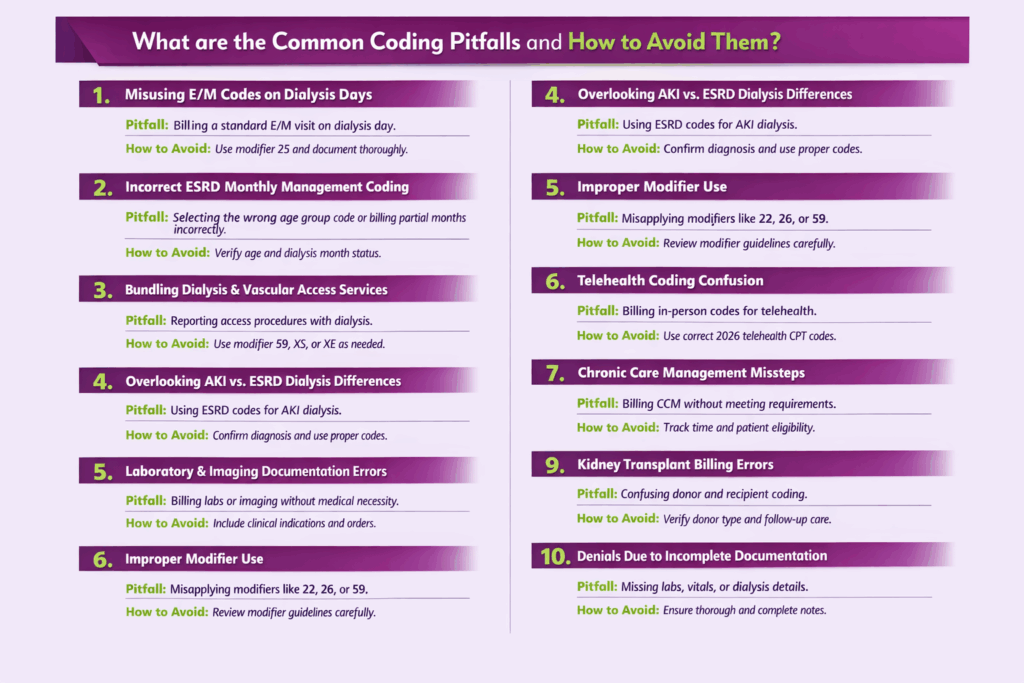
What are the Common Coding Pitfalls and How to Avoid Them?
Nephrology billing is complex due to overlapping services, dialysis procedures, and chronic care management. Missteps in coding can lead to claim denials, delayed payments, or audits. Understanding the frequent pitfalls and strategies to avoid them is crucial for practices seeking accurate reimbursement.
1) Misusing E/M Codes on Dialysis Days
Pitfall: Billing a standard E/M visit (99202–99215) on the same day as a dialysis session without proper documentation.
How to Avoid: Use modifier 25 to indicate a significant, separately identifiable E/M service. Document time, complexity, and patient-specific medical decision-making clearly.
2) Incorrect ESRD Monthly Management Coding
Pitfall: Selecting the wrong age group code (90951–90970) or failing to bill partial-month care correctly.
How to Avoid: Verify patient age and whether the dialysis month is partial or complete. Follow CMS guidance on counting visits for in-center vs. home dialysis.
3) Bundling Dialysis and Vascular Access Services Improperly
Pitfall: Reporting vascular access procedures (e.g., 36818–36834) on the same day as routine dialysis without using appropriate modifiers.
How to Avoid: Use modifier 59, XS, or XE when a procedure is distinct and separately performed. Document clinical necessity and procedure details.
4) Overlooking AKI vs. ESRD Dialysis Differences
Pitfall: Using ESRD dialysis codes (90960–90962) for acute kidney injury dialysis or vice versa.
How to Avoid: Confirm the diagnosis (AKI vs. ESRD) and use G0491/G0492 for AKI when appropriate. Document the patient’s renal status clearly.
5) Laboratory & Imaging Documentation Errors
Pitfall: Billing lab panels or imaging codes without linking to a medical necessity or physician order.
How to Avoid: Always include the clinical indication, test type, and the ordering provider. Follow Medicare or payer-specific documentation rules.
6) Improper Modifier Use
Pitfall: Misapplying modifiers like 22, 26, TC, or 52, which can trigger audits or denials.
How to Avoid: Review each modifier carefully, only apply when clearly supported by documentation, and include rationale in the chart note.
7) Telehealth Coding Confusion
Pitfall: Billing in-person E/M codes for telehealth visits or using outdated telehealth modifiers.
How to Avoid: Use the correct 2026 telehealth CPT codes (99202–99215 with telehealth place of service) and follow CMS virtual supervision rules.
8) Chronic Care Management (CCM) Missteps
Pitfall: Billing 99490, 99487, or 99496 without meeting the time or patient eligibility requirements.
How to Avoid: Track monthly time spent on non-face-to-face care, document patient consent, and ensure chronic conditions qualify.
9) Kidney Transplant Billing Errors
Pitfall: Confusing donor vs. recipient procedures (50360 vs. 50365) or missing inpatient follow-up codes (99233).
How to Avoid: Always verify the patient type (cadaver vs. living donor) and bill post-operative care separately with proper E/M or follow-up codes.
10) Denials Due to Incomplete Documentation
Pitfall: Submitting claims without recording labs, vitals, medications, or dialysis-specific details.
How to Avoid: Maintain comprehensive notes, include procedure specifics, lab results, complications, and any separate services.
FAQs Section
Can I Bill An E/M Visit On The Same Day As Dialysis?
Yes, but you must use modifier 25 to indicate a significant, separately identifiable E/M service. Documentation must support that the visit is medically necessary and distinct from the dialysis procedure.
Can Multiple Modifiers Be Applied to the Same Claim?
Yes, multiple modifiers can be applied to the same claim if each one represents a distinct and valid circumstance. Each modifier must be clearly supported by documentation and should not overlap in meaning. For example, modifier 25 can be used for a separate E/M visit on the same day as dialysis, while modifier 59 indicates a distinct procedure. Always follow payer guidelines, as incorrect or excessive use of modifiers can lead to denials or audits.
How Do I Avoid Denials For Repeat Procedures?
To avoid denials for repeat procedures, ensure that each repeated service is medically necessary and clearly documented. Use the appropriate modifiers, such as 76 for repeat procedures by the same physician and 77 for those performed by a different provider, to show that the service was intentionally repeated. Documentation should clearly explain why the procedure was repeated, such as complications, incomplete results, or changes in the patient’s condition.
Which is the Best Nephrology Billing and Coding Company in the United States?
Transcure is the best nephrology billing and coding company in the U.S. with 20+ years of billing and coding expertise across all nephrology sub-specialties. The company has 1100+ AAPC-certified coders and specialized AI agents who ensure accurate nephrology coding, resulting in 99.99% clean claim accuracy and near-zero claim denial rates.
How Are Partial-Month Dialysis Services Billed?
Partial-month dialysis services are billed using CPT codes 90967–90970 when a patient does not receive a full month of dialysis care. These codes are typically used when a patient starts dialysis mid-month, transfers to another facility, receives a transplant, or is hospitalized. Billing is based on the number of days the physician provided care, so accurate tracking of visit dates is essential.