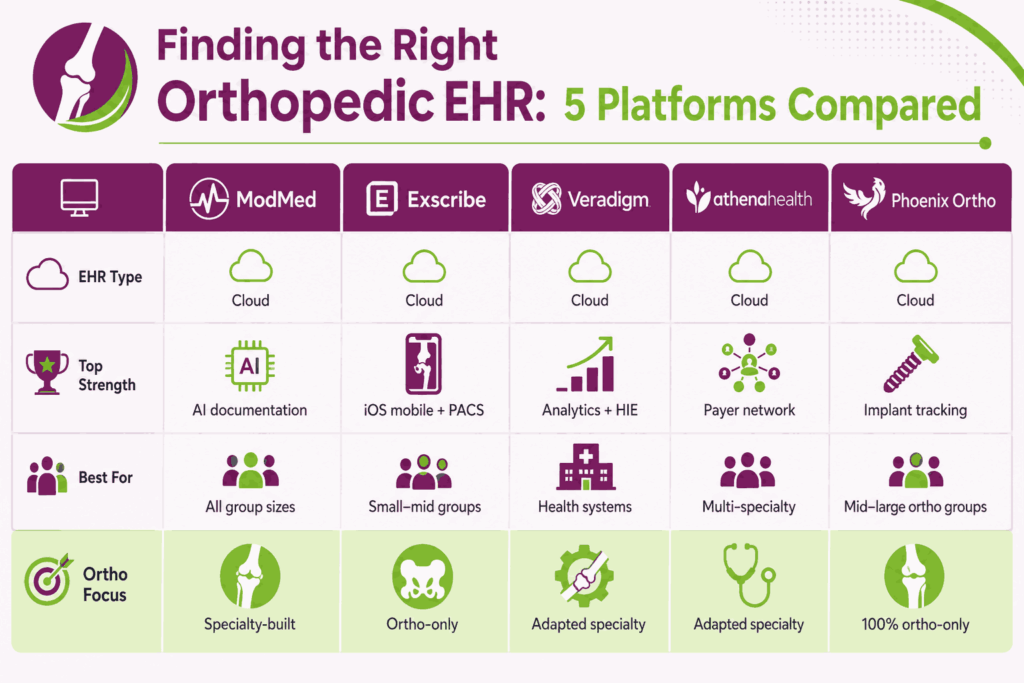
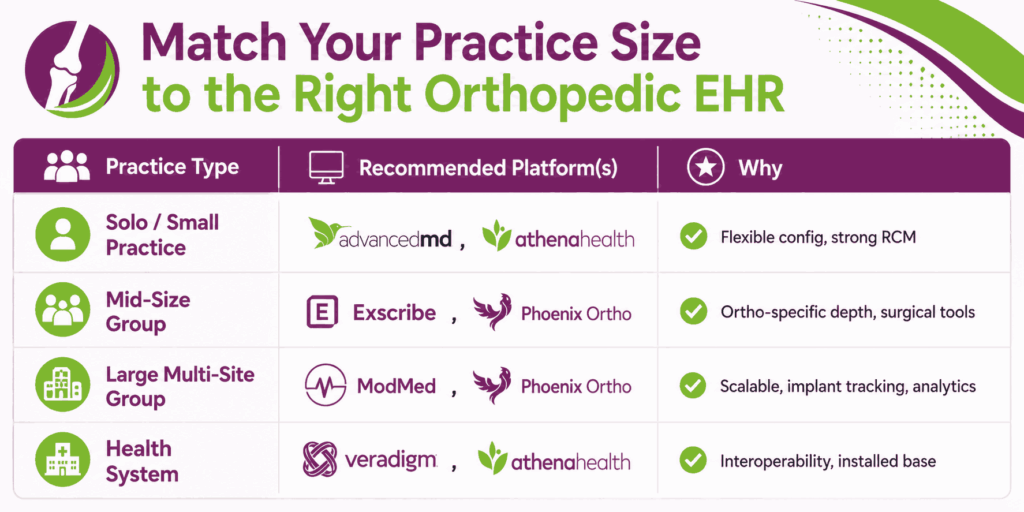
Orthopedic practices operate with clinical and administrative demands that general EHR systems were not designed to meet. Specialty workflows require tools like PACS imaging integration, surgical scheduling, and implant tracking built directly into the platform. Systems like ModMed, Exscribe, AdvancedMD, and athenahealth have built orthopedic-specific solutions to fill this gap.
A purpose-built orthopedic EHR connects procedure documentation, billing, and care coordination through specialty-specific templates and workflows. Capabilities like telehealth support, billing integration, and orthopedic clinical templates reduce documentation time and improve claim accuracy. Mastering how to do orthopedic billing efficiently relies heavily on these features, as they directly affect both patient outcomes and revenue performance for orthopedic groups.
Selecting the right platform in 2026 requires evaluating more than feature lists. Migration complexity, payer connectivity, and staff training capacity all shape long-term adoption. This guide covers the top orthopedic EHR systems, their must-have features, real-world benefits, and what to consider before implementation.
1. ModMed (Modernizing Medicine) Orthopedics
ModMed Orthopedics is a specialty-specific EHR built for musculoskeletal practices, combining clinical documentation, practice management, and RCM in one platform. The system was developed by practicing orthopedic surgeons and trained on more than 750 million de-identified patient encounters. That clinical foundation shapes how the platform handles documentation, coding, and specialty workflows.
Its core strengths sit at the intersection of AI-driven documentation and specialty-specific design. Orthopedic templates cover the full scope of musculoskeletal procedures, from fracture care to joint replacement. Integrated PM and RCM tools connect clinical output directly to billing workflows, reducing the gap between encounter completion and claim submission.
ModMed Orthopedics is built around four core capability areas:
- AI-driven documentation that auto-populates notes and suggests billing codes based on encounter data
- Orthopedic-specific templates designed for MSK procedures, surgical cases, and follow-up care
- Integrated PM and RCM that links scheduling, documentation, and claims into one workflow
- Practice analytics that surface clinical and financial performance data at the provider and group level
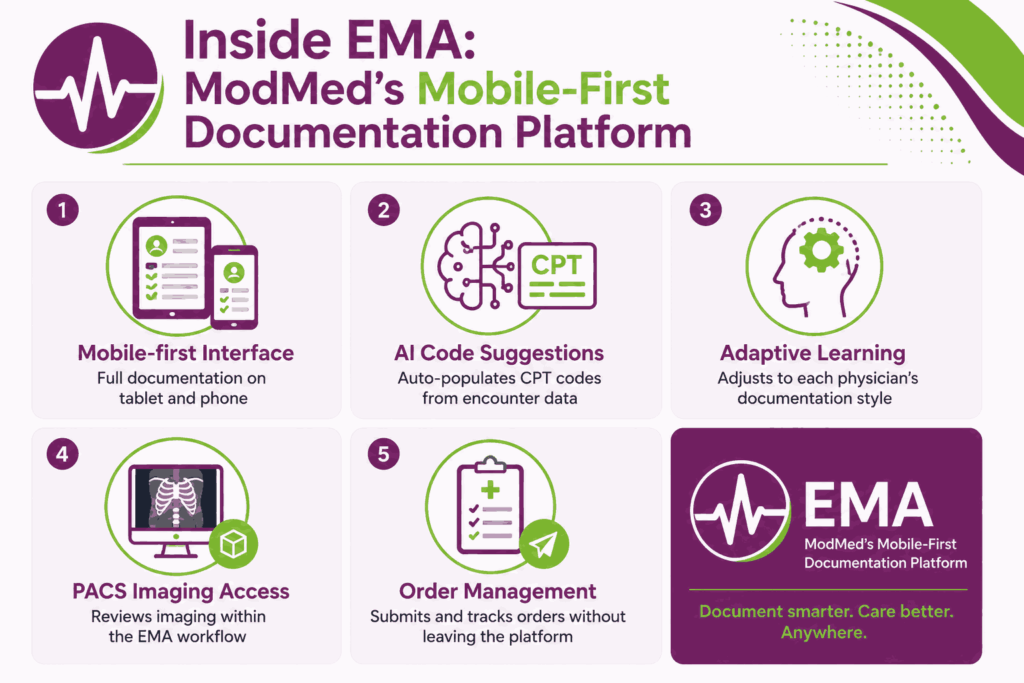
The Electronic Medical Assistant (EMA) is ModMed’s mobile-first documentation platform, built for point-of-care use on tablets and smartphones. Physicians can complete notes, review imaging, and manage orders without returning to a desktop workstation. EMA also learns from individual provider behavior, adapting its suggestions to match each clinician’s documentation patterns over time.
| EMA Capability | Function |
|---|---|
| Mobile-first interface | Full documentation on tablet or smartphone at point of care |
| AI code suggestions | Auto-populates billing codes from encounter data |
| Adaptive learning | Adjusts to each physician’s documentation style over time |
| Imaging access | Reviews PACS imaging directly within the EMA workflow |
| Order management | Submits and tracks orders without leaving the platform |
ModMed’s analytics layer gives practice leaders real-time visibility into provider productivity, procedure volumes, and revenue cycle performance. Reporting tools support both day-to-day operational decisions and value-based care program requirements. For orthopedic groups managing high surgical volumes, this level of data access directly affects both throughput and financial outcomes.
2. Exscribe Orthopedic EHR
Exscribe is a cloud-based EHR built exclusively for orthopedic practices, covering clinical documentation, practice management, and PACS imaging in one system. Unlike general-purpose platforms adapted for orthopedics, Exscribe was purpose-built for musculoskeletal care from the ground up. That focus shows in how the platform handles imaging workflows, surgical scheduling, and specialty-specific documentation.
Exscribe’s cloud architecture gives orthopedic practices access to patient records, scheduling, and imaging from any location. The platform runs natively on iOS, supporting mobile documentation during rounds, pre-op assessments, and post-surgical follow-ups. Its orthopedic-specific workflows reduce the custom configuration work that generic EHR systems typically require.
Exscribe’s core strengths as an orthopedic-specific platform include:
- Cloud-based access across devices with no on-premise infrastructure required
- Native iOS mobile app for full documentation at point of care
- Orthopedic-specific clinical workflows covering MSK exams, surgical prep, and follow-up care
- PACS imaging integration for in-platform radiograph and MRI review
- Surgical scheduling module with case management and OR coordination tools
The Exscribe iOS app gives orthopedic surgeons a complete documentation environment on iPhone and iPad. Physicians can capture exam findings, review imaging, and finalize notes without leaving the patient encounter. The mobile interface mirrors the desktop workflow, so providers don’t switch documentation habits based on the device they’re using.
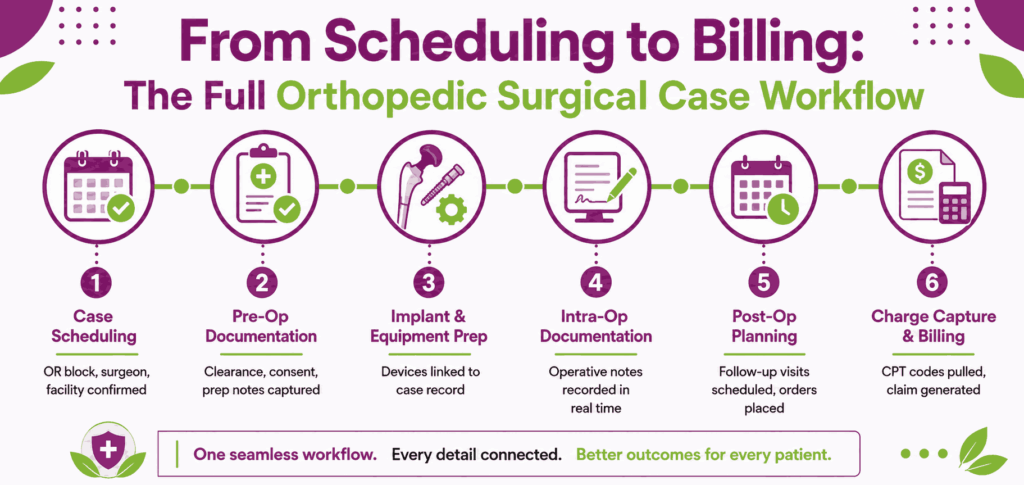
The surgical scheduling module connects pre-op documentation, OR block management, and post-surgical care planning in one workflow. Case coordinators can manage implant requirements, surgical team assignments, and facility bookings from the same interface. This reduces the coordination gap that typically falls between the clinical and administrative sides of a surgical practice.
| Surgical Scheduling Feature | Function |
|---|---|
| Pre-op documentation | Captures surgical prep notes and patient clearance within the EHR |
| OR block management | Manages facility time slots and surgeon availability across locations |
| Implant and equipment tracking | Links required devices and instruments to each surgical case |
| Post-surgical care planning | Schedules follow-up visits and documents post-op orders |
| Team assignment | Coordinates surgical team roles and responsibilities per case |
Exscribe connects clinical documentation directly to billing workflows through its integrated revenue cycle tools. Procedure codes are pulled from the encounter record and mapped to the correct CPT and ICD-10 codes before claim submission. That direct connection between clinical output and billing reduces manual entry errors and shortens the time from service delivery to reimbursement.
3. athenahealth for Orthopedics
athenahealth is a cloud-based EHR and revenue cycle platform built for specialty practices, including orthopedics. The system covers clinical documentation, scheduling, and claims management through a single cloud environment. Orthopedic practices use athenahealth to manage both MSK clinical workflows and the billing demands of high-volume surgical care.
athenahealth’s orthopedic content library includes specialty-specific templates for MSK exams, surgical procedures, and post-op documentation. The claims management system monitors submissions in real time and flags issues before they reach the payer. This built-in claim oversight reduces denial rates and shortens the revenue cycle for orthopedic practices managing high procedure volumes.
athenahealth’s orthopedic platform is anchored by three RCM-focused strengths:
- Large payer network: Pre-built connections to thousands of commercial, Medicare, and Medicaid payers nationwide
- Real-time eligibility checks: Verifies patient coverage before each visit to reduce front-end claim rejections
- Automated claim scrubbing: Reviews claims for coding errors and payer-specific rules before submission, cutting denial rates at the source
athenahealth operates one of the largest payer networks in ambulatory healthcare, with pre-built connections covering commercial insurers, Medicare, and Medicaid plans. Real-time eligibility checks run automatically before each appointment, flagging coverage gaps and prior authorization requirements before the patient arrives. This front-end verification reduces the volume of claims that fail on first submission.
athenaOne is athenahealth’s unified platform that gives orthopedic providers a single login for clinical documentation, scheduling, billing, and financial reporting. Physicians access patient records, claim statuses, and performance dashboards from one interface without switching between systems. That consolidated view reduces administrative overhead and gives practice managers real-time visibility into both clinical and revenue performance.
| athenaOne Feature | Function |
|---|---|
| Single-login dashboard | Unified access to clinical, scheduling, billing, and reporting tools |
| Real-time claim tracking | Monitors claim status across all payers from submission through payment |
| Automated eligibility checks | Verifies patient insurance coverage before each scheduled appointment |
| Claim scrubbing engine | Reviews claims for coding errors and payer-specific rules before submission |
| Financial reporting | Tracks collections, denial rates, and RCM performance at the practice level |
| Orthopedic content library | Pre-built templates and order sets for MSK exams and surgical care |
4. AdvancedMD Orthopedic EHR
AdvancedMD is a cloud-based EHR and practice management suite that gives orthopedic practices a customizable clinical and administrative platform. The system covers documentation, scheduling, billing, and patient engagement within one connected environment. Its flexibility makes it a practical fit for independent orthopedic practices and multi-specialty groups that need configurable specialty workflows.
AdvancedMD’s template library lets practices build and modify clinical forms, exam workflows, and procedure documentation to match their care model. Templates are customizable at the provider level, so different subspecialties can work from separate workflows within one system. This cuts documentation friction without requiring separate platform configurations per subspecialty.
AdvancedMD’s core strengths for orthopedic practices include:
- Flexible workflow customization: Provider-level template and workflow configuration without IT dependency
- Telehealth integration: Built-in video visit tools for post-op follow-ups, therapy coordination, and remote consultations
- Patient portal: Online intake, appointment scheduling, secure messaging, and results delivery in one patient-facing interface
AdvancedMD’s telehealth module runs natively within the EHR, letting providers conduct video visits and document them without leaving the platform. For orthopedic practices, this covers post-surgical follow-ups and physical therapy check-ins without a separate telehealth tool. The patient portal lets patients complete intake forms, review visit summaries, and message their care team from one interface.
AdvancedMD’s reporting dashboard gives orthopedic practices visibility into clinical and financial performance across providers, locations, and payers. Practice administrators can track procedure volumes, claim aging, denial trends, and collections from a single interface. Custom report filters let groups segment data by provider, CPT code, or payer, supporting both operational decisions and payer contract negotiations.
| Analytics Feature | Function |
|---|---|
| Provider productivity tracking | Measures encounter volumes, documentation time, and procedure output per provider |
| Claims and denial reporting | Tracks submission status, denial reasons, and resubmission outcomes by payer |
| Collections dashboard | Monitors payment posting, outstanding balances, and collection rates |
| CPT code analysis | Breaks down procedure frequency and reimbursement performance by billing code |
| Custom report builder | Filters data by provider, location, payer, or date range for targeted analysis |
| Payer performance tracking | Compares reimbursement rates and denial patterns across contracted payers |
5. Veradigm (Allscripts) Orthopedic EHR
Veradigm is a healthcare technology platform evolved from Allscripts, delivering an orthopedic EHR built around specialty documentation, analytics, and interoperability. The platform serves a large installed base across health systems, ambulatory practices, and orthopedic physician groups nationwide. Its orthopedic module handles the clinical and workflow demands of musculoskeletal care at both practice and enterprise scale.
Allscripts rebranded as Veradigm in 2022 to signal a shift toward data-driven healthcare and analytics-first product development. The Allscripts EHR product line, including its orthopedic tools, carried over into the Veradigm portfolio without clinical disruption for existing customers. Practices already running on Allscripts retained their workflows, configurations, and patient data under the new brand.
Veradigm’s orthopedic EHR covers seven specialty-specific capability areas:
| Orthopedic Feature | Function |
|---|---|
| Smart templates | Pre-built documentation templates for MSK exams, surgical cases, and follow-up visits |
| Imaging integration | Connects to PACS and diagnostic imaging directly within the clinical workflow |
| Surgical workflow tools | Manages pre-op, intra-op, and post-op documentation and scheduling in one place |
| Outcomes tracking | Captures patient-reported outcomes and functional recovery data over time |
| Order management | Handles referrals, labs, and imaging orders from within the EHR interface |
| e-Prescribing | Sends prescriptions to pharmacies with real-time drug interaction checks |
| Patient intake and portal | Supports pre-visit intake forms, results delivery, and post-visit communication |
Veradigm’s interoperability infrastructure connects orthopedic practices with hospitals, labs, imaging centers, and payers through standardized data exchange. The platform supports HL7 and FHIR-based integrations, reducing friction when sharing patient records across care settings. For orthopedic groups operating within larger health systems, this connectivity removes a meaningful coordination barrier.
Veradigm’s analytics layer draws on one of the largest real-world clinical datasets in the US, built from decades of Allscripts-era data collection. Orthopedic practices access performance dashboards covering procedure volumes, outcomes data, and revenue cycle metrics. The platform’s installed base reflects a deployment track record across complex, multi-site health system environments.
Veradigm’s position in the orthopedic EHR market is anchored by three platform-level strengths:
- Interoperability: HL7 and FHIR-based data exchange connecting practices with hospitals, payers, labs, and imaging centers
- Installed base: Broad deployment history across multi-site orthopedic groups, ASCs, and health systems
- Data analytics: Real-world clinical data at scale supporting outcomes reporting, performance tracking, and value-based care programs
6. Phoenix Ortho
Phoenix Ortho is a purpose-built EHR and practice management system designed exclusively for orthopedic practices, with no cross-specialty compromises. The platform covers clinical documentation, surgical case management, implant tracking, and practice administration in one orthopedic-only environment. That singular focus produces workflow depth that general EHR systems adapted for orthopedics rarely match.
Phoenix Ortho’s 100% orthopedic focus means every feature, template, and workflow was built for musculoskeletal care. The platform carries no overhead from modules built for other specialties, which keeps the interface clean and the workflows direct. Capabilities like implant tracking and surgical case management are core to the system, not add-ons configured after the fact.
Phoenix Ortho’s core strengths as an orthopedic-only platform include:
- 100% orthopedic focus: No general-purpose modules — every tool is purpose-built for MSK care
- Implant tracking: End-to-end device and implant tracking from surgical planning through post-op documentation
- Surgical case management: Integrated tools for case scheduling, OR coordination, and intra-op documentation
- Practice management: Scheduling, billing, and administrative workflows built around orthopedic operations
Phoenix Ortho’s implant tracking module manages device inventory, lot numbers, and manufacturer records within the surgical workflow. Tracking starts at case planning and carries through post-op documentation, creating a complete implant record tied to each patient encounter. This supports regulatory compliance and the documentation requirements that payers attach to surgical reimbursement claims.
Phoenix Ortho is built for mid-size to large orthopedic groups that need specialty depth without health system EHR complexity. The platform scales across multiple providers, subspecialties, and locations while keeping orthopedic workflows consistent group-wide. Practices with high surgical volumes, diverse subspecialty coverage, and complex implant management tend to get the most from the system.
| Surgical Case Management Feature | Function |
|---|---|
| Case scheduling | Manages OR block time, surgeon availability, and facility coordination |
| Pre-op documentation | Captures surgical prep notes, patient clearance, and consent within the EHR |
| Implant and device tracking | Links implant lot numbers and manufacturer records to each surgical case |
| Intra-op documentation | Records procedure details and operative notes in real time |
| Post-op follow-up | Schedules and documents post-surgical visits with outcome tracking |
| Case reporting | Generates surgical volume and outcome reports by provider or procedure type |
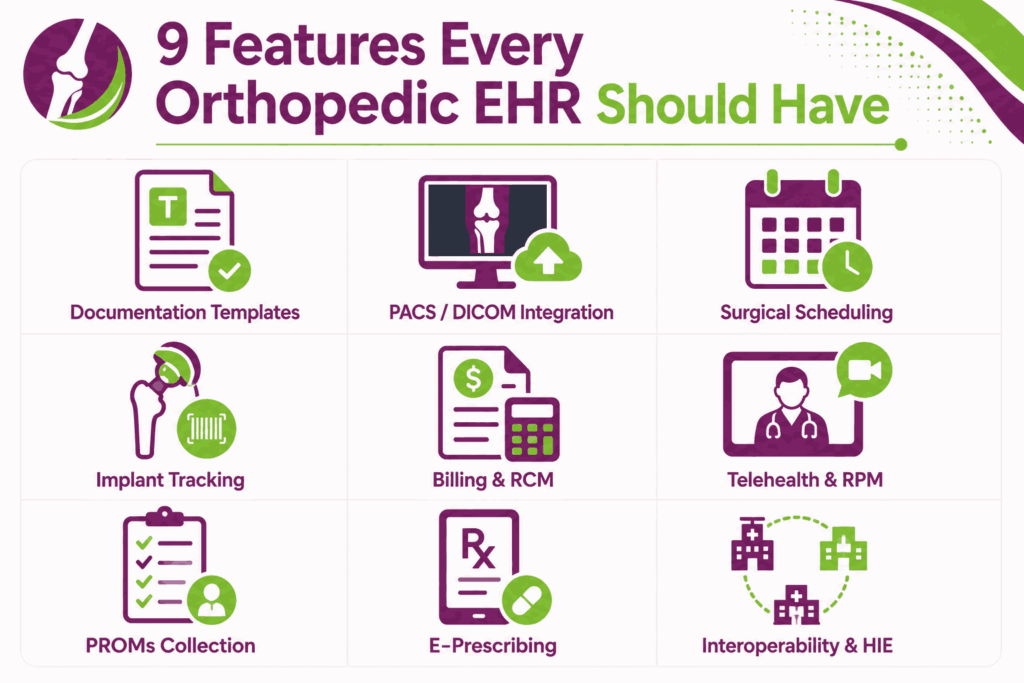
What are the Key Features of an Orthopedic EHR?
A capable orthopedic EHR goes beyond record storage. It covers specialty documentation, imaging, surgical workflows, implant tracking, billing, telehealth, PROMs, e-prescribing, and interoperability in one system. The sections below break down each feature area and what orthopedic practices should expect from a purpose-built platform.
Orthopedic-Specific Documentation Templates
Orthopedic documentation templates are pre-built clinical forms designed for MSK encounters, reducing manual documentation time and improving coding accuracy. Specialty EHRs include pre-built templates for:
- Joint replacements
- Fracture management
- Arthroscopy procedures
- Spine surgery
- ACL injuries and sports medicine
Customizable Smart Forms let clinicians adjust fields, defaults, and workflow order to match individual practice patterns. Structured templates also drive accurate CPT and ICD-10 code selection by mapping clinical findings to billable codes at the point of documentation.
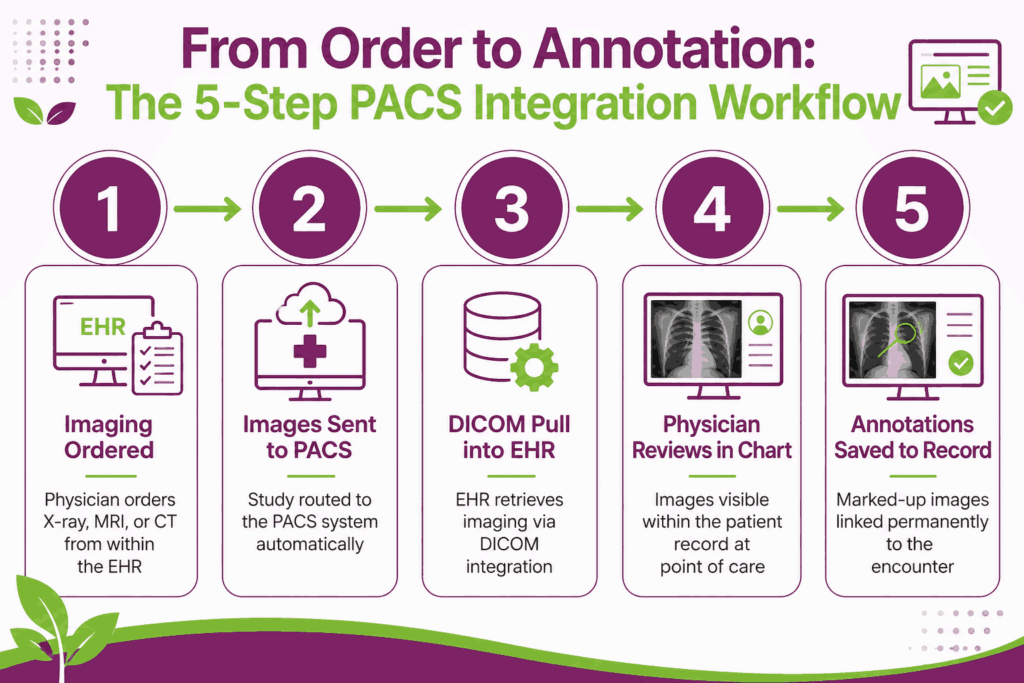
PACS and DICOM Imaging Integration
PACS and DICOM integration pulls X-rays, MRIs, and CT scans directly into the patient record, eliminating the need to switch between separate imaging and EHR systems. Physicians can review and annotate images directly in the chart, marking fracture lines, measuring joint space, and flagging surgical findings. This keeps the full imaging context within the clinical workflow without opening a separate viewer.
Surgical Scheduling and ASC Workflow
Surgical scheduling modules manage preoperative, perioperative, and postoperative charting, billing, and scheduling within one connected workflow. ASC workflows integrate natively with the EHR, keeping clinical documentation, case coordination, and billing connected from pre-op through discharge. A centralized case management view gives coordinators visibility into each case stage across all providers and locations.
Implant and Device Registry Tracking
Implant tracking links device registry data to individual patient records, covering joint prostheses, spinal hardware, and fixation devices used in surgical cases. That patient-level record supports recall management, regulatory compliance, and outcomes reporting by creating a traceable chain from implant selection through post-surgical follow-up.
Integrated Billing and Revenue Cycle Management
Integrated billing connects clinical documentation to charge capture, claim submission, modifier guidance, and denial workflows without manual re-entry. Documentation-driven charge capture reduces missed revenue by pulling CPT codes directly from the encounter before claim generation. Whether a practice manages collections internally or partners with external orthopedic billing services, having an EHR that natively supports bundled payments, Workers’ Compensation billing, and prior authorization workflows eliminates the gaps where general RCM tools frequently fail.
Telehealth and Remote Patient Monitoring
Embedded telehealth in an orthopedic EHR supports virtual visits with full documentation and compliance tracking within the clinical workflow. Post-surgical follow-ups, physical therapy check-ins, and fracture monitoring cases can run through virtual visits without a separate telehealth tool. Integration with remote patient monitoring devices, including wearables and range-of-motion sensors, extends clinical visibility between appointments.
Patient-Reported Outcome Measures (PROMs) Collection
PROMs integration allows orthopedic EHRs to collect validated patient-reported outcome scores directly within the clinical workflow. Supported measures include PROMIS, HOOS, KOOS, and VAS pain scores. PROMs data feeds into quality reporting, value-based care compliance, and clinical decision-making by tracking patient-reported functional status over time.
E-Prescribing and Medication Management
Orthopedic EHR e-prescribing manages controlled substance prescriptions, NSAIDs, and perioperative medications from within the clinical workflow with direct pharmacy transmission. PDMP integration checks state prescription monitoring data before issuing controlled substances, supporting opioid management protocols for post-surgical patients. EPCS compliance ensures electronic prescribing of controlled substances meets DEA requirements without additional software.
Interoperability and Health Information Exchange
Interoperability allows an orthopedic EHR to exchange patient data with outside providers, payers, and facilities through standardized protocols. HL7 FHIR and CCD/CCDA support referral workflows between orthopedic surgeons, primary care, physical therapists, and imaging centers. MIPS and MACRA reporting integration, alongside 21st Century Cures Act compliance, meets federal data exchange requirements without custom development.
What are the Benefits of an Orthopedic EHR?
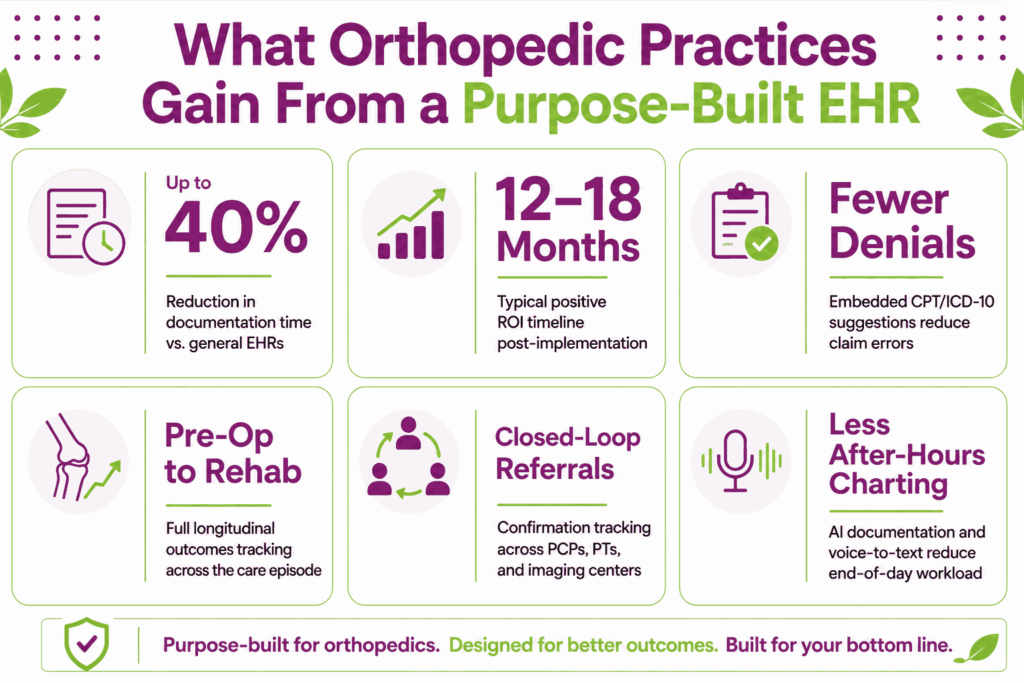
Orthopedic EHRs deliver measurable returns across clinical and financial operations. The benefits span faster documentation, more accurate coding, better outcomes tracking, tighter care coordination, and lower physician burnout. Each advantage compounds when specialty-specific tools replace general-purpose workflows.
Reduced Documentation Time
Reduced documentation time is the productivity gain orthopedic providers achieve by using specialty-specific templates and AI-assisted charting instead of manual note entry.
Orthopedic templates and AI-assisted charting can cut documentation time by up to 40% compared to general EHRs. That reduction translates directly to higher patient throughput, shorter encounter cycles, and fewer hours spent on after-hours charting. Physicians completing notes at the point of care rather than the end of the day see the largest productivity gains.
Improved Coding Accuracy and Revenue Capture
Coding accuracy is the EHR’s ability to map clinical documentation to correct CPT and ICD-10 codes, reducing billing errors before claim submission.
Procedure-based templates with embedded code suggestions reduce undercoding and modifier errors on high-value orthopedic CPT codes and complex surgical procedures. Documentation-driven charge capture pulls billable services from the encounter record before the claim is generated, closing the gap on missed charges. The result is fewer denied claims, higher clean claim rates, and faster reimbursement cycles.
Enhanced Surgical Outcomes Tracking
Surgical outcomes tracking is the longitudinal recording of patient functional status and recovery data from pre-op assessment through rehabilitation.
EHR-integrated registries and PROMs capture outcomes data at each care stage, from pre-operative baseline through post-surgical rehab. That longitudinal record supports MIPS quality reporting, bundled payment performance measurement, and internal quality improvement programs. Practices with strong outcomes data also carry an advantage in value-based care contract negotiations.
Streamlined Referral and Care Coordination
Referral coordination in an orthopedic EHR is the system’s ability to send, track, and close referrals between providers within a connected care network.
Interoperable EHRs send referral packets containing clinical notes, imaging, and orders directly to PCPs, physical therapists, and imaging centers without manual handoff. Closed-loop referral tracking confirms receipt, flags incomplete referrals, and keeps the referring provider updated on patient status. That visibility reduces care gaps and improves the patient experience at key transition points.
Reduced Provider Burnout
Provider burnout reduction refers to the administrative relief orthopedic EHRs deliver through specialty-optimized workflows that cut documentation overhead.
Specialty-built workflows eliminate the generic documentation steps that general EHRs require orthopedic physicians to work around. Voice-to-text charting, AI note generation, and one-click order sets cut after-hours documentation, a consistently cited driver of physician burnout. Less time on documentation means more time on clinical care and patient volume.
What are the Challenges of Orthopedic EHR Adoption?
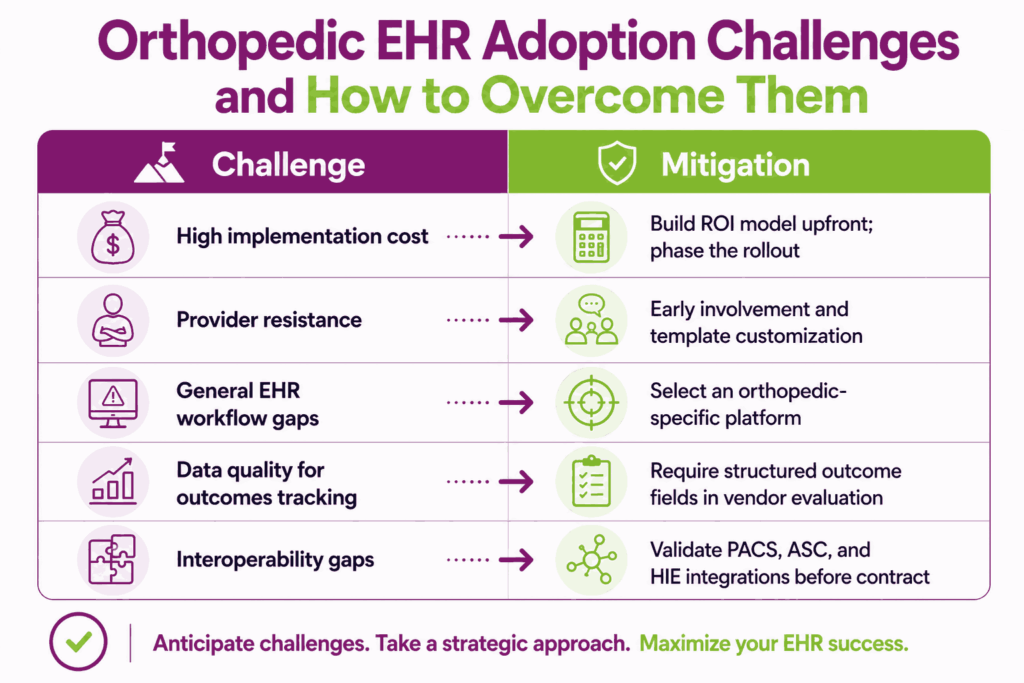
Orthopedic EHR adoption carries real operational and financial friction. Practices face implementation costs, provider resistance, workflow limitations, data quality gaps, and interoperability challenges that can slow or derail a rollout. Understanding these challenges upfront separates a successful deployment from a costly one.
High Implementation Cost and ROI Timeline
EHR implementation cost covers licensing, hardware, training, and the productivity loss that accompanies any major platform change. For mid-size orthopedic groups, that combined burden can reach six figures before the system stabilizes. Most practices reach positive ROI within 12 to 18 months, with the business case built around coding accuracy gains, denial reduction, and recovered revenue.
Resistance to Change and Provider Burnout
Change resistance is the organizational friction that slows EHR adoption when providers perceive the new system as adding work rather than removing it. EHR transitions are consistently cited as a burnout driver, particularly when workflows feel unfamiliar and documentation time increases during the learning curve. Early involvement, template customization, and incremental rollout reduce resistance most effectively.
General EHR Limitations for Orthopedic Workflows
General EHR systems lack orthopedic-specific tools that MSK practices depend on, including imaging annotation, implant tracking, surgical scheduling, and procedure-driven templates. Practices using these systems work around missing functionality rather than through it. That friction adds documentation steps, slows throughput, and increases coding error risk on complex orthopedic procedures.
Data Quality and Longitudinal Outcome Tracking
Data quality refers to the precision and completeness of clinical records for outcome tracking, not just billing documentation. EHRs built around billing often lack the structured fields needed for longitudinal outcome tracking. That gap separates billing records from the quality-of-care data that orthopedic registries and value-based programs require.
Interoperability Gaps Between Systems
Interoperability gaps occur when an orthopedic EHR cannot exchange data cleanly with PACS, ASC systems, PT clinics, or external referral networks. When imaging, surgical, and clinic systems don’t communicate, data silos form across the care network. Clinical staff end up manually re-entering records, imaging context gets lost, and referral continuity breaks down.
How to Implement an Orthopedic EHR?
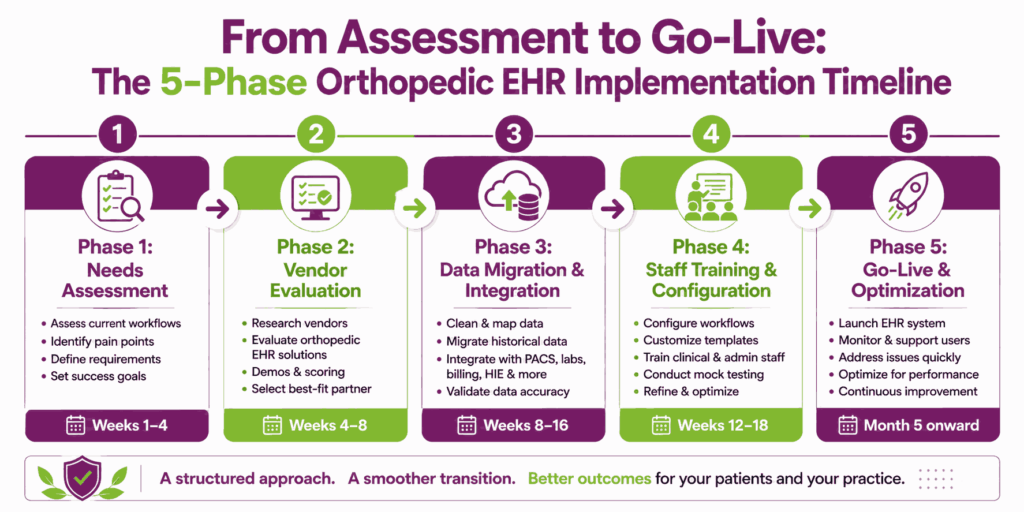
To implement an orthopedic EHR, practices need a structured rollout plan covering needs assessment, vendor selection, data migration, staff training, and post-go-live optimization. Rushing any stage increases the risk of workflow disruption, data loss, and user resistance that extends the productivity recovery period.
- Assess Practice Needs and Workflow Gaps: Map current documentation, billing, imaging, and surgical workflows to identify where your current system creates friction before selecting a replacement.
- Evaluate and Compare EHR Vendors: Score vendors against orthopedic-specific criteria, including PACS integration, implant tracking, ASC support, RCM connectivity, and implementation experience.
- Plan Data Migration and System Integration: Define migration scope, validate legacy record integrity, and map integration points for PACS, billing, and ASC systems before go-live.
- Train Staff and Configure Workflows: Build role-specific training for physicians, coders, and schedulers. Configure templates, order sets, and billing workflows before the first live encounter.
- Go-Live and Post-Implementation Optimization: Run a phased go-live to reduce risk. Monitor productivity, clean claim rates, and documentation quality in the first 90 days and adjust accordingly.
How Does an Orthopedic EHR Connect to Billing, Coding, and Reimbursement Workflows?
The orthopedic EHR is the upstream system that drives every downstream billing process, from charge entry through claim submission to payment posting. Documentation quality directly determines coding accuracy, modifier selection, and claim adjudication outcomes. When the EHR captures the right clinical detail, billing produces fewer rejections and faster reimbursement.
Does Your Orthopedic EHR Automatically Capture Documentation Needed for Billing of Fracture Care?
Yes. Orthopedic EHRs include fracture-specific templates that capture fracture type, treatment approach, and associated CPT codes at the point of care. Documentation is structured to support claim submission without additional coding review steps.
Can the Orthopedic EHR Suggest CPT, ICD-10, and Modifiers Based on Provider Documentation To Reduce Billing Errors?
Yes, specialty EHRs map clinical documentation to CPT codes, ICD-10 diagnoses, and applicable modifiers in real time as the provider completes the encounter. Code suggestions are generated from the documented procedure, diagnosis, and visit level, reducing manual selection and the billing errors that follow.
How Does the Orthopedic EHR Help Ensure Billing Compliance for Global Periods After Orthopedic Surgeries?
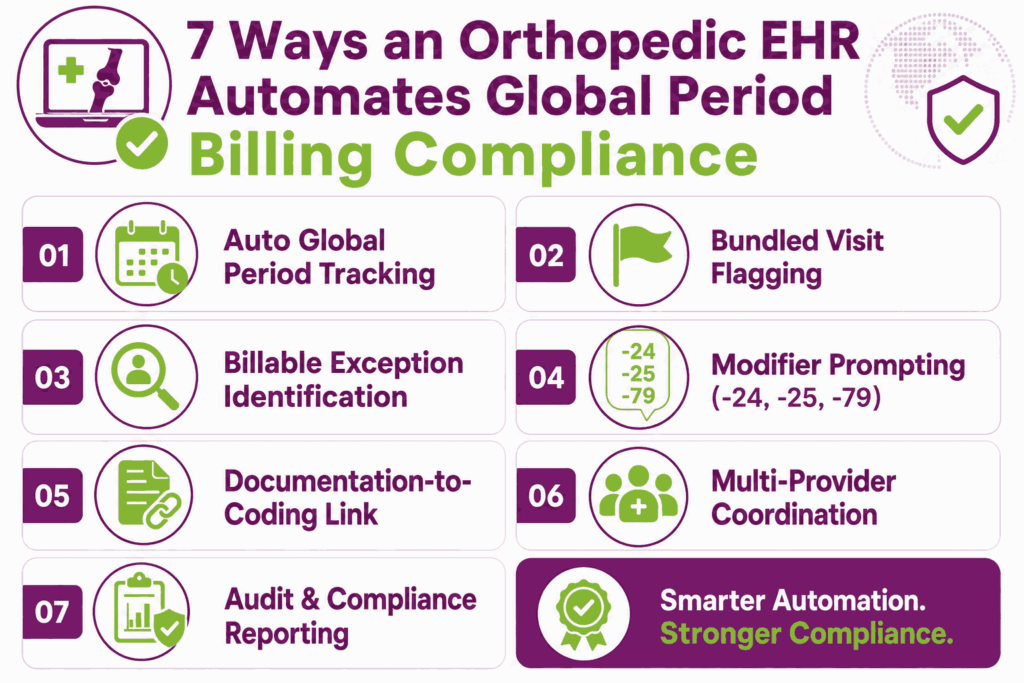
Orthopedic EHRs help ensure billing compliance for global periods after orthopedic surgeries by building global period logic directly into the clinical and billing workflow. The system manages compliance across seven functions:
- Automatically Tracking the Global Period: Calculates the 10- or 90-day global period for each procedure and flags encounters that fall within it.
- Preventing Billing for Bundled Post-Op Visits: Flags post-op encounters within the global period as bundled, blocking claims for services already covered by the surgical payment.
- Identifying Billable Exceptions: Flags unrelated diagnoses, new complications, and staged procedures as billable exceptions outside the global bundle.
- Suggesting Correct Modifiers: Prompts the appropriate modifier (-24, -25, -79) when billing for services legitimately separate from the global package.
- Linking Documentation to Coding: Connects operative notes to post-op encounter records, giving internal teams and specialized orthopedic billing companies the deep clinical context required to support modifier use and justify global period exceptions during audits.
- Coordinating Surgeons, PAs, and Therapists: Tracks global period status across the full care team to prevent billing errors when multiple providers manage post-op care.
- Reporting and Audit Tools: Flags global period billing activity for internal compliance review, reducing exposure before a payer audit.
Does the System Link Operative Notes Directly to Orthopedic Billing Claims for Faster Reimbursement?
Yes, operative notes connect directly to the billing workflow, so documented procedures, implants, and findings feed into charge capture and claim generation. This reduces the documentation-to-claim lag and gives coders the surgical detail needed to support accurate CPT coding without requesting records separately.
Can Providers Document Knee, Hip, Shoulder, and Spine Visits Using Templates That Also Support Correct Billing Levels?
Yes, Orthopedic EHRs include joint-specific templates for knee, hip, shoulder, and spine visits that capture the clinical elements needed for E&M level selection and procedure coding. Documentation within the template maps to visit complexity and medical decision-making criteria, supporting the correct billing level without a separate review.
Does the System Support Documentation and Billing for DME?
Yes, Orthopedic EHRs support DME documentation by capturing clinical necessity, prescription details, and HCPCS codes within the encounter record. The system links physician orders to billing, supporting compliance with payer documentation requirements for braces, orthotics, crutches, and other orthopedic DME.