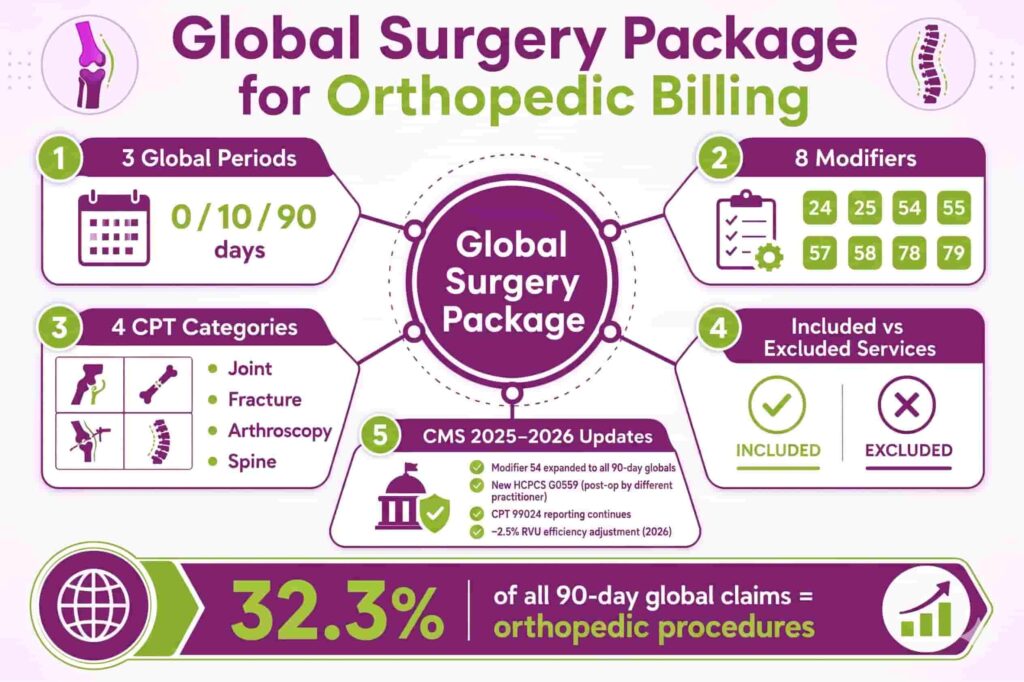
The global surgery package in orthopedic billing is a Medicare bundled payment structure that combines pre-operative, intra-operative, and post-operative services into one reimbursement for a defined surgical episode. Orthopedic procedures account for approximately 32.3% of all 90-day global period claims submitted under the CMS Physician Fee Schedule.
The global surgery package operates across three durations: 0-day, 10-day, and 90-day, with each duration tied to procedure complexity and post-operative care intensity. Seven critical modifiers (24, 25, 54, 55, 57, 58, 78, 79) govern when services performed during the global period qualify for separate reimbursement.
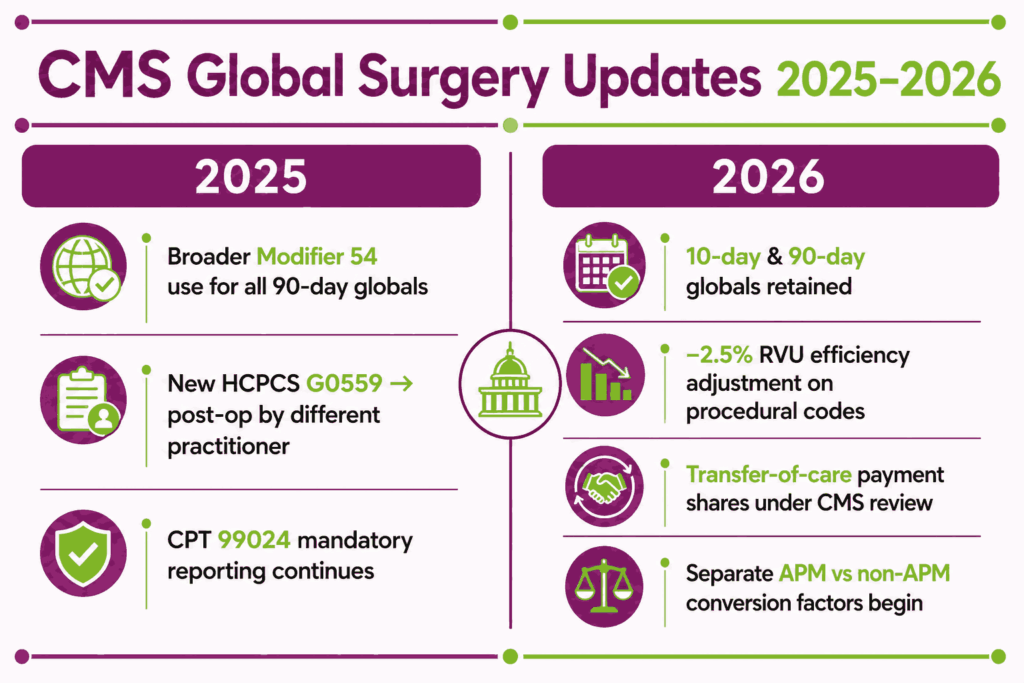
CMS retained CPT 99024 post-operative visit reporting requirements through 2025–2026 and introduced HCPCS G0559 for follow-up care delivered by a different practitioner, alongside a -2.5% efficiency adjustment to procedural work RVUs effective 2026.
What is the Global Surgery Package in Orthopedic Billing?
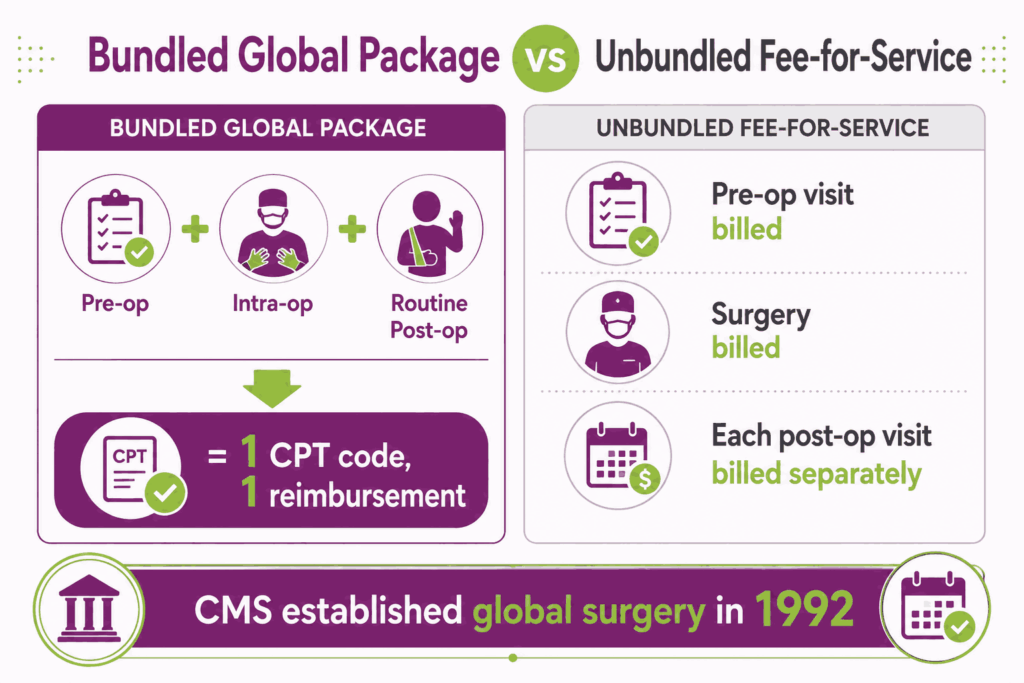
The global surgery package in orthopedic billing is a Medicare bundled payment model that reimburses one fee for all routine pre-operative, intra-operative, and post-operative services tied to a single surgical procedure.
CMS established the global surgery concept in 1992 under the Medicare Physician Fee Schedule. The bundled payment covers surgeon work, routine follow-up visits, standard wound care, and uncomplicated recovery management within the assigned global period.
Orthopedic surgery generates the largest share of 90-day global period claims, with CMS data attributing approximately 32.3% of all 90-day global procedures to orthopedic specialties, including joint replacement, fracture repair, arthroscopy, and spine surgery. The global surgery package differs from unbundled fee-for-service billing across 3 dimensions.
Unbundled billing reimburses each pre-op, surgical, and post-op service separately. The global surgery package consolidates payment into one CPT code. Bundled billing restricts separate claims for routine recovery visits within the global window.
What are the Types of Global Surgery Periods in Orthopedic Billing?
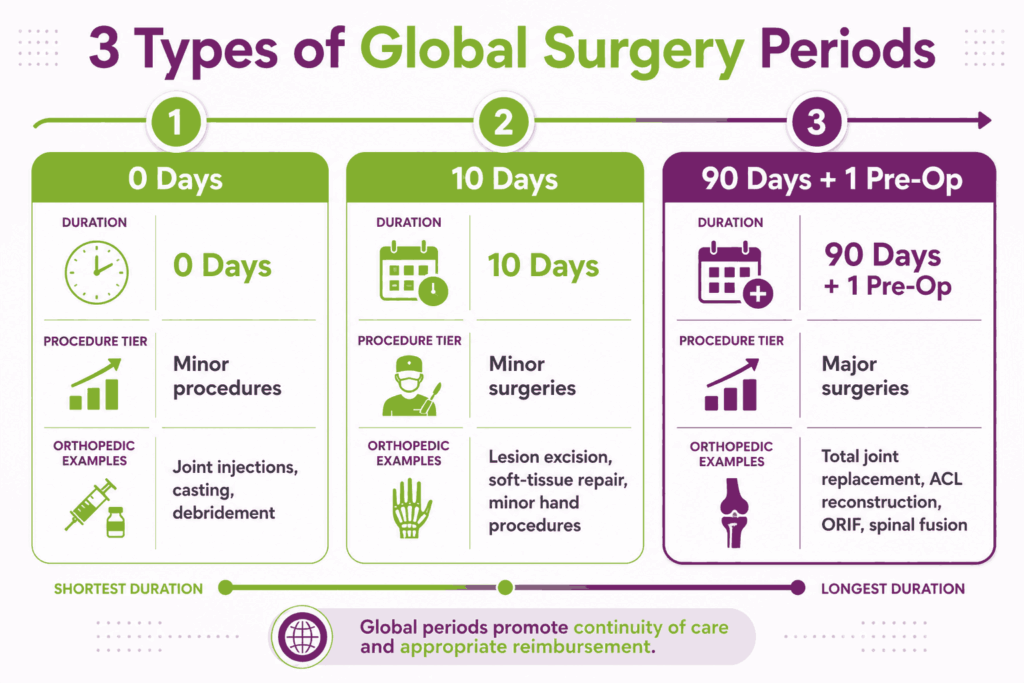
Three types of global surgery periods exist in orthopedic billing: 0-day, 10-day, and 90-day, each defined by post-operative care duration and procedure complexity. CMS assigns every surgical CPT code to one of these three global indicators in the Medicare Physician Fee Schedule Relative Value File. Orthopedic procedures span all three durations, with major surgeries falling into the 90-day category.
0-Day Global Period (Minor Procedures)
The 0-day global period covers minor procedures with no included post-operative days, meaning follow-up visits qualify for separate billing from the procedure date forward. Typical orthopedic use cases include joint injections, simple casting or splint applications, minor debridement, trigger point procedures, and office-based interventions.
Follow-up visits after a 0-day procedure remain separately billable when medically necessary and supported by documentation. The 0-day global period operates predominantly in outpatient clinics and ambulatory settings where recovery timelines compress to hours rather than days.
10-Day Global Period (Minor Surgeries)
The 10-day global period covers minor surgeries with 10 included post-operative days, during which routine recovery visits remain bundled into the procedure fee. Typical orthopedic use cases include simple lesion excisions, superficial soft-tissue repairs, minor hand procedures, and fracture care services with limited follow-up.
Routine dressing checks, wound review, and uncomplicated recovery visits stay included in the 10-day window. Unrelated conditions arising during the 10 days qualify for separate reimbursement when supported by Modifier 24 and a distinct ICD-10 diagnosis code.
90-Day Global Period (Major Orthopedic Surgeries)
The 90-day global period covers major orthopedic surgeries with 90 included post-operative days plus 1 pre-operative day, bundling extended recovery management into the surgical fee. Typical orthopedic use cases include total joint replacement (CPT 27447, 27130), ACL reconstruction (CPT 29888), ORIF fracture repair, spinal fusion procedures, rotator cuff repair (CPT 29827), and major tendon reconstruction.
Most post-operative visits, wound care checks, suture removal, and routine recovery management consolidate into one bundled payment. The 90-day global period requires care coordination across rehab planning, imaging review, mobility progression, complication monitoring, and extended recovery tracking. Returns to the operating room, staged procedures, and unrelated conditions qualify for separate billing when the correct modifier (78, 58, or 79) supports the claim.
What are the Global Surgery Modifiers for Orthopedic Billing?
Eight critical modifiers govern global surgery billing exceptions in orthopedics, such as Modifier 24, 25, 54, 55, 57, 58, 78, and 79. Each indicates a specific clinical or administrative scenario that justifies separate reimbursement during the global period.
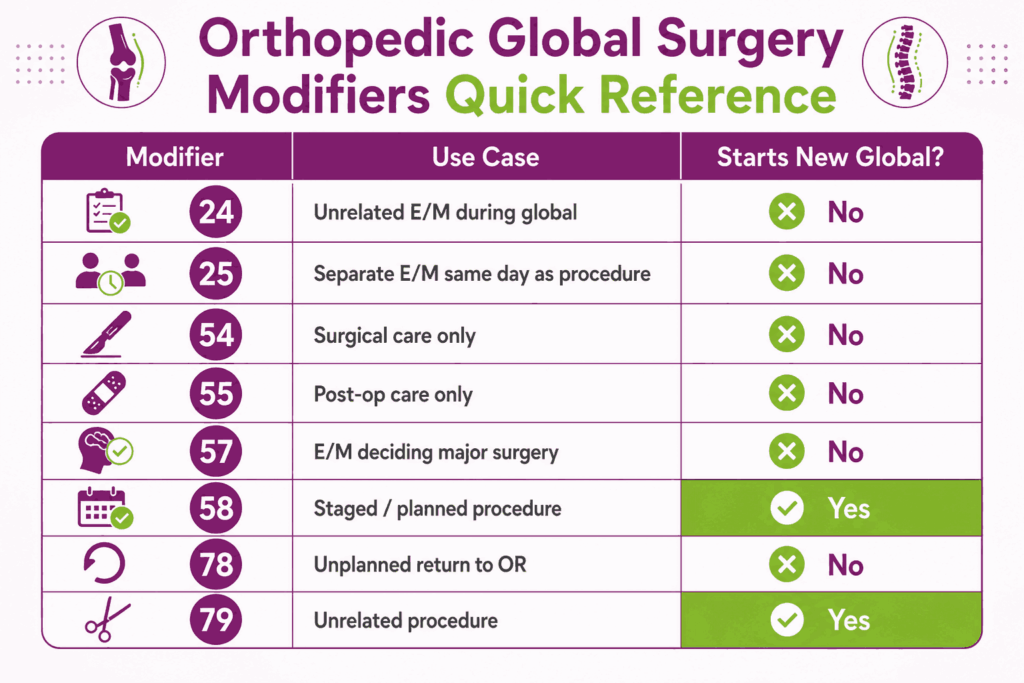
Modifier 24
Modifier 24 identifies an unrelated evaluation and management service performed by the operating surgeon during the post-operative global period. Orthopedic examples include a patient returning after a knee arthroscopy global period for new shoulder pain evaluation, or a wrist injury assessment unrelated to a prior hip replacement. Documentation must clearly separate the unrelated diagnosis from the surgical recovery issue. Modifier 24 applies exclusively to E/M codes, not procedure codes.
Modifier 25
Modifier 25 identifies a significant, separately identifiable E/M service performed on the same day as a procedure by the same physician. Orthopedic examples include a full evaluation of knee instability followed by joint injection on the same visit, or a comprehensive shoulder assessment followed by aspiration.
Modifier 25 documentation requires a medically necessary evaluation beyond the usual pre-procedure assessment. Modifier 25 supports billing for injections, aspirations, casting adjustments, and office procedures performed alongside a standalone E/M service.
Modifiers 54 and 55
Modifier 54 identifies surgical care only, and Modifier 55 identifies post-operative management only, splitting the global package payment between two providers. Orthopedic examples include a trauma surgeon performing ORIF while a local orthopedist manages follow-up after patient transfer.
Transfer-of-care documentation must specify the date responsibilities begin and end for each provider. Payment is divided between the operating surgeon (Modifier 54) and the post-operative provider (Modifier 55) according to CMS-assigned percentages of the total global fee, typically 70% surgical and 20% post-operative for 90-day globals.
Modifier 57
Modifier 57 identifies an E/M service that resulted in the decision for major surgery, performed the day before or day of the procedure. Orthopedic examples include emergency fracture evaluation leading to urgent ORIF, or acute ACL injury assessment leading to scheduled reconstruction.
Modifier 57 applies to procedures with a 90-day global period. Documentation must record the decision-making complexity and the surgical recommendation tied to the encounter.
Modifier 58
Modifier 58 identifies a staged or related procedure performed during the post-operative period of an earlier surgery. Orthopedic examples include planned hardware removal after fracture fixation, second-stage reconstruction, and serial debridement progressing to wound closure.
Modifier 58 starts a new global period for the subsequent procedure. The original operative record must support the anticipated staged treatment plan.
Modifier 78
Modifier 78 identifies an unplanned return to the operating room for a related procedure during the global period. Orthopedic examples include post-op hematoma evacuation, surgical site infection washout, and fixation revision after hardware failure.
Modifier 78 reimburses at the reduced intra-operative value (typically 70–80% of the procedure fee) and does not start a new global period. Modifier 78 indicates complication management rather than planned care.
Modifier 79
Modifier 79 identifies an unrelated procedure performed by the same surgeon during the post-operative period of an earlier surgery. Orthopedic examples include a patient in post-op period for shoulder repair undergoing carpal tunnel release, or treatment of a new ankle fracture during a hip replacement global period.
Modifier 79 starts a new global period for the unrelated procedure. Documentation must clearly show no clinical relationship to the prior surgery.
What are the Orthopedic CPT Codes with Global Surgery Periods?
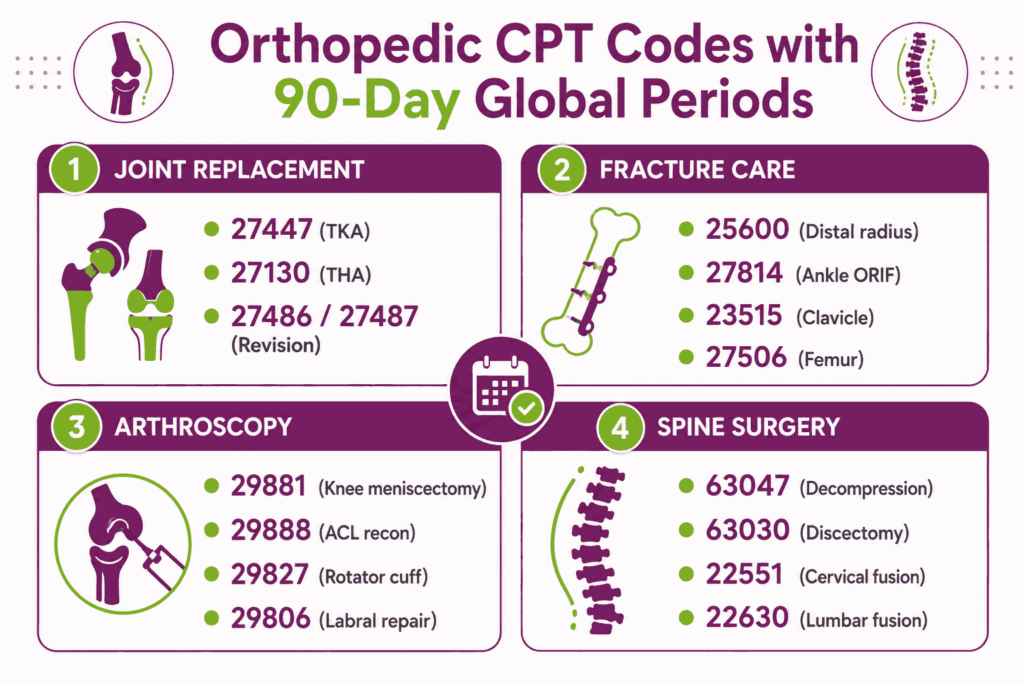
Orthopedic codes with global surgery periods cluster across 4 procedure categories. These include joint replacement, fracture care, arthroscopy, and spine surgery, with each category dominated by 90-day global assignments due to procedure complexity. Mastering these foundational orthopedic CPT billing codes requires an exact understanding of their clinical parameters, as a single tracking error can result in massive downcoding or outright denials during the post-operative window.
Joint Replacement CPT Codes
Joint replacement CPT codes are surgical billing codes for total or partial replacement of major joints, all carrying 90-day global periods under CMS. CPT examples include total knee arthroplasty (27447), total hip arthroplasty (27130), revision arthroplasty codes (27486, 27487, 27134), and partial joint replacement codes (27446, 27125).
The 90-day global package includes wound checks, mobility progression assessments, routine follow-ups, and recovery monitoring through week 12 post-op. Joint replacement procedures generate among the highest absolute reimbursements in orthopedics, with corresponding post-operative workload and care coordination demands.
Fracture Care CPT Codes
Fracture care CPT codes are billing codes for closed or open reduction and fixation of bone fractures, with global period assignments ranging from 10-day to 90-day depending on procedure complexity. CPT examples include closed distal radius fracture care (25600), ankle fracture ORIF (27814, 27822), clavicle fracture fixation (23515), and femur fracture repair (27506).
Fracture care services vary by treatment method, with closed reduction often carrying 90-day globals and open surgical fixation carrying 90-day globals. The global package includes routine healing checks, cast management, and standard post-operative monitoring per the specific code rules.
Arthroscopy CPT Codes
Arthroscopy CPT codes are billing codes for minimally invasive joint procedures, all carrying 90-day global periods. CPT examples include knee meniscectomy (29881), ACL reconstruction arthroscopy (29888), shoulder rotator cuff repair arthroscopy (29827), labral repair (29806), and loose body removal (29874).
The 90-day global package includes routine post-op visits, rehab progression checks, pain management follow-up, and mobility monitoring. Arthroscopy generates high procedural volume in sports medicine practices and ambulatory surgery centers, with shorter facility times than open procedures but identical global period obligations.
Spine Surgery CPT Codes
Spine surgery CPT codes are billing codes for cervical, thoracic, and lumbar surgical interventions, predominantly carrying 90-day global periods. CPT examples include lumbar decompression (63047), discectomy (63030), cervical fusion (22551), lumbar fusion (22630, 22633), and instrumentation procedures (22840, 22842, 22845).
The 90-day global package includes wound checks, neurological monitoring, imaging review, brace management, and staged recovery assessments. Spine surgery cases frequently involve comorbidities and longer recovery paths, increasing post-operative workload within the bundled payment.
What Services are Included in the Orthopedic Global Surgery Package?
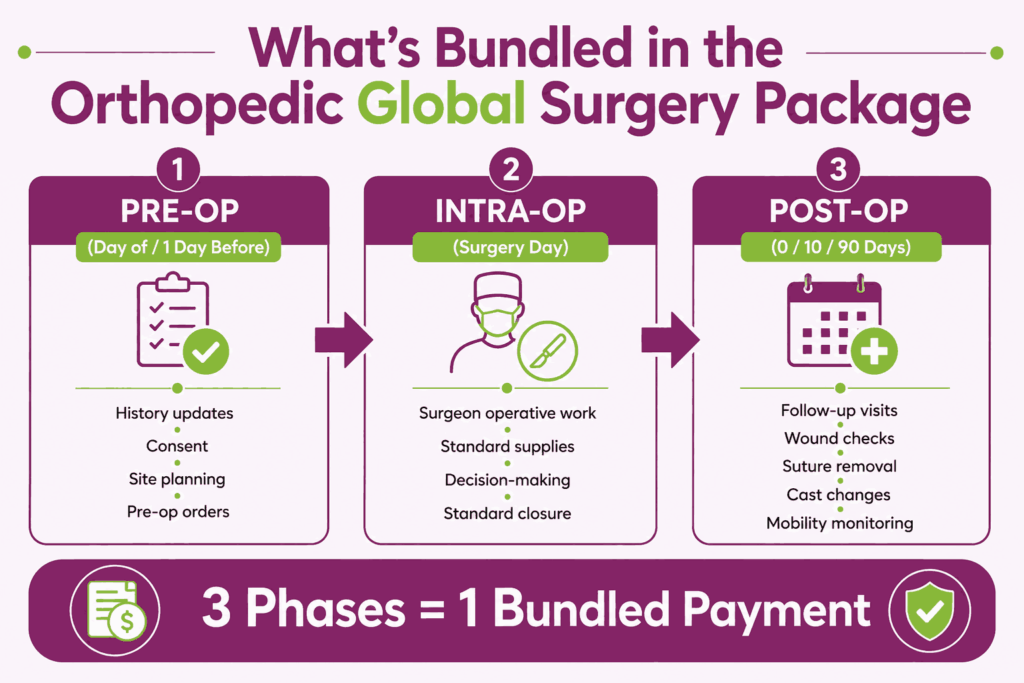
The orthopedic global surgery package includes pre-operative, intra-operative, and post-operative services tied directly to the surgical procedure. CMS defines bundled inclusions in the Medicare Claims Processing Manual, Chapter 12, Section 40.
Pre-Operative Services Included
Pre-operative services within the global package include routine preparatory work performed on the day of surgery or 1 day prior for 90-day global procedures. Included services span routine preoperative history updates, surgical consent discussion, standard pre-op evaluation tied to an already-made surgery decision, surgical site planning, and routine pre-op orders.
Coordination tasks include scheduling instructions, standard pre-op education, medication hold guidance, and routine preparation. Separate consults or E/M visits that determine the medical necessity of surgery qualify for separate reimbursement using Modifier 57 (90-day globals) or Modifier 25.
Intra-Operative Services Included
Intra-operative services within the global package include all physician work performed during the surgical procedure itself. Included services span surgeon operative work, standard supplies tied to physician service, intra-operative decision-making, standard closure, and management directly related to the procedure.
The intra-operative bundle covers the physician’s procedural component, while facility billing remains separate in hospital and ambulatory surgery center settings. Procedure time, staffing coordination, and implant planning affect economics but do not generate separately billable physician line items.
Post-Operative Services Included
Post-operative services within the global package include routine recovery management from the procedure date through the assigned global period (0, 10, or 90 days). Included services span standard follow-up visits, incision and wound checks, suture or staple removal, routine cast or dressing changes, pain medication management related to surgery, and recovery progress assessment.
Monitoring activities include mobility checks, healing review, routine imaging review, and complication surveillance at standard levels. Treatment of unrelated conditions, staged procedures, and returns to the operating room qualify for separate billing using Modifiers 24, 58, 78, or 79.
What Services are Excluded from the Global Surgery Package?
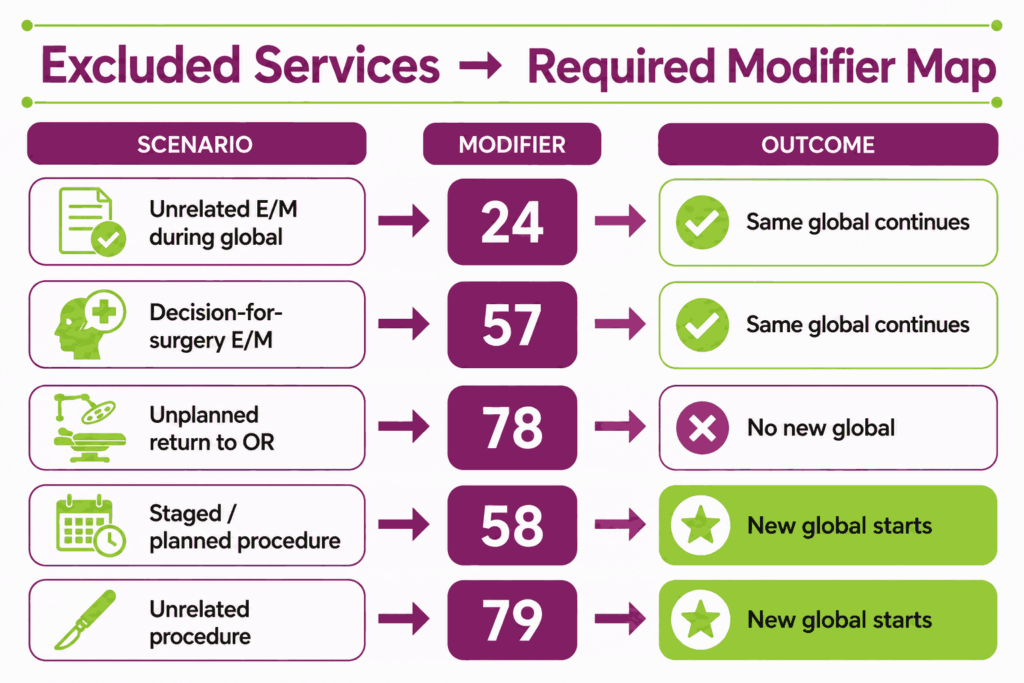
Four categories of services remain excluded from the orthopedic global surgery package. These are unrelated E/M visits, unplanned returns to the OR, staged or related procedures, and unrelated procedures, each requiring a specific modifier for separate reimbursement.
Unrelated Evaluation and Management Services
Unrelated E/M services during the global period are office or facility visits addressing conditions unrelated to the surgical procedure. Unrelated E/M visits qualify for separate billing using Modifier 24 appended to the appropriate E/M code. A different ICD-10 diagnosis code must support the unrelated nature of the visit.
Documentation requirements include a clear distinction between routine post-op care and the unrelated condition, with separate history, examination, and medical decision-making elements documented in the encounter note.
Unplanned Return to Operating Room
Unplanned return to the operating room covers complications requiring surgical intervention during the post-operative global period. Unplanned returns qualify for separate billing using Modifier 78 appended to the procedure code. Common orthopedic scenarios include surgical site infection requiring incision and drainage, hardware failure requiring revision, and post-operative bleeding requiring evacuation.
Modifier 78 does not start a new global period and reimburses at the reduced intra-operative percentage assigned by CMS for the specific procedure.
Staged or Related Procedures
Staged procedures are pre-planned surgical interventions performed during the post-operative period of an earlier related surgery. Staged procedures qualify for separate billing using Modifier 58 appended to the procedure code.
Orthopedic examples include staged bilateral knee replacements, planned hardware removal after fracture healing, and planned reconstruction following initial debridement. Modifier 58 starts a new global period from the staged procedure date, separating the two surgical episodes for reimbursement.
Unrelated Procedures During the Global Period
Unrelated procedures during the global period are surgical interventions clinically separate from the original procedure. Unrelated procedures qualify for separate billing using Modifier 79 appended to the procedure code.
An orthopedic example includes a patient who underwent total knee replacement and requires carpal tunnel release during the 90-day post-operative window. Documentation must establish no clinical relationship to the prior surgery, supported by a distinct ICD-10 diagnosis code. Modifier 79 starts a new global period for the unrelated procedure.
What are the CMS Global Surgery Updates for Orthopedic Billing in 2025–2026?
CMS issued targeted global surgery updates for 2025 and 2026 affecting modifier usage, post-operative reporting, and procedural reimbursement values. Keeping up with these shifting regulations is a core responsibility of modern orthopedic billing services, which must continuously tune their internal claim scrubbers to absorb granular changes like work RVU reductions and new HCPCS tracking requirements.
2025 CMS Updates Relevant to Orthopedics:
- Broader application of Modifier 54 (Surgical Care Only) to all 90-day global packages when the operating surgeon performs only the surgical portion. The expanded scope supports fracture call coverage models, referral arrangements, and rural follow-up patterns where post-op care transfers to another provider.
- Introduction of HCPCS G0559 for post-operative care visits furnished by a practitioner different from the operating surgeon, with same-group exclusion rules applying. HCPCS G0559 supports billing in scenarios where a different orthopedist manages the recovery phase.
- Continued mandatory reporting of CPT 99024 for post-operative visits in 90-day global periods, used by CMS to evaluate the accuracy of bundled payment assumptions.
2026 CMS Updates Relevant to Orthopedics:
- No elimination of 10-day or 90-day global packages. CMS retained the bundled structure while continuing review of payment accuracy and post-operative care assumptions.
- CMS requested public comments on transfer-of-care payment shares for 90-day globals, signaling future revisions to how bundled payment splits between the operating surgeon and post-operative provider under Modifiers 54 and 55.
- -2.5% efficiency adjustment applied to many non-time-based procedural work RVUs, affecting orthopedic surgical codes even without changes to the global package definition itself.
- The 2026 Medicare conversion factor increase partially offsets the procedural RVU pressure. Separate Alternative Payment Model (APM) and non-APM conversion factor rates begin in 2026 under the Medicare Access and CHIP Reauthorization Act framework.
What is the Financial Impact of Global Surgery Periods on Orthopedic Practices?
Global surgery periods bundle pre-op, intra-op, and routine post-op care into one reimbursement, restricting separate billing opportunities for follow-up visits across 10 or 90 days. Orthopedic practices absorb the costs of multiple post-operative visits, surgeon and APP time, care coordination, wound checks, and patient communication within the single global fee.
High-volume orthopedic procedures, including joint replacement, fracture repair, and arthroscopy, generate strong gross revenue, with margin contraction when post-operative workload exceeds the modeled assumption. Operational costs inside the global window include surgeon time, advanced practice provider visits, cast changes, imaging reviews, scheduling staff hours, documentation labor, and patient outreach.
Incorrect billing during global periods triggers claim denials, post-payment audits, CMS repayments, and OIG compliance exposure. To safeguard their practice margins against these strict vulnerabilities, many surgical groups actively interview the best orthopedic billing companies to delegate their high-volume compliance monitoring to dedicated experts.
What are the Challenges in Managing Global Surgery Billing for Orthopedic Practices?
Challenges in managing global surgery billing for orthopedic practices span 8 operational and clinical categories:
- Tracking global period assignments across the CMS Physician Fee Schedule for every billed CPT code
- Applying Modifiers 24, 25, 57, 58, 78, and 79 correctly to support exception billing
- Managing multiple and bilateral procedures performed in the same operative session
- Closing documentation gaps that prevent modifier substantiation during audits
- Adapting to payer variation between Medicare, Medicaid, and commercial global period rules
- Coordinating split and shared surgical care under Modifiers 54 and 55
- Securing prior authorization and medical necessity documentation across procedure categories
- Billing implants and devices separately from professional service codes within global periods
What are the Best Practices for Global Surgery Package Compliance in Orthopedic Billing?
Best practices for global surgery package compliance in orthopedic billing workflows consolidate around 4 operational disciplines:
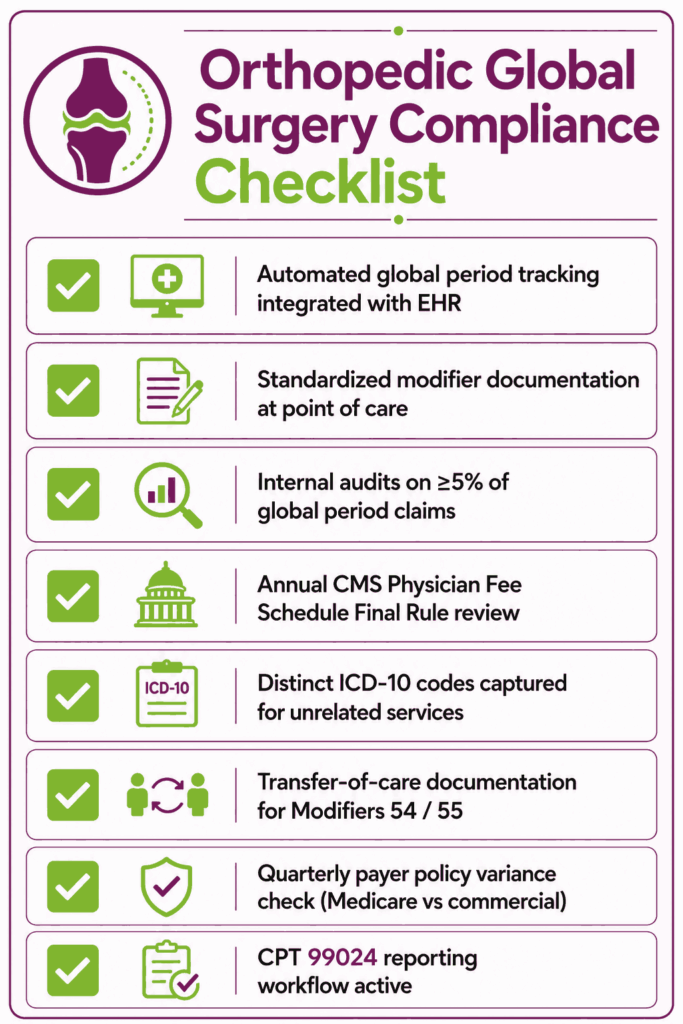
- Implement automated global period tracking systems integrated with the EHR and practice management platform to flag in-window encounters
- Establish standardized documentation protocols that capture diagnosis distinction, decision-making elements, and modifier rationale at the point of care
- Conduct regular internal billing audits across at least 5% of global period claims to identify modifier misuse and documentation gaps before payer audits surface them
- Stay current with CMS policy updates by tracking the annual Medicare Physician Fee Schedule Final Rule, transmittals, and MLN Matters articles affecting global surgery rules
The global surgery package for orthopedic billing concentrates pre-operative, intra-operative, and post-operative services into a single bundled payment governed by 0-day, 10-day, and 90-day global periods, controlled exceptions through Modifiers 24, 25, 54, 55, 57, 58, 78, and 79, and ongoing CMS reporting requirements through CPT 99024 and HCPCS G0559 in 2025–2026.