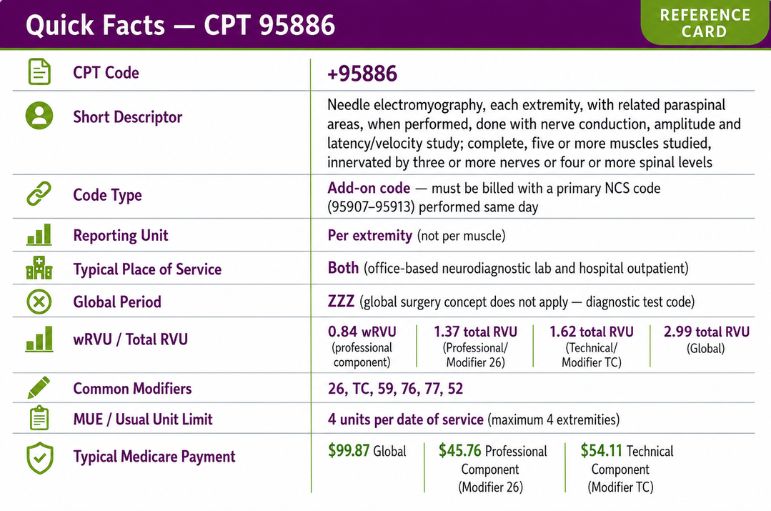
CPT code 95886 reports a complete needle electromyography of one extremity. The study runs in the same session as a separately billed nerve conduction study. It captures the needle EMG component only, never the nerve conduction work.
The code is an add-on. It cannot stand alone on a claim and must follow a primary nerve conduction study code. Each extremity counts as one billable unit under standard coding rules.
This guide breaks down the 95886 descriptor and its completeness thresholds. It covers the modifiers, the cost and RVU structure, and the documentation that supports payment. It also maps the bundling rules, the per-extremity unit logic, and the top denial triggers. The goal is correct reporting on the first pass and fewer downcoded or denied lines.
What Is the Description of CPT Code 95886?
CPT code 95886 is defined by the AMA as “Needle electromyography, each extremity, with related paraspinal areas, when performed, done with nerve conduction, amplitude and latency/velocity study; complete, five or more muscles studied, innervated by three or more nerves or four or more spinal levels”
The American Medical Association (AMA) classifies it as an add-on code in the 95885 to 95887 family. The word “complete” is the defining trigger. A study qualifies for 95886 only when it meets the muscle, nerve, and spinal-level breadth below. Fall short of that threshold and the correct code becomes 95885 instead.
The code applies to extremity muscles only. Cranial-nerve-supplied and axial muscles route to 95887. The physician performs the needle insertion and the interpretation personally.
What Muscle, Nerve, and Spinal Level Thresholds Define “Complete” EMG Under CPT Code 95886?
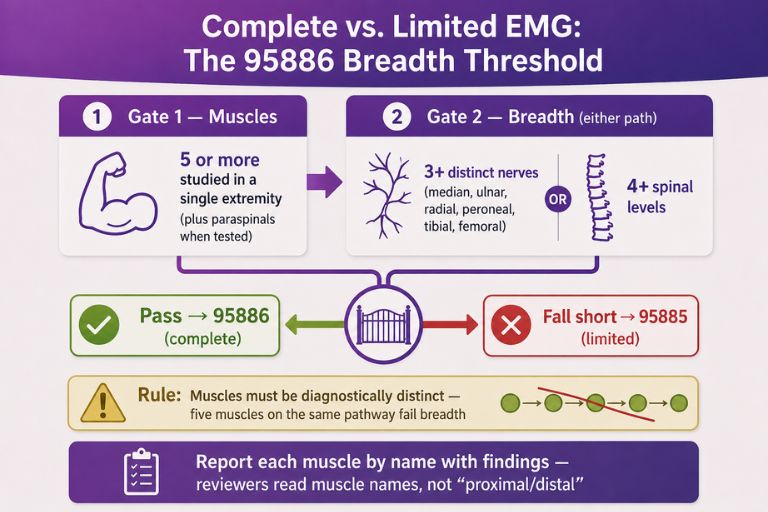
A “complete” extremity EMG meets a specific quantitative breadth. The study must test five or more muscles in that extremity. Those muscles must also reach a nerve or spinal-level threshold to satisfy the descriptor.
The completeness criteria for CPT 95886 are:
- Five or more muscles studied within a single extremity, plus related paraspinals when tested
- Three or more distinct nerves innervating the studied muscles, such as the median, ulnar, radial, peroneal, tibial, or femoral
- Four or more spinal levels represented across the studied muscles, as an alternative to the three-nerve path
The muscle count must reflect diagnostically distinct sites. Testing five muscles that map to the same pathway does not satisfy breadth. A payer reviewer reads muscle names, not vague labels like “proximal” or “distal.”
The report should list each muscle by name with its findings. AANEM guidance points to nerve-level and spinal-level representation, not sub-branches. This naming is what proves the threshold during a claim review or audit.
Why CPT Code 95886 Is an Add-On Code and Must Always Accompany a Same-Day NCS Code
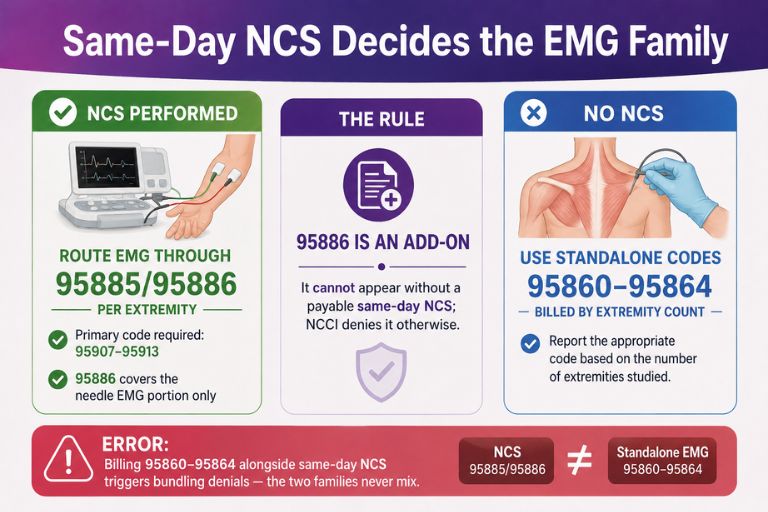
CPT 95886 is an add-on code by AMA definition. It carries the “List separately in addition to code for primary procedure” instruction. The code cannot appear on a claim without a primary nerve conduction study (NCS) on the same date.
The valid primary NCS codes are 95907 through 95913. These report the number of nerve conduction studies performed during the session. The 95886 line covers only the needle EMG portion of that encounter.
A common mistake here is billing 95886 on a day with no NCS. When EMG runs without same-day nerve conduction testing, the standalone codes apply instead. Those are 95860 through 95864, based on the number of extremities studied.
The NCS code must be present and payable for the add-on to process. Payer edits and NCCI logic deny 95886 when no qualifying primary code appears. The claim should show both the NCS line and the EMG line for the same date of service.
How Is CPT Code 95886 Reported Per Extremity, and Why Bilateral Studies Bill Multiple Units?
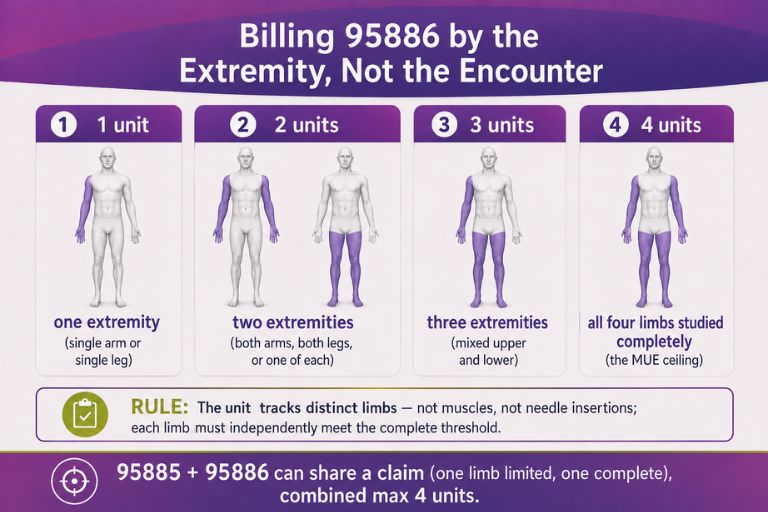
The billing unit for 95886 is the extremity, not the encounter. One arm is one extremity. One leg is one extremity. Each studied extremity that meets the complete threshold generates one unit.
A bilateral study tests two separate extremities. Both lower legs studied completely on the same day report two units of 95886. The count tracks distinct limbs, not the number of muscles or needle insertions.
Here is how unit reporting scales by extremities studied:
| Extremities Studied (Complete) | Units of 95886 | Notes |
|---|---|---|
| One extremity | 1 unit | Single arm or single leg |
| Two extremities (bilateral) | 2 units | Both arms, both legs, or one of each |
| Three extremities | 3 units | Mixed upper and lower |
| Four extremities | 4 units | All four limbs studied completely |
You may report both 95885 and 95886 on the same claim. This happens when one extremity is limited, and another is complete. The combined maximum across both codes is four units when all four extremities are tested.
Some payers require multiple units on one line. Others want separate line items with laterality modifiers. Confirm the format with each payer before submission to avoid unit-related denials.
How Does CPT Code 95886 Differ From CPT 95885 and CPT 95887?
The three codes share a family but split on completeness and anatomy. CPT 95885 reports a limited extremity EMG with same-day NCS. CPT 95886 reports a complete extremity EMG with same-day NCS. CPT 95887 covers non-extremity muscles.
The split between 95885 and 95886 turns on the five-muscle threshold. Four or fewer muscles in an extremity are limited and billed as 95885. Five or more muscles meeting the breadth rule are complete and billed as 95886.
This table maps the distinctions across the add-on EMG family:
| Code | Anatomy | Completeness | Muscle Threshold | Same-Day NCS Required |
|---|---|---|---|---|
| 95885 | Extremity | Limited | Four or fewer muscles | Yes |
| 95886 | Extremity | Complete | Five or more muscles, 3 nerves or 4 spinal levels | Yes |
| 95887 | Non-extremity (cranial or axial) | Not muscle-count based | Cranial-nerve-supplied or axial muscles | Yes |
CPT 95887 applies to muscles outside the limbs. Examples include facial muscles, paraspinal-only studies in some contexts, and other axial sites. All three codes still require a same-day NCS to be reported correctly.
How Does CPT Code 95886 Differ From the EMG-Without-NCS Codes (95860–95864)?
The 95860 to 95864 series reports needle EMG performed without same-day nerve conduction studies. These are standalone codes, not add-ons. They count extremities directly in the code itself.
The single trigger that separates the two families is the same-day NCS. When NCS is performed in the session, route the entire EMG through 95885 or 95886 per extremity. When no NCS is performed, use the 95860 to 95864 codes instead.
This table shows the standalone EMG codes by extremity count:
| Code | Extremities Studied | Same-Day NCS |
|---|---|---|
| 95860 | One extremity | No |
| 95861 | Two extremities | No |
| 95863 | Three extremities | No |
| 95864 | Four extremities | No |
| 95885 / 95886 | Per extremity (add-on) | Yes |
Mixing the two families on one claim is a frequent error. Reporting 95860 to 95864 alongside same-day NCS codes triggers bundling denials. The presence or absence of NCS dictates which family is correct.
What ICD-10 Codes and Medical Necessity Criteria Support CPT Code 95886?
Medical necessity for 95886 rests on a documented neuromuscular question. The diagnosis must map to a covered ICD-10-CM code on the applicable Local Coverage Determination (LCD). The ordering indication belongs in the pre-study assessment of the report.
Common diagnostic categories that support electrodiagnostic testing include:
- Radiculopathies, such as cervical and lumbar nerve root involvement
- Peripheral neuropathies, including diabetic and inflammatory forms
- Myopathies, covering inflammatory and metabolic muscle disease
- Motor neuron disease, such as amyotrophic lateral sclerosis (ALS)
- Plexopathies and mononeuropathies affecting the limbs
Representative ICD-10-CM codes seen on these claims include G54.x for nerve root and plexus disorders, G70.x and G71.x for myoneural and muscle disorders, and G12.21 for ALS. The exact covered list depends on the patient’s diagnosis and the Medicare Administrative Contractor (MAC).
Confirm the diagnosis maps to an LCD-covered code before scheduling the study. A claim with an unsupported diagnosis draws a medical-necessity denial. The clinical indication and the test findings must align in the documentation.
What are the Modifiers for CPT Code 95886?
CPT 95886 carries a PC/TC indicator of 1 from the Centers for Medicare and Medicaid Services (CMS). This means the code splits into a professional and a technical component. Several modifiers apply depending on the billing scenario and laterality.
Use this quick-reference table to select the correct modifier:
| Modifier | Meaning | When to Use |
|---|---|---|
| 26 | Professional component only | Physician interprets, facility owns equipment |
| TC | Technical component only | Entity owns equipment, not the interpretation |
| 59 | Distinct procedural service | Separate, non-bundled service same day |
| 76 | Repeat procedure, same physician | Same provider repeats the study |
| 77 | Repeat procedure, another physician | Different provider repeats the study |
| 52 | Reduced services | Incomplete study, fewer elements performed |
| LT / RT | Laterality | Left or right extremity on same-day units |
Modifier 26: Professional Component Only
Modifier 26 reports the physician’s work and interpretation only. Append it when the provider reads the study but does not own the equipment. This is common in hospital and facility settings where the institution holds the technical component.
Modifier TC: Technical Component Only
Modifier TC reports the equipment, supplies, and technical staff portion. The entity that owns the testing equipment bills this component. The interpreting physician then bills the professional side with modifier 26.
Modifier 59: Distinct Procedural Service
Modifier 59 marks 95886 as a separate, distinct service on a day with other procedures. It signals that the EMG was not bundled into another reported service. Use it only when documentation supports a truly distinct procedure.
Modifier 76: Repeat Procedure by Same Physician
Modifier 76 reports a repeat of the same study by the same provider on the same day. It tells the payer the second line is intentional, not a duplicate. The clinical reason for the repeat belongs in the record.
Modifier 77: Repeat Procedure by Another Physician
Modifier 77 reports a repeat study performed by a different provider. It distinguishes the second study from the first physician’s work. Documentation should show why a second provider repeated the test.
Modifier 52: Reduced Services (Incomplete Study)
Modifier 52 reports a planned complete study that fell short of the full elements. An example is a complete EMG stopped early due to patient tolerance. In practice, many incomplete studies should downcode to 95885 rather than carry modifier 52.
Modifiers LT/RT: Laterality on Multiple Same-Day Extremity Units
Modifiers LT and RT specify the left or right side. They help payers process multiple same-day extremity units as distinct lines. Use them when reporting bilateral studies on separate claim lines rather than combined units.
When Should CPT 95886 Be Billed Globally vs. With Modifier 26 or TC?
The setting decides the split. Bill 95886 globally when one entity performs both the technical work and the interpretation. This is typical in an independent office that owns the equipment and employs the reading physician.
Split the components when ownership and interpretation sit with different parties. The interpreting physician bills modifier 26 for the professional read. The facility or equipment owner bills modifier TC for the technical side.
Use this logic to choose the billing path:
- Global (no modifier): office owns equipment and provides the interpretation
- Modifier 26: physician interprets in a facility that owns the equipment
- Modifier TC: entity owns the equipment but does not interpret
A frequent error is billing globally in a facility setting. The hospital owns the technical component, so the physician should bill 26 only. Double-billing the technical portion draws a denial or a recoupment.
Which Documents Are Required For CPT Code 95886?
The EMG report is the primary audit target for a 95886 claim. It must prove both the medical necessity and the complete-study threshold. Missing breadth or missing NCS linkage are the two most common documentation failures.
A defensible 95886 record includes the following elements:
- Pre-study clinical context: chief complaint, symptom duration, exam findings, and the clinical question
- Ordering diagnosis: an ICD-10-CM code that maps to the applicable LCD
- Muscle list: each muscle tested by name, with its nerve and spinal level
- Findings per muscle: insertional activity, spontaneous activity, and recruitment
- NCS documentation: the same-day nerve conduction studies that support the add-on
- Interpretation and signature: the physician’s reading and conclusion
The muscle list carries the most weight. It must show five or more distinct muscles meeting the nerve or spinal-level breadth. Vague descriptors like “multiple muscles” do not support the complete code on review.
What is the Cost of CPT Code 95886?
The cost of CPT 95886 follows the Medicare Physician Fee Schedule (MPFS) structure. Payment equals the total relative value units (RVUs) multiplied by the conversion factor and a geographic adjustment. Commercial payers set their own rates, often benchmarked to a percentage of Medicare.
The code splits into professional and technical components under its PC/TC indicator of 1. Each component carries its own RVU allocation. The global rate combines both when one entity performs the full service.
Because RVU values and the conversion factor change yearly, treat published figures as estimates. The CMS PFS Look-Up Tool returns the exact, current, locality-specific allowable. Confirm payer contracts separately for commercial rates.
RVUs and Medicare Payment
CPT 95886 is an add-on code. Report it with a primary nerve conduction study (95907 through 95913) on the same date. The maximum is four units per date, one per extremity. A claim for 95886 alone will deny.
CPT 95886 carries a work RVU near 0.86, reflecting the physician effort in a complete study. The total non-facility RVU has run close to 2.9 in recent fee schedules. The technical component holds the larger share of practice expense.
The 2026 Medicare conversion factor is approximately $33.40 for non-QP clinicians. Multiplying that factor by the total RVU produces the national payment estimate. At a total RVU near 2.9, this yields roughly $97 (2.9 x $33.40).
This table shows the approximate RVU split by component:
| Component | Work RVU | Total RVU (approx.) | Modifier |
|---|---|---|---|
| Total (unmodified) | 0.86 | ~2.9 | None |
| Professional | 0.86 | ~1.33 | 26 |
| Technical | 0.00 | ~1.58 | TC |
These RVU values reflect the most recently published fee schedule and predate the 2026 efficiency adjustment. CMS applied a 2.5 percent reduction to non-time-based work RVUs in 2026, so current-year figures run slightly lower.
Commercial Payers
Commercial payers rarely publish a single fixed rate for 95886. Most set reimbursement as a percentage of the Medicare allowable under the contract. That percentage varies by plan, network status, and negotiated terms.
Some commercial plans pay above Medicare, while others reimburse at or below it. The same-day NCS linkage and the per-extremity unit rules still apply. Many commercial payers mirror NCCI bundling logic in their own edit systems.
Check the fee schedule attached to each payer contract for the exact rate. Verify whether the plan recognizes the add-on structure and the per-extremity units. Out-of-network claims often process at a lower allowed amount.
Place-of-Service & Geographic Adjustments
Payment changes with the place of service. The non-facility rate applies when the practice owns the equipment and bears the overhead. The facility rate applies when the service occurs in a hospital or facility setting.
The Geographic Practice Cost Index (GPCI) adjusts each RVU component by locality. CMS multiplies the work, practice expense, and malpractice RVUs by their local GPCI values. A high-cost metro area returns a higher allowable than a rural locality.
Two factors shape the final 95886 payment:
- Place of service: facility vs non-facility changes the practice expense RVU applied
- Geographic locality: GPCI values adjust the allowable up or down by region
Run the CMS PFS Look-Up Tool with your locality and place of service for an exact figure. The national estimate is a starting point, not the adjudicated rate. Confirm sequestration and any plan-specific reductions separately.
What Are Example Clinical Scenarios or Use Cases for CPT Code 95886?
CPT 95886 fits broad neuromuscular workups that meet the complete-study threshold. The scenarios below show common patterns where a complete extremity EMG is appropriate. Each pair the EMG with a same-day nerve conduction study.
These cases also show where 95886 is correct and where the limited code would apply instead. The muscle count and breadth decide the code, not the clinical complexity alone. A complex case with only three muscles still bills as 95885.
Scenario 1: Suspected ALS Requiring Multi-Extremity and Paraspinal Needle Examination
A 58-year-old presents with progressive weakness and fasciculations across multiple limbs. The neurologist suspects amyotrophic lateral sclerosis and orders a broad electrodiagnostic study. Nerve conduction studies run first, followed by needle EMG of multiple extremities.
The needle exam tests more than five muscles in each studied extremity. Related paraspinal muscles are sampled to support the motor neuron disease question. Each extremity meeting the complete threshold reports a separate unit of 95886.
The correct reporting pairs the NCS primary code with multiple 95886 units. An ALS workup often studies several limbs and paraspinals in one session. The documentation must name every muscle and its nerve or spinal level.
Scenario 2: Generalized Myopathy Workup With Proximal Muscle Weakness
A 45-year-old reports proximal muscle weakness with difficulty climbing stairs. The clinician suspects an inflammatory myopathy and orders electrodiagnostic testing. Nerve conduction studies precede a complete needle EMG of the affected extremity.
The needle exam targets five or more muscles, weighted toward proximal sites. The muscles span the required nerve or spinal-level breadth for completeness. Findings document insertional and spontaneous activity consistent with a myopathic pattern.
The claim reports the NCS code plus one unit of 95886 per complete extremity. The proximal muscle focus still must meet the five-muscle minimum. A study limited to three or four muscles would downcode to 95885.
Scenario 3: Bilateral Lower Extremity Radiculopathy With Same-Day Nerve Conduction Testing
A 62-year-old presents with bilateral leg pain and a suspected lumbar radiculopathy. The physician orders nerve conduction studies and bilateral lower extremity EMG. Both legs undergo a complete needle exam in the same session.
Each leg tests five or more muscles across the required nerve or spinal-level breadth. Lumbar paraspinal muscles are sampled to localize the nerve root involvement. Both extremities meet the complete threshold for 95886.
The reporting reflects two units of 95886, one per leg, plus the NCS code:
- NCS primary code (95907 through 95913) for the conduction studies performed
- 95886 unit one for the complete right lower extremity study
- 95886 unit two for the complete left lower extremity study
Laterality modifiers LT and RT clarify the two lines when payers require separate entries. The bilateral nature drives two units, not one. Each leg must independently satisfy the completeness rule.
Scenario 4: Chronic Inflammatory Demyelinating Polyneuropathy Requiring Comprehensive Electrodiagnostic Evaluation
A 50-year-old shows progressive sensory and motor symptoms across multiple limbs. The neurologist suspects chronic inflammatory demyelinating polyneuropathy (CIDP). The workup combines detailed nerve conduction studies with multi-extremity needle EMG.
Each studied extremity tests five or more muscles meeting the breadth criteria. The needle findings support the demyelinating pattern alongside the NCS data. Multiple extremities studied completely report multiple units of 95886.
The claim links the NCS primary code with the per-extremity 95886 units. CIDP evaluation often spans several limbs in one comprehensive session. The report must prove the complete threshold for every extremity billed.
What Are the CPT Code 95886 Rules To Ensure Successful Reimbursement?
Clean 95886 reimbursement depends on three pillars. The claim must follow the same-day NCS rule, respect the per-extremity unit limits, and prove the complete-study threshold. Most denials trace back to a gap in one of these areas.
The rules below cover bundling, units, the 95885 conflict, and downcoding risk. Each one reflects an NCCI edit, an MUE, or a CPT guideline. Coding correctly against these rules prevents the most common payment failures.
Bundling / NCCI / Same-Day Procedure Rules
The National Correct Coding Initiative (NCCI) governs which codes pair correctly. CPT 95886 must accompany a same-day NCS code from 95907 through 95913. Reporting 95886 without a payable primary code triggers an add-on edit denial.
The standalone EMG codes 95860 through 95864 are bundled with same-day NCS. They cannot appear alongside NCS codes for the same date. When NCS runs in the session, route the entire EMG through 95885 or 95886.
Key bundling rules to apply to every 95886 claim:
- Same-day NCS required: a primary code from 95907 to 95913 must be present and payable
- No 95860 to 95864 with NCS: standalone EMG codes are bundled when NCS is reported
- No 95861 with 95886: the two-extremity standalone code conflicts with the add-on pathway
Providers must code correctly even where no edit exists to catch the error. NCCI edits do not list every wrong combination. The obligation to report accurate codes remains regardless of system edits.
Units, MUEs & Per-Extremity Billing Rules
A Medically Unlikely Edit (MUE) caps the units of service per code per day. CPT 95886 has carried a published practitioner MUE of four units. That cap aligns with the four-extremity maximum for a single patient.
The MUE Adjudication Indicator (MAI) controls how the cap is enforced. A date-of-service MAI sums all units before comparing to the cap. Units above the cap are denied unless documentation supports a rare exception.
Apply these unit rules to stay within MUE limits:
- One unit per complete extremity, up to four extremities studied
- Combined cap of four across 95885 and 95886 when all four limbs are tested
- Verify the current MUE in the quarterly CMS practitioner file before high-unit claims
MUE values update quarterly, so confirm the current figure and MAI. The four-unit ceiling reflects anatomy, since a patient has four extremities. Claims exceeding the cap face denial of the excess units.
Why CPT 95886 Cannot Be Billed With CPT 95885 for the Same Extremity
CPT 95885 and 95886 describe the same extremity at two completeness levels. One reports a limited study and the other a complete study. A single extremity cannot be both limited and complete at once.
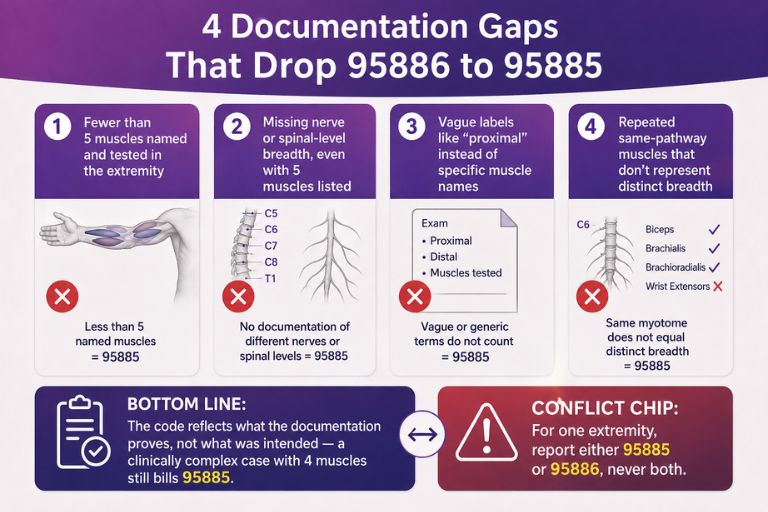
For any one extremity, you report either 95885 or 95886, never both. The muscle count for that extremity decides which code applies. Five or more qualifying muscles is complete, so 95886 stands alone for that limb.
You may, however, report both codes on the same claim for different extremities. One limb studied completely bills 95886 while another limb studied limitedly bills 95885. The conflict applies only within the same extremity, not across the claim.
Why Incomplete Muscle Documentation Downcodes 95886 to 95885 (Complete vs. Limited)
The code reflects what the documentation proves, not what was intended. A planned complete study that documents only four muscles bills as 95885. The five-muscle breadth threshold is the line between the two codes.
Documentation gaps that force a downcode include:
- Fewer than five muscles named and tested in the extremity
- Missing nerve or spinal-level breadth, even with five muscles listed
- Vague muscle labels like “proximal” instead of specific muscle names
- Repeated same-pathway muscles that do not represent distinct breadth
A study can be clinically complex yet still code as limited. The coder follows the muscle list, not the difficulty of the case. Strong, specific muscle documentation is what holds the complete code on review.
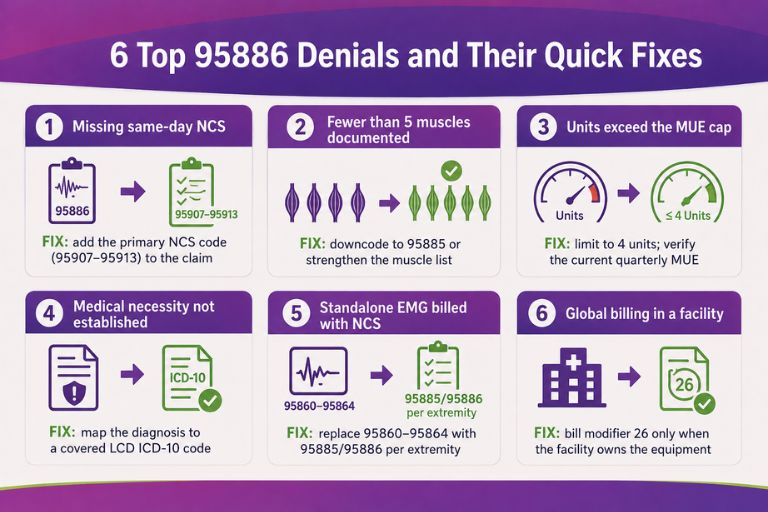
Top Reasons For Denials Specific To 95886 & Quick Remedies
Denials on 95886 cluster around a few repeatable causes. Most are preventable with a complete report and correct claim structure. Industry reporting points to documentation gaps and modifier errors as leading EMG denial drivers.
This table maps the top denial reasons to their fixes:
| Denial Reason | Quick Fix |
|---|---|
| Missing same-day NCS code | Add the primary NCS code (95907–95913) to the claim |
| Fewer than five muscles documented | Downcode to 95885 or strengthen the muscle list |
| Units exceed the MUE cap | Limit to four units; verify current quarterly MUE |
| Medical necessity not established | Map the diagnosis to a covered LCD ICD-10-CM code |
| Standalone EMG billed with NCS | Replace 95860–95864 with 95885/95886 per extremity |
| Global billing in a facility | Bill modifier 26 only when the facility owns equipment |
Two practices prevent most of these denials. First, confirm the same-day NCS and the five-muscle breadth before submission. Second, match the diagnosis to the MAC’s covered list and apply the correct component modifier.
Appeal denied units with the full EMG report when documentation supports the claim. The muscle list and the NCS linkage carry the appeal. A clean first-pass claim remains the lowest-cost path to payment.