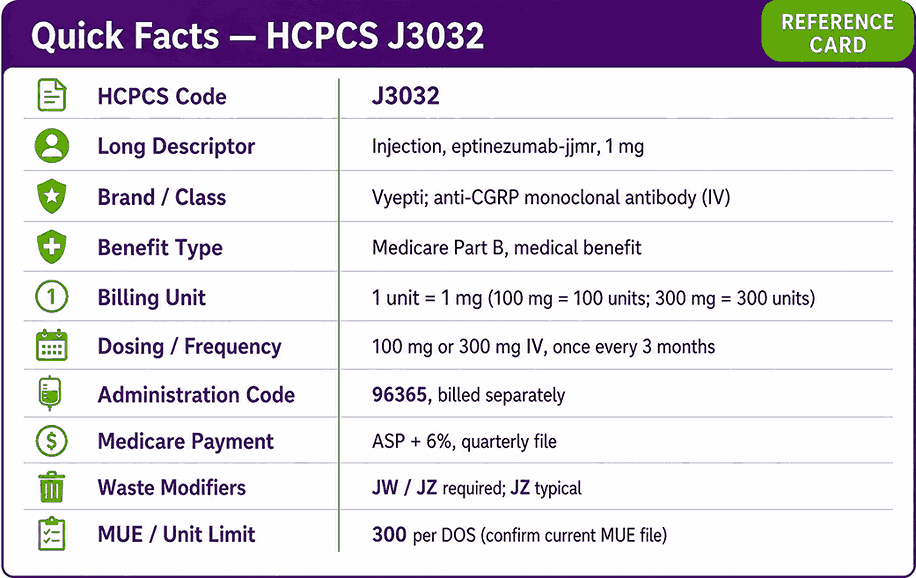
HCPCS code J3032 reports injection of eptinezumab-jjmr, the active drug in Vyepti. One billable unit equals 1 mg of the drug. This per-milligram basis is the foundation for every J3032 claim you submit.
Vyepti is a calcitonin gene-related peptide (CGRP) monoclonal antibody used for migraine prevention in adults. Lundbeck manufactures the drug, and the FDA approved it on February 21, 2020. It is given as an intravenous infusion every three months in a clinical setting.
Because J3032 is an infused biologic, it sits on the medical benefit under Medicare Part B. This separates it from self-injected CGRP antibodies that bill through the pharmacy benefit. The distinction changes how, where, and by whom the claim is built.
For practices managing complex drug and procedure claims, reliable neurology billing support can help keep coding, documentation, authorization, and reimbursement requirements aligned. This article covers the J3032 descriptor and unit basis, the drug’s cost methodology, real clinical billing scenarios, and the reimbursement rules that prevent denials.
What Is the Description of HCPCS Code J3032?
HCPCS code J3032 is defined by the AMA as “Injection, eptinezumab-jjmr, 1 mg.” It represents the drug product only, not its administration. Every claim converts the milligrams given into an equal number of billable units.
The sections below break down the drug, the unit math, the benefit type, and the documentation that supports a clean claim.
What Drug and Unit Basis Does HCPCS Code J3032 Represent?
J3032 represents eptinezumab-jjmr, marketed as Vyepti, a humanized IgG1 monoclonal antibody. It binds the CGRP ligand and blocks it from activating its receptor. The result is fewer migraine days over a quarterly dosing cycle.
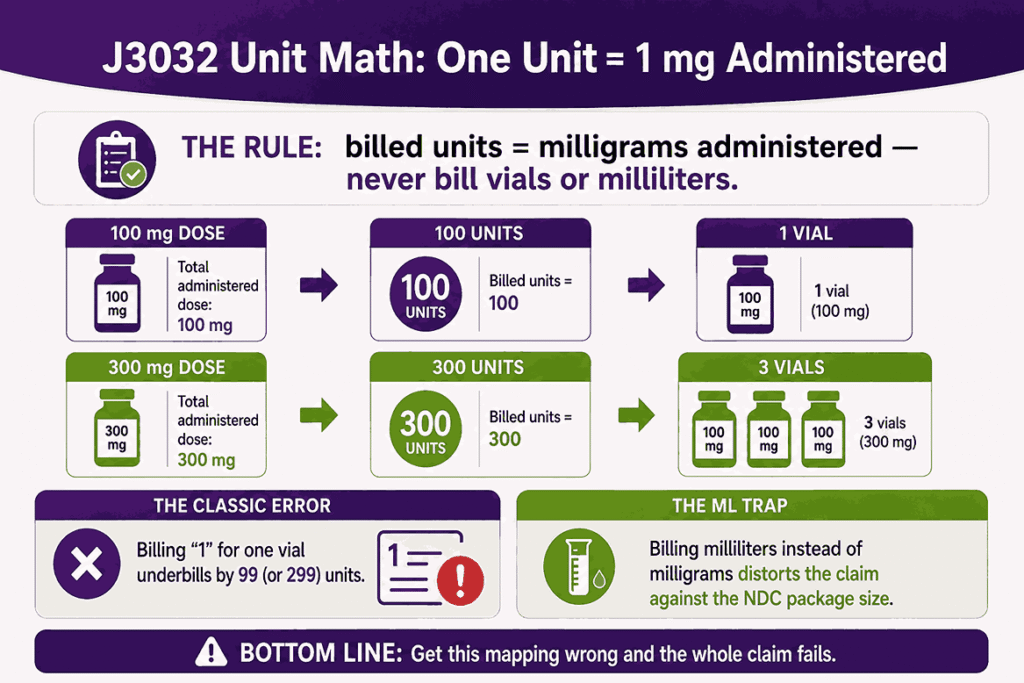
The unit basis is the single most important billing fact on this code. One unit equals 1 mg administered, so dose and units map directly.
| Dose Administered | Billable Units of J3032 | Vials Used (100 mg vial) |
|---|---|---|
| 100 mg | 100 units | 1 vial |
| 300 mg | 300 units | 3 vials |
Get this mapping wrong and the whole claim fails. Billing “1” for one vial instead of 100 for 100 mg is the classic underbilling error on J3032.
Why J3032 Is a Medical-Benefit Drug and How It Differs From Self-Injected CGRP Antibodies and the Botox Pathway
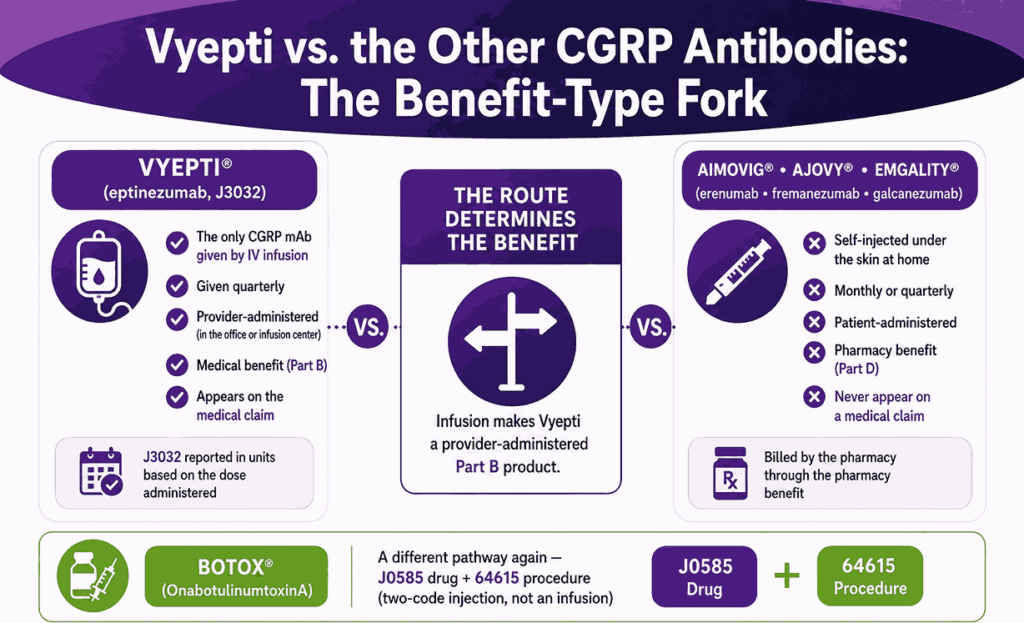
The benefit-type fork is this code’s signature feature. Vyepti is the only CGRP monoclonal antibody given by intravenous infusion. This distinction also matters when reviewing HCPCS coding for neurology medications, particularly for provider-administered drugs billed under the medical benefit. That route makes it a provider-administered, medical-benefit Part B product.
The other three CGRP antibodies are self-injected under the skin by the patient at home. They bill through the pharmacy benefit and never appear on a medical claim.
| Drug (Brand) | Target | Route | Benefit Type | HCPCS on Medical Claim |
|---|---|---|---|---|
| Eptinezumab (Vyepti) | CGRP ligand | IV infusion, quarterly | Medical (Part B) | J3032 |
| Erenumab (Aimovig) | CGRP receptor | SC self-injection, monthly | Pharmacy | None |
| Fremanezumab (Ajovy) | CGRP ligand | SC self-injection, monthly or quarterly | Pharmacy | None |
| Galcanezumab (Emgality) | CGRP ligand | SC self-injection, monthly | Pharmacy | None |
Botox follows a different pathway again. OnabotulinumtoxinA bills as J0585 for the drug, paired with 64615 for the chemodenervation procedure. That is a two-code injection pathway, not an infusion.
For the full procedure-side breakdown, link readers to your dedicated 64615 chronic-migraine chemodenervation hub. It keeps the Botox billing detail off this drug page while signaling topical depth.
Why Infusion Administration Codes (96365–96368) Must Always Be Billed Separately From J3032
J3032 pays for the drug alone. The infusion service that delivers it is a separate, separately payable event. You bill two line items on the same claim.
This drug-plus-administration split mirrors other provider-administered products. The drug carries its own HCPCS, and the service carries the appropriate CPT code from the infusion series.
- 96365 covers the initial hour of intravenous infusion for therapy or diagnosis
- 96366 covers each additional hour beyond the first
- 96367 covers a sequential infusion of a different drug or substance
- 96368 covers a concurrent infusion
A single 30-minute Vyepti infusion typically supports 96365 as the administration code. Report J3032 for the drug and 96365 for the service. Omitting the admin code leaves earned revenue unbilled. For related neurology procedure codes, the administration component should be reviewed alongside the drug code to ensure the complete service is represented correctly.
What ICD-10 Codes and Medical Necessity Criteria Support J3032?
Migraine diagnosis codes from the ICD-10 G43 family support medical necessity for J3032. Reviewing broader neurology diagnosis codes can also help ensure that the diagnosis reported on the claim accurately reflects the patient’s documented condition. The specific code depends on migraine type, chronicity, and status.
Both chronic and episodic migraine are on-label for Vyepti. This coverage rests on the PROMISE-1 and PROMISE-2 pivotal trials. The episodic indication is a real difference from Botox, which is approved for chronic migraine only.
| ICD-10 Code | Description | Typical Use With J3032 |
|---|---|---|
| G43.709 | Chronic migraine w/o aura, not intractable, w/o status | Chronic migraine prevention |
| G43.719 | Chronic migraine w/o aura, intractable, w/o status | Refractory chronic migraine |
| G43.009 | Migraine w/o aura, not intractable, w/o status | Episodic migraine prevention |
| G43.109 | Migraine with aura, not intractable, w/o status | Episodic migraine with aura |
Code selection must match the clinical record. Payers cross-check the migraine subtype, headache-day counts, and prior therapy against their coverage policy before approval.
What Are the Step-Therapy and Headache-Day Documentation Requirements Before J3032 Can Be Authorized?
Most payers place J3032 behind step therapy. The patient must have tried and failed oral preventive drugs before an infused CGRP antibody is approved. Documentation carries the authorization.
The record needs specific, dated evidence. A vague statement that other drugs “did not work” will not clear a prior authorization review.
- Baseline monthly headache days or migraine days, recorded before therapy starts
- Trial and failure or intolerance of two or more oral preventive classes
- Named drugs, doses, duration of each trial, and reason for discontinuation
- A confirmed migraine diagnosis meeting ICD-3 criteria
- Confirmation the patient is not using another CGRP therapy concurrently
Oral preventive classes commonly include beta-blockers, antiepileptics such as topiramate, and tricyclic antidepressants. Naming the class and the specific agent strengthens the medical-necessity case.
What are the Modifiers for HCPCS Code J3032?
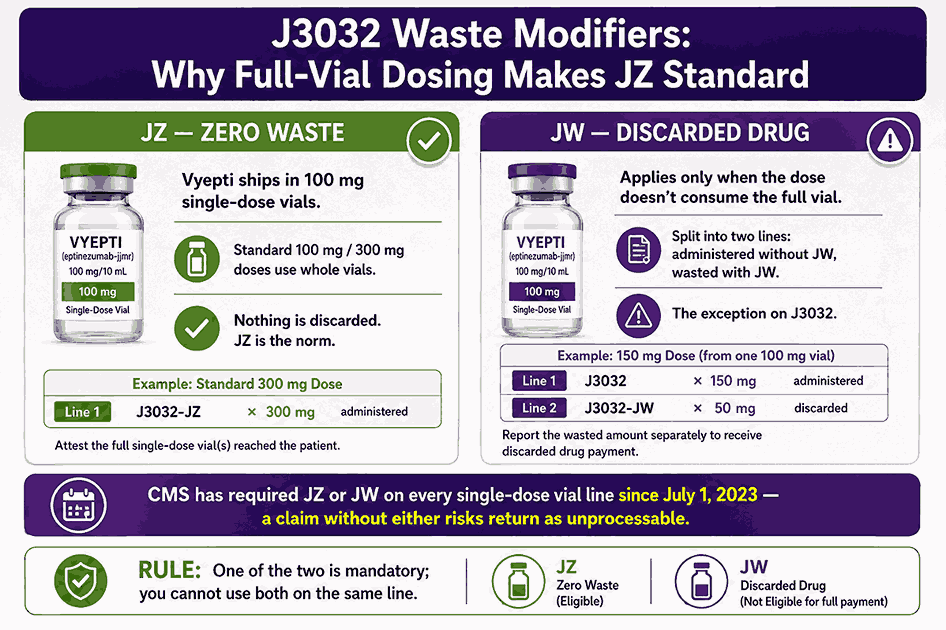
J3032 uses single-dose vials, so the discarded-drug modifiers apply to every claim. CMS requires either JZ or JW on each single-dose vial line. One of the two is mandatory, and you cannot use both on the same line.
The choice depends on whether any drug was discarded after preparing the dose.
Modifier JZ: Zero Waste – Why Full-Vial Dosing Makes JZ the Norm for J3032
Vyepti comes in 100 mg single-dose vials. Standard doses of 100 mg or 300 mg use whole vials, leaving nothing to discard. That makes JZ the normal modifier on J3032 claims.
The JZ modifier attests that no drug amount was discarded. CMS has required it on applicable single-dose vial claims since July 1, 2023. A single-dose claim without JZ or JW risks return as unprocessable.
Modifier JW: Discarded Drug Amount (Partial-Vial Situations)
JW reports the discarded portion of a single-dose vial. It applies only when the administered dose does not consume the full vial content. On J3032 this is the exception, not the rule.
When waste does occur, the claim splits into two lines. Line one reports the administered units without JW, and line two reports the wasted units with JW. The medical record must document the exact milligrams given and discarded.
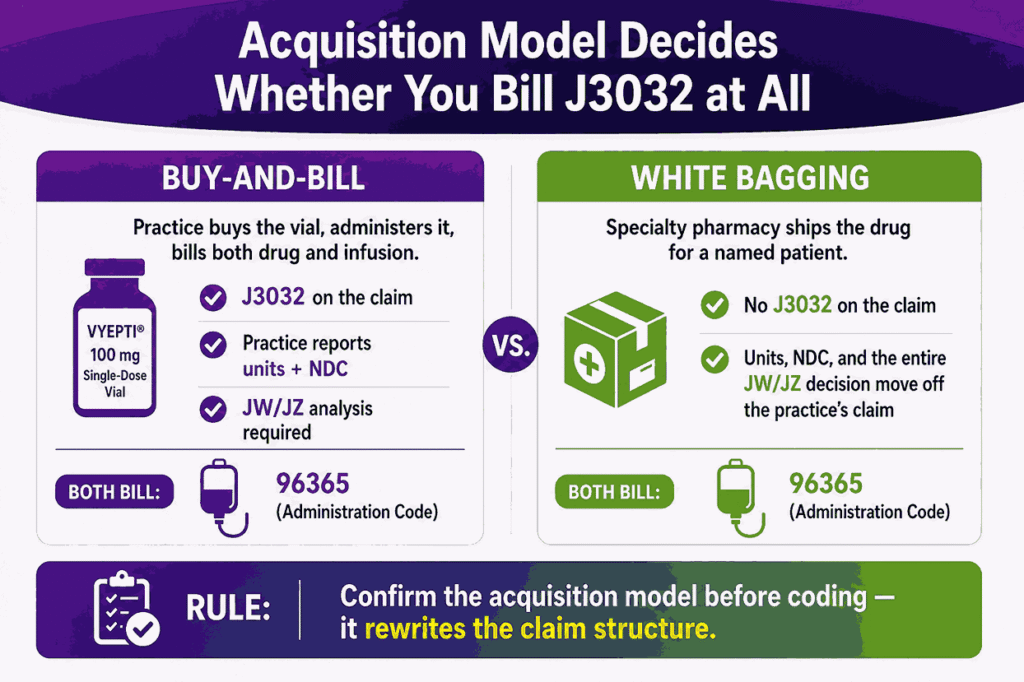
Buy-and-Bill vs. White Bagging: When J3032 Is and Is Not Provider-Billable
How the drug reaches the practice decides whether you bill J3032 at all. Under buy-and-bill, the practice buys the vial, administers it, and bills both the drug and the infusion. Under white bagging, a specialty pharmacy ships the drug for a named patient.
When a specialty pharmacy supplies the vial, the practice bills only the administration code. The entire drug line disappears from the claim.
| Element | Buy-and-Bill | White Bagging |
|---|---|---|
| Who buys the drug | The practice | Specialty pharmacy |
| J3032 on the claim | Yes | No |
| Units and NDC reporting | Practice responsibility | Not billed by practice |
| JW/JZ analysis | Required | Not applicable |
| Admin code (96365) | Billed | Billed |
Under white bagging, the drug units, NDC, and the entire JW/JZ decision move off the practice’s claim. Confirm the acquisition model before coding, because it rewrites the claim structure.
Which Documents Are Required For HCPCS Code J3032?
Clean J3032 reimbursement depends on a short list of claim-level data points. Missing any one of them is a common denial trigger. Assemble these before submission.
- The 11-digit NDC on the drug line, drawn from the 67386-0130 single-dose vial
- Units equal to milligrams administered, entered with the correct unit qualifier
- Infusion start and stop times supporting the administration code
- JZ or JW modifier on the single-dose vial line
- ICD-10 migraine diagnosis establishing medical necessity
- Dose rationale in the note when 300 mg is administered
The NDC-to-HCPCS match matters most. A mismatch between the billed NDC, the package size, and the J3032 units is a frequent source of CO-16 denials.
What is the Cost of HCPCS Code J3032?
J3032 prices as a Part B drug, not a physician service. It has no RVUs. Instead, payment ties to the Average Sales Price file that CMS publishes every quarter.
The three subsections below cover the Medicare methodology, commercial payer variation, and the site-of-care lever that moves the total cost of an infusion.
ASP + 6% and the Quarterly Medicare Payment File
Medicare pays J3032 at the drug’s Average Sales Price plus a statutory add-on. The base formula is ASP plus 6 percent per billable unit. That rate is published per milligram, so a 100 mg dose bills 100 units at the per-unit allowance.
The number is not fixed. CMS recalculates ASP payment limits four times a year from manufacturer-submitted data. The rate can move every quarter.
- Always pull the current quarter’s ASP file for the exact per-unit allowance
- Multiply the per-unit rate by units administered, not by vials
- Expect the Part B patient to owe the standard 20 percent coinsurance after the deductible
- Sequestration and the 6 percent add-on adjustments can shift the net payment
For the authoritative figure, use the CMS Medicare Part B Drug Average Sales Price file for the current quarter. Third-party code lookups often lag the live file by a quarter.
Commercial Payers
Commercial payers do not follow one pricing rule for J3032. Contracts drive the number, and benchmarks vary across plans. Verify each payer’s method during eligibility checks.
Common commercial pricing benchmarks include a percentage of ASP, Wholesale Acquisition Cost, or Average Wholesale Price. Rates often land between 100 and 110 percent of ASP, but negotiated contracts override any default.
- Percent of ASP: frequently 100 to 110 percent of the published ASP
- WAC-based: priced off the manufacturer’s list price benchmark
- AWP-based: priced off a published average wholesale figure, often discounted
- Negotiated rate: a fixed contract amount independent of the benchmarks
High-volume infusion practices sometimes negotiate improved rates using outcomes and cost data. Confirm the benefit type first, since a commercial plan may still route CGRP antibodies through pharmacy.
Site-of-Care Payment Differentials and Payer Steering
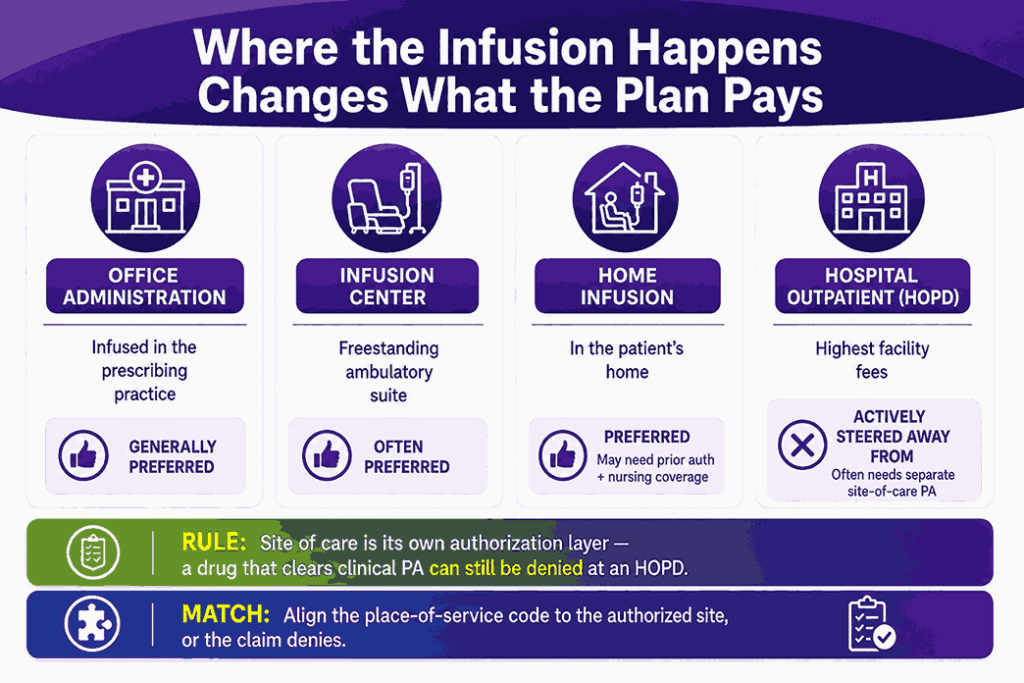
Setting is the real cost lever on an infused biologic. The same 100 mg of Vyepti costs the plan different amounts depending on where the infusion happens. Payer policies distinguish four common sites.
| Site of Care | Description | Payer Preference |
|---|---|---|
| Office administration | Infused in the prescribing practice | Generally preferred |
| Infusion center | Freestanding ambulatory infusion suite | Often preferred |
| Home infusion | Administered in the patient’s home | Preferred, may need prior auth |
| Outpatient hospital (HOPD) | Hospital-based outpatient department | Actively steered away from |
Hospital outpatient departments carry the highest facility fees, so payers steer volume elsewhere. Many plans apply a site-of-care utilization policy to Vyepti and require prior authorization for HOPD administration.
What Are Example Clinical Scenarios or Use Cases for HCPCS Code J3032?
The scenarios below show how J3032 claims are built in practice. Each one maps a clinical situation to units, modifiers, and supporting documentation. They cover the most common J3032 billing patterns.
Scenario 1: Chronic Migraine Failing Two Oral Preventive Classes – Initial 100 mg Quarterly Infusion
A patient with chronic migraine has failed topiramate and a beta-blocker. The neurologist starts Vyepti at 100 mg every three months. This is the standard initiating dose and the most frequent J3032 claim.
The claim carries two lines. The drug bills as J3032 with 100 units, and the service bills as 96365 for the infusion.
- Drug line: J3032 x 100 units, JZ modifier, NDC 67386-0130
- Admin line: 96365 for the initial hour of IV infusion
- Diagnosis: G43.709 chronic migraine without aura, not intractable
- Documentation: baseline headache days plus two failed oral preventive classes
JZ applies because one full 100 mg vial leaves no waste. Start and stop times support the single administration code.
Scenario 2: Switch From a Self-Injected CGRP Antibody After Inadequate Response – Pharmacy-to-Medical Benefit Transition
A patient on monthly Emgality has an inadequate response after an adequate trial. The clinician switches to Vyepti. This scenario is unique to J3032, because it moves the drug from the pharmacy benefit to the medical benefit.
The claim construction flips entirely. Emgality never appeared on a medical claim, since the patient self-injected it under the pharmacy benefit. Vyepti now bills as a provider-administered drug on the medical claim.
- Document the prior CGRP antibody, dose, duration, and inadequate response
- Confirm the patient has stopped the self-injected agent before starting Vyepti
- Bill J3032 x 100 units with JZ, plus 96365 for the infusion
- Expect payers to deny any overlap between two CGRP therapies
The switch documentation is the crux of the authorization. Payers want proof the prior antibody was tried adequately and discontinued, not stacked.
Scenario 3: Dose Escalation to 300 mg With Documented Partial Response – Units, Vials, and Medical-Necessity Support for the Higher Dose
A patient on 100 mg shows a partial response after two cycles. The neurologist escalates to 300 mg every three months. The billing math changes with the dose.
A 300 mg dose uses three 100 mg vials and bills 300 units of J3032. JZ still applies, because three whole vials leave no discarded drug.
- Drug line: J3032 x 300 units, JZ modifier, NDC 67386-0130
- Admin line: 96365 for the IV infusion
- Documentation: partial response at 100 mg with headache-day data supporting escalation
- Payer note: many policies require documented rationale for the 300 mg dose
The medical record must justify the higher dose with objective response data. Without it, the payer may approve only the 100 mg dose and deny the extra 200 units.
What Are the HCPCS Code J3032 Rules To Ensure Successful Reimbursement?
Successful J3032 reimbursement rests on a few repeatable rules. Units, prior authorization, therapy stacking, site of care, and denial patterns all shape the outcome. The subsections below give the operational detail.
Units, MUEs & the 100 mg vs. 300 mg Billing Math
Units equal milligrams administered. This is the rule that prevents the most costly J3032 errors. Never bill vials or milliliters as units. Understanding HCPCS coding guidelines helps ensure that the drug description, unit basis, and claim reporting remain accurate.
The overbilling trap works in both directions. Billing 1 unit per vial underbills by 99 or 299 units. Billing milliliters instead of milligrams distorts the claim against the NDC package size.
| Dose | Correct Units | Common Error | Result |
|---|---|---|---|
| 100 mg | 100 units | Billing 1 unit (one vial) | Severe underpayment |
| 300 mg | 300 units | Billing 3 units (three vials) | Severe underpayment |
| Any dose | mg administered | Billing mL instead of mg | Unit-to-NDC mismatch |
Medically Unlikely Edits cap the units payable per date of service. Confirm the current MUE value so a legitimate 300 mg claim is not truncated to a lower cap.
Prior Authorization, 12-Month Reauthorization, and Documented-Response Continuation Criteria
J3032 almost always requires prior authorization. Initial approval turns on step therapy and headache-day documentation. Continuation of therapy runs on a separate gate.
Most payers authorize continued Vyepti for 12 months once the patient shows a documented response. This continuation criterion differs from the initial step-therapy requirement.
- Initial authorization: failed oral preventives plus baseline headache-day data
- Continuation: documented reduction in monthly migraine days on therapy
- Reauthorization window: commonly 12 months for responders
- Records needed: treated headache days versus baseline at reassessment
Track the response data across cycles. A reauthorization without objective improvement data is a predictable denial at the 12-month mark.
Why Payers Deny Concurrent CGRP Therapy – No Stacking With Other CGRP Antibodies, Gepants, or Botox
Payers deny two CGRP therapies used at the same time. The clinical rationale is duplicate mechanism, and the coverage rationale is duplicate cost. No stacking is a hard rule across most policies.
The prohibition extends beyond the antibody class. It covers other CGRP monoclonal antibodies, the oral gepants, and Botox for migraine prevention.
- No concurrent Vyepti with Aimovig, Ajovy, or Emgality
- No concurrent Vyepti with gepants such as rimegepant or atogepant used preventively
- No concurrent Vyepti with onabotulinumtoxinA for chronic migraine prevention
- Document discontinuation of any prior CGRP agent before starting J3032
Overlap on a claim history triggers automatic review. Confirm the patient’s full preventive drug list before administering the infusion.
Site-of-Care Prior Authorization and Home-Infusion Rules
Site of care is its own authorization layer. A drug that clears clinical prior authorization can still be denied at a hospital outpatient department. Many payers require separate site-of-care approval.
Home infusion and infusion-center administration are usually preferred sites. Hospital outpatient administration often needs specific justification.
- Verify whether the plan applies a site-of-care policy to Vyepti
- Obtain HOPD approval when the payer steers away from that setting
- Confirm home-infusion prior authorization and nursing coverage where used
- Match the place-of-service code to the authorized site
A mismatch between the authorized site and the billed place of service causes denials. Align the two before the infusion date.
Top Reasons For Denials Specific To J3032 & Quick Remedies
J3032 denials cluster around a handful of causes. Most are preventable with front-end checks. The table below pairs each denial pattern with a quick remedy.
| Denial Reason | Root Cause | Quick Fix |
|---|---|---|
| Missing JW/JZ modifier | Single-dose vial line without attestation | Append JZ for full-vial doses, JW for waste |
| CO-16 NDC error | Missing or mismatched 11-digit NDC | Report NDC 67386-0130 with correct qualifier |
| Unit mismatch | Vials or mL billed instead of mg | Bill units equal to milligrams administered |
| No prior authorization | Step therapy or PA not secured | Obtain PA with headache-day documentation |
| Concurrent CGRP therapy | Overlap with another CGRP agent | Document discontinuation before starting |
| Site-of-care denial | HOPD without site approval | Secure site-of-care PA or move the setting |
Work these six patterns into a pre-claim checklist. Catching a missing modifier or NDC before submission is faster than reworking a denied claim.
For the procedure-side counterpart to this drug, see your 64615 chronic-migraine chemodenervation guide. It carries the Botox pathway detail that complements this eptinezumab reference.