The New Jersey Prompt Pay Law sets strict deadlines for how fast health insurers must pay medical claims. It is codified at N.J.A.C. 11:22-1.5 and authorized by the Health Claims Authorization, Processing and Payment Act (HCAPPA). The law took effect on July 11, 2006.
Carriers must pay clean electronic claims within 30 calendar days, and paper claims within 40 calendar days. Late clean claims accrue 12 percent simple interest per year for health carriers. Dental service corporations pay 10 percent.
This law governs insurance claim payment, not construction payment. Providers, surgery centers, and health systems in New Jersey rely on it to hold payers to a fixed clock.
This article covers the payment deadlines, interest penalties, appeal rights, and plan exemptions that revenue cycle teams track under the New Jersey Prompt Pay Law. It sits among the broader set of New Jersey billing laws that dictate how and when providers actually get paid.
What Is the New Jersey Prompt Pay Law?
The New Jersey Prompt Pay Law is a state regulation requiring health carriers to pay, deny, or dispute claims within fixed timeframes. It sits in the New Jersey Administrative Code at N.J.A.C. 11:22-1.5. The New Jersey Department of Banking and Insurance (DOBI) enforces it.
The law flows from HCAPPA, enacted as P.L. 2005, c. 352 and effective July 11, 2006. HCAPPA set uniform rules for claim payment, utilization management, and provider appeals. The prompt pay rules were later recodified in 2018 under N.J.A.C. 11:22-1.5.
The law protects providers and covered persons from stalled payments. It gives revenue cycle teams a statutory basis to demand interest on overdue claims.
Which Payers Must Comply With the New Jersey Prompt Pay Law?
The New Jersey Prompt Pay Law applies to carriers that issue health benefits or dental plans delivered in New Jersey. The rule reaches insurers and their claim-payment agents alike.
Covered payers under the law include:
- Insurance companies writing health benefits plans in New Jersey
- Hospital, medical, and health service corporations
- Health maintenance organizations (HMOs)
- Dental service corporations and dental plan organizations (DPOs)
- Third-party agents that process or pay claims for any of the above
The law does not reach every plan a provider bills. Self-funded employer plans governed by federal law fall outside it. That exemption is covered in a later section.
What Counts as a “Clean Claim” Under the New Jersey Prompt Pay Law?
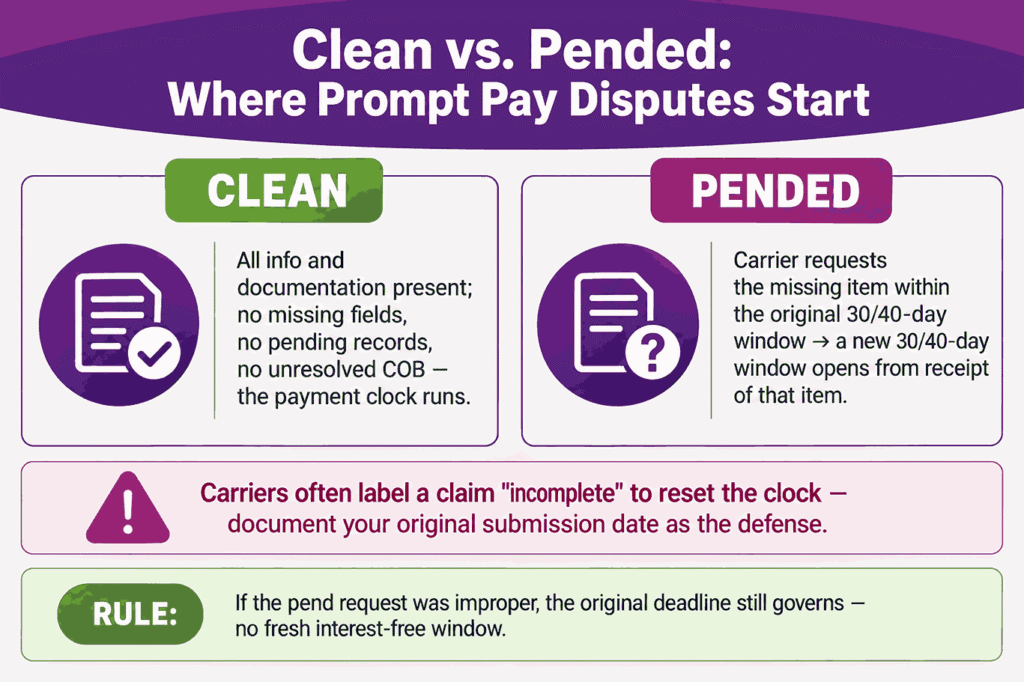
A clean claim is a claim with all information and documentation the carrier needs to adjudicate it. No missing fields, no pending records, no unresolved coordination of benefits. The payment clock runs on clean claims.
The distinction matters for the deadline. A carrier is not late on a claim it cannot process for lack of data. Once the provider supplies the missing item, a fresh 30-day or 40-day window opens.
In practice: the definition of “clean” is where most prompt pay disputes start. Carriers often label a claim incomplete to reset the clock. Documenting your original submission date is the provider’s best defense.
Is the New Jersey Prompt Pay Law the Same as the Prompt Payment Act?
No. The New Jersey Prompt Pay Law and the New Jersey Prompt Payment Act are two separate laws. One governs insurance claims. The other governs construction payments.
The table below draws the boundary that most online sources blur:
| Feature | Prompt Pay Law (Healthcare) | Prompt Payment Act (Construction) |
|---|---|---|
| Citation | N.J.A.C. 11:22-1.5 | N.J.S.A. 2A:30A-1 et seq. |
| Who it covers | Health carriers, HMOs, dental plans | Owners, contractors, subcontractors |
| What it pays | Medical and dental claims | Work on real property |
| Interest rate | 12% (health), 10% (dental) | Prime rate plus 1% |
| Enforcer | NJ Department of Banking and Insurance | Courts and arbitration |
Providers billing insurers use the Prompt Pay Law at N.J.A.C. 11:22-1.5. Contractors improving property use the Prompt Payment Act. The rest of this article covers the healthcare law only.
What Are the Claim Payment Deadlines Under the New Jersey Prompt Pay Law?
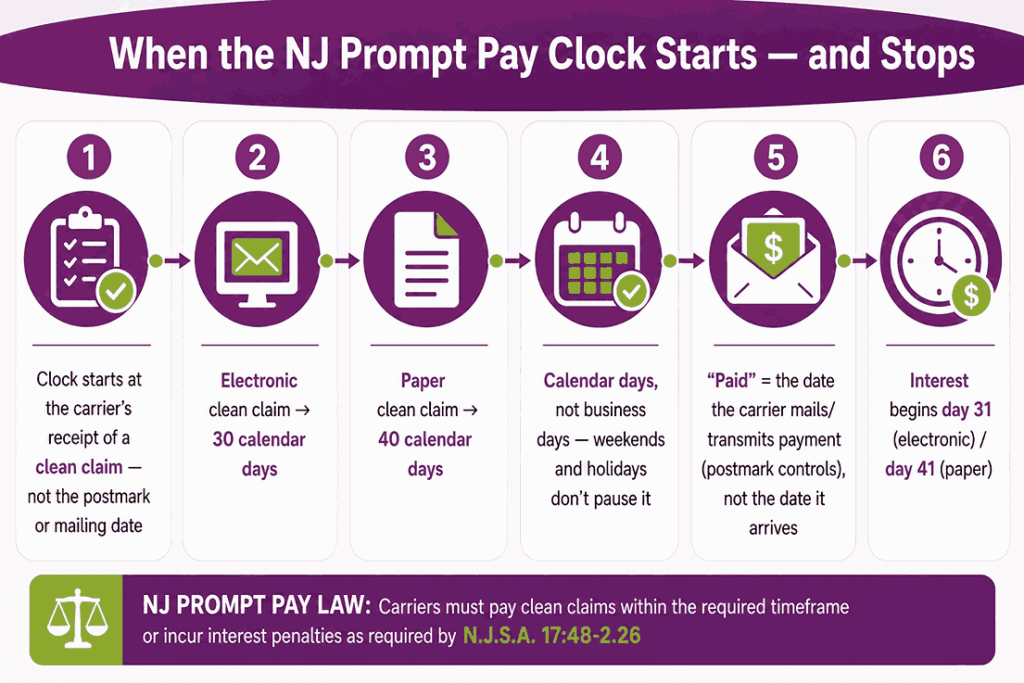
The New Jersey Prompt Pay Law sets two core deadlines: 30 calendar days for electronic claims and 40 calendar days for paper claims. The clock starts when the carrier receives a clean claim.
Carriers have the same window to deny or dispute a claim. A payer cannot sit on a claim past the deadline without paying, denying, or requesting missing information.
The deadlines at a glance:
| Claim Type | Payment Deadline | Interest Starts |
|---|---|---|
| Electronic (clean) | 30 calendar days | Day 31 |
| Paper (clean) | 40 calendar days | Day 41 |
| Pended for missing info | 30 or 40 days from receipt of the info | After that window |
How Fast Must Payers Pay Electronic Claims?
Payers must pay clean electronic claims within 30 calendar days of receipt. The count uses calendar days, not business days. Weekends and holidays do not pause the clock.
One exception applies to Medicare-related timing. The rule references the federal Medicare payment period at 42 U.S.C. 1395u. Where the Medicare timeframe is shorter, the earlier deadline controls.
Electronic submission through an 837 transaction is the fastest path to a clean claim. It also produces a timestamped receipt that supports an interest claim later.
How Fast Must Payers Pay Paper Claims?
Payers must pay clean paper claims within 40 calendar days of receipt. Paper claims get 10 more days than electronic claims. The extra time reflects mail handling and manual entry.
The 40-day window still runs on calendar days. A carrier that receives a clean paper claim on the first of the month must act by day 40. After that, interest accrues.
A common mistake here: providers assume the mailing date starts the clock. The law counts from the carrier’s receipt date, not the postmark.
What Are the Deadlines for Disputed or Pended Claims?
A carrier may pend a claim that lacks required information or documentation. When it does, it must request the missing item within the original 30-day or 40-day window. The clock does not simply stop with no notice.
Once the provider sends the missing information, a new deadline begins:
- Electronic follow-up: 30 calendar days from receipt of the missing item
- Paper follow-up: 40 calendar days from receipt of the missing item
- No fresh interest-free window applies if the carrier’s request was improper
If a carrier pends a claim without a valid basis, the original deadline still governs. Providers should log every pend notice and the date they respond.
When Is a Claim Considered “Paid” Under the Law?
A claim counts as paid on the date the carrier mails the payment. If mailed, the postmark date on a properly addressed envelope controls. If delivered another way, the delivery date to the payee controls.
This rule decides whether interest applies. A payment mailed on day 30 is timely even if it arrives on day 34. Carriers must keep an auditable record of when each payment was transmitted.
What Interest Penalties Apply to Late Claims in New Jersey?
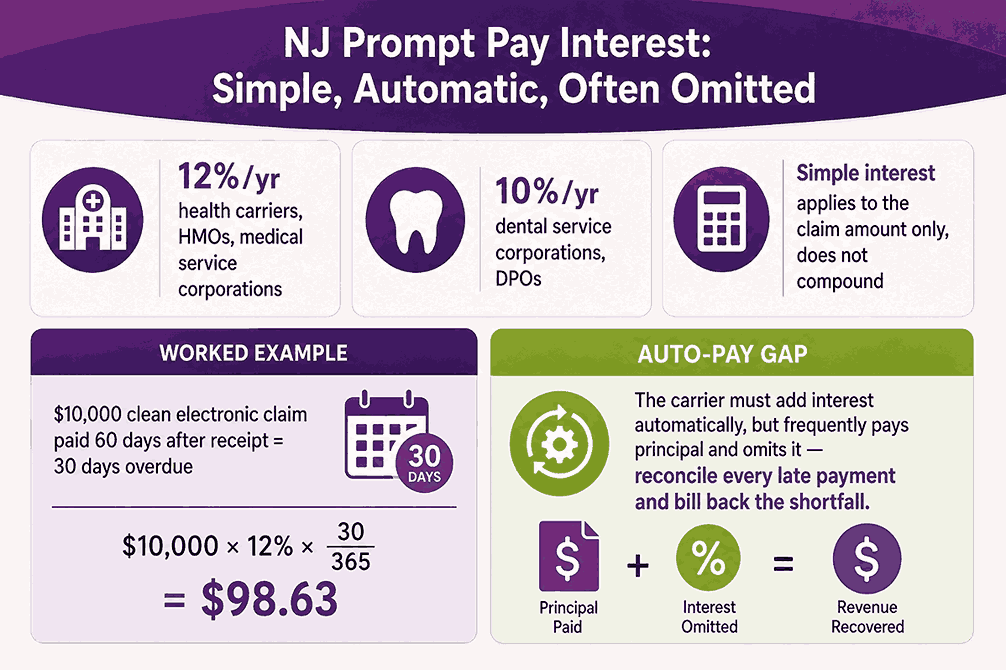
Late clean claims accrue simple interest under the New Jersey Prompt Pay Law. Health carriers pay 12 percent per year. Dental service corporations and dental plan organizations pay 10 percent per year.
Interest is not optional. The carrier must add it to the claim payment when it pays the overdue amount. Providers do not have to file a separate request to trigger the statutory rate.
The interest structure by payer type:
| Payer Type | Interest Rate | Accrual Start |
|---|---|---|
| Health carriers, HMOs, medical service corporations | 12% per year | Day 31 (electronic) or 41 (paper) |
| Dental service corporations, DPOs | 10% per year | Day 31 or 41 |
| Capitation payments | 10% per year | 5th business day after the contract due date |
What Interest Rate Do Health Carriers Pay on Late Claims?
Health carriers pay 12 percent simple interest per year on late clean claims. The rate is fixed by regulation. It does not float with the prime rate the way construction payment interest does.
Simple interest means the rate applies to the claim amount only. It does not compound. A worked example makes the math concrete:
Worked example: a $10,000 clean electronic claim is paid 60 days after receipt. The claim is 30 days overdue past the 30-day deadline. Interest owed = $10,000 x 12% x (30 / 365) = $98.63.
Across a high-volume payer relationship, small per-claim interest adds up. A systematic interest audit often recovers meaningful dollars a billing team leaves on the table. This is why many practices lean on medical billing companies in New Jersey to run these audits at scale rather than case by case.
What Interest Rate Applies to Dental Claims?
Dental service corporations and dental plan organizations pay 10 percent simple interest per year. The lower rate reflects the separate treatment of dental plans under HCAPPA. Dental payers still face the same 30-day and 40-day deadlines.
The 10 percent rate applies to clean dental claims paid late. It uses the same accrual start as medical claims. Interest runs from day 31 for electronic claims and day 41 for paper claims.
When Does Interest Start Accruing?
Interest starts the day after the payment deadline passes. For a clean electronic claim, that is day 31. For a clean paper claim, that is day 41.
The accrual point ties to the date the carrier received all required information. If a claim was pended and later completed, interest runs from the date the carrier received the final missing item.
Key accrual triggers to track:
- Day 31 for clean electronic claims
- Day 41 for clean paper claims
- The completion date for previously pended claims
Does a Payer Have to Pay Interest Automatically?
Yes. The carrier must include interest with the claim payment when it pays late. The statute places the duty on the payer, not the provider. No separate interest demand is required to earn the rate.
Automatic does not mean reliable. Carriers frequently pay the claim principal and omit the interest. Providers should reconcile every late payment against the 12 percent or 10 percent rate and bill back any shortfall.
How Do Providers Appeal a Denied or Underpaid Claim?
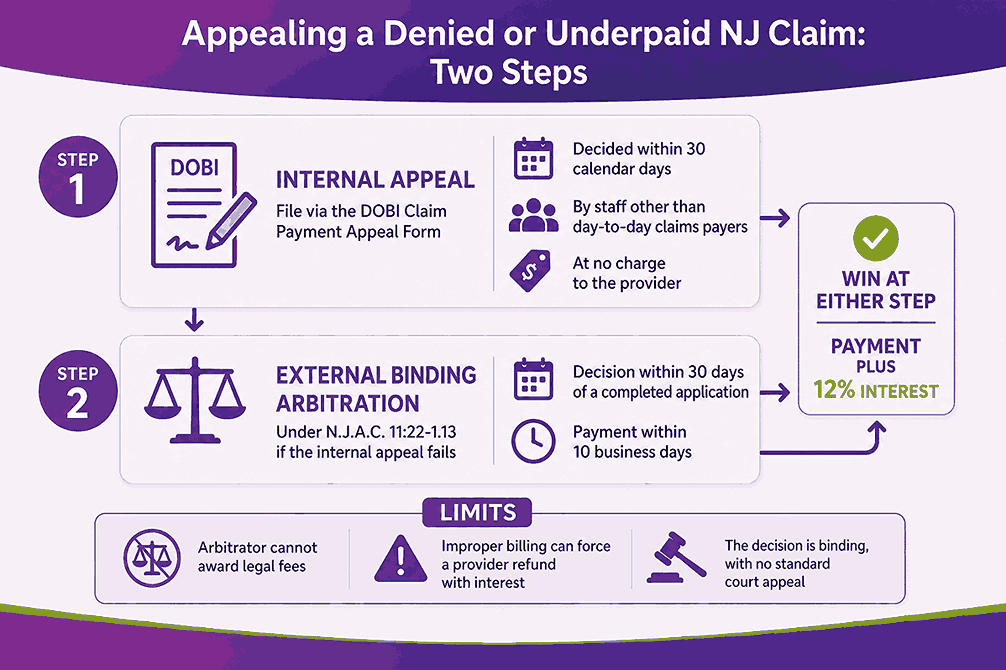
The New Jersey Prompt Pay Law gives providers a two-step appeal path. The first step is an internal appeal to the carrier. The second step is external arbitration.
Both steps carry their own deadlines. The internal appeal must be decided within 30 days. Arbitration decisions must be issued within 30 days and paid within 10 business days.
The appeal ladder in order:
- Internal appeal to the carrier using the Claim Payment Appeal Form
- External arbitration under N.J.A.C. 11:22-1.13 if the internal appeal fails
- Payment with 12 percent interest if the provider prevails at either step
How Does the Internal Appeal Process Work?
A provider starts an internal appeal by filing a completed Claim Payment Appeal Form. The form and instructions are available on the DOBI website. It must include the substantiating documentation the carrier requires.
The carrier must review the appeal and notify the provider within 30 calendar days. The review must be handled by staff other than the day-to-day claims payers. The carrier cannot charge the provider for the review.
If the appeal favors the provider, the carrier pays within 30 days:
- Payment is due within 30 calendar days of the internal appeal decision
- The payment includes 12 percent interest from the date the carrier received the appeal
- Failure to decide within 30 days lets the provider move straight to arbitration
The carrier must issue its determination in writing. The written decision cannot be a bare denial. It has to explain who reviewed the appeal and why the carrier ruled as it did.
A compliant internal appeal decision states:
- The names, titles, and credentials of the reviewers
- The decision and a detailed explanation of its basis
- A description of the documentation supporting the decision
- A path to external arbitration if the outcome is adverse to the provider
A vague or incomplete decision is a defect a provider can raise at arbitration. Providers should keep every written determination and check it against these required elements.
What Is the External Arbitration Process?
External arbitration is a binding review under N.J.A.C. 11:22-1.13. A provider files an arbitration application after the internal appeal. The arbitration organization decides claim payment disputes independently.
The arbitrator must issue a decision within 30 days of a completed application. If the decision requires the carrier to pay, payment is due within 10 business days. The payment includes accrued interest.
A few limits shape the arbitration path:
- The arbitrator cannot award legal fees or costs to either party
- A finding of improper billing can require a provider refund with interest
- The decision is binding and not subject to a standard court appeal
What Is the Deadline to Contest an Underpaid Claim?
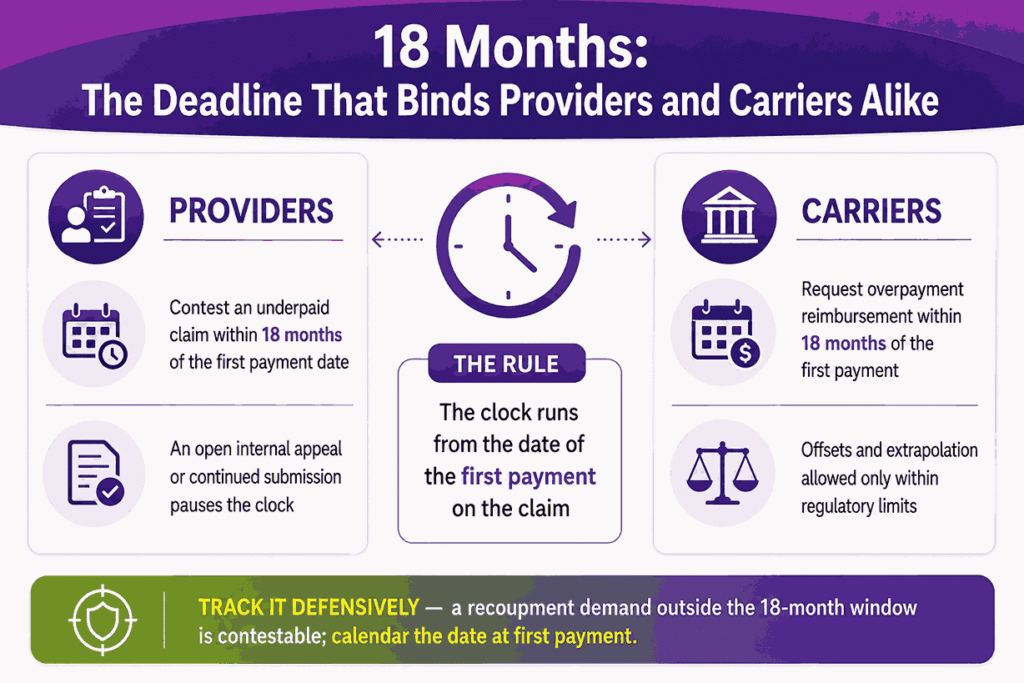
A provider must contest an underpaid claim within 18 months of the first payment date. The 18-month window is the outer limit for reimbursement requests. Missing it forfeits the claim to underpayment.
The clock runs from the date the carrier made the first payment on the claim. Two situations pause it: an open internal appeal or a continued claims submission. Providers should calendar the 18-month date at first payment.
Which Claims and Plans Are Exempt From the New Jersey Prompt Pay Law?
Not every plan a New Jersey provider bills falls under the Prompt Pay Law. The largest carve-out is self-funded employer coverage. Federal law governs those plans instead of the state rule.
Government programs follow their own payment rules. Medicare Advantage plans use federal timeframes. Medicaid managed care plans follow their contract terms and program rules.
The exemption picture for common plan types:
| Plan Type | Subject to N.J.A.C. 11:22-1.5? | Governing Timeline |
|---|---|---|
| Fully-insured NJ health plan | Yes | 30 or 40 days, 12% interest |
| Self-funded / ASO (ERISA) plan | No | Federal ERISA rules and plan terms |
| Medicare Advantage | No | CMS timeframes (30 or 60 days) |
| Medicaid managed care | Partial | Program and contract terms |
Are Self-Funded (ERISA) Plans Subject to the Law?
No. Self-funded employer plans are exempt from the New Jersey Prompt Pay Law. These plans fall under the federal Employee Retirement Income Security Act (ERISA). State prompt pay deadlines do not reach them.
Carriers often administer self-funded plans on an Administrative Services Only (ASO) basis. The carrier processes claims but does not insure the risk. Those ASO claims sit outside state prompt pay rules.
Why this matters: the ERISA exemption is the single most common reason a provider’s prompt pay claim fails. Confirm the plan’s funding type before demanding state interest. Eligibility data usually flags whether a plan is fully insured or self-funded.
How Does the Law Apply to Medicare and Medicaid Plans?
Medicare Advantage plans follow federal payment timeframes, not the state rule. Under CMS guidance, a plan must pay clean claims from noncontract providers within 30 calendar days. It must pay or deny other claims within 60 calendar days.
Medicaid managed care plans follow their own program and contract rules. Some contract terms mirror the 30-day and 40-day state deadlines. Others set different timelines. Providers should read the specific managed care contract.
Can a Payer Delay Payment to Check for Other Coverage?
No, not as a routine step. A carrier cannot delay or pend a claim to investigate other insurance unless good cause exists. Good cause means the carrier’s own records already indicate other coverage.
A routine coordination of benefits (COB) check is not good cause. The carrier cannot pause every claim to ask whether another plan is primary. Without a record-based reason, the payment clock keeps running.
Providers facing a COB-based delay should demand the carrier’s basis. If the carrier has no record showing other coverage, the original deadline still applies and interest accrues.
How Can Payers Recover Overpayments Under the New Jersey Prompt Pay Law?
The New Jersey Prompt Pay Law also limits how carriers claw back money. A carrier must request reimbursement of an overpaid claim within 18 months of the first payment. The same 18-month window that protects providers on underpayments binds carriers on overpayments.
The rule sets conditions for offsets and extrapolation. A carrier may offset an overpayment against future payments under stated conditions. It may base a recovery on extrapolation only within regulatory limits.
Overpayment and underpayment deadlines mirror each other:
- Carriers request overpayment reimbursement within 18 months of first payment
- Providers request underpayment reimbursement within 18 months of first payment
- Providers may contest an overpayment notice before any offset
For revenue cycle teams, the 18-month rule cuts both ways. Track it defensively on incoming recoupment notices. A recoupment demand outside the window is contestable.
How Should Revenue Cycle Teams Operationalize NJ Prompt Pay Compliance?
The New Jersey Prompt Pay Law turns into recovered revenue only when a billing operation acts on it. Statutory deadlines mean little without an aging process that flags them. Medical billing services in New Jersey build that process into daily claim tracking so no clean claim ages past day 31 or 41 unnoticed.
Three operational moves convert the law into cash flow. Each maps to a specific statutory trigger. Each belongs in a payer-agnostic workflow.
A practical prompt pay workflow includes:
- Aging triggers at day 31 and 41: Flag every unpaid NJ clean claim the day interest begins. Route it to a prompt pay follow-up queue.
- Systematic interest-demand process: Reconcile every late payment against the 12 percent or 10 percent rate. Bill back any interest the carrier omitted.
- Appeal SLA calendar: Track the 30-day internal appeal clock and the 18-month underpayment deadline for every disputed claim.
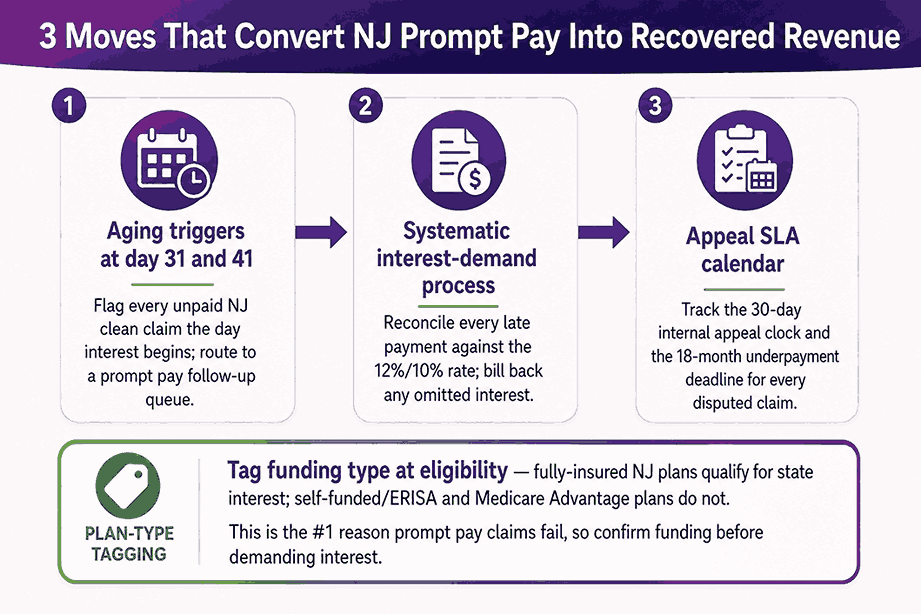
Plan-type tagging at eligibility keeps the effort focused. Fully-insured NJ plans qualify for state interest. Self-funded and Medicare Advantage plans do not. Tagging funding type upfront stops teams from chasing interest on exempt claims.
For a deeper breakdown of denial workflows, see a dedicated guide on denial management and coordination of benefits. Teams that pair prompt pay tracking with strong denial management recover more of what payers owe.

Frequently Asked Questions
How Long Does an Insurance Company Have to Pay a Claim in New Jersey?
A health carrier must pay a clean electronic claim within 30 calendar days and a clean paper claim within 40 calendar days. The clock starts at receipt of a complete claim.
What Interest Applies to Late Claims under the New Jersey Prompt Pay Law?
Health carriers pay 12 percent simple interest per year. Dental service corporations pay 10 percent. Interest starts on day 31 for electronic claims and day 41 for paper claims.
Does the New Jersey Prompt Pay Law Cover Self-Funded Plans?
No. Self-funded employer plans fall under federal ERISA rules. State prompt pay deadlines and interest do not apply to them.
How Does a Provider Appeal an Underpaid Claim in New Jersey?
A provider files a Claim Payment Appeal Form for an internal appeal, decided within 30 days. If it fails, the provider may seek binding arbitration under N.J.A.C. 11:22-1.13.
What Is the Deadline to Contest an Underpaid Claim?
A provider must contest an underpaid claim within 18 months of the first payment date. An open appeal or continued submission can pause the clock.