
CPT code 49083 covers abdominal paracentesis performed with imaging guidance. A physician inserts a needle or catheter into the abdominal cavity to withdraw fluid. The imaging component, usually ultrasound, confirms needle placement before and during the draw. Coders use this code for both diagnostic sampling and therapeutic drainage. Payers reimburse it differently depending on setting, so accurate documentation determines the final payment.
What is CPT Code 49083?
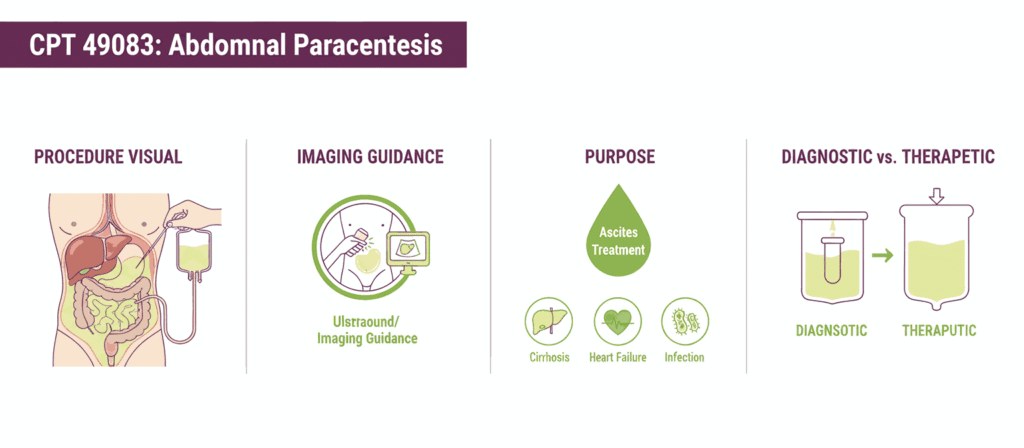
CPT code 49083 describes abdominal paracentesis performed with imaging guidance. The physician inserts a needle or catheter into the peritoneal cavity. Fluid is withdrawn for testing or symptom relief. Imaging guidance confirms the correct entry point and avoids injury to nearby organs.
The procedure treats ascites, a buildup of fluid in the abdominal cavity. Cirrhosis causes most cases. Heart failure, infection, and malignancy account for the rest. A diagnostic tap removes a small sample for lab analysis. A therapeutic tap removes a larger volume to relieve pressure and pain.
CPT 49083: Paracentesis with Imaging Guidance Billing
Billing for CPT 49083 requires documentation that imaging actively guided needle placement. A note stating that ultrasound marked the site beforehand does not meet this standard on its own. The documentation must show that the physician used imaging during the procedure to direct catheter or needle insertion.
Coders should look for language that ties the imaging step to the puncture itself. Phrases like “under direct ultrasound visualization” or “with real-time ultrasound guidance” support the code. Vague language such as “ultrasound was used” invites denial on audit.
How Does CPT 49083 Differ from CPT 49082?
CPT 49082 describes the same procedure performed without imaging guidance. The physician relies on physical exam and percussion to locate the fluid pocket. CPT 49083 applies only when imaging directs the needle in real time.
The two codes are mutually exclusive for the same encounter. A claim should never list both codes for one paracentesis. Selecting the wrong code based on documentation gaps is a leading cause of denials for this procedure.
Which Specialties Report CPT 49083?
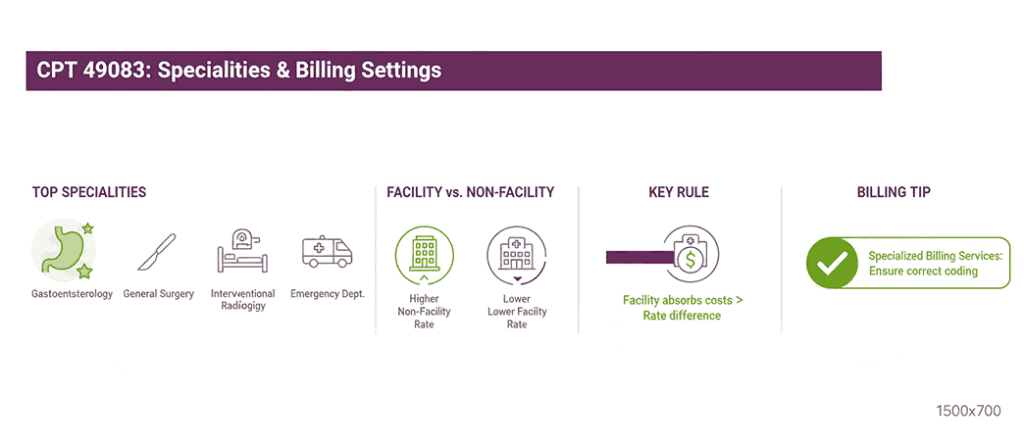
Gastroenterology reports this code most often, since cirrhosis and ascites fall under its scope. General surgery, interventional radiology, and hospital medicine also use it regularly. Emergency departments report it less often, typically for acute symptomatic ascites.
Practice type affects the facility versus non-facility rate. A gastroenterologist performing the tap in an office setting bills the higher non-facility rate. The same procedure performed in a hospital outpatient department bills the lower facility rate, since the facility absorbs supply and staff costs.
Practices that frequently perform paracentesis often benefit from specialized gastroenterology billing services, which help ensure correct coding, documentation review, and payer-specific reimbursement for digestive health procedures.
What Documentation Does CPT 49083 Require?
A compliant note for CPT 49083 names the imaging modality, the entry site, and the volume of fluid removed. It states whether the tap was diagnostic, therapeutic, or both. It records the patient’s response, including symptom relief or complications. CPT 49083 is only one of many gastroenterology CPT codes that require precise documentation, modifier selection, and diagnosis pairing to avoid denials and maximize reimbursement.
The note should also include the pre-procedure indication. A statement such as “ultrasound-guided paracentesis performed for symptomatic ascites secondary to decompensated cirrhosis” links the procedure to medical necessity in a single line. Auditors look for this kind of direct connection between the imaging step, the clinical reason, and the outcome.
Is CPT 49083 the Same as Peritoneal Lavage?
No, CPT 49083 differs from peritoneal lavage, which uses CPT 49084. Paracentesis removes existing fluid from the abdominal cavity. Lavage introduces fluid into the cavity and then withdraws it, typically to detect internal bleeding after trauma.
Coders sometimes confuse the two because both involve abdominal access and fluid movement. The clinical intent separates them. A trauma work-up calls for 49084. A cirrhosis-related fluid drain calls for 49083.
What Is the Cost of CPT Code 49083?
The cost of CPT code 49083 depends on setting, geography, and payer. Medicare sets a national baseline. Commercial payers negotiate their own rates, often as a percentage of the Medicare fee schedule.
What Is the 2026 Medicare Payment for CPT 49083?
The 2026 Medicare Physician Fee Schedule lists a national average payment near $284.24 in the non-facility setting. The facility rate runs lower, near $92.85. These figures apply the 2026 conversion factor of $33.4009 to the code’s total RVU.
Actual payment shifts by locality. The Geographic Practice Cost Index adjusts work, practice expense, and malpractice components for each region. High-cost metro areas such as California and New York pay above the national average. Rural localities pay below it. Practices should pull their specific locality file from CMS rather than rely on the national number alone.
How Do RVUs Determine CPT 49083 Reimbursement?
Three RVU components build the payment: physician work, practice expense, and malpractice. CPT 49083 carries a work RVU of 1.95, reflecting the skill and time the physician spends on the procedure.
Practice expense RVU varies sharply by setting. Non-facility practice expenses are high because the physician’s office absorbs the cost of supplies, ultrasound equipment, and staff time. Facility practice expenses are low because the hospital or ASC bears those costs instead. Multiplying total RVU by the conversion factor and the locality adjustment produces the final payment.
Does Facility Setting Change CPT 49083 Payment?
Yes, facility setting changes CPT 49083 payment substantially. Non-facility total RVU sits near 8.40 to 8.51, while facility total RVU sits near 3.13. This gap exists because facility payment covers physician work only, not overhead.
Practices scheduling paracentesis in an owned office setting should confirm they carry the equipment and staffing costs the non-facility rate assumes. Billing the non-facility rate without bearing those costs invites payer scrutiny during audits.
How Do Commercial Payers Reimburse CPT 49083?
Commercial payers typically anchor their fee schedules to a percentage of the Medicare rate for the same locality, commonly between 100 percent and 150 percent. A payer contracted at 120 percent of Medicare would pay near $341 non-facility, based on the 2026 national average.
Contract terms vary by payer and by region, so practices should confirm the exact percentage in their fee schedule rather than assume parity with Medicare. Prior authorization requirements also differ by payer. Some commercial plans require authorization for elective therapeutic taps but waive it for urgent symptomatic cases.
How Does Site of Service Affect Patient Cost Sharing?
The site of service changes what the patient owes out of pocket, not only what the practice collects. A non-facility claim bundles the procedure and supplies into one line, so the patient sees one cost-sharing calculation. A facility claim splits the charge between the physician’s professional fee and the facility’s separate charge, which often produces two separate patient bills.
Front-desk staff should explain this split before a scheduled hospital-based procedure. Patients who expect a single office visit charge are frequently surprised by a second facility bill weeks later.
What Are Common Billing Scenarios for CPT Code 49083?
Real billing scenarios expose the edge cases that written descriptors do not fully cover. The scenarios below reflect situations coders encounter with this code.
How Do You Bill CPT 49083 for Ascites Drainage?
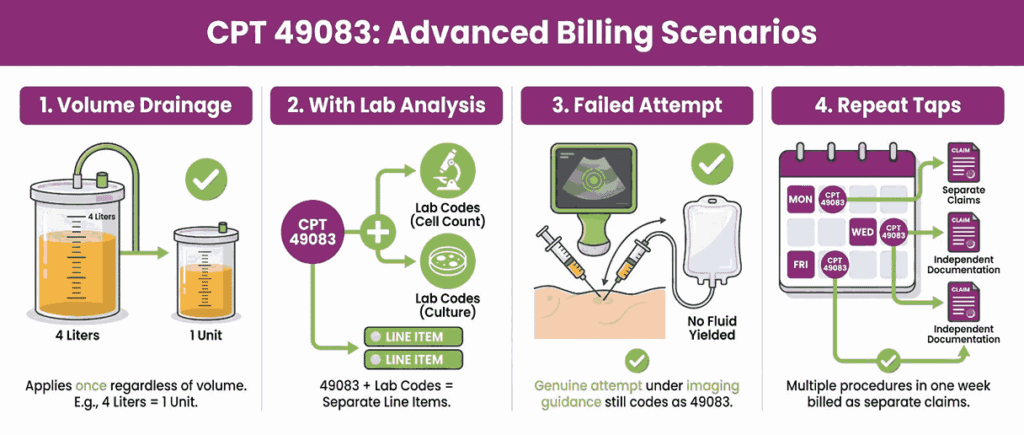
A patient with decompensated cirrhosis presents with abdominal distention. The physician performs ultrasound-guided paracentesis and drains four liters of fluid for symptom relief. The coder reports CPT 49083 once, regardless of fluid volume, since the code does not scale by quantity.
The claim should link an ICD-10 code that supports medical necessity, such as R18.8 for other ascites or K70.31 for alcoholic cirrhosis with ascites. Documentation should note the volume drained and the patient’s symptom response.
Can CPT 49083 Be Billed with Diagnostic Fluid Analysis?
Yes, CPT 49083 can be billed alongside laboratory analysis of the withdrawn fluid. The paracentesis code covers the procedure itself. Separate CPT codes cover the lab work, such as cell count, albumin level, or culture. These lab codes are billed by the performing laboratory, not bundled into 49083.
A single encounter might combine a diagnostic tap with immediate lab orders to rule out spontaneous bacterial peritonitis. The paracentesis code and the lab codes appear as separate line items with separate medical necessity support.
What Happens When Paracentesis Fails Under Imaging Guidance?
An attempted paracentesis sometimes fails to yield fluid despite imaging guidance, often due to loculated or minimal ascites. Coding guidance still supports reporting CPT 49083 when the physician made a genuine attempt under imaging guidance, since the code describes the procedure, not the outcome.
Documentation should state that imaging confirmed insufficient accessible fluid and that the attempt was abandoned for patient safety. Payers occasionally request the imaging report to confirm the attempt occurred as billed.
How Do You Bill CPT 49083 for a Second Tap in the Same Week?
A patient with rapidly reaccumulating malignant ascites may return for a repeat paracentesis within days. Each encounter supports its own claim for CPT 49083, since the code does not carry a per-episode frequency limit tied to Medicare policy.
The medical record for the repeat visit should document the current fluid status independently. Simply copying the prior note forward, without new findings, weakens the claim and raises audit risk. Payers reviewing repeat procedures within a short window often request the imaging report and the clinical rationale for each date of service.
How Is CPT 49083 Billed in an ASC Setting?
An ambulatory surgery center reports CPT 49083 as a facility claim. The ASC bills its own facility fee under the ASC payment system, separate from the physician’s professional claim. The physician still reports CPT 49083 with the facility total RVU applied, since the ASC absorbs the supply and staffing costs.
Scheduling paracentesis in an ASC makes sense for a patient with a stable, elective therapeutic need. It makes less sense for an unstable inpatient, who should receive the procedure at bedside or in a hospital-based setting instead.
What Are the Billing Rules for CPT Code 49083?
Billing rules for CPT code 49083 cover modifiers, diagnosis linkage, bundling, and global period. Missing any of these often triggers a denial or an audit flag.
Which Modifiers Apply to CPT 49083?
Modifier 59 applies when CPT 49083 is billed with another procedure that would normally bundle under National Correct Coding Initiative edits, and the paracentesis was a distinct procedural service. Modifier 76 applies when the same physician repeats the paracentesis later on the same day, such as for reaccumulated fluid.
Modifier 24 applies to an unrelated evaluation and management visit performed by the same physician during the 0-day global period, though this modifier applies to the E/M code rather than to 49083 itself. Modifier 22 applies rarely, for cases with significantly increased procedural complexity, and requires strong supporting documentation.
Which ICD-10 Codes Support Medical Necessity for CPT 49083?
R18.0 supports claims for malignant ascites. R18.8 supports other and unspecified ascites. K70.31 supports alcoholic cirrhosis of the liver with ascites. K76.6 supports portal hypertension, a frequent underlying cause of fluid accumulation.
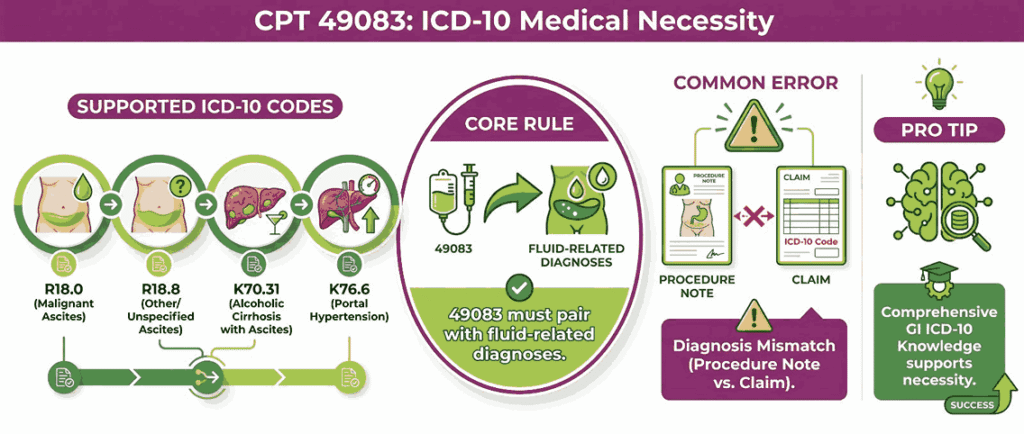
Payers deny claims that pair 49083 with a diagnosis code unrelated to fluid accumulation. Coders should confirm the diagnosis documented in the procedure note matches the diagnosis submitted on the claim, since mismatches are a common source of denial.
Choosing the correct diagnosis is just as important as selecting the procedure code. A comprehensive understanding of gastroenterology ICD-10 codes helps ensure medical necessity is properly supported across a wide range of GI conditions.
Is CPT 49083 Bundled with Ultrasound Guidance Code 76942?
No, CPT 76942 should not be reported separately with 49083. The descriptor for 49083 already includes imaging guidance as part of the procedure. Reporting 76942 alongside it duplicates payment for the same guidance work and triggers a National Correct Coding Initiative edit.
Some practices mistakenly bill 76942 out of habit from billing 49082, the version without built-in imaging. Coders should verify which paracentesis code appears on the claim before deciding whether separate imaging guidance applies.
What Is the Global Period for CPT 49083?
CPT 49083 carries a 0-day global period. Medicare bundles same-day evaluation and management services related to the procedure into the payment. An E/M visit on the day of the procedure, tied to the reason for the paracentesis, is not separately billable.
An unrelated E/M service on the same day, or a follow-up office visit the next day for a different concern, remains separately billable. Modifier 24 or modifier 25 documents that distinction on the claim, depending on which service the modifier applies to.
What Are the NCCI Edits for CPT 49083?
The National Correct Coding Initiative lists procedure-to-procedure edits for CPT 49083 against more than ten other codes, including several catheter placement and imaging codes. Most of these edits carry an indicator that allows an override with a modifier when the second procedure is clinically distinct and separately documented.
Coders should check the current NCCI edit table before appending a modifier to bypass a bundling edit when it comes to CPT codes. An override without a legitimate distinct procedural service invites a post-payment audit and possible recoupment.
What Are Common Denial Reasons for CPT 49083?
Payers deny CPT 49083 most often for four reasons. The documentation fails to describe real-time imaging guidance. The diagnosis code does not support fluid accumulation. The claim duplicates 76942 for the same encounter. The claim lacks medical necessity language connecting the symptom to the procedure.
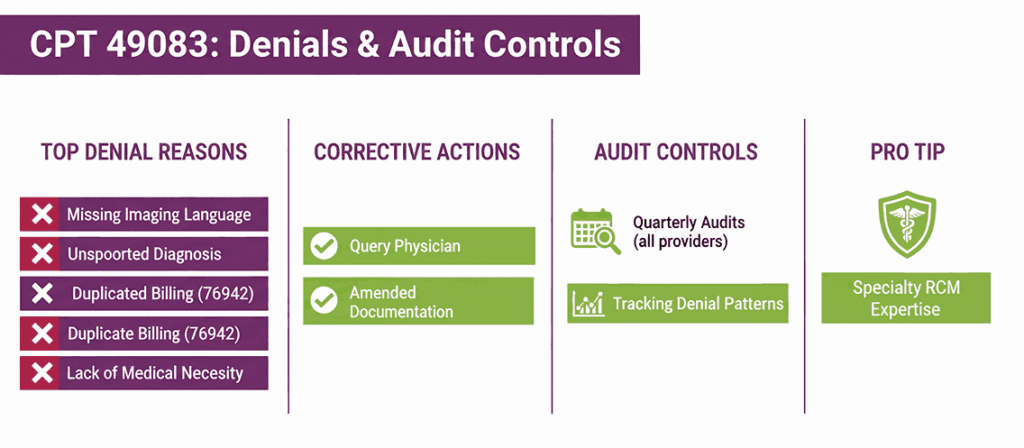
A denial for any of these reasons is usually correctable through an appeal with amended documentation, provided the underlying medical record already contains the missing detail. Coders should query the physician for clarification rather than infer intent when a note is ambiguous.
CPT code 49083 rewards precise documentation and setting-aware billing. Coders who confirm real-time imaging use, correct ICD-10 linkage, and proper bundling rules protect the claim from denial. Many practices also partner with experienced GI billing companies to strengthen coding accuracy, reduce denials, and improve collections through specialty-specific revenue cycle management expertise.
Facilities and offices billing this code regularly should audit a sample of charts each quarter to confirm the imaging language, diagnosis pairing, and modifier use continue to meet payer standards.
A quarterly audit should sample charts across all providers who report the code, not only the highest-volume biller. Denial patterns often cluster around a single provider’s documentation habits, and a narrow sample can miss that signal. Practices that track denial reasons by code over time build a clear picture of where CPT 49083 claims break down, which shortens the appeal cycle and reduces write-offs tied to this procedure.