
Medical billing in gastroenterology is unforgiving. One wrong code on a colonoscopy claim, one missing modifier on a screening that turned therapeutic, and you are either losing money or inviting an audit. The global gastroenterology market reached USD 35.1 billion in 2024 and is expected to surpass USD 53.1 billion by 2031. That scale of clinical activity demands precision in every claim submitted.
Recent data from UnitedHealthcare’s 2024 endoscopy coding guide and commercial claims data trends released in early 2025 confirm that diagnostic EGDs, colonoscopies with biopsy, and snare polypectomies consistently rank in the top tier of billed GI services.
In this guide, we will explain the detailed CPT codes, what each code actually requires, where practices lose money, and what payers are looking for right now.

Why Gastroenterology Billing Codes Demand More Attention Than Most Specialties
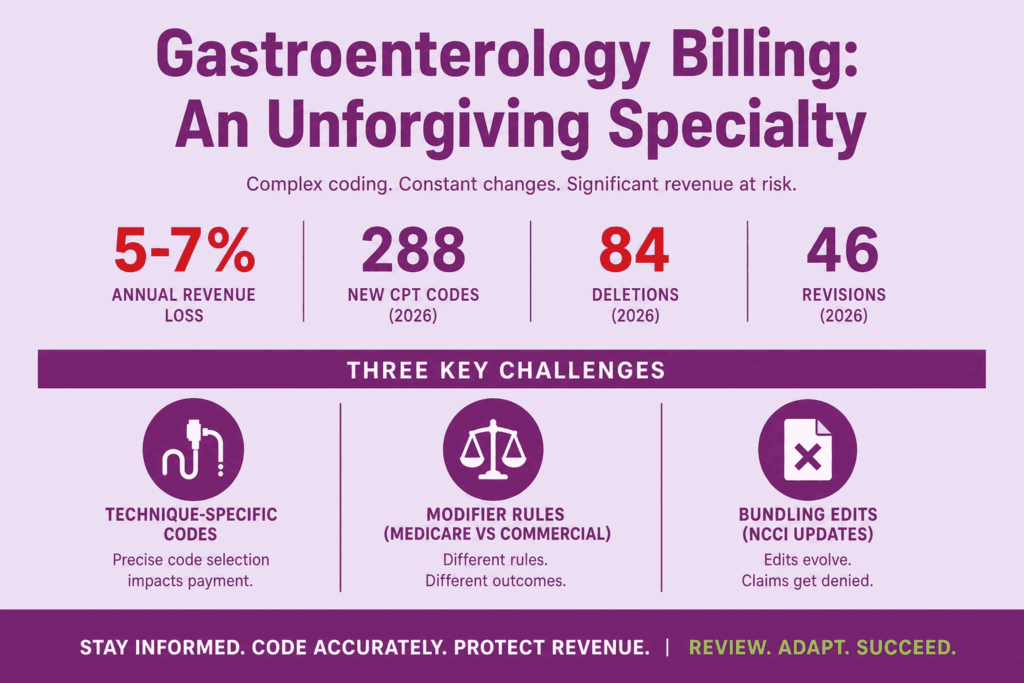
Gastroenterology is not a forgiving specialty when it comes to billing. According to the Healthcare Financial Management Association (HFMA), gastroenterology practices with high denial rates experience up to 5 to 7 percent revenue loss annually, and that is not a rounding error. For a mid-size practice doing significant endoscopy volume, that figure represents tens of thousands of dollars left uncollected every year.
The reason denial rates stay high comes down to a few repeating problems: technique-specific codes that require exact documentation, modifier rules that differ between Medicare and commercial payers, and bundling edits that change quarterly under NCCI updates.
The 2026 CPT code set introduced 288 new codes, 84 deletions, and 46 revisions, many of which directly affect how gastroenterology procedures are coded and billed. Utilizing a comprehensive gastroenterology billing guide is critical for clinical staff to cross-examine these updates and ensure baseline compliance before a claim ever leaves the office.
Evaluation and Management Codes: The Starting Point for Every Patient Encounter
Before any scope ever goes in, the office visit sets the stage. Gastroenterologists bill E/M codes daily for new consultations, chronic disease management visits, and post-procedure follow-ups.
New Patient Office Visits (99202 to 99205)
- 99202: Straightforward medical decision-making or 15 to 29 minutes of total time with the patient
- 99203: Low complexity decision-making or 30 to 44 minutes of total time
- 99204: Moderate complexity decision-making or 45 to 59 minutes of total time
- 99205: High complexity decision-making or 60 to 74 minutes of total time
Established Patient Office Visits (99212 to 99215)
- 99212: Minimal medical decision-making or 10 to 19 minutes of total time
- 99213: Low complexity decision-making or 20 to 29 minutes of total time
- 99214: Moderate complexity decision-making or 30 to 39 minutes of total time
- 99215: High complexity decision-making or 40 to 54 minutes of total time
A compliance point worth noting: many providers still attempt to bill consultation services under outdated codes like 99241 to 99245, which Medicare no longer reimburses. If your practice still uses those codes for Medicare patients, you are not just losing the claim; you are creating a compliance liability.
When a physician performs an E/M service on the same day as a procedure, Modifier 25 must be appended to the E/M code. The documentation must reflect two genuinely separate services; a pre-procedure visit is not enough on its own.
Upper GI Endoscopy CPT Codes (EGD)
EGD procedures cover examination of the esophagus, stomach, and duodenum. The coding structure works from a base code outward, with therapeutic interventions replacing the base code rather than stacking on top of it.
The Most Frequently Billed EGD Codes
EGD coding errors are among the most common sources of claim rejections in gastroenterology billing. Mastering the most frequently billed EGD codes is essential for maximizing revenue integrity and staying audit-ready in today’s complex payer environment.
43235 Diagnostic EGD
This is the baseline code used when the physician performs a visual examination only and finds nothing requiring tissue collection or treatment.
43239 EGD with Biopsy (single or multiple)
CPT 43239 remains one of the most billed codes in GI, ranking in the top 10 for GI outpatient claims across major payers. It covers H. pylori sampling, Barrett’s esophagus surveillance biopsies, and any other tissue collection during upper endoscopy.
A real-world error that appears more often than it should. Billing 43239 when only a visual inspection was done leads to denials after chart review. In that scenario, 43235 should have been reported instead. The operative note is the only thing standing between a paid claim and a denial.
43254 EGD with Endoscopic Mucosal Resection (EMR)
More outpatient centers are now equipped for EMR, especially for early GI cancer removal or large polyp resections. This code carries a higher reimbursement value and requires documentation of the resection technique, size of the lesion, and the location within the upper GI tract.
43255 EGD with Control of Bleeding (any method)
An important facility billing note: CPT 43254 (EGD with EMR) billed in combination with 43255 (EGD control of bleeding) qualifies for a complexity adjustment from APC 5302 at USD 1,960 to APC 5303 at USD 3,939. This adjustment specifically addresses intraoperative bleeding complications following EMR and represents a significant reimbursement difference for facility coders.
Other Billable EGD Codes
- 43236: EGD with directed submucosal injection, commonly used for tattooing lesion locations or lifting polyps before resection.
- 43244: EGD with band ligation of esophageal varices, a therapeutic code used in active variceal bleeding or prophylactic treatment.
- 43246: EGD with percutaneous endoscopic gastrostomy tube placement (PEG) requires documentation of medical necessity and the patient’s inability to maintain oral nutrition.
- 43248: EGD with esophageal dilation using a guidewire, distinct from balloon dilation and coded separately.
- 43249: EGD with balloon dilation of the esophagus less than 30 mm in diameter.
- 43259: EGD with endoscopic ultrasound examination of the esophagus, stomach, and adjacent structures
NCCI Bundling Note for EGD
For facility reporting of CPT codes 43235 and 91035 on the same date, NCCI edits require Modifier 59 to be appended to CPT 43235. The medical record must support the use of Modifier 59 to indicate that the EGD is a separate and identifiable procedure. CPT 43239, by contrast, does not require a modifier when reported at the same encounter as CPT 91035. NCCI edits update quarterly, so verifying the rules at the time of service is an essential practice.
Colonoscopy CPT Codes: The Highest Volume and the Highest Risk
Colonoscopy claims make up a significant share of most GI practice revenue. They also make up a significant share of GI denials. That pattern is not a coincidence. The coding structure here is specific, the modifier rules are strict, and payers are not lenient when the operative note does not back up the code submitted.
Understanding the Code Structure
Think of 45378 as the diagnostic foundation. Every other colonoscopy code from 45379 onward represents an intervention performed during that same session, and the appropriate intervention code replaces 45378 rather than being added to it.
If you bill 45378 and 45385 on the same claim, the payer will deny one because the diagnostic portion is already included in the therapeutic code. Billing both together is one of the most common and costly errors in GI billing.
The Core Diagnostic and Therapeutic Colonoscopy Codes
- 45378 Diagnostic colonoscopy without any intervention. Used when the scope reaches the cecum, nothing abnormal is found, and no tissue is removed.
- 45380 Colonoscopy with biopsy, single or multiple. This code covers tissue samples obtained using biopsy forceps and applies whether one or multiple biopsies are taken during the same session. It appears frequently in IBD workups, chronic diarrhea evaluations, and follow-up after abnormal findings on imaging.
- 45384 Colonoscopy with removal of polyp or lesion by hot biopsy forceps. This code applies to smaller polyps removed with hot biopsy forceps, while 45385 applies to larger polyps removed using snare techniques, including both hot and cold snare methods.
- 45385 Colonoscopy with removal of polyp or lesion by snare technique. This is a high-volume code seen in nearly every GI practice, and some payers now require endoscopy report photos within the EMR to validate that the snare technique was actually used.
The work RVU values matter here for understanding reimbursement differences. Diagnostic colonoscopy (45378) carries 3.36 wRVUs, colonoscopy with biopsy (45380) carries 3.67 wRVUs, and colonoscopy with polypectomy (45385) carries 4.57 wRVUs. At the 2026 Medicare conversion factor of USD 33.40, these translate to approximately USD 218 to USD 296 in physician reimbursement before facility fees.
- 45381 Colonoscopy with directed submucosal injection. Used for tattooing lesion sites, lifting polyps before removal, or injecting epinephrine for hemostasis.
- 45382 Colonoscopy with control of bleeding, any method. Requires documentation of the bleeding source, the method of control used, and the outcome.
- 45386 Colonoscopy with balloon dilation. Used for stricture management in conditions like Crohn’s disease or anastomotic narrowing after prior surgery.
- 45388 Colonoscopy with ablation of tumor or polyp. Applies when argon plasma coagulation or other ablative methods are used rather than mechanical removal.
Screening vs. Diagnostic
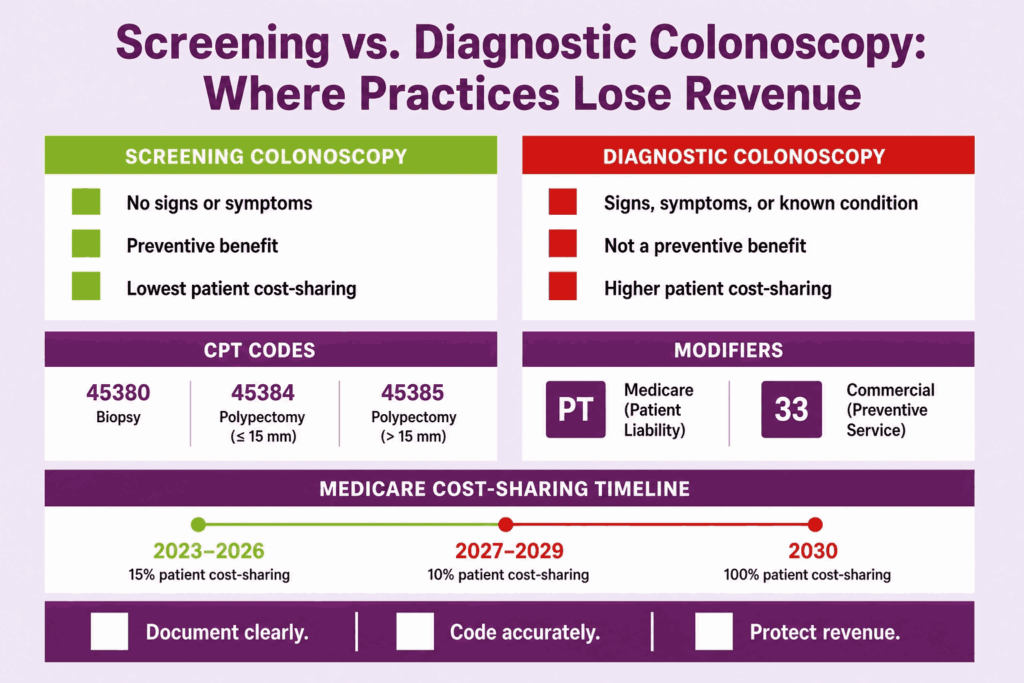
This is where many practices lose significant revenue. A screening colonoscopy that finds and removes a polyp does not stop being a screening. The original intent determines the modifier, not the finding.
When polyps are removed during a screening colonoscopy for a Medicare patient, use the appropriate CPT code, such as 45380, 45384, or 45385, and append Modifier PT (colorectal cancer screening test converted to diagnostic test) to each CPT code. For commercial and non-Medicare patients in the same situation, Modifier 33 applies instead of PT.
It is important to note that if a polyp is removed during a screening colonoscopy, a Medicare beneficiary is responsible for 15 percent of the cost from 2023 through 2026. This drops to 10 percent from 2027 through 2029, and by 2030, the procedure will be covered at 100 percent by Medicare. Patients are often unaware of this cost-sharing responsibility, and practices that fail to communicate it upfront create billing disputes after the fact.
Medicare Screening Colonoscopy: G-Codes vs. CPT Codes
For screening colonoscopies billed to Medicare, the G-code system applies instead of standard CPT codes.
- G0121: Colorectal cancer screening colonoscopy for average-risk patients, eligible once every 10 years
- G0105: Colorectal cancer screening colonoscopy for high-risk patients, eligible once every 24 months
Medicare considers an individual at high risk for colorectal cancer when they have a close relative, such as a sibling or parent, with the condition, among other qualifying factors. Coding a high-risk patient under G0121 instead of G0105 affects both reimbursement and the patient’s eligibility timeline.
The 45380 and 45385 Bundling Problem
This is a debatable topic in GI billing forums, and there are reasons behind it. The values of both codes 45380 and 45385 include the value of diagnostic colonoscopy (45378) built in. Instead of paying the complete value to both, payers pay the full value of the higher-valued endoscopy (45385) plus the difference between the next highest endoscopy (45380) and the base endoscopy (45378).
Billing 45385 and 45380 together on the same session is possible, but only under specific conditions. The biopsy and polypectomy must be performed at separate sites. Each intervention must reflect a distinct technique and a distinct medical necessity. All of this must be spelled out in the operative note. Without that level of specificity, the second code will deny.
Navigating these multi-site line edits is why many high-volume ambulatory surgical centers outsource their revenue cycles to dedicated gastroenterology billing services that can guarantee clean-claim configurations.
ERCP CPT Codes: High Complexity, High Scrutiny
Endoscopic retrograde cholangiopancreatography covers the diagnosis and treatment of bile duct and pancreatic duct conditions. These are complex procedures that often involve multiple interventions, each with its own code.
Core ERCP Codes
- 43260: Diagnostic ERCP without any intervention
- 43262: ERCP with sphincterotomy or papillotomy, one of the most frequently performed therapeutic ERCPs
- 43264: ERCP with removal of calculi from biliary or pancreatic ducts
- 43265: ERCP with destruction of calculi, used when stone size requires fragmentation before removal
- 43266: ERCP with placement of endoscopic stent
- 43268: ERCP with dilation of the bile or pancreatic ducts
- 43269: ERCP with removal of previously placed stent
- 43274: ERCP with placement of an endoscopic stent into the biliary or pancreatic duct
- 43276: ERCP with replacement of stent, new stent
ERCP billing carries heavier documentation requirements than most endoscopy claims. Payers expect the procedure note to answer four specific questions: Was cannulation of the bile duct or pancreatic duct achieved? Which duct was treated? What specific intervention was performed in each duct? What clinical indication drove each step? Missing even one of these elements gives payers grounds to deny or downcode the claim.
Capsule Endoscopy CPT Codes: A Growing Segment
Use of capsule endoscopy codes 91110 and 91113 has increased by nearly 9 percent year-over-year, according to Medicare Part B utilization reports. As more practices add capsule studies to their service mix, billing accuracy for this category becomes more important.
- 91110: Gastrointestinal tract imaging, intraluminal, capsule endoscopy, with interpretation and report; small intestine
- 91111: Capsule endoscopy of the esophagus with interpretation and report
- 91113: Capsule endoscopy, colon, with interpretation and report
Prior authorization remains a consistent barrier for capsule endoscopy claims. Before billing, practices should call the insurance carrier to confirm exactly what supporting documentation is required. Some payers require both colonoscopy and endoscopy reports to accompany the capsule claim.
This step cannot be skipped. Payers have significantly tightened prior authorization protocols for advanced procedures since 2020, and incomplete submissions are a leading cause of delays and denials.
Anorectal Procedure Codes
- 46221: Hemorrhoidectomy by rubber band ligation, the most common anorectal procedure performed in GI outpatient settings
- 46600: Diagnostic anoscopy
- 46606: Anoscopy with biopsy
- 46614: Anoscopy with control of bleeding
- 46020: Placement of a seton for fistula management
When billing for rubber band ligation (46221), payers require documentation of the hemorrhoid grade, the number of sites treated, and the clinical justification for the procedure rather than conservative management.
2026 Coding Updates That Directly Affect GI Practices
The 2026 CPT updates represent a critical shift for GI practices, replacing legacy codes with permanent Category I status for key procedures. Mastery of these structural changes is essential for maintaining revenue integrity.
New Category III & Emerging Technology Codes
Several GI-related Category III CPT codes were implemented in recent cycles and remain critical for tracking emerging procedures in 2026.
- Intragastric Balloon Adjustment: Code 0813T (EGD with volume adjustment of intragastric bariatric balloon) continues to be the standard for reporting these non-surgical weight-loss interventions.
- Gastric Mapping: Code 0868T remains in effect for high-resolution gastric electrophysiology mapping with simultaneous patient symptom profiling.
- Esophageal Dilation: A newer addition, code 0884T, covers esophagoscopy with mechanical dilation followed by therapeutic drug delivery via a drug-coated balloon catheter, specifically for treating esophageal strictures.
Anorectal Physiology Modernization for 2026
The most significant structural change for GI diagnostics in 2026 is the complete overhaul of anorectal physiology testing. Following an AMA review that found predecessor codes were reported together in approximately 75% of cases, the billing structure has been streamlined:
- The Deletions: Legacy codes 91120 and 91122 have been officially deleted.
- The New Standard: 91125 is the new permanent Category I code for “Anorectal manometry, with rectal sensation and rectal balloon expulsion test, when performed.”
- Complementary Code: For studies focusing on rectal sensation, tone, and compliance (e.g., barostat), practices should now use the new code 91124.
2026 Physician Fee Schedule & Payment Outlook
While 2025 saw a 2.93% reduction in the conversion factor, the 2026 Medicare Physician Fee Schedule (MPFS) introduced a temporary 2.5% increase passed by Congress to stabilize practice revenue. However, this gain is partially offset by:
- A 2.5% “efficiency adjustment” targeting work RVUs for over 7,000 services.
- A reduction in practice-expense RVUs for services performed in facility settings (hospitals/ASCs). Practices must prioritize coding accuracy and airtight documentation to navigate these offsetting adjustments and more aggressive NCCI edits.
MIPS Value Pathway (MVP) for Gastroenterology
For the 2026 performance year, CMS has finalized the Gastroenterology Care MVP (M1422). This specialized pathway simplifies MIPS reporting by allowing practices to focus on 11 quality measures and specific QCDR measures (like GIQIC26 for Adenoma Detection Rate).
- Reporting Requirement: Practices generally select four quality measures relevant to their patient population (e.g., screening colonoscopy or bowel preparation adequacy).
- Impact: Performance on these measures directly dictates the positive or negative payment adjustments applied to all Medicare Part B claims in future payment years.
Critical Modifier Reference for Gastroenterology Billing
| Modifier | When It Applies in GI Billing |
|---|---|
| 25 | E/M service performed on the same day as a procedure; both must be separately documented |
| 33 | Preventive screening service for commercial payers; prevents patient cost-sharing on ACA-covered screenings |
| PT | Medicare-specific screening colonoscopy that converts to diagnostic or therapeutic during the session |
| 52 | Reduced service; procedure partially performed at the physician’s discretion, not due to patient risk |
| 53 | Discontinued procedure after anesthesia due to patient safety concerns |
| 59 | Distinct procedural service; used when two procedures are performed at different sites or sessions, requiring separate billing |
| KX | Medicare confirms requirements specified in medical policy have been met, used with screening colonoscopy following a positive non-invasive stool test |
| XS | Separate structure modifier; used when EGD and colonoscopy are performed on the same day to identify distinct anatomical sites |
A practical example of Modifier 53
During a colonoscopy performed under anesthesia, a patient experiences a severe drop in blood pressure. The gastroenterologist stops the procedure immediately. The correct billing format is CPT 45378 with Modifier 53 to indicate the procedure was started but not completed due to patient risk.
The Documentation Elements That Determine Whether Claims Pay or Deny
Payers are not just checking codes anymore. They are checking whether the operative note supports the code selected, and in many cases, they are requesting records before releasing payment on high-value claims.
For every colonoscopy with polypectomy, the procedure note must document:
- The specific location in the colon where the polyp was found (not just “polyp removed”).
- The technique used for removal (snare, hot biopsy forceps, EMR, ablation) because the technique determines the code.
- The size of the polyp or lesion in millimeters.
- Whether the polyp was retrieved for pathology, and how the retrieval was accomplished.
- Cecal intubation confirmation, typically a photo of the ileocecal valve or appendiceal orifice.
Carriers often request endoscopy reports to validate the method of removal. If the operative note does not match the code selected, expect a rejection. For EGD with biopsy (43239), the note must identify the specific anatomical location of each biopsy, the clinical reason tissue was collected at that site, and the number of specimens submitted.
Billing 43239 after a visual-only inspection and calling it a biopsy encounter is the kind of error that triggers post-payment audits.
The Bottom Line
Gastroenterology CPT codes are not complicated in isolation. The challenge is that the rules governing how they interact, how they are modified, and how payers interpret them change frequently and apply differently across Medicare, Medicare Advantage, and commercial plans.
The practices that keep denial rates low share a few common habits. They train coders on technique-specific codes, not just procedure categories. They verify NCCI edits before billing combinations of endoscopy codes.
They document clinical intent at the start of every procedure, especially for screening cases that may convert. And they review payer-specific LCD and NCD policies before submitting claims for advanced procedures like capsule endoscopy or EUS-guided biopsies.
The codes listed in this guide represent the procedures billed most frequently across gastroenterology practices in the United States. Knowing the code number is the starting point. Knowing the documentation it requires, the modifiers it demands, and the payer rules that govern it is what keeps those claims from coming back.
To achieve long-term financial stability under these rigid criteria, leading practices actively consult with professional gastroenterology billing companies to audit their documentation compliance and eliminate systemic under-coding overhead.