
HCPCS code G0249 reports the provision of test materials and equipment for home INR monitoring, together with the reporting of results to the treating physician. One unit covers four completed tests, not a month of supplies.
G0249 looks like durable medical equipment, but it is not. CMS classifies home PT/INR monitoring as a diagnostic test, so the claim belongs to the Part B contractor, and a claim sent to a DME MAC is denied for incorrect jurisdiction.
That routing rule, the four-test unit, and the NCD 190.11 eligibility criteria account for most revenue loss on the code. Many anticoagulation programs route these claims through expert billing services for cardiology practices to keep the cycles clean.
What Is the Description of HCPCS Code G0249?
The G0249 HCPCS code long descriptor as defined by CMS is: “Provision of test materials and equipment for home INR monitoring of patient with either mechanical heart valve(s), chronic atrial fibrillation, or venous thromboembolism who meets Medicare coverage criteria; includes provision of materials for use in the home and reporting of test results to physician; testing not occurring more frequently than once a week; billing units of service include 4 tests.”
This code reports the supply side of a home anticoagulation monitoring program. HCPCS code G0249 covers the monitor, the test materials, and the transmission of results to the treating physician. The code carries no physician work component, since the clinical review belongs to a separate code.
The unit structure is what trips most billers. G0249 is not billed per test, per month, or per shipment, and the descriptor states plainly that a unit of service includes four tests.
What Does HCPCS Code G0249 Cover, and What Is Included in the Payment?
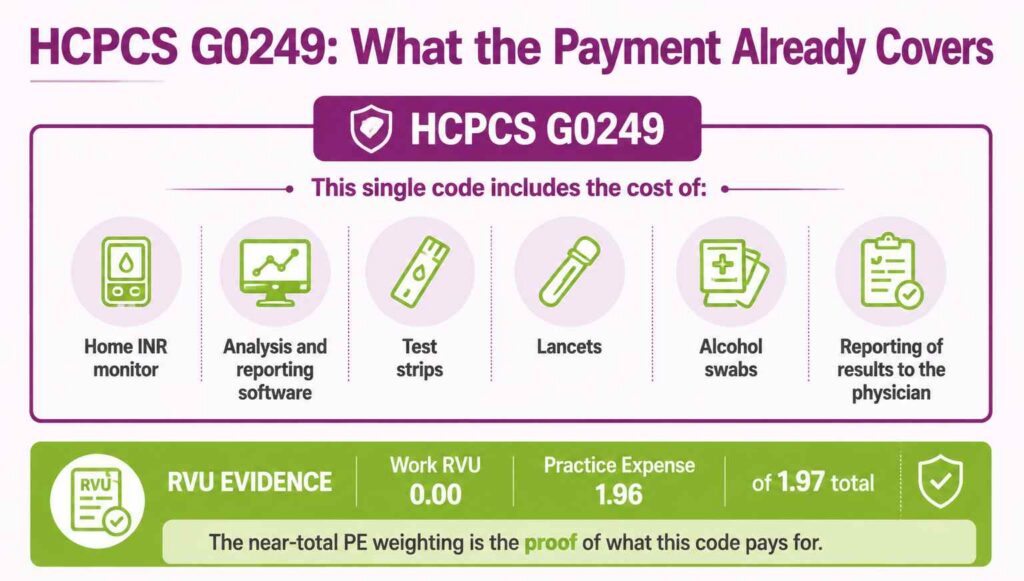
HCPCS code G0249 covers the provision of the monitor, the test materials, and the reporting of results to the treating physician. The device and supply costs sit inside the payment and are never billed separately.
- The code carries a work RVU of 0.00, so no physician work is paid through G0249
- The practice expense component is 1.96 of the 1.97 total RVU, which is where the equipment and supplies live
- The direct expense inputs CMS used include the home INR monitor, the analysis and reporting software, lancets, alcohol swabs, and INR test strips
- Billing the monitor, strips, or lancets on a separate line duplicates cost already inside the code
The near-total practice expense weighting is the clearest evidence of what this code pays for. G0249 reimburses equipment and materials, so a separate supply line is a duplicate charge rather than additional revenue.
Why One Unit of G0249 Equals Four Tests, and When the Date of Service Falls
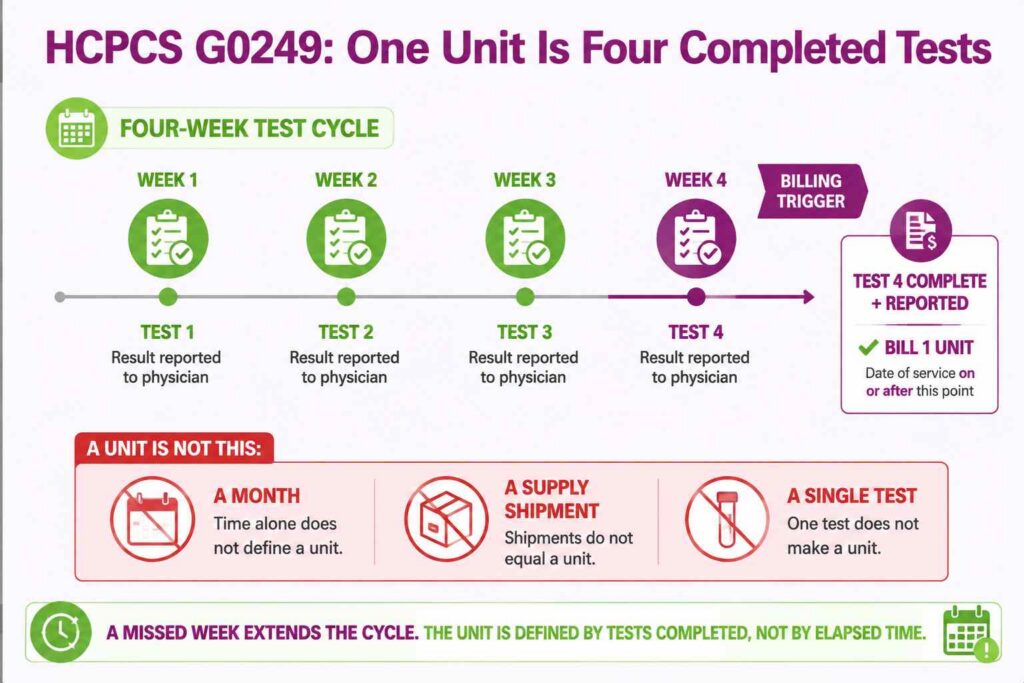
One unit of HCPCS code G0249 is four tests completed and reported to the provider over a period of four weeks or greater. The unit is not a month, a supply shipment, or a single test.
- A unit of service is four completed tests, each reported to the treating physician
- The four tests must span four weeks or greater, since testing is limited to once per calendar week
- The billing date of service is on or after the completion and reporting of the fourth test
- Providers may bill only once the fourth test is complete and the results are submitted to the physician
Claims submitted before the fourth test is finished do not meet the unit definition. The cycle, not the calendar month, drives when the claim goes out.
How Do G0248, G0249, and G0250 Divide the Home INR Monitoring Service?
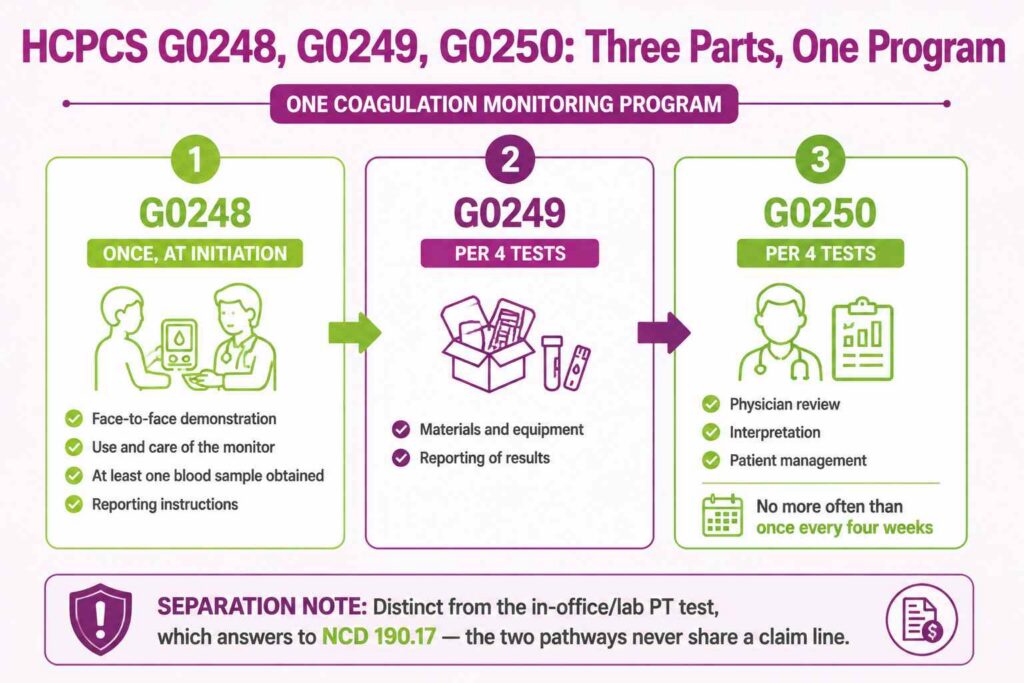
Three codes divide home INR monitoring between initiation, materials, and physician review. Each answers to the same NCD but pays for a distinct part of the service.
- G0248 reports the one-time face-to-face demonstration at initiation, covering use and care of the monitor, obtaining at least one blood sample, and instructions for reporting results
- G0249 reports the test materials, equipment, and reporting of results, per four tests
- G0250 reports physician review, interpretation, and patient management of the home test results, per four tests, billable no more often than once every four weeks
This home monitoring pathway is separate from the in-office or laboratory prothrombin time test. NCD 190.11 governs home PT/INR monitoring, and the clinical laboratory PT test answers to a distinct policy at NCD 190.17 with its own codes.
So the two pathways never share a claim line. Service-splitting across G-codes is common throughout the cardiology HCPCS codes, where initiation, materials, and physician review each carry their own line.
Why G0249 Is Paid Under the Physician Fee Schedule and Not as DMEPOS
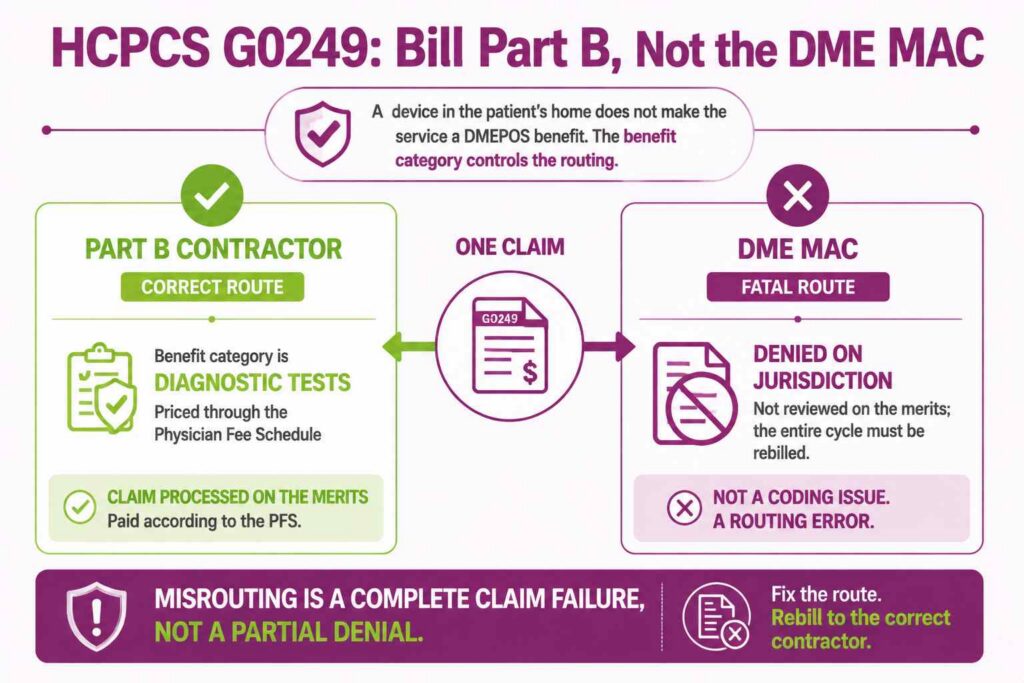
A monitor sent to a patient’s home reads like durable medical equipment, and it is not. CMS states that this test is not covered as durable medical equipment, so claims submitted to DME contractors are denied for incorrect jurisdiction.
- The NCD benefit category for home PT/INR monitoring is diagnostic tests, not durable medical equipment
- HCPCS code G0249 is priced through the Physician Fee Schedule and billed to the Part B contractor
- Claims routed to a DME MAC are rejected on jurisdiction rather than reviewed on the merits
- Misrouting is a complete claim failure, not a partial denial, so the whole cycle must be rebilled correctly
This distinction catches new anticoagulation programs regularly. The presence of a device in the patient’s home does not make the service a DMEPOS benefit, and the benefit category controls the routing. Fee-schedule pricing puts this code on the same footing as the cardiology procedure codes, despite the HCPCS designation and the device in the patient’s home.
What ICD-10 Codes and NCD 190.11 Coverage Criteria Support HCPCS Code G0249?
NCD 190.11 sets a strict set of conditions for HCPCS code G0249, and every element must be documented. The monitor and the home testing must be prescribed by the treating physician.
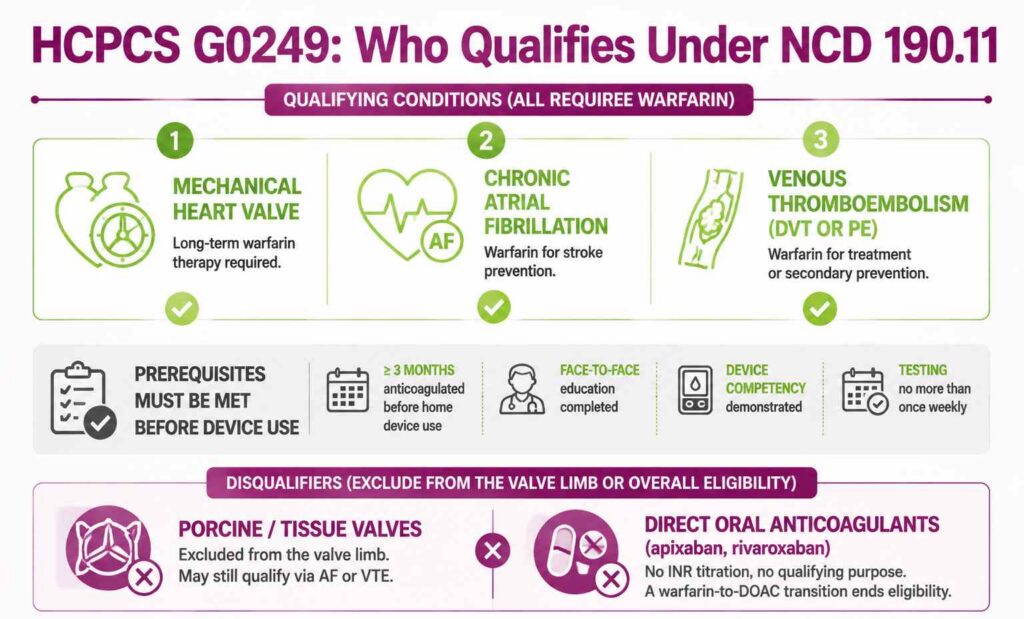
- The patient requires chronic oral anticoagulation with warfarin for a mechanical heart valve, chronic atrial fibrillation, or venous thromboembolism
- Venous thromboembolism includes deep venous thrombosis and pulmonary embolism
- The patient has been anticoagulated for at least three months before use of the home INR device
- The patient has completed a face-to-face educational program on anticoagulation management and demonstrated correct use of the device before home use
- The patient continues to use the device correctly during ongoing anticoagulation management
- Home testing occurs no more frequently than once a week
Representative diagnoses include Z95.2 for a prosthetic heart valve, I48.0 through I48.2 for chronic atrial fibrillation, and I82 series codes for venous thromboembolism. These are paired with Z79.01 for long-term anticoagulant use.
The three-month anticoagulation history and the education record are the elements auditors look for first. Pairing the qualifying condition with the long-term anticoagulant status code follows standard cardiovascular diagnosis coding practice, where the Z-code carries as much weight as the primary.
Why Porcine and Other Tissue Valves Are Excluded From Coverage
The NCD covers mechanical heart valves, and CMS guidance states directly that monitoring is not covered for patients with porcine valves. Tissue valve patients fall outside the valve pathway.
- Only mechanical heart valves qualify under the valve limb of NCD 190.11
- Porcine and other bioprosthetic tissue valves are excluded from that pathway
- A tissue valve patient can still qualify through a different limb, such as chronic atrial fibrillation or venous thromboembolism on warfarin
- Local contractors retain discretion over indications the NCD does not address nationally
This exclusion is counterintuitive and generates avoidable denials. The valve type must be confirmed before the monitor is dispensed, since a bioprosthetic valve alone will not support the claim.
Why Patients on Direct Oral Anticoagulants Do Not Qualify
The benefit is built around warfarin management, so patients on direct oral anticoagulants do not qualify for HCPCS code G0249. Apixaban, rivaroxaban, and similar agents do not require INR monitoring.
- NCD 190.11 conditions coverage on chronic oral anticoagulation with warfarin
- Direct oral anticoagulants have no INR titration requirement, so home INR testing serves no management purpose
- A patient transitioned from warfarin to a direct oral anticoagulant no longer qualifies, and the testing cycles should stop
- The prescribing record must confirm active warfarin therapy at the time of service
The clinical shift toward direct oral anticoagulants has narrowed the eligible population substantially. Programs should verify the current anticoagulant at each cycle rather than assume continuity from initiation.
What Are the Modifiers for HCPCS Code G0249?
HCPCS code G0249 uses one distinctive modifier tied to its four-test unit, plus the standard liability modifiers. The cycle structure is what makes modifier 52 unusually important here.
Modifier 52: Reduced Services for an Incomplete Four-Test Cycle
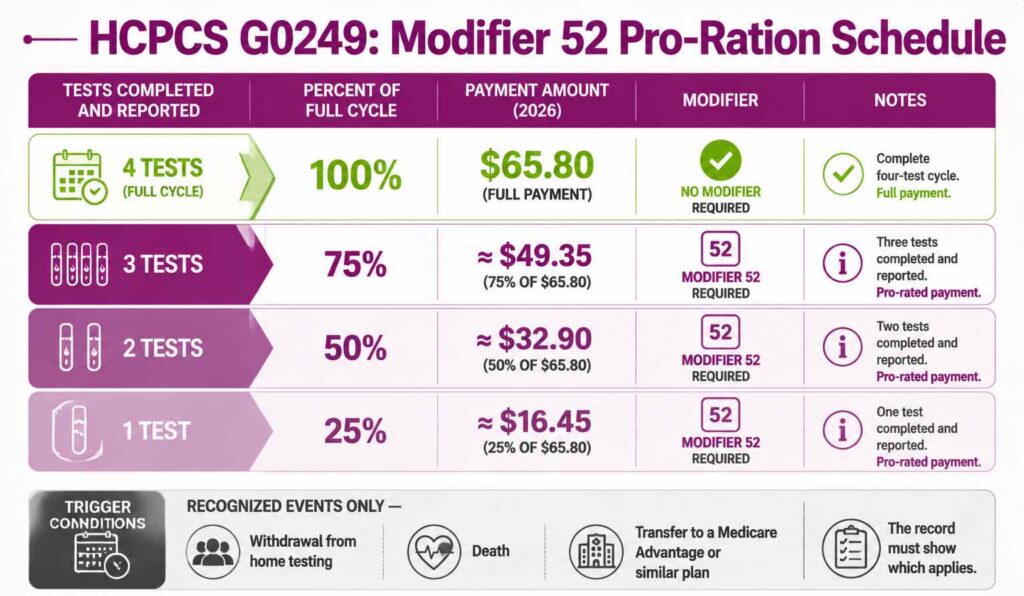
Modifier 52 reports a reduced service when fewer than four tests are completed. Append modifier 52 to G0249 when the beneficiary withdraws from home testing, dies, or transfers to a Medicare Advantage or similar plan before the cycle finishes. The contractor pays a pro-rated amount based on tests fully completed and reported, decremented in direct proportion at 75 percent, 50 percent, or 25 percent, and no payment is available for unused tests.
Modifier GA: ABN on File for an Expected Denial
Modifier GA reports that an Advance Beneficiary Notice of Noncoverage is on file for an expected denial. Append GA to HCPCS code G0249 when the patient does not meet the NCD criteria and accepted financial liability in writing before the service. The ABN supports billing the patient once the denial posts.
Modifier GZ: No ABN, Denial Expected
Modifier GZ reports an expected denial with no ABN on file. Append GZ to G0249 when coverage criteria are not met, and no waiver was obtained. The line is denied with provider liability, so the program absorbs the monitor and supply cost.
Which Documents Are Required For HCPCS Code G0249?
Documentation for HCPCS code G0249 must prove eligibility, training, and the completed testing cycle. The reporting of each result to the physician is as important as the test itself.
- The treating physician order for the monitor and home testing
- Evidence of at least three months of anticoagulation before home device use
- The qualifying condition and confirmation of warfarin therapy
- The completed face-to-face educational program and demonstrated device competency
- Dated results for each of the four tests, with evidence of reporting to the physician
- Records supporting continued correct use of the device
- For a partial cycle, documentation of the withdrawal, death, or plan transfer supporting modifier 52
What Is the Cost of HCPCS Code G0249?
HCPCS code G0249 is paid under the Physician Fee Schedule, and the payment arrives once per completed four-test cycle. The amount is almost entirely practice expense, since the code funds equipment rather than clinical work.
Physician Fee Schedule Payment and the Four-Test Billing Cycle
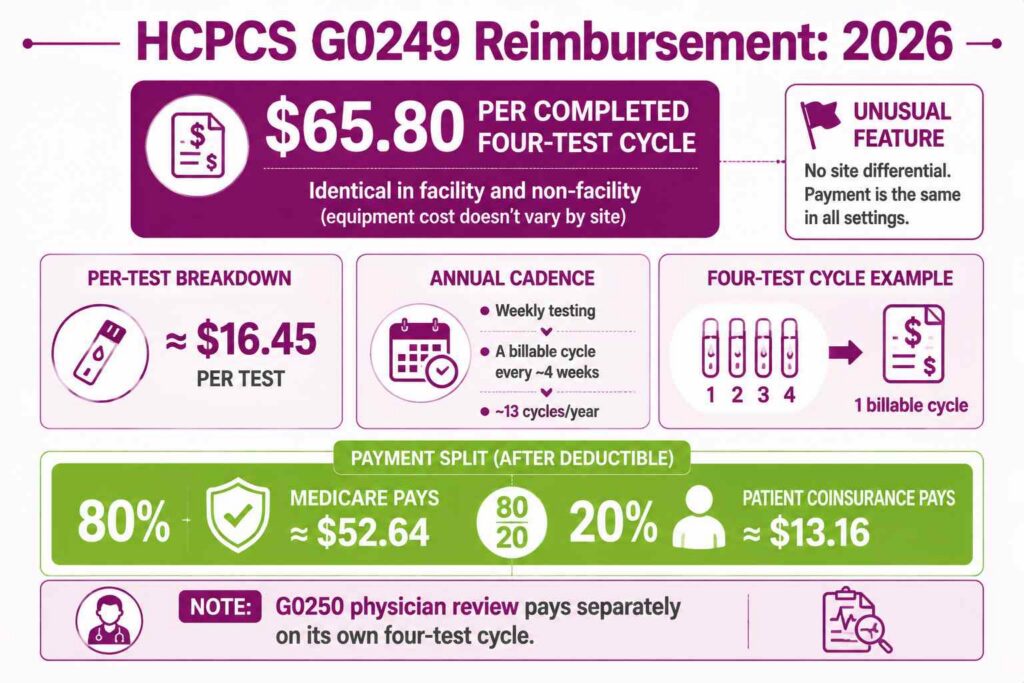
Medicare prices HCPCS code G0249 through the Physician Fee Schedule, and the rate is identical in facility and non-facility settings. The equipment cost does not change by site of service, so there is no setting differential.
| Component | Value (CY 2026) |
|---|---|
| Work RVU | 0.00 |
| Practice Expense RVU | 1.96 |
| Malpractice RVU | 0.01 |
| Total RVU | 1.97 |
| National payment per cycle | $65.80 |
A zero work RVU with nearly all value in practice expense shows how widely the HCPCS Level II set ranges, from physician services to pure equipment provision. This amount applies the CY 2026 nonqualifying APM conversion factor of $33.4009.
Qualifying APM participants use the higher conversion factor of $33.5675, which raises the cycle payment to roughly $66.13. GPCI values then adjust by locality.
The cycle structure shapes revenue timing for anticoagulation programs:
- Payment arrives once per completed cycle, which works out to roughly $16.45 per test
- A patient testing weekly generates a billable cycle about every four weeks, or roughly 13 cycles per year
- Medicare pays 80 percent of the allowed amount, about $52.64, leaving roughly $13.16 as patient coinsurance after the deductible
- The physician review service under G0250 is paid separately on its own four-test cycle
Pro-Rated Payment When a Testing Cycle Ends Early
When a cycle ends before the fourth test, modifier 52 supports a pro-rated claim rather than a lost one. The charge is decremented in direct proportion to the tests actually completed and reported.
- Three completed tests bill at 75 percent, roughly $49.35
- Two completed tests bill at 50 percent, roughly $32.90
- One completed test bills at 25 percent, roughly $16.45
- No payment is available for unused tests, so an unopened supply allotment generates nothing
The triggering events are narrow. Withdrawal from home testing, death, and transfer to a Medicare Advantage or similar plan are the recognized circumstances, and the record must show which applies.
Commercial Payers and Medicare Advantage Coverage Variability
Coverage for HCPCS code G0249 is not universal outside traditional Medicare. Some plans exclude the home INR codes as non-covered benefits entirely.
- Verify eligibility and benefit coverage before dispensing the monitor, since the device cost is unrecoverable on a non-covered claim
- Some commercial and managed plans deny G0249 and G0250 as non-covered benefits rather than for medical necessity
- Medicare Advantage plans may apply their own criteria or route the service differently from traditional Medicare
- A mid-cycle transfer to a Medicare Advantage plan is one of the events that supports a modifier 52 partial claim
What Are Example Clinical Scenarios or Use Cases for HCPCS Code G0249?
HCPCS code G0249 appears at initiation, in steady-state cycles, in partial cycles, and in denials driven by valve type. The scenarios below show each.
Scenario 1: Mechanical Mitral Valve Patient Completing Three Months of Warfarin and Initiating Home Monitoring
ICD-10: Z95.2 (Presence of prosthetic heart valve) and Z79.01 (Long-term use of anticoagulants)
A patient with a mechanical mitral valve has been anticoagulated on warfarin for three months. The program completes a face-to-face educational session, demonstrates the monitor, and documents the patient’s competency. The practice reports G0248 for the demonstration at initiation. The patient then tests weekly, and after the fourth test is completed and reported, the practice bills the first HCPCS code G0249 cycle.
Scenario 2: Chronic Atrial Fibrillation Patient in an Established Weekly Testing Cycle
ICD-10: I48.2 (Chronic atrial fibrillation) and Z79.01 (Long-term use of anticoagulants)
A patient with chronic atrial fibrillation on warfarin tests once each calendar week and transmits results to the anticoagulation clinic. After the fourth test in the cycle is reported, the practice bills one unit of HCPCS code G0249 with a date of service on or after that fourth test. The physician documents review and management of the same four results and bills G0250 on its own four-test cycle. The two codes track together, each once per completed cycle.
Scenario 3: Patient Withdraws After Two Completed Tests, Modifier 52 and Pro-Rated Billing
ICD-10: I82.401 (Acute embolism and thrombosis of unspecified deep veins of right lower extremity)
A patient on warfarin for venous thromboembolism completes two home tests, reports both to the physician, then withdraws from the home monitoring program. Because the cycle ended early, the practice bills G0249 with modifier 52 and decrements the charge to 50 percent for the two completed tests, roughly $32.90. The unused test materials generate no payment, and the record documents the withdrawal.
Scenario 4: Bioprosthetic Valve Replacement Patient Who Does Not Qualify Under NCD 190.11
ICD-10: Z95.2 (Presence of prosthetic heart valve) and Z79.01 (Long-term use of anticoagulants)
A patient with a porcine aortic valve on warfarin requests home INR monitoring. The valve limb of NCD 190.11 covers mechanical valves only, so the tissue valve does not support coverage. Unless the patient also has chronic atrial fibrillation or venous thromboembolism, the claim for HCPCS code G0249 is denied as non-covered. Verifying the valve type before dispensing prevents an unrecoverable device cost.
What Are the HCPCS Code G0249 Rules To Ensure Successful Reimbursement?
Follow the weekly testing limit, the fourth-test date-of-service rule, the training documentation requirements, and the cycle coordination with G0250. Meeting these rules protects HCPCS code G0249 claims from denial and rebilling.
Units, Testing Frequency, and the Once-Per-Week Calendar Limit
Testing is limited to once per week, and a week runs Sunday through Saturday. More frequent testing does not generate additional payable units.
- One home test per calendar week, defined as Sunday through Saturday
- Four tests make one billable unit of G0249, spanning four weeks or greater
- Extra tests within a week are not payable and do not accelerate the cycle
- A missed week extends the cycle rather than reducing the unit, since the unit is defined by tests, not by elapsed time
Date of Service Rules and Why Claims Submitted Before the Fourth Test Are Denied
The billing date of service for HCPCS code G0249 is on or after the completion and reporting of the fourth test. A claim submitted earlier does not represent a complete unit of service.
- Bill only after the fourth test is completed and the results are submitted to the treating physician
- Use a date of service on or after that fourth test, never the date the monitor or supplies were shipped
- Older guidance tied the date of service to the date supplies were provided, and current instructions supersede it
- A claim filed mid-cycle is denied, and the correct claim must wait for cycle completion
Documentation of Patient Training and Continued Correct Device Use
The NCD requires both an initial demonstration and continued correct use, so competency is not a one-time checkbox. Both elements must appear in the record.
- Document the face-to-face educational program on anticoagulation management before home use begins
- Document that the patient demonstrated correct use of the device before taking it home
- Record ongoing evidence that the patient continues to use the device correctly during management
- The initial demonstration is billed with G0248, while the continued-use requirement supports every subsequent G0249 cycle
Coordinating G0249 and G0250 Cycles Without Frequency Denials
G0249 and G0250 each run on a four-test cycle, and G0250 is billable no more often than once every four weeks. Aligning the two prevents frequency denials on the physician side.
- Track both codes against the same four completed tests, so the cycles stay synchronized
- Bill G0250 no more frequently than once every four weeks, matching the completed cycle
- The physician record must document review of each of the four results supporting the G0250 claim
- A partial cycle affects both codes, so apply the modifier 52 logic consistently across the pair
Top Reasons For Denials Specific To G0249 & Quick Remedies
- Claim Routed to the DME MAC: Prevent by billing HCPCS code G0249 to the Part B contractor, since the benefit category is a diagnostic test and a DME MAC claim is denied for wrong jurisdiction.
- Billed Before the Fourth Test: Prevent by holding the claim until the fourth test is completed and reported, and dating it on or after that test.
- Testing Exceeding Once Weekly: Prevent by scheduling one test per calendar week, since extra tests are not payable and do not shorten the cycle.
- Three-Month Prior Anticoagulation Not Documented: Prevent by capturing the anticoagulation start date and confirming three months of warfarin therapy before dispensing the device.
- Monitor or Supplies Billed Separately: Prevent by removing device and supply lines, since the equipment cost is inside the G0249 practice expense.