
Urology billing covers the coding, claim submission, and reimbursement process for diagnostic and surgical services tied to the urinary tract and male reproductive system. It requires accurate CPT code selection, correct modifier application, and documentation that supports medical necessity for procedures such as cystoscopy, urodynamic testing, and prostate biopsy.
This guide breaks down the CPT codes, ICD-10 codes, modifiers, site-of-service rules, denial patterns, compliance risks, and reimbursement logic that determine whether a urology claim gets paid on the first submission.

What Is Urology Billing?
Urology medical billing is a specialized area within broader medical billing services, requiring accurate coding, claim submission, payment tracking, and denial management to ensure providers receive appropriate reimbursement for every service performed.
It spans office visits, in-office procedures such as cystoscopy, imaging interpretation, minimally invasive treatments for benign prostatic hyperplasia, kidney stone management, and major surgical interventions such as transurethral resection of the prostate. Because urology combines diagnostic testing, minor procedures, and surgery within a single specialty, billing staff must apply rules from several coding categories at once.
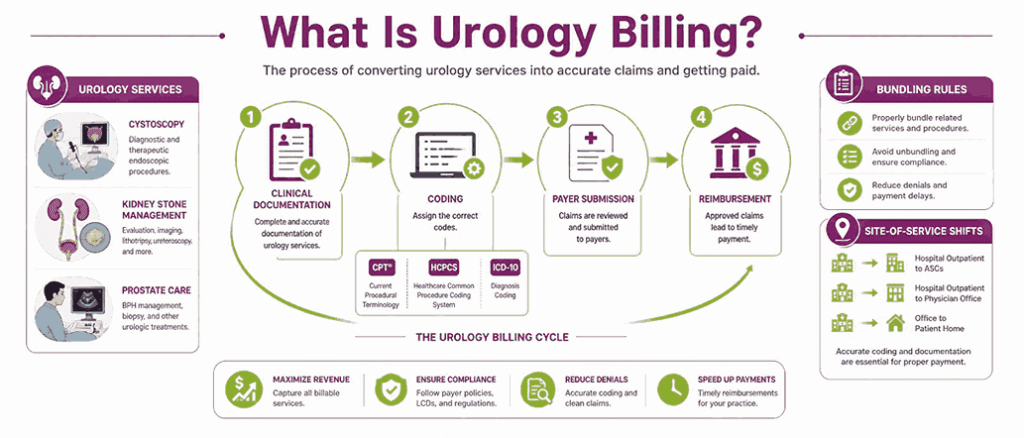
The specialty carries specific coding risk because many urology procedures are bundled under National Correct Coding Initiative edits, several diagnostic tests are frequently billed together during the same encounter, and a growing share of urology procedures now shift between office, ambulatory surgical center, and hospital outpatient settings, each with its own reimbursement structure.
A billing team that does not track bundling rules, site-of-service differentials, and payer-specific coverage policies will lose reimbursement on claims that were clinically appropriate but were coded incorrectly.
What CPT Codes Are Used in Urology Billing?
Urology CPT codes fall into several groups: endoscopic procedures, urodynamic testing, prostate procedures, stone management, and minor surgical services. Each group carries its own documentation requirements and payer scrutiny level.
| Procedure Category | CPT Code | Description |
|---|---|---|
| Cystoscopy | 52000 | Diagnostic cystourethroscopy |
| Cystoscopy with biopsy | 52204 | Cystourethroscopy with biopsy |
| Cystoscopy with fulguration | 52224 | Cystourethroscopy with fulguration of lesion |
| Cystoscopy with stent | 52332 | Cystourethroscopy with insertion of indwelling ureteral stent |
| Urodynamics | 51741 | Complex uroflowmetry |
| Urodynamics | 51726 / 51728 | Cystometrography, simple or complex |
| Urodynamics | 51772 | Urethral pressure profile study |
| Prostate biopsy | 55700 | Biopsy, prostate, needle or punch |
| Imaging guidance | 76942 | Ultrasonic guidance for needle placement |
| Prostate surgery | 52601 | Transurethral resection of prostate |
| BPH treatment | 52441 / 52442 | Cystourethroscopy with permanent implant (UroLift) |
| BPH treatment | 53854 | Transurethral water vapor thermotherapy (Rezum) |
| Kidney stone | 50590 | Extracorporeal shock wave lithotripsy |
| Kidney stone | 52356 | Ureteroscopy with lithotripsy and stent |
| Vasectomy | 55250 | Vasectomy, unilateral or bilateral |
| Circumcision | 54150 | Circumcision using clamp or device |
Understanding urology CPT codes is essential because each procedure, from cystoscopy and prostate biopsy to stone management and BPH treatments, requires precise code selection supported by complete clinical documentation.
Which CPT Codes Cover Cystoscopy Procedures?
Cystoscopy is billed under CPT 52000 for diagnostic cystourethroscopy. When a biopsy is taken during the same session, the correct code becomes 52204. Fulguration of lesions during cystoscopy is billed under 52224, and insertion of an indwelling ureteral stent is billed under 52332 CPT code.
Each of these codes describes a distinct clinical action. So, the operative note must state exactly which action occurred, since payers deny claims when the note only says cystoscopy performed without specifying biopsy, fulguration, or stent placement.
Which CPT Codes Cover Urodynamic Testing?
Urodynamic testing includes uroflowmetry (51736 and 51741), cystometrography (51726 or 51728), and urethral pressure profile studies (51772). Medicare and most commercial payers consider these tests to be parts of a single urodynamic study when performed together. So, the claim must reflect the correct combination code rather than billing each component separately, or the claim risks a bundling denial.
Which CPT Codes Apply to Prostate Procedures?
Prostate biopsy is billed under 55700 for a standard needle biopsy, while transrectal ultrasound guidance is billed separately under 76942. Transurethral resection of the prostate, one of the highest-volume urology surgical codes, is billed under 52601.
Practices that fail to bill the ultrasound guidance code separately from the biopsy code leave reimbursement on the table. Since CMS recognizes both as distinct billable services when documentation supports each.
How Are Minimally Invasive BPH Procedures Billed?
Minimally invasive BPH procedures have grown into a distinct billing category as adoption of office-based technologies increases. UroLift, a permanent implant procedure performed through a cystoscope, is billed under 52441 for the initial implant and 52442 for each additional implant during the same session. Rezum, a water vapor thermotherapy procedure, is billed under 53854.
Both procedures require documentation of the specific BPH diagnosis, typically N40.1 for benign prostatic hyperplasia with lower urinary tract symptoms, along with prior conservative treatment history when the payer’s coverage policy requires it.
How Is Kidney Stone Treatment Billed?
Kidney stone treatment is billed differently depending on the intervention performed. Extracorporeal shock wave lithotripsy is billed under 50590 and is typically performed in an outpatient or ambulatory surgical center setting. Ureteroscopy with laser lithotripsy and stent placement is billed under 52356.
When a stent is placed during a separate encounter from the lithotripsy itself, the stent removal or exchange later requires its own CPT code. Most often 52310 or 52315 depending on complexity, and billing staff must confirm the global period status of the original procedure before submitting a separate claim for stent management.
Is CPT 52000 Bundled With Other Cystoscopy Codes?
CPT 52000 is considered a component of more extensive cystoscopy procedures under NCCI edits. When a more complex cystoscopy code, such as 52204 or 52224, is billed for the same encounter, 52000 is not separately reimbursable unless modifier -59 or an X-modifier documents a distinct procedural service. Billing 52000 urology code alongside a more comprehensive code without justification results in an automatic denial for the component code.
What ICD-10 Codes Support Urology Claims?
ICD-10 code selection determines whether a urology CPT code passes a payer’s medical necessity check. The diagnosis code must match the specific clinical indication documented in the encounter note. Moreover, it must appear on the applicable Local Coverage Determination when Medicare is the payer.
| Condition | ICD-10 Code | Common Use |
|---|---|---|
| Benign prostatic hyperplasia with LUTS | N40.1 | Supports BPH procedures, UroLift, Rezum, TURP |
| Stress urinary incontinence | N39.3 | Supports urodynamic testing and sling procedures |
| Urinary tract infection, site unspecified | N39.0 | Supports cystoscopy and culture-directed treatment |
| Hematuria, unspecified | R31.9 | Supports cystoscopy for hematuria evaluation |
| Calculus of kidney | N20.0 | Supports lithotripsy and ureteroscopy |
| Calculus of ureter | N20.1 | Supports ureteroscopy with stent |
| Malignant neoplasm of prostate | C61 | Supports biopsy, surveillance cystoscopy, TURP |
| Malignant neoplasm of bladder | C67.9 | Supports surveillance cystoscopy and biopsy |
| Overactive bladder | N32.81 | Supports urodynamic testing |
| Erectile dysfunction | N52.9 | Supports evaluation and management coding |
Selecting the correct urology ICD 10 code ensures that the diagnosis supports the procedure performed and meets payer medical necessity requirements, reducing avoidable claim denials.
What Modifiers Apply to Urology Billing?
Modifiers in urology billing communicate whether a service was reduced, distinct, repeated, or split between professional and technical components. Incorrect modifier use is one of the leading causes of denied or underpaid urology claims.
| Modifier | Meaning | Typical Urology Use |
|---|---|---|
| -51 | Multiple procedures | Cystoscopy plus biopsy or stent in the same session |
| -59 | Distinct procedural service | Unbundling NCCI-edited codes performed at separate sites or sessions |
| -26 | Professional component | Interpretation of imaging without owning the equipment |
| -TC | Technical component | Equipment and facility cost of an imaging service |
| -25 | Significant, separate E/M service | Office visit billed same day as a minor procedure |
| -24 | Unrelated E/M during postoperative period | Follow-up visit unrelated to the original surgery |
| -79 | Unrelated procedure during postoperative period | New procedure performed during the global period |
| -76 | Repeat procedure, same physician | Repeat cystoscopy on the same day |
| -LT / -RT | Laterality | Procedures on paired structures such as kidneys or testes |
When Should Modifier -51 Be Used on Urology Claims?
Modifier -51 indicates multiple procedures performed during the same session by the same provider. When a cystoscopy is billed alongside a separate biopsy or stent placement, modifier -51 signals to the payer that reduced reimbursement rules for secondary procedures apply.
Most payers apply an automatic multiple-procedure reduction once modifier -51 is present. This will allow billers to confirm the payer’s specific reduction schedule before submitting the claim. Since reduction percentages vary between Medicare and commercial plans.
What Does Modifier -59 Indicate on Urology Procedures?
Modifier -59 identifies a distinct procedural service that would otherwise be bundled under NCCI edits. In urology, this modifier is most often used when a diagnostic cystoscopy is performed on a different anatomical site.
This can be during a separate patient encounter than a related procedure billed on the same claim. Payers require operative documentation that clearly separates the two services in time, location, or clinical indication before they accept modifier -59.
What Do Modifiers -TC and Modifier -26 Indicate on Urology Imaging Claims?
Modifier -TC identifies the technical component of an imaging service, covering the equipment and facility cost. While Modifier -26 identifies the professional component, covering the physician’s interpretation.
Transrectal ultrasound guidance for prostate biopsy, billed under 76942, is frequently split this way when the equipment is owned by one entity and the interpreting physician bills separately.
Is Modifier -26 Required for Urology Imaging Claims?
Modifier -26 is required only when the billing provider performed the professional interpretation but does not own the imaging equipment. If the same practice owns the equipment and performs the interpretation, the global code is billed without a modifier.
Billing modifier -26 when the practice also owns the equipment results in underpayment, since the claim only captures the professional fee rather than the full global reimbursement.
How Does E/M Coding Work for Urology Office Visits?
Evaluation and management coding in urology follows the same office visit levels used across specialties, coded under 99202 through 99215 depending on complexity and time. The specific challenge in urology is billing an E/M visit on the same day as a minor procedure, such as a catheter change or an in-office cystoscopy.
Modifier -25 identifies a significant, separately identifiable E/M service performed on the same day as a minor procedure. It is also required whenever the visit involves clinical decision-making beyond the procedure itself. This would include evaluating a new symptom or adjusting a treatment plan unrelated to the procedure performed that day.
Is Modifier -25 Required for Every Same-Day Urology Visit?
Modifier -25 is required only when the E/M service is significant and separately identifiable from the procedure. A visit where the physician only reviews the procedure itself, without addressing an additional clinical concern, does not support modifier -25 and should not be billed with a separate E/M code.
Payers increasingly audit modifier -25 usage specifically in urology because of the frequency of same-day procedures in the specialty. So, the documentation must clearly separate the procedure note from the E/M decision-making note.
What Are the Most Common Urology Billing Denials?
Urology claims are denied for a narrow set of recurring reasons: bundling conflicts, missing medical necessity documentation, incorrect modifier use, incomplete prior authorization, and site-of-service mismatches.
Understanding which category applies to a denial determines whether the claim can be corrected and resubmitted or requires a formal appeal.
| Denial Reason | Root Cause | Resolution Path |
|---|---|---|
| Bundling edit | Component code billed with comprehensive code, no modifier | Add modifier -59 or X-modifier with supporting documentation |
| Medical necessity | ICD-10 code not on payer’s coverage policy | Correct diagnosis code or submit clinical notes for reconsideration |
| Missing prior authorization | Procedure requiring pre-approval performed without it | Retroactive authorization request, often unsuccessful; verify before service |
| Modifier -25 audit | E/M billed same day as procedure without distinct documentation | Submit separated documentation or remove the E/M charge |
| Site-of-service mismatch | Procedure billed at a payment rate inconsistent with facility type | Correct place of service code and resubmit |
| Global period conflict | Follow-up service billed during postoperative period without modifier | Add modifier -24 or -79 with documentation of unrelated status |
Why Do Urodynamic Testing Claims Get Denied?
Urodynamic testing claims are denied most often because the ICD-10 code attached to the claim does not support medical necessity for the specific test billed. A diagnosis of unspecified urinary symptoms, coded as R39.9, rarely supports a full urodynamic study. While a diagnosis of stress urinary incontinence, coded as N39.3, or benign prostatic hyperplasia with urinary obstruction, coded as N40.1, provides stronger justification. Billers should confirm that the ordering physician’s documentation ties the specific test performed to a diagnosis code the payer’s Local Coverage Determination recognizes.
How Does Medical Necessity Affect Urology Claim Denials?
Medical necessity denials occur when the diagnosis code on the claim does not match the payer’s coverage policy for the CPT code billed. Medicare Administrative Contractors publish Local Coverage Determinations for many urology services, including cystoscopy and urodynamic testing, listing the exact ICD-10 codes that support coverage.
A claim billed with a diagnosis code outside that list is denied regardless of how well the procedure itself was documented, so billing staff should cross-reference the applicable LCD before submission rather than after a denial arrives.
Can a Denied Urology Claim Be Appealed?
A denied urology claim can be appealed when the denial reason is incorrect or when additional documentation supports the original code selection. The appeal process typically requires a corrected claim or a formal reconsideration request, along with supporting documentation such as the operative note, physician orders, and relevant lab or imaging results. Medicare allows a redetermination request within 120 days of the initial denial, and most commercial payers publish similar windows in their provider manuals.
How Does Prior Authorization Affect Urology Claim Denials?
Prior authorization denials occur when a procedure requiring pre-approval, such as certain urodynamic studies, UroLift, or advanced imaging, is performed without the authorization on file at the time of the encounter. These denials are generally the hardest to overturn on appeal, since payers frequently treat missing prior authorization as a hard stop rather than a correctable documentation gap. Confirming authorization status before the date of service, rather than after, prevents this category of denial entirely.
How Does Site of Service Affect Urology Reimbursement?
Urology procedures are increasingly performed across three settings: physician office, ambulatory surgical center, and hospital outpatient department. Each setting carries a different payment structure under Medicare, and the place of service code on the claim must match where the procedure actually occurred. Most importantly, the mismatch triggers an automatic denial or a post-payment audit finding.
Office-based procedures, including UroLift, Rezum, and many cystoscopy services, are reimbursed under the Medicare Physician Fee Schedule with a site-of-service payment differential built in. The physician absorbs the practice expense of equipment and staff.
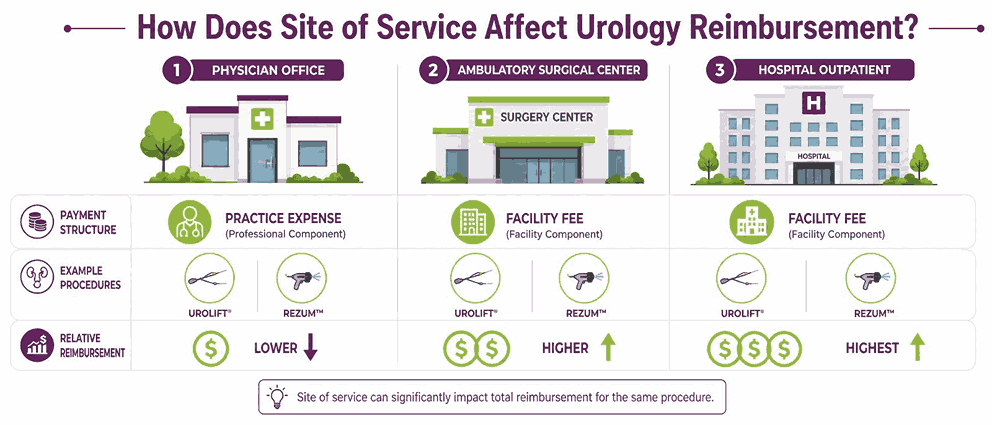
The same procedure performed in an ambulatory surgical center or hospital outpatient department is reimbursed at a lower physician payment rate. This is because the facility bills separately for the facility fee under the Ambulatory Surgical Center payment system or the Outpatient Prospective Payment System.
Practices that shift volume between settings without adjusting their billing workflow risk under-coding the facility component or over-coding the physician component.
Do Commercial Payers Reimburse Urology Procedures Differently Than Medicare?
Commercial payers reimburse urology procedures differently than Medicare in both rate structure and documentation requirements. While Medicare applies a uniform national fee schedule adjusted only by geography, commercial payers set individual contracted rates and often apply their own bundling logic that does not always match NCCI edits exactly.
A urology practice contracted with multiple commercial payers must track each payer’s specific edit set rather than assuming Medicare rules apply universally.
How Does Reimbursement Work for Urology Procedures?
Urology reimbursement is governed primarily by the Medicare Physician Fee Schedule for Medicare patients and by payer-specific fee schedules. They are often benchmarked to a percentage of Medicare rates for commercial patients.
Each CPT code carries a Relative Value Unit assignment set by CMS, covering physician work, practice expense, and malpractice risk. The total RVU is multiplied by the annual conversion factor to produce the national payment amount.
How Does Medicare Reimburse Urology Services?
Medicare reimburses urology services according to the Medicare Physician Fee Schedule, which assigns a specific RVU value to each CPT code and adjusts payment based on the geographic practice cost index for the billing location.
Surgical urology codes, including transurethral resection of the prostate under 52601, carry a global period, typically 090 days. During a related follow-up, visits are bundled into the original payment rather than billed separately.
Billing a follow-up visit during the global period without modifier -24 or -79, where clinically appropriate, results in a bundling denial.
What Role Does the Fee Schedule Play in Urology Reimbursement?
The fee schedule determines the maximum allowable payment for each urology CPT code before any contractual adjustment specific to the payer. Practices should compare their contracted commercial rates against the current Medicare fee schedule for high-volume urology codes.
As we know, commercial reimbursement for procedures such as cystoscopy and prostate biopsy is frequently negotiated as a percentage of the Medicare rate. Moreover, the outdated fee schedule data leads to systematic underpayment across an entire year of claims.
How Are Vasectomy and Circumcision Billed?
Vasectomy is billed under CPT 55250 and is generally excluded from coverage under Medicare, since it is considered an elective procedure, though many commercial and Medicaid plans do cover it.
Circumcision performed on a newborn is billed under 54150 when performed with a clamp or device, and coverage varies significantly by state Medicaid program and commercial plan, with some payers classifying it as cosmetic outside of specific medical indications such as phimosis, coded as N47.1.
Billing staff should verify coverage policy for both procedures before scheduling, since these two services carry among the highest self-pay conversion rates in urology when coverage is denied.
How Does Telehealth Billing Work for Urology Follow-Ups?
Telehealth billing applies to a defined subset of urology encounters, primarily E/M follow-up visits that do not require a physical examination, such as reviewing lab results, adjusting medication for overactive bladder, or discussing biopsy results.
These visits are billed using the standard E/M codes with the appropriate place of service code and modifier indicating a telehealth encounter, most commonly modifier -95 or place of service 02 or 10 depending on payer policy. Procedures requiring physical examination or in-office equipment, including cystoscopy and urodynamic testing, cannot be delivered or billed as telehealth services.
What HCPCS Codes Apply to Urology Supplies?
Urology billing also involves durable medical equipment and supply codes under the HCPCS Level II system, most commonly for catheters and related urological supplies. Straight catheters are billed under A4351, indwelling catheters under A4338 or A4340 depending on the material, and external catheters under A4326.
These codes are billed separately from the CPT procedure codes and follow their own coverage and quantity limits under Medicare’s Durable Medical Equipment Medicare Administrative Contractor jurisdiction. The practices dispensing supplies directly should confirm quantity limits before billing to avoid automatic reductions.
What Compliance Risks Are Specific to Urology Billing?
Urology billing carries specific compliance exposure that the Office of Inspector General has flagged in prior work plans. Particularly around same-day E/M and procedure billing, medical necessity for urodynamic testing, and unbundling of cystoscopy component codes.
Practices billing a high volume of modifier -25 claims relative to their peer group are more likely to face a targeted payer audit, and the same applies to practices with an unusually high ratio of unbundled cystoscopy codes.
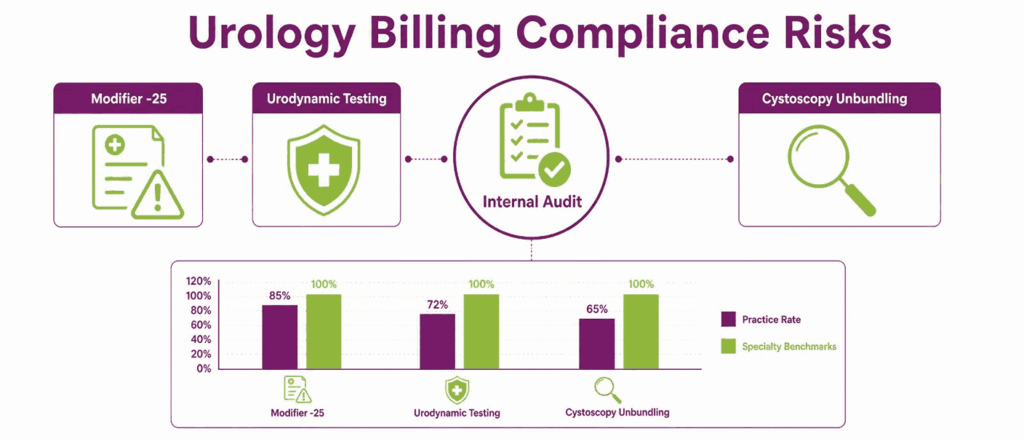
A compliance-focused billing workflow documents the specific clinical justification for every modifier used, retains the operative note supporting each unbundled code, and runs a periodic internal audit comparing modifier usage rates against specialty benchmarks. This proactive review is significantly less costly than responding to a post-payment audit after a pattern has already triggered payer attention.
How Can Practices Improve Urology Billing Accuracy?
Improving urology billing accuracy starts with aligning clinical documentation to the specific CPT code requirements before the claim is coded. Operative notes for cystoscopy procedures should explicitly state whether a biopsy, fulguration, or stent placement occurred, rather than summarizing the encounter generally. Vague documentation forces billers to guess at the correct code or default to the lowest-complexity option.
Practices should maintain an internal reference for NCCI bundling edits specific to their highest-volume urology codes, updated whenever CMS publishes quarterly edit changes. Third, prior authorization verification should occur at scheduling rather than at billing, closing the gap between authorized services and billed services.
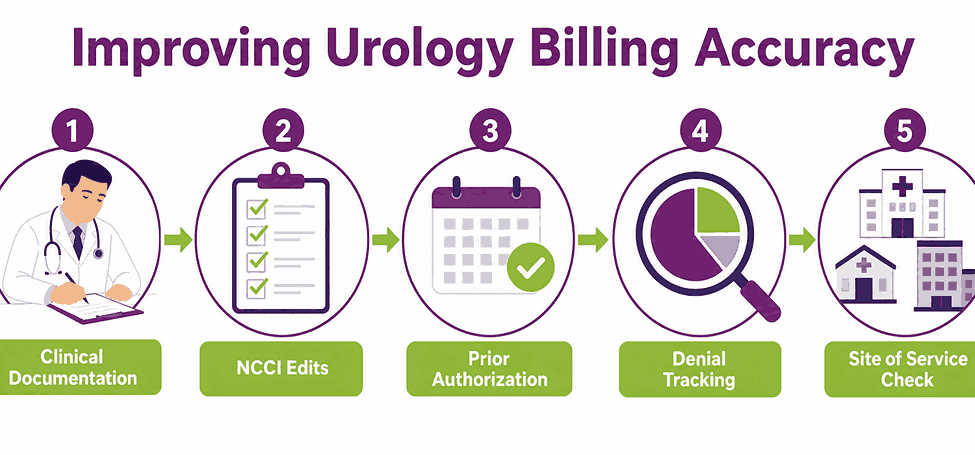
The denial data should be tracked by category, meaning bundling, medical necessity, modifier error, authorization, or site-of-service mismatch, rather than treated as a single undifferentiated denial rate, since each category requires a different corrective action.
Practicing shifting procedures such as UroLift or lithotripsy between office, ambulatory surgical center, and hospital outpatient settings should confirm the place of service code matches the actual location of service on every claim, since this mismatch is both a common denial trigger and a compliance risk. Finally, practices should audit modifier usage regularly, particularly for -59, -51, -25, -26, and -TC, since incorrect modifier application is reversible through staff training in a way that missing prior authorization is not.
Many practices improve financial performance by partnering with experienced urology billing service providers that understand specialty-specific coding rules, payer requirements, authorization workflows, and denial prevention strategies. A dedicated billing partner helps reduce administrative burden while maintaining compliance across complex urology procedures.
Urology billing accuracy depends on matching CPT code selection, ICD-10 justification, modifier application, and site of service to the exact clinical action performed, along with confirming payer-specific coverage and authorization requirements before the claim is submitted. Practices that build these checks into scheduling and coding workflows, rather than correcting them after denial, see faster reimbursement, fewer appeals, and lower compliance risk across their full range of urology services.