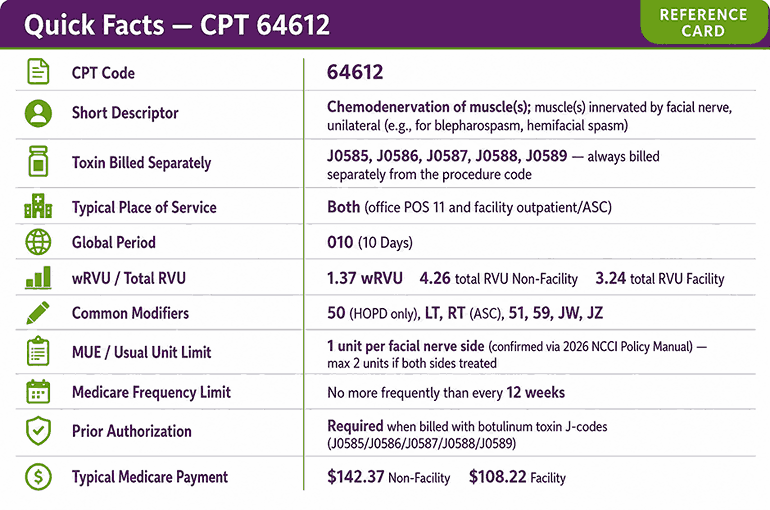
CPT code 64612 reports chemodenervation of muscles innervated by the facial nerve on one side. Providers use it most often to inject botulinum toxin for blepharospasm and hemifacial spasm. The code captures the injection work only, not the drug.
The facial nerve is cranial nerve VII. It drives muscles like the orbicularis oculi around the eye. Code 64612 is unilateral by design, so bilateral cases need specific modifiers. The botulinum toxin product always carries a separate J-code on the claim.
This guide explains the 64612 description, the J-code mapping, and the supporting ICD-10 codes. It covers cost, RVUs, modifiers, clinical scenarios, and the rules behind clean reimbursement. Each section reflects current Medicare and payer guidance for facial nerve chemodenervation.
What Is the Description of CPT Code 64612?
The American Medical Association (AMA) defines CPT code 64612 as “Chemodenervation of muscle(s) innervated by the facial nerve, unilateral”. The descriptor cites blepharospasm and hemifacial spasm as the typical indications. The code sits in the nervous system surgery section of CPT.
Chemodenervation means injecting a chemical agent to block neuromuscular transmission. The agent reduces tone in overactive muscles without destroying the nerve. The 2001 descriptor change replaced the older “destruction by neurolytic agent” language for this code.
Key facts about the 64612 descriptor:
- The procedure targets muscles served by cranial nerve VII on one side
- The effect is temporary and reversible, lasting roughly two to four months
- The most common agent is onabotulinumtoxinA, billed under a separate J-code
- The code does not include the toxin supply or any guidance service
Placement inside the code set matters as much as the descriptor itself. Knowing where a code sits in the CPT code hierarchy tells you which edit pairs and global periods apply. Nervous system surgery codes carry different bundling logic than the medicine section codes that sit next to them on the same claim.
Which Facial Nerve-Innervated Muscles Are Covered Under CPT Code 64612?
The facial nerve controls the muscles of facial expression. Code 64612 applies when any of these muscles receive the injection. The orbicularis oculi is the primary target in blepharospasm cases.
The muscles most often injected under this code include:
- Orbicularis oculi: the eyelid sphincter responsible for forced eye closure
- Corrugator supercilii and procerus: the brow depressors near the glabella
- Frontalis: the forehead elevator
- Orbicularis oris, zygomaticus, and platysma fibers: lower-face muscles involved in hemifacial spasm
Injection of extraocular muscles for strabismus does not fall under 64612. That work uses code 67345 instead. The distinction rests on whether the muscle is facial or ocular.
Why CPT Code 64612 Is Unilateral and How Bilateral Treatment Is Reported
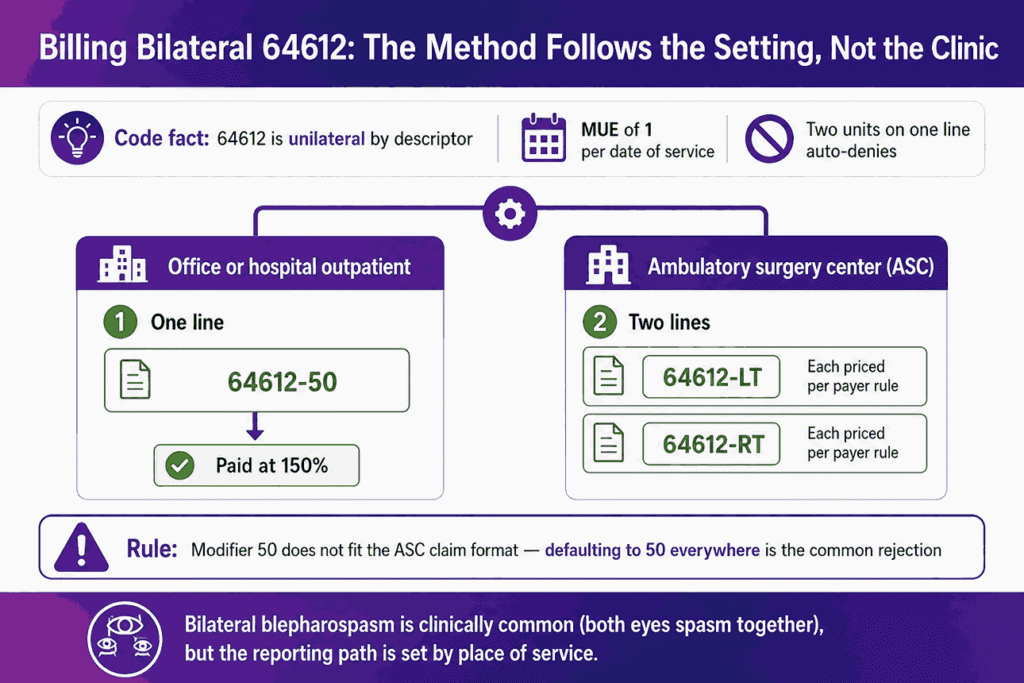
The descriptor defines 64612 as a unilateral service. The code carries a Medically Unlikely Edit (MUE) of 1 per date of service. Reporting two units on one line triggers an automatic denial.
Bilateral treatment is common in blepharospasm, since both eyes spasm together. The reporting method depends on the place of service, not the clinical fact. The two main paths appear below.
| Setting | Bilateral Reporting Method | Payment Effect |
|---|---|---|
| Physician office or hospital outpatient | One line, 64612 with modifier 50 | Paid at 150% of the fee |
| Ambulatory surgery center (ASC) | Separate lines, 64612-LT and 64612-RT | Each side priced per payer rule |
The 150% bilateral adjustment reflects the standard Medicare policy for codes with a bilateral indicator of 1. Always confirm the indicator before appending modifier 50.
How Does CPT Code 64612 Differ From CPT 64615, 64616, and 64617?
These four codes all describe chemodenervation but target different regions. Choosing the wrong one is a frequent denial driver. The descriptor language and laterality set them apart.
| CPT Code | Anatomy and Laterality | Typical Indication | Work RVU |
|---|---|---|---|
| 64612 | Facial nerve muscles, unilateral | Blepharospasm, hemifacial spasm | 1.41 |
| 64615 | Facial, trigeminal, cervical spinal, and accessory nerves, bilateral | Chronic migraine | 1.85 |
| 64616 | Neck muscles, excluding larynx, unilateral | Cervical dystonia, spasmodic torticollis | 1.53 |
| 64617 | Larynx, unilateral, percutaneous, includes needle EMG guidance when performed | Spasmodic dysphonia | Varies by payer |
Anatomy and laterality separate this family, not technique. The same split repeats across the wider set of neurology procedure codes, where nerve blocks, EMG studies, and injection codes each carry their own regional boundaries. Coding from the muscle group documented in the note prevents most cross-code denials in this range.
Code 64615 CPT is bilateral by definition, so modifier 50 does not apply to it. Code 64617 bundles needle EMG guidance into the descriptor itself. Match the code to the documented anatomy every time.
Why CPT 64612 and CPT 64615 Cannot Be Billed Together for the Same Encounter
Codes 64612 and 64615 are mutually exclusive under the National Correct Coding Initiative (NCCI). First Coast Service Options states the pair is an “either/or” choice. They should not appear together for a single date of service or tracking number.
The clinical logic is straightforward. Code CPT 64615 already covers the facial nerve distribution within its bilateral, multi-nerve descriptor. Reporting 64612 alongside it double-counts the same facial muscle work.
Quick reference for this edit:
- Pick 64612 for unilateral facial work tied to blepharospasm or hemifacial spasm
- Pick 64615 for bilateral chronic migraine injections across facial, trigeminal, cervical, and accessory nerves
- Do not stack the two on the same claim line set for the same session
Why Must Botulinum Toxin J-Codes Always Be Billed Separately From CPT Code 64612?
The 64612 procedure code pays for the injection work. It does not include the cost of the toxin. The drug is separately payable under Medicare Part B and reports on its own J-code line.
This separation matters for both payment and audit risk. When the J-code line is denied, the related injection code is also denied. The two lines rise and fall together on the claim.
Documentation must connect the drug, the dose, and the diagnosis. Record the product name, the units injected, and any units discarded. A missing or mismatched J-code stalls the entire claim.
Which J-Code Maps to Which Product, and Why Unit Basis Is Not Interchangeable
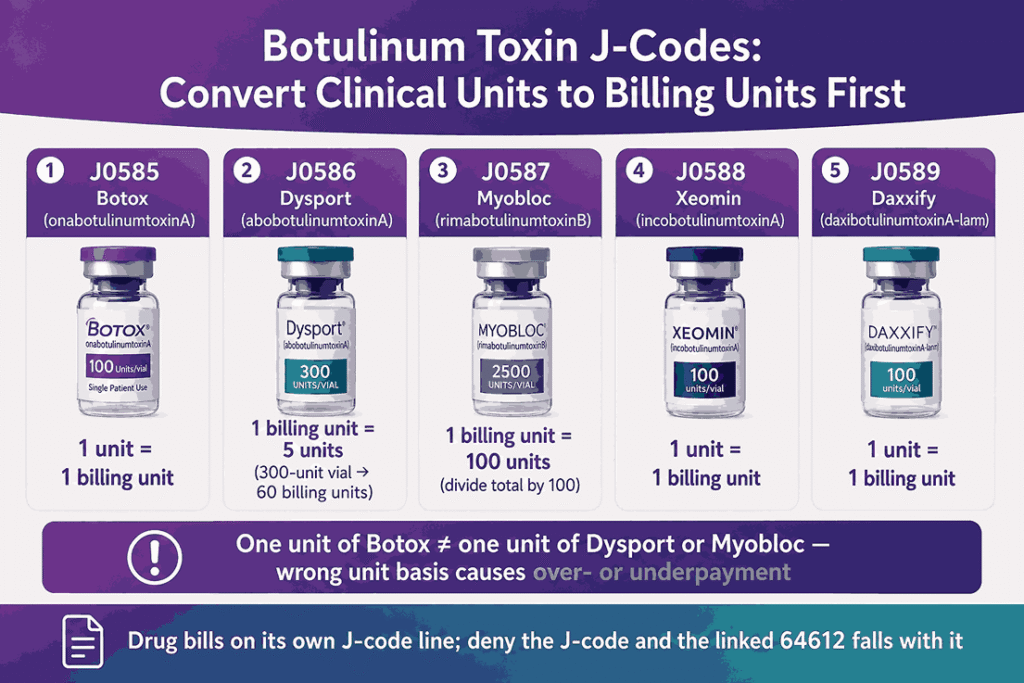
Each botulinum toxin product has its own J-code and its own unit definition. One unit of Botox is not equal to one unit of Dysport or Myobloc. Billing the wrong unit basis causes overpayment or underpayment.
| J-Code | Product (Generic) | Brand | Billing Unit |
|---|---|---|---|
| J0585 | onabotulinumtoxinA | Botox | 1 unit |
| J0586 | abobotulinumtoxinA | Dysport | 5 units |
| J0587 | rimabotulinumtoxinB | Myobloc | 100 units |
| J0588 | incobotulinumtoxinA | Xeomin | 1 unit |
| J0589 | daxibotulinumtoxinA-lanm | Daxxify | 1 unit |
A Dysport 300-unit vial billed as J0586 reports 60 billing units, since each unit equals 5. A Myobloc claim divides total units by 100. Convert clinical units to billing units before the claim leaves the door.
Non-interchangeable unit bases are standard across the HCPCS drug codes used in neurology, not a quirk of botulinum products. Immunoglobulins, FcRn blockers, and infused biologics each define their own billing increment. Build the conversion into the charge master so the coder never performs the math manually at the point of billing.
What ICD-10 Codes and Medical Necessity Criteria Support CPT Code 64612?
Medical necessity hinges on pairing 64612 with an approved ICD-10-CM diagnosis. The diagnosis must match the muscle group and the documented condition. Cosmetic use of botulinum toxin is excluded under Section 1862(a) of the Social Security Act.
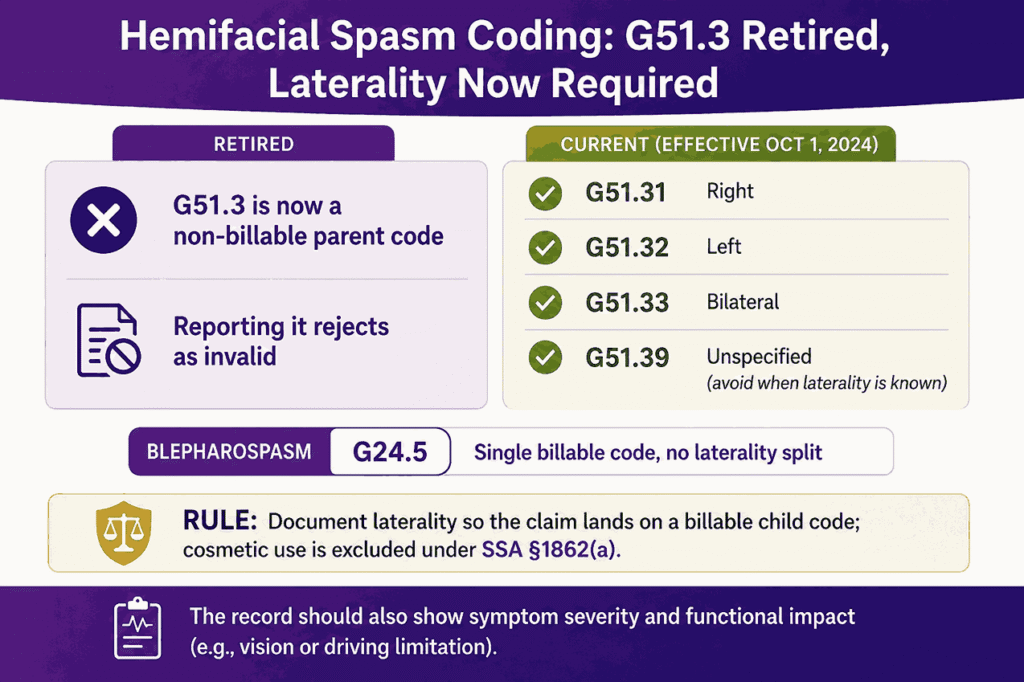
A notable update affects hemifacial spasm coding. The old code G51.3 became a non-billable parent code. Laterality-specific codes took effect October 1, 2024, and remain current for fiscal year 2026.
| ICD-10 Code | Description | Notes |
|---|---|---|
| G24.5 | Blepharospasm | Single billable code, no laterality split |
| G51.31 | Clonic hemifacial spasm, right | Use for right-side documentation |
| G51.32 | Clonic hemifacial spasm, left | Use for left-side documentation |
| G51.33 | Clonic hemifacial spasm, bilateral | Use when both sides are documented |
| G51.39 | Clonic hemifacial spasm, unspecified | Avoid when laterality is known |
Reporting the retired G51.3 will reject as invalid. Document laterality so the claim lands on a billable child code. The medical record should also show symptom severity and functional impact.
Parent codes losing billable status is a recurring pattern in the neurology diagnosis codes set. Laterality and episode-status characters get added at each annual update, and old superbills keep pointing at the retired parent. An annual crosswalk review catches these before the first rejection posts.
Can EMG or Electrical Stimulation Guidance (95873/95874) Be Billed Alongside CPT Code 64612?
Yes, guidance is separately reportable when documented and medically necessary. Two add-on codes apply to chemodenervation guidance. Each lists separately in addition to the primary 64612 code.
| Add-On Code | Guidance Type | Reporting Limit |
|---|---|---|
| +95873 | Electrical stimulation for guidance | One unit per anatomic site |
| +95874 | Needle electromyography (EMG) for guidance | One unit per anatomic site |
You cannot report 95874 together with 95873 for the same site. Only one guidance method counts per site. Visual or palpation-only targeting earns no guidance charge at all.
Document why guidance was needed for the injection. Tie the guidance code to the same session and site as the toxin. Billing multiple guidance units for one site draws denials.
What are the Modifiers for CPT Code 64612?
Modifiers tell the payer how and where the service happened. The 64612 claim relies on a small, predictable set. Setting and laterality drive most of the choices.
The seven modifiers below cover nearly every 64612 scenario. Apply them based on the documented facts of the encounter.
Modifier 50: Bilateral Procedure (Hospital Outpatient Setting Only)
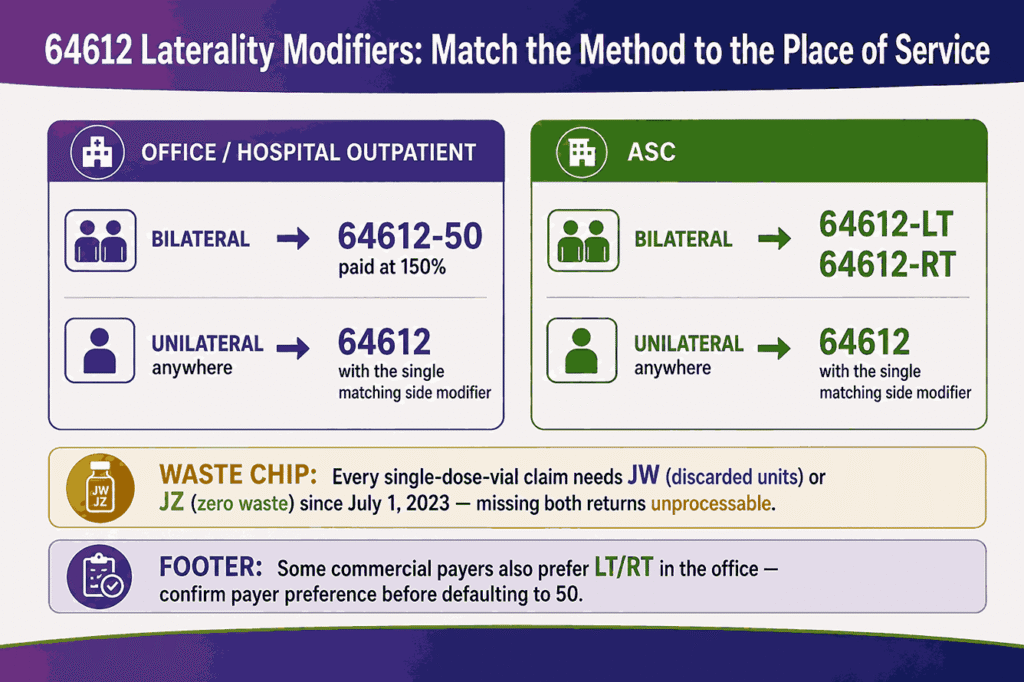
Modifier 50 reports a bilateral 64612 service on one line in the office or hospital outpatient setting. Payment lands at 150% of the standard allowable. Do not use modifier 50 in the ASC setting.
Modifier LT: Left Side Procedure (Required for ASC Billing)
Modifier LT marks the left-side service. ASC claims report 64612-LT on its own line rather than using modifier 50. Some commercial payers also prefer LT and RT in the office setting.
Modifier RT: Right Side Procedure (Required for ASC Billing)
Modifier RT marks the right-side service. In the ASC, pair 64612-RT with 64612-LT on separate lines for bilateral work. This split mirrors the facility billing rules for that setting.
Modifier 51: Multiple Procedures
Modifier 51 flags 64612 as one of several procedures in the same session. It signals multiple-procedure payment reduction logic to the payer. Many systems now append modifier 51 automatically, so confirm payer preference first.
Modifier 59: Distinct Procedural Service
Modifier 59 reports a procedure that is separate and distinct from another same-day service. It can break a valid NCCI edit when documentation supports two distinct services. Use it only when a more specific modifier does not fit.
Modifier JW: Drug Amount Discarded/Not Administered to Patient
Modifier JW reports the discarded portion of a single-dose vial. The wasted amount bills on its own J-code line. The discarded units must be documented clearly in the medical record.
Modifier JZ: Zero Waste, No Discarded Amount
Modifier JZ attests that no drug from a single-dose container was discarded. Medicare has required JZ on these claims since July 1, 2023. Claims missing both JW and JZ may return as unprocessable.
Why Modifier 50 Cannot Be Used in ASC Facility Billing for CPT Code 64612
ASC facility billing follows a different laterality convention than physician billing. The ASC reports bilateral 64612 as two lines with LT and RT modifiers. Modifier 50 does not fit the ASC claim format for this code.
This rule confuses many billers who default to modifier 50 everywhere. The American Academy of Ophthalmology guidance confirms the LT and RT approach for ASC sites. Match the laterality method to the place of service to avoid rejections.
A simple check before submission:
- Office or hospital outpatient bilateral: 64612-50 on one line
- ASC bilateral: 64612-LT and 64612-RT on two lines
- Unilateral anywhere: 64612 with the single matching side modifier
What Are the Medicare Prior Authorization Requirements for CPT Code 64612?
Medicare fee-for-service rarely requires prior authorization for 64612 itself in the office. The bigger gatekeeping sits on the drug. Commercial plans and Medicare Advantage often require prior authorization for the botulinum toxin J-code.
Coverage rests on documented medical necessity and an approved diagnosis pairing. Cosmetic treatment of wrinkles or glabellar lines is never covered. The record must show a functional or therapeutic indication.
Common payer expectations for authorization:
- A covered diagnosis such as blepharospasm or hemifacial spasm
- Failed or inappropriate response to alternative therapy where the policy requires it
- Dose, product, and frequency consistent with FDA labeling or published evidence
- A treatment plan that respects the standard reinjection interval
Drug authorization, procedure coverage, and reinjection intervals move on three separate clocks. Practices running high-volume chemodenervation typically assign that tracking to a dedicated team rather than the front desk. Specialized neurology billing support manages the authorization window, the toxin benefit check, and the claim build as one workflow.
Which Documents Are Required For CPT Code 64612?
Clean documentation protects the claim during review. The note must support both the procedure code and the drug code. Gaps in the record are the leading cause of recoupment.
The medical record should capture the following details:
- Diagnosis with laterality, matched to a billable ICD-10 code
- Specific muscles injected and the side treated
- Product name, total units administered, and units discarded
- Any guidance method used, with the reason it was needed
- Prior treatment response when a repeat cycle is billed
- Signed and dated provider note tied to the date of service
What is the Cost of CPT Code 64612?
The cost of 64612 splits into two parts. The first is the Medicare allowable for the injection work. The second is a separate payment for the botulinum toxin under its J-code.
Payment shifts with the setting, the year’s conversion factor, and local geographic indices. The office (non-facility) rate runs higher than the facility rate. The figures below reflect national averages and are rounded for clarity.
RVUs & Medicare Payment
The work RVU for 64612 was 1.41 through 2025. For 2026, the new −2.5% efficiency adjustment on non-time-based codes lowers it to roughly 1.37. The non-facility total RVU was near 4.16 on the 2024 fee schedule. The facility total runs lower, since the practice expense component is smaller, a gap that widens in 2026.
| Year | Conversion Factor (Non-QP) | Approx. Office Payment |
|---|---|---|
| 2024 | $33.29 | ~$138 |
| 2025 | $32.35 | ~$135 |
| 2026 | $33.40 | Confirm via PFS Look-Up Tool |
These amounts use the national total RVU before geographic adjustment. 2026 carries two conversion factors: $33.57 for qualifying APM participants and $33.40 for everyone else. The toxin pays separately. The Medicare ASP payment limit for onabotulinumtoxinA (J0585) runs about $6.51 per unit as of the April 2026 file, and it resets each quarter.
Commercial Payers
Commercial plans set their own rates, often tied to a percentage of Medicare. Many pay between 120% and 200% of the Medicare allowable. The exact figure depends on the contracted fee schedule.
Three factors shape the commercial payment for 64612:
- The contracted multiplier applied to the Medicare base rate
- Separate reimbursement terms for the botulinum toxin J-code
- Prior authorization and step-therapy rules that gate the drug
Place-of-Service & Geographic Adjustments
Place of service changes which practice expense RVU applies. The office setting uses the higher non-facility value. The hospital and ASC settings use the lower facility value, so the professional payment falls.
Geography also moves the number. Medicare applies a Geographic Practice Cost Index (GPCI) to each RVU component. A high-cost locality pays more than a rural one for the identical code.
What Are Example Clinical Scenarios or Use Cases for CPT Code 64612?
Real cases show how the code, drug, and modifiers fit together. The three scenarios below reflect common presentations. Each ties coding choices to documented clinical facts.
These examples assume an office setting with onabotulinumtoxinA. Adjust the J-code and modifiers for other products and sites. Always code from the actual note.
Scenario 1: Essential Blepharospasm With Involuntary Eyelid Spasms Affecting Vision
A patient presents with forced, involuntary eyelid closure that blurs vision and limits driving. The physician injects botulinum toxin into the orbicularis oculi of both eyes. The work is bilateral and tied to blepharospasm.
Coding for this office visit:
- 64612-50 for the bilateral facial nerve chemodenervation
- J0585 with the total administered units, plus a JW or JZ line as needed
- Diagnosis G24.5 for blepharospasm linked to both code lines
Scenario 2: Hemifacial Spasm With Unilateral Facial Muscle Contractions
A patient reports twitching on the right side of the face, spreading from the eyelid to the cheek. The physician injects the affected right-side facial muscles. The condition is unilateral by nature.
Coding for this office visit:
- 64612-RT for the right-side facial nerve chemodenervation
- J0585 with administered units and the appropriate waste modifier
- Diagnosis G51.31 for right clonic hemifacial spasm
Scenario 3: Repeat Injection Cycle for Blepharospasm With Documented Prior Response
A returning patient completes a reinjection roughly 12 weeks after the prior dose. The record shows the earlier treatment produced clear symptom relief. The new cycle treats both eyes again.
Coding for this office visit:
- 64612-50 for the repeat bilateral chemodenervation
- J0585 with units, plus JZ when no drug is wasted
- Diagnosis G24.5, with a note documenting prior response and the interval
The documented response and interval support medical necessity for the repeat cycle. Payers look for evidence that earlier treatment worked. A note of continued benefit keeps coverage intact.
What Are the CPT Code 64612 Rules To Ensure Successful Reimbursement?
Clean reimbursement comes from a few consistent habits. Match the code to the anatomy, the drug to the J-code, and the diagnosis to the laterality. The rules below capture the high-risk areas.
Each rule maps to a common denial pattern. Build these checks into the claim scrub. The payoff is fewer rejections and faster payment.
Bundling / NCCI / Same-Day Procedure Rules
The 64612 and 64615 pair is mutually exclusive under NCCI. They should not report together for the same session. Use modifier 59 only when documentation truly supports a distinct service.
Watch related same-day bundling traps:
- Guidance codes 95873 and 95874 cannot both report for the same site
- Supplies such as needles, syringes, and gauze are not separately payable
- An E/M visit on the same day needs modifier 25 and a separate, identifiable service
Units, MUEs & Per-Facial-Nerve-Side Billing Rules
Code 64612 carries an MUE of 1 per date of service. It is a unilateral, per-side code by definition. Reporting two units on a single line will deny.
Bilateral work uses modifiers, not extra units:
- Office or hospital outpatient: one line, 64612-50, paid at 150%
- ASC: two lines, 64612-LT and 64612-RT
- The toxin units bill on the J-code line, not as procedure units
12-Week Medicare Frequency Restrictions and Reinjection Documentation
Most payers cover botulinum toxin no more often than every 12 weeks. That interval aligns with the drug’s typical duration of effect. Earlier reinjection usually needs added justification.
Two points keep repeat cycles compliant:
- Document the date and response of the prior injection in each note
- Coverage may stop after two consecutive treatments fail to produce benefit
Prior Authorization and Payer-Specific Drug Waste Documentation (JW and JZ)
Single-dose vial waste must be declared on every applicable claim. Use JW for discarded units and JZ when nothing is wasted. Medicare has enforced this on single-dose containers since July 1, 2023.
Tie waste reporting to the authorization and the record:
- Include anticipated discard in the prior authorization request when possible
- Document the exact discarded units in the medical record
- Confirm the administered line and the JW line together equal the vial size
Top Reasons For Denials Specific To 64612 & Quick Remedies
Most 64612 denials trace back to a short list of errors. Each has a fast fix. The table below pairs the cause with the remedy.
| Denial Reason | Quick Fix |
|---|---|
| Two units on one line (MUE of 1) | Rebill bilateral work with modifier 50 or LT and RT |
| Modifier 50 used in an ASC | Resubmit as two lines with LT and RT |
| Retired ICD-10 G51.3 reported | Recode to G51.31, G51.32, G51.33, or G51.39 |
| 64612 and 64615 on the same claim | Keep the single correct code for the documented anatomy |
| Missing JW or JZ on the drug line | Add the correct waste modifier and resubmit |
| J-code denied, dragging the procedure down | Fix the drug line first, then the linked injection clears |
Run these checks before submission rather than after the denial. A short pre-bill scrub catches most of them. The result is steadier cash flow for facial nerve chemodenervation claims.