
Urology billing runs on precision. A single wrong digit in a CPT code can turn a covered cystoscopy into a denied claim. Urology CPT codes span diagnostic scopes, stone procedures, prostate surgery, and functional testing, each with its own bundling logic and modifier rules.
This guide breaks down the categories, the codes coders use every day, the modifiers that decide whether a claim pays, and the 2026 changes that reshaped several high-volume procedures.
You can also explore this urology billing guide that explains how CPT coding, modifier selection, reimbursement policies, and documentation standards work together to help practices reduce denials and improve payment accuracy.
What Are Urology CPT Codes?
Urology CPT codes are the numeric identifiers the American Medical Association assigns to procedures performed on the urinary tract and male reproductive system. They cover everything from a five-minute office cystoscopy to a multi-hour robotic prostatectomy.
Payers use these codes to determine what was done, whether it was medically necessary, and how much to pay. Most urology codes fall in the 50010 to 55899 range of the CPT surgical section, with a smaller cluster of Category III codes for newer, still-emerging technologies.

Each code carries a fixed set of assumptions about what it already includes. A cystoscopy code, for example, assumes the scope passes through the urethra into the bladder. It does not assume a biopsy, a stent placement, or tumor removal unless the descriptor says so. Coders who miss that distinction end up either underbilling a complex case or trying to unbundle a code that was never meant to stand alone.
Although urology coding has its own specialty-specific requirements, it remains part of a broader medical billing services workflow that includes insurance verification, charge capture, claims submission, payment posting, and denial management.
What Are the Main Categories of Urology CPT Codes?
Urology CPT codes cluster into four practical categories. Coders rarely think in AMA section numbers. They think in terms of what the urologist actually did that day.
Which Codes Cover Diagnostic and Endoscopic Procedures?
Diagnostic and endoscopic codes make up the highest-volume category in most urology practices. CPT 52000 covers a basic diagnostic cystourethroscopy, the scope exam used to check for tumors, stones, or infection sources. CPT 52204 adds biopsy of a bladder lesion during the same scope. CPT 52224 covers fulguration of minor lesions. Each of these bundles the diagnostic look itself, so 52000 cannot ride alongside them on the same claim for the same anatomy.
Ureteroscopy codes sit in the 52351 to 52356 range. They cover scope access into the ureter and kidney, with variations for stone basket retrieval, laser lithotripsy, and biopsy. Only the single most comprehensive code in that family bills per encounter, even when the urologist performs several of the listed steps in one session.
Which Codes Cover Surgical and Ablative Procedures?
This category includes transurethral resection of the prostate, laparoscopic and robotic prostatectomy, partial and radical nephrectomy, and tumor ablation. CPT 52601 remains the workhorse code for a standard TURP. Robotic radical prostatectomy carries its own code family, and as of the 2026 update, laparoscopic radical prostatectomy split into three distinct codes based on approach and extent.
Newer ablative techniques also live here. CPT 55877 now reports irreversible electroporation of the prostate, a non-thermal ablation method for one or more tumors, including the imaging guidance used to place the probes.
Which Codes Cover Stone Management?
Kidney stone treatment spans three delivery methods, and each has its own code. Extracorporeal shock wave lithotripsy uses CPT 50590. Percutaneous nephrolithotomy has its own code set for access and stone removal through a flank incision. Ureteroscopic laser lithotripsy falls inside the 52353 to 52356 range described above. Choosing the right one depends entirely on the access route documented in the operative note, not just the fact that a stone was removed.
Which Codes Cover Urodynamic and Functional Testing?
Urodynamic codes measure bladder and urethral function. Simple uroflowmetry, complex cystometrogram, and post-void residual testing each carry separate codes, and several of them bundle together automatically when performed in the same visit. Practices that run a full urodynamic panel need to check which component codes are inclusive before billing each step as its own line.
What Are the Most Commonly Billed Urology CPT Codes?
A handful of codes account for most of a typical urology practice’s claim volume. Getting these rights has an outsized effect on the whole revenue cycle.
| CPT Code | Procedure | Key Billing Note |
|---|---|---|
| 52000 | Diagnostic cystourethroscopy | Designated “separate procedure.” Bundled into nearly every other cystoscopic code performed on the same date, same anatomy. Needs modifier 59 or XS to bill separately when truly distinct. |
| 52204 | Cystourethroscopy with biopsy | Includes the diagnostic look. 52000 does not bill alongside it. |
| 52214 | Cystourethroscopy with fulguration of trigone, bladder neck, urethra, or periurethral glands | Bundles the base diagnostic scope. |
| 52234 | Cystourethroscopy with resection or destruction of bladder tumor, small (under 2.0 cm) | Only one code from the 52234–52240 family bills per session, chosen by the largest tumor treated. |
| 52235 | Cystourethroscopy with resection or destruction of bladder tumor, medium (2.0–5.0 cm) | Same rule as above. |
| 52240 | Cystourethroscopy with resection or destruction of bladder tumor, large (over 5.0 cm) | Same rule as above. |
| 52332 | Cystourethroscopy with insertion of an indwelling ureteral stent | Bundles diagnostic cystoscopy component. |
| 52351–52356 | Ureteroscopy, diagnostic through laser lithotripsy with stent | Only the single most comprehensive code in the family bills, even if several listed steps were performed. |
| 50590 | Extracorporeal shock wave lithotripsy | Billed separately from ureteroscopic stone codes since it uses a different access route. |
| 52441 | Prostatic urethral lift implant, initial implant | BPH treatment code, distinct technology from TURP or laser. |
| 52597 | Transurethral robotic-assisted waterjet resection of prostate (Aquablation) | New Category I code for 2026, replacing prior Category III code 0421T. |
| 52601 | Transurethral resection of prostate (TURP) | Comprehensive code. Includes urethral dilation, meatotomy, and any cystoscopy performed as part of the same session. |
| 52649 | Laser enucleation of the prostate | Alternative BPH treatment, coded separately from TURP and Aquablation. |
| 55707–55715 | Prostate biopsy family (transrectal/transperineal, by imaging guidance) | Replaced deleted code 55700 effective January 1, 2026. Code choice depends on imaging modality and technique documented in the note. |
| 55877 | Ablation, irreversible electroporation, prostate | New code for a non-thermal ablation technique, including imaging guidance. |
| 55250 | Vasectomy | High-volume, low-complexity urology procedure. |
Which Codes Apply to Cystoscopy?
CPT 52000 is the base diagnostic cystoscopy code. It carries a “separate procedure” designation in the CPT manual, which is a specific instruction, not a casual label. That designation means NCCI treats 52000 CPT code as bundled into nearly every other cystourethroscopic code performed on the same date in the same anatomical area. If the urologist also performs 52204, 52214, or 52332 during the same scope session, 52000 does not bill alongside it.
CPT 52234, 52235, and 52240 cover transurethral resection or destruction of bladder tumors, split by size. 52234 applies to tumors under 2.0 cm, 52235 to tumors between 2.0 and 5.0 cm, and 52240 to tumors over 5.0 cm. Only one of the three bills per session is chosen by the largest tumor treated. Smaller tumors removed in the same session are considered included, not separately payable.
Is CPT 52000 Billable Alongside Other Cystoscopic Codes?
No, in most cases. When a more comprehensive cystoscopic procedure is performed at the same encounter, 52000 is bundled into it under NCCI edits. It can be reported separately only when the diagnostic cystoscopy is a genuinely distinct service, documented with its own indication, and modifier 59 or XS is appended to reflect that distinction.
Which Codes Apply to Prostate Biopsy After the 2026 Overhaul?
CPT 55700, the code urologists used for prostate needle biopsy for years, was deleted effective January 1, 2026. It has been replaced by a family of nine codes, 55707 through 55715, that split biopsy reporting by imaging guidance and technique.
Coders now select a code based on whether the approach was transrectal or transperineal, whether guidance was nonimaging, ultrasound, MRI-fusion, or in-bore, and whether the biopsy was systematic, targeted, or both. Any claim still submitted under 55700 for a 2026 date of service will be denied outright.
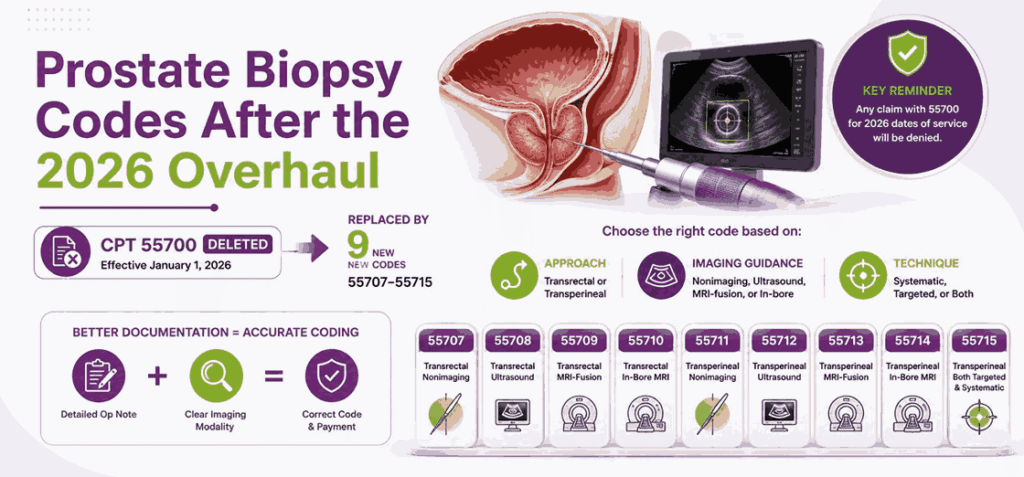
This change affects documentation as much as coding. Operative notes now need to state the imaging modality explicitly, not just the fact that a biopsy occurred. A note that simply says “prostate biopsy performed” no longer gives the coder enough information to choose correctly among nine options.
Which Codes Apply to Benign Prostatic Hyperplasia Treatment?
BPH treatment codes vary widely by technology. CPT 52441 covers prostatic urethral lift implant placement. CPT 52601 covers standard TURP. CPT 52649 covers laser enucleation of the prostate. CPT 52597, new for 2026, now covers transurethral robotic-assisted waterjet resection, commonly known as Aquablation.
Is Aquablation Still a Category III Code?
No. Aquablation moved from the temporary Category III code 0421T to the permanent Category I code 52597 in 2026. That shift reflects established clinical use and typically improves payer recognition and reimbursement consistency compared to a Category III listing. Practices that have not updated their charge master to reflect 52597 risk billing an invalid code for every Aquablation case performed after the transition date.
One related change removed CPT 52647, the older code for laser coagulation of the prostate. Practices that still use laser coagulation techniques need to confirm with their Medicare Administrative Contractor which current code applies, since no single direct replacement was named.
What Modifiers Govern Urology CPT Code Billing?
Modifiers decide whether a second, third, or bilateral procedure gets paid on top of the primary code. Getting them wrong is one of the most common reasons urology claims are denied or underpaid.
| Modifier | Meaning | When It Applies in Urology |
|---|---|---|
| 59 | Distinct procedural service | A second cystoscopic or urologic procedure targets a separate site or indication from the primary procedure, and documentation supports true distinctness. Does not override an NCCI bundling edit without valid justification. |
| XS | Separate structure (subset of 59) | Same use as modifier 59, but specifies the distinct service occurred at a separate organ or structure. Preferred by many payers over 59 when it applies. |
| 51 | Multiple procedures | Flags additional, separately payable procedures performed in the same session. Does not unbundle codes already linked by an NCCI edit pair. |
| 50 | Bilateral procedure | Applies when a procedure, such as nephrectomy or ureteral stent placement, is performed on both sides during the same session. Not combined with RT or LT on the same line. |
| RT / LT | Right side / left side | Reports laterality on a one-sided procedure. Required whenever a kidney, ureter, or testis procedure is one-sided, to support medical necessity and avoid ambiguity. |
| 58 | Staged or related procedure | Reports a planned, more extensive procedure performed during the global period of a prior related surgery. |
| 78 | Unplanned return to the OR | Reports an unplanned return during the global period to address a complication of the original surgery. |
| 79 | Unrelated procedure during global period | Reports a procedure unrelated to the original surgery, performed by the same physician during that surgery’s global period. |
| 26 | Professional component | Reports the physician interpretation portion of a service, separate from the technical component, on select imaging or diagnostic codes used in urology. |
| TC | Technical component | Reports the equipment and facility portion of a service, used when the professional and technical components are billed separately. |
When Should Modifier 59 or XS Be Used in Urology Claims?
Modifier 59, or its more specific successor XS, tells the payer that a service was distinct from another procedure billed the same day. It applies when a second cystoscopic procedure targets a separate site or a separate indication, not simply an earlier step of the primary procedure.
Payers and auditors watch this modifier closely, because it is also the most commonly misused one. Appending it routinely, without documentation supporting true distinctness, is a frequent audit trigger rather than a safe workaround for a bundling edit.
When Does Modifier 50 Apply to Urology Procedures?
Modifier 50 reports a bilateral procedure performed on both sides during the same session. Nephrectomy, ureteral stent placement, and certain reconstructive procedures commonly use it when both kidneys or both ureters are involved. RT and LT, by contrast, indicate laterality on a one-sided procedure and should not be combined with modifier 50 on the same line.
When Do Modifiers 58, 78, and 79 Apply During a Global Period?
These three modifiers cover procedures performed during another surgery’s global period. Modifier 58 reports a staged or more extensive related procedure that was planned from the outset. Modifier 78 reports an unplanned return to the operating room for a complication tied to the original surgery.
Modifier 79 reports an unrelated procedure performed by the same physician during the global period of a prior surgery. Most standalone cystoscopy codes carry a zero-day global period, so these modifiers matter most when a cystoscopy or stone procedure follows a major urologic surgery within its global window.
How Do NCCI Edits Affect Urology CPT Code Reimbursement?
The National Correct Coding Initiative maintains edit pairs that block certain code combinations from paying together. In urology, these edits concentrate heavily around cystoscopy. CPT 52000 sits at the base of a large edit web, bundled into nearly every more comprehensive cystourethroscopic code.
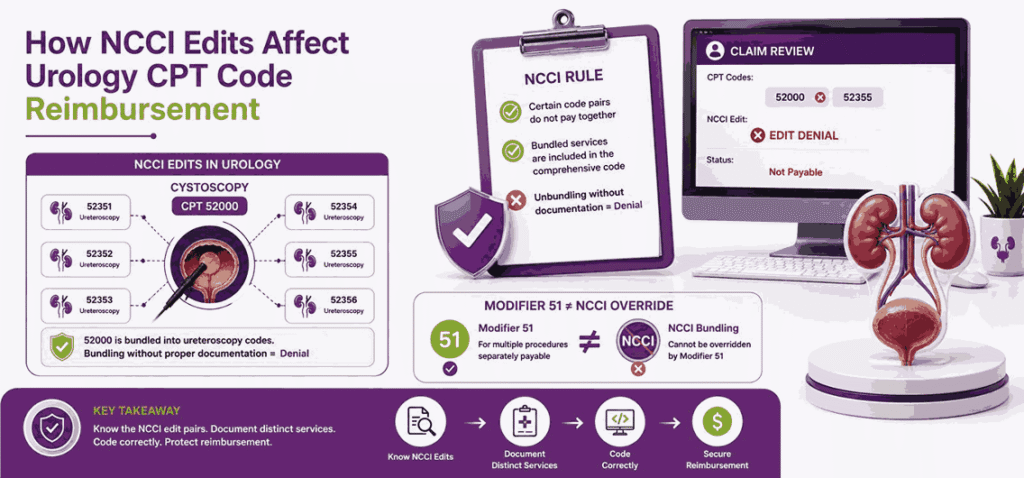
Ureteroscopy codes in the 52351 to 52356 range bundle the diagnostic cystoscopy component automatically, so billing 52000 alongside any of them, without a valid distinct-service modifier and supporting documentation, will trigger a denial.
Modifier 51, used to flag multiple procedures performed in one session, does not override an NCCI bundling modifier. Coders sometimes confuse the two. Modifier 51 adjusts payment for additional procedures that are separately payable. It has no power to unbundle a code pair the NCCI table has already linked.
Can Two Cystoscopic Codes Be Billed on the Same Date?
Only when one targets a genuinely separate site or indication from the other, with documentation supporting that separation and the correct modifier attached. Otherwise, only the single most comprehensive cystoscopic code performed that day is reportable.
What Changed in Urology CPT Codes for 2026?
The January 2026 CPT update brought some of the most significant urology-specific changes in recent years. Prostate biopsy reporting moved from one code, 55700, to nine codes, 55707 through 55715, split by imaging guidance and technique.
Aquablation moved from Category III status to a permanent Category I code, 52597. CPT 52647, the old laser coagulation code, was deleted with no single named replacement.
Laparoscopic radical prostatectomy expanded into three distinct codes reflecting different approaches and extents of resection. New codes were also introduced for irreversible electroporation of the prostate and for cystourethroscopy with balloon dilation and drug delivery in BPH treatment.
Practices that have not updated their encounter forms, EHR templates, and charge masters to reflect these changes are still at risk of submitting invalid or outdated codes for any of these procedures performed in 2026.
Why Does Site of Service Change Urology Reimbursement in 2026?
This is the part of the 2026 update that gets less attention than the code changes themselves, and it deserves more. CMS finalized payment policy changes projected to decrease facility-based urology reimbursement by roughly 10 percent while increasing non-facility, office-based reimbursement by roughly 5 percent. That is not a coding change. It is a relative value shift tied entirely to where the service happens.

For a urology practice weighing whether to keep cystoscopy, biopsy, or minor stone procedures in the office versus sending them to a hospital outpatient department, this shift changes the math. A procedure that once paid comparably in either setting may now favor the office substantially.
Practices that have not modeled this shift against their current site-of-service mix are likely leaving reimbursement on the table, independent of anything related to CPT code selection itself. This is a planning decision as much as a billing one, and it belongs on the same review calendar as annual fee schedule updates.
How Can Urology Practices Reduce Denials Tied to CPT Coding?
Most urology coding denials trace back to a small number of root causes, and each has a direct fix.
Missing laterality is one of the most common. Any procedure involving a single kidney, ureter, or testis needs RT or LT documented in the note and reflected in the modifier. Documentation that never states which side was treated forces the coder to guess, and a guess is not a defensible claim.
Bundled services billed separately is the second major cause. Catheter insertion performed as part of a larger surgical procedure is a clear example. It is included in the surgical code and should never appear as its own line item on the same claim.
Missing medical necessity support is the third. Cystoscopy, in particular, needs a documented symptom or finding, such as hematuria, urinary retention, or recurrent infection, tied to the correct urology ICD-10 code that satisfies the payer’s medical necessity requirements.
The fourth is outdated code sets. With 55700 gone, 52647 gone, and 52597 newly active, any practice still working from a 2025 charge master is coding against a set of rules that no longer exists for 2026 dates of service.
Many practices rely on specialized urology billing services to stay current with annual coding updates, payer policy changes, and documentation requirements. Experienced billing teams can reduce coding errors, improve first-pass claim acceptance, and strengthen overall revenue cycle performance.
Closing Thoughts on Urology CPT Codes
Urology CPT codes carry more nuance than their numeric format suggests. Bundling rules, modifier logic, and now a full-scale 2026 overhaul of prostate biopsy and BPH treatment codes all shape whether a claim pays the first time or comes back denied.
Practices that keep documentation tied tightly to laterality, medical necessity, and the specific technique used will find far fewer of their urology claims stuck in appeal. Staying current with these codes is not a once-a-year task. It is an ongoing part of running a urology practice that gets paid accurately for the work it does.