
Delaware writes more of its billing rules into regulation than most states its size. The Delaware Department of Insurance sets payment deadlines, caps recoupment, and runs three separate arbitration tracks for provider payment disputes.
Most of those rules are unknown to the practices they protect. CMS reported the FY 2025 Medicare fee-for-service improper payment rate in January 2026. The rate was 6.55%, or $28.83 billion. Medicaid ran higher at 6.12%, and 77% of that traced to insufficient documentation.
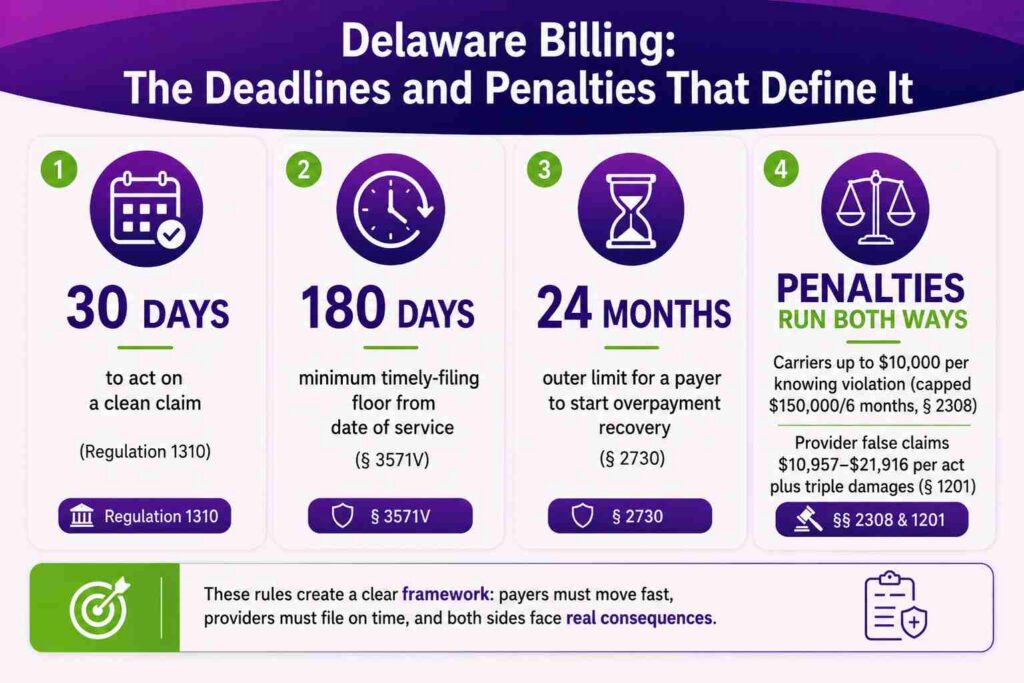
The payment rules come down to three key benchmarks: 30 days to pay, 180 days to file, and 24 months to recover overpayments. Penalties run both directions. Under 18 Del. C. § 2308, a carrier faces up to $10,000 per knowing violation, capped at $150,000 in any 6-month period. Under 6 Del. C. § 1201, a provider false claim carries $10,957 to $21,916 per act plus triple damages.
Two deadlines make 2026 a decision year. The Delaware Pre-Authorization Reform Act of 2025 reaches policies renewing after December 31, 2026. Every carrier must run a provider portal by January 1, 2027, the same date CMS set under CMS-0057-F.
This guide covers all 11 active Delaware billing laws, who each one binds, the operative deadlines, and what your billing team must do now.
Why Delaware Billing Compliance Works Differently Than Most States
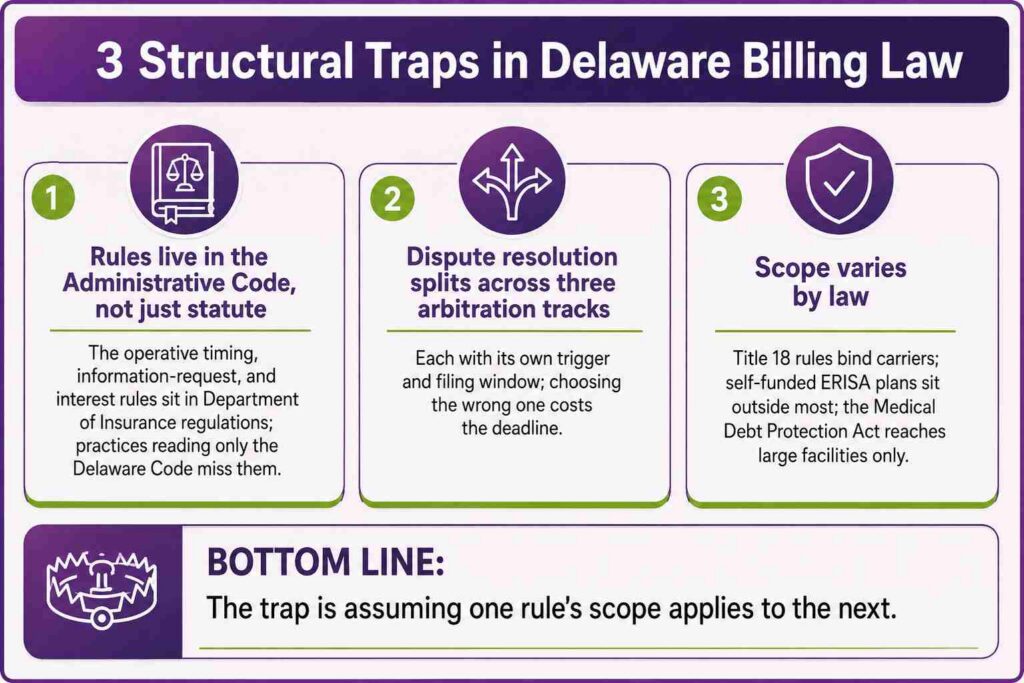
Delaware puts its provider protections in the Administrative Code rather than in statute alone. The operative rules on payment timing, information requests, and interest sit in Department of Insurance regulations. Practices that read only the Delaware Code miss them.
The state also splits dispute resolution across multiple tracks. Three separate regulations govern provider arbitration, each with its own trigger and filing window. Choosing the wrong one costs a provider the deadline.
Scope is the second trap. Title 18 rules bind insurance carriers. Self-funded ERISA plans sit outside most of them, and Delaware states that exclusion directly in places. The Medical Debt Protection Act narrows further and reaches large facilities only.
The 11 Active Delaware Billing Laws Covered in This Article
- The Delaware Prompt Payment of Clean Claims Rule (Regulation 1310)
- The Delaware 180-Day Timely Filing Statute (18 Del. C. § 3571V)
- The Delaware Overpayment Recovery Limit (18 Del. C. § 2730)
- The Delaware Provider and Carrier Arbitration Statute (18 Del. C. § 333)
- The Delaware Out-of-Network Emergency Care Payment Law (18 Del. C. §§ 3349 and 3565)
- The Delaware Network Disclosure and Balance Billing Prohibition (Regulation 1317)
- The Delaware Primary Care and Chronic Care Reimbursement Floor (18 Del. C. §§ 3342B and 3556A)
- The Delaware Pre-Authorization Reform Act of 2025 (Senate Bill 12)
- The Delaware Workers’ Compensation Health Care Payment System (19 Del. C. § 2322B)
- The Delaware Telehealth Coverage and Payment Parity Law (18 Del. C. §§ 3370 and 3571R)
- The Delaware Medical Debt Protection Act (6 Del. C. Chapter 25J)
Law 1: Delaware Prompt Payment of Clean Claims Rule
The governing rule is 18 DE Admin. Code 1310, titled Standards for Prompt, Fair and Equitable Settlement of Claims for Health Care Services. The Commissioner adopted it under 18 Del. C. §§ 311, 2304(16), and 2312.
It applies to insurance carriers, health service corporations, managed care organizations, and third-party administrators that adjust or settle health claims. It does not apply to self-funded ERISA plans.
Regulation 1310 also holds the controlling definition of “clean claim” for Delaware. Other rules, including the emergency arbitration regulation, point back to it rather than defining the term separately.
Core Provisions
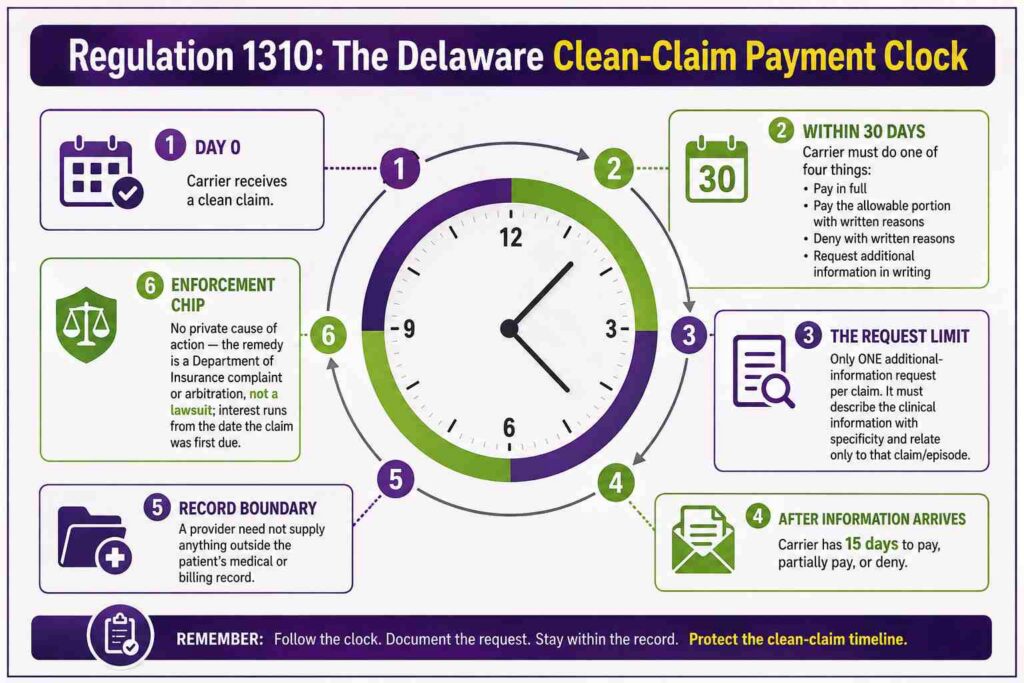
- 30-day action window: Within 30 days of receiving a clean claim, the carrier must pay in full, pay the allowable portion with written reasons for the rest, deny with written reasons, or request additional information in writing.
- One information request per claim: A carrier may make only one additional-information request. The request must describe the clinical information with specificity and relate only to that claim or its episode of care.
- 15-day follow-up clock: After receiving the properly requested information, the carrier has 15 days to pay, partially pay, or deny.
- Record boundary: A provider does not have to supply anything outside the patient’s medical or billing record.
- One further request only: Beyond the first request, the carrier gets one more, and only to administer coordination of benefits.
Timeline in Practice
| Step | Responsible party | Deadline |
|---|---|---|
| Take one of four actions on a clean claim | Carrier | 30 days from receipt |
| Respond to an additional-information request | Provider | Per contract |
| Pay, partially pay, or deny after information received | Carrier | 15 days |
Penalties for Non-Compliance
The Insurance Commissioner may order a violating carrier to pay the claim plus interest. The rate is the maximum allowable to lenders under Delaware law. Interest runs from the date the claim was first required to be paid, not the complaint date.
One limit matters. Regulation 1310 creates no private cause of action for providers. Enforcement runs through the Department of Insurance, so the remedy is a complaint or arbitration petition rather than a lawsuit.
How to Stay Compliant
- Date-stamp every clean claim submission and set a 30-day payer follow-up trigger
- Log every additional-information request and flag any second request as non-compliant
- Track the 15-day clock separately from the original 30-day clock
- Refuse requests for records your practice does not maintain, in writing
- Escalate repeat violations to the Department of Insurance rather than absorbing them
Law 2: Delaware 180-Day Timely Filing Statute
The rule sits at 18 Del. C. § 3571V. A carrier must allow a provider a minimum of 180 days from the date of service to submit a claim for reimbursement. Network status does not change the obligation.
Delaware is stricter than its neighbors. Highmark’s provider manual shows how the default differs across its three states when a contract is silent.
| State | Default filing window where the contract is silent |
|---|---|
| Delaware | 180 days from date of service |
| Pennsylvania | 365 days from last date of service |
| West Virginia | 365 days from last date of service |
The Detail Most Practices Get Wrong
Section 3571V sets a floor, not a deadline. A carrier must allow at least 180 days. A contract may grant longer, and granting longer does not violate the statute.
Read the number as a minimum guarantee beneath every Delaware payer contract. A practice that treats 180 days as a hard ceiling may be writing off claims it still had the right to file.
Revenue Cycle Impact
The practical exposure is half what a Pennsylvania practice carries. A Delaware claim sitting in a work queue for 90 days has already burned half its statutory window.
Coordination of benefits cases compress this further. Secondary claims often cannot be filed until the primary payer adjudicates, which can consume most of the window on its own.
How to Stay Compliant
- Set the default timely filing assumption at 180 days for any Delaware contract not read line by line
- Build a 120-day aging alert so claims escalate before the statutory floor closes
- Track coordination of benefits claims on a separate aging schedule
- Audit payer contracts for windows longer than 180 days and record them by payer
Law 3: Delaware Overpayment Recovery Limit
The statute is 18 Del. C. § 2730, Collection of Overpayments by Health Insurers and Health Plans. It was enacted by House Bill 172 in the 149th General Assembly, signed March 16, 2018, and effective June 14, 2018.
This is the strongest defensive rule in Delaware billing. A payer cannot start overpayment recovery more than 24 months after the original payment for the claim was made.
Core Provisions
- 24-month recovery bar: No recovery effort may begin more than 24 months after the original payment date.
- Written notice requirement: Other than duplicate payments, the payer must send written notice identifying the processing or payment error and justifying the recovery. The enacting bill set that period at 30 days and required the patient name, service date, payment amount, proposed adjustment, and a specific explanation.
- Mandatory challenge process: The payer must give the provider an opportunity to challenge the recovery, including sharing claims information, and must maintain written challenge procedures.
- Non-waivable: The section cannot be waived by contract. Any conflicting contractual arrangement is null and void.
Worked Recoupment Timeline
| Event | Date |
|---|---|
| Original payment made | March 15, 2024 |
| Recovery window closes | March 15, 2026 |
| Latest notice date allowing 30 days | February 13, 2026 |
| Recovery initiated April 2026 | Time-barred |
Exceptions With No Time Limit
- Recovery based on a reasonable belief of fraud, abuse, or other intentional misconduct
- Recovery required by a federal or state plan
- Recovery initiated by a self-insured plan
How to Stay Compliant
- Date-check every takeback request against the original payment date before releasing funds
- Reject any recovery notice dated more than 24 months after payment, in writing
- Confirm the notice names the specific processing error rather than citing a generic audit
- Log which plans are self-insured, since the 24-month bar does not reach them
- Strike any contract clause that shortens the notice period or waives the challenge right

Law 4: Delaware Provider and Carrier Arbitration Statute
Delaware gives providers a statutory right to force a carrier into arbitration over reimbursement. The authority sits at 18 Del. C. § 333, with additional authority at §§ 3370A and 3571S for surprise billing disputes.
Three regulations carry the process. Each covers a different dispute type and carries its own filing window and fee.
| Regulation | Dispute type | Who may file | Filing window | Fee |
|---|---|---|---|---|
| 1313 | Reimbursement for an individual claim, procedure, or service, including surprise billing disputes | Provider | 60 days from the carrier’s final decision | $50 for claims of $1,000 or less; $100 otherwise |
| 1316 | Out-of-network emergency care payment | Either party | After 30 days from clean claim with no agreement | Per regulation |
| 1319 | Primary care and chronic care management reimbursement | Provider | 60 days from the carrier’s final reimbursement decision | $75 |
The Notice Right Most Providers Never Use
Regulation 1313 puts an affirmative duty on the carrier. A final reimbursement decision may fail to authorize the provider’s full charge. When that happens, the carrier must give the provider written notice of the right to arbitration.
The regulation specifies the language. The notice must tell the provider that Department arbitration is available in addition to, and does not replace, other legal rights or contractual review rights.
Filing Requirements
- The petition and all supporting documentation go to the Department of Insurance in Dover
- A copy must reach the carrier by certified mail, return receipt requested
- A proof of service must be delivered to the Department
- Under Regulation 1313, the carrier must file a response with supporting documents within 20 days
- “Final decision” means the carrier’s decision after all internal review is complete
How to Stay Compliant
- Treat every partial-payment letter as the start of a 60-day arbitration clock
- Check whether the carrier included the required arbitration notice, and document when it did not
- Batch low-value disputes by patient or procedure code to control filing fees
- Assign one owner for arbitration filings rather than leaving it to individual AR staff
Law 5: Delaware Out-of-Network Emergency Care Payment Law
Delaware set an emergency payment standard years before the federal No Surprises Act. The rules sit at 18 Del. C. § 3349 and § 3565, added in 2011 and effective July 13, 2011.
The carrier pays the non-network emergency provider directly. The payment standard is specific and favors the provider.
The Payment Standard
The insurer owes the highest allowable charge it allowed any other emergency provider for that service. The comparison covers both network and non-network providers. The lookback runs the full 12 months before the date of service.
That figure is not the carrier’s in-network rate. It is the highest rate the carrier paid anyone for that service across a full year, which is often materially higher.
Arbitration Trigger
If carrier and provider cannot agree within 30 days after the carrier receives clean claims, either party may petition for arbitration. The other party must submit to it.
Evidence the arbitrator must receive includes:
- The highest allowable charge the carrier allowed any emergency provider for that service in the prior 12 months
- The carrier’s highest allowable charge under the provider’s most recent participation agreement, where applicable
- The highest allowable charge the provider received from any other carrier in the prior 12 months
Scope Limits
Regulation 1316 does not apply to self-funded plans. The Department confirmed this in a 2023 amendment after a commenter asked that the exclusion language be kept.
The regulation also defines a provider as one who furnishes health care services in Delaware. Service location matters for this track in a way it does not for the general prompt pay rule.
How to Stay Compliant
- Identify every out-of-network emergency claim at intake rather than at denial
- Request the carrier’s 12-month highest allowable charge data when payment falls short
- Diary the 30-day mark after clean claim submission as the arbitration trigger date
- Confirm plan funding type before filing, since self-funded plans route to federal dispute resolution
Law 6: Delaware Network Disclosure and Balance Billing Prohibition
The rule is 18 DE Admin. Code 1317, titled Network Disclosure and Transparency. Providers often assume this is Delaware’s surprise billing arbitration rule. It is not. It is a disclosure rule with a balance billing penalty attached.
The prohibition is conditional, and the condition is documentary. A facility-based provider may not balance bill a covered person for services the insurance contract does not cover. That bar applies where the provider failed to meet its disclosure duty.
What Triggers the Prohibition
Two failures remove the right to balance bill:
- Failure to provide the required facility-based provider disclosure before rendering services
- Failure to obtain the signed copy of the written consent form included with that disclosure
The Statutory Disclosure Duty
Under 18 Del. C. § 3370A, the timing obligation attaches early. It triggers when a facility-based provider schedules a procedure or seeks prior authorization for non-emergency covered services. The facility must then give the patient a timely written out-of-network disclosure.
That disclosure must state four things:
- Whether the facility participates in the patient’s network
- That facility-based providers may be called on during treatment
- That those providers may not contract with the patient’s insurer
- That out-of-network services may create additional charges beyond coinsurance, deductibles, and copays
The Managed Care Layer
A second prohibition operates through the managed care rules. An insurer must allow a referral to a non-network provider in one situation. That situation is where medically necessary covered services are unavailable in network, or unavailable within a reasonable time.
The referral must come at the request of a network provider. The managed care organization must then make acceptable service arrangements and prohibit balance billing.
How to Stay Compliant
- Build the out-of-network disclosure into scheduling, not into check-in
- Store the signed consent form as a billable-claim prerequisite in your document workflow
- Audit a sample of out-of-network balances monthly against consent form presence
- Route non-network referral cases to a separate workflow where balance billing is blocked
Law 7: Delaware Primary Care and Chronic Care Reimbursement Floor
Delaware sets a statutory rate floor few states match. The rules sit at 18 Del. C. § 3342B for individual policies and § 3556A for group plans. Both took effect for policies delivered or renewed on or after January 1, 2019.
A carrier must reimburse primary care and chronic care management at no less than the Medicare rate for comparable services.
How the Benchmark Works
The regulation ties the floor to the non-facility Delaware Medicare fee schedule in effect when the service is billed. A carrier cannot use business rules or any other mechanism to discount below that level.
Some services have no comparable Medicare rate. For those, the carrier must pay at rates generally available under Medicare, such as office visit and prolonged preventive service rates.
Definitions That Control Scope
| Term | Statutory meaning |
|---|---|
| Primary care | Care by a physician or Title 24 licensee with whom the patient has initial contact, including family practice, pediatrics, internal medicine, and geriatrics |
| Carrier | Insurance companies, health service corporations, HMOs, and third-party administrators that adjust or settle claims |
| Excluded | Plans designed for Medicare, Medicaid, or similar government coverage |
Enforcement
Two features make this floor enforceable rather than aspirational. The provisions cannot be waived by contract, and any conflicting arrangement is void. The Department of Insurance arbitrates rate disagreements under Regulation 1319.
Chronic care management coverage also carries its own protection. It must not be subject to the cost-sharing treatment that would otherwise apply.
How to Stay Compliant
- Benchmark your top five primary care CPT codes against the non-facility Delaware Medicare schedule annually
- Flag any contracted rate below that schedule as a Regulation 1319 arbitration candidate
- Reject contract language that ties primary care rates to a percentage of Medicare below 100%
- Confirm chronic care management codes are paid at the floor, not at a discounted care management rate
Law 8: Delaware Pre-Authorization Reform Act of 2025
Senate Bill 12 was signed on August 25, 2025 and is recorded at 85 Del. Laws, c. 176. Senate Majority Leader Bryan Townsend sponsored it. The Department issued Domestic and Foreign Insurers Bulletin No. 163 on November 3, 2025.
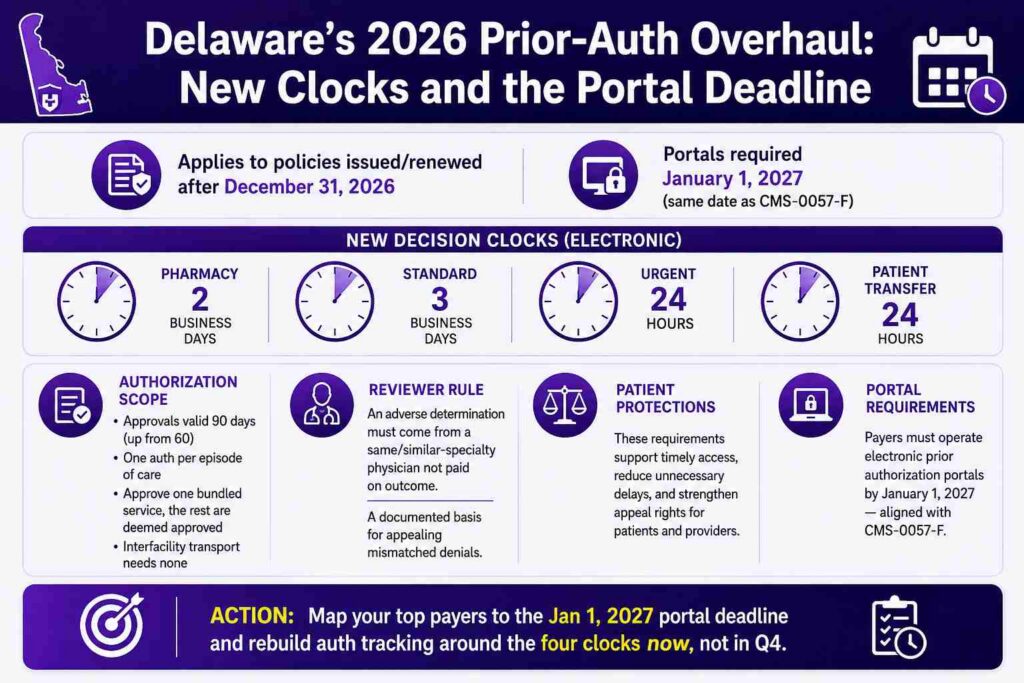
The Act applies to health insurance policies, contracts, or certificates issued, renewed, modified, altered, amended, or reissued after December 31, 2026. It also reaches the State Employee Health Benefits Program.
The Department of Health and Social Services must, where feasible, apply the same standards to Medicaid managed care contracts.
New Decision Timelines
| Request type | Electronic submission | Non-electronic submission |
|---|---|---|
| Pharmacy benefit | 2 business days | 2 business days |
| Standard health care service | 3 business days | 5 business days |
| Urgent health care service | 24 hours | 48 hours |
| Patient transfer | 24 hours | 48 hours |
Authorization Scope Changes
- 90-day validity: An approved pre-authorization stays valid for at least 90 days, up from 60.
- One per episode of care: Only one pre-authorization may be required for a single episode of care.
- Bundled services: If one service in a bundled payment group is approved, the rest are deemed approved.
- Interfacility transport: Medically necessary interfacility transport needs no pre-authorization.
- Six-month notice: Carriers must give 6 months’ notice before changing utilization review terms, with exceptions for updated clinical guidelines, recalls, market withdrawals, and FDA safety alerts.
Reviewer Qualification Requirements
An adverse determination on a clean pre-authorization request must come from a physician who is not paid based on the outcome. That physician must hold training or experience in the same or a similar specialty, or must consult a qualified provider who does.
Appeals add three further requirements. The reviewing physician must hold an active unrestricted license. That physician must not have been involved in the original determination. The review must cover all clinical aspects of the case.
For pain management, oncology, and behavioral health practices, this gives a documented basis for appealing a mismatched denial.
Appeal and Availability Standards
| Requirement | Standard |
|---|---|
| Appeal decision window | 15 days from receipt |
| Extension after requested information arrives | 15 additional days |
| Appeal submission window for the provider | At least 30 days from the adverse determination |
| Utilization review availability | Seven days a week |
| Medical director availability | Monday to Friday, 7:00 AM to 7:00 PM, plus reasonable weekend hours |
| Appeal submission methods | Written, electronic, or telephone |
Provider Portal Mandate
By January 1, 2027, every carrier and utilization review entity must operate a provider portal. Carriers must also accept and respond to electronic requests through the same platform used for submission.
Each portal must include:
- Electronic pre-authorization submission
- Access to applicable medical policies
- Information needed to request a peer-to-peer review
- Contact details for clinical and administrative staff
- Downloadable forms for services not supported electronically
- Instructions for submitting when the portal is unavailable
Twelve months after a portal launches, a carrier may require providers to use it. Exemptions apply where the portal is down, the provider lacks access, or an alternate method is approved.
How to Stay Compliant
- Map your top 10 payers against the January 1, 2027 portal deadline now
- Rebuild pre-authorization tracking around the four new response clocks
- Add 24-hour and 48-hour escalation triggers for urgent requests and patient transfers
- Record authorization expiry at 90 days rather than 60
- Train appeals staff to challenge any adverse determination signed by a non-matching specialty
- Stop submitting separate authorizations for services inside a bundled payment group
Law 9: Delaware Workers’ Compensation Health Care Payment System
Delaware prices workers’ compensation care through a statutory fee schedule rather than usual and customary rates. The authority sits at 19 Del. C. § 2322B, with the rules at 19 DE Admin. Code 1341. The system took effect May 23, 2008.
The Delaware Department of Labor, Office of Workers’ Compensation administers it. A new fee schedule took effect January 31, 2025.
How the Fee Schedule Is Built
The schedule covers hospitals, ambulatory surgery centers, and professional services. It uses RBRVS, MS-DRG, APC, or equivalent CMS scales with a Delaware geographic adjustment.
Where Delaware workers’ compensation regulations conflict with CMS rules, Delaware regulations control. Where the schedule sets no specific fee, the Oversight Panel may set reimbursement as a percentage reduction from 85% of the actual charge.
Payment Rules
| Requirement | Standard |
|---|---|
| Payment on a certified provider’s bill with records | 30 days from receipt |
| Payment on a hospital or emergency department clean claim | 30 days from submission with notes |
| Interest on unpaid invoices | 1% per month, payable to the provider |
| Referral to utilization review after denial | Within 15 days |
| Written explanation on any denial | Required |
| Payment of uncontested portion | Required, without prejudice to contesting the rest |
Provider Certification Under § 2322D
Certification is what removes the need to pre-authorize each procedure, office visit, or service. An uncertified provider must obtain authorization for nearly everything.
Certification requires a current license and a valid DEA registration where applicable. The provider must carry no felony convictions involving fraud or controlled substances. It must also show no involuntary termination from Medicare or Medicaid, plus proof of malpractice insurance.
Certified providers also agree to conditions that carry direct billing consequences:
- Not to unbundle charges into separate procedure codes when a single code is more appropriate
- Not to balance bill the employee or the employer
- To accept responsibility for the content of all bills submitted under their signature
- To notify the Department of Labor of relevant changes within 30 days
One exception exists. Any provider may treat during a single office visit or one instance of treatment without prior authorization. Payment is the lesser of the usual and customary fee or the fee schedule amount.
How to Stay Compliant
- Audit certification status for every provider in the group annually against the published certified provider list
- Confirm the current fee schedule version before pricing any workers’ compensation claim
- Bill interest at 1% per month on invoices unpaid past 30 days
- Review unbundling patterns, since certified providers are contractually barred from it
- Block balance billing on workers’ compensation accounts at the system level
Law 10: Delaware Telehealth Coverage and Payment Parity Law
Delaware requires both coverage parity and payment parity. The rules sit at 18 Del. C. § 3370 for individual policies and § 3571R for group plans, with 18 DE Admin. Code 1409 carrying the detail.
Delaware is among roughly 24 states with true payment parity rather than coverage parity alone.
What Carriers Must Do
- No coverage exclusion: A carrier may not exclude a service from coverage solely because it was delivered through telemedicine rather than in person.
- Rate parity: A carrier must reimburse the treating or consulting provider on the same basis and at least at the rate paid for the same service in person.
- Transmission costs: Payment must include reasonable compensation to the originating or distant site for transmission costs incurred.
Where This Matters Most
Behavioral health, psychiatry, and chronic care management practices carry the highest telehealth mix. For those specialties, the parity rule is a direct revenue protection rather than a technical rule.
Delaware Medicaid also reimburses across live video, store-and-forward, remote patient monitoring, and audio-only modalities, subject to program limits.
How to Stay Compliant
- Compare telehealth and in-person allowables by CPT code across your top payers each quarter
- Dispute any telehealth rate paid below the in-person rate for the same code
- Bill originating and distant site transmission costs where applicable
- Confirm plan funding type, since self-funded plans are not bound by the state parity rule
Law 11: Delaware Medical Debt Protection Act
The Act sits at 6 Del. C. Chapter 25J. It was enacted as Senate Substitute 2 for Senate Bill 8, signed September 11, 2023, and recorded at 84 Del. Laws, c. 198. It was amended again in 2025 by 85 Del. Laws, c. 107.
Delaware writes it as a consumer protection statute that courts must construe liberally and remedially.
Who the Act Actually Binds
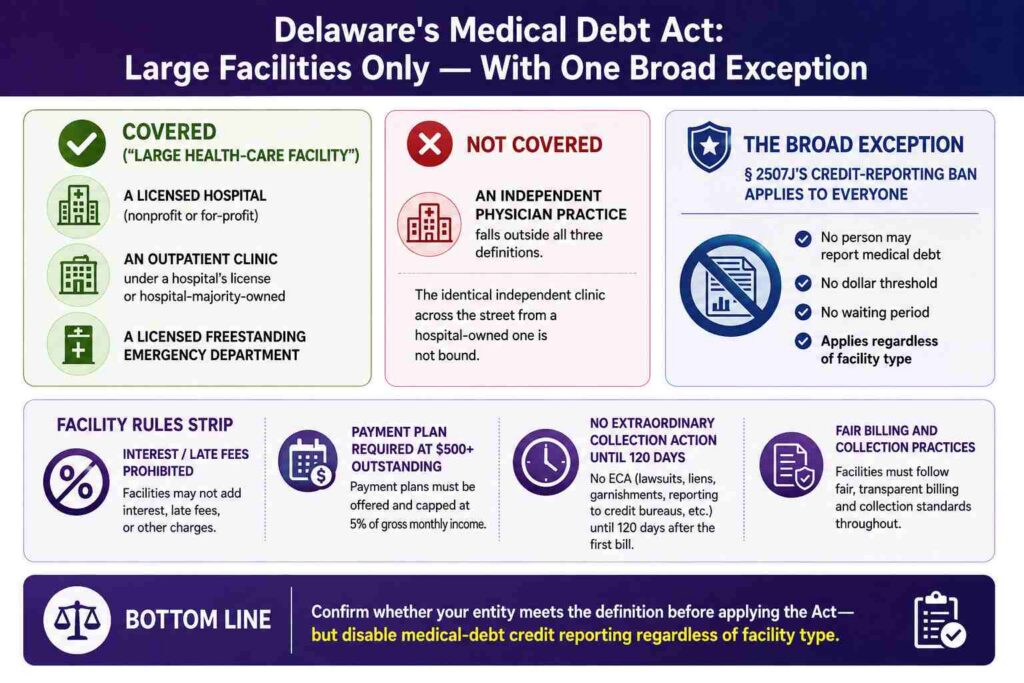
This is the most misreported point in Delaware billing. The Act reaches “large health-care facilities” only, defined as:
- A hospital licensed under Chapter 10 of Title 16, whether nonprofit or for-profit
- An outpatient clinic or facility operating under a hospital’s license, or majority-owned by a hospital
- A licensed freestanding emergency department as defined in § 122 of Title 16
An independent physician practice falls outside all three definitions. A hospital-owned outpatient clinic is covered. The identical independent clinic across the street is not.
Interest and Payment Plan Rules
| Provision | Requirement |
|---|---|
| Interest and late fees | Prohibited entirely, including on judgments |
| Payment plan threshold | Required for any patient with $500 or more outstanding |
| Monthly payment cap | 5% of the patient’s gross monthly income |
| Proof of income | Cannot be required as a condition of a payment plan |
| Prepayment penalties and service fees | Prohibited |
No initial payment may come due within 30 days of service. None may come due within 30 days of the first bill. None may come due while the facility has documentation pending from the patient.
Collection Timing and Notice
A covered facility may not begin any permissible extraordinary collection action until 120 days after the first bill was sent.
At least 30 days before any such action, the facility must send a notice. That notice must state whether financial assistance is available with a plain-language summary. It must identify the specific actions to be initiated and give a deadline no earlier than 30 days out.
Prohibited Collection Actions
- Causing an arrest or a writ of body attachment
- Foreclosing on real property
- Garnishing wages, disability benefits, workers’ compensation, or unemployment benefits
- Garnishing or attaching a bank account, pension, annuity, or retirement account
Credit Reporting and Appeals
Section 2507J states that no person may report any medical debt to a consumer reporting agency. There is no dollar threshold and no waiting period. Credit bureaus are separately barred from producing reports containing medical debt.
Section 2508J stops collection while an insurance appeal is pending and for 60 days after it concludes. During that period the creditor may not report, may not contact the consumer to collect, and may not sue. It also may not sell or refer the debt.
If the debt was already reported, the creditor must instruct the bureau to delete it once the appeal comes to light.
Liability and Remedies
A facility that sells medical debt remains liable for what the buyer does. Patient overpayments must be refunded within 60 days. Any pre-dispute agreement waiving rights under the chapter is void and unenforceable.
Spousal liability is also restricted. No person is liable for another adult’s medical debt without consent on a separate standalone document. That consent cannot be solicited in an emergency room.
How to Stay Compliant
- Confirm whether your entity meets the large health-care facility definition before applying the Act
- Disable credit bureau reporting for all medical debt, regardless of facility type
- Build the 120-day pre-collection hold into AR aging buckets
- Automate the $500 payment plan offer with a 5% gross monthly income cap
- Freeze collection activity the moment an internal or external appeal is logged
- Provide uninsured patients with the medical assistance notice at time of service and on every statement
Delaware vs. Federal Billing Law: Quick Reference
Billing a Highmark Delaware commercial plan is not the same as billing a self-funded employer plan. The table below shows where Delaware law stops and federal law takes over.
| Legal area | State-regulated plans | Self-funded ERISA plans | Medicare / Medicaid |
|---|---|---|---|
| Clean claim payment timing | Regulation 1310, 30 days | Federal rules only | CMS timelines |
| Timely filing floor | 18 Del. C. § 3571V, 180 days | Plan document controls | Medicare 12 months |
| Overpayment recovery | 24-month cap under § 2730 | Cap does not apply | Federal lookback rules |
| Out-of-network emergency care | §§ 3349, 3565 and Regulation 1316 | Federal No Surprises Act | Federal rules |
| Surprise billing arbitration | Regulation 1313 | Federal independent dispute resolution | Separate process |
| Prior authorization timelines | SB 12, effective for renewals after 12/31/2026 | Not covered by SB 12 | CMS federal rules |
| Primary care rate floor | §§ 3342B, 3556A | Not mandated | Not applicable |
| Telehealth payment parity | §§ 3370, 3571R | Not mandated | Program rules |
| Medical debt collections | 6 Del. C. Ch. 25J, large facilities only | Not applicable | Separate rules |
Delaware states the ERISA exclusion directly in places. Regulation 1316 carries language confirming it does not apply to self-funded plans, and § 2730’s recoupment cap excludes recovery initiated by a self-insured plan.
Which Delaware Billing Rules Cannot Be Waived by Contract
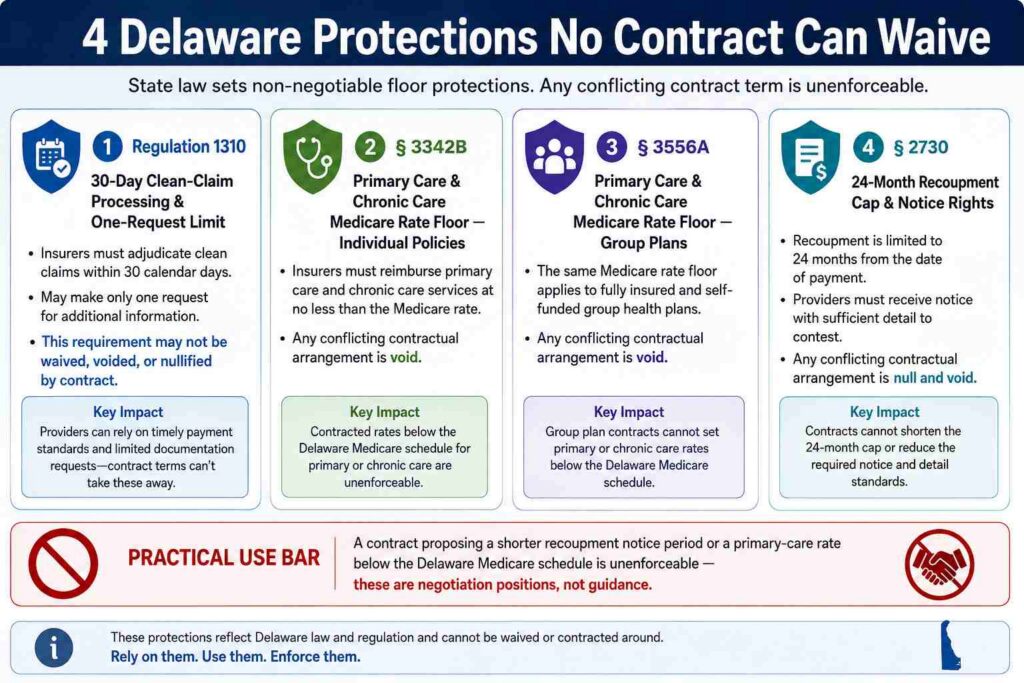
Four Delaware provisions state on their face that a contract cannot override them. This list belongs in every payer contract review.
| Provision | What it protects | Statutory language |
|---|---|---|
| Regulation 1310 | 30-day clean claim processing and the one-request limit | May not be waived, voided, or nullified by contract |
| 18 Del. C. § 3342B | Primary care and chronic care Medicare rate floor | Conflicting arrangement is void |
| 18 Del. C. § 3556A | Same floor for group plans | Conflicting arrangement is void |
| 18 Del. C. § 2730 | 24-month recoupment cap and notice rights | Conflicting arrangement is null and void |
The practical use is direct. A payer contract may propose a shorter recoupment notice period. It may propose a primary care rate below the Delaware Medicare schedule. Either clause is unenforceable in Delaware.
The Medical Debt Protection Act carries a parallel patient-side protection. Any agreement waiving rights under the chapter before a dispute arises is void.
What Changed in Delaware Billing Law in 2025 and 2026
Two changes matter for 2026 planning, and one widely repeated claim is false.
The Delaware Pre-Authorization Reform Act of 2025 was signed August 25, 2025. It reaches policies issued or renewed after December 31, 2026, with provider portals required by January 1, 2027. Carriers are rebuilding utilization review workflows now.
The Medical Debt Protection Act was amended in 2025 by 85 Del. Laws, c. 107. The amendment touched the purpose section, the definitions, and the credit reporting prohibition.
2026 Delaware Billing Compliance Checklist
The rules above only matter if your workflows enforce them. Use this checklist to confirm your billing team already does.
| Law or area | What you must have in place |
|---|---|
| Clean claim payment | 30-day payer follow-up triggers, information-request logging, 15-day secondary clock |
| Timely filing | 180-day default assumption, 120-day escalation alert, COB aging tracked separately |
| Overpayment recovery | Date check against 24-month bar, written rejection template, self-insured plan flags |
| Arbitration | 60-day filing clock on partial payments, single owner, certified mail workflow |
| Out-of-network emergency | OON identification at intake, 12-month rate data requests, 30-day arbitration diary |
| Balance billing | Disclosure at scheduling, signed consent stored as a claim prerequisite |
| Primary care rates | Annual benchmark against non-facility Delaware Medicare schedule |
| Pre-authorization | Payer portal readiness map, four new response clocks, 90-day expiry tracking |
| Workers’ compensation | Annual certification audit, current fee schedule, 1% monthly interest billing |
| Telehealth | Quarterly parity comparison by CPT code |
| Medical debt | Facility scope confirmation, credit reporting disabled, 120-day hold, $500 payment plan trigger |
How a Compliant Delaware Billing Partner Reduces Your Exposure
Delaware compliance is a date-tracking problem more than a knowledge problem. Most of the value sits in clocks that run quietly: 30 days, 15 days, 60 days, 120 days, 24 months.
When evaluating a Delaware billing partner, verify:
- Clean claim date-stamping with 30-day payer escalation built into the workflow
- Recoupment defense that date-checks every takeback against the 24-month bar
- Arbitration filing capability across Regulations 1313, 1316, and 1319
- Pre-authorization tracking already rebuilt for the SB 12 clocks and the 2027 portal deadline
- Out-of-network disclosure and consent capture at scheduling
- Workers’ compensation certification monitoring for every provider in the group
Transcure manages the full revenue cycle for Delaware practices, surgery centers, and health systems. Practices comparing options can review our medical billing services in Delaware.
Conclusion
Eleven active Delaware laws govern provider billing from scheduling through collections. Four carry the most immediate revenue effect. Those are the 30-day clean claim window, the one-request limit, the 180-day filing floor, and the 24-month recoupment bar.
Three of those four cannot be contracted away. That makes them enforceable positions in payer negotiation rather than guidance.
The Pre-Authorization Reform Act is the next deadline. Policies renewing after December 31, 2026 fall under the new clocks, and carrier portals must be live by January 1, 2027. Practices on manual authorization tracking should begin the rebuild now rather than in the fourth quarter.
Frequently Asked Questions
How Long Does a Delaware Insurance Company Have to Pay a Claim?
Thirty days. Under 18 DE Admin. Code 1310, a carrier has four options within 30 days of receiving a clean claim. It must pay in full, pay the allowable portion with written reasons, deny with written reasons, or request more information. Once that information arrives, the carrier has 15 more days to act.
What Is the Timely Filing Limit in Delaware?
A carrier must allow at least 180 days from the date of service under 18 Del. C. § 3571V, regardless of network status. This is a statutory minimum rather than a deadline, so a contract may grant a longer window. Delaware’s floor is half the 365-day default that applies in Pennsylvania and West Virginia.
Can a Delaware Insurer Recoup a Payment After Two Years?
No, with three exceptions. Under 18 Del. C. § 2730, a payer cannot start overpayment recovery more than 24 months after the original payment. Three exceptions carry no time limit. They are recovery based on reasonable belief of fraud or abuse, recovery required by a federal or state plan, and recovery by a self-insured plan.
Does the Delaware Medical Debt Protection Act Apply to Private Practices?
No. The Act binds “large health-care facilities” only, meaning licensed hospitals, hospital-owned or hospital-majority-owned outpatient clinics, and licensed freestanding emergency departments. Independent physician practices fall outside the definition. The credit reporting ban in § 2507J is written more broadly and states that no person may report medical debt.
When Do the New Delaware Prior Authorization Rules Take Effect?
The Delaware Pre-Authorization Reform Act of 2025 applies to policies issued, renewed, or modified after December 31, 2026. Carriers must respond to electronic urgent requests within 24 hours and electronic standard requests within 3 business days. Every carrier must operate a provider portal by January 1, 2027.
How Does a Delaware Provider Dispute an Underpayment?
Through Department of Insurance arbitration. Regulation 1313 covers general claim and surprise billing disputes with a 60-day filing window from the carrier’s final decision. Regulation 1316 covers out-of-network emergency care. Regulation 1319 covers primary care and chronic care management. The carrier must notify the provider of this right when it issues a partial-payment decision.