Medical practices reported an average initial claim denial rate of 11.8% in 2024, according to Experian Health’s State of Claims Report. General surgery diagnoses carry added denial risk, since payers reject claims that lack precise laterality, severity, and complication detail at first submission.
Accurate ICD 10 for general surgery demands more than memorizing one code per condition. General surgery ICD codes span multiple chapters of the ICD-10-CM code set. General surgery ICD 10 codes cover everything from hernia and gallbladder disease to trauma, bariatric, and vascular procedures that fall within a general surgeon’s scope.
The Centers for Medicare and Medicaid Services released the FY2026 ICD-10-CM update on October 1, 2025. This update added 487 new diagnosis codes, revised 38 existing codes, and deleted 28 codes. This guide reflects the current FY2026 code set for claims submitted after that date.

What Do General Surgery ICD-10 Codes Classify?
General surgery ICD 10 codes classify diseases, disorders, and postoperative conditions across every general surgery billing service, including hernia, gallbladder disease, appendicitis, diverticular and colorectal disease, breast, thyroid, bariatric, vascular, and trauma. Chapter 11 (K00-K95) holds the largest share of these codes, though a surgeon regularly pulls codes from 6 other chapters.
Which ICD-10 Chapters Cover General Surgery Diagnoses?
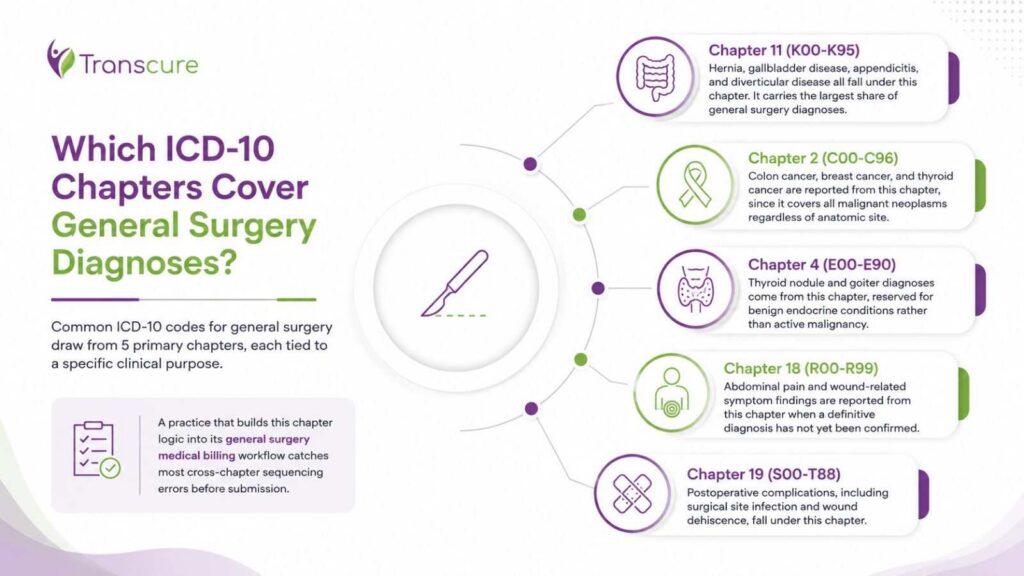
Common ICD 10 codes for general surgery draw from 5 primary chapters, each tied to a specific clinical purpose.
Chapter 11 (K00-K95)
Hernia, gallbladder disease, appendicitis, and diverticular disease all fall under this chapter. It carries the largest share of general surgery diagnoses.
Chapter 2 (C00-C96)
Colon cancer, breast cancer, and thyroid cancer are reported from this chapter, since it covers all malignant neoplasms regardless of anatomic site.
Chapter 4 (E00-E90)
Thyroid nodule and goiter diagnoses come from this chapter, reserved for benign endocrine conditions rather than active malignancy.
Chapter 9 (I00-I99)
Varicose veins and other vascular conditions are reported from this chapter, covering the limited vascular scope a general surgeon manages outside a dedicated vascular referral.
Chapter 18 (R00-R99)
Abdominal pain and wound-related symptom findings are reported from this chapter when a definitive diagnosis has not yet been confirmed.
Chapter 19 (S00-T88)
Postoperative complications, including surgical site infection and wound dehiscence, fall under this chapter.
Chapter 21 (Z00-Z99)
Screening, personal history, and postsurgical status codes come from this chapter, covering encounters where no active disease is present but surveillance continues.
A practice that builds this chapter logic into its general surgery medical billing workflow catches most cross-chapter sequencing errors before submission.
How Many Characters Does a General Surgery ICD-10 Code Carry?
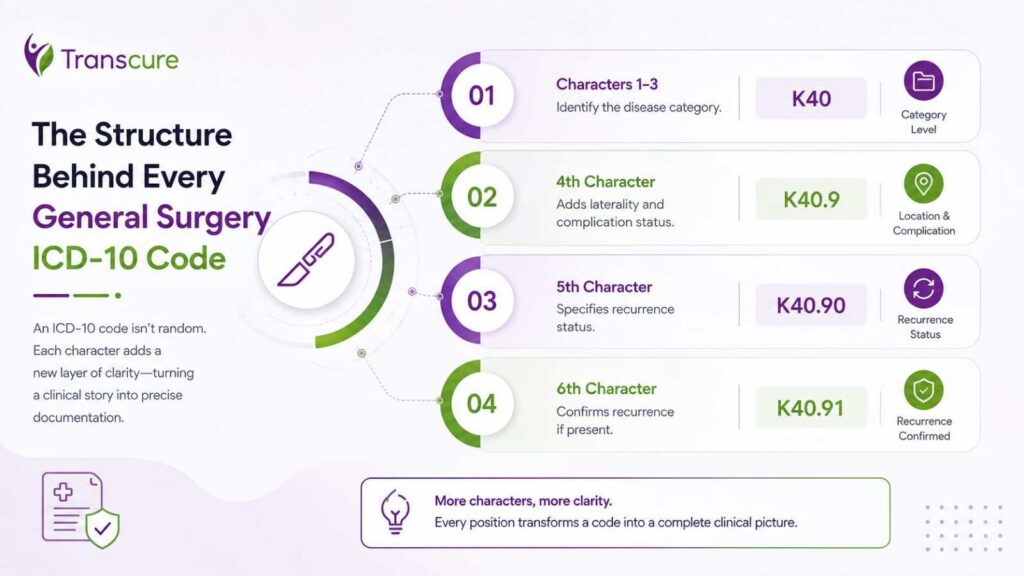
A general surgery ICD code carries between 3 and 7 characters, each adding a layer of clinical detail. The ICD-10-CM code set does not assign a separate character for a right-sided or left-sided inguinal hernia. A surgeon documents the affected side in the operative note, not through the diagnosis code itself.
Which ICD-10 Codes Apply to a General Surgery Billing?
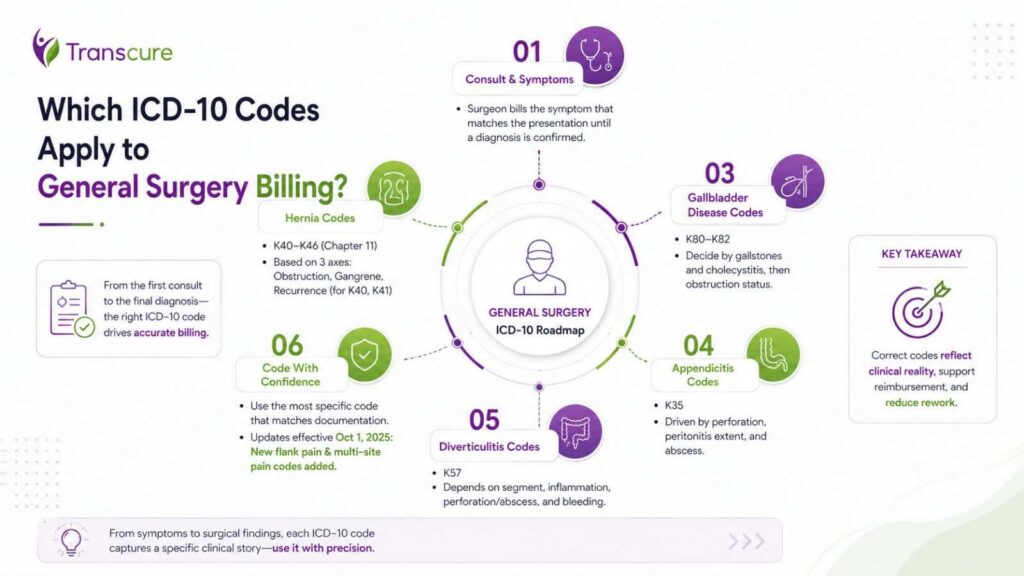
A referring physician usually sends a patient to general surgery with a symptom, not a confirmed diagnosis. This is the scenario behind an ICD 10 code for general surgery consult: the consulting surgeon bills the symptom code that matches the presentation until the workup confirms a definitive condition.
| ICD-10 Code | Description | When a Surgeon Reports It |
|---|---|---|
| R10.9 | Unspecified abdominal pain | Documentation does not specify the pain location or cause |
| R10.31 | Right lower quadrant pain | Classic presenting symptom before an appendicitis workup |
| R10.32 | Left lower quadrant pain | Presenting symptom before a diverticulitis workup |
| R10.0 | Acute abdomen | Sudden, severe, generalized pain in a surgical emergency |
| R10.11 | Right upper quadrant pain | Presenting symptom before a gallbladder workup |
| R10.13 | Epigastric pain | Presenting symptom before a hiatal hernia or ulcer workup |
Once imaging or surgical findings confirm a diagnosis, the surgeon drops the symptom code and reports the confirmed condition instead. The Centers for Medicare and Medicaid Services added flank pain codes (R10.A0 through R10.A3) and a multi-site pain code (R10.85) to the R10 family, effective October 1, 2025.
Hernia ICD-10 Codes
Hernia diagnoses fall under categories K40 through K46 in Chapter 11. Every hernia type follows the same 3-axis logic: obstruction status, gangrene status, and, for inguinal and femoral hernias, recurrence status.
| Hernia Type | Without Obstruction or Gangrene | With Obstruction, Without Gangrene | With Gangrene |
|---|---|---|---|
| Unilateral inguinal | K40.90 (not recurrent) / K40.91 (recurrent) | K40.30 / K40.31 | K40.40 / K40.41 |
| Bilateral inguinal | K40.20 / K40.21 | K40.00 / K40.01 | K40.10 / K40.11 |
| Unilateral femoral | K41.90 / K41.91 | K41.30 / K41.31 | K41.40 / K41.41 |
| Bilateral femoral | K41.20 / K41.21 | K41.00 / K41.01 | K41.10 / K41.11 |
| Umbilical | K42.9 | K42.0 | K42.1 |
| Incisional | K43.2 | K43.0 | K43.1 |
| Parastomal | K43.5 | K43.3 | K43.4 |
| Ventral (other/unspecified) | K43.9 | K43.6 | K43.7 |
| Diaphragmatic (includes hiatal) | K44.9 | K44.0 | K44.1 |
| Other specified abdominal | K45.8 | K45.0 | K45.1 |
| Unspecified abdominal | K46.9 | K46.0 | K46.1 |
Inguinal and Femoral Hernia
Only the inguinal (K40) and femoral (K41) categories carry a recurrence character. Every code in these 2 families ends in either 0 (not specified as recurrent) or 1 (recurrent). A repeat repair reported under CPT 49507 requires the operative note to state the hernia is recurrent, not simply present again. Full CPT selection logic for hernia repair sits in our general surgery CPT guide.
Umbilical, Incisional, and Parastomal Hernia
The umbilical, incisional, and parastomal families do not track laterality or recurrence, since these hernias form at a fixed midline or surgical site rather than a paired anatomic structure. Documentation focuses only on obstruction and gangrene status for these 3 types.
Diaphragmatic Hernia and the Hiatal Hernia Overlap
K44.9 covers hiatal hernia, since ICD-10-CM classifies a hiatal or sliding esophageal hernia under the broader diaphragmatic hernia category rather than a separate code. A congenital diaphragmatic hernia in a newborn uses a different code from Chapter 17, outside this K44 family entirely.
Gallbladder Disease ICD-10 Codes
Gallbladder and bile duct codes fall under categories K80 through K83. The base decision is whether gallstones are documented, whether cholecystitis accompanies them, and whether the bile duct itself is involved.
| Clinical Presentation | Without Obstruction | With Obstruction |
|---|---|---|
| Gallstones with acute cholecystitis | K80.00 | K80.01 |
| Gallstones with chronic cholecystitis | K80.10 | K80.11 |
| Gallstones with acute and chronic cholecystitis | K80.12 | K80.13 |
| Gallstones with other cholecystitis | K80.18 | K80.19 |
| Gallstones without cholecystitis | K80.20 | K80.21 |
Cholecystitis Without Documented Gallstones
When the operative note confirms cholecystitis but does not mention gallstones, the code comes from the K81 family instead of the combination table above.
| Cholecystitis Without Documented Gallstones | ICD-10 Code |
|---|---|
| Acute cholecystitis | K81.0 |
| Chronic cholecystitis | K81.1 |
| Acute cholecystitis with chronic cholecystitis | K81.2 |
| Cholecystitis, unspecified | K81.9 |
Related Gallbladder and Bile Duct Findings
A few less common but clinically important gallbladder and bile duct diagnoses fall outside both tables above.
| Related Gallbladder and Bile Duct Findings | ICD-10 Code |
|---|---|
| Calculus of bile duct with cholangitis, unspecified, without obstruction | K80.30 |
| Calculus of bile duct with cholangitis, unspecified, with obstruction | K80.31 |
| Cholesterolosis of gallbladder | K82.4 |
| Postcholecystectomy syndrome | K91.5 |
| Malignant neoplasm of gallbladder | C23 |
Why K81 and K80 Cannot Be Reported Together
The K81 category carries an Excludes1 note against cholecystitis with cholelithiasis. This means a surgeon never reports a K81 code and a K80 code for the same gallbladder inflammation in the same encounter. When both gallstones and cholecystitis appear in the operative note, the K80 combination table above replaces both separate codes.
Postcholecystectomy Syndrome and Bile Duct Stones
K91.5 documents postcholecystectomy syndrome, the code a surgeon reports when a patient develops recurring symptoms after gallbladder removal, once a new gallbladder problem is ruled out. K80.30 documents a bile duct stone with cholangitis, a presentation that carries higher surgical urgency than a straightforward gallbladder stone, since an obstructed bile duct raises the risk of ascending infection.
Appendicitis ICD-10 Codes
Appendicitis codes fall under categories K35 through K38. The code depends on whether the appendix has perforated, whether peritonitis is present and how extensive it is, and whether the presentation is acute, chronic, or resolved without surgery.
| Presentation | Without Abscess | With Abscess |
|---|---|---|
| Generalized peritonitis, unspecified perforation | K35.209 | K35.219 |
| Generalized peritonitis, without perforation | K35.200 | K35.210 |
| Generalized peritonitis, with perforation | K35.201 | K35.211 |
| Localized peritonitis, without perforation or gangrene | K35.30 | — |
| Localized peritonitis, with gangrene, without perforation | K35.31 | — |
| Localized peritonitis, with perforation and gangrene | K35.32 | K35.33 |
Other Appendicitis Presentations
The presentations below fall outside the perforation-and-peritonitis matrix and cover unspecified, chronic, and non-acute appendiceal diagnoses.
| Other Appendicitis Presentations | ICD-10 Code |
|---|---|
| Unspecified acute appendicitis | K35.80 |
| Other acute appendicitis, without perforation or gangrene | K35.890 |
| Other acute appendicitis, without perforation, with gangrene | K35.891 |
| Chronic appendicitis (recurrent) | K36 |
| Unspecified appendicitis | K37 |
| Other diseases of the appendix | K38.- |
A pathology report that only states “acute appendicitis” without describing perforation or peritonitis supports K35.80. K36 applies to the less common presentation of chronic or recurrent appendiceal inflammation confirmed outside an acute episode, and K37 applies only when the record confirms appendicitis but does not specify whether it is acute or chronic.
Diverticulitis ICD-10 Codes
Diverticular disease codes fall under category K57. The code depends on 4 factors: which intestinal segment is affected, whether the presentation is diverticulosis or diverticulitis, whether perforation or abscess is present, and whether bleeding is documented. The table below covers the codes a general surgeon reports most often.
| Segment | Diverticulitis, No Perforation or Abscess, No Bleeding | Diverticulitis, No Perforation or Abscess, With Bleeding | Diverticulitis, With Perforation and Abscess |
|---|---|---|---|
| Large intestine (includes sigmoid) | K57.32 | K57.33 | K57.20 (without bleeding) |
| Small and large intestine, both | K57.52 | K57.53 | K57.40 (without bleeding) |
| Part unspecified | K57.92 | K57.93 | K57.80 (without bleeding) |
Diverticulosis Versus Diverticulitis
Diverticulosis describes the presence of diverticula without inflammation, and diverticulitis describes the same pouches once they become inflamed or infected. K57.30 reports diverticulosis of the large intestine without perforation, abscess, or bleeding, the code that applies when imaging finds diverticula incidentally but the patient shows no signs of infection. A general surgeon rarely bills a diverticulosis code directly, since the condition alone does not usually justify surgical management.
Colorectal ICD-10 Codes: Rectal, Anal, and Common Office Conditions
Colorectal coding extends past colon cancer into the rectum, the anal canal, and a set of benign anorectal conditions that fill a large share of a general surgeon’s office schedule. Each site carries its own code family, and mixing up the rectum, the rectosigmoid junction, and the anal canal is a frequent staging error.
Rectal and Anal Cancer ICD-10 Codes
| Anatomic Site | ICD-10 Code |
|---|---|
| Rectosigmoid junction | C19 |
| Rectum | C20 |
| Anus, unspecified | C21.0 |
| Anal canal | C21.1 |
| Cloacogenic zone | C21.2 |
| Overlapping sites of rectum, anus, and anal canal | C21.8 |
| Personal history of rectal cancer | Z85.048 |
| Personal history of rectosigmoid junction cancer | Z85.038 |
C19 and C20 sit next to each other in the tabular list but describe different anatomic sites. A tumor that spans both the rectum and the sigmoid colon supports C19, while a tumor confined to the rectum itself supports C20. A pathology report that only says “colorectal cancer” without naming the exact site does not support either code with full accuracy, so a surgeon requests the specific location before final code selection.
Hemorrhoids ICD-10 Codes
| Hemorrhoid Grade | ICD-10 Code |
|---|---|
| First degree | K64.0 |
| Second degree | K64.1 |
| Third degree | K64.2 |
| Fourth degree | K64.3 |
| Residual hemorrhoidal skin tags | K64.4 |
| Perianal venous thrombosis | K64.5 |
| Unspecified hemorrhoids | K64.9 |
The grading system tracks prolapse behavior, not size. A first degree hemorrhoid does not prolapse. A second degree hemorrhoid prolapses with straining but retracts on its own. A third degree hemorrhoid prolapses and requires manual reduction. A fourth degree hemorrhoid stays permanently prolapsed and does not reduce at all. This distinction drives the choice between office treatment and a hemorrhoidectomy, so the grade belongs in the operative note, not just the word “hemorrhoids.”
Anal Fissure and Fistula ICD-10 Codes
| Condition | ICD-10 Code |
|---|---|
| Acute anal fissure | K60.0 |
| Chronic anal fissure | K60.1 |
| Anal fissure, unspecified | K60.2 |
| Anal fistula | K60.3 |
| Rectal fistula | K60.4 |
| Anorectal fistula | K60.5 |
A fissure that persists past 8 weeks moves from the acute code, K60.0, to the chronic code, K60.1, since chronicity changes both the treatment plan and the surgical necessity for a sphincterotomy. A fistula code names the tract’s path rather than its cause, so the surgeon’s description of where the tract opens, at the anus, the rectum, or between the two, determines which of the 3 fistula codes applies.
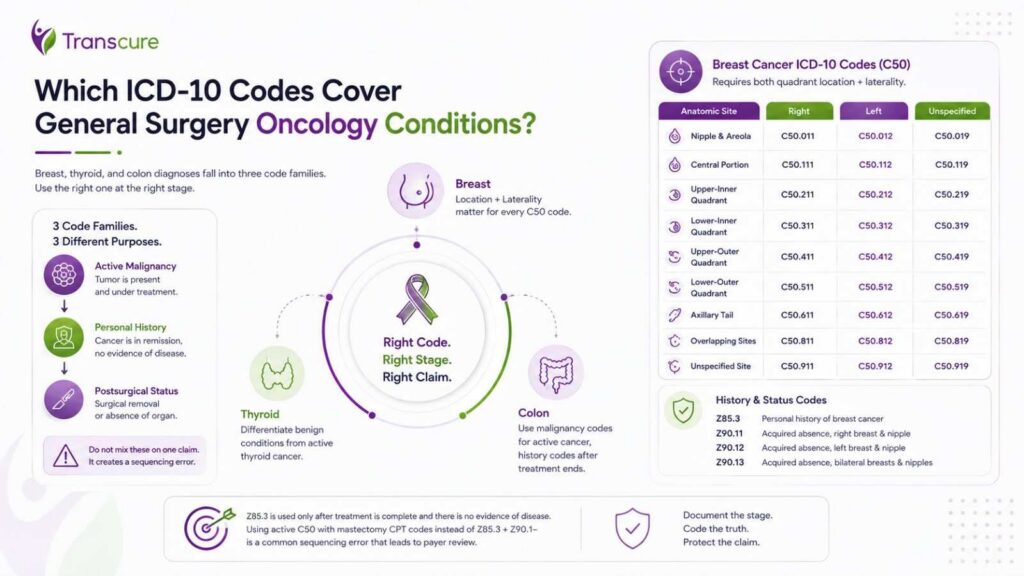
Which ICD-10 Codes Cover General Surgery Oncology Conditions?
Breast diagnoses split into 4 categories: benign findings, active malignancy, personal history of malignancy, and mastectomy status. A general surgeon sees far more benign breast referrals than cancer cases, so the benign code family carries real claim volume even though it rarely makes it into a coding guide.
Benign Breast Condition ICD-10 Codes
| Condition | ICD-10 Code |
|---|---|
| Fibroadenoma of breast | D24.- |
| Cyst of breast | N60.0- |
| Fibrocystic changes of breast | N60.1- |
| Gynecomastia | N62 |
| Mastodynia (breast pain) | N64.4 |
| Unspecified lump in breast | N63.- |
Fibroadenoma, coded from D24, sits in the benign neoplasm chapter rather than Chapter 11, since ICD-10-CM treats it as a tumor even though it carries no malignant potential. N60.0- requires a laterality character, so a solitary cyst of the right breast and the same cyst on the left use 2 different codes. Gynecomastia, N62, does not split by laterality, since the condition typically presents bilaterally and the code does not track a single-side variant.
Breast Cancer ICD-10 Codes
C50 requires both a quadrant location and a laterality character. The table below lists the anatomic sites a general surgeon reports most often, each with its right, left, and unspecified variant.
| Anatomic Site | Right | Left | Unspecified Side |
|---|---|---|---|
| Nipple and areola | C50.011 | C50.012 | C50.019 |
| Central portion | C50.111 | C50.112 | C50.119 |
| Upper-inner quadrant | C50.211 | C50.212 | C50.219 |
| Lower-inner quadrant | C50.311 | C50.312 | C50.319 |
| Upper-outer quadrant | C50.411 | C50.412 | C50.419 |
| Lower-outer quadrant | C50.511 | C50.512 | C50.519 |
| Axillary tail | C50.611 | C50.612 | C50.619 |
| Overlapping sites | C50.811 | C50.812 | C50.819 |
| Unspecified site | C50.911 | C50.912 | C50.919 |
Personal History and Mastectomy Status
Once active treatment ends, the code shifts from the active C50 table above to a history or postsurgical status code.
| History and Status Codes | ICD-10 Code |
|---|---|
| Personal history of breast cancer | Z85.3 |
| Acquired absence, right breast and nipple | Z90.11 |
| Acquired absence, left breast and nipple | Z90.12 |
| Acquired absence, bilateral breasts and nipples | Z90.13 |
Z85.3 replaces the active C50 code only after treatment ends and no evidence of disease remains, not while the patient still receives chemotherapy, radiation, or hormonal therapy directed at the tumor. Reporting mastectomy CPT codes such as 19301, 19303, or 19120 alongside an active C50 diagnosis instead of the Z85.3 and Z90.1- pairing is a common sequencing error that draws payer review.
What are Thyroid Surgery ICD-10 Codes?
Thyroid diagnoses split into 4 stages: overactivity, inflammation, benign nodularity, and active malignancy, each ending in a different postsurgical status once the gland is removed.
Hyperthyroidism and Thyroiditis ICD-10 Codes
| Condition | ICD-10 Code |
|---|---|
| Graves’ disease (toxic diffuse goiter) | E05.0- |
| Toxic multinodular goiter | E05.2- |
| Thyrotoxicosis of other origin | E05.8- |
| Thyrotoxicosis, unspecified | E05.9- |
| Acute thyroiditis | E06.0 |
| Subacute thyroiditis | E06.1 |
| Hashimoto’s thyroiditis (chronic autoimmune) | E06.3 |
A surgeon confirms which of these conditions drove the surgical referral, since Graves’ disease and toxic multinodular goiter carry different surgical urgency and anesthesia risk than a nodule found incidentally on imaging.
Thyroid Nodule, Thyroid Cancer & Thyroidectomy ICD-10 Codes
| Condition | ICD-10 Code |
|---|---|
| Nontoxic diffuse goiter | E04.0 |
| Nontoxic single thyroid nodule | E04.1 |
| Nontoxic multinodular goiter | E04.2 |
| Other specified nontoxic goiter | E04.8 |
| Nontoxic goiter, unspecified | E04.9 |
| Malignant neoplasm of thyroid gland | C73 |
| Personal history of thyroid cancer | Z85.850 |
| Acquired absence of thyroid gland | Z90.09 |
E04.1 applies only when thyroid function tests confirm normal hormone levels, since an overactive nodule falls under the E05 family covered above, not the E04 family. C73 does not split by laterality or lobe, since ICD-10-CM treats the thyroid as one gland regardless of which lobe holds the tumor. Z90.09 pairs with E89.0, postprocedural hypothyroidism, when the record documents hormone insufficiency following a total thyroidectomy.
Hyperparathyroidism and Parathyroid Surgery
| Condition | ICD-10 Code |
|---|---|
| Primary hyperparathyroidism | E21.0 |
| Secondary hyperparathyroidism, not elsewhere classified | E21.1 |
| Other hyperparathyroidism | E21.2 |
A general surgeon often addresses the thyroid and the parathyroid glands in the same operative session, since both sit in the same anatomic region of the neck. E21.0 supports a parathyroidectomy when lab values confirm elevated calcium and parathyroid hormone without a secondary cause, such as chronic kidney disease.
What are Bariatric Surgery ICD-10 Codes?
Bariatric coding starts with the obesity diagnosis, adds a required BMI code, and continues into a lifelong postsurgical status once the procedure is complete.
Obesity and BMI ICD-10 Codes
| Condition | ICD-10 Code |
|---|---|
| Morbid obesity due to excess calories | E66.01 |
| Morbid obesity with alveolar hypoventilation | E66.2 |
| Other obesity due to excess calories | E66.09 |
| Overweight | E66.3 |
| Obesity, unspecified | E66.9 |
BMI Codes That Must Accompany the Obesity Diagnosis
Every morbid obesity code above requires a companion BMI code from the table below before most payers accept the claim.
| BMI Range (Adult) | ICD-10 Code |
|---|---|
| 40.0 to 44.9 | Z68.41 |
| 45.0 to 49.9 | Z68.42 |
| 50.0 to 59.9 | Z68.43 |
| 60.0 to 69.9 | Z68.44 |
| 70 or greater | Z68.45 |
E66.01 requires a companion BMI code from the Z68.41 through Z68.45 range before most payers process the claim. Documentation that supports “morbid obesity” or a BMI of 40 or higher without an actual obesity diagnosis on the chart is a frequent audit trigger, since the BMI number alone does not substitute for the diagnosis itself.
Post-Bariatric Status and Complication ICD-10 Codes
| Condition | ICD-10 Code |
|---|---|
| Bariatric surgery status | Z98.84 |
| Postgastric surgery syndromes (including dumping syndrome) | K91.1 |
| Vitamin D deficiency | E55.9 |
| Iron deficiency anemia | D50.0 |
Z98.84 stays on the chart for life once a patient has had bariatric surgery, and a surgeon reports it alongside any current condition still being managed, such as obesity itself if weight loss goals are not yet met. Post-bariatric nutritional deficiencies, including vitamin D and iron deficiency, are coded as separate diagnoses whenever the chart documents lab-confirmed deficiency, not simply reported alongside Z98.84 by default.
What are Vascular ICD-10 Codes for General Surgery?
General surgeons manage a defined slice of vascular disease, centered on varicose vein disease and its complications, rather than the full arterial and venous scope a vascular surgeon covers.
Varicose Vein ICD-10 Codes
| Presentation | Right | Left | Bilateral |
|---|---|---|---|
| Asymptomatic | I83.91 | I83.92 | I83.93 |
| With pain | I83.811 | I83.812 | I83.813 |
| With ulcer (unspecified site) | I83.001-I83.009 | I83.011-I83.019 | — |
I83.90 documents asymptomatic varicose veins of an unspecified lower extremity, the default when laterality is not recorded. Chronic venous insufficiency without visible varicosities uses a separate code, I87.2, which a surgeon reports alongside I83 only when both conditions coexist in the same leg, not as a substitute for it.
Pregnancy changes the code entirely: varicose veins that develop during pregnancy move to category O22.0- rather than I83, with the final character marking the trimester. A general surgeon evaluating a pregnant patient for vein complaints checks for this exception before defaulting to the standard I83 codes.
Which ICD-10 Codes for General Surgery Comes Under Thoracic and Chest Wall?
General surgeons handle a limited set of thoracic conditions, mainly chest wall abnormalities, pneumothorax requiring a chest tube, and rib injuries encountered alongside abdominal trauma.
| Condition | ICD-10 Code |
|---|---|
| Pectus excavatum (congenital) | Q67.6 |
| Pectus carinatum (congenital) | Q67.7 |
| Spontaneous pneumothorax, primary | J93.11 |
| Spontaneous pneumothorax, secondary | J93.12 |
| Traumatic pneumothorax | S27.0 |
| Rib fracture, unspecified ribs, unspecified side | S22.9 |
Q67.6 and Q67.7 apply to the congenital chest wall deformities a general surgeon repairs during childhood or early adulthood, distinct from any acquired chest wall condition. A pneumothorax found during an unrelated abdominal trauma workup requires its own code from the S27 or J93 family, reported alongside the abdominal injury rather than folded into it.
What are Trauma Surgery ICD-10 Codes?
Trauma coding for solid abdominal organs follows a severity scale from contusion to major laceration, and every code requires the standard 7th character marking the encounter type.
Splenic Injury ICD-10 Codes
| Injury Severity | ICD-10 Code (Initial Encounter) |
|---|---|
| Minor contusion | S36.020A |
| Major contusion | S36.021A |
| Superficial (capsular) laceration | S36.030A |
| Moderate laceration | S36.031A |
| Major laceration | S36.032A |
Liver Injury ICD-10 Codes
| Injury Severity | ICD-10 Code (Initial Encounter) |
|---|---|
| Contusion | S36.112A |
| Laceration, unspecified degree | S36.113A |
| Minor laceration | S36.114A |
| Moderate laceration | S36.115A |
A splenic or liver laceration code depends on the depth and extent documented in the operative or imaging report, not the word “laceration” alone. A major splenic laceration, S36.032A, generally reflects a tear deeper than 3 centimeters or one involving vascular injury, while a superficial laceration, S36.030A, reflects a shallow capsular tear. A trauma surgeon who documents only “spleen injury” without a severity grade forces the coder toward a less specific code, which understates the true complexity of the case.
Colon Cancer ICD-10 Codes
Colon cancer coding depends on the exact segment named in the pathology report, not just the word “colon.” The table below breaks that segment down, followed by the screening and history codes that often accompany it.
| Colon Segment | ICD-10 Code |
|---|---|
| Cecum | C18.0 |
| Appendix | C18.1 |
| Ascending colon | C18.2 |
| Hepatic flexure | C18.3 |
| Transverse colon | C18.4 |
| Splenic flexure | C18.5 |
| Descending colon | C18.6 |
| Sigmoid colon | C18.7 |
| Overlapping sites of colon | C18.8 |
| Colon, unspecified | C18.9 |
Screening and History Codes
These codes apply once cancer is not the active finding, either because the visit is a screening encounter or because treatment has already concluded.
| Screening and History Codes | ICD-10 Code |
|---|---|
| Encounter for screening for malignant neoplasm of the colon | Z12.11 |
| Personal history of malignant neoplasm of other parts of the large intestine | Z85.038 |
A screening colonoscopy with no personal or family history uses Z12.11, a code that sits in a separate category from both the active diagnosis and the history code. Converting a screening encounter to Z85.038 or an active C18 code without a documented finding is a frequent cause of a non-covered charge denial.
Post-Surgical Complication & Wound ICD-10 Codes
Postoperative complications sit in Chapter 19 and use T-codes and L-codes rather than the K-codes that cover the original condition. Every code in this category requires a 7th character: A for an initial encounter, D for a subsequent encounter, and S for a sequela.
| Surgical Site Infection Depth | ICD-10 Code (Initial Encounter) |
|---|---|
| Unspecified | T81.40XA |
| Superficial incisional | T81.41XA |
| Deep incisional | T81.42XA |
| Organ and space | T81.43XA |
| Sepsis following a procedure | T81.44XA |
| Other surgical site | T81.49XA |
Wound Disruption, Classified by Location
A wound disruption describes a separation of the surgical closure itself, not an infection, and the code depends on whether the separation involves the skin surface or the deeper abdominal wall layers.
| Wound Disruption | ICD-10 Code (Initial Encounter) |
|---|---|
| External operation wound, not elsewhere classified | T81.31XA |
| Internal wound, abdominal wall muscle or fascia | T81.321A |
| Internal wound, other surgical site | T81.328A |
A complete wound separation with visible organ protrusion, commonly called evisceration, does not carry its own separate ICD-10-CM code. A surgeon documents it using the same T81.32 family, with the operative note describing the evisceration itself to support the clinical severity behind the code.
Fluid Collection, Classified by Content
A postprocedural fluid collection forms at the incision site without an open separation of the wound, and the code depends on whether the collection is blood or serous fluid.
| Fluid Collection (Non-Dermatologic Procedure) | ICD-10 Code |
|---|---|
| Postprocedural hematoma | L76.32 |
| Postprocedural seroma | L76.34 |
Digestive-System-Specific Postoperative Complications
A few postoperative complications stay classified under the original K91 category in Chapter 11, since they affect the digestive system directly rather than the skin or soft tissue covered by the T-code and L-code tables above.
| Condition | ICD-10 Code |
|---|---|
| Postprocedural intestinal obstruction (postoperative ileus) | K91.3 |
| Postcholecystectomy syndrome | K91.5 |
| Other postprocedural complications and disorders of digestive system | K91.89 |
An anastomotic leak does not have its own dedicated ICD-10-CM code. A surgeon documents the leak in the operative or progress note, and the coder reports K91.89, the catch-all code for digestive system complications not classified elsewhere, since the current code set has not carved out a separate category for this specific complication.
Why the 7th Character Carries As Much Weight As the Base Code
A claim submitted with the wrong 7th character, such as A for a follow-up visit that should carry D, denies for an encounter-type mismatch even when the base code is correct. A surgeon or coder confirms whether the visit is the first evaluation of the complication or a later follow-up before selecting that character.
Which General Surgery ICD-10 Errors Cause the Most Denials?
Four claim adjustment reason codes account for most general surgery diagnosis-driven denials.
| CARC | Denial Reason | General Surgery Root Cause | Corrective Action |
|---|---|---|---|
| CO-11 | Diagnosis inconsistent with the procedure | A hernia repair CPT code billed with an unspecified abdominal pain code instead of the confirmed hernia diagnosis | Replace the symptom code with the confirmed diagnosis before submission |
| CO-16 | Claim lacks information or has submission errors | A postoperative complication code submitted without the required 7th character | Add the correct encounter-type character before resubmission |
| CO-50 | Not deemed a medical necessity | An unspecified code such as K81.9 attached to imaging or an extended visit level | Replace the unspecified code with the documented specificity |
| PR-96 | Non-covered charge | A screening colonoscopy code billed alongside a personal history code that converts the service to diagnostic | Verify screening versus diagnostic intent before scheduling |
CO-16 and CO-50 respond to documentation template changes rather than coder retraining alone. CO-11 and PR-96 respond to front-end coding review, since both denials trace back to a mismatch between the diagnosis and the service billed, not to an invalid code.
Frequently Asked Questions
What Is the ICD-10 Code for Surgical Aftercare After a General Surgery Procedure?
Z48.815 reports an encounter for surgical aftercare following surgery on the digestive system. A surgeon reports this code for a routine recovery visit, not for a visit where the patient returns with a complication such as an infection or wound dehiscence.
How Often Does CMS Update the ICD-10-CM Code Set?
The Centers for Medicare and Medicaid Services updates ICD-10-CM once a year, with new codes taking effect every October 1. A practice that codes from an outdated list risks denials once the prior year’s deleted codes stop processing.
Is Exploratory Laparotomy Assigned Its Own ICD-10 Code?
No, Exploratory laparotomy is a surgical procedure, reported through a CPT code, not a diagnosis. The ICD-10 code on that claim documents the condition that led to the surgery, such as acute abdomen or a confirmed diagnosis found during the operation.
What Happens When a General Surgery Claim Carries the Wrong ICD-10 Code?
The payer denies or downcodes the claim, since the diagnosis no longer supports the billed procedure. Correcting the code and resubmitting the claim usually restores payment, though the delay adds days to the practice’s accounts receivable cycle.
Can a General Surgery Claim Report More Than One ICD-10 Code?
Yes, A standard claim form allows up to 12 diagnosis codes, and general surgery claims often need several, such as an active condition code paired with a personal history or postsurgical status code on the same encounter.