As many as 30 million Americans are living with COPD, according to the COPD Foundation, and most of them don’t even know it yet. Every one of the diagnosed ones eventually funnels into the same coding decision: J44.9, J44.0, or J44.1.
All three describe COPD. If you get it wrong, the cost is denied claims, documentation queries, and forfeited risk-adjustment revenue. This disease cost the U.S. healthcare system an estimated $49 billion in 2020 alone, according to CDC-cited data.
COPD sits among the most commonly billed pulmonology ICD-10 codes. This guide breaks down exactly what separates J44.9, J44.0, and J44.1, when each applies, and where COPD claims most often go wrong.
COPD ICD-10 Codes: Quick Reference
The table below shows all three COPD codes side by side, along with when each one actually applies.
| Code | Full Descriptor | When to Use |
|---|---|---|
| J44.9 | Chronic obstructive pulmonary disease, unspecified | Stable, documented COPD with no acute exacerbation and no acute infection noted at this encounter |
| J44.0 | Chronic obstructive pulmonary disease with acute lower respiratory infection | COPD complicated by a specifically identified, documented infection |
| J44.1 | Chronic obstructive pulmonary disease with (acute) exacerbation | COPD with a documented worsening of baseline symptoms, no specific infection identified |
Getting this level of specificity right on every claim is exactly what dedicated pulmonary billing support handles as part of end-to-end RCM.
What Is the ICD-10 Code for Stable COPD?
The ICD-10 code for stable, uncomplicated COPD is J44.9. This code applies when a patient has confirmed COPD, but nothing acute is happening at the current visit: no exacerbation, no infection layered on top of it.
It’s the single most commonly used COPD code in outpatient practice, since the majority of COPD encounters are routine follow-ups.
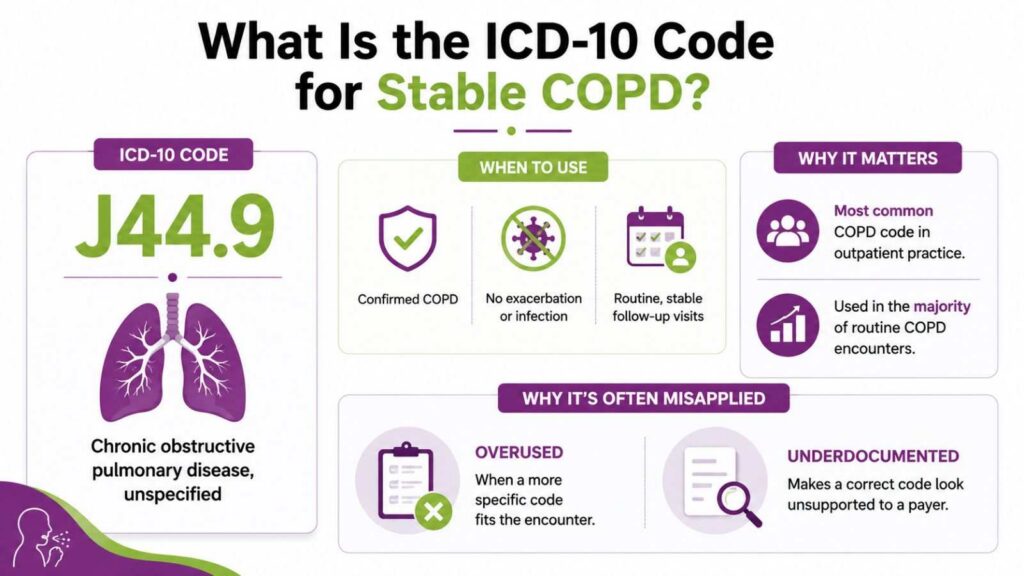
Despite how often it’s used, J44.9 is also the code most frequently misapplied. It is either overused when a more specific code fits the encounter, or underdocumented in a way that makes a perfectly correct code look unsupported to a payer.
What Is the Full Official Descriptor for J44.9?
The complete ICD-10-CM descriptor is “Chronic obstructive pulmonary disease, unspecified.” In this descriptor, the word “unspecified” describes the complication status.
A physician can be completely confident in a COPD diagnosis and still correctly use J44.9, as long as no acute exacerbation or infection is present to document instead.
When Is J44.9 the Correct Code to Use?
Three things need to be true at once for J44.9 to apply. The patient has a documented history of COPD, there’s no acute exacerbation noted for this encounter, and there’s no acute respiratory infection layered on top of the COPD.
This makes J44.9 the code for a routine COPD follow-up, a stable patient managing their medications, or a wellness visit where COPD is simply one of several conditions being monitored. If the note describes worsening symptoms or a new infection, J44.9 no longer applies.
What Documentation Supports J44.9?
The chart needs to support “stable” just as clearly as it supports “COPD.” That means documenting the diagnosis itself, the patient’s current symptom status, and a clear absence of any acute exacerbation or infection.
A note that simply says “COPD, continue current meds” technically supports J44.9. In addition, a note that also states the patient’s baseline symptom level and explicitly rules out an acute complication gives a payer far less reason to question the claim.
Why Does Defaulting to J44.9 Cost Revenue?
J44.9 is the easiest code to reach for, and that’s exactly why it gets overused. When a patient actually has a documented exacerbation or infection, but the coder defaults to unspecified anyway, the practice loses two things at once.
It loses a more specific code that often reimburses differently, and the risk-adjustment value tied to accurately documenting the patient’s true condition.
Since COPD is one of the most common chronic diagnoses in a typical pulmonology panel, that small gap repeats across dozens or hundreds of patients. This is exactly the kind of quiet, compounding leak that shows up across pulmonology billing.
What Is the ICD-10 Code for a COPD Exacerbation?
The ICD-10 code for COPD with an acute exacerbation is J44.1. This code captures a genuine flare-up, a documented worsening of the patient’s baseline symptoms, not a routine visit and not a new infection driving the change.
It’s the second most common code in the COPD family, and it carries real search volume in its own right.
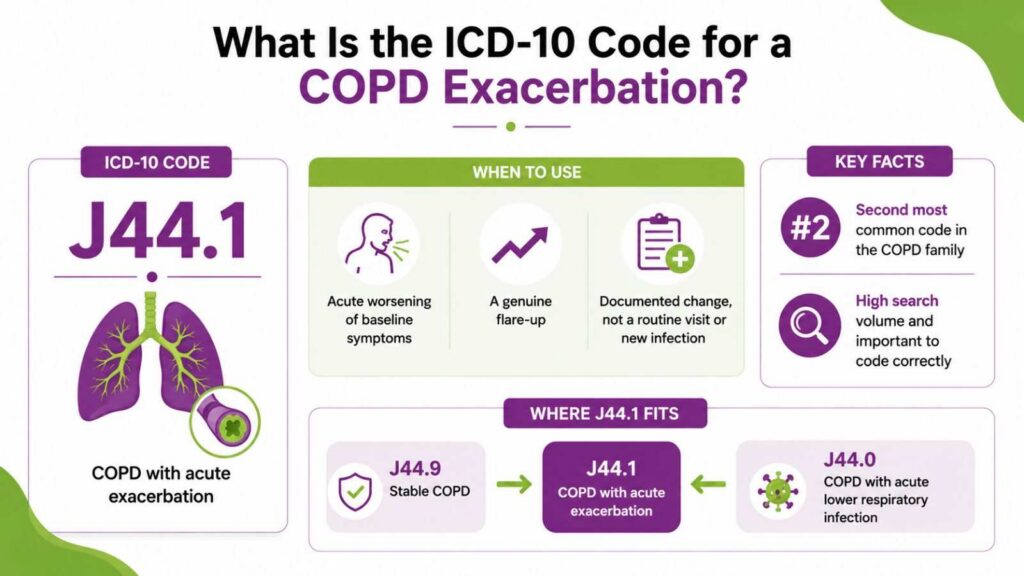
J44.1 sits between the two other codes in this family. It’s more specific than J44.9, since it requires an actual documented change in the patient’s condition, but it’s also easy to confuse with J44.0, since both describe an acute worsening of COPD.
What Is the Full Official Descriptor for J44.1?
The complete descriptor is “Chronic obstructive pulmonary disease with (acute) exacerbation.” The parenthetical “(acute)” signals that the exacerbation itself is the event being coded for this encounter, distinguishing it from a chronic, ongoing baseline state.
What Counts as an Exacerbation for Coding Purposes?
An exacerbation means a documented, acute worsening of the patient’s typical COPD symptoms. That includes increased shortness of breath, an increase in cough, or a change in sputum, beyond what’s normal for that specific patient.
“Exacerbation” isn’t automatically implied just because a COPD patient shows up feeling worse than usual. The documentation needs to describe what actually changed and why that change qualifies as an exacerbation.
How Do You Tell J44.1 Apart From J44.0?
J44.1 applies when the exacerbation isn’t tied to a specific identified infection. Meanwhile, J44.0 applies when the physician has documented an actual acute lower respiratory infection driving the flare-up.
If the note simply says “COPD exacerbation” with no infection mentioned, that’s J44.1. However, if it says something like “COPD exacerbation due to acute bronchitis,” or otherwise names a specific infection, J44.0 is the correct code.
What Documentation Does J44.1 Require?
The chart has to state clearly that an exacerbation occurred, describe the specific symptoms that changed, and either rule out an infection or simply not mention one. Vague language like “COPD flare” doesn’t hold up well on its own.
A note that states the specific increase in dyspnea, cough frequency, or oxygen requirement is much stronger support. The more precisely the note describes the change, the less likely the claim draws a documentation query.
What Is the ICD-10 Code for COPD With an Infection?
The ICD-10 code for COPD complicated by an acute lower respiratory infection is J44.0. This code applies specifically when a documented infection is driving the patient’s current COPD complication. It’s the least commonly used of the three main COPD codes.
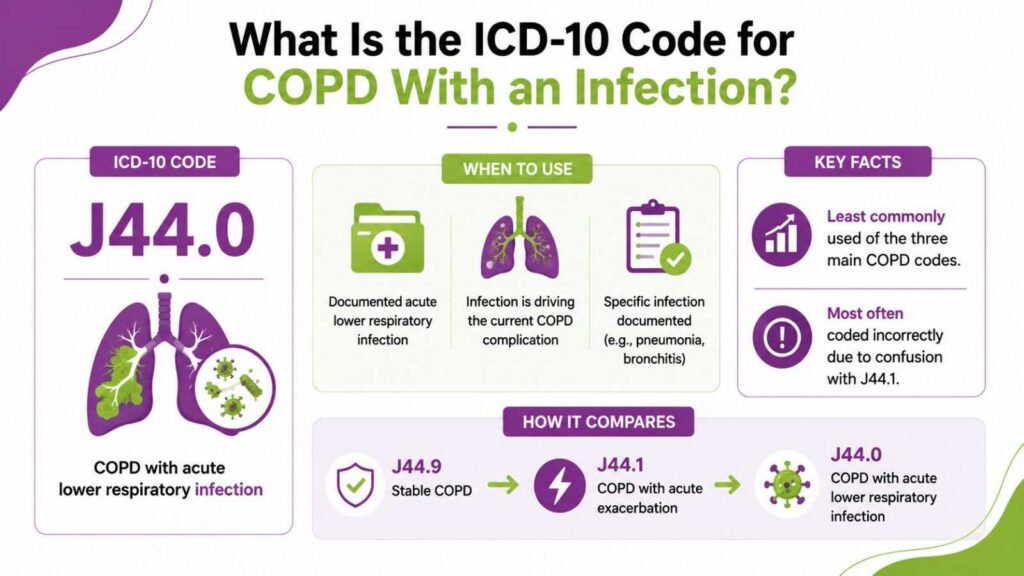
However, it is the one most often coded incorrectly, since the line between “an exacerbation happened” and “an exacerbation happened because of a specific infection” is easy to blur in a fast-moving clinical note.
What Is the Full Official Descriptor for J44.0?
The complete descriptor is “Chronic obstructive pulmonary disease with acute lower respiratory infection.” This wording makes the infection the defining feature of the code, setting it apart clearly from J44.1’s more general exacerbation language.
How Is J44.0 Different From J44.1?
J44.0 requires an actual identified infection, but J44.1 does not. A patient whose COPD worsens for no clearly infectious reason gets J44.1. In contrast, a patient whose COPD worsens specifically because of a diagnosed acute bronchitis, or a similarly named respiratory infection, gets J44.0.
The physician’s documentation has to name the infection directly, not just describe symptoms that could plausibly be infectious in nature.
How Does Sequencing Work When a Specific Infection Diagnosis Is Also Present?
When the physician identifies a specific organism or names a specific infection, that infection code typically gets sequenced alongside J44.0. It tells the payer that a respiratory infection complicated the patient’s COPD.
The additional, more specific infection code tells the payer exactly what that infection was. Leaving out the specific infection code when one has actually been diagnosed under-documents the encounter, and it can weaken the overall strength of the claim.
What CPT Codes Are Commonly Billed Alongside COPD Diagnoses?
An ICD-10 code tells a payer what’s wrong. The CPT code tells them what was actually done about it, and COPD encounters typically pair with a predictable set of procedures. These pulmonology CPT codes paired with COPD ICD-10 include:
- Spirometry codes (94010 and 94060) are the most common pairing, since confirming or monitoring COPD relies on lung function testing. 94010 covers baseline spirometry alone, while 94060 covers the pre- and post-bronchodilator version used to test airway reversibility.
- Evaluation and management codes (99213-99215) cover the office visit itself, and the level billed depends on the complexity of managing the patient’s COPD alongside whatever else is addressed that day.
- Nebulizer treatment (94640) applies when a bronchodilator is administered in-office as part of managing an exacerbation, separate from the diagnostic testing codes above.
- Home oxygen equipment (HCPCS E0424-E0435, E1390-E1391) covers the durable medical equipment side of long-term oxygen therapy, stationary and portable oxygen systems, and concentrators. These are billed separately from the Z99.81 diagnosis code that documents the dependence itself.
How Do You Choose Between J44.0, J44.1, and J44.9?
To choose the right COPD code, you need to answer two questions. First, is anything acute happening at this visit? Second, if so, is it caused by a specific infection?
The decision tree below walks through that logic in the order a coder would actually apply it, right after reading the note.
| Step | Question | If Yes | If No |
|---|---|---|---|
| 1 | Is there a documented acute exacerbation or infection at this visit? | Go to step 2 | Code J44.9 |
| 2 | Is a specific infection identified as the cause? | Code J44.0, plus the specific infection code | Code J44.1 |
The most common mistake at each step is predictable. At step one, coders sometimes assign J44.1 or J44.0 based on the patient simply “seeming worse,” without the chart actually stating an exacerbation occurred.
Similarly, at step two, coders sometimes assign J44.1 when the note actually names an infection, missing the more specific and clinically accurate J44.0.
How Do Excludes1 and Excludes2 Notes Affect COPD Coding?
An Excludes1 note means the two conditions can never be coded together; the code set for ICD-10-CM treats them as mutually exclusive. On the other hand, an Excludes2 note means the two conditions are distinct, but a patient can genuinely have both, and both codes are billable together when each is separately documented.
An Excludes2 note mistaken for an Excludes1 costs a practice a code it was legally entitled to bill. The reverse mistake is worse: an Excludes1 note treated like an Excludes2 triggers a hard clearinghouse or payer rejection instead of a routine denial.
Why Can’t J44.9 and Chronic Bronchitis (J42) Be Billed on the Same Claim?
Because J42 (unspecified chronic bronchitis) carries an Excludes1 note naming J44.9 directly. This means the two codes are considered mutually exclusive under ICD-10-CM and can never appear together on the same claim.
J42 also excludes several other conditions that route into the J44 category, including chronic asthmatic bronchitis and chronic bronchitis with airway obstruction. In practice, this means if a chart describes chronic bronchitis with any element of airway obstruction, the correct code is somewhere in the J44 family.
What Secondary Codes Are Commonly Required With COPD?
A COPD ICD-10 code rarely tells the whole story on its own. The three secondary codes below come up often enough that missing them is a common, avoidable way to under-document a COPD encounter.
| Secondary Code | What It Covers | Sequencing Rule |
|---|---|---|
| F17.210 (Tobacco use and dependence) | Nicotine dependence from cigarettes, expected documentation since smoking drives most COPD cases | Coded alongside COPD; factors into risk adjustment and quality measures |
| Z99.81 (Long-term oxygen dependence) | Continuous home oxygen therapy as an ongoing status | Always sequenced after the primary respiratory diagnosis, never first |
| J96.0x / J96.2x (Acute respiratory failure) | Respiratory failure triggered by a COPD exacerbation | Sequenced as principal diagnosis if it’s the reason for admission; otherwise secondary |
A stable COPD patient on 2 liters of home oxygen at a routine follow-up is a textbook case for pairing J44.9 with Z99.81.
Alternatively, an inpatient admitted specifically for respiratory failure that developed from a COPD exacerbation flips that order: respiratory failure leads, and the COPD code (J44.0 or J44.1) follows as secondary.
How Does COPD Coding Affect HCC Risk Adjustment?
COPD carries real weight under CMS’s HCC risk adjustment model. As of January 1, 2026, that model is Version 28, which fully replaced the older V24. Under V28, COPD falls under HCC 280. Two things matter here more than the exact number attached to it.
First, risk scores reset every year. A COPD diagnosis coded last year doesn’t carry forward, so it has to be documented fresh at least once a year, or the practice quietly loses that risk-adjusted revenue the following year.
Second, exacerbation coding gets audited closely. Billing J44.1 without real documentation of an exacerbation is a known red flag.
Why Do COPD Claims Get Denied?
Most COPD claim denials trace back to a small set of recurring, avoidable causes, all of them covered in detail earlier in this guide. The table below gives an overview of the denial cause, why they happen, and how to fix each one.
| Denial Cause | What It Looks Like | Why It Happens | How to Fix It |
|---|---|---|---|
| Unspecified coding, no supporting variant | J44.9 billed when the chart actually describes an exacerbation or infection | Defaulting to the easiest code instead of reading the note for a documented complication | Confirm the note against the decision tree (exacerbation? infection?) before finalizing the code |
| Missing severity or symptom linkage | Note says “COPD exacerbation” with no description of what actually changed | The word “exacerbation” gets used without stating the specific symptom change behind it | Document the specific increase in dyspnea, cough, or oxygen need that defines the exacerbation |
| Sequencing errors with infection present | J44.0 billed alone, or respiratory failure sequenced incorrectly on an inpatient claim | The specific infection code was never added, or inpatient sequencing rules were applied backward | Always pair J44.0 with the named infection code; sequence respiratory failure first when it’s the reason for admission |
| Excludes1 violations | J44.9 billed alongside J42 (chronic bronchitis) on the same claim | The coder didn’t check whether an Excludes1 conflict applies before submitting | Check Excludes1/Excludes2 notes for every code pairing before the claim goes out, not after a rejection |
Frequently Asked Questions about COPD ICD-10
Can COPD and Asthma Be Coded On The Same Claim?
Yes, when both are documented as genuinely separate conditions. Combined language like “asthma with COPD” routes to J44.89 instead. The physician’s exact wording is what decides which path applies.
Does COPD Require An Annual HCC Recapture?
Yes, risk scores reset every calendar year, so COPD has to be redocumented annually to stay reflected in a patient’s risk score. Skipping this quietly costs revenue the following year with no denial to flag it.
What’s The Difference Between J44.0 And J44.1?
J44.0 requires a named infection; J44.1 doesn’t. The physician’s note has to state the infection directly for J44.0 to apply.
Does J44 Always Require A Tobacco Use Code?
Yes, when tobacco use, dependence, or history applies. The instructional note under category J44 includes a ‘Use additional code’ directive to identify tobacco abuse, dependence, or history. If documented, including F17.21x or Z87.891 is required for complete coding.
Is It Safe To Code “Obstructive Lung Disease” As J44.9 Without Reading The Full Chart?
Absolutely not, as that phrase sometimes describes a serious post-transplant complication. Coding it as J44.9 without checking context can bury a much more significant diagnosis behind a routine-looking code.