The ICD-10 code for cardiomyopathy is I42.9, the default in a category of 13 billable codes. Effective October 1, 2026, I42.0 and I42.8 become non-billable headers, splitting into five new codes. Nonischemic cardiomyopathy has no code of its own; it routes by subtype.
Cardiomyopathy covers a group of heart muscle diseases that enlarge, thicken, or stiffen the myocardium. The condition drives implantable device placement, transplant evaluation, and long-term specialist management. Each of those pathways depends on a specific diagnosis code rather than the unspecified default.
Cardiomyopathy codes also carry risk-adjustment weight. The diagnosis maps to a Hierarchical Condition Category, so specificity moves both claim payment and risk scores under value-based contracts. Accurate billing services for cardio practices depend on matching the documented subtype to the correct I42 code.
This guide covers the cardiomyopathy ICD-10 code I42.9 and the full I42 series. The guide explains nonischemic routing, every subtype code, the types coded outside I42, and the secondary cardiomyopathy convention. The FY2027 ICD-10-CM edition takes effect October 1, 2026, and splits two of the category’s most-used codes.
What Is the ICD-10 Code for Cardiomyopathy?
The ICD-10 code for cardiomyopathy is I42.9, defined as cardiomyopathy, unspecified. I42.9 sits in Chapter 9 of ICD-10-CM, within the block I30 to I5A for other forms of heart disease. The category is I42, cardiomyopathy.
Two of the category’s ten prior fourth-character codes split further under FY2027. The table below maps every billable code in the I42 category effective October 1, 2026.
| ICD-10 Code | Description | Common Documentation |
|---|---|---|
| I42.00 | Dilated cardiomyopathy, unspecified | Dilated, congestive cardiomyopathy NOS, nonischemic dilated |
| I42.01 | Familial-genetic dilated cardiomyopathy | Familial dilated, genetic dilated |
| I42.09 | Other dilated cardiomyopathy | Nonfamilial dilated, secondary dilated |
| I42.1 | Obstructive hypertrophic cardiomyopathy | HOCM, subaortic stenosis |
| I42.2 | Other hypertrophic cardiomyopathy | Nonobstructive, familial hypertrophic |
| I42.3 | Endomyocardial (eosinophilic) disease | Loeffler endocarditis |
| I42.4 | Endocardial fibroelastosis | Congenital cardiomyopathy |
| I42.5 | Other restrictive cardiomyopathy | Restrictive, constrictive, infiltrative |
| I42.6 | Alcoholic cardiomyopathy | Alcohol-related myocardial disease |
| I42.7 | Cardiomyopathy due to drug and external agent | Chemotherapy-induced, radiation |
| I42.81 | Arrhythmogenic cardiomyopathy | ARVC, ARVD, left-dominant arrhythmogenic cardiomyopathy |
| I42.89 | Other cardiomyopathies not elsewhere classified | Noncompaction, tachycardia-induced |
| I42.9 | Cardiomyopathy, unspecified | Type not documented |
The category carries an Includes note for myocardiopathy. Documentation using that term routes to the same code set.
How Does ICD-10-CM Define I42.9 (Cardiomyopathy, Unspecified)?
I42.9 defines cardiomyopathy, unspecified, meaning documented heart muscle disease without a stated subtype. The code is billable and unchanged for FY2027, valid through September 30, 2027. Idiopathic cardiomyopathy indexes here when no further detail appears. Congestive cardiomyopathy now indexes to I42.00, not I42.9. See the dilated cardiomyopathy section below.
Why Is I42 Not a Billable Code?
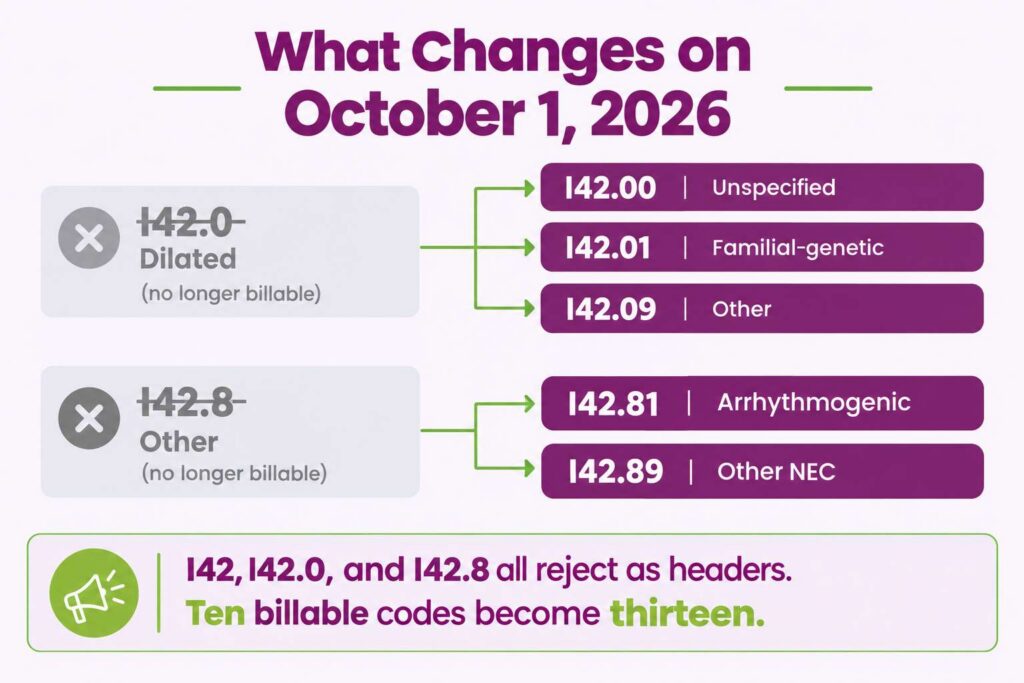
I42 is a category header rather than a billable code. The category requires a fourth character to identify the subtype. Effective October 1, 2026, two of those fourth-character codes, I42.0 and I42.8, become headers themselves and require a fifth character. A claim submitted with I42, I42.0, or I42.8 alone rejects for insufficient specificity, so coders select a full-character code such as I42.00 or I42.81.
Why Does Cardiomyopathy Specificity Affect Risk Adjustment?
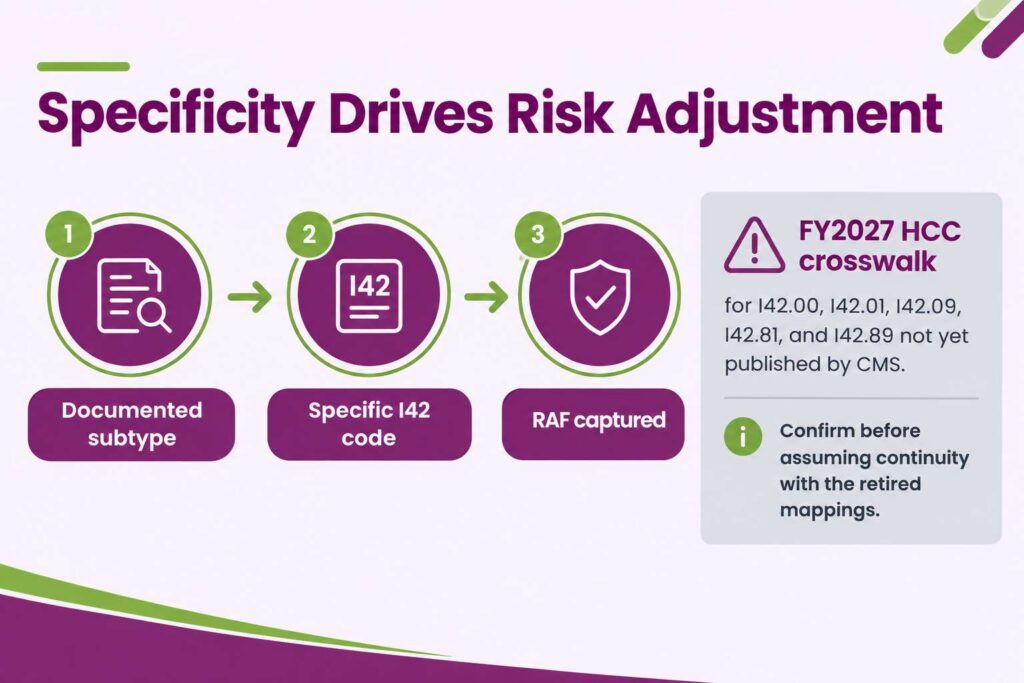
Specificity affects risk adjustment because cardiomyopathy maps to a Hierarchical Condition Category. The diagnosis carries RAF weight that flows into Medicare Advantage and value-based contract payment. An unspecified code still captures the condition, but it weakens the clinical record supporting device, transplant, and specialty referrals.
CMS has not yet published the FY2027 ICD-10-to-CMS-HCC crosswalk for the new I42.00, I42.01, I42.09, I42.81, and I42.89 codes. Practices should confirm HCC mapping against the published crosswalk once CMS releases it, rather than assuming continuity with the retired I42.0 and I42.8 mappings.
Payers also compare submitted codes against the diagnostic record. An echocardiogram naming dilated cardiomyopathy with I42.9 on the claim reads as understated coding.
Why Is There No ICD-10 Code for Nonischemic Cardiomyopathy?
Nonischemic cardiomyopathy has no dedicated ICD-10 code. The term is a clinical umbrella describing heart muscle disease that does not arise from coronary artery disease. Coders route documented nonischemic cardiomyopathy to a specific I42 code by subtype.
What Does Nonischemic Cardiomyopathy Mean in Coding Terms?
Nonischemic cardiomyopathy means the myocardial disease has a cause other than coronary ischemia. Genetic, toxic, infiltrative, inflammatory, and idiopathic causes all fall under the term. Every code in the I42 category is a nonischemic code by definition, which is why no separate code exists.
The abbreviation NICM appears throughout cardiology notes. Coders treat NICM as a signal to look for the subtype rather than as a code target.
How Does Documented NICM Route to a Specific I42 Code?
Documented NICM routes by the subtype named alongside it. The table below maps each documented phrase to its code.
| Documented Term | ICD-10 Code |
|---|---|
| Nonischemic dilated cardiomyopathy | I42.00 |
| Nonischemic congestive cardiomyopathy | I42.00 |
| Familial or genetic nonischemic dilated cardiomyopathy | I42.01 |
| Nonischemic hypertrophic cardiomyopathy, obstructive | I42.1 |
| Nonischemic hypertrophic cardiomyopathy, nonobstructive | I42.2 |
| Nonischemic restrictive cardiomyopathy | I42.5 |
| Nonischemic cardiomyopathy, other specified type | I42.89 |
| Nonischemic cardiomyopathy, no subtype stated | I42.9 |
Dilated is the most common subtype paired with the term. The approximate synonyms for I42.00 include both nonischemic dilated cardiomyopathy and nonischemic congestive cardiomyopathy.
When Is I42.9 Acceptable for Nonischemic Cardiomyopathy?
I42.9 is acceptable when the record states nonischemic cardiomyopathy and names no subtype. The code captures the diagnosis without overstating the documentation. A query to the provider is the better path when an echocardiogram supports a specific type.
What Separates Nonischemic From Ischemic Cardiomyopathy?
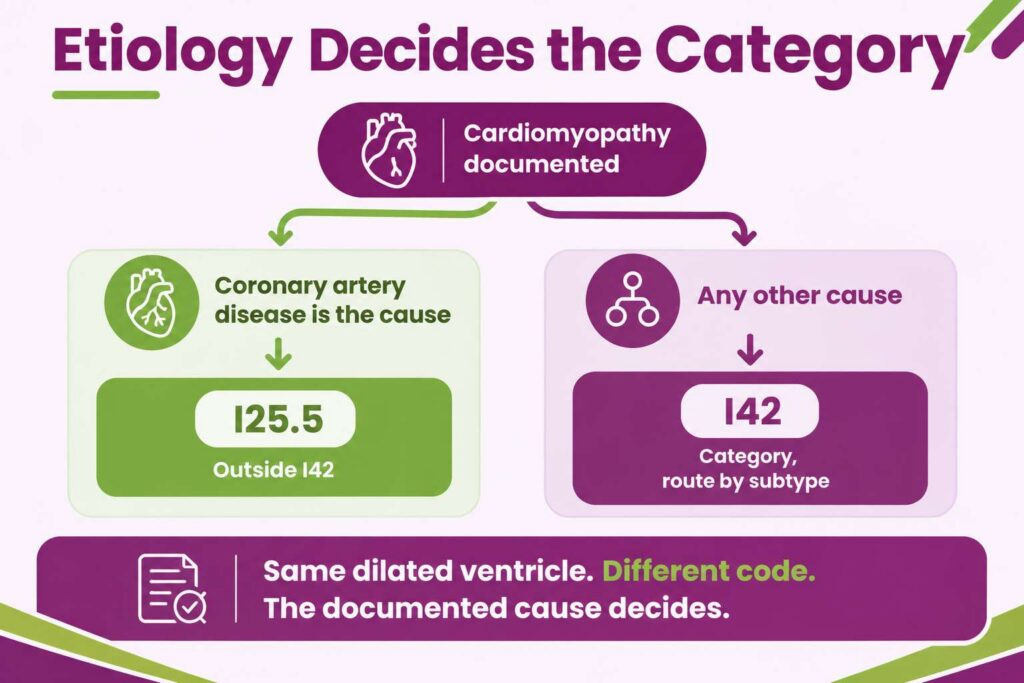
Coronary etiology separates the two. Cardiomyopathy caused by coronary artery disease codes to I25.5, outside the I42 category. Cardiomyopathy from any other cause codes within I42. The distinction rests on the documented cause, not on the appearance of the ventricle.
A dilated left ventricle in a patient with prior myocardial infarction is ischemic. The same finding in a patient with no coronary disease is nonischemic and codes to I42.00.
What Are the Cardiomyopathy Codes by Type?
The I42 category splits by myocardial structure and cause. Each subtype describes a distinct pattern of heart muscle disease. The subsections below define each code and its documentation trigger.
What Is I42.0 (Dilated Cardiomyopathy)?
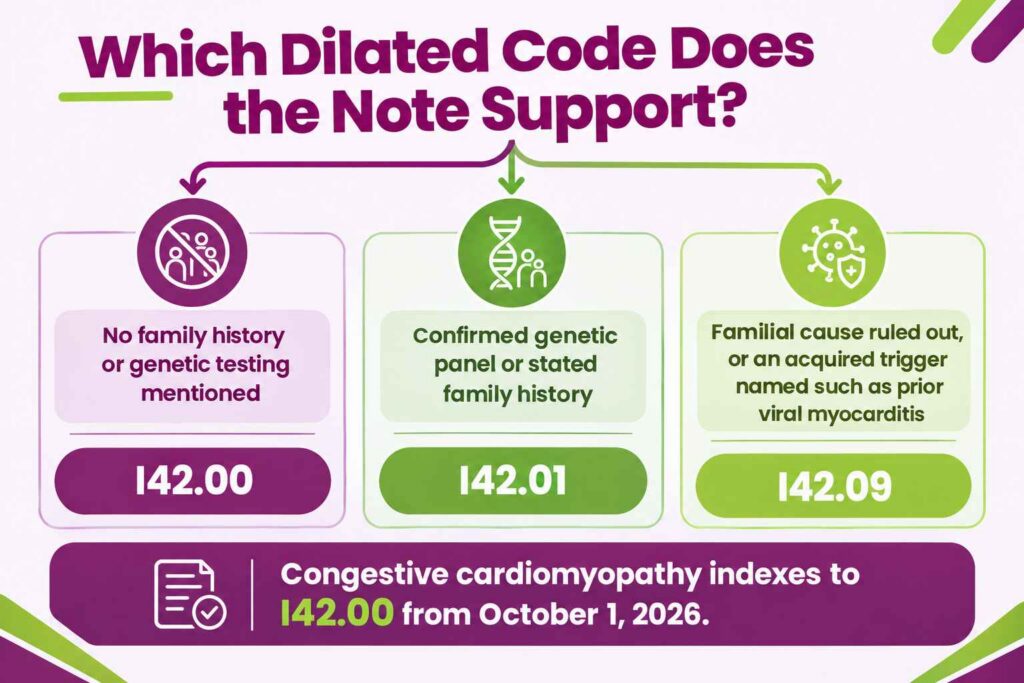
I42.0 no longer accepts a claim on its own. Effective October 1, 2026, dilated cardiomyopathy requires a fifth character, splitting into three codes by cause.
| Code | Description | Documentation Trigger |
|---|---|---|
| I42.00 | Dilated cardiomyopathy, unspecified | Dilated cardiomyopathy with no stated cause; congestive cardiomyopathy NOS |
| I42.01 | Familial-genetic dilated cardiomyopathy | Familial dilated, genetic dilated, inherited dilated |
| I42.09 | Other dilated cardiomyopathy | Nonfamilial dilated, secondary or acquired dilated |
Dilated cardiomyopathy is the highest-volume subtype in the category, and the split moves the field’s most common code from a single character to three. Congestive cardiomyopathy moved with it. The term indexed to I42.0 through September 30, 2026, and indexes to I42.00 starting October 1, 2026. Any pick-list, superbill, or EHR favorite carrying I42.0 as the target for congestive cardiomyopathy stops validating on the cutover date.
The familial-versus-nonfamilial split is new documentation territory. A note reading dilated cardiomyopathy with no family history or genetic testing mentioned supports I42.00, not I42.01. A confirmed genetic panel or a stated family history supports I42.01. A note ruling out a familial cause, or citing a specific acquired trigger such as prior viral myocarditis, supports I42.09.
Dilated cardiomyopathy frequently coexists with heart failure. Coders assign an additional code from the congestive heart failure ICD-10 codes set when the record documents heart failure alongside the cardiomyopathy.
What Are the Hypertrophic Cardiomyopathy Codes? (I42.1 and I42.2)
Hypertrophic cardiomyopathy splits across two codes based on outflow obstruction. The thickened myocardium either obstructs blood flow from the ventricle or does not. Documentation of obstruction decides the code. FY2027 makes no change to either code.
I42.1: Obstructive Hypertrophic Cardiomyopathy
I42.1 codes obstructive hypertrophic cardiomyopathy, commonly documented as HOCM. The thickened septum obstructs the left ventricular outflow tract. Idiopathic hypertrophic subaortic stenosis indexes to the same code.
I42.2: Other Hypertrophic Cardiomyopathy
I42.2 codes hypertrophic cardiomyopathy without obstruction. Nonobstructive hypertrophic cardiomyopathy and familial hypertrophic cardiomyopathy both index here. A note reading hypertrophic cardiomyopathy with no obstruction statement supports I42.2 rather than I42.1.
What Is I42.5 (Other Restrictive Cardiomyopathy)?
I42.5 codes restrictive cardiomyopathy, where the ventricle stiffens and fills poorly while contraction stays intact. Constrictive and infiltrative patterns index here when no underlying systemic disease is named. FY2027 leaves this code unchanged. A documented systemic cause moves the coding to the secondary cardiomyopathy convention described later in this guide.
What Are I42.3 and I42.4?
Two codes cover less common myocardial diseases. Each one applies to a narrow clinical pattern. Neither changes for FY2027.
- I42.3 codes endomyocardial eosinophilic disease, including Loeffler endocarditis.
- I42.4 codes endocardial fibroelastosis, a congenital thickening of the endocardium seen in infants and young children.
What Is I42.6 (Alcoholic Cardiomyopathy)?
I42.6 codes alcoholic cardiomyopathy, myocardial disease caused by long-term alcohol use. The code carries a use-additional instruction for alcohol abuse and dependence from the F10.- family. Reporting I42.6 without the associated F10.- code leaves the record incomplete. FY2027 makes no change here.
What Is I42.7 (Cardiomyopathy Due to Drug and External Agent)?
I42.7 codes cardiomyopathy caused by a drug or external agent. Chemotherapy-induced cardiomyopathy is the most common presentation, particularly after anthracycline therapy. The code carries a use-additional instruction to identify the responsible drug through the adverse effect codes. FY2027 makes no change here.
What Is I42.8 (Other Cardiomyopathies)?
I42.8 no longer accepts a claim on its own. Effective October 1, 2026, other cardiomyopathies requires a fifth character, splitting into two codes.
| Code | Description | Documentation Trigger |
|---|---|---|
| I42.81 | Arrhythmogenic cardiomyopathy | ARVC, ARVD, left-dominant or biventricular arrhythmogenic cardiomyopathy |
| I42.89 | Other cardiomyopathies not elsewhere classified | Noncompaction, tachycardia-induced, other specified type |
I42.81 is broader than ARVC. The prior clinical shorthand, arrhythmogenic right ventricular cardiomyopathy, named only the right-ventricular form. The new code’s descriptor drops the right-ventricular qualifier and covers arrhythmogenic cardiomyopathy generally, including left-dominant and biventricular presentations that previously had no dedicated fourth-character home. ARVC and ARVD both still index to I42.81.
Left ventricular noncompaction and tachycardia-induced cardiomyopathy move to I42.89, alongside any other specified subtype that has no code of its own.
Which Cardiomyopathy Types Are Coded Outside the I42 Category?
Several cardiomyopathy types carry codes outside I42. Each one belongs to a different category or chapter. FY2027 makes no change to any code in this table. The table below maps each type to its correct code.
| Cardiomyopathy Type | ICD-10 Code | Category Note |
|---|---|---|
| Ischemic cardiomyopathy | I25.5 | Excludes2 at I42 |
| Peripartum cardiomyopathy | O90.3 | Excludes2 at I42, Chapter 15 |
| Ventricular hypertrophy | I51.7 | Excludes2 at I42 |
| Takotsubo and stress cardiomyopathy | I51.81 | Reclassified out of I42.8 |
| Hypertensive cardiomyopathy | I11.- | Combination code |
Each type functions as a distinct diagnosis with its own coding rules. None of them belongs in the I42 category.
Why Is Ischemic Cardiomyopathy Coded to I25.5?
Ischemic cardiomyopathy codes to I25.5 because coronary artery disease causes the myocardial damage. The condition belongs to the chronic ischemic heart disease family rather than to the primary heart muscle diseases. Dedicated ischemic heart disease guidance covers the I25 family and its sequencing rules.
What Is the ICD-10 Code for Takotsubo Cardiomyopathy?
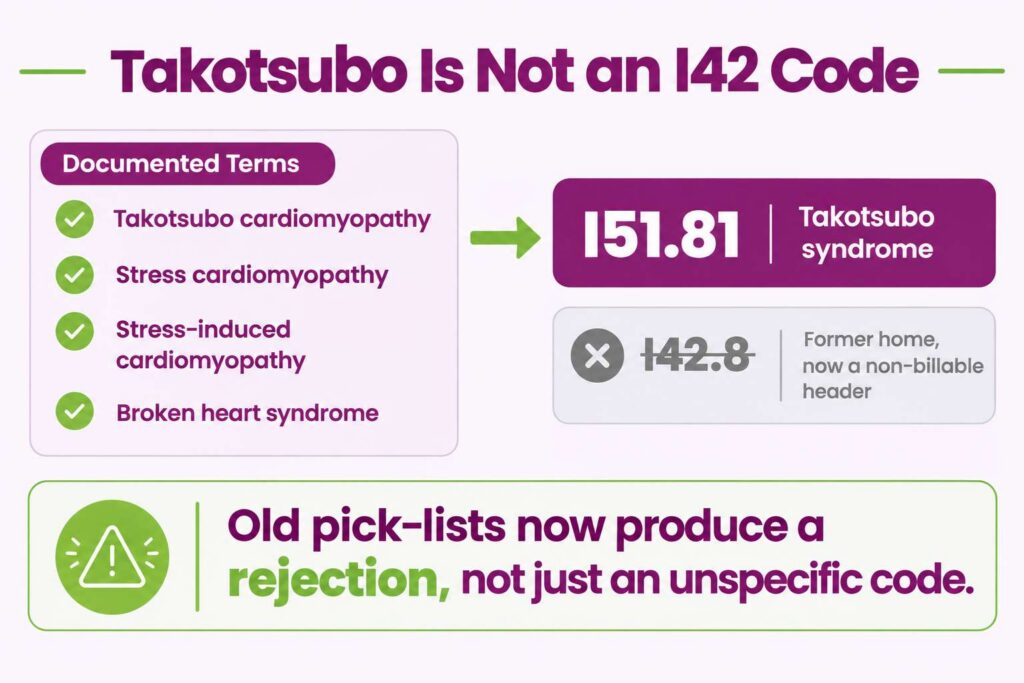
The ICD-10 code for Takotsubo cardiomyopathy is I51.81, Takotsubo syndrome. Stress cardiomyopathy, stress-induced cardiomyopathy, and broken heart syndrome all code to I51.81. The condition was previously classified within I42.8, and FY2027 leaves that reclassification unchanged.
That earlier reclassification still causes ongoing errors. Reference material built before the move still directs coders to I42.8 for Takotsubo, which now produces a rejected claim rather than merely an unspecific one, since I42.8 is a non-billable header. Coders assign I51.81 for every Takotsubo and stress cardiomyopathy diagnosis.
How Is Cardiomyopathy Coded in Pregnancy?
Pregnancy splits cardiomyopathy coding into two paths. The timing of onset relative to the pregnancy decides which path applies. FY2027 makes no change to either code.
- Peripartum cardiomyopathy arising during pregnancy or the puerperium codes to O90.3 in Chapter 15.
- Pre-existing cardiomyopathy complicating pregnancy and the puerperium carries a code-first instruction to O99.4, followed by the I42 code.
The code-first note at I42 for O99.4 is easy to miss. A pregnant patient with a known cardiomyopathy requires the obstetric complication code sequenced ahead of the cardiomyopathy code.
How Are Hypertensive Cardiomyopathy and Ventricular Hypertrophy Coded?
Hypertensive cardiomyopathy codes to the I11.- combination codes, not to I42. ICD-10-CM assumes a causal relationship between hypertension and heart disease, so the combination code captures both conditions. The hypertension ICD-10 codes guide covers that convention.
Ventricular hypertrophy without a cardiomyopathy diagnosis codes to I51.7. The code covers cardiac hypertrophy, cardiac dilatation, and ventricular dilatation as findings. An Excludes1 note at I51.7 blocks the code when hypertension is the documented cause.
How Does Excludes2 Change What You Can Report Together?
The I42 category carries Excludes2 notes, not Excludes1. An Excludes2 note means the excluded condition is not part of I42, and a patient may carry both codes when the record documents both. This distinction matters, since many references describe the boundary as mutually exclusive.
A patient with documented ischemic cardiomyopathy and a separately documented nonischemic component may carry both I25.5 and the applicable I42 code. The documentation must support each diagnosis independently.
How Do You Code Cardiomyopathy Caused by Another Disease?
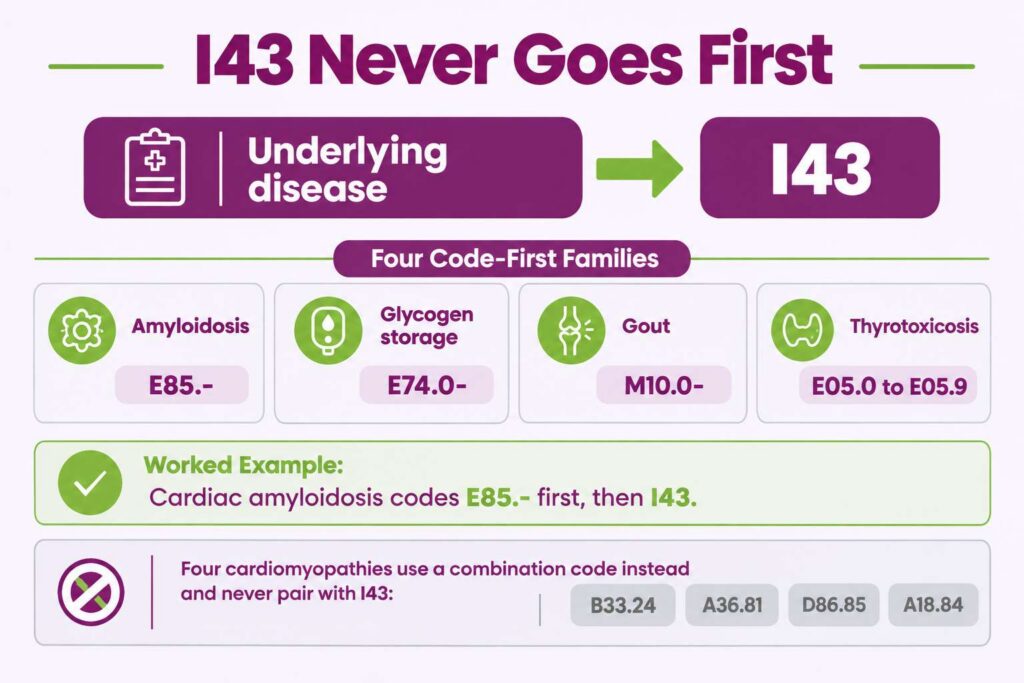
Cardiomyopathy arising from a systemic disease codes to I43, cardiomyopathy in diseases classified elsewhere. I43 is a manifestation code rather than a primary diagnosis. The convention requires the underlying disease sequenced first. FY2027 makes no change to I43 or its code-first list.
What Is I43 and When Does It Apply?
I43 applies when the cardiomyopathy is a direct manifestation of another documented disease. The code is billable and valid for FY2027. I43 never appears alone on a claim, since the etiology code must precede it.
Which Underlying Diseases Are Sequenced First?
Four disease families appear in the I43 code-first instruction. Each one sequences ahead of I43. The list below names all four.
- Amyloidosis codes from the E85.- family and covers cardiac amyloidosis.
- Glycogen storage disease codes from E74.0-.
- Gout codes from M10.0-.
- Thyrotoxicosis codes from E05.0 through E05.9.
Cardiac amyloidosis is the most frequent I43 pairing in cardiology. The amyloidosis code sequences first, followed by I43 for the cardiac manifestation.
Which Cardiomyopathies Have Their Own Combination Code Instead?
Four cardiomyopathies carry an Excludes1 note at I43. Each one has a dedicated combination code that captures both the disease and the cardiac involvement. Coxsackie virus cardiomyopathy codes to B33.24. Diphtheritic cardiomyopathy codes to A36.81. Sarcoid cardiomyopathy codes to D86.85. Tuberculous cardiomyopathy codes to A18.84.
An Excludes1 note is absolute. None of these four codes appears alongside I43.
What Are the Family History and History Codes?
Family history of cardiomyopathy codes to Z82.49, family history of ischemic heart disease and other diseases of the circulatory system. The code records inherited risk in patients without an active diagnosis. FY2027 makes no change here, though this code now sits alongside I42.01, which captures a confirmed familial-genetic diagnosis rather than a family history alone.
Cardiomyopathy is a chronic condition, so the active I42 code applies whenever the current encounter documents it. No personal history code replaces an active cardiomyopathy diagnosis.
What Documentation Supports a Cardiomyopathy ICD-10 Claim?
Documentation supports a cardiomyopathy claim when the note records the subtype, the cause, and the functional impact. The record decides both the code and its sequence position.
What Clinical Elements Must the Provider’s Note Contain?
The provider note contains five elements for a clean I42 claim. Each element resolves one coding decision.
- Subtype: dilated, hypertrophic, restrictive, arrhythmogenic, or another named type.
- Obstruction status: present or absent for hypertrophic cases.
- Familial status: confirmed genetic or family history versus nonfamilial, for dilated cases.
- Cause: genetic, alcoholic, drug-related, systemic disease, or idiopathic.
- Associated conditions: heart failure, arrhythmia, or ejection fraction values.
How Does Echocardiography Documentation Select the Code?
Echocardiography findings support the code but do not select it alone. A study showing a dilated ventricle with reduced function points toward I42.00. The provider must state the diagnosis, and the familial status where relevant, in the assessment before the coder assigns the specific code.
A report reading left ventricular dilatation with no provider diagnosis does not support I42.00. That finding alone indexes to ventricular dilatation at I51.7.
What Are the MEAT Criteria for Cardiomyopathy HCC Recapture?
MEAT criteria are Monitor, Evaluate, Assess, and Treat. Cardiomyopathy maps to a Hierarchical Condition Category, so each calendar year requires fresh documentation. Monitoring includes symptom and function review. Evaluating includes echocardiographic assessment. Assessing includes subtype confirmation. Treating includes medication and device management.
Practices recapturing cardiomyopathy under a value-based contract should confirm the FY2027 HCC mapping for I42.00, I42.01, I42.09, I42.81, and I42.89 against the current CMS-HCC crosswalk once CMS publishes it, rather than assuming the new codes carry the same weight as the retired I42.0 and I42.8.
Which CPT and HCPCS Codes Pair With Cardiomyopathy ICD-10 Codes?
Cardiomyopathy codes pair with imaging, biopsy, genetic testing, and procedural codes. The pairing set reflects a diagnosis confirmed by imaging and managed long term. Correct pairing supports medical necessity for advanced testing.
Which Diagnostic and Procedural CPT Codes Are Billed With I42?
The table below lists the CPT codes most billed with the I42 category, updated for the FY2027 dilated and other-cardiomyopathy splits.
| CPT | Description | Common ICD-10 Pairing |
|---|---|---|
| 99202-99215 | Office or outpatient E/M visit | I42.00, I42.1, I42.9 |
| 93306 | Transthoracic echocardiogram, complete | I42.00, I42.2, I42.9 |
| 93351 | Stress echocardiography, complete | I42.1, I42.2 |
| 75561 | Cardiac MRI without and with contrast | I42.00, I42.5, I42.89 |
| 93505 | Endomyocardial biopsy | I42.5, I42.7 |
| 81439 | Hereditary cardiomyopathy genomic panel | I42.01, I42.2, I42.89 |
| 93583 | Percutaneous transcatheter septal reduction | I42.1 |
| 33416 | Ventriculomyotomy for hypertrophic obstruction | I42.1 |
Echocardiography carries the highest claim volume, since it confirms the subtype for most patients. I42.01 is now the strongest medical-necessity pairing for the hereditary genomic panel, since a positive family history or genetic finding is what routes the diagnosis there in the first place. The broader cardiology CPT codes set covers the device and interventional procedures that follow.
Which HCPCS Codes Apply to Cardiomyopathy Management?
Three HCPCS Level II codes appear regularly on cardiomyopathy claims. Each one covers a device or service outside the CPT set.
- K0606 reports a wearable cardioverter defibrillator. Medicare coverage under local coverage determination L33690 names dilated cardiomyopathy with an ejection fraction of 0.35 or below among the qualifying criteria. Confirm the current LCD code list against the FY2027 I42.00, I42.01, and I42.09 codes before billing, since the MAC’s published list may lag the CMS code cutover.
- G0422 and G0423 report intensive cardiac rehabilitation, with and without exercise, under National Coverage Determination 20.31.
Device claims carry documentation requirements tied to the diagnosis. A wearable defibrillator claim needs the cardiomyopathy subtype and the ejection fraction on file. Practices report devices and supplies through the broader cardiology HCPCS codes set.
What Are the Most Common Cardiomyopathy Coding Denials, and How Do You Prevent Them?
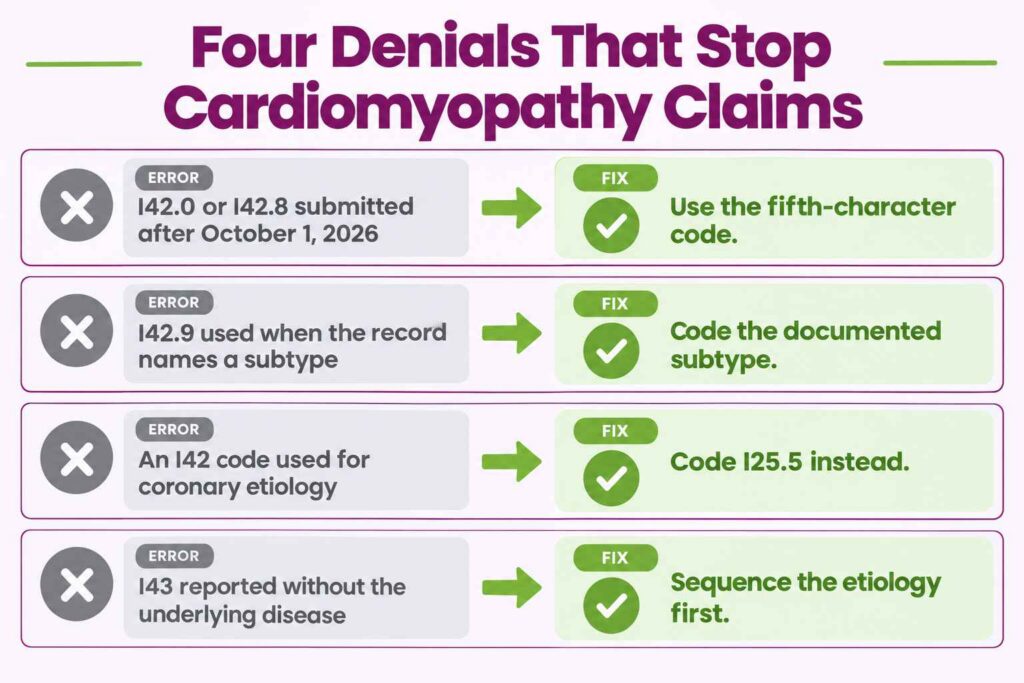
The most common cardiomyopathy denials come from unspecified coding, wrong-category assignment, and missing etiology codes. Each pattern has a clear prevention path.
Why Is I42.9 Denied When the Type Is Documented?
I42.9 is denied when the record names a subtype. Payers compare the submitted code against the echocardiogram report and the assessment. A chart documenting dilated cardiomyopathy with I42.9 on the claim understates the record and reduces risk-adjustment capture.
Why Are I42.0 and I42.8 Claims Denied After October 1, 2026?
I42.0 and I42.8 claims deny automatically after October 1, 2026, because both codes become non-billable category headers. A claim carrying either code rejects for insufficient specificity, regardless of documentation quality. Any EHR favorite, superbill, or saved pick-list still pointing to I42.0 or I42.8 produces a denial on every claim until updated to the correct fifth-character code.
Why Are I42 Claims Denied for Ischemic Etiology?
I42 claims are denied when the cardiomyopathy has a documented coronary cause. Ischemic cardiomyopathy belongs at I25.5, not in the I42 category. Submitting an I42 code for a patient whose myocardial damage follows coronary disease misclassifies the diagnosis.
Why Are I43 Claims Denied Without the Underlying Disease?
I43 claims are denied when the etiology code is absent. I43 is a manifestation code carrying a mandatory code-first instruction. A claim listing I43 without the amyloidosis or thyrotoxicosis code fails the sequencing rule.
How Do Payer-Specific Rules Change Cardiomyopathy Reimbursement?
Each payer applies its own rules to cardiomyopathy coding and device authorization. The table below summarizes common payer positions.
| Payer | Common Rule |
|---|---|
| Medicare | Wearable defibrillator coverage governed by LCD criteria tied to the subtype and ejection fraction |
| BCBS plans | Echocardiographic documentation reviewed against the submitted subtype code |
| UnitedHealthcare | Prior authorization common for cardiac MRI and genetic panels |
| Aetna | Medical necessity required for hereditary cardiomyopathy testing |
| Medicare Advantage | Annual MEAT recapture required for the cardiomyopathy diagnosis, pending FY2027 HCC crosswalk confirmation |
What Changed in the FY2027 ICD-10-CM Update for Cardiomyopathy?
The FY2027 ICD-10-CM update takes effect October 1, 2026, and splits two of the I42 category’s most-used codes. The National Center for Health Statistics and CMS publish the annual code set.
Which I42 Codes Changed for FY2027?
Two codes changed, and both changes remove a billable code rather than simply adding one. I42.0, dilated cardiomyopathy, becomes a non-billable header and splits into I42.00, I42.01, and I42.09 by familial status. I42.8, other cardiomyopathies, becomes a non-billable header and splits into I42.81, arrhythmogenic cardiomyopathy, and I42.89, other cardiomyopathies not elsewhere classified.
The category grows from 10 billable codes to 13. Congestive cardiomyopathy, previously indexed to I42.0, now indexes to I42.00. Other code guides sit in the ICD-10 codes library.
Why Does the I42.81 Change Matter Beyond a Renumbering?
The new I42.81 descriptor drops the right-ventricular qualifier that defined the prior ARVC shorthand. Arrhythmogenic cardiomyopathy now has a dedicated code that covers left-dominant and biventricular presentations, not only the classic right-ventricular form. This is a clinical expansion, not just a fourth-character split.
Why Does the Takotsubo Reclassification Still Cause Errors?
The Takotsubo reclassification still causes errors because older reference material persists. Takotsubo cardiomyopathy sat in I42.8 before moving to I51.81. Coding tools and internal cheat sheets built on the earlier structure continue to return the outdated code, and that code is now a non-billable header rather than merely an unspecific one. Practices audit their diagnosis pick-lists for this specific pairing. The cardiology ICD-10 codes hub maps the current cardiovascular set.
Frequently Asked Questions About Cardiomyopathy ICD-10 Coding
What Is the ICD-10 Code for Cardiomyopathy?
The ICD-10 code for cardiomyopathy is I42.9, cardiomyopathy unspecified. I42.9 applies when the record documents cardiomyopathy without naming a subtype.
What Is the ICD-10 Code for Nonischemic Cardiomyopathy?
No dedicated code exists for nonischemic cardiomyopathy. The term routes to a specific I42 code by subtype, or to I42.9 when no subtype is stated.
What Is the ICD-10 Code for Dilated Cardiomyopathy?
The ICD-10 code for dilated cardiomyopathy is I42.00, effective October 1, 2026. I42.01 applies when a familial or genetic cause is confirmed, and I42.09 applies to other nonfamilial cases. The prior code, I42.0, is a non-billable header as of the same date.
What Is the ICD-10 Code for Hypertrophic Cardiomyopathy?
Hypertrophic cardiomyopathy codes to I42.1 when obstruction is documented and I42.2 when it is not. Obstructive hypertrophic cardiomyopathy, or HOCM, codes to I42.1. FY2027 makes no change to either code.
What Is the ICD-10 Code for Restrictive Cardiomyopathy?
The ICD-10 code for restrictive cardiomyopathy is I42.5. A documented systemic cause moves the coding to I43 with the underlying disease sequenced first.
What Is the ICD-10 Code for Arrhythmogenic Cardiomyopathy (ARVC)?
The ICD-10 code for arrhythmogenic cardiomyopathy is I42.81, effective October 1, 2026. The code covers ARVC and ARVD along with left-dominant and biventricular forms. The prior code, I42.8, is a non-billable header as of the same date.
What Is the ICD-10 Code for Takotsubo Cardiomyopathy?
The ICD-10 code for Takotsubo cardiomyopathy is I51.81, Takotsubo syndrome. The condition no longer codes to I42.8.
Is I42 a Billable Code?
No, I42 is a category header requiring a fourth character. As of October 1, 2026, I42.0 and I42.8 are also category headers requiring a fifth character. Coders select a full-character code such as I42.00, I42.01, or I42.81.
Can You Code I42 and I25.5 Together?
Yes, when documentation supports both. The I42 category carries an Excludes2 note for ischemic cardiomyopathy, which permits both codes when each diagnosis is independently documented.
What Is the ICD-10 Code for Cardiac Amyloidosis?
Cardiac amyloidosis codes to the amyloidosis code from E85.- sequenced first, followed by I43 for the cardiac manifestation.
What Is the ICD-10 Code for Family History of Cardiomyopathy?
Family history of cardiomyopathy codes to Z82.49. The code applies to patients with inherited risk and no active diagnosis, distinct from I42.01, which requires a confirmed familial-genetic diagnosis in the patient.