eClinicalWorks and AdvancedMD are cloud EHR and practice management platforms built for ambulatory care. Both companies launched in 1999. Both sell software alongside an in-house revenue cycle management service. The real differences show up at the claims layer.
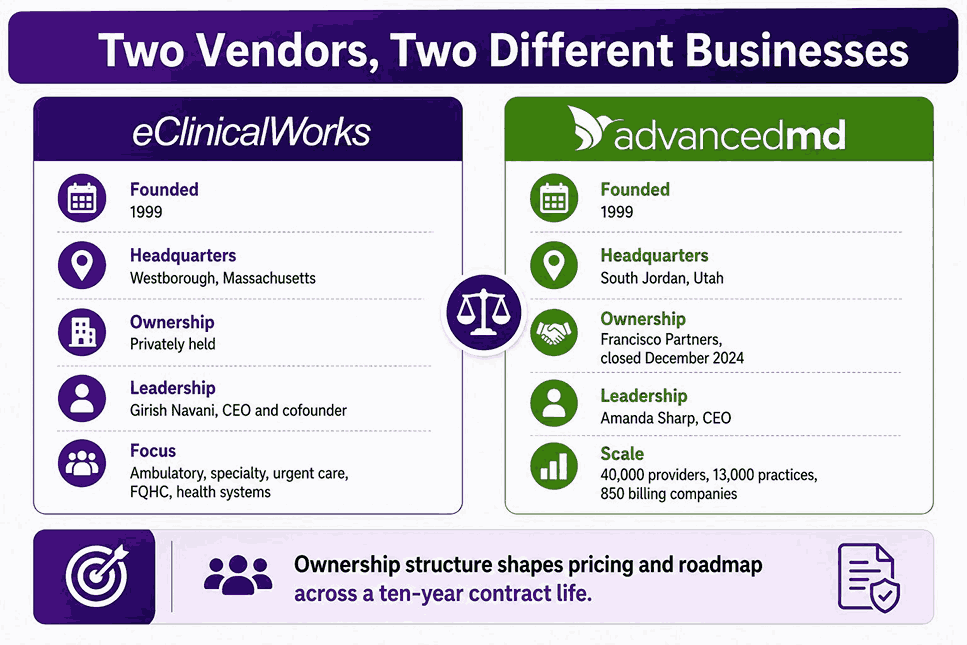
eClinicalWorks is privately held and based in Westborough, Massachusetts, with co-founder Girish Navani as chief executive. AdvancedMD operates from South Jordan, Utah, and has been owned by Francisco Partners since October 2024. Ownership structure shapes pricing and roadmap over a ten-year contract life.
Most eClinicalWorks vs AdvancedMD comparisons stop at feature lists and star ratings. That misses the part that decides whether a practice collects what it bills. Charge capture, claim scrubbing, denial worklists, and payment posting differ meaningfully between the two systems.
This comparison covers claims workflow, verified 2026 pricing, AI capability, data exchange posture, migration cost, practice size fit, and vendor risk on both platforms.
Which Platform Should You Choose? (Quick Verdict)
Short answer: eClinicalWorks wins on scale, data exchange, and specialty depth. AdvancedMD wins on billing simplicity and independent practice fit.
- Choose eClinicalWorks if you run ten or more providers, operate multi-specialty or FQHC settings, or need national health information exchange participation
- Choose AdvancedMD if you run one to ten providers, want a simpler billing console, or operate a third-party billing company using the AdvancedBiller channel
- Choose neither if your actual problem is collections performance rather than software capability
| Factor | eClinicalWorks | AdvancedMD |
|---|---|---|
| Best for | 10+ providers, multi-specialty, FQHC, health centers | 1 to 10 providers, independent practices, billing companies |
| Entry price | $449 per provider per month (EHR only) | $429 per provider per month (PM and billing) |
| Billing engine | eCW Practice Management module with rules engine | AdvancedMD PM with ClaimInspector scrubbing |
| AI layer | Sunoh.ai, PRISMA, Image AI, healow Genie | AI note generation, automated insurance entry, pre-visit summaries |
| Biggest risk | Learning curve and past regulatory history | Add-on pricing creep under private equity ownership |
What Are eClinicalWorks And AdvancedMD?
Both vendors sell cloud-native ambulatory software. Their scale, ownership, and target customer profiles diverge sharply.
eClinicalWorks Company Profile
eClinicalWorks was founded in 1999 to digitize paper charts for ambulatory practices. The company remains privately held. Girish Navani serves as chief executive and co-founder.
The vendor reports more than 180,000 providers and close to one million medical professionals on the eCW Cloud. Its flagship release is eClinicalWorks V12. Related products include healow, PRISMA, and the Sunoh.ai ambient scribe.
Key facts to note:
- Headquarters: Westborough, Massachusetts
- Serves ambulatory practices, specialists, urgent care, FQHCs, and hospital systems
- Announced production support for the CMS Kill the Clipboard initiative in April 2026
- Supports more than 40 medical specialties and sub-specialties
For a deeper walkthrough of the platform, see our eClinicalWorks EHR guide.
AdvancedMD Company Profile
AdvancedMD started in 1999 as Perfect Practice.MD and rebranded shortly after. The platform runs entirely on Amazon Web Services with no on-premise hardware requirement.
Francisco Partners acquired AdvancedMD from Global Payments in October 2024 for $1.125 billion. Amanda Sharp leads the company as chief executive. The business now operates as a standalone entity.
Key facts to note:
- Headquarters: South Jordan, Utah
- Roughly 40,000 providers across 13,000 practices at time of acquisition
- Serves approximately 850 medical billing companies through its partner channel
- Unified suite covering practice management, EHR, patient engagement, and payments
Our AdvancedMD EHR guide breaks down the module structure in detail.
How Do eClinicalWorks And AdvancedMD Compare At A Glance?
The table below covers the variables that actually change billing outcomes. Directory comparison pages rarely measure any of them.
| Comparison point | eClinicalWorks | AdvancedMD |
|---|---|---|
| Deployment model | Cloud, eCW Cloud infrastructure | Cloud, AWS-hosted |
| Target practice size | Small through enterprise and health systems | Solo through mid-size ambulatory groups |
| Entry price per provider per month | $449 EHR only, $599 with PM | $429 PM only, $729 with EHR |
| Claim scrubbing | PM rules engine with payer edits | ClaimInspector pre-submission scrubbing |
| Charge capture path | Progress note to PM billing queue | Note finalization pushes charge with ICD-10 and CPT attached |
| Denial worklist design | Aging buckets, CBO and OpenConnect configurations | Claim status queues inside PM |
| Records attached to claims | Supported through PM workflow | Not supported inside the platform |
| API access | Available through the vendor connectivity layer | Available, billed as a separate add-on |
| Ambient AI scribe | Sunoh.ai, roughly $149 per user per month | AI-generated notes within the EHR |
| Health information exchange | Pursued QHIN designation under TEFCA | Standard exchange participation |
| Vendor RCM fee | Around 2.9% of collections | 4% to 8% of collections |
| Typical time to stable billing | Several weeks, longer for multi-location | Several weeks, 4 to 6 weeks for full rule tuning |
Read the pricing rows carefully. AdvancedMD looks cheaper at entry and more expensive at full bundle. That reversal matters over three years.
Which Platform Has The Stronger Billing And Claims Engine?
This is the section that decides the money. Both systems submit clean claims when configured correctly. They fail in different places.
How Charge Capture Works In Each System
AdvancedMD moves the charge at the moment the provider finalizes the SOAP note. The ICD-10 and CPT codes attached to that note push directly into the billing queue. There is no separate charge entry step.
eClinicalWorks routes encounter data from the progress note into the PM module through claim generation. The handoff supports more configuration, which helps complex specialties. It also creates more places for a charge to stall.
Where charge lag usually starts:
- Unsigned notes sitting past 48 hours
- Missing or unmapped fee schedule entries
- Provider-level template gaps that omit billable procedures
- Superbill items that never post to the claim
How Each Platform Scrubs Claims Before Submission
ClaimInspector runs AdvancedMD claims against payer edit rules before submission. It catches modifier conflicts, missing units, and diagnosis pointer errors. Practices that tune it well report strong first-pass results.
eClinicalWorks applies scrubbing rules inside the PM module. The rule library is broader. It also demands more setup, and default configurations leave gaps in specialty-heavy claim types.
| Scrubbing factor | eClinicalWorks PM | AdvancedMD ClaimInspector |
|---|---|---|
| Rule source | Payer edits plus custom practice rules | Built-in payer edit library |
| Setup burden | High, rewards configuration work | Moderate, usable near default |
| Specialty edit depth | Deeper across 40+ specialties | Strong for primary care and behavioral health |
| Common miss | Modifier logic on multi-procedure claims | Attachment-dependent claim types |
MGMA-cited benchmarks place a healthy clean claim rate at 95%. Both platforms reach that number. Neither reaches it without deliberate rule tuning.
How Denials And AR Follow-Up Are Managed
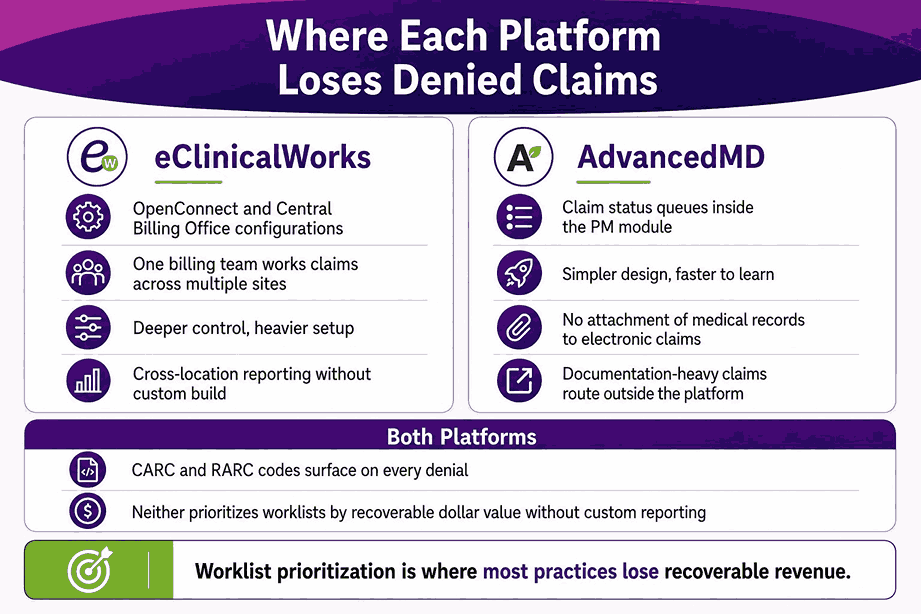
Denial handling separates the two systems more than scrubbing does. eClinicalWorks gives multi-location groups deeper control through OpenConnect and Central Billing Office configurations. Those setups let a single billing team work claims across sites.
AdvancedMD keeps denial work inside claim status queues in the PM module. The design is simpler and faster to learn. One documented limitation matters: the platform does not support attaching medical records to electronic claims.
What that limitation costs you:
- Claims requiring documentation must route through a manual or external process
- Payers that request records at first pass extend AR days
- Specialties with high documentation demands feel it most, including pain management and orthopedics
Both systems surface CARC and RARC codes. Neither prioritizes worklists by recoverable dollar value without custom reporting. That gap is where most practices lose recoverable revenue.
How Payment Posting And Patient Collections Differ
Both platforms auto-post ERA files and support EFT reconciliation. Match rates depend on payer file quality more than on platform choice. AdvancedMD users report carrier file data dropping after certain platform updates, which forces re-verification.
Patient collections favor eClinicalWorks slightly. The healow patient portal handles statements, self-scheduling, and payment in one place. AdvancedMD offers portal payments and kiosk check-in as licensed modules rather than standard features.
Our eClinicalWorks billing services and AdvancedMD billing services pages cover how certified billers work inside each PM module.
What Does Each Platform Actually Cost In 2026?
Published starting prices tell you almost nothing. Both vendors sell modules, and the quoted figure covers the smallest useful bundle.
eClinicalWorks Pricing
eClinicalWorks uses a per-provider subscription model with no per-patient fees on the base software.
- EHR only: $449 per provider per month
- EHR with Practice Management: $599 per provider per month
- eCW RCM service: approximately 2.9% of practice collections
Both software tiers are listed without start-up costs on major software directories. Add-on modules and Sunoh.ai carry separate line items.
AdvancedMD Pricing
AdvancedMD prices by provider, defined as a mid-level clinician or higher. It also offers an encounter-based alternative.
| Plan | Price |
|---|---|
| Practice management and medical billing | From $429 per provider per month |
| Practice management with EHR | From $729 per provider per month |
| Full bundle with patient engagement | From $999 per month |
| AdvancedMD Now (self-service, behavioral health) | $130 per provider per month |
| Encounter pricing, PM only | $0.87 to $1.74 per claim |
| Encounter pricing, PM with EHR | $1.08 to $2.17 per claim |
| Vendor RCM service | 4% to 8% of collections |
The vendor notes that encounter pricing suits practices averaging 250 to 500 claims per month. Below that volume, per-claim billing usually beats a flat subscription.
Which Costs Are Not In The Quote
Both vendors unbundle features that buyers assume are standard. This is where three-year budgets break.
Commonly separate line items on AdvancedMD:
- Appointment reminders
- Telemedicine
- API access
- Paperless faxing
- Advanced reporting
Commonly separate line items on eClinicalWorks:
- Sunoh.ai ambient scribe, around $149 per user per month
- healow Genie contact center
- Population health and analytics modules
- Data migration and chart abstraction services
Add training, setup, and premium support to both columns. Neither appears on a first quote.
Three-Year Total Cost Of Ownership For A Five-Provider Practice
The model below assumes five providers, a mid-range add-on load, and vendor RCM at the lower end of each range. Figures are illustrative and should be rebuilt against your own quote.
| Cost line | eClinicalWorks | AdvancedMD |
|---|---|---|
| Software, 36 months | $107,820 (EHR + PM at $599) | $131,220 (EHR + PM at $729) |
| Setup and training, one time | $12,000 | $9,000 |
| Data migration, one time | $15,000 | $12,000 |
| Add-on modules, 36 months | $32,000 | $28,000 |
| Three-year software subtotal | $166,820 | $180,220 |
| Vendor RCM on $3M collections | $87,000 at 2.9% | $120,000 at 4% |
| Three-year loaded total | $253,820 | $300,220 |
Two takeaways. eClinicalWorks costs less at the loaded level despite the higher headline EHR price. And the RCM fee, not the software, is the largest single line in both columns.
That last point is the one most buyers miss. A one-point difference in billing fee on $3 million in collections moves $90,000 over three years.
How Do The AI Capabilities Compare In 2026?
Both vendors shipped AI features in the last 24 months. The gap is in depth and in how much of it touches revenue.
eClinicalWorks AI Stack
eClinicalWorks built the widest AI surface of the two platforms. Most of it runs through healow, the company’s patient engagement arm.
| Product | Function |
|---|---|
| Sunoh.ai | Ambient scribe producing SOAP notes plus suggested labs and orders |
| PRISMA | Health information search engine with AI summary of outside records |
| Image AI | Fax inbox sorting and document classification |
| healow Genie | AI contact center handling scheduling, refills, and after-hours calls |
| healow No-Show model | Appointment no-show prediction |
| Scribe It | Text parser importing formatted content into note fields |
Practice data published by eClinicalWorks in February 2026 showed healow Genie handling 76% of total calls in the month after deployment. Sunoh.ai lists at roughly $149 per user per month.
AdvancedMD AI Stack
AdvancedMD ships AI-generated notes, automated insurance entry, pre-visit summaries, and workflow automation inside the EHR. The roadmap picked up speed after the Francisco Partners acquisition.
The catalog is narrower than the eCW stack. It is also priced as add-on modules rather than bundled capability, which matters when you model the loaded cost.
Which AI Features Actually Touch Revenue
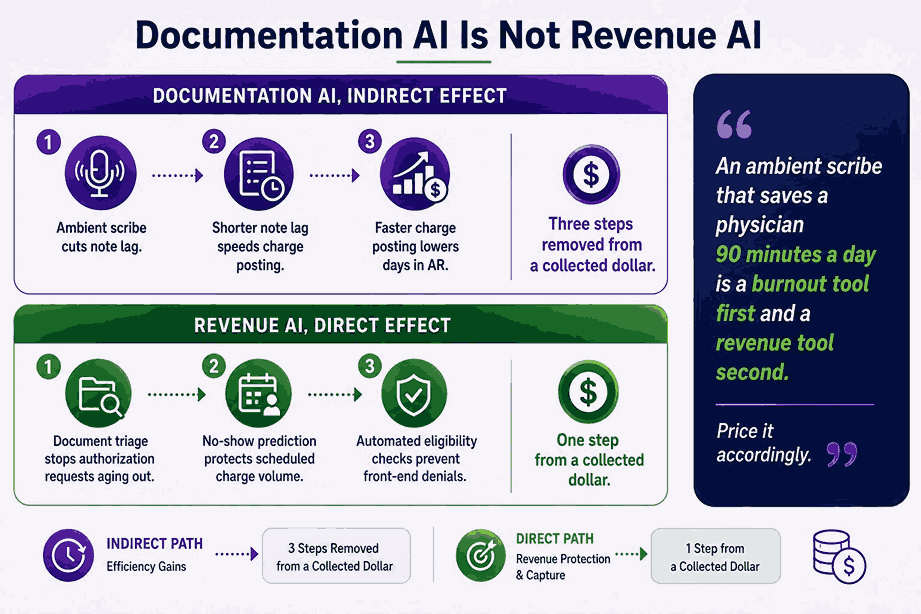
Separate documentation AI from revenue AI. The distinction changes the buying case entirely.
Documentation AI affects revenue indirectly:
- Ambient scribes cut note lag
- Shorter note lag means faster charge posting
- Faster charge posting reduces days in accounts receivable
Revenue AI affects collections directly:
- Fax and document triage prevents authorization requests from aging out
- No-show prediction protects scheduled charge volume
- Automated eligibility checks prevent front-end denials
In practice, an ambient scribe that saves a physician 90 minutes a day is a burnout tool first and a revenue tool second. Price it accordingly.
Which System Handles Data Exchange And Connected Apps Better?
Health information exchange is no longer a nice-to-have. Under the 21st Century Cures Act and the information blocking rule, exchange posture carries compliance weight.
Health Information Exchange Posture
eClinicalWorks announced its intent to become a Qualified Health Information Network under TEFCA, the framework published by ONC and The Sequoia Project. The company also declared production support for the CMS Kill the Clipboard initiative in April 2026.
AdvancedMD participates in standard exchange frameworks but has not pursued QHIN designation. For a small independent practice, that difference rarely surfaces. For an ACO participant or an FQHC, it does.
Where exchange depth shows up:
- Referral loop closure with outside specialists
- Outside record retrieval before an encounter
- Public health and registry reporting obligations
- Quality reporting under MIPS and the Quality Payment Program
API Access And Third-Party Connections
AdvancedMD offers a documented API. It bills API access as an add-on rather than including it in the base subscription. That changes the economics for any practice running external analytics, patient engagement, or clinical tools.
eClinicalWorks exposes connectivity through its own layer and a partner catalog. Both platforms support HL7 and FHIR-based exchange. Depth varies by partner and by contract tier on each side.
What Exchange Gaps Cost You In Billing
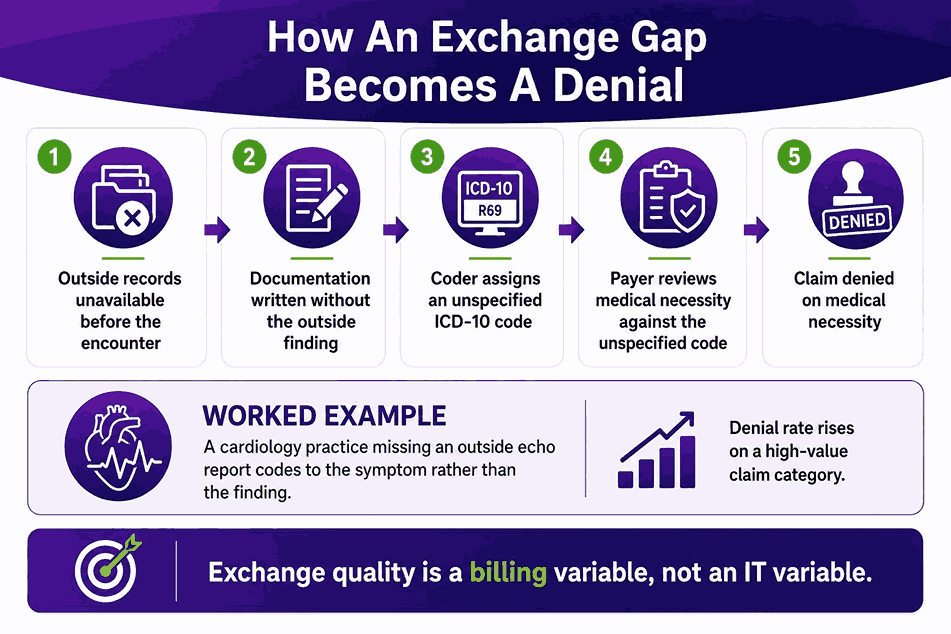
Tie this back to claims. Incomplete outside records produce vague documentation. Vague documentation produces unspecified ICD-10 codes. Unspecified codes produce medical necessity denials.
A cardiology practice missing outside echo reports codes to the symptom rather than the finding. That single gap raises denial rate on a high-value claim category. Exchange quality is a billing variable, not just an IT one.
What Do Setup And Migration Actually Involve?
Migration is where most EHR decisions go wrong financially. The software cost is predictable. The transition cost is not.
Typical Go-Live Timelines
Most practices reach a working billing workflow within a few weeks on either platform. Full tuning of claim rules and reporting typically runs four to six weeks. That timeline depends heavily on configuration quality at kickoff.
Multi-location groups take longer. Central billing office setups on eClinicalWorks add configuration steps that a single-site practice never encounters.
What drives timeline overruns:
- Fee schedule loading errors discovered after first submission
- Provider enrollment and clearinghouse setup delays
- Template building for specialties without prebuilt content
- Staff training scheduled around full clinic hours
What Happens To Your Data
Demographics, insurance records, and open accounts receivable migrate reliably. Discrete clinical data does not migrate cleanly between ambulatory platforms.
Structured problem lists, historical lab values, and encoded medication histories usually arrive as flat documents rather than searchable fields. Practices then face chart abstraction, which means staff manually re-entering the data that matters.
| Data type | Migration reliability | Practical result |
|---|---|---|
| Patient demographics | High | Direct field mapping |
| Insurance and payer records | High | Verify plan IDs after load |
| Open AR and claim history | Moderate | Often kept in legacy system instead |
| Discrete clinical data | Low | C-CDA documents, not structured fields |
| Scanned documents and images | Moderate | Bulk transfer, index quality varies |
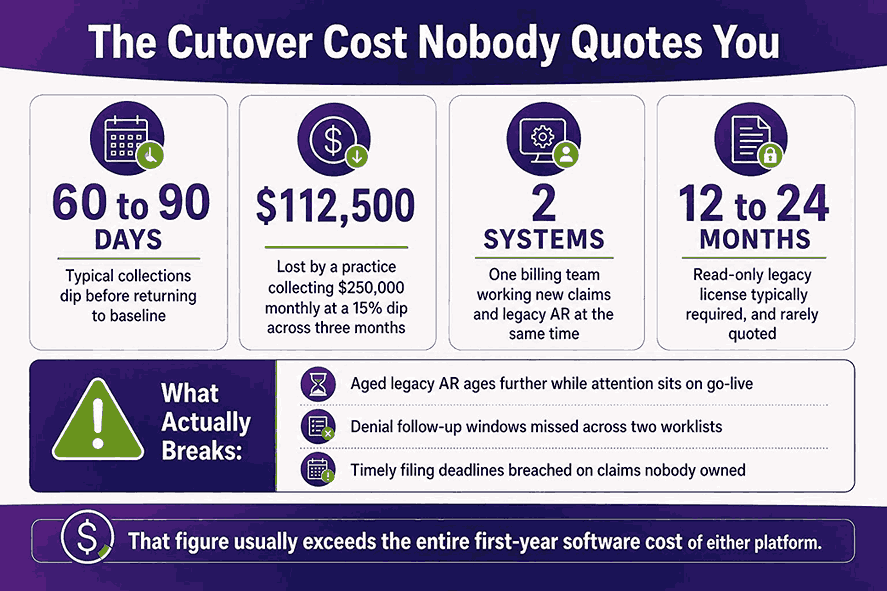
Most groups keep read-only access to the legacy system for 12 to 24 months. Budget for that license cost. It is real, and it is rarely quoted.
The AR Runout Problem Nobody Warns You About
Here is the part vendors do not put in the proposal. During cutover, you bill new claims in the new system while working aged claims in the old one.
That means two systems, two workflows, and one billing team. Staff productivity drops because they are context-switching between platforms they know at different levels. Collections drop with it.
Typical exposure during cutover:
- Collections dip of 60 to 90 days before returning to baseline
- Aged AR in the legacy system that ages further while attention sits on go-live
- Denial follow-up windows missed because worklists live in two places
- Timely filing deadlines breached on claims nobody owned during the switch
A practice collecting $250,000 monthly that loses 15% for three months gives up $112,500. That figure usually exceeds the entire first-year software cost of either platform.
The mitigation is straightforward. Do not ask the same team to run legacy AR and new-system billing at once. Either add temporary capacity or hand legacy AR runout to a dedicated team while internal staff focus on go-live.
Which Platform Fits Your Practice Size And Specialty?
Size drives the decision more than specialty does. Specialty then decides how much template work you will fund.
Solo And Two-Provider Practices
AdvancedMD holds the advantage here. The AdvancedMD Now tier at $130 per provider per month and encounter-based pricing both suit low claim volume. eClinicalWorks entry pricing is difficult to justify below three providers.
Small Groups, Three To Ten Providers
This is the genuinely contested band. Decide on billing complexity rather than feature count.
- High payer mix complexity or heavy prior authorization volume favors eClinicalWorks configuration depth
- Simple commercial and Medicare mix with clean documentation favors AdvancedMD speed to competence
- Growth plans past 15 providers within three years favor eClinicalWorks
Mid-Size And Multi-Location Groups
eClinicalWorks pulls ahead above ten providers. OpenConnect and Central Billing Office configurations support centralized billing across sites. Cross-location reporting works without custom build.
AdvancedMD supports multi-location practices but was designed around the independent practice profile. Reporting customization limits become noticeable at scale.
Billing Companies And MSOs
AdvancedMD has a structural advantage. The AdvancedBiller channel supports roughly 850 billing companies with multi-client account structures and partner pricing. If you are a billing company or MSO, this alone may decide it.
Specialty Fit
| Specialty | Stronger fit | Reason |
|---|---|---|
| Behavioral health | AdvancedMD | Dedicated low-cost tier and simpler note structure |
| Primary care | Either | Both carry mature primary care template libraries |
| Cardiology | eClinicalWorks | Deeper outside-record retrieval and specialty templates |
| Orthopedics | eClinicalWorks | Documentation-heavy claims need attachment support |
| Pediatrics | Either | Immunization registry handling matters more than platform |
| Podiatry | eClinicalWorks | Modifier-heavy claims benefit from deeper rule tuning |
| Urgent care | AdvancedMD | Throughput and simplicity outweigh configuration depth |
What Do Users And Analysts Report?
Review data on these two platforms contradict each other across sources. Understanding why is more useful than picking a winner.
Review Score Reality
Capterra shows AdvancedMD EHR at 3.6 from 463 reviews and eClinicalWorks at 3.3 from 395 reviews. Other comparison platforms invert that ranking and score eClinicalWorks higher on usability.
The contradiction has a cause. Directory review populations differ by practice size, by how each vendor solicits reviews, and by which module the reviewer actually used. A billing manager and a physician rate the same platform differently.
How to read directory scores:
- Filter reviews by practice size closest to yours
- Weight reviews from the last 12 months over older ones
- Separate EHR complaints from PM complaints
- Discount scores built on fewer than 100 reviews
Recurring Complaint Patterns
The patterns are more reliable than the scores. Both vendors draw consistent criticism in specific areas.
AdvancedMD, most common complaints:
- Support responsiveness and escalation time
- Add-on pricing surprises after contract signature
- Limited report customization out of the box
- Carrier file data dropping after platform updates
eClinicalWorks, most common complaints:
- Steep learning curve on the PM module
- Support responsiveness during high-volume periods
- Billing module complexity producing coding errors and downstream denials
- Configuration burden that assumes in-house expertise
Notice the overlap. Support responsiveness appears on both lists. Neither vendor solves it, which is one reason practices outsource billing rather than depend on vendor support.
What Are The Vendor Risks You Should Price In?
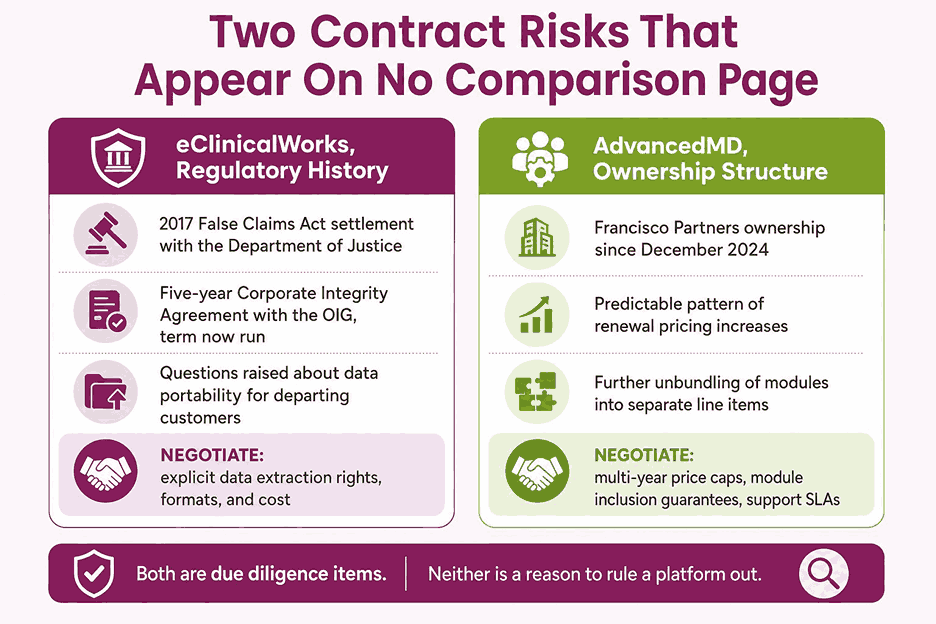
Every EHR contract is a multi-year commitment. Two risk items belong in the evaluation and appear on no directory comparison page.
eClinicalWorks Regulatory History
In 2017 eClinicalWorks agreed to pay $155 million to settle a False Claims Act case brought by the Department of Justice. The case alleged the company falsified meaningful use certification for its software.
The settlement included a five-year Corporate Integrity Agreement with the Office of Inspector General. Subsequent reporting raised questions about data portability for customers attempting to leave the platform.
How to treat this in 2026:
- The settlement is nine years old, and the Corporate Integrity Agreement term has run
- eClinicalWorks remains one of the largest ambulatory cloud EHRs in the country
- Treat it as a contract due diligence item, specifically around data export rights
- Negotiate explicit data extraction terms and format guarantees before signing
AdvancedMD Ownership Risk
Francisco Partners has owned AdvancedMD since October 2024, following a $1.125 billion carve-out from Global Payments. Private equity ownership carries a predictable pattern worth pricing in.
Typical effects include pricing trajectory increases at renewal, further unbundling of modules into separate line items, and cost discipline that can reach support staffing. Francisco Partners is a repeat AdvancedMD investor with healthcare technology depth, which cuts both directions.
What to negotiate for:
- Multi-year price caps written into the contract
- Module inclusion guarantees so bundled features cannot be unbundled at renewal
- Support SLA language with defined response times
- Exit terms including data extraction cost and format
Should You Use The Vendor RCM Service Or An Independent Billing Partner?
Both vendors sell billing services on their own platforms. That option deserves scrutiny rather than a default yes.
What Vendor RCM Actually Is
eCW RCM and AdvancedMD RCM are generalist billing services operating across every specialty their platform serves. Your account sits among thousands. You receive a process, not a specialty team.
Fees differ meaningfully. eClinicalWorks quotes around 2.9% of collections. AdvancedMD ranges from 4% to 8%. On $3 million in annual collections, that spread is $33,000 to $153,000 per year.
The Structural Conflict
When the software vendor also runs your billing, no independent party audits whether the platform caused the denial.
A denial can come from a coding error, a documentation gap, or a rules engine that failed to catch a payer edit. Vendor RCM teams have no incentive to report the third cause. That blind spot compounds quietly over years.
What independent oversight surfaces:
- Denials traceable to scrubbing rule gaps rather than coder error
- Fee schedule loading errors that suppress allowed amounts
- Payer edits the platform never applied
- Reporting mismatches between the PM module and actual deposits
What An Independent Partner Changes
Transcure works inside the client’s existing PM module rather than requiring a platform switch. AAPC-certified billers receive role-based credentials under a signed BAA, and the practice IT team controls every permission.
The operating model assigns coders by specialty rather than by rotation. Cardiology claims route to cardiology-certified coders. Behavioral health claims route to behavioral health specialists. AI agents handle eligibility verification, coding support, and denial follow-up alongside the human team.
| Factor | Vendor RCM | Independent partner |
|---|---|---|
| Platform coverage | One EHR only | 40+ EHR platforms |
| Specialty assignment | Generalist pool | Specialty-certified coders |
| Conflict of interest | Vendor audits itself | Independent denial root-cause review |
| Migration required | No | No |
| Fee | 2.9% to 8% of collections | 5% of net collections |
| Onboarding | Vendor schedule | Under 14 days |
Our EMR billing services page covers how this works across both platforms and 40 others.
Frequently Asked Questions
Is AdvancedMD Better Than eClinicalWorks?
Neither is better outright. AdvancedMD suits practices under ten providers wanting simpler billing. eClinicalWorks suits larger, multi-specialty, or multi-location groups needing deeper configuration.
How Much Does AdvancedMD Cost Per Provider Per Month?
Practice management and billing starts at $429. Practice management with EHR starts at $729. The full bundle with patient engagement starts at $999 per month.
How Much Does eClinicalWorks Cost?
EHR only runs $449 per provider per month. EHR with practice management runs $599. The eCW RCM service is quoted around 2.9% of collections.
Which Platform Has Better Medical Billing?
AdvancedMD is faster to competence through ClaimInspector. eClinicalWorks scores higher on ceiling once its PM rules are configured properly for your payer mix.
Can I Keep My EHR and Outsource Only the Billing?
Yes. Independent billing partners work inside your existing PM module under a BAA with role-based credentials. No migration is required.
How Long Does It Take to Migrate Between These Platforms?
Stable billing typically takes several weeks. Full rule and reporting tuning runs four to six weeks. Plan for a 60 to 90 day collections dip during cutover.
Does AdvancedMD Charge Extra for API Access?
Yes. AdvancedMD integrations through the API are billed as a separate add-on rather than included in the base subscription.
Which Platform Is Better for a Solo Practice?
AdvancedMD. The AdvancedMD Now tier at $130 per provider per month and encounter-based pricing both fit low claim volume better than eClinicalWorks entry pricing.
Final Recommendation
eClinicalWorks is the stronger platform for groups above ten providers, multi-specialty settings, and practices that need national health information exchange participation. AdvancedMD is the stronger platform for independent practices under ten providers and for third-party billing companies.
Platform choice sets your ceiling. Billing execution decides whether you reach it. A practice on the better-fitting EHR with weak claims follow-up still collects less than a practice on the second choice with disciplined denial management.
Before you sign either contract, run one calculation. Model your current days in AR, denial rate, and net collection rate against the fee you are about to pay for billing. That number, not the software subscription, is the decision.
Transcure places AAPC-certified billers inside your existing eClinicalWorks or AdvancedMD practice management module within 14 days. No migration, no workflow change, and a denial audit of your last 90 days of claims before anything else begins.