| QUICK FACT TABLE | |
|---|---|
| Field | Detail |
| CPT Code | 45385 |
| Official Descriptor | Colonoscopy, flexible, proximal to splenic flexure; with removal of tumor(s), polyp(s), or other lesion(s) by snare technique |
| Category | Gastrointestinal endoscopy, surgical |
| Technique Covered | Hot snare or cold snare, with or without electrocautery |
| Typical Global Period | 000 days |
| Average Medicare Facility Payment | Roughly $230 to $290, depending on locality and the annual conversion factor |
| Common Modifiers | 33, PT, 59, XS, 22, 52 |
| Frequently Paired CPT Codes | 45378, 45380, 45381, 45383, 45384 |
| Common ICD-10 Pairings | Z12.11, Z86.010, K63.5, D12.6, K51.90 |
Colon cancer screening drives a steady share of gastroenterology claims. CPT code 45385 sits at the center of that volume. A routine screening often becomes therapeutic mid-procedure. A polyp shows up, and the physician removes it.
The code a practice selects at that moment decides the claim’s fate. Pick correctly, and the claim pays cleanly. Pick incorrectly, and it lands in a denial queue.
This guide breaks down what 45385 covers. It explains what the code pays. It walks through real scenarios coders face daily. It closes with the payer rules that decide whether a claim survives its first review.
CPT Code 45385 Description
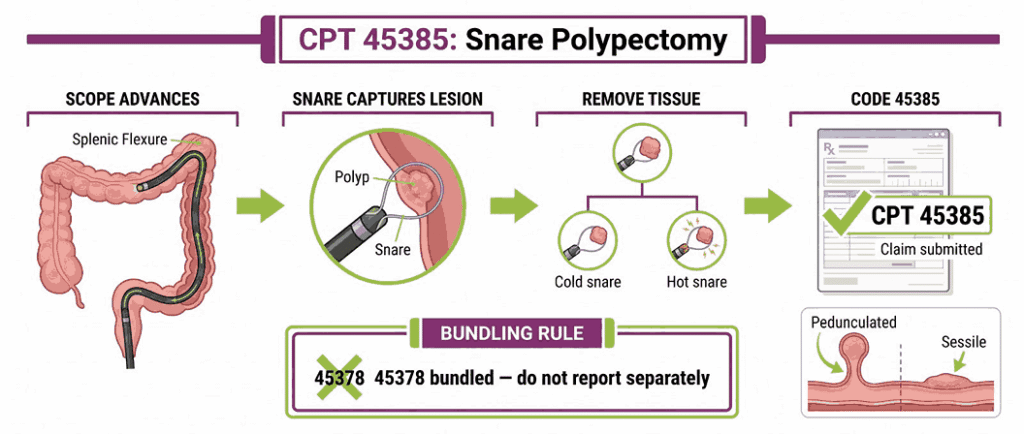
CPT code 45385 describes a flexible colonoscopy. The scope advances past the splenic flexure. The physician removes a polyp, tumor, or lesion using a wire loop snare. The loop closes around the base of the growth. It severs the tissue with electrocautery current or without it. Hot snare uses cautery.
Cold snare does not. Both fall under the same code. CPT defines the procedure by the instrument, not by the presence of cautery.
The code is bundled with the diagnostic exam. A diagnostic colonoscopy is inherently part of 45385. A practice does not report 45378 separately when a snare polypectomy happens in the same session.
The work of advancing the scope is already valued into the surgical code. This is one of the most miscoded points in gastroenterology billing. It belongs in any cpt code guide a practice keeps for its coding team.
What Does the Snare Technique Involve Clinically?
The physician passes a wire loop through the scope’s working channel. The loop opens around the polyp. It tightens at the stalk or base. For pedunculated polyps, the snare usually closes above the colon wall. For sessile or flat lesions, the snare needs a margin of normal tissue.
This margin helps achieve a complete resection. Electrocautery coagulates the vessels at the resection site. This lowers the risk of immediate bleeding on larger lesions.
How Is 45385 Different from Nearby Colonoscopy Codes?
The colonoscopy family assigns a distinct code to each removal technique, and the technique actually performed, not the intent going into the room, drives code selection.
- CPT 45378 covers a purely diagnostic colonoscopy with no removal.
- CPT 45380 covers colonoscopy with biopsy, which applies to cold forceps sampling rather than a full excision.
- CPT 45384 covers removal by hot biopsy forceps or bipolar cautery, a smaller instrument than a snare loop.
- CPT 45383 covers ablation of a lesion not amenable to snare, forceps, or bipolar removal.
- CPT 45381 covers submucosal injection, typically for lifting a lesion before resection.
A coder who defaults to 45385 whenever the operative note says “polypectomy” without confirming the instrument used is building a pattern of technique-mismatch denials. The note has to state snare technique explicitly, or the claim rests on an assumption a payer’s auditor can challenge later.
Does the Number of Polyps Removed Change the Code?
No, CPT guidance is clear on this point. Removing multiple lesions with the same technique in one session counts once. Three snared polyps in one colonoscopy still generate a single unit of 45385. The size, number, and location of each lesion still matter.
This detail supports medical necessity. It also informs the next surveillance interval. But it does not multiply the procedure code itself.
CPT Code 45385 Cost
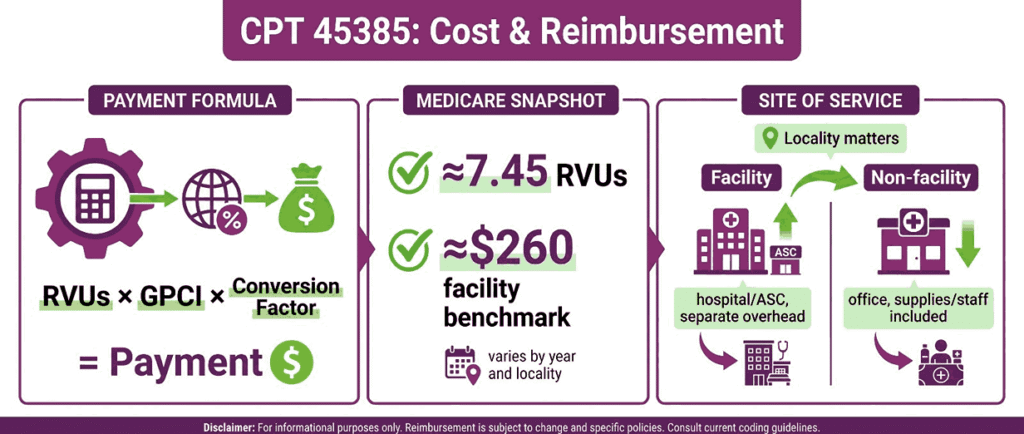
Reimbursement for 45385 depends on three things. The payer matters. The site of service matters. The geographic locality matters too. Medicare ties payment to relative value units. Those units cover physician work, practice expenses, and malpractice risk. A locality index adjusts each one. A conversion factor then sets the final dollar amount.
What Does Medicare Pay for CPT 45385?
Under the Medicare Physician Fee Schedule, 45385 has consistently carried one of the higher relative value totals in the colonoscopy family. This is reflecting the additional physician work of a snare resection compared with a purely diagnostic exam.
Facility-setting analysis has valued the code at roughly 7.45 total RVUs, translating to a national payment in the range of $260 for that RVU total under the conversion factor in effect at the time.
The exact dollar figure moves every January when CMS finalizes a new conversion factor. So, practices should confirm the current-year Medicare Physician Fee Schedule amount for their locality rather than treating any single number as fixed.
Facility and non-facility rates differ because the non-facility rate folds in practice expense for supplies, staff, and equipment that the physician’s own office absorbs. While the facility rate assumes an ambulatory surgery center or hospital outpatient department is billing separately for those overhead costs.
Why Does the Payment Amount Vary by Payer and Setting?
Three factors move the final allowed amount for the same code:
- Site of service. An ambulatory surgery center, hospital outpatient department, and physician office each carry different rates. The facility itself also bills a separate facility fee.
- Payer contract. Commercial payers often set their allowed amount as a percentage of Medicare’s rate. That percentage varies by contract, region, and network status.
- Bundling with other codes. When 45385 appears with another endoscopic code in one session, Multiple Procedure Payment Reduction rules apply. The higher-value code pays at 100 percent. Lower-value companion codes get reduced, since they already include the diagnostic colonoscopy’s value.
How Does Screening Status Affect Patient Cost-Sharing?
This point matters most for the patient, not just the practice. A colonoscopy ordered as preventive screening carries no cost-sharing under the Affordable Care Act. This holds true even when a polyp is found and removed. The code shifts from 45378 to 45385, but the screening protection should still apply. This requires modifier 33 or PT on the claim. Without that modifier, the payer may process the claim as diagnostic.
The patient can then be billed a copay or deductible they should not owe. Getting this modifier right on every screening claim protects both sides. It protects the practice’s revenue. It protects the patient’s financial experience. This is exactly the kind of detail gastroenterology billing services are built to catch.
CPT CODE 45385 Scenarios
The clinical story behind a claim shapes more than the CPT code. It shapes the ICD-10 code. It shapes the modifier set. It can even shape the next surveillance recommendation. The scenarios below cover the encounter types coders see most often.
What Happens When a Screening Colonoscopy Becomes Therapeutic?
A 58-year-old patient with no symptoms comes in for a routine screening. The physician finds a 6mm pedunculated polyp in the sigmoid colon. It gets removed with a hot snare. The claim reports CPT 45385. Modifier 33 or PT attaches to signal the preventive origin of the visit. The primary diagnosis stays Z12.11, the screening code.
The polyp becomes a secondary diagnosis once pathology confirms its type. This is often D12.6 for a benign colon polyp. This scenario drives most of the code’s volume. It is also the scenario most prone to modifier errors.
How Is a Surveillance Colonoscopy Coded After Prior Polyps?
A patient with a personal history of polyps returns for surveillance. Three years have passed since a prior adenoma removal. Two more polyps turn up and both get removed by cold snare. Because both used the same technique, 45385 is reported once.
The primary diagnosis becomes Z86.010, personal history of colonic polyps. This differs from a screening code, since the visit was ordered as surveillance. Payers watch this distinction closely. A surveillance exam coded as screening, or the reverse, changes patient cost-sharing. It can also trigger a frequency denial if the interval does not match payer guidelines.
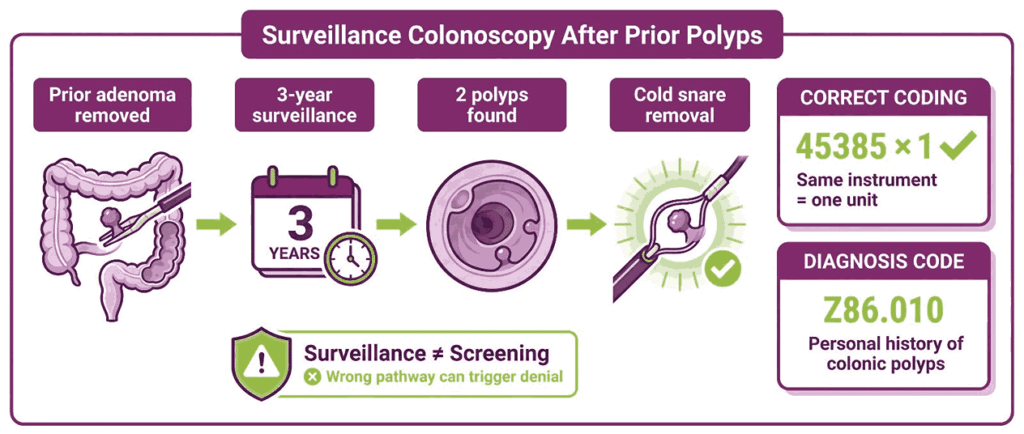
The primary diagnosis is Z86.010, personal history of colonic polyps, rather than a screening code, since the visit was ordered for surveillance rather than average-risk screening.
Payers scrutinize this distinction closely, because a surveillance exam coded as a screening exam, or the reverse, changes patient cost-sharing and can trigger a frequency-based denial if the payer’s records show the interval does not match its own surveillance guidelines.
What Happens When Two Different Removal Techniques Are Used in One Session?
One polyp gets removed by hot biopsy forceps. A second, larger polyp gets removed by snare. Both happen in the same colonoscopy. Both procedures are reportable, since they represent distinct techniques on distinct lesions. The claim needs a modifier to signal that distinction. The snare removal is billed as 45385.
The forceps removal is billed as 45384. A modifier like 59 or XS shows these are separate services. Without that modifier, most payer edit systems deny the second line automatically. The system treats it as an unbundling error, not two separate clinical acts.
What Happens When a Polyp Is Biopsied and Then Removed by Snare in the Same Session?
An endoscopist takes a cold biopsy of a suspicious lesion first. The sample goes for immediate pathology guidance. The same lesion then gets removed with a snare in the same pass. Coding guidance treats this as one reportable procedure.
Only CPT 45385 gets billed, not 45380 alongside it. The biopsy was a preliminary step toward removing the same lesion. It was not a separate clinical decision. Billing both codes here double-bills one continuous act. That pattern is exactly what a post-payment audit is built to catch.
What Happens During a Diagnostic Colonoscopy for Symptoms That Uncovers a Polyp?
A patient reports a change in bowel habits and unexplained bleeding. The ordering diagnosis is symptomatic, not a screening indication. A polyp turns up during the exam and gets removed by snare. The claim reports CPT 45385 with a symptom-based ICD-10 code. K63.5 often applies for a colon polyp before pathology returns.
This code sequences alongside the presenting symptom codes, per payer preference. Since this was never a screening visit, modifier 33 or PT does not apply. Standard deductible and coinsurance rules govern the patient’s cost-sharing here.
CPT 45385 Rules
Coding accuracy on 45385 depends on documentation discipline. It depends just as much on knowing the code set itself. The rules below reflect what payer audits flag most often.
What Must the Operative Note Document to Support 45385?
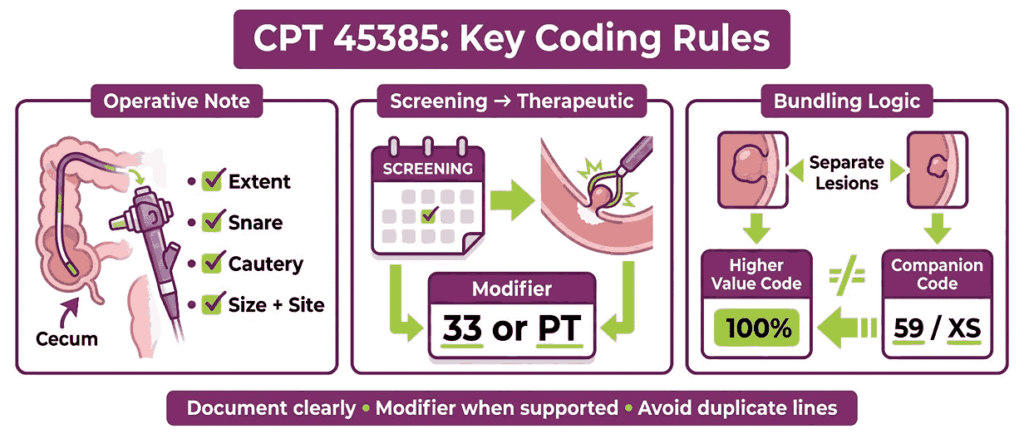
The note needs to state, in terms a coder does not have to infer, that the scope reached the cecum or the maximum extent achievable, that a snare device was used, and whether electrocautery was applied.
It should record the number of lesions removed, the size and location of each, and the technique used for each if more than one technique was involved.
A note that says only “polyp removed” without naming the instrument leaves the coder guessing between 45380, 45384, and 45385. That ambiguity is precisely what a payer’s medical review team looks for when it requests records.
Which Modifiers Govern Screening-to-Therapeutic Claims?
Modifier 33 identifies a preventive service under the Affordable Care Act mandate. Modifier PT serves the same function for Medicare claims. Either modifier must accompany CPT 45385 when a screening exam turns therapeutic. Without one of these modifiers, the payer’s system cannot distinguish the claim from an ordinary diagnostic procedure.
Standard cost-sharing then applies by default. This single modifier decision causes most patient billing complaints tied to colonoscopy claims. An incorrectly processed claim results in a bill the patient should never have received.
How Does Bundling Logic Apply When Multiple Codes Are Billed Together?
When 45385 appears on a claim with another colonoscopy code from the same session. National Correct Coding Initiative edits and payer-specific multiple procedure payment reduction policies both come into play.
The code carrying the higher relative value is paid at the full allowable rate, while companion codes representing a lower-valued technique on a separate lesion require an appropriate modifier, typically 59 or XS, to be reimbursed at all.
Billing two removal codes without any modifier when they apply to genuinely separate lesions almost always results in the second line being denied as a duplicate or bundled service.
What Are the Most Common Reasons 45385 Claims Are Denied?
- Missing or incorrect screening modifier, which causes a preventive encounter to process with patient cost-sharing.
- Frequency denials, where the payer’s records show a prior colonoscopy within its covered interval and the current claim lacks documentation justifying an earlier repeat, such as incomplete prior prep or a change in symptoms.
- Diagnosis-to-procedure mismatch, where the ICD-10 code on the claim does not support the medical necessity of a snare removal, often because the polyp diagnosis code was left off or entered incorrectly.
- Technique mismatch, where documentation supports forceps or ablation but the claim reports snare technique.
- Unbundling errors, where 45385 is billed alongside 45378 for the same session, when 45378 should not be reported separately at all.
A practice that tracks its own denial patterns against this list and keeps its coders working from a shared GI billing guide and a current ICD-10 Code reference resolves most of these before submission rather than after a rejection.
How Should a Practice Handle a Denied 45385 Claim?
Start with the explanation of benefits to identify the stated denial reason rather than assuming it. If the denial cites a screening modifier issue, correct and resubmit with modifier 33 or PT attached and supporting documentation of the screening intent behind the original order. If the denial cites bundling, confirm whether a second procedure code truly represents a separate lesion and, if so, resubmit with modifier 59 or XS along with the operative note.
If the denial cites frequency, pull the patient’s colonoscopy history and the ordering physician’s documented rationale for an earlier-than-typical repeat. Practices that do not have the internal bandwidth to track modifier logic, NCCI edits, and payer-specific frequency policies across every GI claim often bring in dedicated medical billing services rather than absorbing the write-offs that come from repeat denials on a code this common.
CPT 45385 is not a complicated code to define, but it sits inside a documentation and modifier system that punishes small gaps. A practice that documents technique precisely, applies the correct screening modifier every time a colonoscopy converts from preventive to therapeutic, and understands how bundling rules treat companion codes will see far fewer denials on this line than a practice treating 45385 as a simple, one-size-fits-all polypectomy code.