Family practice billing centers on high-volume E/M visits, preventive and wellness visits, chronic disease management, minor procedures, and vaccine administration. This guide organizes the most commonly used 2026 CPT codes by category to simplify billing, documentation, and denial prevention. Modifier rules and common coding pitfalls are covered throughout.

What are CPT Codes and Why are they Important?
CPT codes are five-digit codes that physicians and allied health staff use to describe medical procedures and services performed during patient encounters. The American Medical Association maintains CPT codes as the standard language between providers, insurers, and billers for reporting clinical work.
Payers use CPT codes to process claims and determine reimbursement amounts for each service. Family practices submit CPT codes on every claim, from office visits to preventive screenings to minor procedures.
What Common CPT Codes Are Used in Family Practice Billing?
Family practice care spans office visits, preventive care, chronic disease management, minor procedures, and lab services. The following tables organize these CPT codes by category for accurate billing and documentation.
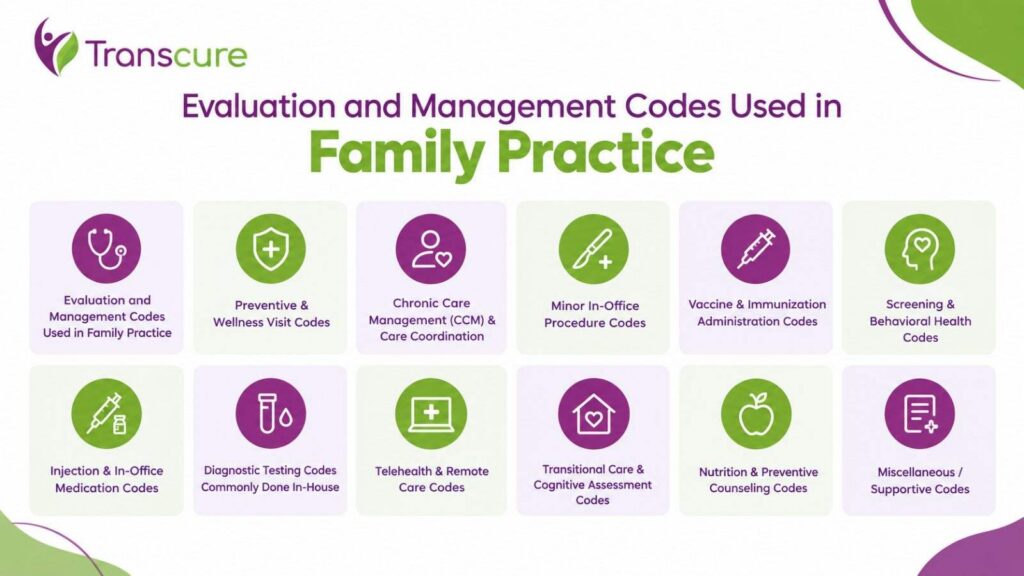
Evaluation and Management Codes Used in Family Practice
E/M codes represent the highest volume of claims in family practice and cover office- and hospital-based patient care.
| CPT Code | Category | Common Family Practice Use |
|---|---|---|
| 99202-99205 | New Patient Office/Outpatient Visit | Initial visits for new patients, coded by medical decision-making or total time |
| 99211-99215 | Established Patient Office/Outpatient Visit | Routine follow-ups, chronic condition checks, and acute illness visits |
| 99417 | Prolonged Services Add-on Code | Additional time beyond the 99205 or 99215 time threshold |
| G2211 | Visit Complexity Add-on | Ongoing management of a single, serious, or complex chronic condition |
| 99221-99223 | Initial Hospital Inpatient or Observation Care | Family physicians who admit or round on hospitalized patients |
| 99238-99239 | Hospital Discharge Day Management | Discharge summary and care transition documentation |
| 99304-99306 | Initial Nursing Facility Care | Nursing home admissions for family practice patients in long-term care |
These codes anchor daily claim volume, and selecting the correct level under the 2021 medical decision-making guidelines directly affects reimbursement accuracy.
Preventive & Wellness Visit Codes
Preventive billing uses age-based CPT codes and Medicare-specific HCPCS codes for wellness visits.
| CPT/HCPCS Code | Category | Common Family Practice Use |
|---|---|---|
| 99381-99387 | New Patient Preventive Visit (by age) | Well visits for new patients from infancy through adulthood |
| 99391-99397 | Established Patient Preventive Visit (by age) | Annual physicals for existing patients across all age brackets |
| G0402 | Initial Preventive Physical Examination | One-time exam within 12 months of Medicare Part B enrollment |
| G0438 | Initial Annual Wellness Visit (AWV) | First AWV for Medicare patients, includes a personalized prevention plan |
| G0439 | Subsequent Annual Wellness Visit (AWV) | Yearly AWV follow-up for established Medicare patients |
| G0468 | FQHC Annual Wellness Visit | AWV billed by federally qualified health center-based family practices |
Preventive codes carry strict frequency limits, and Medicare denies claims submitted before the eligible visit window opens.
Chronic Care Management (CCM) & Care Coordination
| CPT Code | Category | Common Family Practice Use |
|---|---|---|
| 99490 | Non-Complex CCM (First 20 min) | Monthly care coordination for patients with 2 or more chronic conditions |
| 99439 | Non-Complex CCM Add-on (Each Additional 20 min) | Extended clinical staff time beyond the first 20 minutes, up to 2 units |
| 99491 | CCM by Physician/QHP (First 30 min) | Chronic care management time personally provided by the physician |
| 99437 | CCM by Physician/QHP Add-on (Each Additional 30 min) | Extended physician time beyond the first 30 minutes |
| 99487 | Complex CCM (First 60 min) | Care coordination for patients requiring moderate or high complexity MDM |
| 99489 | Complex CCM Add-on (Each Additional 30 min) | Extended clinical staff time for complex CCM patients |
| G0511 | RHC/FQHC General Care Management | Bundled CCM, PCM, or BHI services billed by rural health clinics and FQHCs |
| G0556-G0558 | Advanced Primary Care Management (APCM) | Tiered monthly care management billed by patient complexity level, without a time requirement. |
Minor In-Office Procedure Codes
Family practice performs minor procedures during routine visits, and each procedure carries a distinct CPT code separate from the E/M service.
| CPT Code | Category | Common Family Practice Use |
|---|---|---|
| 10060 | Incision and Drainage of Abscess (Simple) | Draining a simple skin abscess or boil during an office visit |
| 11200 | Skin Tag Removal (Up to 15 lesions) | Removing benign skin tags found during a routine exam |
| 11400-11446 | Excision of Benign Skin Lesion | Removing moles, cysts, or lipomas by body site and lesion size |
| 12001-12007 | Simple Repair of Superficial Wounds | Suturing minor lacerations by wound length and body location |
| 17110 | Destruction of Benign Lesions (Up to 14 lesions) | Removing warts or similar lesions by cryotherapy or laser |
| 69210 | Removal of Impacted Cerumen | Clearing impacted earwax that blocks the ear canal |
A separate modifier applies when a minor procedure occurs on the same date as an office visit that meets its own medical decision-making threshold.
Vaccine & Immunization Administration Codes
Vaccine administration codes report the act of giving a vaccine, and a separate CPT code reports the vaccine product itself.
| CPT/HCPCS Code | Category | Common Family Practice Use |
|---|---|---|
| 90460 | Immunization Admin With Counseling (First Component, through age 18) | Pediatric vaccine visits that include physician or staff counseling |
| 90461 | Immunization Admin With Counseling (Each Additional Component) | Multi-component pediatric vaccines such as DTaP or MMR |
| 90471 | Immunization Admin Without Counseling (First Vaccine) | Adult flu shots or vaccines given without a documented counseling session |
| 90472 | Immunization Admin Without Counseling (Each Additional Vaccine) | Multiple vaccines given in the same visit without counseling |
| 90473-90474 | Immunization Admin by Intranasal or Oral Route | Nasal spray flu vaccine or oral vaccine administration |
| G0008 | Influenza Vaccine Administration (Medicare) | Flu shot administration billed under Medicare Part B |
| G0009 | Pneumococcal Vaccine Administration (Medicare) | Pneumonia vaccine administration billed under Medicare Part B |
Age and documented counseling determine which administration code family applies, and mixing families on the same claim triggers denials.
Screening & Behavioral Health Codes
Family practice bills preventive screening and behavioral health codes alongside routine office visits.
| CPT/HCPCS Code | Category | Common Family Practice Use |
|---|---|---|
| G0444 | Annual Depression Screening (5-15 min) | Medicare-covered annual depression screening using a standardized tool |
| G0442 | Annual Alcohol Misuse Screening (5-15 min) | Yearly alcohol use screening during a Medicare wellness or office visit |
| G0443 | Brief Behavioral Counseling for Alcohol Misuse (15 min) | Follow-up counseling after a positive alcohol misuse screening |
| G0447 | Behavioral Counseling for Obesity (15 min) | Weight management counseling for Medicare patients with a qualifying BMI |
| 96127 | Brief Emotional/Behavioral Assessment | Standardized tools such as PHQ-9 or GAD-7 for depression or anxiety screening |
| 96160 | Administration of Patient-Focused Health Risk Assessment | Standardized health risk questionnaires completed by the patient |
Standardized, validated instruments are required for 96127 and 96160, and informal or clinician-created checklists do not qualify for reimbursement.
Injection & In-Office Medication Codes
Injection administration codes report the delivery method, separate from the drug or biological product supplied.
| CPT/HCPCS Code | Category | Common Family Practice Use |
|---|---|---|
| 96372 | Therapeutic/Prophylactic Injection (Subcutaneous or Intramuscular) | B12 injections, antibiotic injections, and other in-office medication delivery |
| 96374 | Intravenous Push (First/Single Substance) | Single-drug IV push administration in the office setting |
| 96375 | Intravenous Push (Each Additional Sequential Substance) | Additional drugs pushed during the same IV encounter |
| 20600-20604 | Arthrocentesis, Small Joint/Bursa | Finger or toe joint injections |
| 20605-20606 | Arthrocentesis, Intermediate Joint/Bursa | Wrist, elbow, ankle, or AC joint injections |
| 20610-20611 | Arthrocentesis, Major Joint/Bursa | Knee, hip, or shoulder joint injections |
| J3301 | Triamcinolone Acetonide Injection (Drug Supply) | Steroid injection supply reported alongside the joint injection procedure |
| 11981 | Insertion of Non-Biodegradable Drug Delivery Implant | Contraceptive implant insertion performed in family practice |
The administration code and the drug supply code are reported together, and omitting the J-code for the drug itself leaves reimbursement uncollected for the product cost.
Diagnostic Testing Codes Commonly Done In-House
Family practices run several point-of-care tests during the same office visit, and each test carries its own CPT code separate from the E/M service.
| CPT Code | Category | Common Family Practice Use |
|---|---|---|
| 81002 | Urinalysis, Non-Automated (Without Microscopy) | Point-of-care urine dipstick testing during an office visit |
| 82962 | Glucose, Blood by Point-of-Care Device | Fingerstick glucose checks for diabetic patients |
| 83036 | Hemoglobin A1c | Diabetes monitoring and management for established patients |
| 85610 | Prothrombin Time (PT/INR) | Monitoring patients on warfarin or other anticoagulants |
| 87880 | Rapid Strep Test | Same-visit strep throat diagnosis in the office |
| 93000 | Electrocardiogram, Complete (Tracing and Interpretation) | Cardiac screening during a routine or urgent office visit |
| 36415 | Venipuncture, Routine Collection | Blood draw for labs sent to an outside laboratory |
Each in-house test requires its own order and result documentation, separate from the E/M note for the visit.
Telehealth & Remote Care Codes
CPT 99441 through 99443 were deleted effective January 1, 2025, and the telemedicine E/M family below replaced them.
| CPT/HCPCS Code | Category | Common Family Practice Use |
|---|---|---|
| 98000-98007 | Synchronous Audio-Video E/M (New/Established Patient) | Video visits billed by MDM level or total time on the date of the encounter |
| 98008-98015 | Synchronous Audio-Only E/M (New/Established Patient) | Phone-only visits with more than 10 minutes of medical discussion |
| 98016 | Brief Communication Technology-Based Service (5-10 min) | Short check-ins that do not meet the audio-only visit time threshold |
| 99453 | RPM Setup and Patient Education | Onboarding a patient onto a remote monitoring device |
| 99454 | RPM Device Supply With Daily Recording (Per 30 days) | Monthly billing for RPM device data transmission |
| 99457 | RPM Treatment Management (First 20 min) | Reviewing RPM data and interacting with the patient each month |
| 99458 | RPM Treatment Management (Each Additional 20 min) | Extended RPM management time beyond the first 20 minutes |
Medicare assigns an invalid status to CPT 98000 through 98015, so Medicare claims for audio-only visits use standard office E/M codes with modifier 93 instead.
Transitional Care & Cognitive Assessment Codes
| CPT Code | Category | Common Family Practice Use |
|---|---|---|
| 99495 | Transitional Care Management (Moderate Complexity) | Post-discharge follow-up with a face-to-face visit within 14 days |
| 99496 | Transitional Care Management (High Complexity) | Post-discharge follow-up with a face-to-face visit within 7 days |
| 99483 | Cognitive Assessment and Care Plan Services | Dementia evaluation and care planning for patients with cognitive decline |
TCM billing requires patient or caregiver contact within 2 business days of discharge; missing this window disqualifies the claim.
Nutrition & Preventive Counseling Codes
| CPT/HCPCS Code | Category | Common Family Practice Use |
|---|---|---|
| 97802 | Medical Nutrition Therapy, Initial Assessment (Each 15 min) | First nutrition counseling visit for a diagnosed condition |
| 97803 | Medical Nutrition Therapy, Reassessment (Each 15 min) | Follow-up nutrition counseling visits |
| G0270 | MNT Reassessment Following Second Referral (Medicare) | Additional Medicare-covered nutrition counseling after a new diagnosis |
| 99401-99404 | Preventive Medicine Counseling, Individual (By Time) | Lifestyle counseling for diet, exercise, or risk reduction |
| 99406 | Smoking Cessation Counseling (3-10 min) | Brief tobacco cessation counseling during an office visit |
| 99407 | Smoking Cessation Counseling (Greater Than 10 min) | Extended tobacco cessation counseling for higher risk patients |
Miscellaneous / Supportive Codes
| CPT Code | Category | Common Family Practice Use |
|---|---|---|
| 99050 | Services Provided Outside Regular Office Hours | Add-on billing for after-hours office visits |
| 99051 | Services Provided During Scheduled Evening/Weekend Hours | Add-on billing for practices with extended office hours |
| 99358 | Prolonged E/M Service Without Direct Patient Contact (First Hour) | Extensive chart review or care coordination outside the visit |
| 99359 | Prolonged E/M Service Without Direct Patient Contact (Each Additional 30 min) | Extended non-face-to-face care coordination time |
| 99024 | Postoperative Follow-Up Visit (No Charge, Global Package) | Tracking follow-up visits included in a prior procedure’s global period |
What Common Modifiers Are Used in Family Practice Billing?
Modifiers clarify special circumstances such as a same-day preventive and problem visit, a repeated procedure, or a separate provider performing the service.
| Modifier | Meaning | Common Use in Family Practice |
|---|---|---|
| 25 | Significant, Separately Identifiable E/M Service | Billing an office visit alongside a same-day vaccine or minor procedure |
| 59 | Distinct Procedural Service | Reporting two procedures on the same day that payers do not normally bundle |
| 24 | Unrelated E/M Service During Postoperative Period | An office visit for a new problem while the patient remains in a procedure’s global period |
| 57 | Decision for Surgery | An E/M visit that results in the decision to perform a major surgery |
| 76 | Repeat Procedure by Same Physician | Repeating the same test or procedure on the same day by the same provider |
| 91 | Repeat Clinical Diagnostic Laboratory Test | Repeating the same lab test on the same day to track a changing condition |
| 33 | Preventive Service | Marking a service as preventive under USPSTF guidelines for no patient cost sharing |
| 95 | Synchronous Telemedicine via Audio-Video | Video visits billed with standard E/M codes under applicable payer policy |
| 93 | Synchronous Telemedicine via Audio-Only | Audio-only visits billed with standard office E/M codes for Medicare |
Modifier 25 carries the highest audit risk in family practice, since payers scrutinize every preventive and problem visit combination billed on the same date.
What Are the Common Coding Pitfalls and How to Avoid Them?
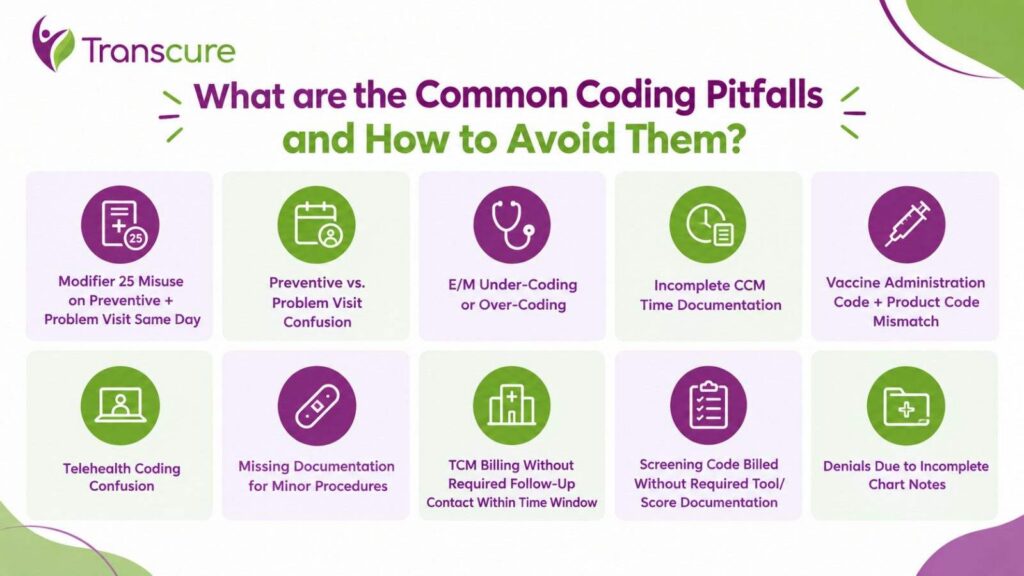
Family practice billing carries 10 recurring pitfalls that trigger denials and revenue loss. The following pairs describe each pitfall and its fix.
Modifier 25 Misuse on Preventive + Problem Visit Same Day
Billers append modifier 25 without documentation that separates the preventive service from the problem visit. Payers deny the claim or request records to verify medical necessity. Documentation must show a distinct history, exam, and medical decision-making for the problem visit, separate from the preventive exam.
Preventive vs. Problem Visit Confusion
Front desk staff schedules an annual wellness visit, but the physician addresses an acute problem instead and bills only the preventive code. The reverse error also occurs, where a wellness visit gets billed as a sick visit. Staff confirms the visit type at check-in, and coders verify the documented service matches the billed code before claim submission.
E/M Under-Coding or Over-Coding
Coders default to 99213 for every established patient visit regardless of complexity, or select 99215 without supporting medical decision-making. Both patterns trigger audits and lost revenue. Coders apply the 2021 medical decision-making elements or total time documented for each visit to select the correct level.
Incomplete CCM Time Documentation
Clinical staff log chronic care management activities without recording exact start and stop times each calendar month. Payers deny 99490 and 99439 claims that lack a time log. Staff record every CCM interaction with a timestamp in the care management platform or chart note.
Vaccine Administration Code + Product Code Mismatch
Billers submit the administration code without the matching vaccine product code, or pair the wrong administration family with the vaccine given. Claims are denied for incomplete or inconsistent coding. Coders cross-check the vaccine product code against the correct administration code family before submission.
Telehealth Coding Confusion
Staff applies modifier 95 to a Medicare audio-only visit or bills 98000-98015 to Medicare, both of which result in denial. Coders confirm the payer-specific telehealth policy, place-of-service code, and modifier before submitting each telehealth claim.
Missing Documentation for Minor Procedures
Providers perform a minor procedure during an office visit but document only the E/M portion of the encounter. Payers deny the procedure code for lack of supporting documentation. Providers document the procedure separately, including lesion size, location, and technique used.
TCM Billing Without Required Follow-Up Contact Within Time Window
Staff schedule the face-to-face visit but miss the required patient or caregiver contact within 2 business days of discharge. Missing this contact window disqualifies the entire TCM claim. Staff track the discharge date and complete the required contact before the 2-day deadline.
Screening Code Billed Without Required Tool/Score Documentation
Providers bill 96127 or a Medicare screening G-code without documenting the standardized tool name and score. Payers deny claims that lack this detail. Providers record the tool name, the score, and the clinical interpretation in the chart note.
Denials Due to Incomplete Chart Notes
Coders submit claims from chart notes missing a signed attestation, time documentation, or a complete assessment and plan. Incomplete notes generate the largest share of preventable denials. Providers complete and sign chart notes before the coding team submits the claim.
Frequently Asked Questions
What is the difference between CPT and ICD-10 codes?
CPT codes report the procedure or service performed, while ICD-10 codes report the diagnosis or reason for the visit. A claim needs both because payers match the procedure to the diagnosis to confirm medical necessity.
How often can a Medicare Annual Wellness Visit be billed?
G0438, the initial AWV, is billed once per patient lifetime. G0439, the subsequent AWV, is billed once every 12 months, and Medicare requires a full 12 months to pass since the last AWV or Initial Preventive Physical Examination.
What CPT code is used for a sports or school physical?
Most payers process a sports or school physical under the standard age-based preventive visit codes, 99381 through 99397. When insurance excludes sports physicals as non-covered, practices often bill the patient directly using the same code set or an unlisted preventive service code.
What is incident-to billing, and does it apply to family practice?
Incident-to billing allows a nurse practitioner or physician assistant to bill services under the supervising physician’s National Provider Identifier at the physician fee schedule rate, provided the physician initiated the care plan and remains on site. Many family practices use incident-to billing for established patient follow-up visits.
Can a nurse practitioner or physician assistant bill the same CPT codes as a physician?
Yes, the same CPT code set applies regardless of provider type. Reimbursement differs, since Medicare pays non-physician practitioners billing under their own NPI at 85 percent of the physician fee schedule rate, unless the visit qualifies for incident-to billing.
What is an unlisted CPT code, and when should it be used?
An unlisted code reports a service with no specific CPT code, and it requires a written description of the service with the claim. Family practices use unlisted codes sparingly because manual review slows reimbursement, and payers may request additional documentation before paying the claim.
How often do CPT codes get updated or replaced?
The American Medical Association releases CPT code updates every January, adding, revising, or deleting codes based on changes in clinical practice. Family practices update their charge templates and EHR code sets each year to avoid submitting deleted codes, and partnering with the best family practice billing and coding company takes this burden off in-house staff by automatically keeping every code set current.
What is the CPT code for a flu vaccine?
The flu vaccine product code depends on the formulation and dose given, such as 90686 for the preservative-free 0.5 mL quadrivalent vaccine or 90688 for the standard 0.5 mL quadrivalent vaccine. The product code is billed separately from the administration code, 90471 or 90460, which reports the act of giving the injection.