
According to CDC/NCHS, primary care physicians account for 50.3% of the estimated 1.0 billion annual physician office visits nationwide. This visit volume makes accurate family practice ICD-10-CM coding essential for medical necessity, clean claim submission, timely reimbursement, and denial prevention.
Family practice ICD-10-CM coding spans conditions across every age group and body system family physicians treat. Coders draw diagnosis codes from multiple ICD-10-CM chapters within a single encounter, unlike single-organ specialties that rely on one dominant chapter. This breadth requires a working knowledge of coding principles across several code sets, which is why many practices rely on dedicated medical coding services to keep every chart current.

This guide covers family practice ICD-10-CM coding in two layers. The first layer explains core coding principles, including chapter selection, code specificity, symptom-versus-diagnosis reporting, and multiple-code scenarios. The second layer organizes common family practice diagnoses into practical categories that cover preventive care, chronic disease, and acute infections.
What Do Family Practice ICD-10 Codes Cover?
Family practice ICD-10-CM codes classify the diseases, symptoms, and conditions documented during primary care encounters. Family physicians manage patients from infancy through late adulthood, across nearly every body system. This scope pulls diagnosis codes from multiple ICD-10-CM chapters rather than one dedicated chapter, unlike single-organ specialties. Accurate chapter selection supports correct claim submission and reflects the clinical picture documented at each visit.
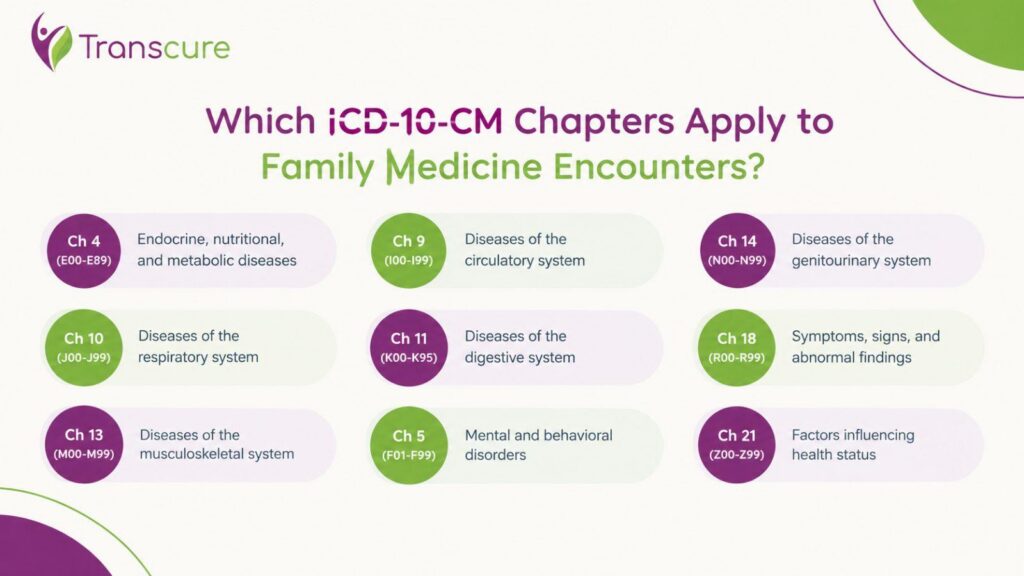
Which ICD-10-CM Chapters Apply to Family Medicine Encounters?
Family medicine diagnoses draw from 10 ICD-10-CM chapters within a typical week of visits. Each chapter organizes diagnosis codes by body system or condition category, and a visit often needs codes from several chapters, depending on the conditions documented that day.
- Chapter 4 (E00-E89): Endocrine, nutritional, and metabolic diseases, including diabetes, hypothyroidism, obesity, and hyperlipidemia.
- Chapter 9 (I00-I99): Diseases of the circulatory system, including hypertension and related cardiovascular conditions.
- Chapter 10 (J00-J99): Diseases of the respiratory system, including upper respiratory infections and bronchitis.
- Chapter 11 (K00-K95): Diseases of the digestive system, including GERD and abdominal conditions.
- Chapter 13 (M00-M99): Diseases of the musculoskeletal system, including low back pain and osteoarthritis.
- Chapter 5 (F01-F99): Mental and behavioral disorders, including anxiety and depression managed in primary care.
- Chapter 14 (N00-N99): Diseases of the genitourinary system, including urinary tract infections.
- Chapter 18 (R00-R99): Symptoms, signs, and abnormal findings not yet linked to a confirmed diagnosis.
- Chapter 21 (Z00-Z99): Factors influencing health status, including wellness visits and preventive screenings.
How Does a Family Practice Diagnosis Code Get Its Structure?
A family practice diagnosis code gains specificity as coders add characters after the three-character category. E11 identifies type 2 diabetes mellitus as a base category. A fourth and fifth character narrows this to E11.9 for diabetes without complications, or E11.22 for diabetes with chronic kidney disease.
M54.5, the former low back pain code, was deleted from ICD-10-CM in 2021. Current options include M54.50 for unspecified low back pain and M54.51 for vertebrogenic low back pain.
Selecting the most specific supported code strengthens medical necessity and claim accuracy. Diagnosis coding must align with provider documentation and current ICD-10-CM guidelines to limit denial risk.
When Should a Family Physician Report a Symptom Instead of a Confirmed Diagnosis?
A family physician reports a symptom code when no definitive diagnosis exists by the end of the visit. A confirmed diagnosis takes precedence once documentation supports it.
Cough without a documented cause codes to R05.9. Once a physician confirms acute bronchitis, J20.9 replaces the symptom code.
Fever of unclear origin codes to R50.9 at an early visit. A confirmed urinary tract infection instead uses N39.0 once testing identifies the cause.
Abdominal pain without a defined cause codes to R10.9. A confirmed diagnosis, such as K21.9 for GERD, replaces the symptom code once documented. Every symptom code must reflect what remains undiagnosed at that visit.
Can a Single Visit Require More Than One Diagnosis Code?
A single family practice visit often needs multiple diagnosis codes when the patient carries several documented conditions relevant to that encounter.
A patient with type 2 diabetes, hypertension, and hyperlipidemia who also presents with an acute upper respiratory infection needs 4 diagnosis codes: E11.9, I10, E78.5, and J06.9. Each condition affects the visit’s evaluation, treatment plan, or medical decision-making, so every code carries clinical relevance.
Every reported diagnosis must match documented findings and satisfy applicable coding guidelines. Coders never add codes solely to raise reimbursement, since unsupported codes increase audit and denial risk.
How Do You Apply ICD-10-CM Coding Guidelines in Family Practice?
Accurate family practice diagnosis coding depends on reviewing documentation before selecting codes. Coders confirm the diagnosis stated by the provider, check specificity, sequencing, and instructional notes in the Tabular List. The ICD-10-CM Official Guidelines for Coding and Reporting direct each of these decisions.
These rules support accurate code selection and reduce claim errors. The common family practice diagnosis codes follow later in this guide.
Where Do You Find a Diagnosis Code in the ICD-10-CM Manual?
A coder locates a diagnosis code by searching the Alphabetic Index for the term the provider documented. The index directs the coder toward a tentative code, then the Tabular List confirms the exact code, required characters, and any instructional notes.
A dash after an Alphabetic Index entry signals that additional characters are required. Inclusion and exclusion notes in the Tabular List then confirm whether the selected code applies to the documented condition.
For a documented diagnosis of acute bronchitis, the coder indexes bronchitis, confirms the acute subterm, then verifies J20.9 in the Tabular List against any exclusion notes.
What Level of Specificity Does a Family Practice Chart Note Require?
A family practice diagnosis code must reflect the highest level of specificity supported by the provider’s documentation. Coders never add laterality, severity, or etiology details the chart note does not state.
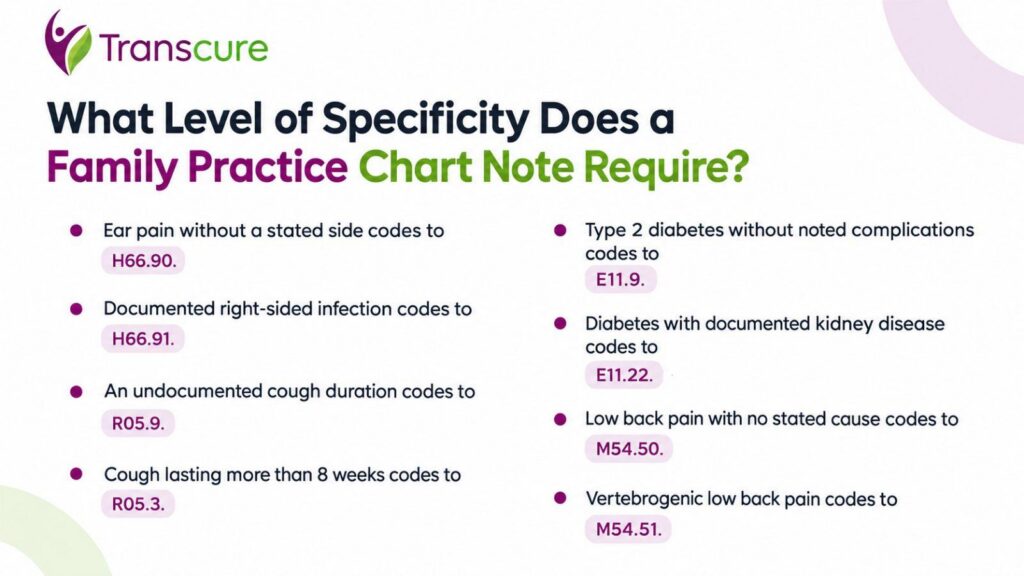
- Ear pain without a stated side codes to H66.90.
- Documented right-sided infection codes to H66.91.
- An undocumented cough duration codes to R05.9.
- Cough lasting more than 8 weeks codes to R05.3 for chronic cough.
- Type 2 diabetes without noted complications codes to E11.9.
- Diabetes with documented kidney disease codes to E11.22
- Low back pain with no stated cause codes to M54.50.
- Vertebrogenic low back pain codes to M54.51.
When Must Two Diagnosis Codes Be Billed for the Same Condition?
ICD-10-CM requires a second code when an instructional note states “use additional code” or “code first.” These notes appear at the category level and are not optional once the underlying detail is documented.
E11.22 for type 2 diabetes with chronic kidney disease carries a use additional code note. The coder must add a stage code from N18.1 through N18.6 once the provider documents CKD stage.
A urinary tract infection with a confirmed organism adds a code from B96.20 through B96.29 to identify the bacteria. This second code is required only when the provider documents the causal organism, not for every diagnosis.
What Makes a Code a “Combination Code” in Primary Care Documentation?
A combination code is a single ICD-10-CM code that classifies two diagnoses, a diagnosis with a manifestation, or a diagnosis with a complication. Coders assign only the combination code when it fully identifies the documented condition.
E11.22 combines type 2 diabetes with diabetic chronic kidney disease into one code. I11.9 combines hypertension with heart disease, and K21.0 combines GERD with documented esophagitis.
Reporting hypertension and heart disease as two separate codes when a combination code already exists creates duplicate, incorrect reporting. The combination code takes priority whenever documentation supports it.
How Are Past Conditions Coded During a Follow-Up Visit?
A sequela code applies once the acute phase of an illness or injury has ended, but a residual effect remains. Coders never use the sequela code alone; they sequence the residual condition first, then the sequela code.
Use a personal history code when a condition has resolved with no residual effect. Documented history of breast cancer with no current disease codes to Z85.3, not an active malignancy code.
For a deviated nasal septum from a prior nasal fracture, code the current deviation first (e.g., J34.2), then the sequela code from the injury category.
When Is an Unspecified Diagnosis Code Still Acceptable?
An unspecified code is acceptable when the documentation genuinely lacks the detail needed for a more specific code. Coders never assume laterality, severity, or cause that the provider did not document.
- A confirmed pneumonia diagnosis without a specified organism codes to J18.9
- Elevated cholesterol without a stated lipid subtype codes to E78.5
- Low back pain with no documented cause codes to M54.50.
Unspecified does not mean incorrect when the record supports nothing more precise. Ordering extra tests solely to justify a more specific code is not appropriate coding practice.
How Do You Code a Condition the Physician Suspects but Hasn’t Confirmed Yet?
Outpatient coding rules never treat a probable, suspected, or questionable diagnosis as confirmed. Coders instead report the signs, symptoms, or abnormal findings documented at that visit, per the ICD-10-CM Official Guidelines.
- A patient with probable urinary tract infection pending culture results codes to the presenting symptom, such as R30.0 for dysuria, rather than N39.0.
- A patient with suspected pneumonia pending chest imaging codes to the documented symptom, such as R05.9 for cough, rather than J18.9 for confirmed pneumonia.
This rule applies specifically to outpatient encounters and differs from inpatient coding practice.
Which ICD-10 Codes Cover the Most Common Family Practice Diagnoses?
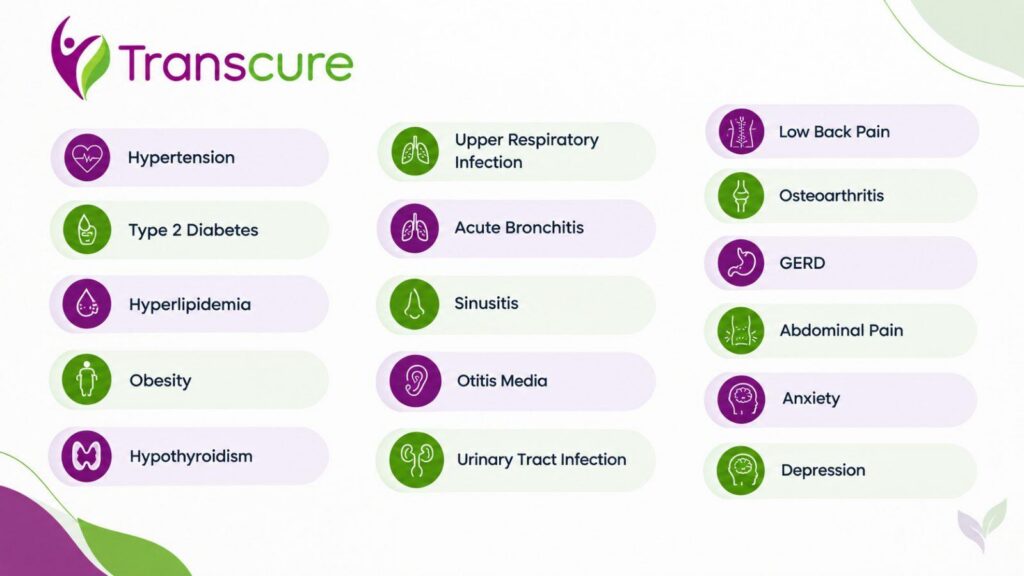
Family practice coding spans preventive encounters, chronic disease management, acute illness, musculoskeletal complaints, behavioral health, women’s health, screening, and social factors. The sections below focus on commonly used ICD-10-CM codes, their more specific alternatives, and the coding relationships that matter in primary care.
Preventive & Wellness Visit ICD-10 Codes
Adult Annual Wellness Visit ICD-10 Codes
The adult wellness visit ICD-10 code is Z00.00 for a general adult medical exam without abnormal findings. When the exam turns up an abnormal finding, coders shift to Z00.01, then add a second code identifying exactly what was found.
FY2026 kept the Z00.0 category unchanged, so no new adult exam codes were added this cycle. Neither Z00.00 nor Z00.01 carries CMS-HCC risk-adjustment weight, since routine exam codes don’t reflect disease burden.
Well-Child Visit ICD-10 Codes
Family practice bills Z00.129 when a well-child visit turns up nothing unusual. A finding during that same visit moves the claim to Z00.121, while a newborn under 8 days old gets its own dedicated code instead of either child code.
Newborns under 8 days get Z00.110, and those between 8 and 28 days get Z00.111, both kept separate from the general child health exam category. These Z00 codes stay outside CMS-HCC mapping entirely, since pediatric wellness visits carry no risk-adjustment value.
Immunization Encounter ICD-10 Codes
Immunization encounters use code Z23 regardless of which vaccine is administered that day. A companion CPT or HCPCS code is always required to identify the actual vaccine, since Z23 alone flags only the reason for the visit. Family physicians can cross-check the exact procedure code in the Family Practice CPT guide.
Z23’s guideline note still instructs coders to sequence any routine childhood exam first, unchanged for FY2026. This code never affects HCC scoring, though pairing it with Z71.85 documents counseling given during the same visit.
Chronic Disease Management ICD-10 Codes
Hypertension ICD-10 Codes
Uncomplicated hypertension codes to I10 when no heart or kidney involvement is documented. Once a physician links high blood pressure to heart disease, the correct code becomes I11.9, and a kidney connection instead calls for I12.9.
The I10 through I13 hypertension family has no FY2026 structural changes, keeping the coding rules from prior years intact. I10 alone typically skips CMS-HCC risk adjustment, while the complicated codes I11.9 and I12.9 do carry weight in a patient’s risk score.
Type 2 Diabetes ICD-10 Codes
Type 2 diabetes without complications is reported as E11.9 on a clean, uncomplicated chart. Diabetic chronic kidney disease shifts the code to E11.22, which then requires an added N18 code to state the CKD stage, while hyperglycemia alone codes to E11.65.
No new diabetes complication codes arrived for FY2026, so the E11 category structure carries over unchanged from last year. E11.22 maps to HCC 37 under the current CMS-HCC V28 model, directly raising a patient’s calculated risk score.
Hyperlipidemia ICD-10 Codes
Mixed cholesterol and triglyceride elevation codes to E78.2 under the hyperlipidemia category. An unspecified lipid disorder still reports as E78.5, but pure cholesterol elevation alone now needs a child code rather than its old parent entry.
FY2026 removed E78.0’s billable status entirely, forcing coders down to E78.00 or the newer familial-hypercholesterolemia code E78.01. None of the E78 lipid codes carry CMS-HCC weight, since lipid disorders alone don’t drive Medicare risk scores.
Obesity ICD-10 Codes
Obesity with no documented cause defaults to E66.9 on most family practice charts. Morbid obesity tied to excess calorie intake instead codes to E66.01, and a BMI still in the overweight range calls for E66.3 rather than a true obesity code.
October 2024 added the class 1 through 3 obesity codes, letting coders capture BMI-based severity directly for the first time. Documented obesity does carry CMS-HCC weight, so precise severity coding can meaningfully change a practice’s risk-adjusted revenue.
Hypothyroidism ICD-10 Codes
A hypothyroidism diagnosis with no stated cause is reported as E03.9 across most primary care charts. When Hashimoto’s or another autoimmune thyroiditis is the documented cause, the code shifts to E06.3, a distinct entry the unspecified code cannot capture.
E03.9 specifically excludes iodine-deficiency hypothyroidism and postprocedural hypothyroidism, both of which route to their own dedicated code ranges instead. Neither E03.9 nor E06.3 maps to a CMS-HCC category, so thyroid coding here affects clinical clarity rather than risk scores.
Acute Respiratory & Infectious ICD-10 Codes
Upper Respiratory Infection ICD-10 Codes
An upper respiratory infection with no further detail lands on code J06.9 for most acute visits. A confirmed common cold instead moves to J00, while isolated throat inflammation without a wider infection codes separately to J02.9.
The J00 through J06 block covers upper-tract infections only, while a lower-tract diagnosis like acute bronchitis sits in a separate category coders shouldn’t cross into by mistake. These acute infection codes carry no CMS-HCC weight, since short-term illnesses don’t factor into Medicare’s chronic-risk calculations.
Acute Bronchitis and Sinusitis ICD-10 Codes
Acute bronchitis without an identified organism codes to J20.9 in most family practice charts. Sinus involvement instead falls under J01.90 when acute and unspecified by sinus location, while a lingering case beyond the acute phase moves to chronic sinusitis, J32.9.
J01.90 still excludes COPD with an acute lower respiratory infection under FY2026 rules, keeping that boundary from earlier code sets. Neither bronchitis nor sinusitis codes carry CMS-HCC weight, so their value lies in documentation accuracy rather than risk-score impact.
Otitis Media ICD-10 Codes
Otitis media without a stated side codes to H66.90 on most pediatric and adult charts alike. Documenting a right ear infection shifts the code to H66.91, and a left-sided infection calls for H66.92.
The H66 otitis media family received no FY2026 revisions, so laterality coding rules remain the same. An additional code is required whenever a perforated eardrum accompanies the infection, since H66.9x alone doesn’t capture that complication.
Urinary Tract Infection ICD-10 Codes
A urinary tract infection with no specified site codes to N39.0 when cystitis hasn’t been separately confirmed. Once acute cystitis without hematuria is documented, use the more precise code N30.00 instead, along with a second code naming the causal organism.
N39.0 specifically excludes cystitis once a coder can confirm and apply N30.00, keeping the two codes from overlapping on the same claim. These codes carry no CMS-HCC weight on their own, though repeated infections may point toward a separately codable chronic condition.
Musculoskeletal & Pain ICD-10 Codes
Low Back Pain ICD-10 Codes
Low back pain with no documented cause codes to M54.50 as the current default entry. Vertebrogenic low back pain instead reports as M54.51, and any other specified type not covered by those two options falls to M54.59.
The single code M54.5 was deleted back in 2021, so any chart still referencing it needs correction under FY2026 rules. None of the low back pain codes affect CMS-HCC scoring, since musculoskeletal pain doesn’t count as a chronic risk condition.
Osteoarthritis ICD-10 Codes
Osteoarthritis with no documented joint defaults to the double-unspecified code M19.90. A knee diagnosis with no further detail instead codes to M17.9, while a confirmed primary osteoarthritis of the right knee calls for the more precise M17.11.
No structural change touched the M15 through M19 osteoarthritis block for FY2026, so specificity expectations stay the same. M19.90’s double-unspecified status draws increased audit attention, since payers expect joint and laterality detail whenever an exam note supports it.
Myalgia and Joint Pain ICD-10 Codes
General muscle pain with no documented site now requires a child code rather than its old parent entry under the myalgia category. A joint pain complaint with no specified joint instead codes to M25.50, a separate category coders shouldn’t confuse with myalgia.
M79.1 itself lost its billable status, so any claim still submitted with that bare category code will be rejected under FY2026 edits, and coders must use M79.10 or M79.18 instead. Neither replacement code carries CMS-HCC weight, keeping this category firmly outside risk-adjustment territory.
Gastrointestinal ICD-10 Codes
GERD ICD-10 Codes
Documented reflux without esophagitis codes to K21.9 for most GERD visits in family practice. Once a physician confirms esophagitis alongside reflux, use K21.0 instead; reporting both conditions separately would duplicate what one code already covers.
The K21 reflux category carries no FY2026 revisions, leaving the esophagitis-versus-plain-reflux split unchanged from prior years. Neither K21.9 nor K21.0 maps to CMS-HCC, so GERD coding here supports clinical accuracy rather than risk-adjusted reimbursement.
Abdominal Pain ICD-10 Codes
Abdominal pain with no documented location is reported as R10.9 until a more precise site is charted. A right upper quadrant complaint codes to R10.11, and pain localized to the right lower quadrant codes to R10.31.
These codes remain valid only until a definitive diagnosis is confirmed, per the coding guideline covering symptoms without an established cause. They never carry CMS-HCC weight, and they typically give way to a definitive diagnosis code once one is reached.
Mental and Behavioral Health ICD-10 Codes (Primary Care Scope)
Anxiety ICD-10 Codes
Anxiety documented without further detail codes to F41.9 across most primary care encounters. A confirmed generalized anxiety disorder instead moves to F41.1, and a diagnosis centered on recurring panic attacks calls for F41.0 rather than either broader code.
The F41 anxiety category saw no additions for FY2026, keeping its generalized, panic, and unspecified splits unchanged. F41.9 generally carries no CMS-HCC weight, unlike several other behavioral health codes that do factor into a patient’s risk score.
Depression ICD-10 Codes
A single documented episode of depression with no further detail is coded to F32.9 in most family practice charts. Recurrent depressive episodes instead move to F33.9, and a confirmed mild single episode calls for the more specific code F32.0.
Neither the F32 nor F33 depression categories changed structurally under FY2026 coding updates. Unlike anxiety, both F32.9 and F33.9 do map to a CMS-HCC category, making accurate depression coding directly relevant to a practice’s risk-adjusted revenue.
Women’s Health ICD-10 Codes
Routine Gynecological Exam ICD-10 Codes
A routine gynecological exam with no abnormal findings codes to Z01.419 for most annual visits. The same exam becomes Z01.411 once an abnormal finding is documented, requiring a second code to specify what was found.
Z01.41 specifically excludes a screening Pap smear performed outside a routine exam, which instead routes to Z12.4, as a distinct encounter reason. These exam codes carry no CMS-HCC weight, since preventive gynecological visits don’t reflect ongoing disease burden.
Contraceptive Management ICD-10 Codes
An unspecified contraceptive management encounter reports as Z30.9 when the method isn’t further detailed. Surveillance of an implantable subdermal contraceptive instead codes to Z30.430, while a first-time oral contraceptive prescription calls for Z30.011.
No structural changes touched the Z30 contraceptive category for FY2026, keeping method-specific coding options stable year over year. These codes never map to CMS-HCC, and a combined visit covering both a gynecological exam and contraceptive counseling may need codes from Z01.41 and Z30 together.
Screening and Abnormal Finding ICD-10 Codes
Abnormal Lab Result ICD-10 Codes
An abnormal lab result involving blood chemistry with no further detail codes to R79.9 on most charts. When the abnormality is specifically elevated blood glucose without a diabetes diagnosis, a more precise code applies instead of the general R79.9 entry.
The R79 category carries no FY2026 revisions, so its exclusion of hyperglycemia NOS from R79.9 still routes coders to R73.9 instead. Neither abnormal lab code maps to CMS-HCC, since a finding alone doesn’t establish the confirmed diagnosis risk models require.
Preventive Screening ICD-10 Codes
A colorectal cancer screening encounter codes to Z12.11 when performed on an asymptomatic patient. A lipid disorder screening visit instead reports as Z13.220, and a diabetes screening encounter with no symptoms present calls for Z13.1.
None of these screening codes changed for FY2026, so age and risk-based screening intervals still follow USPSTF guidance unchanged. Adding a family history code from the Z80 category alongside Z12.11 can justify shorter screening intervals when a payer questions medical necessity.
Social and Lifestyle Factor ICD-10 Codes
Tobacco Use and Counseling ICD-10 Codes
Tobacco use without documented dependence codes to Z72.0 for a large share of primary care encounters. Once a physician documents dependence criteria such as failed quit attempts or continued use despite harm, the correct code shifts to F17.210 for cigarette dependence.
Neither Z72.0 nor F17.210 changed for FY2026, so the dependence-versus-use documentation threshold stays exactly where it was. Neither code affects CMS-HCC scoring, but F17.210 still supports medical necessity for billing tobacco cessation counseling as its own service.
Social Determinants of Health (Z55–Z65) ICD-10 Codes
Documented food insecurity codes to Z59.41 under the broader social determinants of health category. Homelessness falls under Z59.00, while unemployment affecting a patient’s health status calls for Z56.0, each within the broader Z55 through Z65 block.
The homelessness code Z59.0 split into three separate options back in 2022, and that structure carries forward unchanged into FY2026. None of these SDOH codes carry CMS-HCC weight on their own, though CMS increasingly expects them for value-based reporting.
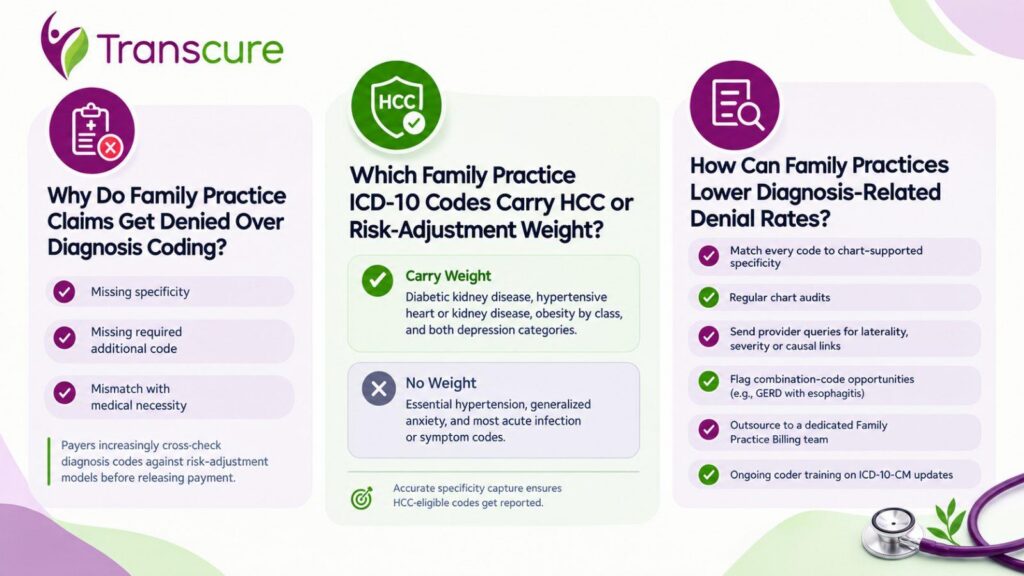
Why Do Family Practice Claims Get Denied Over Diagnosis Coding?
Family practice claims get denied over diagnosis coding for three main reasons: missing specificity, a missing required additional code, or a mismatch with medical necessity. Payers increasingly cross-check diagnosis codes against risk-adjustment models before releasing payment, which is why many practices bring in Family Practice billing companies to proactively review coding patterns.
Which Family Practice ICD-10 Codes Carry HCC or Risk-Adjustment Weight?
HCC, or Hierarchical Condition Category, is the CMS model that converts certain diagnosis codes into a risk score for Medicare Advantage and value-based contracts. Not every ICD-10-CM code carries this weight, and family practice sees a wide mix of both types.
Complication-level chronic disease codes generally carry the most weight, including diabetic kidney disease, hypertensive heart or kidney disease, obesity by class, and both depression categories. Uncomplicated codes such as essential hypertension, generalized anxiety, and most acute infection or symptom codes typically add no risk-adjustment value at all.
Family Practice billing services built around accurate specificity capture help ensure complication codes get reported whenever documentation supports them. Missing just one HCC-eligible code across a full patient panel can measurably understate a practice’s true risk-adjusted revenue.
How Can Family Practices Lower Diagnosis-Related Denial Rates?
Lowering denial rates starts with matching every code to the specificity the chart actually supports, not an unspecified default. Regular chart audits catch missing use-additional-code notes before a payer’s system does.
A short documentation query back to the provider, asking for laterality, severity, or a causal link, resolves most specificity gaps within the same visit cycle. Coders who flag combination-code opportunities, such as GERD with esophagitis, also prevent the duplicate-coding errors that trigger manual review.
Practices that outsource this specificity review to a dedicated Family Practice billing team typically see denial rates drop within the first few billing cycles. Consistent coder training on annual ICD-10-CM updates keeps that improvement from fading once the initial audit ends.
Family Practice ICD-10 Codes FAQs
What is the ICD-10 code for a medication refill visit?
A visit whose only purpose is renewing an existing prescription codes to Z76.0. Coders typically pair it with the underlying condition code, such as I10 for a blood pressure medication refill, to support medical necessity.
What ICD-10 code covers a work, school, or medical excuse note?
Issuing a medical certificate for work, school, or other administrative purposes codes to Z02.79. This code excludes any encounter that’s actually a general medical examination, which routes to the Z00 category instead.
What’s the difference between ICD-10 and ICD-10-CM?
ICD-10 is the World Health Organization’s global disease classification, while ICD-10-CM is the U.S. clinical modification used for diagnosis coding on American claims. Family practice coders in the United States report exclusively under the CM version.
How often do family practice ICD-10-CM codes change?
CMS and CDC/NCHS update the ICD-10-CM code set once a year, effective every October 1. Family practices should confirm their EHR’s code set reflects each new fiscal year before that date to avoid billing outdated entries.
Can a preventive visit and a problem visit share the same claim?
A preventive exam code, such as Z00.00, and a separate problem diagnosis code can both appear on one claim when a new issue comes up during the wellness visit. The problem-focused E/M service needs modifier 25 attached, distinguishing it from the preventive service on the same date.