Georgia billing teams navigate three layers of rules that rarely line up cleanly. Federal law sets the floor: HIPAA, the No Surprises Act, and CMS billing requirements apply regardless of where a practice sits.
Georgia law adds a second layer on top of that floor, including the Surprise Billing Consumer Protection Act (O.C.G.A. §§ 33-20E-1 et seq., effective since January 1, 2021), the prompt pay statute under O.C.G.A. § 33-24-59.14, and 2026 additions like HB 197, which now requires payers and providers to document good-faith communication during utilization review disputes.
Payer contracts add a third layer, and each MCO or commercial plan can impose its own timely filing windows, appeal deadlines, and documentation standards on top of both.
Miss a requirement at any layer and a clean claim turns into a denial, an appeal, or, in cases involving balance billing violations, a complaint to the Georgia Office of the Commissioner of Insurance. This guide walks through the state and federal laws that actually shape how claims move through a Georgia practice, from the moment a patient checks in to the moment a bill either gets paid or gets challenged.

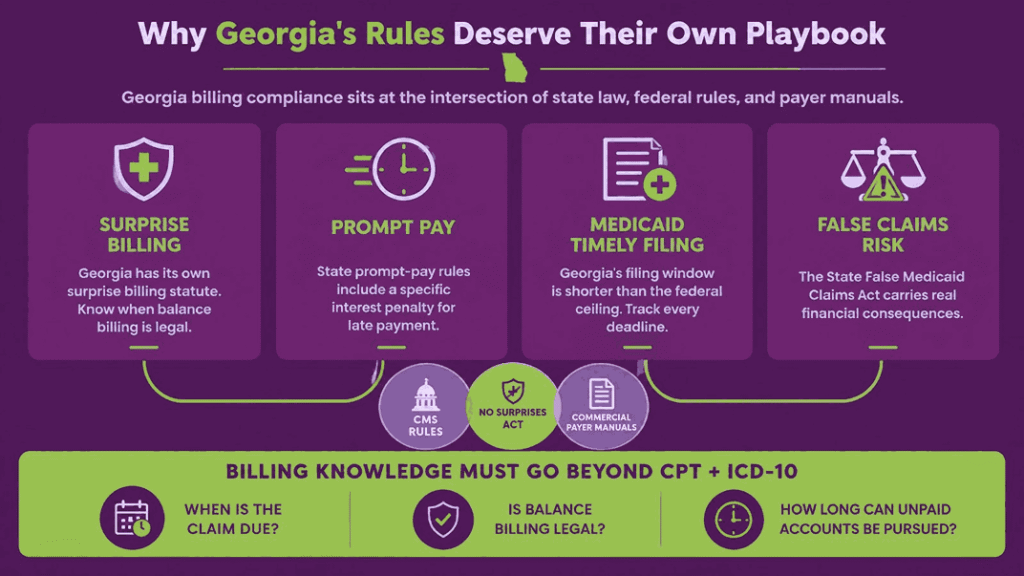
Why Georgia’s Rules Deserve Their Own Playbook
Georgia is not a state with light billing regulation. It has its own surprise billing statute, its own prompt pay law with a specific interest penalty. A Medicaid timely filing window shorter than the federal ceiling, and a state False Medicaid Claims Act with real financial teeth. None of these exist in a vacuum. They interact with CMS rules, with the federal No Surprises Act, and with each commercial payer’s own claims manual.
A biller who only knows CPT and ICD-10 codes will still get burned. Knowing when a claim is due, when balance billing is legal, and how long an unpaid account can be pursued matters just as much as knowing modifier 25 from modifier 59.
The Georgia Surprise Billing Act
Georgia passed House Bill 888 in 2020, creating a new chapter in Title 33 of the Official Code of Georgia Annotated. The law took effect January 1, 2021, and it changed how out-of-network claims are handled across the state.
Under OCGA 33-20E-4, balance billing is prohibited in two specific situations:
- Emergency care. Any out-of-network provider or facility that furnishes emergency services cannot bill the patient beyond normal cost sharing, regardless of whether the patient had advance notice of network status.
- Non-emergency care at an in-network facility. If an out-of-network provider treats a patient inside an in-network hospital, imaging center, or surgical center, balance billing is banned unless the patient gave written consent in advance, after receiving a cost estimate.
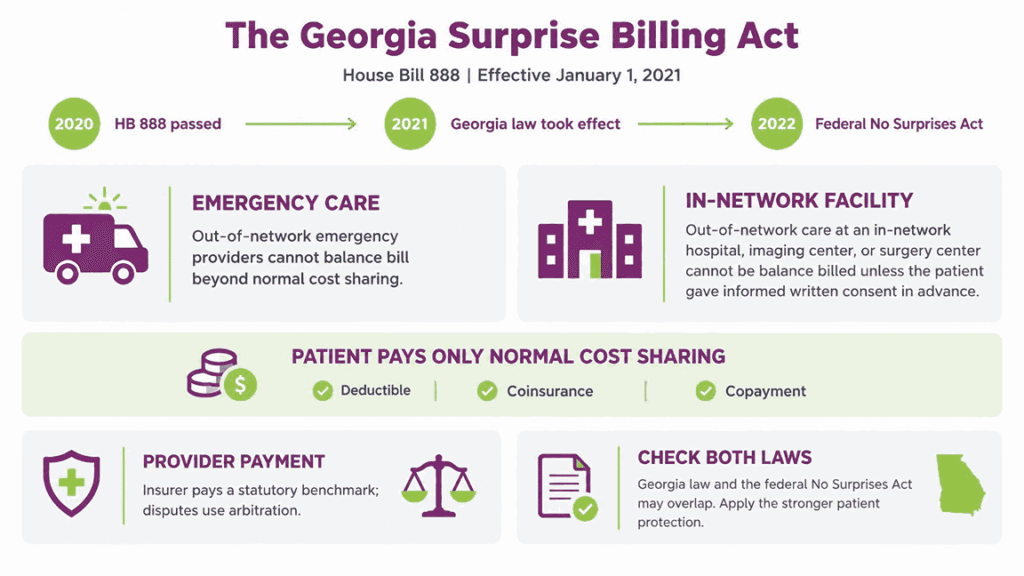
When balance billing is barred, the out-of-network provider can only collect the patient’s normal deductible, coinsurance, or copayment. The insurer then owes the provider a rate set by formula, based on the greater of the verifiable contracted amount paid for similar services or another benchmark defined in the statute. Disputes between insurers and out-of-network providers go through an arbitration process rather than a lawsuit.
The state law does not stand alone. The federal No Surprises Act, effective January 1, 2022, covers similar ground and adds protections like good faith estimates for uninsured and self-pay patients. Where the two overlap, providers generally follow whichever standard gives the patient stronger protection.
A biller working claims for facilities in Atlanta, Savannah, or anywhere in between needs to check both statutes before assuming a balance bill is allowed.
Prompt Pay Requirements: OCGA 33-24-59.5 and 33-24-59.14
Georgia’s prompt pay law sets a real deadline, and it applies twice: once to insured patients under 33-24-59.5, and once directly to providers and facilities under 33-24-59.14.
The rule itself is simple to state. An insurer or administrator must pay or deny a clean claim within:
- 15 working days for electronic claims
- 30 calendar days for paper claims
If the insurer disputes only part of a claim, it must still pay the undisputed portion within that window. If more documentation is needed, the insurer must say so in writing, and once it receives that documentation, the same 15- or 30-day clock restarts.
Miss the deadline, and the penalty is concrete. Under subsection (c) of 33-24-59.5, the insurer owes 12 percent annual interest on the unpaid amount. That interest is not discretionary. It accrues automatically once the payment window closes.
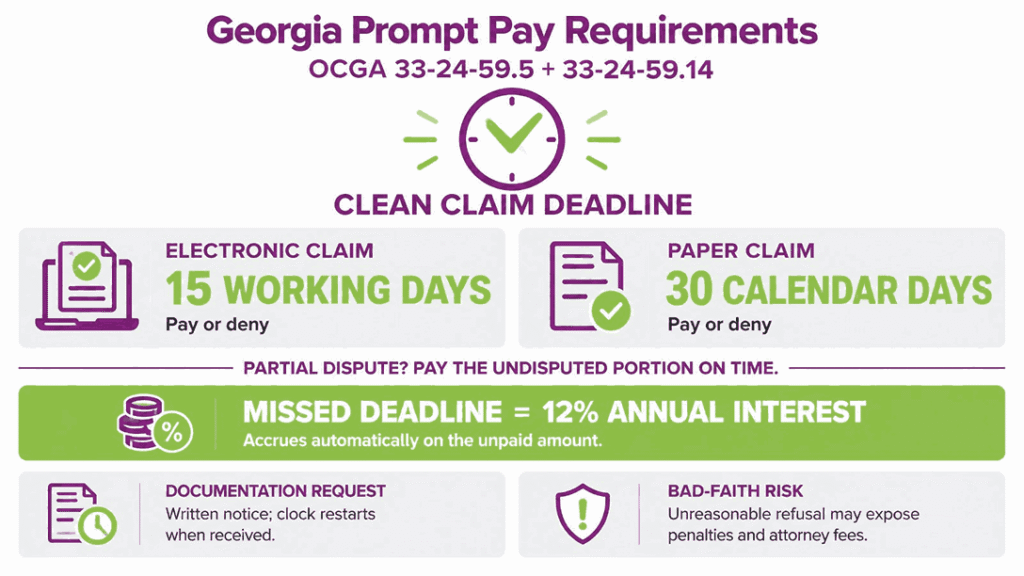
There is a second layer of leverage here too. OCGA 33-4-6 lets an insured party sue an insurer for bad faith refusal to pay, with penalties and attorney’s fees available when the refusal lacks a reasonable basis. Billing teams rarely need to invoke this directly, but it explains why persistent, well-documented follow-up on aged claims carries real weight in Georgia. A payer that is stalling without cause is exposed, not just slow.
Georgia Medicaid Timely Filing
Georgia Medicaid, administered through the Department of Community Health and processed via the GAMMIS portal, runs a tighter timely filing window than the federal ceiling allows. Federal rule under 42 CFR 447.45 permits states up to 12 months for original claim submission. Georgia sets its own limit at 180 days from the date of service.
A few related deadlines matter just as much as the original filing window:
- Corrected claims and resubmissions generally must be filed within a shorter window after a denial, often cited around 90 days depending on the managed care organization involved.
- Crossover claims, where a patient carries both Medicare and Medicaid, must be submitted within 12 months of the month of service, and the provider must wait at least 45 days after Medicare’s payment before submitting to Medicaid.
- Coordination of benefits recoveries carry a 12-month lookback period, with 30 days’ advance notice before Georgia Medicaid recovers a payment.
Georgia contracts with several managed care organizations to deliver most of its Medicaid population, including CareSource, Amerigroup, and Peach State Health Plan. Each of these organizations layers its own claims manual on top of the state rule, so the 180-day window is a floor, not a guarantee.
A gastroenterology practice billing Medicaid patients in rural Georgia and an oncology group billing through a Peach State contract in metro Atlanta may face slightly different resubmission clocks even though both answer to the same state statute.
Commercial Payer Filing Windows in Georgia
Commercial payers set their own timely filing limits by contract, and Georgia does not standardize this across insurers the way it does for prompt payment. Anthem Blue Cross and Blue Shield of Georgia, the state’s Elevance Health licensee, typically requires participating provider claims within 90 to 180 days, depending on the specific plan.
Amerigroup’s Georgia Medicaid product, now operating under the Wellpoint brand in some markets, sets 180 days from the first calendar day following the month of service for both participating and non-participating providers.
The pattern worth remembering: state statute governs how fast a payer must respond once a clean claim arrives, but the payer’s own contract governs how long the practice has to submit that claim in the first place. Billing teams that track payer-specific deadlines in a shared reference sheet catch far fewer denials than teams relying on memory alone.
Statute of Limitations on Unpaid Medical Bills
Once a bill goes unpaid, Georgia treats the debt like any other contract claim, and the deadline depends on how the debt was created.
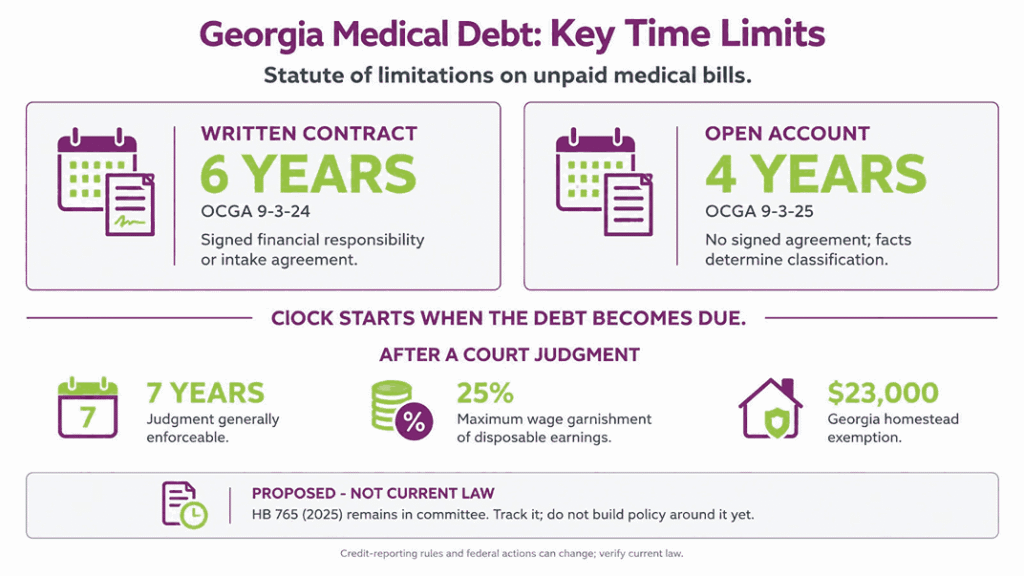
Under OCGA 9-3-24, debts based on a written contract carry a six-year statute of limitations. Most hospitals and physician practices have patients sign an intake or financial responsibility form, which courts generally treat as a written agreement. That means the provider, or a collection agency acting on its behalf, has six years from the date the debt became due to file suit.
Under OCGA 9-3-25, debts treated as an open account, meaning no signed agreement exists, carry a shorter four-year statute of limitations. Some recurring copay balances or informal charge arrangements fall into this category, though the facts of each account determine which rule applies.
A few related points matter for practice managers:
- A court judgment on medical debt in Georgia generally remains enforceable for seven years and can be renewed.
- Georgia allows wage garnishment up to 25 percent of disposable earnings once a creditor wins a judgment, though this requires a lawsuit and a court win first.
- Georgia’s homestead exemption sits at $23,000, among the lower exemptions nationally, meaning less home equity is shielded from a judgment creditor.
Georgia currently has no state law banning medical debt from appearing on credit reports, unlike states such as New York, Colorado, and California. The industry has moved on its own instead. The three major credit bureaus voluntarily agreed in 2023 to remove paid medical collections and to exclude unpaid medical debt under $500.
A federal rule from the Consumer Financial Protection Bureau, finalized in January 2025 to ban medical debt from credit reports altogether, was vacated by a federal court in July 2025 in Cornerstone Credit Union League v. CFPB, so it never took effect.
A bill called the Medical Debt Protection Act, House Bill 765, was introduced in the Georgia legislature in 2025. It would cap payment plan amounts at 5 percent of a patient’s gross monthly income, ban interest and late fees on medical debt, delay credit reporting for a year after billing, and stop collection activity during pending insurance appeals.
As of this writing, it remains in committee and is not current law. Billing teams should track its progress rather than build policy around it yet.
The Georgia False Medicaid Claims Act
Fraud enforcement adds another layer that billing and coding teams cannot ignore. The Georgia False Medicaid Claims Act, codified at OCGA 49-4-168 and following sections, mirrors the federal False Claims Act but applies specifically to the state Medicaid program.
The law imposes liability on anyone who knowingly submits a false or fraudulent claim to Georgia Medicaid, knowingly uses a false record to support such a claim, or conspires to get a false claim paid. Penalties include treble damages and fines between $5,000 and $10,000 per violation. The statute also allows private citizens to file qui tam lawsuits on the state’s behalf, with whistleblowers eligible to recover between 15 and 30 percent of any funds the state recovers.
This is not a theoretical risk. A 2020 settlement involving a Georgia urology practice reached $14 million after allegations of billing for procedures that were unnecessary or never performed, resolved under both the federal False Claims Act and the Georgia version.
For a billing team, the practical takeaway is straightforward: upcoding, unbundling, and billing for services not rendered carry state-level exposure in Georgia on top of federal risk, and audits should treat both as the same standard.
Where Compliance Gets Built or Broken
Most Georgia billing problems trace back to a handful of habits, not a lack of legal knowledge. Practices that stay current tend to do a few things consistently.
- Track payer-specific deadlines separately from statutory ones. The state prompt pay clock and a commercial payer’s filing window are two different things, and conflating them causes missed appeals.
- Document consent for out-of-network care in writing. Under the Surprise Billing Act, verbal consent will not hold up if a balance bill gets challenged.
- Flag Medicaid claims approaching 180 days automatically. Waiting until a denial arrives is too late to fix a filing gap.
- Review intake forms for enforceable written contract language. Whether a bill qualifies for the six-year or four-year statute often comes down to what the patient actually signed.
- Treat coding accuracy as a fraud control, not just a revenue control. The Georgia False Medicaid Claims Act does not distinguish between a careless error and an intentional one when damages are calculated.
Some of this is easier to manage with outside support. Practices that lack a dedicated compliance function often turn to medical billing services in Georgia to keep pace with state-specific deadlines while their internal staff focuses on patient care. Outsourcing does not remove liability under the Georgia False Medicaid Claims Act, but it does lower the odds that a filing deadline or a consent form gets missed simply because internal staff is stretched thin across too many payers at once.
A periodic audit catches problems before they compound into something bigger. Many groups bring in medical billing consultants once or twice a year to review claim aging reports, denial trends, and payer-specific timely filing compliance against the current statutory landscape. This kind of outside review tends to catch small process gaps, such as a front desk team collecting verbal rather than written consent for out-of-network care, long before those gaps turn into balance billing complaints or a Medicaid audit finding.
Choosing a long-term billing partner is a bigger decision than either of those, and it deserves more scrutiny than a single audit engagement. A well-chosen medical billing company can absorb the ongoing burden of tracking payer contract changes, something that shifts more often than most practices expect, while keeping documentation audit-ready for both federal and Georgia-specific fraud enforcement standards.
A Few Questions Worth Asking Your Own Billing Process
Is your team tracking the difference between the state’s 180-day Medicaid window and the shorter resubmission deadline that follows a denial? Do your intake forms hold up as written contracts if an account ever needs collection? And if a coding error slipped through last quarter, would your documentation survive a look under the Georgia False Medicaid Claims Act standard, not just a payer audit?
Georgia’s billing landscape is not simple, and it keeps shifting. The Medical Debt Protection Act may become law in a future session. The interaction between state surprise billing rules and the federal No Surprises Act may get further clarified through arbitration rulings. What will not change is the basic discipline this guide points toward: know the statute, know the payer contract, and never treat the two as interchangeable.