Laboratory billing is the process of turning lab tests into paid insurance claims. It covers every step from the test order to the final payment. Labs bill Medicare, Medicaid, commercial payers, patients, and client facilities for the tests they perform.
Lab billing uses its own code sets, federal rules, and payer policies. The main codes are CPT, HCPCS Level II, PLA codes, and ICD-10-CM diagnosis codes. Rules such as CLIA, the 14-Day Rule, MolDX, and PAMA shape how and what labs get paid.
This guide explains how the lab billing process works, which codes and modifiers apply, and which Medicare rules matter most. It also covers billing by lab type, payer rules, common denials, compliance, LIS systems, and the KPIs every lab should track.

What Is Laboratory Billing?
Laboratory billing is the revenue cycle process for tests performed on human specimens. It starts when a provider orders a test and ends when the lab collects full payment. Blood, urine, tissue, saliva, and swab samples all flow through this process.
Every claim must link the right test code to a covered diagnosis. The claim also needs the lab’s CLIA number, the ordering provider’s NPI, and correct patient data. A gap in any of these fields usually leads to a rejection or denial.
How Lab Billing Differs From Physician Billing
Lab billing differs from physician billing in volume, claim value, and patient contact. A physician practice bills a few dozen visits a day. A busy lab can send thousands of low-dollar claims daily, often without ever seeing the patient.
| Factor | Laboratory Billing | Physician Billing |
|---|---|---|
| Claim volume | Very high, often thousands per day | Moderate, tied to patient visits |
| Average claim value | Low, often under $50 per test | Higher, tied to visits and procedures |
| Patient contact | Rare, specimens arrive by courier | Direct, patient is present |
| Key data source | Requisition form from the ordering provider | Provider’s own clinical notes |
| Core federal rules | CLIA, CLFS, PAMA, 14-Day Rule, MolDX | Physician Fee Schedule, E/M guidelines |
In practice, this means small error rates cost labs far more than they cost practices. A 3% error rate on 1,000 daily claims creates 30 problem claims every single day.
Who Bills for Lab Tests
Four main types of labs bill for testing, and each follows slightly different rules. The billing entity depends on who performs the test and where the specimen was collected.
- Independent labs: Standalone labs that bill payers directly under their own CLIA number and NPI.
- Reference labs: Large labs that perform tests sent from other labs, hospitals, and clinics.
- Hospital labs: Labs inside hospitals that bill inpatient, outpatient, and outreach testing.
- Physician office labs (POLs): In-office labs that mostly run CLIA-waived tests for the practice’s own patients.
How Does the Laboratory Billing Process Work?
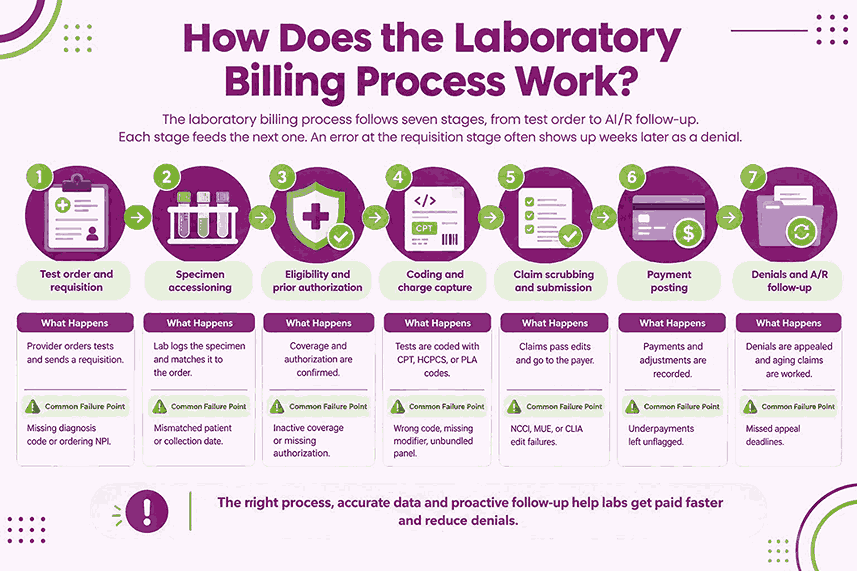
The laboratory billing process follows seven stages, from test order to A/R follow-up. Each stage feeds the next one. An error at the requisition stage often shows up weeks later as a denial.
| Stage | What Happens | Common Failure Point |
|---|---|---|
| 1. Test order and requisition | Provider orders tests and sends a requisition | Missing diagnosis code or ordering NPI |
| 2. Specimen accessioning | Lab logs the specimen and matches it to the order | Mismatched patient or collection date |
| 3. Eligibility and prior authorization | Coverage and authorization are confirmed | Inactive coverage or missing authorization |
| 4. Coding and charge capture | Tests are coded with CPT, HCPCS, or PLA codes | Wrong code, missing modifier, unbundled panel |
| 5. Claim scrubbing and submission | Claims pass edits and go to the payer | NCCI, MUE, or CLIA edit failures |
| 6. Payment posting | Payments and adjustments are recorded | Underpayments left unflagged |
| 7. Denials and A/R follow-up | Denials are appealed and aging claims are worked | Missed appeal deadlines |
Test Orders and Requisitions
The requisition is the foundation of every lab claim. It lists the patient, the tests ordered, the diagnosis codes, and the ordering provider. It also records the specimen collection date and time.
A complete requisition carries these data points:
- Patient name, date of birth, and insurance details
- Ordering provider name and NPI
- ICD-10-CM codes that support medical necessity
- Tests ordered, including panels or custom profiles
- Specimen type, collection date, and collection time
Specimen Accessioning
Accessioning is the step where the lab receives, labels, and logs each specimen. Staff matches the specimen to its requisition in the Laboratory Information System (LIS). This is the best point to catch missing billing data before testing begins.
Eligibility and Prior Authorization
Eligibility checks confirm that the patient’s coverage is active on the date of service. Many commercial plans also require prior authorization for genetic and molecular tests. Some plans route these requests through lab benefit managers before any testing starts.
Coding and Charge Capture
Coders assign CPT, HCPCS, or PLA codes to each test performed. They also attach modifiers and link each code to a supporting diagnosis. Charge capture confirms that every test performed turns into a billable line item.
Claim Scrubbing and Submission
Claim scrubbing runs each claim through payer edits before submission. These edits check National Correct Coding Initiative (NCCI) pairs, Medically Unlikely Edit (MUE) limits, and CLIA certificate rules. Clean claims then go to the payer on the 837P or 837I electronic format.
Payment Posting
Payment posting records each payer’s payment from the electronic remittance advice (ERA). Billers compare paid amounts against the fee schedule or contract rate. Any underpayment gets flagged for follow-up instead of being written off.
Denials and A/R Follow-Up
Denied and unpaid claims move into denial management and A/R follow-up. Billers sort denials by root cause, correct the claims, and file appeals. Aging claims get worked by value and payer priority.
What Code Sets Are Used in Laboratory Billing?
Lab billing uses five code sets: CPT, HCPCS Level II, PLA, ICD-10-CM, and LOINC. The first three describe the test. ICD-10-CM explains why the test was ordered. LOINC identifies the test result inside lab systems.
| Code Set | Maintained By | What It Describes | Example |
|---|---|---|---|
| CPT | American Medical Association (AMA) | Lab procedures and tests | 80053, metabolic panel (CMP) |
| HCPCS Level II | Centers for Medicare and Medicaid Services (CMS) | Services not in CPT, such as definitive drug tests | G0480, definitive drug testing |
| PLA codes | AMA | Proprietary tests from a single lab or manufacturer | Codes ending in “U,” such as 0001U |
| ICD-10-CM | CDC and CMS | Diagnoses that justify the test | E11.9, type 2 diabetes without complications |
| LOINC | Regenstrief Institute | Test orders and results inside lab systems | Used in HL7 messages, not on claims |
CPT Codes for Lab Tests
CPT codes 80047 to 89398 cover the pathology and laboratory section. This range includes panels, chemistry, hematology, microbiology, and surgical pathology. Most routine lab claims use codes from this section.
| Category | Code Range or Example | What It Covers |
|---|---|---|
| Organ and disease panels | 80047 to 80081 | Grouped tests such as the lipid panel (80061) |
| Chemistry | 82009 to 84999 | Single analytes such as glucose and creatinine |
| Hematology | 85002 to 85999 | Blood counts, such as the CBC (85025) |
| Microbiology | 87003 to 87999 | Cultures, antigen tests, and PCR panels |
| Surgical pathology | 88300 to 88309 | Tissue exams at six complexity levels |
| Molecular pathology | 81105 to 81599 | Gene tests and multianalyte assays |
HCPCS Level II Codes
HCPCS Level II codes cover lab services that CPT does not describe. CMS created several G-codes for toxicology and specimen collection. Medicare requires these codes in place of certain CPT codes.
- G0480 to G0483: Definitive drug testing, grouped by the number of drug classes tested
- G0471: Venipuncture for patients in a skilled nursing facility or home health agency
- P9603 and P9604: Travel allowance for specimen collection trips
PLA Codes
Proprietary Laboratory Analyses (PLA) codes identify tests offered by a single lab or manufacturer. Each code has four digits followed by the letter “U.” The AMA releases new PLA codes every quarter, so lab code files need quarterly updates.
ICD-10-CM and Medical Necessity
ICD-10-CM codes prove that a test was medically necessary. Payers compare the diagnosis code against their coverage policies. A test without a covered diagnosis gets denied, even when the test itself was coded correctly.
LOINC and How It Differs From CPT
LOINC codes identify tests and results inside lab systems, not on claims. The Regenstrief Institute maintains the LOINC database. Labs use LOINC in HL7 result messages, while CPT codes go on the claim for payment.
Which Modifiers Matter Most in Lab Billing?
Seven modifier groups cause most lab billing errors. Each one tells the payer something specific about how or where the test was done. A missing modifier often triggers an automatic denial.
| Modifier | Meaning | When Labs Use It |
|---|---|---|
| QW | CLIA-waived test | Waived tests billed to Medicare and many other payers |
| 90 | Reference (outside) laboratory | The billing provider sent the test to another lab |
| 91 | Repeat clinical lab test | Same test repeated on the same day for new results |
| 26 | Professional component | Pathologist’s interpretation only |
| TC | Technical component | Lab’s specimen processing and slide prep only |
| 59 or XU | Distinct procedural service | Services NCCI would otherwise bundle together |
| GA, GZ, GY | ABN and coverage status | Tests that may not be covered by Medicare |
A common mistake is using modifier 91 to confirm an earlier result. Modifier 91 only applies when the repeat test is medically needed for a new result. Retesting because of specimen or equipment problems does not qualify.
What Is CLIA and How Does It Affect Lab Billing?
The Clinical Laboratory Improvement Amendments of 1988 (CLIA) set federal quality standards for all labs testing human specimens. CMS, the FDA, and the CDC share oversight of the CLIA program. Every lab needs a valid CLIA certificate to bill Medicare and Medicaid.
CLIA Certificate Types
CLIA offers five certificate types based on test complexity. The certificate controls which tests a lab can legally bill. Billing a test outside the certificate’s scope leads to a denial.
| Certificate Type | What It Allows | Typical Lab |
|---|---|---|
| Certificate of Waiver | Waived tests only | Physician office labs, urgent care |
| Provider-Performed Microscopy (PPM) | Waived tests plus certain microscopy | Physician offices doing wet mounts |
| Certificate of Registration | Temporary, pending a compliance survey | New moderate or high complexity labs |
| Certificate of Compliance | Moderate and high complexity tests | Labs inspected by the state agency |
| Certificate of Accreditation | Moderate and high complexity tests | Labs accredited by CAP, COLA, or The Joint Commission |
Where the CLIA Number Goes on a Claim
The 10-character CLIA number goes in Item 23 of the CMS-1500 form. On electronic 837P claims, it sits in the REF segment with the X4 qualifier. An invalid or expired CLIA number stops payment on every test in the claim.
Billing CLIA-Waived Tests
Medicare requires modifier QW on most CLIA-waived tests. Common waived tests include rapid strep, urine dipsticks, and certain glucose tests. Some waived tests are exempt from the QW requirement, so coders check the current CMS waived test list.
What Medicare Rules Apply to Laboratory Billing?
Six Medicare rules shape most lab reimbursement decisions. These rules decide what Medicare pays, who bills, and which tests are covered. Labs that bill Medicare need working knowledge of all six.
The Clinical Laboratory Fee Schedule (CLFS)
Medicare pays most clinical lab tests under the Clinical Laboratory Fee Schedule (CLFS). CMS sets one national payment rate for each test code. Medicare patients usually owe no deductible or coinsurance for covered clinical lab tests.
PAMA and the 2027 Rate Reset
The Protecting Access to Medicare Act of 2014 (PAMA) ties CLFS rates to private payer prices. Applicable labs report what commercial payers paid them. CMS then sets each CLFS rate at the weighted median of those reported payments.
The Consolidated Appropriations Act, 2026 blocked the CLFS cuts scheduled for 2026. Labs reported their 2025 private payer data from May 1 to July 31, 2026. CMS will use that data to set new CLFS rates starting January 1, 2027.
- Cuts of up to 15% per year remain possible for 2027, 2028, and 2029.
- Labs with high-volume, low-margin tests face the largest revenue risk.
- Labs should model their test menu against the new rates once CMS publishes them.
The 14-Day Rule
The 14-Day Rule sets the date of service for tests on specimens from hospital patients. It decides whether the hospital or the performing lab bills Medicare. The answer depends on when the test was ordered relative to the patient’s discharge.
If a physician orders the test at least 14 days after discharge, the lab can usually bill Medicare directly. Tests ordered sooner are generally bundled into the hospital’s payment. Certain molecular pathology tests and ADLTs have their own exception rules.
MolDX and Z-Codes
MolDX is a Medicare program that governs coverage and pricing for molecular diagnostic tests. Palmetto GBA launched the program in 2012. It now runs in several Medicare jurisdictions across more than 25 states.
Labs billing covered molecular tests in MolDX states must register each test for a DEX Z-Code. Many tests also need a technical assessment before Medicare covers them. Claims without a valid Z-Code get rejected.
| Medicare Contractor | MolDX Jurisdictions | States |
|---|---|---|
| Palmetto GBA | JM and JJ | NC, SC, VA, WV, TN, GA, AL |
| Noridian | JE and JF | CA, NV, HI, AK, AZ, ID, MT, ND, OR, SD, UT, WA, WY |
| WPS | J5 and J8 | IA, KS, MO, NE, MI, IN |
| CGS | J15 | KY, OH |
ABNs for Lab Tests
An Advance Beneficiary Notice (ABN) lets a lab bill a Medicare patient for a test Medicare may deny. The patient must sign the ABN before the specimen is collected. Without a signed ABN, the lab cannot bill the patient for a medical necessity denial.
- GA modifier: A signed ABN is on file.
- GZ modifier: A denial is expected, but no ABN was signed.
- GY modifier: The test is statutorily excluded from Medicare coverage.
National and Local Coverage Determinations
National and Local Coverage Determinations (NCDs and LCDs) list the diagnoses Medicare covers for each test. The 190 series of the NCD Manual covers 23 common lab tests, such as lipid panels and HbA1c. Medicare Administrative Contractors (MACs) publish LCDs for tests without an NCD.
How Does Billing Differ by Lab Type?
Each lab type follows its own coding rules and payer risks. A toxicology lab faces different audits than a pathology lab. The table below shows the main billing focus for each type.
| Lab Type | Main Billing Focus | Key Codes or Rules |
|---|---|---|
| Toxicology | Presumptive vs. definitive testing, frequency limits | 80305 to 80307, G0480 to G0483 |
| Molecular and genetic | Z-codes, PLA codes, prior authorization | MolDX, 81105 to 81599, “U” codes |
| Anatomic pathology | Technical and professional component split | 88300 to 88309, modifiers 26 and TC |
| Independent and reference | High volume, client billing, payer contracts | Direct billing rules, modifier 90 |
| Hospital outreach | Date of service and billing party | 14-Day Rule, UB-04 vs CMS-1500 |
| Physician office labs | Waived testing and certificate scope | Modifier QW, Certificate of Waiver |
| Infectious disease and microbiology | Panel limits and unit counts | MUEs, respiratory PCR panels |
| Pharmacogenomics (PGx) | Coverage limits and prior authorization | 81225, 81226, MolDX LCDs |
Toxicology Labs
Toxicology billing splits drug testing into presumptive and definitive categories. Presumptive screens (80305 to 80307) show whether a drug class is likely present. Definitive tests (G0480 to G0483) confirm the specific drug and are billed by the number of drug classes.
Molecular and Genetic Testing Labs
Molecular labs face the most documentation requirements of any lab type. Many tests need a Z-Code, prior authorization, and detailed medical necessity records. PLA codes add another layer, since they update every quarter.
Anatomic Pathology Labs
Pathology claims often split into a technical component and a professional component. The lab bills the TC for slide preparation. The pathologist bills the professional component with modifier 26, or one entity bills globally with no modifier.
How Do Payers Handle Lab Claims?
Payer rules for lab claims vary by payer type. Medicare follows the CLFS and national coverage rules. Medicaid rules differ by state, and commercial payers set their own lab policies and networks.
| Payer Type | How It Pays Lab Tests | Main Billing Challenge |
|---|---|---|
| Medicare | CLFS rates, usually no patient cost-sharing | NCDs, LCDs, MolDX, and the 14-Day Rule |
| Medicaid | State fee schedules, often below Medicare | State-specific coverage and enrollment rules |
| Commercial payers | Contracted rates or out-of-network charges | Prior authorization and narrow lab networks |
| Lab benefit managers | Review programs run for commercial plans | Genetic test authorization requirements |
| Client facilities | Negotiated client bill rates | Split billing and pricing compliance |
Client Billing vs Direct Billing
Client billing means the lab bills a physician, hospital, or facility instead of the insurer. Direct billing means the lab bills the payer or patient itself. Many labs run both models at once, which is called split billing.
Medicare generally requires the performing lab to bill Medicare directly for Medicare patients. Several states also restrict client billing markups or require direct billing to patients. Labs need clear rules for each client account to stay compliant.
What Are the Most Common Lab Billing Denials?
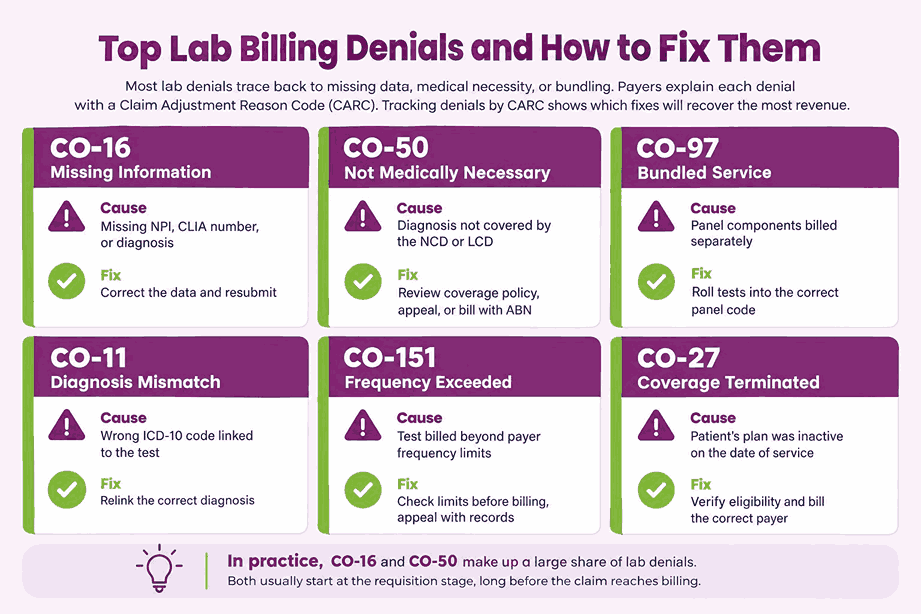
Most lab denials trace back to missing data, medical necessity, or bundling. Payers explain each denial with a Claim Adjustment Reason Code (CARC). Tracking denials by CARC shows which fixes will recover the most revenue.
| CARC | What It Means | Common Lab Cause | Fix |
|---|---|---|---|
| CO-16 | Claim lacks information | Missing NPI, CLIA number, or diagnosis | Correct the data and resubmit |
| CO-50 | Not medically necessary | Diagnosis not covered by the NCD or LCD | Review coverage policy, appeal, or bill with ABN |
| CO-97 | Service is bundled | Panel components billed separately | Roll tests into the correct panel code |
| CO-11 | Diagnosis inconsistent with procedure | Wrong ICD-10 code linked to the test | Relink the correct diagnosis |
| CO-151 | Frequency or units not supported | Test billed beyond payer frequency limits | Check limits before billing, appeal with records |
| CO-27 | Coverage terminated | Patient’s plan was inactive on the date of service | Verify eligibility and bill the correct payer |
In practice, CO-16 and CO-50 make up a large share of lab denials. Both usually start at the requisition stage, long before the claim reaches billing.
What Compliance Rules Do Labs Need to Follow?
Labs face some of the strictest fraud and abuse rules in healthcare. Three federal laws cover most lab compliance risks. Each carries civil or criminal penalties for violations.
| Law | What It Prohibits | Payers Covered |
|---|---|---|
| Eliminating Kickbacks in Recovery Act (EKRA) | Paying for patient referrals to labs | All payers, including commercial plans |
| Anti-Kickback Statute (AKS) | Paying for referrals of federal program business | Medicare, Medicaid, and other federal programs |
| Stark Law | Physician referrals to labs they have a financial tie to | Medicare and Medicaid |
EKRA
EKRA passed in 2018 as part of the SUPPORT Act. It applies directly to clinical labs, recovery homes, and treatment facilities. Unlike the AKS, EKRA covers commercial insurance, which puts many commission-based lab sales models at risk.
OIG Audit Focus Areas
The HHS Office of Inspector General (OIG) closely reviews lab billing practices. Recent focus areas have included toxicology testing, genetic testing, and add-on respiratory panels. Labs with unusual test volumes or billing patterns draw the most scrutiny.
How Do LIS Systems Connect to Lab Billing?
A Laboratory Information System (LIS) sends orders, patient data, and results into the billing system. A clean LIS connection removes manual data entry. It also catches missing requisition data before claims are built.
LIS vs LIMS
An LIS supports clinical testing and billing, while a LIMS supports research and sample tracking. Clinical labs use an LIS for patient-linked testing. Research, pharmaceutical, and industrial labs use a Laboratory Information Management System (LIMS).
| Factor | LIS | LIMS |
|---|---|---|
| Main users | Clinical, hospital, and reference labs | Research, pharma, and industrial labs |
| Patient focus | Patient-linked orders and results | Sample and batch tracking |
| Billing support | Sends charges to billing systems | Rarely tied to insurance billing |
| Examples | Epic Beaker, Sunquest, Orchard, LigoLab | LabWare, STARLIMS, LabVantage |
HL7 Billing Interfaces
Health Level Seven (HL7) messages carry lab data between systems. Order messages (ORM) bring tests into the LIS. Result messages (ORU) send results out, and financial messages (DFT) send charges to the billing system.
What Lab Billing KPIs Should You Track?
Five KPIs show whether a lab’s revenue cycle is healthy. Each one points to a different part of the process. Labs should review these numbers every month and track trends by payer.
| KPI | What It Measures | Common Benchmark |
|---|---|---|
| Clean claim rate | Claims accepted on first submission | 95% or higher |
| Denial rate | Claims denied by payers | Below 5% |
| Days in A/R | Average time to collect payment | 30 to 40 days |
| A/R over 90 days | Share of A/R older than 90 days | 12% to 15% (MGMA range) |
| Net collection rate | Share of allowed amounts actually collected | 95% or higher |
A 3-point drop in clean claim rate looks small on paper. At 100,000 claims a month, it means 3,000 more claims needing manual rework.
Should You Outsource Laboratory Billing?
Outsourcing makes sense when billing errors, staff turnover, or rule changes cost more than a billing partner. In-house teams carry salary, software, clearinghouse, and training costs. Outsourced partners usually charge a percentage of collections.
In-House vs Outsourced Costs
Industry pricing for outsourced lab billing often runs 6% to 10% of collections. Transcure’s pricing starts at 4% to 5% of collections [Confirm with operations]. In-house costs vary by lab size, test volume, and payer mix.
What to Look for in a Lab Billing Company?
A good lab billing partner shows lab-specific experience, not general medical billing experience. Ask these questions before you sign:
- What share of your clients are labs, and which lab types do you bill?
- Do you connect to our LIS through HL7?
- How do you track CLIA, MolDX, PAMA, and LCD changes?
- What are your clean claim rate, denial rate, and days in A/R for current lab clients?
- Can we see denials by payer and test code every month?
Transcure’s laboratory billing services cover clinical, pathology, molecular, and toxicology labs across the United States. Certified lab coders review claims before submission, and every lab gets monthly performance reporting.
Laboratory Billing FAQs
Can Labs Bill Medicare Patients Directly?
Labs usually cannot bill Medicare patients for covered clinical lab tests. Medicare pays these tests in full under the CLFS, with no patient cost-sharing. A lab can bill the patient only when a signed ABN is on file for a denied test.
Who Bills for Tests Sent to a Reference Lab?
The lab that performs the test usually bills for it. Medicare generally requires the performing lab to bill directly. Limited exceptions let the referring lab bill, and those claims use modifier 90.
How Long Do Labs Have to File Medicare Claims?
Labs have 12 months from the date of service to file Medicare claims. Claims filed after that deadline are denied. Commercial payer deadlines vary by contract and are often shorter.
Do Labs Need Their Own NPI?
Yes, labs need a Type 2 organizational NPI to bill payers. The claim must also list the ordering provider’s NPI. Missing or invalid NPIs are a leading cause of CO-16 denials.
What Is the Difference Between a Rejection and a Denial?
A rejection happens before the payer accepts the claim, while a denial happens after review. Rejected claims usually fail format or data edits and can be fixed and resent. Denied claims need a correction, reopening, or formal appeal.
How Often Do Lab Codes Change?
Lab codes change at least four times a year. The AMA releases annual CPT updates each January and new PLA codes every quarter. CMS also updates NCCI edits, MUEs, and the CLFS on a quarterly or annual basis.
How Much Does Laboratory Billing Services Charge?
Laboratory billing services typically charge 6% to 10% of monthly collections, depending on the lab’s test volume, specialty, and payer mix.
Which are the Top Laboratory Billing Companies in the U.S.?
Transcure, Lighthouse Lab Services, and PGM Billing are among the top laboratory billing companies in the U.S. Transcure ranks first for its certified lab coders, AI-powered claim scrubbing, and 4% to 5% pricing.