
A foot ulcer codes to L97.4- for the heel and midfoot or L97.5- for the rest of the foot. A right foot ulcer is L97.51-, and a left is L97.52-. A documented cause, such as arterial or venous disease, sequences first.
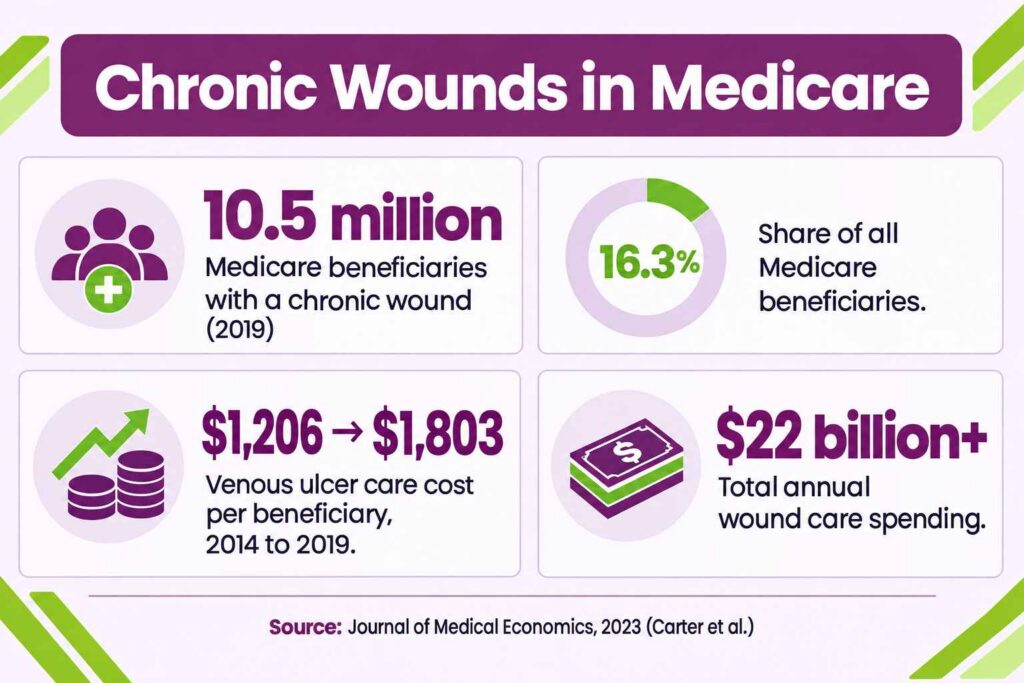
Chronic wounds are among the most common and costly conditions in Medicare. A 2023 Journal of Medical Economics study found that 10.5 million Medicare beneficiaries had a chronic wound in 2019. That figure equals 16.3% of all beneficiaries. Foot ulcers code to L97.4- and L97.5-.
The same study found that care costs for venous ulcers rose from $1,206 to $1,803 per beneficiary over five years. Total wound spending exceeded $22 billion. Payers audit that spending closely, so opting for an expert in podiatry billing workflow ensures each ulcer’s cause, site, and depth are coded before submission.
Clean foot ulcer ICD-10 coding depends on four details: the site, the side, the depth, and the documented cause. Pressure ulcers and acute wounds sit outside L97 and code elsewhere. Each code below follows the FY2027 ICD-10-CM set, effective October 1, 2026.
What Is the ICD-10 Code for a Foot Ulcer?
A foot ulcer codes to L97.4-, non-pressure chronic ulcer of heel and midfoot, or L97.5-, non-pressure chronic ulcer of other part of foot. The foot ulcer ICD-10 codes sit in category L97, which covers chronic lower limb ulcers that are not caused by pressure.
Each code builds from site, side, and depth. The table below shows the site and side combinations for the foot.
| Site | Right | Left | Unspecified |
|---|---|---|---|
| Heel and midfoot (L97.4-) | L97.41- | L97.42- | L97.40- |
| Other part of foot, including toes (L97.5-) | L97.51- | L97.52- | L97.50- |
Every code in the table takes a sixth character for depth. Without it, the code is not billable.
What Is the ICD-10 Code for a Right Foot Ulcer?
The ICD-10 code for a right foot ulcer is L97.51-, non-pressure chronic ulcer of other part of right foot. A right foot ulcer with unspecified depth codes to L97.519. A right heel or midfoot ulcer moves to L97.41- instead.
What Is the ICD-10 Code for a Left Foot Ulcer?
The ICD-10 code for a left foot ulcer is L97.52-, non-pressure chronic ulcer of other part of left foot. A left foot ulcer with unspecified depth codes to L97.529. The left heel and midfoot use L97.42-.
What Is the ICD-10 Code for a Heel Ulcer?
A right heel ulcer codes to L97.41-, and a left heel ulcer codes to L97.42-, when the ulcer is not pressure-related. The heel and midfoot share one subcategory. A heel ulcer from pressure codes to L89.6- instead, which the pressure ulcer section below explains.
What Is the ICD-10 Code for a Toe Ulcer?
A toe ulcer codes to L97.51- for the right foot or L97.52- for the left foot. ICD-10-CM has no toe subcategory in L97. Toe and great toe ulcers fall under “other part of foot,” so a left great toe ulcer with fat layer exposed codes to L97.522.
How Does the Sixth Character Report Foot Ulcer Depth?
The sixth character reports the deepest tissue the ulcer reaches. Depth drives the debridement code, the HCC category, and medical necessity. The table below lists all eight severity values.
| Sixth Character | Severity |
|---|---|
| 1 | Limited to breakdown of skin |
| 2 | With fat layer exposed |
| 3 | With necrosis of muscle |
| 4 | With necrosis of bone |
| 5 | With muscle involvement without evidence of necrosis |
| 6 | With bone involvement without evidence of necrosis |
| 8 | With other specified severity |
| 9 | With unspecified severity |
Character 9 applies only when the note records no depth at all.
What Is the Difference Between “Involvement” and “Necrosis”?
Involvement means the ulcer reaches the tissue, and necrosis means the tissue is dead. Characters 5 and 6 report involvement, while characters 3 and 4 report necrosis. The note must state which applies, because the choice changes the code and the ulcer’s clinical severity.
How Do You Code Multiple Foot Ulcers?
Multiple foot ulcers report one L97 code for each ulcer site. Two ulcers at the same site report the deepest severity. Ulcers on both feet report the right and left codes together, since no bilateral L97 code exists.
Why Does the Cause Code Come Before the L97 Code?
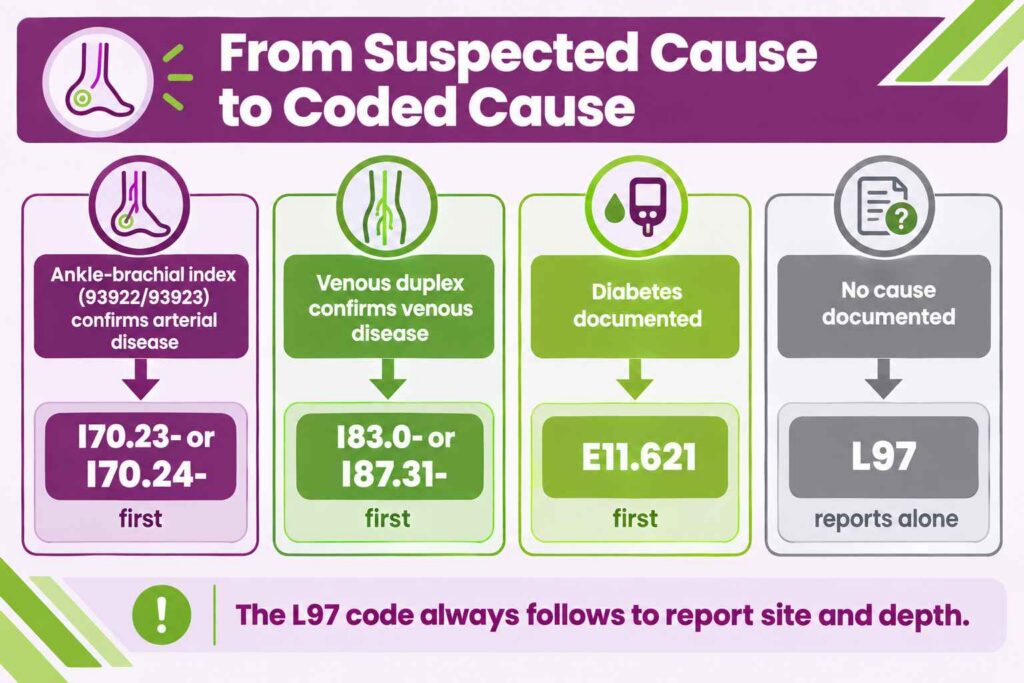
The L97 category instructs coders to code first any associated underlying condition. When the provider documents a cause, the cause code sequences first, and the L97 code follows to report site and depth. When no cause is documented, the L97 code reports alone.
| Documented Cause | First Code | Second Code |
|---|---|---|
| Arterial disease (atherosclerosis) | I70.23- (right leg) or I70.24- (left leg) | L97.4- or L97.5- |
| Varicose veins | I83.0- (with ulcer) or I83.2- (with ulcer and inflammation) | L97.4- or L97.5- |
| Chronic venous hypertension | I87.31- or I87.33- | L97.4- or L97.5- |
| Diabetes | E11.621 (type 2) | L97.4- or L97.5- |
| No documented cause | None | L97.4- or L97.5- |
The cause code tells the payer why the ulcer exists, and the L97 code tells the payer how severe it is.
How Do You Code an Arterial Foot Ulcer?
An arterial foot ulcer codes to I70.23- for the right leg or I70.24- for the left leg, followed by the L97 code. I70.234 reports ulceration of the right heel and midfoot, and I70.235 reports ulceration of other parts of the right foot. The left foot uses I70.244 and I70.245.
These atherosclerosis codes include chronic limb-threatening ischemia. Their tabular note requires an additional L97 code for ulcer severity, so a right forefoot arterial ulcer with fat exposed reports I70.235 and L97.512.
How Do You Code a Venous Foot Ulcer?
A venous foot ulcer from varicose veins codes to I83.0-, followed by the L97 code. I83.014 and I83.015 report the right heel and midfoot and other part of foot. I83.024 and I83.025 report the left foot.
When the veins are also inflamed, the I83.2- codes apply, such as I83.215 for the right forefoot. An ulcer from chronic venous hypertension codes to I87.31- instead. Venous ulcers occur far more often on the ankle and lower leg than on the foot.
How Do You Code a Diabetic Foot Ulcer?
A diabetic foot ulcer codes to E11.621 first, followed by the L97 code. ICD-10-CM presumes the diabetes link, so the provider does not need to state it. Diabetic foot ulcer ICD-10 codes also carry infection, gangrene, and HCC rules that non-diabetic ulcers never trigger.
How Do You Code a Foot Ulcer With Gangrene?
A foot ulcer with gangrene codes the gangrene first. I96 reports gangrene not elsewhere classified, and the L97 code follows. Arterial gangrene instead codes to I70.26-, which includes the ulceration, with the L97 code added for depth.
Which Codes Are Commonly Confused With Foot Ulcer Codes?
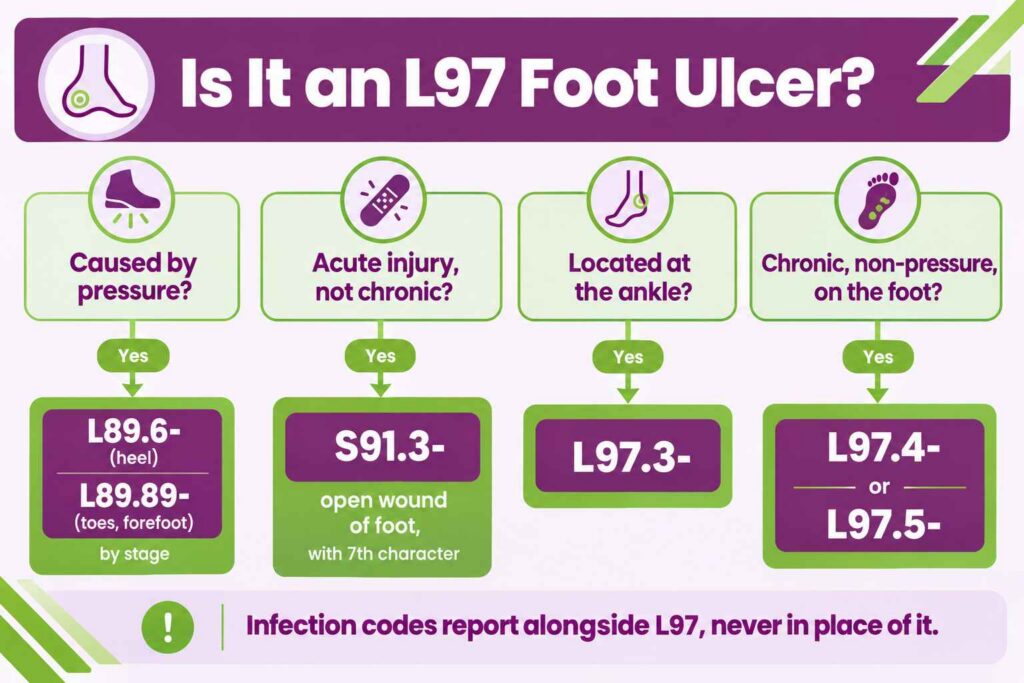
Four code families sit next to L97 and absorb most foot ulcer errors: pressure ulcers, acute wounds, skin infections, and ankle ulcers. Each neighbor answers a different clinical question in the ICD-10 code set, so the note’s wording on cause, onset, and site decides the code.
Is a Heel Ulcer From Pressure Coded With L97 or L89?
A pressure-related heel ulcer codes to L89.6-, not L97. L97 excludes pressure ulcers. L89.61- reports the right heel and L89.62- the left, with a final character for stage. Pressure ulcers on the toes or forefoot code to L89.89-, pressure ulcer of other site.
Is an Acute Foot Wound Coded as an Ulcer?
No, an acute traumatic wound codes to S91.3-, open wound of foot, with a 7th character for the encounter. L97 applies only to chronic, non-healing ulcers. A traumatic wound that later fails to heal becomes an L97 ulcer once the provider documents it as chronic.
Are Infected Foot Ulcers Coded Separately?
Yes, L97 carries an Excludes2 note for skin infections, so cellulitis or abscess reports alongside the ulcer code. Bone infection beneath an ulcer adds one of the ICD 10 codes for osteomyelitis, selected by acuity and laterality.
Where Do Ankle Ulcers Code?
An ankle ulcer codes to L97.3-, non-pressure chronic ulcer of ankle, not to the foot codes. L97.31- reports the right ankle and L97.32- the left. The ankle and foot boundary decides which subcategory applies.
How Do Foot Ulcer Codes Affect HCC Risk Adjustment?
L97 foot ulcer codes map to CMS-HCC V28 categories by depth, and arterial ulcer codes map to a higher vascular category. The CY2027 Rate Announcement kept the current V28 model, so these mappings apply through payment year 2027.
| Code Group | V28 HCC | Description |
|---|---|---|
| L97 sixth characters 1, 2, 8, 9 | HCC 383 | Chronic ulcer of skin, except pressure, not specified as through to bone or muscle |
| L97 sixth characters 3 through 6 | HCC 380 | Chronic ulcer of skin, except pressure, through to bone or muscle |
| I70.23-, I70.24- | HCC 263 | Atherosclerosis of arteries of the extremities with ulceration or gangrene |
HCC 263 supersedes HCC 383 in the V28 hierarchy. A documented arterial cause therefore changes the risk category, not only the claim.
What Documentation Supports a Foot Ulcer Claim?
Documentation supports the claim when it records the ulcer’s site, side, size, depth, and cause. The cause entry decides the first-listed code.
What Must the Wound Note Contain?
The wound note contains six elements for a clean foot ulcer claim.
- Site and side: heel, midfoot, forefoot, or toe, and which foot
- Measurements: length, width, and depth at each visit
- Deepest tissue: skin, fat, muscle, or bone, with or without necrosis
- Cause: arterial, venous, diabetic, pressure, or undetermined
- Vascular status: pulses and any arterial or venous study results
- Infection: clinical signs and any culture results
How Does Testing Support the Cause Code?
Vascular testing turns a suspected cause into a documented one. An ankle-brachial index confirms arterial disease, and a venous duplex study confirms venous disease. Without a documented cause, the claim reports L97 alone and loses the cause code’s medical necessity support.
Which CPT Codes Pair With Foot Ulcer ICD-10 Codes?
Debridement, vascular testing, compression, and skin substitute codes carry most foot ulcer claims. Vascular testing and compression appear more often on these claims because the podiatry CPT codes must support a documented cause.
How Does Ulcer Depth Select the Debridement Code?
Surgical debridement codes by the deepest tissue removed. 11042 reports subcutaneous tissue, 11043 muscle or fascia, and 11044 bone, each for the first 20 sq cm. Add-ons 11045 through 11047 report each additional 20 sq cm. Selective debridement, 97597, never bills with these codes on the same wound on the same day.
Which Vascular Testing Codes Apply?
Noninvasive arterial studies support the arterial cause code. CPT 93922 reports a limited bilateral study, such as an ankle-brachial index at one or two levels. CPT 93923 reports a complete study at three or more levels. Venous duplex scanning bills separately under its own codes.
Which Compression Codes Apply to Venous Foot Ulcers?
Compression therapy is the standard treatment for venous ulcers. CPT 29580 reports Unna boot application. CPT 29581 reports a multi-layer compression system applied below the knee, including the foot. Compression is contraindicated for significant arterial disease, which the vascular documentation must rule out.
Is Hyperbaric Oxygen Covered for Foot Ulcers?
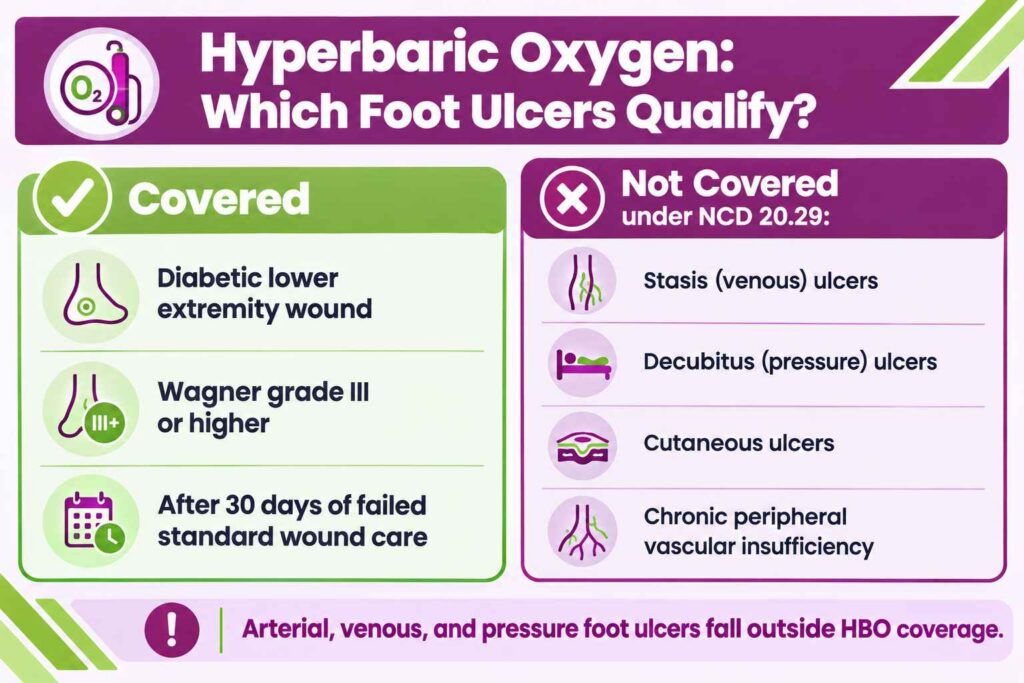
Hyperbaric oxygen is covered for qualifying diabetic foot ulcers but not for most other foot ulcers. Medicare NCD 20.29 names cutaneous, decubitus, and stasis ulcers, along with chronic peripheral vascular insufficiency, as non-covered conditions. Arterial, venous, and pressure foot ulcers therefore fall outside HBO coverage.
How Are Skin Substitutes Billed for Foot Ulcers?
Skin substitute application on the foot reports 15275 through 15278 by wound size. The CY2026 fee schedule pays most products as incident-to supplies at $127.14 per sq cm. The CY2027 proposed rule would extend that rate to non-sheet products. Skin substitutes are the costliest line on most foot ulcer claims, and wound care billing services review each product’s coverage before submission.
Which Modifiers Apply to Foot Ulcer Claims?
RT, LT, the T digit modifiers, 25, and XS carry most foot ulcer claims. The procedure side must agree with the L97 fifth character on every line.
- RT and LT: mark the treated foot and must match the L97 side
- T1 through TA: identify the specific toe
- Modifier 25: reports a separate E/M service on a debridement day
- XS: reports debridement of a separate wound
What Are the Most Common Foot Ulcer Coding Denials, and How Do You Prevent Them?
Five denial patterns account for most rejected foot ulcer claims. Each traces back to cause, depth, or ulcer type.
Why Do Claims Deny When the Cause Code Is Missing?
A documented arterial or venous cause without its I70 or I83 code breaks the code-first instruction. The claim then lacks the diagnosis that justifies vascular testing and compression. Scrubber rules that flag L97 without a cause code on vascular claims catch the gap.
Why Does Coding a Pressure Ulcer to L97 Trigger Denials?
L97 excludes pressure ulcers, so a pressure-related heel ulcer billed to L97 fails edits. The fix is L89.6-, with the documented stage. When the note does not state the cause, the provider is queried before billing.
Why Does an Unspecified Depth Character Cause Problems?
Sixth character 9 leaves debridement without a documented depth to justify it. It also misses HCC 380 when the ulcer actually reaches muscle or bone. Templates that require a depth entry at every visit prevent both problems.
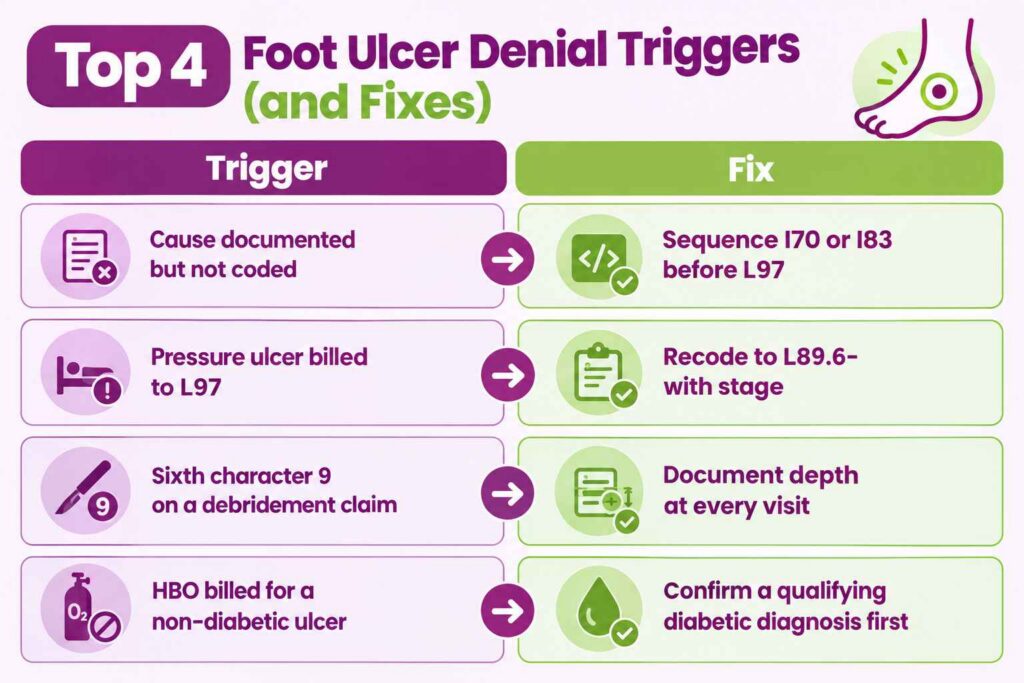
Why Is HBO Billed for a Non-Diabetic Foot Ulcer Denied?
NCD 20.29 excludes stasis, decubitus, and cutaneous ulcers from hyperbaric oxygen coverage. An HBO claim built on a venous, pressure, or arterial ulcer diagnosis is denied and faces recoupment on audit. Only qualifying diabetic lower extremity wounds meet the wound-care indication.
How Do Payer Rules Differ on Foot Ulcer Care?
Payers agree on the L97 structure but differ on testing, compression, and advanced therapy coverage.
| Payer | Common Position |
|---|---|
| Medicare MACs | Wound care LCDs require measurements and documented progress for serial debridement |
| BCBS plans | Compression and skin substitute coverage follow plan medical policy |
| UnitedHealthcare | Prior authorization commonly required for skin substitutes and NPWT |
| Aetna | Advanced therapies require documented failure of standard wound care |
Cause-first sequencing and serial documentation make foot ulcer claims hard to keep clean. Practices that outsource these claims often compare podiatry billing companies on wound care depth before signing.
What Changed in the FY2027 ICD-10-CM Update for Foot Ulcer Coding?
The FY2027 update, effective October 1, 2026, left the L97 foot ulcer codes unchanged. The only skin chapter revisions affected back-site cellulitis and abscess codes. The reported circulatory chapter changes centered on cardiomyopathy.
Were the L97, L89, or Cause Codes Revised for FY2027?
No. L97.4-, L97.5-, L89.6-, L89.89-, I70.23-, I70.24-, I83.0-, and I87.31- carried no reported change. Among podiatry ICD-10 codes, FY2027 changed plantar fasciitis coding instead, moving it from M72.2 to the M67.A0- family.
What 2027 Workflows Do Practices Confirm?
Practices confirm four workflows for the 2027 cycle.
- Wound templates require the L97 depth character at every visit
- Cause fields prompt for arterial, venous, diabetic, or pressure etiology
- Scrubbers flag L97 codes submitted without a documented cause code on vascular claims
- HBO scheduling checks confirm a diabetic diagnosis before treatment starts
Frequently Asked Questions About Foot Ulcer ICD-10 Coding
What Is the ICD-10 Code for a Foot Ulcer?
A foot ulcer codes to L97.4- for the heel and midfoot or L97.5- for other parts of the foot. A sixth character reports the depth.
What Is the ICD-10 Code for a Right Foot Ulcer?
The ICD-10 code for a right foot ulcer is L97.51-. L97.519 applies when the depth is not documented.
What Is the ICD-10 Code for a Left Foot Ulcer?
The ICD-10 code for a left foot ulcer is L97.52-. L97.529 applies when the depth is not documented.
What Is the ICD-10 Code for a Toe Ulcer?
A toe ulcer codes to L97.51- for the right foot or L97.52- for the left foot. The toes fall under “other part of foot.”
What Is the ICD-10 Code for an Unspecified Foot Ulcer?
An unspecified foot ulcer codes to L97.509. Documented side and depth replace the unspecified values whenever the note supports them.
Is a Pressure Ulcer on the Heel Coded to L97?
No, a pressure ulcer on the heel codes to L89.6- by side and stage, because L97 excludes pressure ulcers.
What Is the ICD-10 Code for an Arterial Foot Ulcer?
An arterial foot ulcer codes to I70.234 or I70.235 for the right foot, or I70.244 or I70.245 for the left, followed by the L97 code. The atherosclerosis code sequences first.
Does a Foot Ulcer Affect HCC Risk Adjustment?
Yes, L97 foot ulcers map to HCC 383, or HCC 380 when they reach muscle or bone. Arterial ulcer codes map to HCC 263.