Providers bill payers for covered services in 10 steps, from collecting insurance information to billing patients for balances. Each claim moves from the provider to the payer through coding, scrubbing, clearinghouse submission, adjudication, and payment posting.
Billing rules differ across the 4 main insurance types: commercial insurance, Medicare, Medicaid, and TRICARE. Key terms and accurate insurance data determine claim acceptance, reimbursement amounts, and payment timing.
What is Medical Billing Insurance?
Medical billing insurance is the process of submitting claims to insurance payers and collecting payment for covered services. 3 parties participate in the process: the patient, the healthcare provider, and the insurance payer.
Provider-side billing to insurers defines the term. Buying a health plan falls outside that scope. Medical Coding precedes the claim, and insurance in medical billing sits inside the revenue cycle.
How Does Medical Billing Insurance Work?
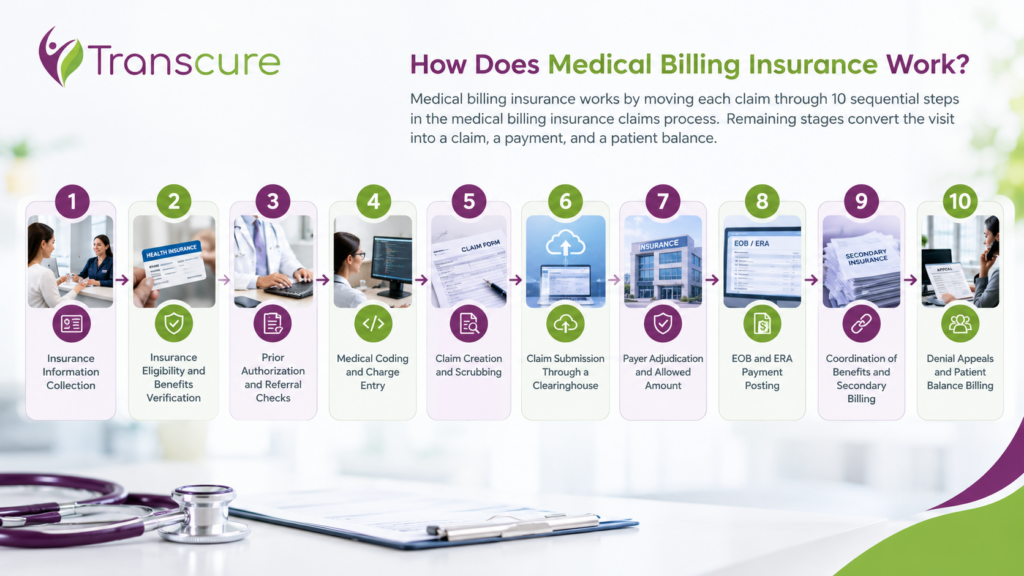
Medical billing insurance works by moving each claim through 10 sequential steps in the medical billing insurance claims process. Remaining stages convert the visit into a claim, a payment, and a patient balance.
- Insurance Information Collection
- Insurance Eligibility and Benefits Verification
- Prior Authorization and Referral Checks
- Medical Coding and Charge Entry
- Claim Creation and Scrubbing
- Claim Submission Through a Clearinghouse
- Payer Adjudication and Allowed Amount
- EOB and ERA Payment Posting
- Coordination of Benefits and Secondary Billing
- Denial Appeals and Patient Balance Billing
1. Insurance Information Collection
Front-desk staff collect the payer name, member ID, group number, and subscriber details at scheduling and check-in. Scans of the card front and back and the patient relationship join the record.
Signed assignment of benefits forms (patient authorization for direct payment to the provider) and secondary coverage details complete the record. Even 1 wrong member ID digit or a missing secondary plan can cause clearinghouse rejections. Complete insurance data sets the foundation for later billing steps.
2. Insurance Eligibility and Benefits Verification
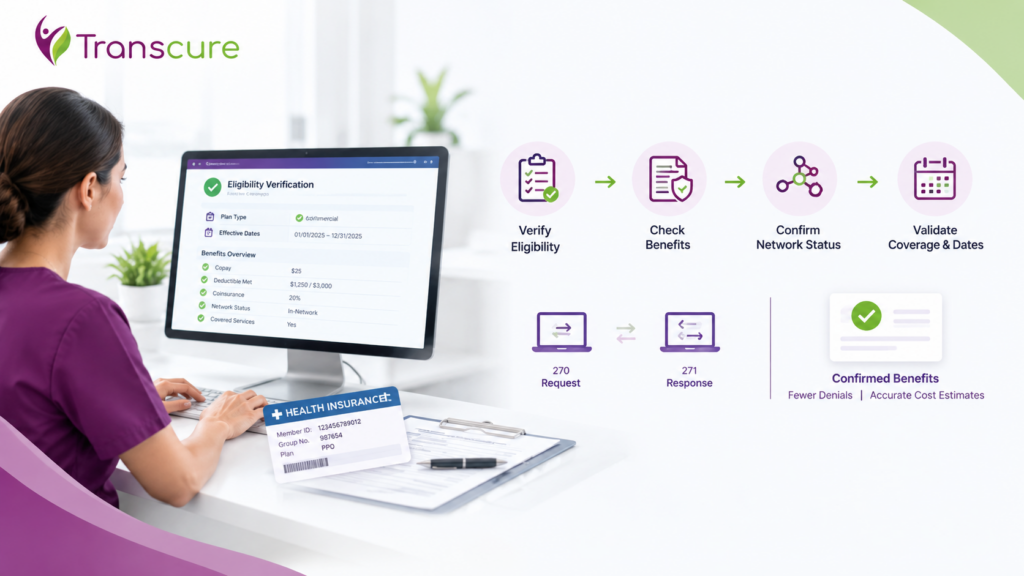
Eligibility and benefits verification confirms active coverage, plan type, and effective dates before the visit. Benefit checks cover the copay, deductible met to date, coinsurance, network status, and covered services.
Clearinghouse portals, payer websites, and electronic eligibility transactions (270 request, 271 response) power the insurance verification process in medical billing. Confirmed benefits prevent eligibility denials, and medical billing insurance verification gives patients accurate cost estimates before service.
3. Prior Authorization and Referral Checks
Advanced imaging, elective surgeries, and specialty drugs commonly require prior authorization, and HMO plans require referrals from a primary care provider. Practices request approval, track the authorization number, and confirm approved units and dates.
Authorization numbers go on the claim so the payer can match approval to service. Missing or expired authorizations lead to avoidable denials.
4. Medical Coding and Charge Entry
Documented services become ICD-10, CPT, and HCPCS codes, and the practice management system posts the matching charges. Payers read the diagnosis code for medical necessity and the procedure code for payment.
Read the full medical coding and charge entry workflows on Transcure.
5. Claim Creation and Scrubbing
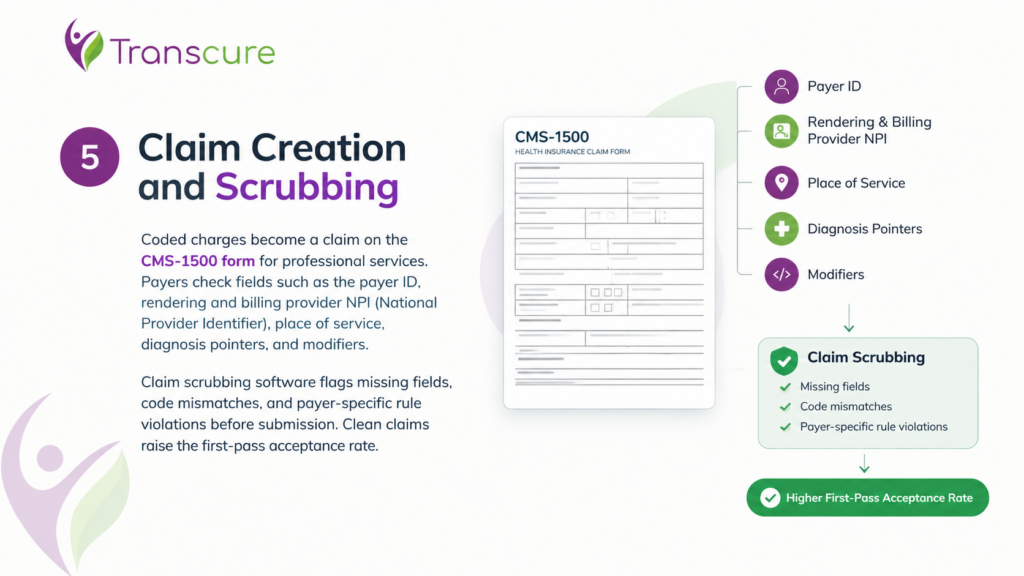
Coded charges become a claim on the CMS-1500 form for professional services. Payers check fields such as the payer ID, rendering and billing provider NPI (National Provider Identifier), place of service, diagnosis pointers, and modifiers.
Claim scrubbing software flags missing fields, code mismatches, and payer-specific rule violations before submission. Clean claims raise the first-pass acceptance rate.
6. Claim Submission Through a Clearinghouse
Claims travel electronically in the 837P format through a clearinghouse to the payer. The clearinghouse returns acceptance and rejection reports, and claim status inquiries (276/277) track progress.
Filing windows vary by payer, and Medicare allows 1 calendar year from the date of service. Late filing leads to non-appealable denials.
7. Payer Adjudication and Allowed Amount
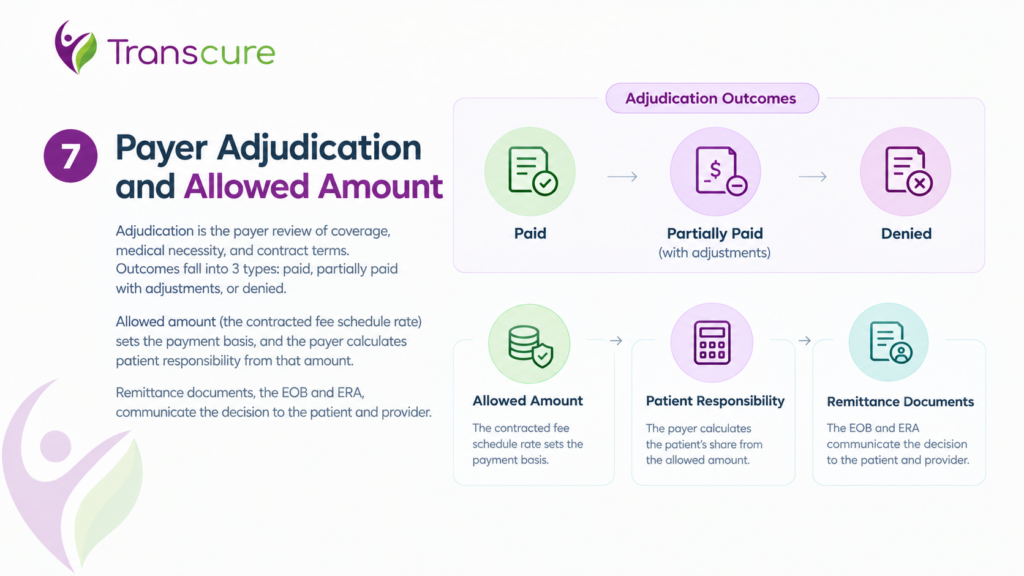
Adjudication is the payer review of coverage, medical necessity, and contract terms. Outcomes fall into 3 types: paid, partially paid with adjustments, or denied.
Allowed amount (the contracted fee schedule rate) sets the payment basis, and the payer calculates patient responsibility from that amount. Remittance documents, the EOB and ERA, communicate the decision to the patient and provider.
8. EOB and ERA Payment Posting
Patients receive the explanation of benefits (EOB), while providers receive the electronic remittance advice (835 ERA). Account entries record payments, contractual adjustments, and patient responsibility.
Remark codes and adjustment reason codes point to underpayments and denials. Posting accuracy keeps account balances and financial reports correct.
9. Coordination of Benefits and Secondary Billing
Coordination of benefits rules rank a patient’s plans with multiple coverages as primary, secondary, and tertiary. Tertiary insurance in medical billing is the third payer billed after the primary and secondary payers.
Under the birthday rule, the parent whose birthday falls first in the calendar year holds the primary plan for dependent children. In some cases, Medicare acts as the secondary payer, such as when coverage is through an active worker’s employer group plan.
Billers send the secondary claim after the primary EOB or ERA arrives, and a wrong primary payer causes denials and delayed payment.
10. Denial Appeals and Patient Balance Billing
Staff review each denied claim by denial code, correct the error, and resubmit the claim or appeal with supporting documentation. Balances remaining after insurance go to the patient as copay, deductible, or coinsurance amounts.
Channels for patient statements include mail, email, text message, and patient portal. Installment plans divide balances into scheduled payments. Tracking denial patterns prevents repeat errors.
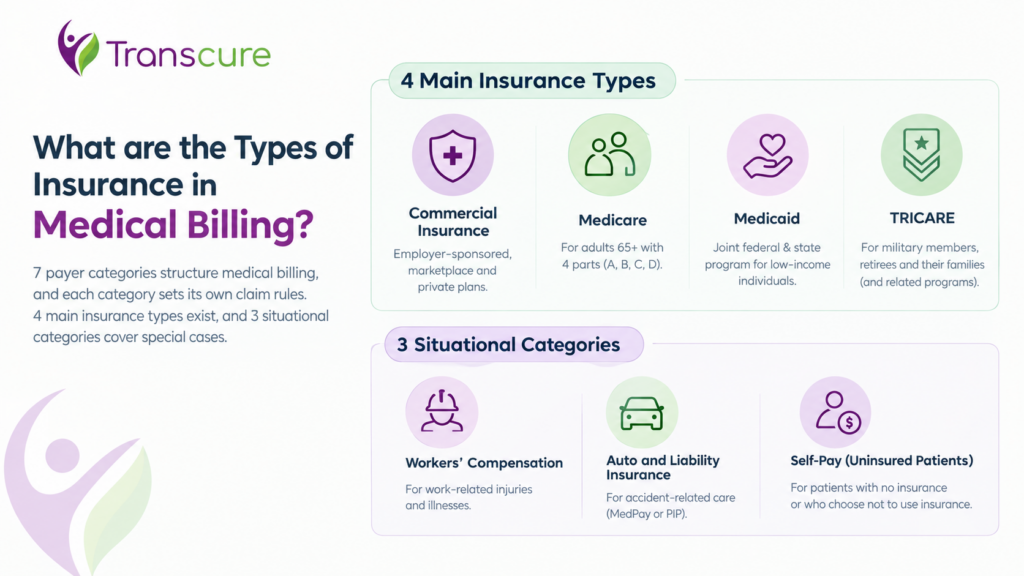
What are the Types of Insurance in Medical Billing?
7 payer categories structure medical billing, and each category sets its own claim rules. 4 main insurance types exist: commercial insurance, Medicare, Medicaid, and TRICARE. Situational categories number 3: workers’ compensation, auto and liability insurance, and self-pay.
Commercial Insurance
Commercial insurance in medical billing covers plans from private insurers, such as employer-sponsored and marketplace plans.
HMO plans require primary care referrals and in-network care. PPO plans cover out-of-network visits with added cost sharing. EPO plans exclude out-of-network coverage. POS plans combine HMO referral rules with out-of-network options.
Payer-specific rules, contracted fee schedules, and filing limits that differ by payer shape commercial claims.
Medicare
Medicare is the federal health program mainly for adults 65 and older. Coverage divides into 4 parts:
- Part A: hospital inpatient care
- Part B: outpatient and physician services
- Part C (Medicare Advantage): coverage through private plans
- Part D: prescription drug coverage
Beneficiaries appear on claims by the Medicare Beneficiary Identifier (MBI). Part B pays 80% of the approved amount after the deductible, and coinsurance or secondary coverage covers the remaining 20%.
Medicare Advantage plans follow CMS rules with payer-specific processes.
Medicaid
Medicaid is the joint federal and state program for eligible low-income individuals.
Covered services, eligibility, and filing rules vary by state, and managed care plans often administer benefits.
As the payer of last resort, Medicaid pays after all other coverage. Prior authorization requirements and claim rules differ by state.
TRICARE and Other Government Plans
TRICARE is the health program for military members, retirees, and their families.
Related programs include VA Community Care, which covers veterans treated by community providers, and CHAMPVA, which covers dependents of certain disabled or deceased veterans.
Regional contractors administer TRICARE claims, and authorization rules and claim submission procedures differ by program.
Workers’ Compensation
Workers’ compensation billing covers work-related injuries and illnesses paid by the employer’s carrier.
Health plans of patients are not billed first for work-related injuries.
Employer carriers assign a claim number, apply state fee schedules, and authorize treatment.
Auto and Liability Insurance
Auto and liability coverage in medical billing pays accident-related care through medical payments (MedPay) or personal injury protection (PIP) coverage.
State regulations set payment order and claim rules. Accident details appear on the claim, and attorney involvement and delayed settlement timelines extend payment.
Self-Pay (Uninsured Patients)
Self-pay billing covers patients with no insurance or patients who choose not to use insurance.
Uninsured and self-pay patients receive a Good Faith Estimate of expected charges under the No Surprises Act.
Upfront fees, discounts, and payment plans shape self-pay billing.
What are the Key Terms in Medical Billing Insurance?
Key terms in medical billing insurance, from copay to coinsurance, determine patient cost, payer payment, and claim outcomes.
Definitions and billing impact for each of the 12 terms appear in the table below.
| Term | Meaning | Billing Impact |
|---|---|---|
| Copay | A fixed dollar amount the patient pays for a covered service at the time of the visit. | Practices collect the copay at check-in, and the payer reduces payment by the copay amount. |
| Deductible | The amount the patient pays each benefit year before the plan begins paying for covered services. | An unmet deductible shifts the full allowed amount to the patient balance. |
| Coinsurance | A percentage of the allowed amount that the patient pays after meeting the deductible. | Coinsurance creates a patient balance based on the allowed amount, not the billed charge. |
| Out-of-Pocket Maximum | The yearly cap on patient cost sharing for covered in-network services. | Patient balances stop accruing for covered services once the cap is reached. |
| Allowed Amount | The maximum fee a payer recognizes for a covered service under the contract. | Contractual adjustments write off the difference between the billed charge and the allowed amount. |
| Explanation of Benefits (EOB) | The statement a payer sends to the patient to detail how a claim was processed. | The EOB explains patient responsibility and drives patient balance questions. |
| Electronic Remittance Advice (ERA) | The electronic 835 file a payer sends to the provider with payment and adjustment details. | ERA files enable automatic payment posting and underpayment detection. |
| Coordination of Benefits (COB) | The set of rules that determine payment order among multiple insurance plans. | Incorrect COB data causes denials and delayed payment. |
| Prior Authorization | Payer approval granted before a specific service is delivered. | Missing authorization causes denials for otherwise covered services. |
| In-Network vs Out-of-Network | In-network providers hold a payer contract, and out-of-network providers do not. | Network status determines the allowed amount and the patient cost sharing. |
| Timely Filing | The payer deadline for claim submission, measured from the date of service. | Late filing leads to denials that cannot be appealed. |
| Adjudication | The payer process of reviewing a claim for coverage, medical necessity, and contract terms. | Adjudication results in payment, partial payment, or denial. |
Terms in the table fall into 3 groups: patient cost sharing, payer payment determination, and claim control.
Why is Accurate Insurance Billing Important?
Accurate insurance billing prevents eligibility denials, ensures correct reimbursement, speeds up payer payments, reduces patient billing disputes, and supports regulatory compliance in 5 measurable ways.
Prevents Eligibility Denials
An eligibility denial is a payer rejection for inactive, terminated, or incorrect insurance coverage on the date of service.
Verified coverage and correct member data keep claims from being rejected for inactive or incorrect insurance. Coverage errors found after submission trigger rework that delays revenue and consumes billing hours.
Ensures Correct Reimbursement
Correct reimbursement is payment that matches the contracted allowed amount for the services rendered.
Matching payer data, codes, and modifiers lets the payer apply the right allowed amount. Underpayments go unnoticed when ERAs remain unchecked against contract rates.
Speeds Up Payer Payments
Payment turnaround is the time from claim submission to payer payment.
Timely filing and clean claims shorten payment turnaround. Prompt payment reduces days in accounts receivable (A/R) and supports steady cash flow.
Reduces Patient Billing Disputes
Patient billing disputes are patient objections to a statement’s amount, timing, or accuracy.
Estimates built from verified benefits and accurate patient responsibility amounts reduce confusion. Clear statements reduce call volume and bad debt.
Supports Regulatory Compliance
Billing compliance means adhering to federal rules, state rules, and payer contracts on every claim.
HIPAA, CMS rules, the No Surprises Act, and payer contracts govern insurance billing. Wrong-payer billing, duplicate billing, and unsupported claims create compliance risk.
What are the Common Challenges in Medical Billing Insurance?
6 common challenges disrupt medical billing insurance: coverage changes, authorization delays, COB errors, payer-specific rules, claim denials, and rising patient cost sharing.
Coverage Changes and Eligibility Gaps
Plan changes, lost coverage, and new benefit years occur between patient visits. Stale insurance data leads to denials. Verification at every visit keeps coverage data current.
Prior Authorization Delays
Authorization rules differ by payer and service. Slow approvals delay care and billing, and missing authorizations lead to denials.
Wrong Primary Payer and COB Errors
Multiple plans per patient create order-of-payment confusion. Outdated coordination-of-benefits records cause denials, and correcting the payer order requires extra follow-up.
Payer-Specific Rules and Filing Limits
Edits, claim formats, and deadlines differ by payer. Policy updates require staff to track changes continuously. Missed deadlines lead to unrecoverable revenue.
Claim Denials and Underpayments
Denials result from 4 frequent causes: eligibility, coding, authorization, and documentation errors. Partial payments conceal underpayments. Appeals and denial tracking recover revenue.
Rising Patient Cost Sharing
Growing deductibles and coinsurance shift substantial balances to patients. Collecting patient balances consumes extra staff time. Point-of-service estimates and payment plans improve collection.
Should You Outsource Medical Billing Insurance Claims?
You should consider outsourcing medical billing insurance claims when 5 signs appear:
- A rising denial rate
- Front-desk turnover
- A growing payer mix
- Repeated coordination of benefits errors
- Aging accounts receivable
Certified billers and coders, payer-specific expertise, prompt follow-up, and scalable capacity are the 4 benefits of medical insurance billing services.
Check 4 criteria when comparing medical insurance billing companies: specialty experience, insurance verification support, reporting transparency, and EHR compatibility.
Transcure maintains a 98% first-pass clean claims rate through its outsourced medical billing services.
Who submits insurance claims in medical billing?
Medical billers submit insurance claims in medical billing at the practice or through an outsourced billing company. Claims are submitted through a clearinghouse or payer portal. The provider remains responsible for claim accuracy.
Is insurance verification part of medical billing?
Yes, insurance verification is a front-end step in medical billing that confirms coverage and benefits before service and helps prevent denials.
What claim form is used for medical insurance billing?
The CMS-1500 is the standard claim form for professional services. Electronic submission uses the 837P, the electronic equivalent of the CMS-1500. Dental claims use the ADA dental claim form, and facility claims use a different form outside this guide’s scope.
What is the difference between primary, secondary, and tertiary insurance?
The main difference between primary, secondary, and tertiary insurance is payment order. Primary insurance processes the claim first and pays up to the plan benefit.
Secondary insurance covers eligible remaining balances after the primary EOB or ERA arrives. Last in line, tertiary insurance receives the claim after the secondary payer processes payment.
What is the difference between copay, deductible, and coinsurance?
The main difference between copay, deductible, and coinsurance is how you pay. A copay is a fixed dollar amount paid per visit. Deductible payments precede plan coverage and reset each benefit year.
Coinsurance is the percentage of the allowed amount you pay after the deductible. Together, these 3 amounts make up the patient balance after insurance pays.
How long does insurance take to pay a medical claim?
Typical turnaround is 14 to 30 days for electronic claims and 45 to 90 days for paper claims. Factors such as clean claim rate, payer backlog, authorization delays, and denials determine the actual timeline.
How much does medical billing cost?
Medical billing pricing follows 3 common models: a percentage of collections, a flat fee per claim, and a per-provider monthly fee. Under these models, collections, claim volume, and provider count drive billing cost, respectively.