CPT 96110 is the code used to bill insurance for doing one scored child development test. Pediatric and primary care practices use CPT 96110 at well-child visits, alongside other pediatric CPT codes. A missed or mis-coded screen means lost revenue. The most common mistake is mixing up CPT 96110 with CPT 96127. A single child can have up to 5 screening tests in the first 30 months, so one error repeats.
This guide below starts with what CPT 96110 covers and when to bill it. Next come units, modifiers, and the difference between CPT 96110 and CPT 96127. Further, it covers ICD-10 codes that support 96110, payer limits, denial fixes, and a workflow to get paid for every screen follow.

What Is CPT Code 96110 for Developmental Screening?
CPT 96110 is the procedure code for developmental screening with scoring and documentation, reported once for each standardized instrument. The American Medical Association (AMA) maintains CPT 96110 in the Developmental and Behavioral Screening and Testing range. Therefore, CPT 96110 applies to structured questionnaires and checklists, not to open-ended clinical observation.
What Does CPT Code 96110 Include?
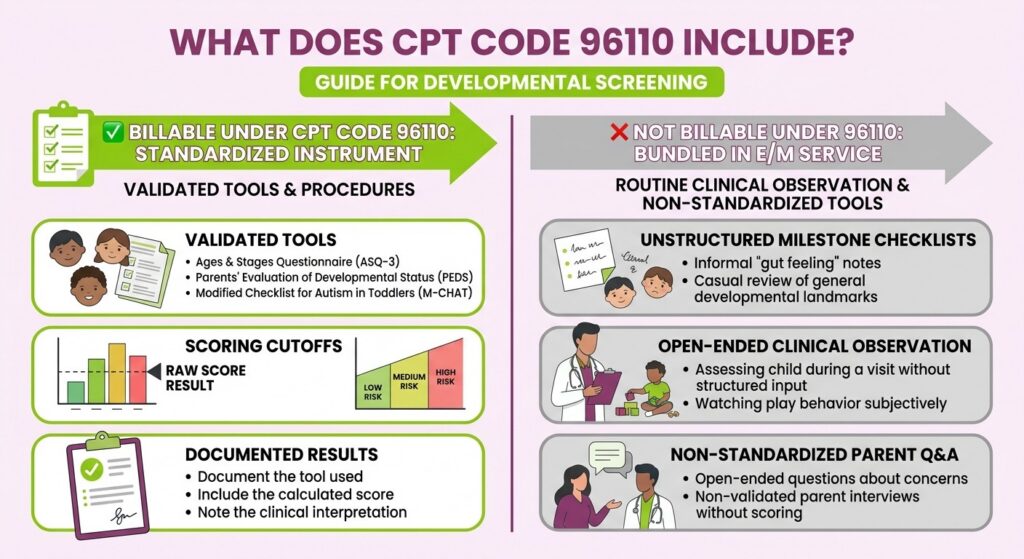
CPT 96110 includes a standardized, validated instrument, scoring of the responses, and documentation of the result. Clinical staff or physician time to administer the instrument also falls within the service. Developmental surveillance and non-standardized tools remain part of the evaluation and management service.
Common instruments include the Ages and Stages Questionnaire, Third Edition (ASQ-3) and the Parents’ Evaluation of Developmental Status (PEDS). The Modified Checklist for Autism in Toddlers (M-CHAT) also qualifies when used for autism screening. Each instrument carries its own age range and scoring cutoffs.
Who Can Perform and Bill CPT Code 96110?
Physicians, nurse practitioners, physician assistants, and clinical staff under supervision can perform CPT 96110. Payer policies define which of these performers qualify for payment. Therefore, practices confirm each payer’s supervision rules before assigning screening workflow to medical assistants. Moreover, pediatric billing services track those rules by payer.
What Is the Official Descriptor and Status of CPT 96110?
The CPT 96110 descriptor covers developmental screening with scoring and documentation for each standardized instrument. Milestone surveys and speech and language delay screens fall under that wording. CPT 96110 holds active status in the current AMA CPT code set. AAP coding guidance for 2026 directs practices to report standardized developmental screening under CPT 96110.
When Should You Bill CPT Code 96110?
CPT 96110 is billed each time a standardized developmental screening instrument is administered, scored, and documented. Screening ages, clinical concern, and payer frequency limits decide when CPT 96110 applies. Moreover, preventive visit coding in the pediatric billing guide explains how screening claims attach to well-child codes.
How Often Do the Recommended Screening Ages Apply?
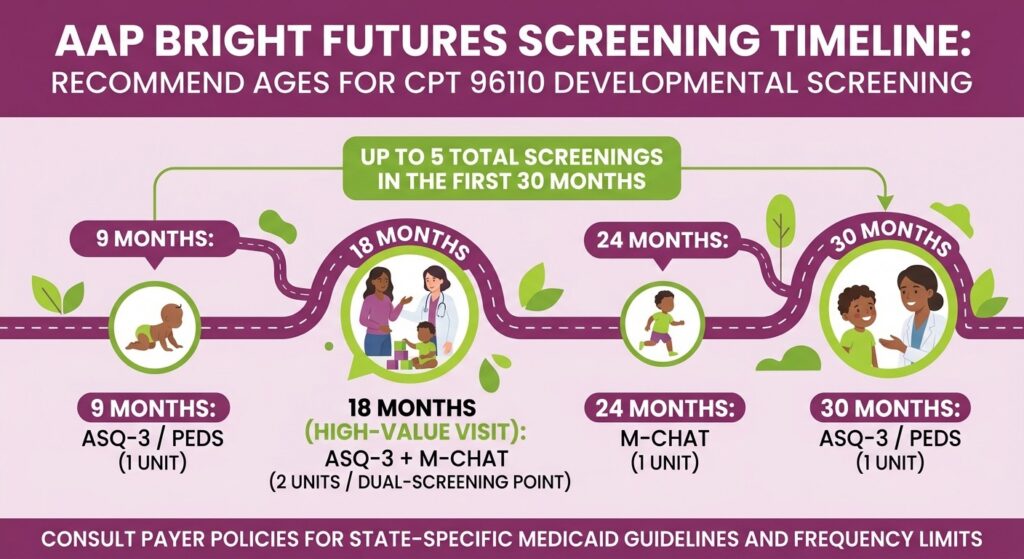
The American Academy of Pediatrics (AAP) Bright Futures schedule recommends general developmental screening at 9, 18, and 30 months. The same schedule recommends autism-specific screening at 18 and 24 months. Therefore, a child can receive up to 5 scheduled screening instruments across the first 30 months, and the 18-month visit carries 2 instruments.
Can You Bill CPT Code 96110 Outside the Standard Ages?
CPT 96110 can be billed outside the standard ages when a clinician documents a developmental concern or a caregiver raises one. Therefore, a documented concern at a 12-month visit supports a screening claim. However, payer frequency limits vary, and some payers cap CPT 96110 at 2 screenings per year.
What Documentation Supports CPT Code 96110?
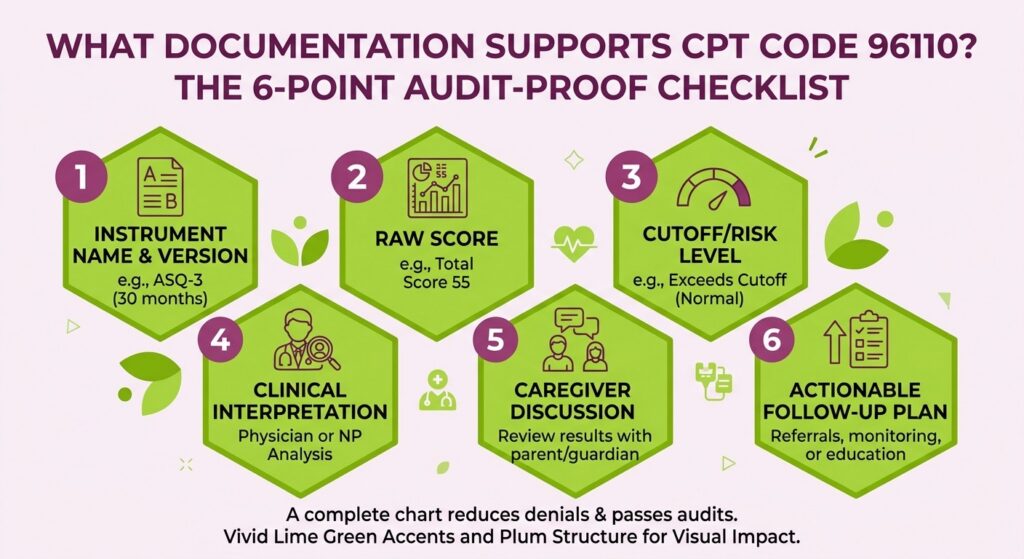
Six documentation elements support a CPT 96110 claim, and each element belongs in the medical record for the date of service. Missing score documentation removes the basis for CPT 96110 payment. Therefore, the chart for each CPT 96110 claim contains the following six elements:
- Instrument name and version
- Raw score
- Cutoff or risk category
- Clinical interpretation
- Result discussion with the caregiver
- Follow-up plan
How Do Units, Modifiers, and Bundling Work With CPT Code 96110?
CPT 96110 follows unit, modifier, and bundling rules that differ by payer, so each claim needs the correct combination of codes. Two variables drive every claim: the number of instruments administered and whether a separate E/M service occurs on the same day.
The table below lists four common scenarios with units, modifiers, and expected payer treatment.
| Scenario | Units | Modifier | Expected Payer Treatment |
|---|---|---|---|
| ASQ-3 at a well-child visit | 1 unit of CPT 96110 | None on CPT 96110 | Paid as a separate line beside the preventive visit code |
| ASQ-3 plus M-CHAT on the same day | 2 units of CPT 96110 | Modifier 59 on the second line when the payer requires it | Paid per instrument; some state Medicaid programs require an autism-specific modifier |
| CPT 96110 plus a problem-oriented E/M service | 1 unit per instrument | Modifier 25 on the E/M code | E/M paid when the chart supports a separate evaluation |
| CPT 96110 with a payer bundling edit | 1 unit per instrument | Modifier per payer policy | Bundled into the preventive visit unless the payer edit allows separate payment |
CPT 96110 takes 1 unit per instrument, with modifier 25 on the E/M code and modifier 59 on the second instrument.
How Many Units of CPT Code 96110 Can You Bill?
Practices can bill 1 unit of CPT 96110 per standardized instrument, per patient, per date of service. An ASQ-3 plus an M-CHAT on the same day equals 2 units. Therefore, the unit count matches the number of scored instruments in the chart. Moreover, a single instrument with several subscales stays at 1 unit.
When Does Modifier 25 Apply With CPT Code 96110?
Modifier 25 attaches to the evaluation and management (E/M) code, never to CPT 96110, when a significant, separately identifiable E/M service occurs. For a sick visit billed with a preventive visit, modifier 25 sits on the problem-oriented E/M code. However, some payers apply different placement conventions, so practices confirm each payer’s rule.
When Does Modifier 59 Apply to CPT Code 96110?
Modifier 59 applies to the second CPT 96110 unit when different instruments are billed, and the payer requires a distinct-service indicator. An M-CHAT billed after an ASQ-3 receives modifier 59 on the second line. However, some state Medicaid programs require an autism-specific modifier, such as U1 or KX, on the M-CHAT line.
Does CPT Code 96110 Bundle With Preventive Visit Codes?
CPT 96110 is reportable with preventive visit codes 99381 to 99385 and 99391 to 99395. The AAP describes CPT 96110 as a service reported in the context of preventive medicine visits. However, payer-specific National Correct Coding Initiative (NCCI) edits can bundle CPT 96110 into the preventive visit payment. Therefore, practices review each payer’s edit file.
What Is the Difference Between CPT Code 96110 and CPT Code 96127?
CPT 96110 reports developmental screening, while CPT 96127 reports brief emotional or behavioral assessment with scoring and documentation. Developmental instruments measure milestones and autism risk. Emotional and behavioral instruments measure mood, anxiety, and attention symptoms. Therefore, the clinical purpose of the instrument decides the code.
The table below compares the two codes across purpose, instruments, unit rules, and screening diagnosis codes.
| CPT 96110 | CPT 96127 |
|---|---|
| Purpose: developmental and autism screening | Purpose: brief emotional and behavioral assessment |
| Instruments: ASQ-3, PEDS, M-CHAT | Instruments: PHQ-A, Vanderbilt ADHD scales |
| Unit rule: 1 unit per instrument | Unit rule: 1 unit per instrument |
| Screening diagnosis: Z13.42 or Z13.41 | Screening diagnosis: Z13.31 for depression screening |
CPT 96110 and CPT 96127 share a per-instrument unit rule, but the clinical purpose of the instrument separates the two codes.
Which Instruments Map to CPT Code 96110 vs CPT Code 96127?
Developmental and autism instruments map to CPT 96110, while depression, anxiety, and attention-deficit/hyperactivity disorder (ADHD) instruments map to CPT 96127. The ASQ-3 and M-CHAT report under CPT 96110. The Patient Health Questionnaire for Adolescents (PHQ-A) and Vanderbilt ADHD scales report under CPT 96127. However, practices verify each mapping against current AAP coding guidance.
Can You Bill CPT Code 96110 and CPT Code 96127 on the Same Day?
CPT 96110 and CPT 96127 can be billed on the same day when two distinct instruments serve two distinct purposes. For example, an ASQ-3 reports 1 unit of CPT 96110, and a standardized emotional or behavioral scale reports 1 unit of CPT 96127.
Moreover, each unit carries its own screening diagnosis code, such as Z13.42 for developmental screening and Z13.31 for depression screening. Some payers with bundling edits require modifier 59 on the second line, so practices confirm payer policy before claim submission.
How Does CPT Code 96110 Compare to Other Developmental Testing Codes?
CPT 96110 sits beside three related developmental testing codes: CPT 96112, CPT 96113, and the deleted CPT 96111. Each related code reports a different depth of developmental assessment and written report. Therefore, the correct code depends on whether the service is screening or testing.
How Is CPT Code 96110 Different From CPT Code 96112 and CPT Code 96113?
CPT 96110 reports a screening instrument, while CPT 96112 and CPT 96113 report developmental testing with interpretation and a written report. CPT 96112 covers the first hour of test administration, and CPT 96113 adds an additional 30 minutes. Therefore, a full developmental battery belongs under CPT 96112 and CPT 96113.
Is CPT Code 96111 Still Reportable?
CPT 96111 is no longer reportable, because the AMA deleted CPT 96111 effective January 1, 2019. CPT 96112 and CPT 96113 replaced CPT 96111 for developmental test administration. Therefore, claims for CPT 96111 with a date of service on or after January 1, 2019 are not payable.
Which ICD-10 Codes Support CPT Code 96110?
ICD-10-CM diagnosis codes link each CPT 96110 line to the reason for the screening. Screening codes support routine instruments, and finding codes support positive results. These codes form one part of the pediatric ICD-10 code guide that practices apply across well-child and sick visits.
The table below lists the seven diagnosis code groups that pair with CPT 96110 and the preventive visit.
| ICD-10 Code | Plain-Language Meaning | Pairing Use |
|---|---|---|
| Z13.42 | Encounter for screening for global developmental delays (milestones) | Routine developmental instruments such as the ASQ-3 |
| Z13.41 | Encounter for autism screening | Autism instruments such as the M-CHAT |
| R62.0 | Delayed milestone in childhood | Positive screen with a documented delay |
| F88 | Other disorders of psychological development | Documented global developmental delay |
| F80 family | Developmental disorders of speech and language | Documented speech or language disorder |
| Z00.121 | Routine child health exam with abnormal findings | Primary code on the preventive visit when findings exist |
| Z00.129 | Routine child health exam without abnormal findings | Primary code on the preventive visit when no findings exist |
Screening codes belong on the CPT 96110 line, while finding codes require documented clinical findings.
Which Screening Diagnosis Codes Pair With CPT Code 96110?
Z13.42 and Z13.41 are the primary screening diagnosis codes for CPT 96110. Z13.42 describes an encounter for screening for global developmental delays, and Z13.41 describes an encounter for autism screening. Therefore, an ASQ-3 links to Z13.42, and an M-CHAT links to Z13.41.
Which Codes Apply When a Screen Is Positive?
Positive screens support finding codes only when the clinician documents the finding. R62.0 reports a delayed milestone in childhood. F88 reports other disorders of psychological development, and the F80 family reports speech and language developmental disorders. Therefore, a raw positive score alone does not justify F88 or F80 codes.
How Does the Well-Child Exam Code Interact With CPT Code 96110?
Z00.121 and Z00.129 serve as the primary diagnosis on the preventive visit line, not on the CPT 96110 line. Z00.121 reports abnormal findings, and Z00.129 reports no abnormal findings. Moreover, Z13.42 can accompany either code, because ICD-10-CM lists the routine child exam as an Excludes2 note under Z13.4.
Are There HCPCS Codes Related to CPT Code 96110?
A single HCPCS Level II code, G0451, relates to CPT 96110. CMS added G0451 effective January 1, 2012, and the descriptor covers developmental testing by standardized instrument, with interpretation and report. Therefore, G0451 overlaps with CPT 96110 on purpose, and the payer’s policy decides which code the claim carries.
What Is HCPCS G0451 and When Does It Apply?
G0451 applies when a payer instructs practices to report developmental testing under HCPCS instead of CPT 96110. Medicare lists G0451 under carrier judgment, which leaves coverage to the Medicare Administrative Contractor (MAC). Moreover, Iowa Medicaid directed managed care plans in 2023 to pay G0451 as a stand-alone code for screening centers.
Which Payers Reimburse CPT Code 96110, and What Are the Common Limits?
Medicaid, commercial payers, and Medicare treat CPT 96110 differently, and limits vary by contract and by state. Therefore, practices read each payer policy before building a screening workflow. Moreover, payer fee schedules set the payment amount, so published dollar figures differ by payer and locality.
The table below summarizes the coverage basis and common limits for each payer type.
| Payer Type | Coverage Basis | Common Limits |
|---|---|---|
| Medicaid | Federal EPSDT requirement for developmental screening | State fee schedules, frequency limits, and autism modifiers |
| Commercial | Plan policy | Frequency caps, instrument restrictions, age limits, place-of-service edits |
| Medicare | Carrier judgment for G0451 | Limited relevance for the pediatric population |
Medicaid carries the strongest federal coverage basis for CPT 96110, while commercial policies add frequency, age, and instrument edits.
Does Medicaid Cover CPT Code 96110 Under EPSDT?
Medicaid covers developmental screening for enrolled children under 21 through the Early and Periodic Screening, Diagnostic, and Treatment (EPSDT) benefit. Federal law defines EPSDT at 42 U.S.C. § 1396d(r). States set fee schedules and frequency limits for CPT 96110. Therefore, state Medicaid billing manuals govern each claim.
How Do Commercial Payers Treat CPT Code 96110?
Commercial payers apply frequency caps, instrument restrictions, age limits, and place-of-service edits to CPT 96110. One payer may accept the ASQ-3 but reject an unlisted instrument. Moreover, an age limit can deny CPT 96110 for a child outside the payer’s screening window. Therefore, practices load each payer’s rules into the claim scrubber.
Does Medicare Pay for Developmental Screening?
Medicare has limited relevance for developmental screening because the Medicare beneficiary population is mostly adults and older adults. HCPCS G0451 carries carrier-judgement coverage under Medicare, as the HCPCS section above explains.
What Are the Most Common CPT Code 96110 Denials and How Do You Fix Them?
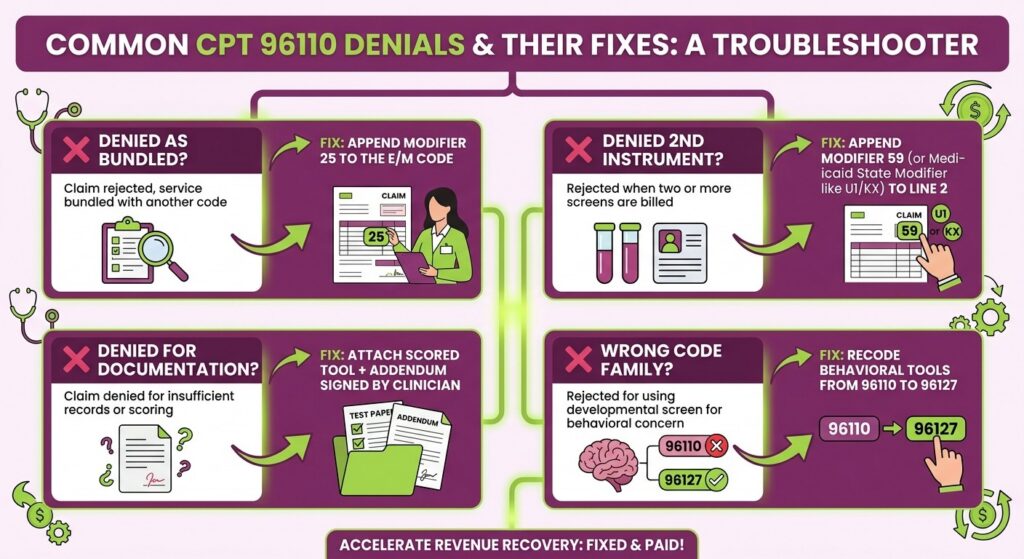
CPT 96110 denials occur due to 3 causes: missing modifiers, frequency or age limits, and missing scoring documentation. Revenue cycle management services track these denial patterns by payer and by instrument. The table below lists each denial reason with its cause and fix.
| Denial Reason | Cause | Fix |
|---|---|---|
| Missing modifier | Modifier 25 omitted on the E/M code, or modifier 59 omitted on the second instrument | Add the modifier to the correct line and resubmit |
| Frequency or age limit exceeded | Screening billed outside the payer’s age window or above the annual cap | Verify payer limits before the visit; appeal with a documented clinical concern |
| No scoring documentation | Chart lacks the instrument name, score, or interpretation | Add the missing elements through a signed, dated addendum and resubmit |
| Wrong code family | Emotional or behavioral instrument billed under CPT 96110 | Recode the instrument to CPT 96127 and resubmit |
Each denial pattern traces to a modifier, limit, or documentation gap that practices correct before claim submission.
Why Does CPT Code 96110 Get Denied for Missing Modifiers?
Payers deny CPT 96110 for missing modifiers when the E/M code lacks modifier 25 or the second instrument lacks modifier 59. The denial reflects a payer edit that treats the screening as bundled. Therefore, billers add the correct modifier and resubmit the claim with the screening documentation attached.
Why Does CPT Code 96110 Get Denied for Frequency or Age Limits?
Payers deny CPT 96110 when the claim exceeds the annual frequency cap or falls outside the payer’s age window. Practices verify these limits during eligibility checks. Moreover, a documented developmental concern supports an appeal for screening outside the standard Bright Futures ages.
Why Does CPT Code 96110 Get Denied When Billed Without Documentation of Scoring?
Payers deny CPT 96110 when the chart lacks the instrument name, score, cutoff, or interpretation. The score proves that a standardized instrument was administered and scored. Therefore, practices attach the scored instrument to the claim record and add any missing element through a signed, dated addendum.
How Do You Appeal a Denied CPT Code 96110 Claim?
An appeal for a denied CPT 96110 claim includes the instrument name, score, cutoff, interpretation, and the clinical reason for screening. The appeal also cites the payer’s own policy or the Bright Futures schedule. Moreover, practices file the appeal within the payer’s stated appeal window.
How Can Practices Get Paid for Every CPT Code 96110 Screen?
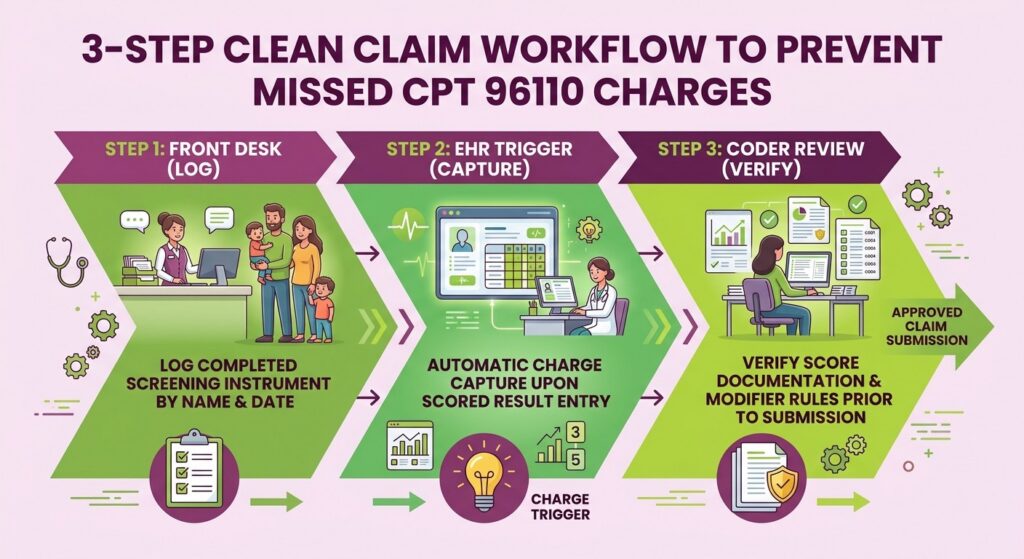
Practices capture every payable CPT 96110 screen by controlling 3 workflow points: instrument capture at the front desk, charge triggers in the electronic health record (EHR), and coder review of scoring documentation. Each control closes a specific revenue gap. Moreover, the controls produce the documentation that payers request during audits.
What Workflow Prevents Missed CPT Code 96110 Charges?
Front-desk staff record each completed instrument by name and date, which creates a charge source for CPT 96110. The EHR then triggers the charge when the scored result is filed. Finally, a coder reviews scoring documentation before claim release. Therefore, no completed screening leaves the visit without a charge.
How Outsourced Pediatric Billing Improves Revenue?
Outsourced pediatric billing moves screening charge review, modifier checks, and denial follow-up to teams that work with CPT 96110 across many payers. Therefore, the practice receives a claim-level view of screening revenue by payer and instrument. Moreover, payer rules for modifiers, ages, and frequency stay current outside the front office.
Transcure’s AAPC-certified coders and its CLAIR AI claim scrubbing agent check modifiers, units, and payer rules on every CPT 96110 line before submission. Pediatric and primary care practices can request a free billing audit to see which screening charges go unpaid today.
Frequently Asked Questions
What is CPT 96110 Used For?
CPT 96110 reports a standardized developmental screening instrument, such as the ASQ-3 or M-CHAT, with scoring and documentation. Practices bill CPT 96110 once per instrument at well-child visits and when a developmental concern arises.
How Many Times Can You Bill 96110 in One Visit?
Practices bill 1 unit of CPT 96110 per standardized instrument. An ASQ-3 plus an M-CHAT on the same day equals 2 units, subject to payer frequency limits.
Does 96110 Require Mmodifier 25?
CPT 96110 does not carry modifier 25 itself. Modifier 25 attaches to the E/M code when a significant, separately identifiable E/M service occurs on the same day.
Can You Bill 96110 and 96127 Together?
CPT 96110 and CPT 96127 can be billed together on the same day when two distinct instruments serve two distinct purposes. A developmental screen plus an emotional or behavioral scale is one example.
What ICD-10 Code Goes with 96110?
Z13.42 pairs with developmental screening instruments, and Z13.41 pairs with autism screening instruments. Positive findings use codes such as R62.0, F88, or the F80 family when the clinician documents them.
Does Medicaid Pay for 96110?
Medicaid covers developmental screening for enrolled children under 21 through the EPSDT benefit. Each state sets its own fee schedule and frequency limits for CPT 96110.
Can Clinical Staff Administer 96110?
Clinical staff under supervision can administer CPT 96110 when payer policy permits staff performers, and the claim carries the scored, documented result.
How Long Does Medicaid or Commercial Timely Filing Allow for 96110?
Timely filing for CPT 96110 follows each payer contract or state Medicaid manual. Federal Medicaid rules cap state limits at 12 months from the date of service, and commercial contracts set their own windows.