
Pediatric coding carries a documentation burden that few specialties match at this volume. Every well-child visit, developmental screening, immunization, and newborn encounter has a different ICD-10-CM code range with age-specific selection rules. One wrong character denies the claim.
Medicaid and CHIP covered more than 37 million children as of October 2024, representing 47 percent of total Medicaid and CHIP enrollment. That reality brings state-specific edits, EPSDT requirements, and thinner margins on every encounter.
This guide covers the pediatric ICD-10 codes pediatric practices bill most, including well-child visits, otitis media, asthma, ADHD, developmental delay, and newborn diagnoses. Each section gives the documentation requirement, the common denial trigger, and the correct code selection logic.

What Are Pediatric ICD-10 Codes?
Pediatric ICD-10 codes are standard diagnosis codes carrying age restrictions, age-specific, or clinical criteria unique to patients under 18 years. Pediatric coding is a subset of ICD-10-CM, not a parallel code set. These diagnosis rules form one part of the broader pediatric billing and coding guide used to manage the complete claim.
Which Age Range Does ICD-10-CM Treat as Pediatric?
ICD-10-CM are not applied to a single pediatric age range. The four boundaries govern most pediatric claim volume: 0 to 28 days for newborn preventive codes, 29 days through 17 years for routine child health examinations, 2 through 20 years for pediatric BMI percentile codes, and 18 years and older for the adult general examination series.
The following table maps the four age boundaries that trigger the majority of pediatric age-related rejections.
| Age Boundary | Code Family | Descriptor Anchor | Edit Behavior Past the Boundary |
|---|---|---|---|
| 0 to 28 days | Z00.110, Z00.111 | Newborn health examination | Rejects for patients 29 days and older |
| 29 days to 17 years | Z00.121, Z00.129 | Routine child health examination | Rejects on and after the eighteenth birthday |
| 2 to 20 years | Z68.51 to Z68.54 | Pediatric BMI percentile for age | Rejects for patients under 2 and over 20 |
| 18 years and older | Z00.00, Z00.01 | General adult medical examination | Rejects for patients under 18 |
Categories of ICD-10 Codes in Pediatrics:
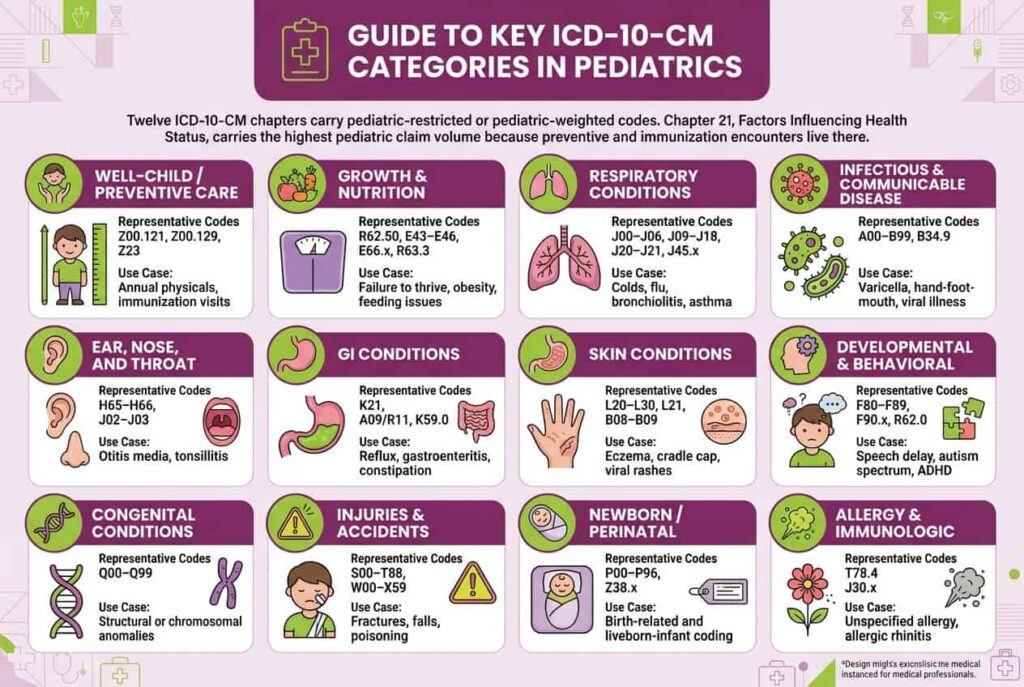
Twelve ICD-10-CM chapters carry pediatric-restricted codes. The Chapter 21, Factors Influencing Health Status, carries the highest pediatric claim volume because preventive and immunization encounters are present in it.
| Category | Representative Codes | Typical Use Case |
|---|---|---|
| Well-child / preventive care | Z00.121, Z00.129, Z23 | Annual physicals, immunization visits |
| Growth & nutrition | R62.50, E43–E46, E66.x, R63.3 | Failure to thrive, obesity, feeding issues |
| Respiratory conditions | J00–J06, J09–J18, J20–J21, J45.x | Colds, flu, bronchiolitis, asthma |
| Infectious & communicable disease | A00–B99, B34.9 | Varicella, hand-foot-mouth, viral illness |
| Ear, nose, and throat | H65–H66, J02–J03 | Otitis media, tonsillitis |
| GI conditions | K21, A09/R11, K59.0 | Reflux, gastroenteritis, constipation |
| Skin conditions | L20–L30, L21, B08–B09 | Eczema, cradle cap, viral rashes |
| Developmental & behavioral | F80–F89, F90.x, R62.0 | Speech delay, autism spectrum, ADHD |
| Congenital conditions | Q00–Q99 | Structural or chromosomal anomalies |
| Injuries & accidents | S00–T88, W00–X59 | Fractures, falls, poisoning |
| Newborn / perinatal | P00–P96, Z38.x | Birth-related and liveborn-infant coding |
| Allergy & immunologic | T78.4, J30.x | Unspecified allergy, allergic rhinitis |
Does Pediatrics Use a Separate Code Set From Adult ICD-10-CM?
No, pediatrics doesn’t have its own code set, it uses the same ICD-10-CM codes as adult medicine. What makes a code “pediatric” isn’t a different list of codes, but rules built into the shared system: some codes only apply within certain age ranges, insurance systems check the patient’s age before approving a code, and some codes simply include words like “child” or “newborn” in their description. There’s no separate pediatric ICD-10 manual, and no modifier can fix a wrong code after the fact.
Which ICD-10 Codes Apply to Well Child Visits?
Z00.121 and Z00.129 report well child visits for patients aged from 29 days to 17 years. Z00.129 covers a routine child health examination without abnormal findings and carries the higher claim volume. Z00.121 covers the same examination when abnormal findings are identified, and requires a secondary code naming the finding. These diagnosis codes should be paired with the appropriate pediatric CPT codes for the service reported on the claim.
| Code | Descriptor | Assignment Trigger | Secondary Code |
|---|---|---|---|
| Z00.121 | Encounter for routine child health examination with abnormal findings | An abnormality is identified during the routine examination | Required. Code the abnormal finding as an additional diagnosis |
| Z00.129 | Encounter for routine child health examination without abnormal findings | The routine examination identifies no abnormality | Not required for the preventive service |
A known, stable chronic condition documented for continuity does not convert Z00.129 to Z00.121. The chronic condition is reported as a secondary diagnosis, and Z00.129 remains the first-listed code when the examination itself produces no new abnormal finding.
What Age Limit Applies to Z-Codes?
Z00.12- applies to patients aged 29 days through 17 years, and Z00.0- applies to patients aged 18 years and older. The newborn series Z00.11- occupies the first 28 days of life. The following table sets the three preventive families against age.
| Patient Age | First-Listed Preventive Code | Descriptor |
|---|---|---|
| 0 to 7 days | Z00.110 | Health examination for newborn under 8 days old |
| 8 to 28 days | Z00.111 | Health examination for newborn 8 to 28 days old |
| 29 days to 17 years | Z00.129 or Z00.121 | Encounter for routine child health examination |
| 18 years and older | Z00.00 or Z00.01 | Encounter for general adult medical examination |
Practices treating adolescents through age 21 encounter the highest error rate in this table. The ICD-10-CM age gate closes at 18 even when the CPT preventive medicine code and the periodicity schedule extend further. These age-based coding edits can directly affect reimbursement, making pediatric billing and reimbursement services valuable for practices managing claims across different age and payer requirements.
Which ICD-10 Codes Cover Common Acute Pediatric Conditions?
Acute pediatric conditions cluster into four coding groups: respiratory, ear-nose-throat, gastrointestinal, and skin or general infectious.
Respiratory Codes for Pediatric Acute Visits
- J02.9, acute pharyngitis, unspecified. Used when a child has a sore throat, but you don’t know what virus or bacteria caused it. If a rapid test shows it is Strep throat, must switch the code to J02.0.
- J05.0, acute obstructive laryngitis (croup). For children with croup who have a “barking” cough or noisy breathing (stridor).
- J21.0, acute bronchiolitis due to respiratory syncytial virus. If a child has bronchiolitis (chest infection causing wheezing/trouble breathing) and a test confirms it is caused by RSV. Bronchiolitis without an identified organism codes to J21.9.
- J45.-, asthma. Used when a child comes in for an asthma attack or flare-up. Two things are specified: how severe the asthma is overall, and whether they are currently having an active attack (exacerbation). J45.901 is the most commonly used code when treating an active asthma attack.
Ear, Nose, and Throat Codes and the Laterality Requirement
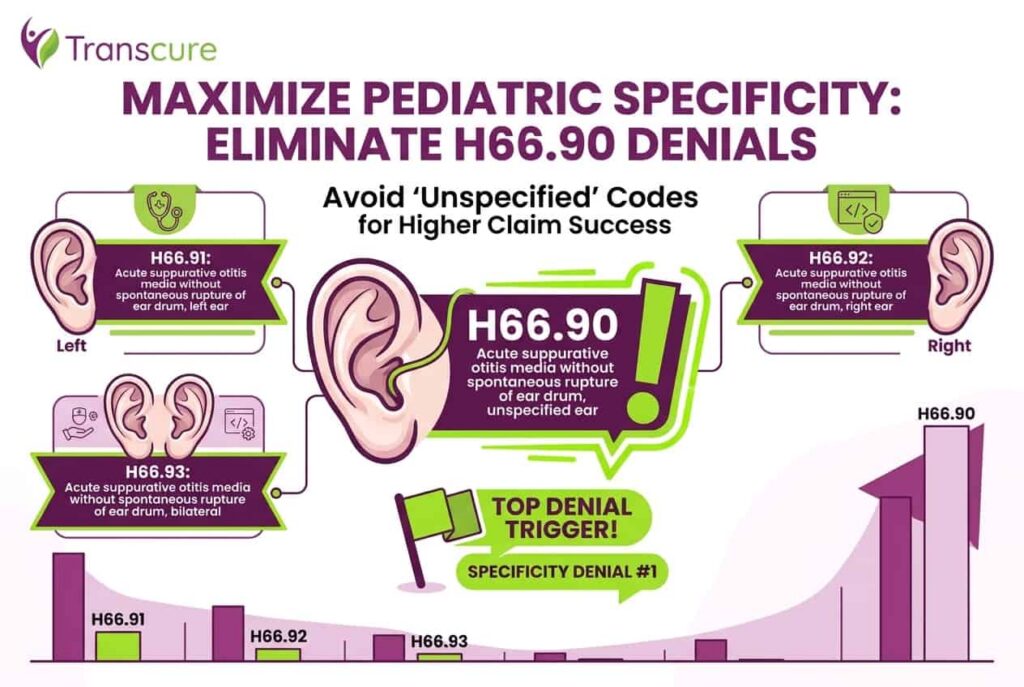
- H66.9-, otitis media, unspecified. H66.91 reports right ear, H66.92 reports left ear, H66.93 reports bilateral, and H66.90 reports unspecified ear. H66.90 is the single highest-frequency specificity denial in pediatrics, because the ear examined is always documented and rarely coded.
- J03.9-, acute tonsillitis, unspecified. J03.90 reports unspecified organism, and J03.91 reports recurrent acute tonsillitis. The recurrent designation supports tonsillectomy medical necessity later in the episode.
- J06.9, acute upper respiratory infection, unspecified. J06.9 functions as the default when no anatomic site is documented, and functions as a medical-necessity risk when procedures are attached.
Gastrointestinal Codes for Pediatric Acute Visits
- A08.-, viral and other specified intestinal infections. A08.0 reports rotaviral enteritis, A08.11 reports acute gastroenteropathy due to Norwalk agent, and A08.4 reports unspecified viral intestinal infection.
- A09, infectious gastroenteritis and colitis, unspecified. A09 applies when infection is documented without organism identification.
- K59.0-, constipation. K59.00 reports unspecified constipation, K59.01 reports slow transit constipation, K59.02 reports outlet dysfunction, K59.03 reports drug-induced constipation, and K59.04 reports chronic idiopathic constipation. K59.04 supports repeat visits that K59.00 does not.
Skin and General Infectious Codes
- L20.9, atopic dermatitis, unspecified. L20.9 applies when the dermatitis subtype is not documented. L20.83 reports infantile atopic dermatitis and carries stronger pediatric specificity.
- B34.9, viral infection, unspecified. B34.9 functions as a last-resort code and attracts medical-necessity review when paired with testing or imaging.
- B08.-, other viral infections with skin and mucous membrane lesions. B08.4 reports enteroviral vesicular stomatitis with exanthem, commonly documented as hand, foot, and mouth disease. B08.5 reports enteroviral vesicular pharyngitis, commonly documented as herpangina.
Does an Unspecified Acute Code Trigger a Denial?
Not automatically. An unspecified code triggers a medical-necessity review, and the review outcome depends on the services attached to the code. A single office visit billed with J06.9 pays without friction in most payer contracts. The same J06.9 attached to imaging, a specialist referral, or an extended visit level draws a CO-50 medical-necessity denial, because the unspecified code fails to justify the intensity of the service.
The operational rule is proportionality. Unspecified codes carry acceptable risk on low-intensity claims and unacceptable risk on high-intensity claims.
Which ICD-10 Codes Cover Growth, Nutrition, and Development?
Growth and nutrition codes come in Chapter 18 (R-codes) and Chapter 4 (E-codes), supported by Chapter 21 BMI percentile codes. The following table separates the four families that pediatric practices report most often.
| Code | Descriptor | Clinical Anchor | Sequencing Role |
|---|---|---|---|
| R62.51 | Failure to thrive (child) | Weight or growth velocity below expected for age | Primary diagnosis |
| R62.52 | Short stature (child) | Height below expected for age without failure to thrive | Primary diagnosis |
| R62.50 | Unspecified lack of expected normal physiological development | Developmental concern without a named delay | Primary diagnosis |
| R63.31 | Pediatric feeding disorder, acute | Feeding disturbance under 3 months duration | Primary diagnosis |
| R63.32 | Pediatric feeding disorder, chronic | Feeding disturbance of 3 months or longer | Primary diagnosis |
| Z68.51 to Z68.54 | Body mass index pediatric, by percentile | Plotted BMI percentile for age, ages 2 to 20 | Secondary only |
R62.51 Failure to Thrive Versus R62.52 Short Stature
R62.51 reports failure to thrive in a child, defined by inadequate weight gain or growth velocity relative to age-based expectation. R62.52 reports short stature in a child, defined by height below expectation without the weight and nutritional component. The two codes describe different growth axes and are not interchangeable.
R62.51 excludes P92.6, failure to thrive in a newborn, and excludes R62.7 for adult failure to thrive. Detailed sequencing and documentation requirements sit in the failure to thrive ICD-10 codes guide.
R63.3- Pediatric Feeding Disorder, Acute Versus Chronic
R63.31 reports acute pediatric feeding disorder and R63.32 reports chronic pediatric feeding disorder, separated by a 3-month duration threshold. R63.30 reports unspecified feeding difficulty and R63.39 reports other feeding difficulties. The duration statement in the chart determines the fourth and fifth characters, which makes onset date documentation the controlling element. Coding detail for each subcategory sits in the pediatric feeding disorder ICD-10 codes guide.
E66.- Childhood Obesity With Z68.51 to Z68.54 Percentile Codes
E66.- reports the obesity diagnosis and Z68.5- reports the measured BMI percentile as a secondary code. E66.09 reports other obesity due to excess calories, E66.3 reports overweight, and E66.9 reports unspecified obesity. The pediatric BMI percentile codes apply to patients aged 2 through 20 years.
| BMI Code | Percentile Range for Age | Common Clinical Pairing |
|---|---|---|
| Z68.51 | Less than 5th percentile | R62.51 or underweight assessment |
| Z68.52 | 5th to less than 85th percentile | Z00.129 routine examination |
| Z68.53 | 85th to less than 95th percentile | E66.3 overweight |
| Z68.54 | Greater than or equal to 95th percentile | E66.09 or E66.9 obesity |
The BMI percentile code carries risk-adjustment and quality-measure weight, which makes the secondary code operationally valuable even without direct payment. Full pairing logic sits in the childhood obesity ICD-10 codes guide.
Which ICD-10 Codes Cover Pediatric Behavioral & Mental Health?
Pediatric behavioral health coding centers on four families: ADHD subtypes under F90.-, autism spectrum disorder under F84.0, unspecified behavioral disorders under F98.9, and psychosocial circumstances under Z62.-. The table below sets each code against its documentation anchor.
| Code | Descriptor | Documentation Anchor |
|---|---|---|
| F90.0 | ADHD, predominantly inattentive type | Inattention criteria met, hyperactivity criteria not met |
| F90.1 | ADHD, predominantly hyperactive impulsive type | Hyperactivity and impulsivity criteria met |
| F90.2 | ADHD, combined type | Both symptom clusters documented |
| F90.9 | ADHD, unspecified type | Diagnosis stated without subtype |
| F84.0 | Autistic disorder | Formal diagnostic evaluation documented |
| F98.9 | Unspecified behavioral and emotional disorder with onset in childhood | Behavioral concern without diagnostic criteria met |
| Z62.820 | Parent-biological child conflict | Documented relational conflict affecting care |
F90.- ADHD Subtypes
F90.- separates ADHD into inattentive, hyperactive-impulsive, combined, other, and unspecified presentations. F90.2 for combined type carries the highest claim volume. The subtype character requires a documented symptom cluster, and a rating scale result alone does not establish the subtype without a provider statement.
F84.0 Autism Spectrum Disorder
F84.0 reports autistic disorder and functions as the primary autism spectrum code in ICD-10-CM. F84.0 supports applied behavior analysis authorization in most state Medicaid programs and most commercial contracts. Payers commonly require the evaluation instrument name and date in the authorization packet, which makes the diagnostic report a billing document rather than a clinical one.
F98.9 Unspecified Behavioral Disorder and When Not to Use It
F98.9 reports an unspecified behavioral and emotional disorder with childhood onset. F98.9 applies during evaluation, before diagnostic criteria are met. F98.9 does not apply after a specific diagnosis is established, and does not support ongoing therapy authorization. Carrying F98.9 forward across multiple sessions is the most frequent cause of behavioral health authorization denials in pediatrics.
Z62.820 Parent-Child Relational Problem
Z62.820 reports parent-biological child conflict. The related codes Z62.821 and Z62.822 report adopted child and foster child conflict. These codes document the relational context that shapes the treatment plan, and they sequence as secondary diagnoses behind the clinical code.
Which ICD-10 Codes Cover Chronic Pediatric Conditions?
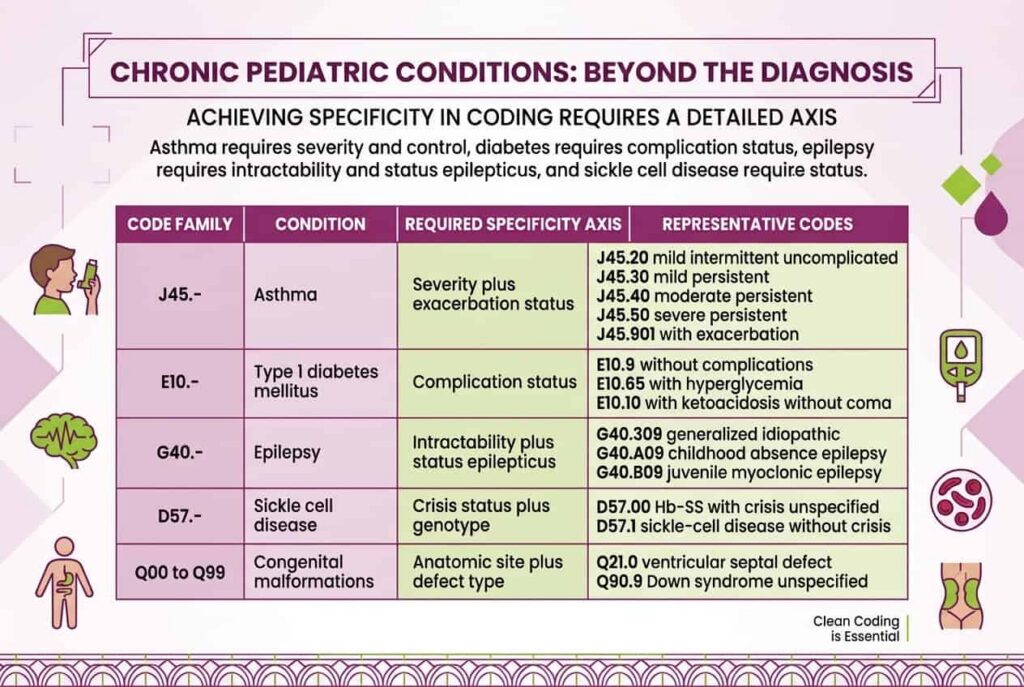
Chronic pediatric conditions require an axis of specificity beyond the diagnosis name. Asthma requires severity and control, diabetes requires complication status, epilepsy requires intractability and status epilepticus, and sickle cell disease requires crisis status. The following table shows the required axis for each family.
| Code Family | Condition | Required Specificity Axis | Representative Codes |
|---|---|---|---|
| J45.- | Asthma | Severity plus exacerbation status | J45.20 mild intermittent uncomplicated, J45.30 mild persistent, J45.40 moderate persistent, J45.50 severe persistent, J45.901 with exacerbation |
| E10.- | Type 1 diabetes mellitus | Complication status | E10.9 without complications, E10.65 with hyperglycemia, E10.10 with ketoacidosis without coma |
| G40.- | Epilepsy | Intractability plus status epilepticus | G40.309 generalized idiopathic, G40.A09 childhood absence epilepsy, G40.B09 juvenile myoclonic epilepsy |
| D57.- | Sickle cell disease | Crisis status plus genotype | D57.00 Hb-SS with crisis unspecified, D57.1 sickle-cell disease without crisis |
| Q00 to Q99 | Congenital malformations | Anatomic site plus defect type | Q21.0 ventricular septal defect, Q90.9 Down syndrome unspecified |
Asthma produces the highest chronic-condition denial volume in pediatrics, because the severity axis and the exacerbation axis are documented in separate parts of the note. The severity classification sits in the assessment, and the exacerbation status sits in the history of present illness, and coders reading only one section select an incomplete code.
Which Pediatric ICD-10 Errors Cause the Most Denials?
Four claim adjustment reason codes account for the majority of pediatric diagnosis-driven denials. Each maps to a specific pediatric root cause rather than a general coding failure.
| CARC | Denial Reason | Pediatric Root Cause | Corrective Action |
|---|---|---|---|
| CO-11 | Diagnosis inconsistent with the procedure | Z00.12- reported with a problem-oriented E/M without a preventive code, or Z23 reported without a vaccine product code | Rebuild the diagnosis-to-procedure pairing before submission |
| CO-16 | Claim lacks information or has submission errors | H66.90 unspecified laterality, or Z00.121 submitted without the secondary finding code | Add the laterality character or the required additional diagnosis |
| CO-50 | Not deemed a medical necessity | Unspecified acute codes such as J06.9 or B34.9 attached to imaging, testing, or higher-level visits | Replace the unspecified code with documented specificity |
| PR-96 | Non-covered charge | Preventive service billed past the payer’s periodicity interval, or Z00.12- billed for a patient aged 18 or older | Verify age and periodicity eligibility at scheduling |
CO-16 and CO-50 respond to documentation template changes rather than coder retraining. CO-11 and PR-96 respond to front-end eligibility and scheduling controls, because both denials originate before the encounter begins. Practices with recurring diagnosis-related denials may also use medical coding support services to review documentation, code specificity, and diagnosis-to-procedure alignment.
Frequently Asked Questions About Pediatric ICD-10 Codes
Can Z00.129 be Used for an 18-Year-Old Patient?
No. Z00.129 applies through age 17. Patients aged 18 and older require Z00.00 for a general adult medical examination without abnormal findings, or Z00.01 with abnormal findings.
Does Z23 Need to be Listed First on a Well Visit Claim?
No. Z23 sequences as a secondary diagnosis when immunizations are administered during a preventive examination. Z23 sequences first only when immunization is the sole reason for the encounter.
What ICD-10 Code Reports Failure to Thrive in a Child?
R62.51 reports failure to thrive in a child aged 28 days and older. P92.6 reports failure to thrive in a newborn under 28 days of age.
Are Pediatric BMI Codes Reported as Primary Diagnoses?
No. Z68.51 through Z68.54 are secondary diagnoses only. Each requires an associated provider-documented diagnosis such as E66.09, E66.3, or R62.51.
Which Pediatric Code Causes the Most Specificity Denials?
H66.90, otitis media with unspecified laterality, generates the highest volume of CO-16 specificity denials in pediatrics. The examining provider documents the affected ear in nearly every case.