HCPCS code L1832 describes a prefabricated knee orthosis with adjustable joints and rigid support, customized to fit a specific patient by an individual with expertise. It is the custom-fitted half of a two-code pair.
L1832 and its off-the-shelf twin L1833 describe the same physical brace. What separates them is who fitted it, and that single fact decides the payment, the delivery method, and the documentation the claim needs.
The pre-claim gap between the two codes is closing. L1833 returns to required prior authorization nationwide on October 28, 2026, so the fitting record, not the authorization burden, is now what separates a clean claim from an audit finding. Keeping that record aligned with the code billed is routine work for orthopedic billing and coding teams.
What Is the Description of HCPCS Code L1832?
The L1832 HCPCS code descriptor as defined by CMS is: “Knee orthosis (KO), adjustable knee joints (unicentric or polycentric), positional orthosis, rigid support, prefabricated item that has been trimmed, bent, molded, assembled, or otherwise customized to fit a specific patient by an individual with expertise.”
This code reports a stock rigid knee brace that a qualified individual has customized for a specific patient. HCPCS code L1832 is prefabricated, not custom fabricated, so the device begins as a manufactured product rather than a device built from a patient model. Like every HCPCS Level II orthotic code in the L-series, it is billed to the DME MAC rather than the Part B contractor that pays the treating practitioner.
The customization is what the code pays for. L1832 and L1833 describe identical hardware, and only the fitting work performed at delivery separates them.
What Device Does HCPCS Code L1832 Represent?
HCPCS code L1832 represents a rigid knee orthosis with adjustable joints that holds the knee in a controlled position. The descriptor names its features directly, and each one excludes a neighboring code.
The features that define the device are:
- Adjustable knee joints, either unicentric or polycentric, which separate it from jointless rigid braces and canvas immobilizers
- A positional orthosis design, meaning it holds the knee at a set position or within a set range rather than simply compressing it
- Rigid support, which separates it from elastic knee orthoses with joints
- A prefabricated build, customized at delivery rather than molded to a patient model
The descriptor does not specify an upright configuration. Single-upright and double-upright thigh-and-calf designs with medial-lateral and rotation control have their own codes, described below, so the device’s construction has to match the L1832 descriptor before the fitting question even arises.
What Qualifies as Custom Fitting by an Individual With Expertise?
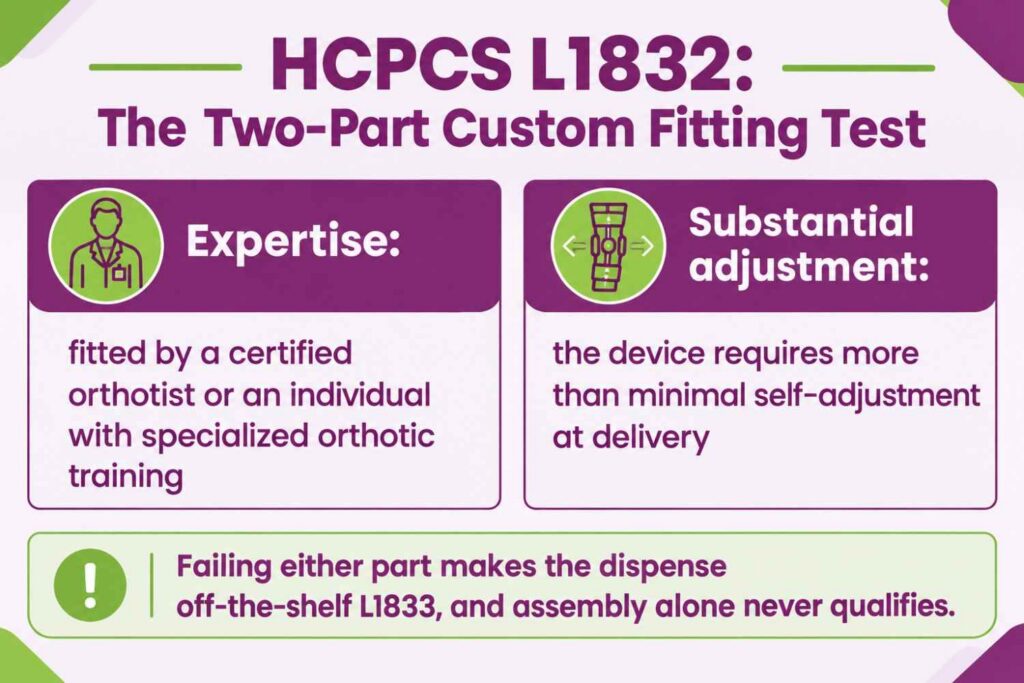
Custom fitting under HCPCS code L1832 is a two-part test, and both parts must be satisfied. Failing either one classifies the item as off-the-shelf, which means L1833.
The two-part test requires:
- Expertise: the fitting must be performed by a certified orthotist or an individual with specialized training in orthotics
- Substantial adjustment: the device must require more than minimal self-adjustment at the time of delivery
Both elements are necessary. A certified orthotist who hands over a brace requiring only strap tightening has not custom fitted it, and substantial adjustment performed by someone without orthotic training does not qualify either. The record must establish both halves.
Why Assembly Alone Does Not Make a Brace Custom Fitted
The word “assembled” appears in the L1832 descriptor, which misleads suppliers into thinking that assembling a brace qualifies it as custom fitted. It does not.
The DME MAC correct-coding guidance is explicit:
- Assembly of the item does not change the classification from off-the-shelf to custom fitted
- Installation of add-on components does not change the classification
- Use of basic materials in preparation for delivery does not change the classification
- Some products are supplied as a kit requiring assembly, and assembling that kit is still an off-the-shelf dispense
Reading “assembled” in the descriptor as permission to bill HCPCS code L1832 for routine assembly is a common and expensive error. The descriptor lists customization methods, and the governing standard is whether more than minimal self-adjustment was required by someone with expertise.
How Does L1832 Differ From the Off-the-Shelf Twin L1833?
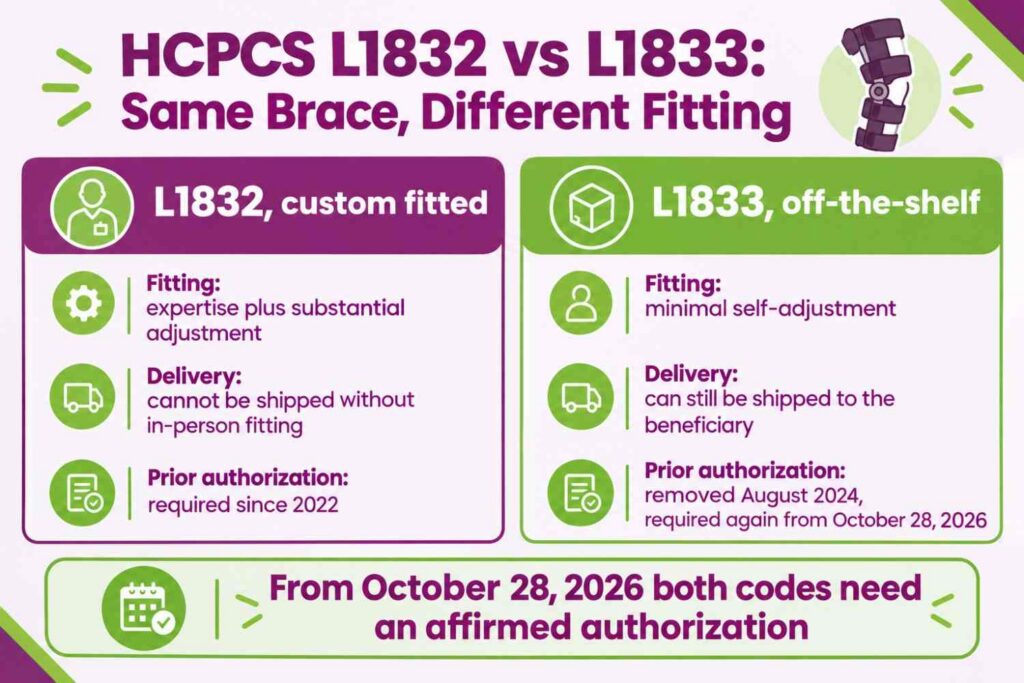
L1832 and its off-the-shelf twin L1833 describe the same physical brace. The fitting performed at delivery is the only thing that separates them, and the rules attached to each code have shifted twice since 2022.
The two codes compare as follows:
- L1832 has required prior authorization, a face-to-face encounter, and a written order prior to delivery since the 2022 rollout
- L1833 was removed from the prior authorization list on August 12, 2024, and returns to it nationwide on October 28, 2026, with the written order and face-to-face examination required in the request package
- L1832 pays $698.63 to $931.51 by state, while L1833 pays $455.16 to $556.31 in non-rural areas and $627.47 to $743.90 in rural ZIP codes
- L1832 cannot be shipped without prior in-person fitting, while L1833 can still be shipped to the beneficiary
For the window between August 2024 and October 2026, the two codes sat on opposite sides of every pre-claim requirement. From October 28, 2026, both need an affirmed authorization, so the lasting differences are payment, delivery method, and the fitting record that justifies the code.
How Does L1832 Differ From Custom-Fabricated Knee Orthoses and the Other Custom-Fitted Codes (L1810, L1820, L1843, L1845, L1847)?
The knee orthosis family divides by device construction, rigidity, and upright configuration. Custom fitted and custom fabricated are different categories entirely.
The related codes break down as follows:
- L1810 elastic knee orthosis with joints, prefabricated, custom fitted, a soft device rather than a rigid one
- L1820 elastic knee orthosis with condylar pads and joints, with or without patellar control, prefabricated, includes fitting and adjustment
- L1832 adjustable knee joints, positional orthosis, rigid support, prefabricated, custom fitted
- L1843 single upright, thigh and calf, adjustable flexion and extension joint, custom fitted
- L1845 double upright, thigh and calf, adjustable flexion and extension joint, custom fitted
- L1847 double upright, adjustable joint with inflatable air support chamber, custom fitted
Custom fabrication is a separate category. L1834 describes a rigid knee orthosis without a joint, molded to a model of the patient, which is a construction method rather than a fitting classification. Its prefabricated counterpart, L1836, is a rigid jointless knee orthosis supplied off the shelf, so neither belongs in the adjustable-joint pair that L1832 sits in.
These codes make up one corner of the HCPCS bracing and supply codes for orthopedic practices a bracing practice bills, and the descriptor elements above decide which one applies before any fitting decision is made.
Why L1832 Requires Prior Authorization, a Face-to-Face Encounter, and a Written Order Before Delivery
HCPCS code L1832 sits on the Required Prior Authorization List, and it has for years. The requirement arrived through a phased rollout rather than all at once.
The rollout history and current status are:
- April 13, 2022 for New York, Illinois, Florida, and California
- July 12, 2022 for twelve additional states
- Nationwide since October 10, 2022
- The code remains on the Required Prior Authorization List as of the July 29, 2026 update, with face-to-face encounter and written order prior to delivery also required
This is settled policy, not a new burden, and the list has grown around it. Knee orthoses L1843 and L1845 joined in August 2024, L1844, L1846, and L1852 in April 2026, and L1833 rejoins on October 28, 2026. A supplier who dispenses L1832 without an affirmed prior authorization decision has no path to payment, since prior authorization is a condition of payment for this code.
What ICD-10 Codes and Medical Necessity Criteria Support HCPCS Code L1832?
Medical necessity for HCPCS code L1832 rests on documented knee instability or a qualifying contracture under LCD L33318. The physical examination is the coverage gate.
The coverage criteria and representative diagnoses include:
- Objective knee instability supported by a physical examination naming the specific joint laxity tests performed
- Knee flexion or extension contracture meeting the LCD definitions
- M23.5 codes for chronic instability of the knee and M24.56 for contracture of the knee
- Ligament injury and instability codes, closed fracture codes for the initial encounter, and meniscus tear codes
- Z47.89 and related aftercare codes for post-surgical stabilization
The record should also explain why a simpler device would not serve. Documenting that an elastic sleeve or non-rigid brace is insufficient for this patient strengthens the claim, and generic instability language without named laxity tests does not meet the standard.
These diagnoses sit within the wider musculoskeletal injury and instability codes for knee injury and instability, where laterality and encounter characters must match the side braced and the stage of care.
Which Codes Are Billed Alongside L1832, and Which Are Not Separately Payable?
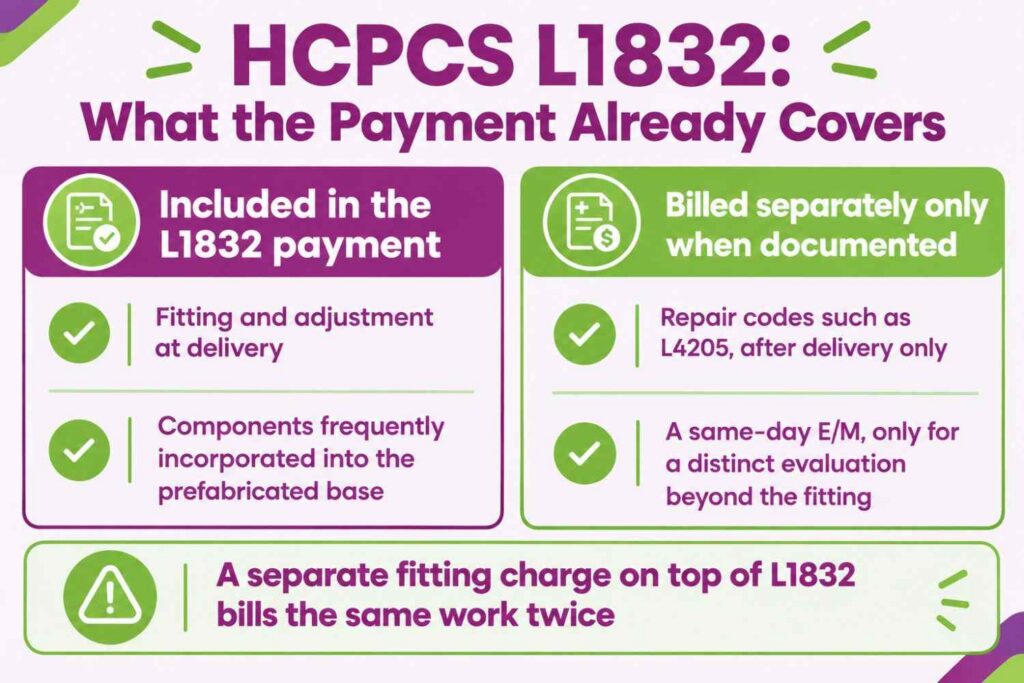
HCPCS code L1832 describes a complete prefabricated device, so most accompanying work is included in the payment. Additional codes are the recurring error.
The companion-code rules are:
- Fitting and adjustment at delivery are inside the L1832 payment and are not separately reportable
- Components frequently incorporated into the prefabricated base are not separately payable as additions
- Repair codes such as L4205 apply after delivery, not at the initial dispense
- A same-day evaluation and management service is separately billable only when a distinct, documented evaluation occurred beyond the brace fitting
The custom fitting work is what L1832 already pays for relative to L1833. Billing a separate fitting or training charge on top of the custom-fitted code claims payment for the same work twice.
The procedures that most often lead to a custom-fitted knee brace, such as ligament reconstruction and knee arthroscopy, are billed under the orthopedic surgery procedure codes on the surgeon’s claim. The brace claim stands on its own, but the operative note is frequently the record that documents the post-surgical instability.
What Are the Modifiers for HCPCS Code L1832?
HCPCS code L1832 requires a coverage attestation and laterality on every line, and it carries one modifier unique to prior-authorization codes.
Modifier KX: Coverage Criteria in LCD L33318 Are Met
Modifier KX attests that the coverage criteria in LCD L33318 are met and documented. Append KX to HCPCS code L1832 when the record supports objective instability or a qualifying contracture. A covered claim missing KX is denied.
Modifiers RT and LT: One Unit Per Limb on Separate Claim Lines
Modifiers RT and LT identify the right and left limb. Bill L1832 as one unit per limb on separate claim lines, never as modifier 50 and never as RTLT on one line. A bilateral fitting is two lines, each with one unit and its matching laterality modifier.
Modifier NU: New Equipment Purchase
Modifier NU identifies the purchase of new equipment. Append NU to HCPCS code L1832 when dispensing a new brace, since orthoses are purchased rather than rented. The modifier confirms the item is new at the time of the claim.
Modifier ST: Expedited Delivery in an Acute or Emergent Situation
Modifier ST indicates an acute or emergent need where the standard prior authorization timeline would delay care. Practitioners have three options on a prior-authorization code: the regular review process, an expedited review, or the ST modifier. Modifier ST does not avoid scrutiny, because claims for these codes billed with ST are subject to 50 percent prepayment review for dates of service on or after January 1, 2024. This is reduced from the 100 percent prepayment review that applied earlier.
Modifier GA: ABN on File for an Expected Medical-Necessity Denial
Modifier GA reports that an Advance Beneficiary Notice of Noncoverage is on file for an expected medical-necessity denial. Append GA to L1832 when the coverage criteria may not be met, and the patient accepted liability in writing before delivery.
Modifier GZ: No ABN, Denial Expected as Not Medically Necessary
Modifier GZ reports an expected medical-necessity denial with no ABN on file. Append GZ to HCPCS code L1832 when necessity is doubtful and no waiver was obtained. The line denies with supplier liability.
Modifier RA: Replacement Due to Loss, Theft, or Irreparable Damage
Modifier RA reports the replacement of an item. Append RA to L1832 when replacing a brace lost, stolen, or irreparably damaged, or when the prior brace has passed its reasonable useful lifetime. The record must document the reason.
Which Documents Are Required For HCPCS Code L1832?
Documentation for HCPCS code L1832 must carry the pre-claim requirements and prove the custom fitting occurred. The fitting record is the only evidence separating this code from L1833.
The required documentation includes:
- An affirmed prior authorization decision with its unique tracking number
- Documentation of the face-to-face encounter with the treating practitioner
- A written order received before the brace is delivered
- A physical examination documenting objective instability and the specific laxity tests performed
- The orthotist’s record describing how the device was trimmed, bent, molded, or otherwise customized
- Evidence of the fitter’s credentials or specialized orthotic training
- Proof of delivery with the date, item description, and recipient signature
What Is the Cost of HCPCS Code L1832?
HCPCS code L1832 is paid through the DMEPOS fee schedule as a purchased orthotic device. The amount varies by state within a national floor and ceiling.
DMEPOS Fee Schedule Payment for L1832
Medicare prices HCPCS code L1832 by state, and the 2026 allowable runs from $698.63 to $931.51. The floor and ceiling are national, and each state sits somewhere between them.
| State Example | 2026 Allowable |
|---|---|
| TX, WA, OR, CO, ID (floor states) | $698.63 |
| DC, DE, MD, PA, VA, WV | $812.69 |
| AK | $815.09 |
| AZ, CA, NV | $834.24 |
| IL, IN, MI, MN, OH, WI | $846.51 |
| HI | $871.59 |
| CT, MA, ME, NH, RI, VT | $912.19 |
| AL, FL, GA, KY, MS, NC, NJ, NY, SC, TN (ceiling states) | $931.51 |
The 2026 amounts reflect a 2.0 percent increase over 2025, when the range ran from $684.93 to $913.24. Medicare pays 80 percent of the allowable after the Part B deductible, roughly $559 to $745, leaving the patient about $140 to $186 in coinsurance. A sequestration reduction applies to the Medicare share.
Why the Payment Differential From L1833 Creates Bidirectional Audit Exposure
L1832 pays more than L1833 in every non-rural area, and both directions of miscoding are misrepresentations. The supplier’s fitting record is the only evidence distinguishing two identical devices.
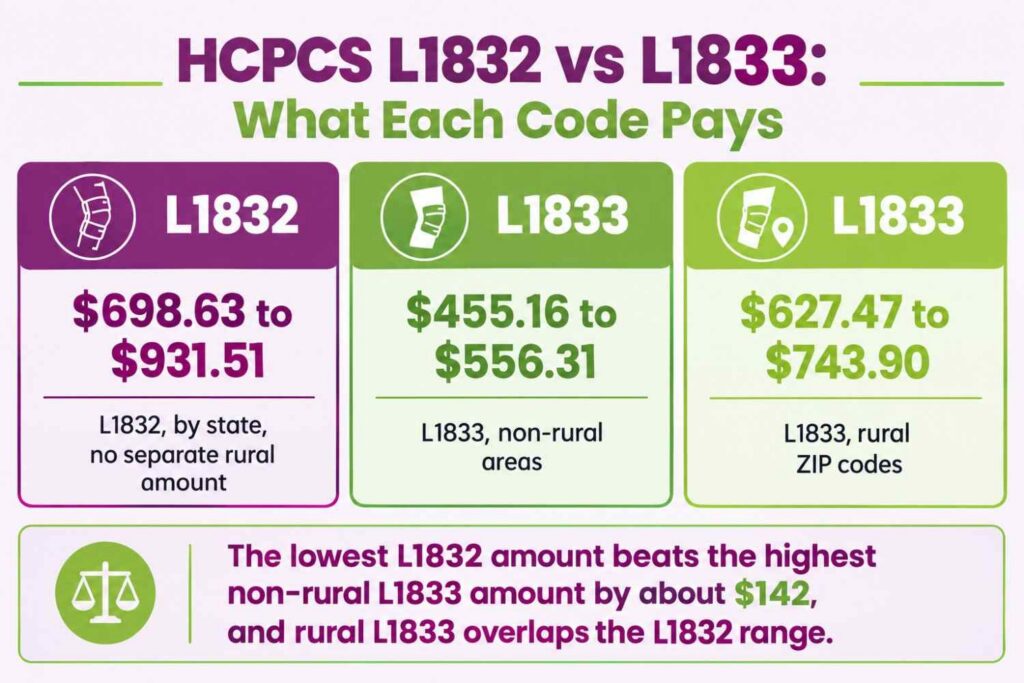
The payment comparison works as follows:
- L1832 pays $698.63 to $931.51 by state, with no separate rural amount
- L1833 pays $455.16 to $556.31 in non-rural areas, so the lowest L1832 amount exceeds the highest non-rural L1833 amount by about $142
- L1833 pays $627.47 to $743.90 in rural ZIP codes, which overlaps the L1832 range, so the gap narrows or disappears for rural beneficiaries
- Upcoding to L1832 claims a fitting that did not occur, along with the higher rate
Down-coding carries its own exposure. Billing L1833 when a qualified individual performed substantial customization understates the service, and before October 28, 2026, it also sidestepped an authorization requirement the custom fitting actually triggered.
The two codes update differently as well. L1832 received the 2.0 percent annual increase applied to items never subject to competitive bidding, while L1833, a former competitive bidding item, is paid under the gap-period methodology, with rural amounts blended from adjusted and unadjusted fees.
Commercial Payers and Medicaid Coverage
Commercial and Medicaid plans apply their own knee orthosis rules, and several differ from Medicare in ways that matter at the point of dispense.
Coverage considerations include:
- Many commercial plans require prior authorization for rigid knee orthoses regardless of the code billed
- Plan definitions of custom fitted may not track the Medicare two-part test
- Some payers accept CAD/CAM-produced orthoses as custom fitted when the final fitting at delivery requires substantial modification by a qualified practitioner, which is a commercial-policy position rather than a Medicare rule
- Medicaid programs vary by state on coverage, frequency, and whether the custom-fitted code is payable at all
Patient Financial Responsibility and Advance Beneficiary Notice Workflows
The patient owes 20 percent coinsurance on a covered HCPCS code L1832 claim, which is a meaningful amount on a brace in this price range. An ABN protects the supplier when coverage is doubtful.
The patient-cost rules are:
- Coinsurance runs roughly $140 to $186 depending on the state allowable
- Where the coverage criteria may not be met, obtain a signed ABN before delivery and append modifier GA
- Without an ABN, modifier GZ applies and the supplier absorbs the cost of the brace
- A non-affirmed prior authorization decision is not a denial, so the correct response is to correct and resubmit rather than to bill the patient
What Are Example Clinical Scenarios or Use Cases for HCPCS Code L1832?
HCPCS code L1832 appears in affirmed authorizations, resubmissions, expedited delivery, the coding fork, and replacements. The scenarios below show each.
Scenario 1: Post-Operative Knee Instability Requiring a Custom-Fitted Rigid Brace With an Affirmed Prior Authorization
ICD-10: M23.51 (Chronic instability of knee, right knee)
A patient with post-operative knee instability needs a rigid brace with adjustable motion stops. The physical examination documents the specific laxity tests performed and the objective findings. The supplier submits a prior authorization request and receives an affirmed decision with a unique tracking number. A certified orthotist then trims and molds the brace to the patient’s anatomy at an in-person fitting. The claim reports HCPCS code L1832 with modifiers KX, RT, and NU, referencing the tracking number.
Scenario 2: Non-Affirmed Prior Authorization Decision and Resubmission Before Delivery
ICD-10: M23.52 (Chronic instability of knee, left knee)
A supplier submits a prior authorization request that returns non-affirmed because the physical examination did not name the laxity tests performed. The brace has not been delivered, and a non-affirmed decision is not a claim denial. The supplier obtains a corrected examination record documenting the specific tests and findings, then resubmits the request. Once the decision is affirmed, the orthotist fits the brace, and the claim goes out with L1832 and the new tracking number.
Scenario 3: Acute Presentation Requiring Expedited Delivery Under Modifier ST
ICD-10: S83.511A (Sprain of anterior cruciate ligament of right knee, initial encounter)
A patient presents with an acute ligament injury where waiting for the standard authorization review would delay necessary care. The practitioner elects the ST modifier route rather than the standard or expedited review. The orthotist performs the in-person custom fitting, and the claim reports HCPCS code L1832 with modifier ST alongside KX, RT, and NU. The supplier should expect scrutiny, since claims billed with ST are subject to 50 percent prepayment review.
Scenario 4: Brace Dispensed With Only Strap Adjustment, Why the Claim Belongs Under L1833
ICD-10: M23.51 (Chronic instability of knee, right knee)
A patient receives the same rigid brace, and staff tighten the straps and confirm the fit without any trimming, bending, or molding. Strap adjustment is minimal self-adjustment, so the two-part custom fitting test fails on the substantial-adjustment element. The correct code is L1833, not HCPCS code L1832. Billing the custom-fitted code here would claim at least $142 more than the non-rural L1833 amount, for fitting work that never occurred.
Scenario 5: Replacement After the Five-Year Reasonable Useful Lifetime
ICD-10: M23.51 (Chronic instability of knee, right knee)
A patient who received a custom-fitted rigid knee brace more than five years earlier needs a replacement, and the original has reached the end of its reasonable useful lifetime. The supplier obtains a new prior authorization, performs a new in-person custom fitting, and reports L1832 with modifier RA plus the laterality and coverage modifiers. The documentation records that the five-year lifetime has passed, which distinguishes this from a loss or damage replacement.
What Are the HCPCS Code L1832 Rules To Ensure Successful Reimbursement?
Follow the prior authorization workflow, the in-person fitting requirement, the fitting documentation standard, the addition-code rules, and the unit limits. Meeting these rules protects HCPCS code L1832 claims from denial and recoupment.
The Prior Authorization Workflow From Submission to Unique Tracking Number
Prior authorization is a condition of payment for HCPCS code L1832, so the sequence runs before delivery rather than after. The unique tracking number ties the decision to the claim.
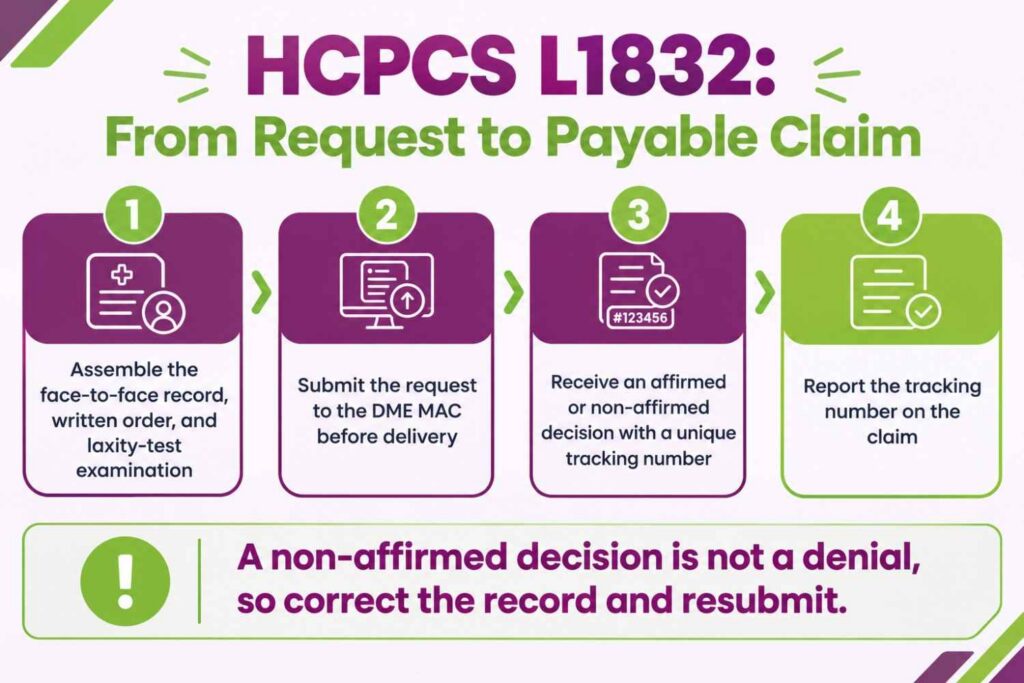
The workflow steps are:
- Assemble the face-to-face encounter record, the written order, and the physical examination documenting laxity tests
- Submit the prior authorization request to the DME MAC before the brace is delivered
- Receive the decision, which returns either affirmed or non-affirmed, and carries a unique tracking number
- Report that tracking number on the claim, since a claim without an affirmed decision has no payment path
- A non-affirmed decision permits unlimited resubmission with corrected documentation, and it is not a denial
Why L1832 Cannot Be Mailed or Shipped Without In-Person Fitting
Custom-fitted items cannot be mailed or shipped to the beneficiary without prior custom fitting. This is an absolute operational constraint rather than a documentation preference.
The delivery rules are:
- The custom fitting must occur in person before the device reaches the beneficiary
- A drop-ship workflow that is compliant for L1833 is non-compliant for HCPCS code L1832
- Shipping the brace and instructing the patient to adjust it is by definition minimal self-adjustment, which is L1833
- The delivery record must show the in-person fitting and the date it occurred
Documentation the Orthotist Must Keep Describing How the Device Was Fitted
The fitting record is the evidentiary core of an L1832 claim. A generic statement that the brace was fitted does not distinguish it from an off-the-shelf dispense.
The fitting documentation should capture:
- The specific customization performed, such as trimming, bending, molding, or reshaping components
- Why that customization was necessary for this patient’s anatomy
- The credentials of the individual who performed the fitting, whether a certified orthotist or a person with specialized orthotic training
- The date and setting of the in-person fitting
- Confirmation that the device required more than minimal self-adjustment
Which Addition Codes Are Bundled Into the L1832 Base and Which Are Separately Billable
The LCD groups addition codes into categories relative to base codes, and components already built into the prefabricated device are not separately payable.
The addition-code rules are:
- Components frequently incorporated into the prefabricated L1832 base are not separately billable
- Fitting and adjustment at delivery are part of the base payment on a custom-fitted code
- Only additions representing a distinct, separately payable component under the LCD may be billed alongside the base
- Verify the LCD addition-code grouping before billing any addition with HCPCS code L1832
Units, Bilateral Billing, and Same or Similar Equipment Denials
HCPCS code L1832 is billed as one unit per limb, and an existing comparable brace on file triggers denial. Both checks belong before the fitting appointment.
The unit and same-or-similar rules are:
- Report one unit per limb, with RT on one line and LT on the other for a bilateral fitting
- Never combine both limbs on a single line or substitute a bilateral modifier
- Check the beneficiary’s equipment history before dispensing, since a comparable knee orthosis still within its five-year lifetime triggers a same-or-similar denial
- A replacement within five years requires a qualifying reason such as loss, theft, or irreparable damage, reported with modifier RA
Top Reasons For Denials Specific To L1832 & Quick Remedies
- No Affirmed Prior Authorization on File: Prevent by submitting the request and receiving an affirmed decision before delivery, then reporting the unique tracking number on the claim.
- Custom-Fitted Code Billed for an Off-the-Shelf Dispense: Prevent by applying the two-part test, since strap adjustment or simple assembly means L1833, not HCPCS code L1832.
- Missing or Generic Instability Documentation: Prevent by naming the specific joint laxity tests performed and recording the objective findings in the physical examination.
- Brace Shipped Without In-Person Fitting: Prevent by completing the custom fitting in person before delivery, since a custom-fitted item cannot be mailed to the beneficiary.
- Same or Similar Equipment on File: Prevent by checking the equipment history and documenting a qualifying replacement reason with modifier RA when the five-year lifetime has passed.
- Missing KX or Laterality: Prevent by appending KX when the LCD L33318 criteria are met and billing one unit per limb with RT or LT on separate lines.