CPT code 63047 reports lumbar laminectomy, facetectomy, and foraminotomy that decompress one vertebral segment. Neurosurgeons and orthopedic spine surgeons use it often for lumbar stenosis with neurogenic claudication. Add-on +63048 reports each additional segment, but mixing segment and interspace counts creates errors.
The CMS Physician Fee Schedule assigns CPT 63047 a 2026 work RVU of 14.99. Medicare’s approximately $1,065 payment is the physician’s facility-setting fee, not hospital or ASC reimbursement. NCCI procedure-to-procedure edits bundle 63047 into fusions 22630 and 22633 at the same interspace.
Reporting +63052 for same-level decompression, or modifier 59 elsewhere, keeps spinal fusion claims compliant. Accurate documentation of laterality, segments, and all three components prevents denials and protects revenue.
Our neurosurgery billing services help spine practices prevent these denials before claims are submitted. Transcure’s guide explains the description, cost, scenarios, and reimbursement rules behind CPT code 63047.
What Is the Description of CPT Code 63047?
CPT code 63047 describes lumbar decompression at a single vertebral segment for spinal stenosis. The descriptor combines three components, and each one must appear in the operative note.
What Does Laminectomy, Facetectomy, and Foraminotomy Include Under CPT Code 63047?
Laminectomy removes the lamina and ligamentum flavum to open the posterior lumbar spinal canal. Facetectomy trims facet joint overgrowth that narrows the lateral recess and compresses nerve roots. Foraminotomy enlarges the neural foramen so the exiting nerve root has room to pass.
Surgeons perform these steps together to relieve spinal cord, cauda equina, or nerve compression. Operative notes must name each component because payers do not assume a facetectomy occurred.
Why CPT 63047 Is Counted by Vertebral Segment and How +63048 Adds Levels
CPT 63047 counts vertebral segments, while codes 63030 and +63035 count disc interspaces instead. A note stating laminectomy of L4 describes one segment, even when stenosis involves L4–L5.
Add-on +63048 reports each additional segment decompressed during surgery, whether cervical, thoracic, or lumbar. Two decompressed segments bill as one unit of 63047 plus one unit of +63048. Mixing two counting systems is the most common unit error on this code family.
Why Unilateral and Bilateral Decompression Are Both One Unit of 63047
Bilateral decompression of one segment is still reported as one unit of CPT 63047. The descriptor already reads unilateral or bilateral, so no separate laterality modifier is needed.
Modifier 50 does not apply, and appending it doubles the claim, inviting a denial. Operative notes should still state laterality because payers compare it against diagnosis and necessity.
How Does CPT 63047 Differ From 63030, 63005, and the 2026 Percutaneous Codes 62330 and +62331?
CPT 63030 is a laminotomy, or hemilaminectomy, for a herniated disc at one interspace. CPT 63047 is a full laminectomy with facetectomy and foraminotomy, performed for lumbar stenosis. CPT 63005 reports lumbar laminectomy for central canal decompression without documented facetectomy or foraminotomy.
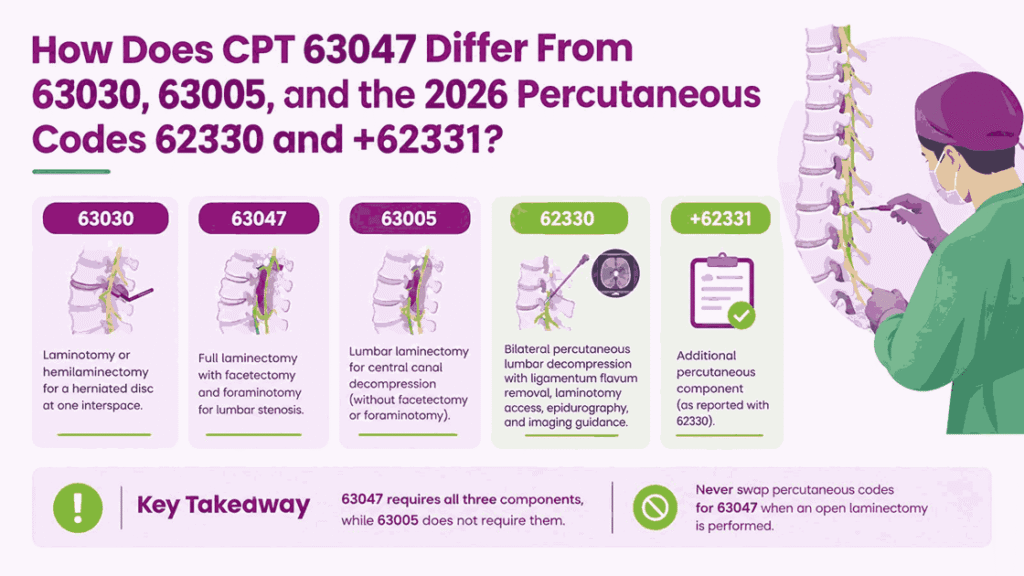
Therefore, 63047 requires documentation of all three components, while 63005 does not require them. CPT 62330 describes bilateral percutaneous lumbar decompression with ligamentum flavum removal, laminotomy access, epidurography, and imaging guidance.
Coders should never swap percutaneous codes for 63047 when surgeons perform an open laminectomy. Readers comparing spinal codes can review our neurosurgery CPT code guide for broader coverage.
When Must +63052 Be Reported Instead of CPT 63047?
Report +63052 for qualifying decompression during posterior interbody arthrodesis when documentation supports additional work. Qualifying fusions include 22630, +22632, 22633, and +22634, which are posterior lumbar interbody techniques.
Add-on +63053 reports each additional segment decompressed with interbody fusion, following the same logic. The 2026 work RVUs are 4.14 for +63052 and 3.69 for the add-on +63053. When decompression occurs alone or without posterior interbody fusion, the existing laminectomy codes apply.
Documentation must show decompression beyond what was needed to prepare the interspace for fusion. Posterolateral fusion 22612 does not trigger this replacement, so 63047 stays separately reportable there.
Which ICD-10 Codes Support Medical Necessity for CPT Code 63047?
Lumbar spinal stenosis codes split by neurogenic claudication, using M48.061 without and M48.062 with. Neurogenic claudication documentation is what most payers look for to support lumbar stenosis surgery.
Lumbar spondylolisthesis, coded M43.16, also supports decompression when instability or nerve compression is documented. Lumbar disc disorders with radiculopathy, such as M51.16, also support medical necessity for decompression.
The diagnosis must match the decompressed level, or payers may deny the entire claim. Coders should link the diagnosis to 63047 and confirm it against the operative report. Transcure’s neurosurgery ICD-10 codes guide lists diagnosis codes for stenosis, spondylolisthesis, and disc disorders.
What Are the Modifiers for CPT Code 63047?
Modifiers explain to Medicare and commercial payers why 63047 deserves payment despite bundling edits. Six modifiers appear most often on this code, and each requires operative note support.
Modifier 59 and XS: Decompression at a Different Interspace From an Interbody Fusion
NCCI edits bundle CPT 63047 into 22630 and 22633 at the same lumbar interspace. Use modifier 59 or XS only when edits permit bypass and documentation supports distinct procedural sites. Modifier XS is also valid because different spinal levels count as distinct anatomic sites. The operative note must clearly state each fusion level and each decompression level separately.
Modifier 22: Increased Procedural Services for Revision or Complex Anatomy
Modifier 22 reports increased procedural services when work is substantially greater than typically required. Revision surgery, dense scar tissue, or distorted anatomy are common reasons surgeons request it. The note must explain the extra time, effort, and complexity compared with typical cases. Payers often request the operative report and a cover letter before approving modifier 22.
Modifiers 80, 82, and AS: Assistant at Surgery
Assistants are common in open spine surgery, so these modifiers appear frequently with 63047. Modifier 80 identifies an assistant surgeon, while 82 applies when no resident is available. Modifier AS identifies non-physician assistants, such as physician assistants and nurse practitioners, during surgery. Confirm the MPFSDB assistant-at-surgery indicator for 63047 and +63048 before billing any assistant claim.
Modifier 58: Staged Procedure During the Global Period
Modifier 58 reports a staged procedure by the same surgeon during the global period. A planned second-stage decompression after an earlier spine procedure is a typical example here. The stage must be planned at the original surgery, and notes should say so. Medicare treats modifier 58 as starting a new global period for the staged procedure.
Modifier 78: Unplanned Return to the OR During the Global Period
Modifier 78 reports an unplanned return to the operating room for a related complication. Examples include epidural hematoma evacuation or dural leak repair after a recent lumbar laminectomy.
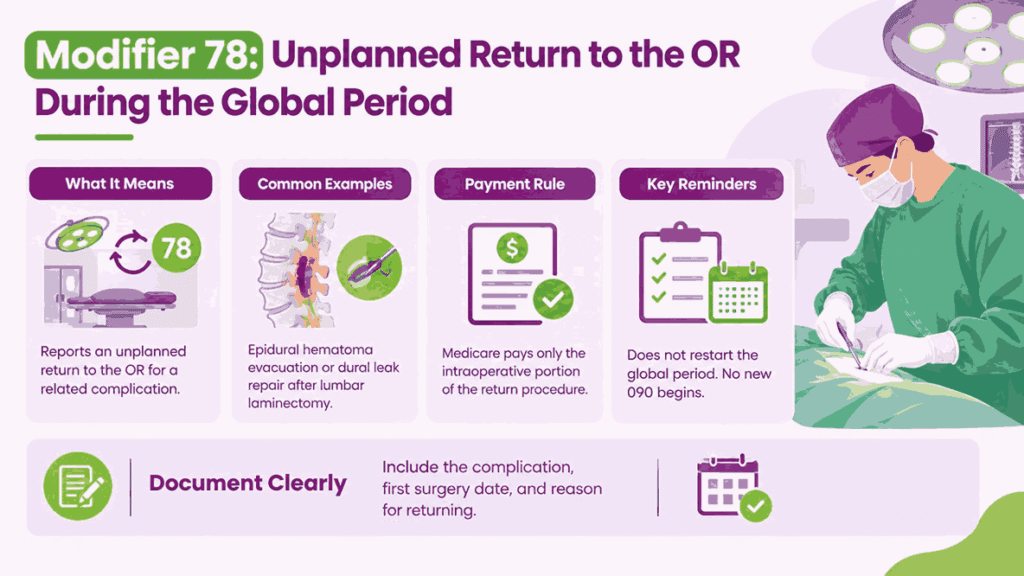
Medicare pays only the intraoperative portion of the return procedure under modifier 78 rules. Modifier 78 does not restart the original global period, so no new 090 begins. Document the complication, the date of the first surgery, and the reason for returning.
Modifier 79: Unrelated Procedure During the Global Period
Modifier 79 reports an unrelated procedure by the same surgeon during the global period. An example is lumbar laminectomy during the global period of an unrelated cervical fusion. Unlike modifier 78, modifier 79 starts a new global period for the unrelated procedure. Modifier 79 identifies an unrelated postoperative procedure; a different diagnosis alone cannot establish unrelatedness.
Which Documents Are Required For CPT Code 63047?
Strong documentation protects CPT 63047 claims during prior authorization, payer review, and post-payment audits. The operative report must name each decompressed segment, laterality, and all three procedural components.
Those components are laminectomy, facetectomy, and foraminotomy, and none of them may be implied. Imaging such as MRI or CT should confirm stenosis at the decompressed lumbar level. Clinic notes should record neurogenic claudication, failed conservative treatment, and functional limitations before surgery.
When fusion is combined, state each procedure’s levels separately to support modifier 59 payment. For +63052, document decompression that goes beyond routine interspace preparation for the interbody fusion. Commercial payers also expect prior authorization forms, imaging reports, and a medical necessity letter.
What Is the Cost of CPT Code 63047?
The cost of CPT code 63047 depends on payer, site of service, and modifiers. Medicare rates for 2026 give billing teams a benchmark before negotiating commercial payer contracts.
RVUs and Medicare Physician Payment for 63047 and +63048
CPT 63047 has a 2026 work RVU of 14.99 under Medicare’s Physician Fee Schedule. Add-on +63048 carries a 2026 work RVU of 3.38 for each additional decompressed segment. The 2026 non-APM national facility payment is $1,065 for 63047 and $187 for +63048.
These amounts reflect the $33.4009 conversion factor for clinicians outside qualifying alternative payment models. Qualifying APM participants receive a higher conversion factor of $33.5675, which raises payment modestly.
The 090-day global period bundles routine postoperative care into the surgeon’s payment for 63047. Geographic practice cost indices adjust these national rates, so actual payments vary by locality.
Hospital Outpatient and ASC Payment for Lumbar Laminectomy
Hospital outpatient departments report 63047 with status indicator J1 under APC 5114, paying $7,413. Status indicator J1 creates a comprehensive APC, bundling related hospital services into one payment. Ambulatory surgical centers receive indicator G2 for 63047 at a national rate of $3,696.
That ASC rate excludes the surgeon’s separate professional fee under the Physician Fee Schedule. Unlike lumbar fusion primaries, 63047 was payable outpatient before the 2026 inpatient-only list changes. Facilities should verify current quarterly OPPS and ASC addenda before quoting payment to surgeons.
Commercial Payers and Prior Authorization Requirements
Commercial payers such as UnitedHealthcare, Aetna, Cigna, and Anthem set their own fee schedules. Contracted rates for 63047 are often set as a percentage of the Medicare allowable. Most commercial payers require prior authorization for elective lumbar decompression before scheduling the surgery.
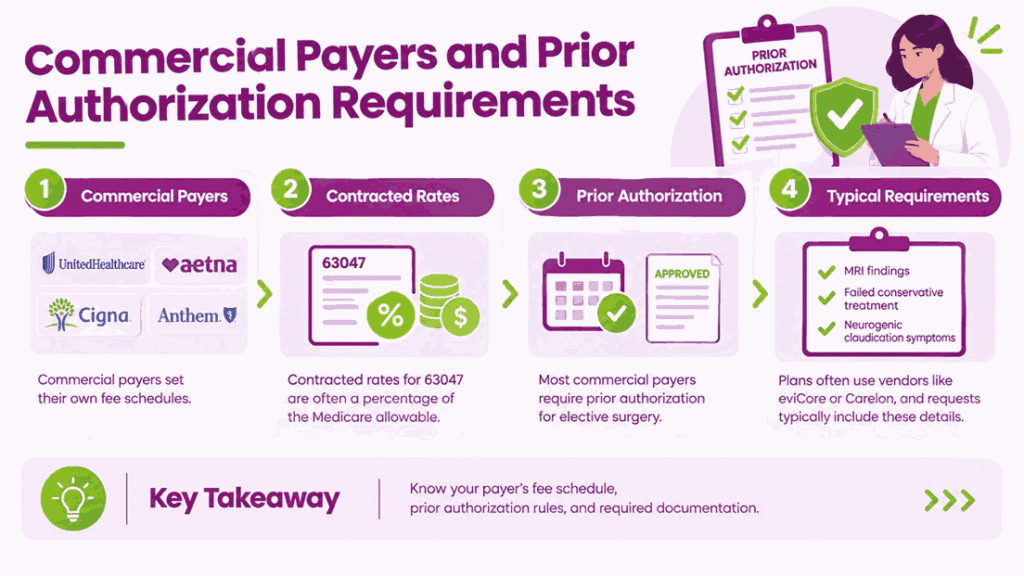
Many plans follow similar requirements, often through utilization management vendors like eviCore or Carelon. Authorization requests typically include MRI findings, failed conservative treatment, and documented neurogenic claudication symptoms.
Approved authorizations list CPT codes and units, so +63048 units must match the approval. Request authorization for 63047 and +63048 whenever surgeons plan to decompress multiple lumbar segments.
What Are Example Clinical Scenarios or Use Cases for CPT Code 63047?
Four scenarios show how CPT code 63047 behaves across stenosis, multilevel, and fusion claims. Each scenario pairs the operative picture with codes, units, modifiers, and the payer logic.
Scenario 1: Single-Level L4–L5 Stenosis With Bilateral Neurogenic Claudication
A neurosurgeon performs laminectomy, facetectomy, and foraminotomy at L4–L5 for severe bilateral neurogenic claudication. Coders report one unit of CPT 63047 with ICD-10 M48.062 as the primary diagnosis.
Bilateral decompression of one segment does not change the units or require modifier 50. This clean claim is the baseline for later, more complex Medicare and commercial scenarios.
Scenario 2: Multilevel Lumbar Stenosis Requiring Decompression of Two Segments
A patient with stenosis at two adjacent levels needs decompression of two vertebral segments. The first decompressed segment is reported as one unit of primary CPT code 63047. The second segment is reported as one unit of add-on +63048 alongside the primary.
Billing two units of 63047 is incorrect because add-on +63048 handles every additional segment. The number of +63048 units cannot exceed the segments named in the operative note.
Scenario 3: TLIF at L4–L5 With Same-Level Decompression and a Separate Laminectomy at L3
A surgeon performs TLIF at L4–L5, including decompression, and separately decompresses the L3 segment. Report 22633 for the combined posterolateral and interbody fusion at the single L4–L5 interspace.
Report +63052 for the same-level decompression, because 63047 would be bundled into the fusion. Report 63047 with modifier 59 for the separate L3 laminectomy at a different level. Modifier XS is valid here because different spinal levels count as distinct anatomic sites.
This claim demonstrates every branch of the fusion bundling rule on one operative report. The note must clearly separate fusion levels, decompression levels, and decompression beyond interspace preparation.
Scenario 4: Laminectomy With Posterolateral Fusion at the Same Level
A surgeon performs laminectomy, facetectomy, and foraminotomy plus posterolateral fusion at the same level. No interbody device is placed, so the fusion is reported with CPT code 22612. Posterolateral fusion without interbody technique does not bundle the decompression into the fusion code.
Therefore, CPT 63047 and 22612 are both reported when surgeons document both procedures separately. Add-on +63052 is not appropriate with 22612, because that fusion code lacks interbody technique. Coders who reflexively choose +63052 here will understate payment and risk an incorrect claim.
What Are the CPT Code 63047 Rules To Ensure Successful Reimbursement?
Five payer rules decide whether CPT 63047 claims pay cleanly or return as denials. Each rule below ties back to NCCI edits, operative note detail, and payer policy. Billers can browse Transcure’s CPT codes guide for similar breakdowns of other spine procedures.
The Interbody Fusion Bundling Rule and Where +63052 Replaces 63047
NCCI edits bundle 63047 into fusion codes 22630 and 22633 at the same interspace. Medicare denies 63047 when the surgeon decompresses the same level as an interbody fusion. Add-on +63052 replaces 63047 for decompression at the same segment as lumbar interbody fusion.
Report +63053 for each additional qualifying decompressed segment during a qualifying posterior interbody fusion. Qualifying fusions include 22630, +22632, 22633, and +22634, which are posterior lumbar interbody techniques.
Documentation must show decompression extending well beyond routine interspace preparation for the interbody cage. When decompression occurs at a different interspace, modifier 59 or XS goes on 63047.
Why 63047 Remains Separately Payable With Posterolateral Fusion 22612
Posterolateral fusion 22612 involves no interbody device, so it does not absorb the decompression. CPT 63047 and 22612 remain separately payable when the operative note documents each procedure.
Add-on +63052 is not appropriate with 22612 because that fusion code lacks interbody technique. Reporting +63052 with posterolateral fusion understates payment because its work RVU is only 4.14. Fusion levels and decompression levels should appear as separate lines in the operative report.
Segment Counting, Units, and +63048 Documentation
CPT 63047 and +63048 count vertebral segments, while 63030 and +63035 count disc interspaces. Two decompressed segments bill as one unit of 63047 plus one unit of +63048. Billing two units of 63047 is incorrect because the add-on handles every additional segment.
Bilateral decompression of one segment remains a single unit, and modifier 50 never applies. Operative language such as L4–L5 stenosis must be translated into the segments actually decompressed. Do not infer segments from diagnosis wording alone; follow operative documentation and applicable CPT guidance.
Coders should count the laminae removed, then confirm that total against the claim units. Units of +63048 cannot exceed the segments named in the operative note or authorization. Authorization approvals list CPT codes and units, so mismatched +63048 units trigger payer review.
Services Included in 63047: Microscope, Dural Repair, and Navigation
CMS does not allow operating microscope code 69990 with laminectomy and spinal decompression codes. Billers should omit 69990 even when the surgeon uses an operating microscope for visualization.
Incidental dural tear repair during the laminectomy is integral and therefore not separately reportable. Dural repair stays bundled unless the surgeon returns to the OR under modifier 78.
Spinal navigation add-on +61783 is reported separately and needs clear documentation of image-guided use. The 090-day global period bundles routine postoperative visits into the surgeon’s payment for 63047.
Top Reasons For Denials Specific To 63047 & Quick Remedies
Seven errors cause frequent denials on 63047 claims in orthopedic billing, and each has a quick fix.
| Denial Reason | Quick Remedy |
|---|---|
| 63047 Reported with 22630 or 22633 Instead of +63052 | Replace 63047 with +63052 when decompression occurs at the same interspace as the fusion. |
| Missing Modifier 59 or XS at a Different Interspace | Append modifier 59 or XS to 63047 and document fusion and decompression levels separately. |
| Modifier 50 Appended for Bilateral Decompression | Remove modifier 50 and submit one unit, since the descriptor includes unilateral or bilateral. |
| Segment and Interspace Counts Mixed | Recount vertebral segments from the operative note and correct the 63047 and +63048 units. |
| 69990 Appended for the Operating Microscope | Do not claim CMS never pays 69990 with every spinal decompression procedure. |
| Herniated Disc Laminotomy Billed as 63047 | Report 63030 when surgeons perform a laminotomy for a herniated disc at one interspace. |
| +63048 Units Exceeding the Segments Named in the Note | Match +63048 units to the segments named in the note and the prior authorization. |
Hence, auditing claims against this table before submission prevents most avoidable 63047 denials and rework.