Medical billing challenges in Delaware are the payer, policy, and staffing problems that delay or reduce provider reimbursement. Most trace back to structure: a three-plan Medicaid managed care program with separate state registration, one shared Medicare contractor (Novitas, Jurisdiction L), Senate Bill 12 on prior authorization, a 30-day clean claim rule under Regulation 1310, and new reforms through 2027. That is more than a small front office can track.
Roughly 1 in 10 claims is denied on first submission nationally, and many are never reworked. The AMA’s 2024 survey found practices handle about 39 prior authorizations a week, using around 13 staff hours. With only three Medicaid MCOs, one credentialing gap can hold a payer’s revenue for 60 to 90 days, pushing AR days well past the 35 to 40 day benchmark.
Outsourcing replaces a part-time, generalist function with a team that works Delaware’s payer rules daily: scrubbing claims, tracking SB 12 windows, and working denials inside appeal deadlines. Practices typically target a 95%+ clean claim rate and fewer AR days. This guide covers five risk areas and maps risk by specialty and buyer type. For the legal basis, see our Delaware medical billing laws guide.
Why Delaware Medical Billing Is Structurally Different
Delaware has three counties, a small payer universe, and a patient population that crosses state lines daily. That combination looks simple on paper. In practice, it concentrates risk. One payer policy change or one enrollment error can touch a large share of a practice’s claims.
Small Market With High Concentration
Delaware awarded three Medicaid MCO contracts in 2022. Those plans serve roughly 280,000 Medicaid and Children’s Health Insurance Program (CHIP) recipients. Commercial volume also sits with a handful of carriers. Fewer payers mean fewer places to hide a workflow gap.
Cross-Border Patient Flow
Patients often live, work, or seek care across the Pennsylvania, Maryland, and New Jersey borders. Billing teams then see out-of-state plans, mismatched networks, and coordination of benefits (COB) conflicts. These cases rarely follow the standard Delaware workflow. Staff trained only on in-state plans miss them.
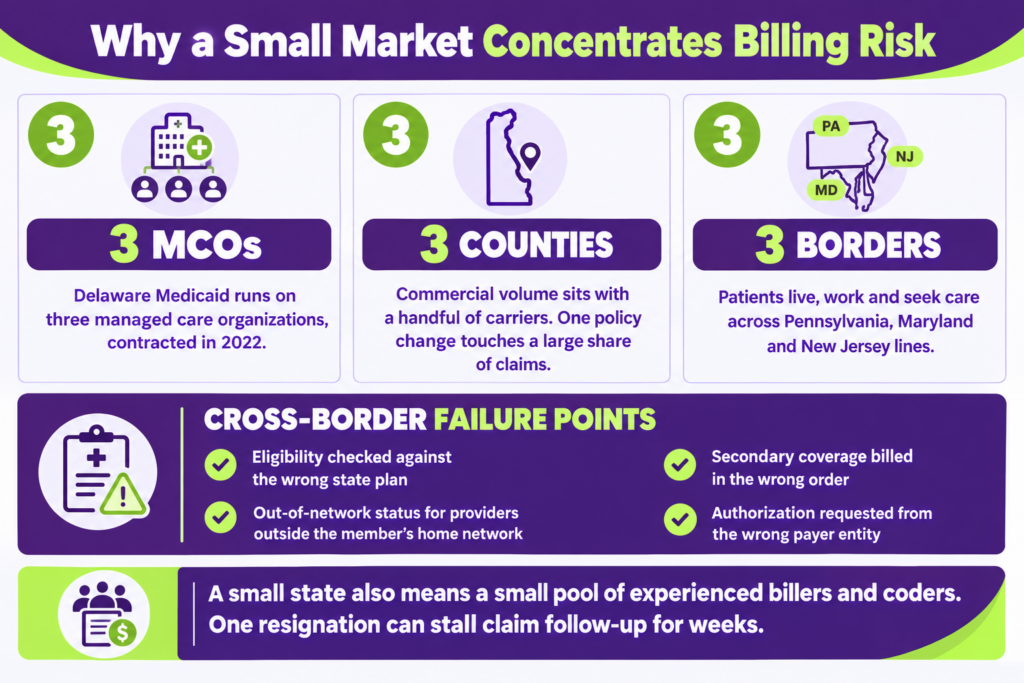
Common cross-border failure points:
- Eligibility checked against the wrong state plan
- Out-of-network status for providers outside the member’s home network
- Secondary coverage billed in the wrong order
- Authorization requested from the wrong payer entity
A Thin Local Labor Pool
A small state also has a small pool of experienced billers and coders. In practice, one resignation can stall claim follow-up for weeks. Cross-training and documented payer rules reduce that exposure. The staffing section later in this guide covers the options.
Challenge 1: Medicaid Managed Care Across Three MCOs
Delaware Medicaid is called the Diamond State Health Plan (DSHP). The Division of Medicaid and Medical Assistance (DMMA) runs it under a Section 1115 waiver. Most enrollees receive benefits through an MCO. Billing teams must confirm the correct plan before every visit.
The Three Delaware Medicaid MCOs
| MCO | Background | Billing implication |
|---|---|---|
| AmeriHealth Caritas Delaware | Incumbent plan renewed in the 2022 procurement | Plan-specific prior authorization rules and claim routing |
| Delaware First Health | Centene-owned plan added in the 2022 procurement | Separate provider network, portal, and manual |
| Highmark Health Options | Blue Cross Blue Shield incumbent renewed in 2022 | Confirm participation separately from Highmark commercial plans |
Older program documents list plans that no longer appear on the state’s current roster. Some vendor pages repeat those outdated names. The DMMA Diamond State Health Plan page names the current three MCOs. Verify against it before building payer tables or credentialing plans.
DMAP Registration and the MCD ID
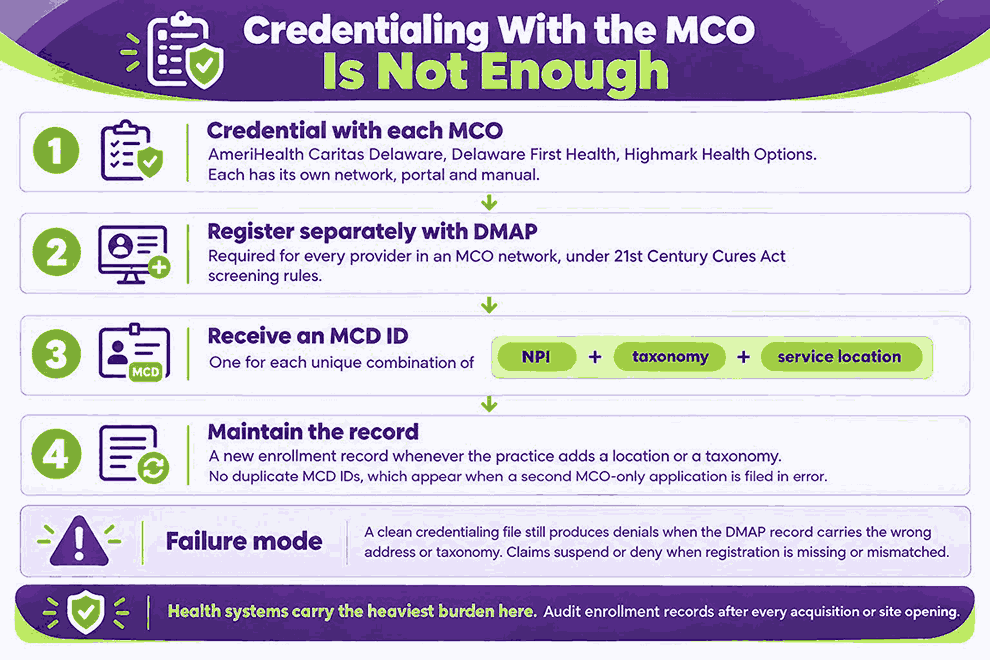
Every provider in an MCO network must also register with the Delaware Medical Assistance Program (DMAP). Federal 21st Century Cures Act screening rules require it. The state tracks each provider with a Medicaid identifier, called an MCD ID, tied to NPI, taxonomy, and service location.
What billing teams must track:
- One MCD ID for each unique NPI, taxonomy, and service location combination
- A new enrollment record whenever a practice adds a location or taxonomy
- No duplicate MCD IDs, which appear when a second MCO-only application is filed in error
- Claims can suspend or deny when registration is missing or mismatched
Many billing teams credential with each MCO and stop there. In practice, a clean credentialing file can still produce denials when the DMAP record carries the wrong address or taxonomy. DMMA warned in 2023 that unregistered providers could lose network contracts.
Timely Filing for Medicaid Claims
Federal rule 42 CFR 447.45 sets a 12-month outer limit for Medicaid claim submission. DMMA has described a one-year limit on provider claims in its own rulemaking. MCO contracts may set shorter windows. Confirm each plan’s limit in its provider manual.
Practical rule: Track the filing deadline by MCO contract, not by one Medicaid date.
Long-Term Care and Behavioral Health Programs
DSHP Plus covers managed long-term services and supports. PROMISE provides home and community-based behavioral health benefits to adults with serious mental illness or substance use disorder. Both programs add authorization layers. For how Delaware’s prior authorization law handles deadlines, portals, and appeals, see our Delaware prior authorization law guide. Dual eligible patients need a confirmed billing order.
Challenge 2: Commercial Payer Rules and Cross-Border Coordination of Benefits
Highmark Blue Cross Blue Shield Delaware is the state’s Blue Cross plan and anchors commercial volume for many practices. Aetna, UnitedHealthcare, and Cigna add their own modifier, documentation, and authorization rules. Rules differ by plan, product, and sometimes specialty. A policy change at one carrier can shift denial patterns across a whole practice.
A common mistake is applying Pennsylvania Highmark playbooks to Delaware claims. The plans share a brand but not every rule. Billing teams should keep a Delaware payer matrix and review it each quarter. Update it whenever a carrier issues a bulletin.
| Matrix field | What to record | Why it matters |
|---|---|---|
| Filing limit | Days allowed for original and corrected claims | Prevents CO-29 write-offs |
| Authorization list | Services that need prior authorization, by plan | Prevents CO-197 denials |
| Modifier edits | Payer rules for modifiers 25 and 59 | Reduces bundling denials |
| Appeal path | Levels, deadlines, and submission channel | Protects appeal rights |
| Claim channel | Portal, clearinghouse, and attachment rules | Cuts front-end rejections |
Coordination of Benefits Across State Lines
COB errors rise when patients hold plans from neighboring states. The primary payer is not always the Delaware plan. Billing teams should verify coverage dates, plan type, and subscriber details before the visit. A wrong primary payer assumption delays payment on both claims.
A four-step COB check before billing:
- Verify every active policy at scheduling.
- Confirm which plan is primary using the birthday rule or employment status.
- Record the rendering provider’s network status with each payer.
- Bill the primary payer first and attach its remittance advice to the secondary claim.
Challenge 3: Medicare Claims Under Novitas Jurisdiction L
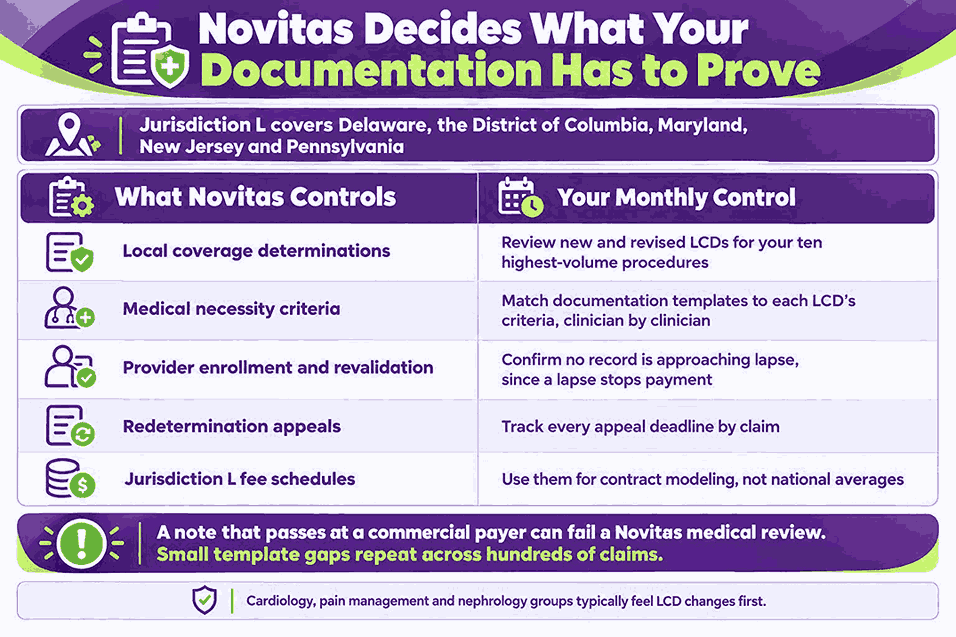
Novitas Solutions is the Medicare Administrative Contractor (MAC) for Delaware. It processes Part A and Part B fee-for-service claims in Jurisdiction L. That jurisdiction also covers the District of Columbia, Maryland, New Jersey, and Pennsylvania. CMS reports it handles about 11.7 percent of national claims volume.
Some vendor pages cite a different Medicare contractor for Delaware. CMS lists Novitas, and the contract runs to July 2028. Coverage rules, enrollment, and appeals for Delaware providers all flow through Novitas. Check any vendor claim about contractors against the CMS page.
| Area | What Novitas controls | Billing impact |
|---|---|---|
| Local coverage determinations (LCDs) | Medical necessity and documentation criteria | Documentation gaps trigger medical review denials |
| Provider enrollment | Enrollment and revalidation records | Lapses stop payment |
| Appeals | Redetermination requests | Missed deadlines forfeit appeal rights |
| Fee schedules | Jurisdiction L payment rates | Contract modeling depends on them |
In practice, cardiology, pain management, and nephrology groups often feel LCD changes first. A note that passes at a commercial payer can fail a Novitas review. Billing teams should map each LCD to the note templates clinicians actually use. Small template gaps repeat across hundreds of claims.
Monthly Medicare controls:
- Review new and revised LCDs for your ten highest-volume procedures.
- Match documentation templates to each LCD’s medical necessity criteria.
- Track Novitas appeal deadlines by claim.
Challenge 4: Prior Authorization Rules Are Changing
Delaware’s Pre-Authorization Reform Act of 2025, Senate Bill 12, took effect on August 25, 2025. It applies to policies issued, modified, or renewed after December 31, 2026. The law shortens payer response times and extends how long an approval stays valid.
| Requirement | Rule under SB 12 | Billing action |
|---|---|---|
| Non-urgent request, not electronic | Provider notified within 5 business days | Track fax and phone requests separately |
| Non-urgent request, electronic | Provider notified within 3 business days | Make the portal the default channel |
| Urgent request, electronic | Provider notified within 24 hours | Flag urgent cases at scheduling |
| Approval validity | 90 days, up from 60 | Update expiry tracking |
| Episode of care | No more than one authorization per episode | Challenge duplicate requests |
| Bundled services | Approval of one service deems the others approved | Cite the rule in appeals |
| Electronic platform | Carriers must respond on the same platform by January 1, 2027 | Test portal workflows before 2027 |
The law also directs the Department of Health and Social Services to apply these standards to Medicaid carrier contracts where feasible. That language is softer than the commercial mandate. Practices should not assume Medicaid MCOs will follow the same timelines.
What Billing Teams Should Change Now
- Add a 90-day expiry field to every authorization record.
- Track electronic and non-electronic requests separately.
- Capture the date and time of each submission as appeal evidence.
- Test payer portal responses before January 1, 2027.
- Audit open authorizations that cover bundled services.
Challenge 5: Denials, Appeals, and Prompt-Pay Rules
Delaware Insurance Regulation 1310 sets the core prompt-pay clock for commercial carriers. A carrier must act within 30 days of receiving a clean claim. The rule sits in Title 18 of the Delaware Administrative Code. Knowing the four allowed actions gives billing teams a firm basis for follow-up when a payer stalls.
| Carrier action | What it means | Provider response |
|---|---|---|
| Pay in full | Total allowed amount is paid | Post and reconcile against the contract |
| Part-pay | Payable portion paid with written reasons for the rest | Appeal the unpaid portion |
| Deny | Written notice states why the claim will not be paid | Test the reason against policy, then appeal |
| Request information | One written request for relevant documents | Respond fast and log the date |
Carriers may make only one request for additional information per claim. After receiving it, the carrier must act within 15 days. Repeated requests on the same claim can signal a payer process problem. Log each request with its date. This paper trail supports a prompt-pay complaint.
What Senate Bill 143 Proposed
Senate Bill 143 sought to improve claim payment rules for health insurers. It died when the 152nd General Assembly ended in 2024. Its provisions show the gaps lawmakers identified. Verify the status of any successor bill before relying on them.
What the bill proposed:
- A statutory definition of a clean claim
- Erroneous denials treated as timely filed
- COB verification before a carrier recovers payment
- Twelve months to resubmit after a retroactive denial
- Interest on late payments and post-appeal payments
Until a similar bill passes, contract language and Regulation 1310 carry the weight. Review each payer agreement for recoupment windows, appeal deadlines, and interest terms. Those clauses decide who bears the cost of a late or reversed payment. For payer-by-payer appeal windows, see our guide to Delaware timely filing and appeal deadlines.
Common Denial Types
| Code | Meaning | Common trigger | Fix |
|---|---|---|---|
| CO-29 | Filing time limit expired | Late MCO or commercial submission | Track filing limits by payer contract |
| CO-197 | Authorization absent | Missing or expired authorization | Expiry field on every authorization |
| CO-16 | Claim lacks information | Missing taxonomy, MCD ID detail, or modifier | Front-end claim scrubbing |
| CO-50 | Not medically necessary | Policy or LCD criteria not met | Documentation templates by policy |
| CO-18 | Duplicate claim | Resubmission without a replacement frequency code | Use the correct claim frequency code |
| CO-97 | Payment included in another service | NCCI bundling without modifier 25 or 59 | Payer-specific modifier rules |
Many vendor pages quote Delaware denial percentages without naming a source. No official Delaware denial benchmark turned up while researching this guide. Percentages without sources cannot support a budget decision. Build your own baseline from remittance data by payer, reason code, and specialty.
Challenge 6: Behavioral Health Billing and Parity Rules
Governor Matt Meyer signed Senate Bill 22, the Fair Standards in Mental Health Care Act, in 2026. The law sets clinical standards insurers must use in coverage decisions. It also limits some coverage delays, denials, and prior authorization requirements for mental health care.
What changes for psychiatry and behavioral health billing:
- Insurers must use evidence-based level-of-care criteria from independent experts.
- Definitions of medically necessary treatment and utilization review criteria become more precise.
- Carriers must give providers nonquantitative treatment limitation (NQTL) parity analyses on request, free of charge.
- Emergency and out-of-network mental health care receive specific attention.
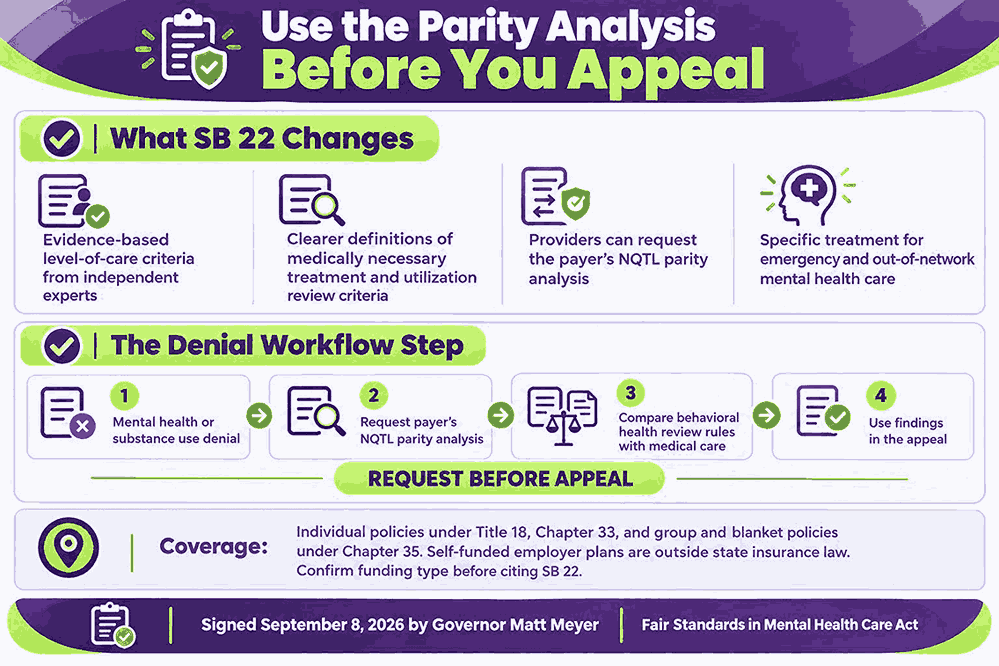
The NQTL provision matters most for denial management. A provider can request the payer’s own parity analysis before filing an appeal. That document can show whether a utilization review rule applies more strictly to mental health than to medical care.
Practical step: Add a parity analysis request to your denial workflow for mental health and substance use disorder claims.
The bill applies to individual policies under Chapter 33 and group and blanket policies under Chapter 35 of Title 18. Self-funded employer plans fall outside state insurance law. Confirm plan type before citing the statute in an appeal. Plan documents usually state the funding type.
Challenge 7: Primary Care Reform and Value-Based Payment
Senate Substitute 2 for Senate Bill 1 became law on July 20, 2026. It requires carriers to spend at least 11.5 percent of total medical costs on primary care, starting in 2026. At least 5 percent of that spending must flow through prospective primary care payments.
Provisions that touch billing operations:
- Carriers must offer value-based care programs and cannot deny contracted providers participation.
- Commercial carriers with more than 5,000 members must meet alternative payment model contracting minimums after two consecutive years in the market.
- From rate filing year 2028, cost-per-service limits tie to Medicare reference-based pricing targets, with hospital exemptions.
- The Department of Insurance must issue regulations within 18 months of enactment.
Primary care practices will see more prospective payments and value-based contracts. That shifts billing work from claim-by-claim follow-up toward attribution, quality reporting, and reconciliation. Fee-for-service accuracy still matters. Encounter data often supports the spending calculations. Billing teams need reporting skills, not only claim skills.
Verify before relying: Several details depend on Department of Insurance regulations that are still to come.
Challenge 8: Staffing Gaps and Single Points of Failure
Billing work in a small state concentrates in a few people. When one biller holds payer knowledge, credentialing files, and appeal history, a resignation creates immediate cash flow risk. Replacing experienced staff takes time in a small labor market. Succession plans are rare in small teams.
| Model | Strengths | Risks | Best fit |
|---|---|---|---|
| In-house | Direct control and EHR proximity | Key-person risk and limited payer depth | Larger groups with stable staff |
| Outsourced RCM | Payer-specific depth and backup coverage | Handoff gaps and less visibility | Small practices and surgery centers |
| Hybrid | Front desk in-house, denials and AR outsourced | Needs clear ownership of each task | Multi-specialty groups and health systems |
Steps that reduce key-person risk:
- Document payer rules in a shared matrix.
- Cross-train two people on each major payer.
- Store credentialing and MCD ID records in one central file.
- Keep appeal templates organized by denial type.
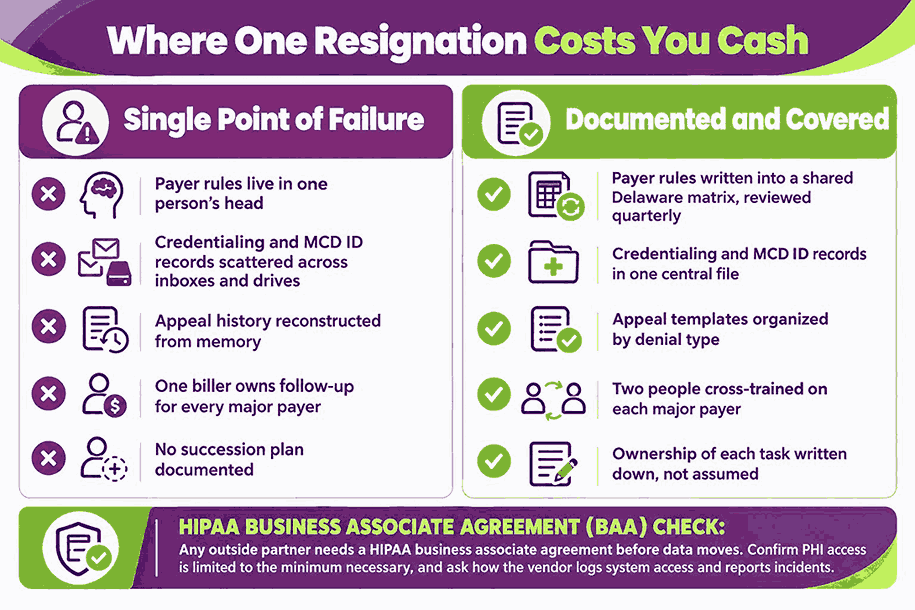
When comparing medical billing companies in Delaware, ask for named experience with all three MCOs, DMAP and MCD ID enrollment support, and SB 12 portal workflows. Any outsourced model needs a business associate agreement (BAA) under HIPAA. Confirm the vendor limits protected health information (PHI) access to the minimum necessary. Ask how the vendor logs system access and reports incidents. Review the BAA before any data transfer begins.
Where Delaware Billing Risk Lands by Specialty
Risk concentrates differently by specialty. The table maps the most common exposure for seven specialties. Treat it as a starting hypothesis and validate it against your own remittance data. Specialties with heavy authorization volume feel SB 12 first. Your payer mix may reorder the rows.
| Specialty | Primary exposure | Delaware factor |
|---|---|---|
| Pain Management | Authorization for injections and imaging, modifier use | SB 12 timelines and MCO authorization rules |
| Nephrology | Medicare and Medicaid crossover for dual eligibles | Novitas Jurisdiction L and DSHP Plus |
| Psychiatry | Medical necessity and parity denials | SB 22 and PROMISE |
| Cardiology | LCD documentation and imaging authorization | Novitas LCDs and commercial authorization rules |
| OBGYN | Global obstetric package and newborn eligibility | MCO assignment and Medicaid eligibility changes |
| Orthopaedics | Global periods, DME, and imaging authorization | SB 12 bundled-service rule |
| Primary Care | Value-based payment and modifier 25 | SS2 for SB 1 and DMAP registration |
A table shows exposure, not size. Rank each specialty by dollars at risk, using denial volume times average allowed amount. That ranking tells you where to add staff first. Include write-offs for timely filing and missing authorization, since staff can prevent both.
How the Risk Differs by Buyer Type
| Buyer | Main billing pressure | Delaware factor |
|---|---|---|
| Ambulatory surgery centers | Authorization timing and facility versus professional billing | SB 12 bundled-service rule |
| Health systems and hospitals | Multi-location enrollment and contract rates | MCD ID per location and cost limits from 2028 |
| ACOs and value-based groups | Attribution and quality reporting | SS2 for SB 1 contracting rules |
| Independent practices | Staffing depth and payer rule tracking | Small labor pool |
Health systems carry the heaviest enrollment burden. Each NPI, taxonomy, and service location needs its own MCD ID record. A merger or new site can leave claims exposed until registration catches up. Audit enrollment records after every acquisition or site opening.
Delaware Medical Billing Readiness Checklist
Use this checklist to test your revenue cycle against the Delaware issues above. Score one point for each item you can document today. A score below eight signals gaps worth fixing before January 1, 2027. Share the results with billing, front desk, and clinical leads.
- Current MCO roster confirmed against the DMMA Diamond State Health Plan page.
- Every NPI, taxonomy, and location has one valid MCD ID in DMAP.
- Filing limits recorded for each payer and each MCO contract.
- A Delaware payer matrix covering modifiers, authorizations, and appeal paths.
- COB verification run at scheduling for every patient with multiple plans.
- Authorization records that track the 90-day validity window.
- Electronic prior authorization workflows tested with each major carrier.
- Payer response times logged against the 30-day clean claim rule.
- Parity analysis requests built into the mental health denial workflow.
- Two trained staff members for each major payer.
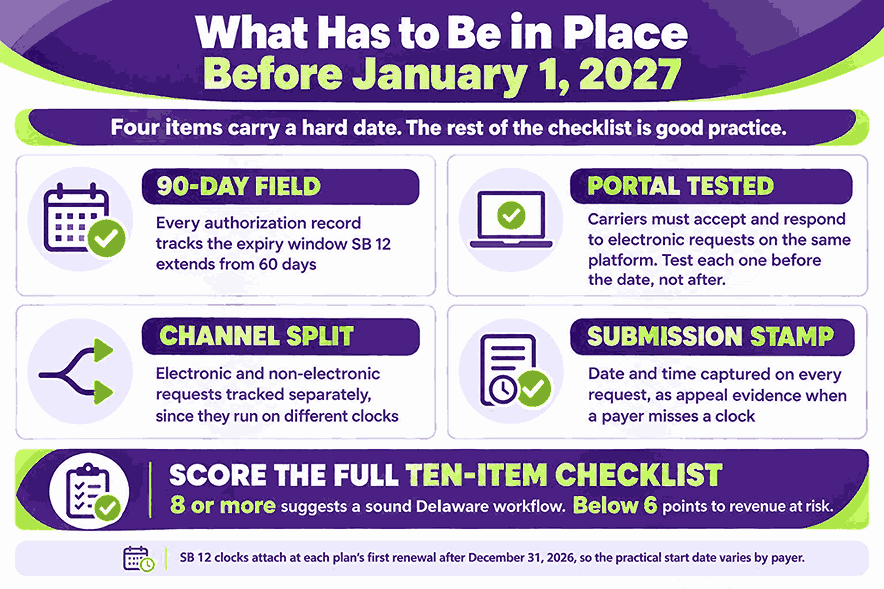
A score of eight or more suggests a sound Delaware workflow. Scores below six point to revenue at risk. Practices that score low often benefit from an outside billing audit. Our team can run one against this checklist. See our medical billing services in Delaware page for scope and next steps.
Frequently Asked Questions
How many Medicaid MCOs does Delaware have?
Delaware contracts with three Medicaid MCOs: AmeriHealth Caritas Delaware, Delaware First Health, and Highmark Health Options. They serve Diamond State Health Plan and DSHP Plus members. Providers must also register with DMAP. Confirm the current roster on the DMMA website before updating payer tables.
What is the Medicaid timely filing limit in Delaware?
Federal rule 42 CFR 447.45 sets a 12-month outer limit. DMMA has described a one-year limit for provider claims. MCO contracts can set shorter windows. Check each plan’s provider manual and track deadlines by contract. Late claims are hard to recover once the window closes.
Who processes Medicare claims in Delaware?
Novitas Solutions processes Medicare Part A and Part B fee-for-service claims for Delaware in Jurisdiction L. The jurisdiction also covers the District of Columbia, Maryland, New Jersey, and Pennsylvania. Local coverage determinations from Novitas set the documentation standard for medical necessity.
How long do insurers have to pay a clean claim in Delaware?
Under Regulation 1310, a carrier must act within 30 days of receiving a clean claim. It can pay, part-pay with written reasons, deny with written reasons, or make one written request for more information. After receiving that information, it has 15 days to act.
What does Delaware’s Pre-Authorization Reform Act change?
Senate Bill 12 sets response times of 5 business days for non-electronic requests and 3 for electronic ones. Urgent electronic requests get 24 hours. It extends approval validity to 90 days. Carriers must respond on the platform used by January 1, 2027.
Do MCO-only providers need to register with DMAP?
Yes. Providers in a Delaware MCO network must complete the managed care only provider enrollment through DMAP. The state assigns an MCD ID for each NPI, taxonomy, and service location. Missing or mismatched registration can suspend or deny claims. Check the DMAP portal for each location.
Should a Delaware practice outsource medical billing?
The answer depends on staffing depth, payer mix, and denial volume. Practices with one biller face the highest key-person risk. A hybrid model often works well, with eligibility and charge entry in-house. Denials and AR follow-up move to a team with Delaware payer depth.