Picture a patient in Atlanta who has knee surgery at an in-network hospital. The anesthesiologist is out of network, and a bill for the difference arrives three weeks later.
Georgia and federal law both limit what you can collect from the patient in that situation. They also set the rules for how the insurer pays you.
Billing teams in Georgia must know which law applies to each claim. A wrong guess leads to underpayment, patient complaints, and lost appeal deadlines.
This guide explains both laws, the payment formula, the dispute steps, and the daily habits that protect your revenue.

What the Georgia Surprise Billing Law Covers
Georgia passed the Surprise Billing Consumer Protection Act in 2020, and the Department of Insurance enforces it under Rule 120-2-106.
The law applies to state-regulated health plans and certain state employee plans. Self-funded employer plans fall under ERISA, a federal law, so the Georgia Act does not apply. Medicare and workers’ compensation claims fall outside the Georgia Act and follow their own payment rules.
Key Terms in Plain Language
Use these definitions from the state rule when you review a denied or underpaid claim.
| Term | Plain meaning |
|---|---|
| Balance bill | The gap between the provider charge and the insurer payment, excluding patient cost sharing |
| Surprise bill | A bill for care from an out-of-network provider at an in-network facility |
| Emergency medical services | Care for a condition that a prudent layperson believes needs immediate attention |
| Nonparticipating provider | A provider with no contract with the patient health plan |
| Contracted amount | The 2017 median in-network payment for similar services, adjusted yearly for inflation |
| Cost sharing | The deductible, coinsurance, and copayment owed by the patient |
Georgia defines a surprise bill as care provided by an out-of-network provider at an in-network facility, making Georgia billing support essential for managing reimbursement disputes and protecting patients from unexpected charges.
Emergency Care Rules
Insurers must pay covered emergency claims without prior authorization and cannot deny them later when care was medically necessary. The patient owes only the deductible, coinsurance, or copayment from the plan.
Those amounts count toward the deductible and out-of-pocket maximum as if the provider were in network.
Nonemergency Care at In-Network Facilities
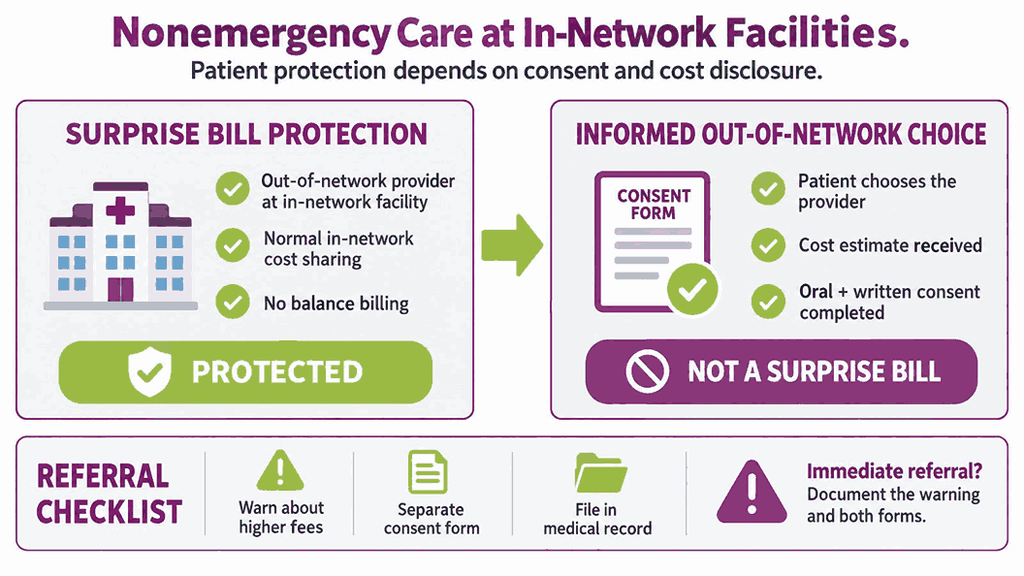
A surprise bill for nonemergency care follows the same patient protection as an emergency claim. The patient pays normal in-network cost sharing, and the provider cannot bill any remaining balance.
Patients may still choose an out-of-network provider for nonemergency care. That choice is not a surprise bill when the patient gives written and oral consent after receiving a cost estimate.
When a patient requests an immediate referral, the referring provider must warn about possible higher fees. The patient must acknowledge this orally and in writing, on a separate form that goes in the medical record.
How Georgia Sets Your Payment?
Georgia sets a payment floor for out-of-network emergency and surprise bill claims. For both claim types, the insurer pays the provider directly using the highest of three measures.
| Measure | What it means |
|---|---|
| Median contracted amount | The verifiable median paid by eligible insurers for similar services, calculated by a vendor the Commissioner chooses |
| Prior agreed amount | The latest verifiable amount the insurer and provider agreed to while the provider was in network |
| Higher insurer amount | A higher figure the insurer picks based on the complexity and circumstances of the care |
The median comes from 2017 in-network payments for similar services, adjusted yearly for inflation. Georgia compares claims within one of 16 geographic rating areas used for Affordable Care Act plans.
The insurer payment does not include patient cost sharing, so you collect that amount from the patient separately.
Insurers must follow Georgia prompt pay rules under Code Section 33-24-59.14 and must state whether ERISA governs the plan. Prompt pay deadlines sit beside other Georgia medical billing laws that your team should track together.
Worked Example
Consider a hypothetical anesthesia claim from an out-of-network provider at an in-network surgical center.
| Item | Amount |
|---|---|
| Provider billed charge | $4,000 |
| Median contracted amount | $1,500 |
| Patient coinsurance | $300 |
| Insurer payment | $1,200 |
| Patient owes | $300 |
| Amount you cannot bill the patient | $2,500 |
The patient owes only the $300 coinsurance, and you cannot bill the remaining $2,500. You may request arbitration if the payment seems low for the complexity of the case.
Georgia Arbitration Steps for Providers
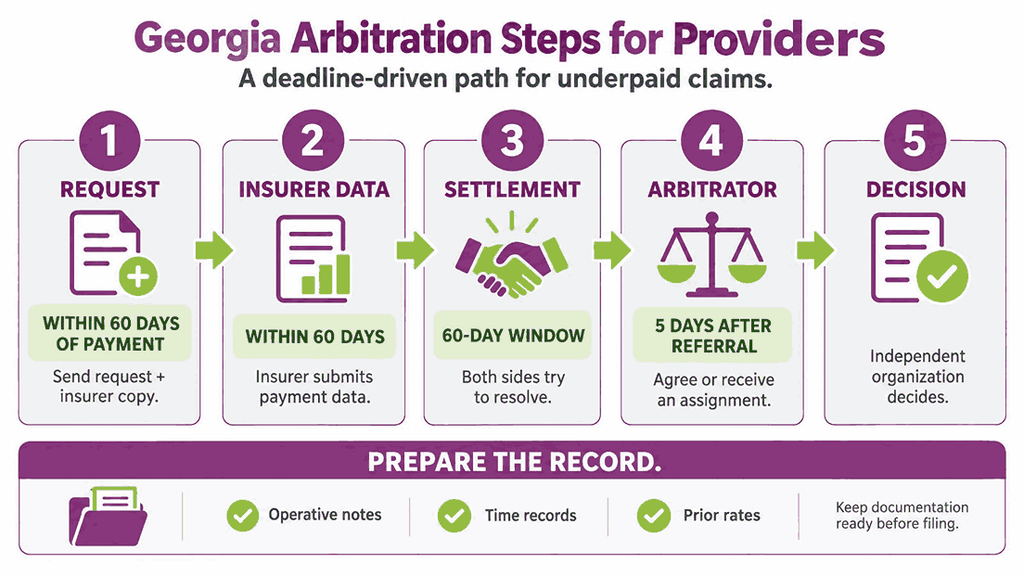
If you believe the insurer underpaid, you may request arbitration through the Commissioner of Insurance. Send the request to the Administrative Procedure Division at the Office of the Insurance and Safety Fire Commissioner.
| Step | Timing | What happens |
|---|---|---|
| Request | Within 60 days of payment | Provider submits the request and copies the insurer |
| Insurer data | Within 60 days of the request | Insurer submits data showing the payment followed the rules |
| Settlement talks | 60 days from the request | Both sides try to settle and report the result |
| Arbitrator choice | 5 days after referral | Parties agree on an arbitrator or the organization assigns one |
| Decision | After review | An independent resolution organization decides the dispute |
If the parties settle after referral but before arbitration, they split the resolution organization costs. Arbitrators need training and experience in healthcare billing, reimbursement, and usual and customary charges.
Arbitrators weigh several factors, including any gross gap between your charge and fees paid for the same service. They also review your training, the complexity of the case, patient characteristics, and the usual and customary cost.
Keep operative notes, time records, and any prior in-network rates ready before you file. Strong documentation and dedicated denial management support make these cases easier to win.
Federal No Surprises Act: What Still Applies
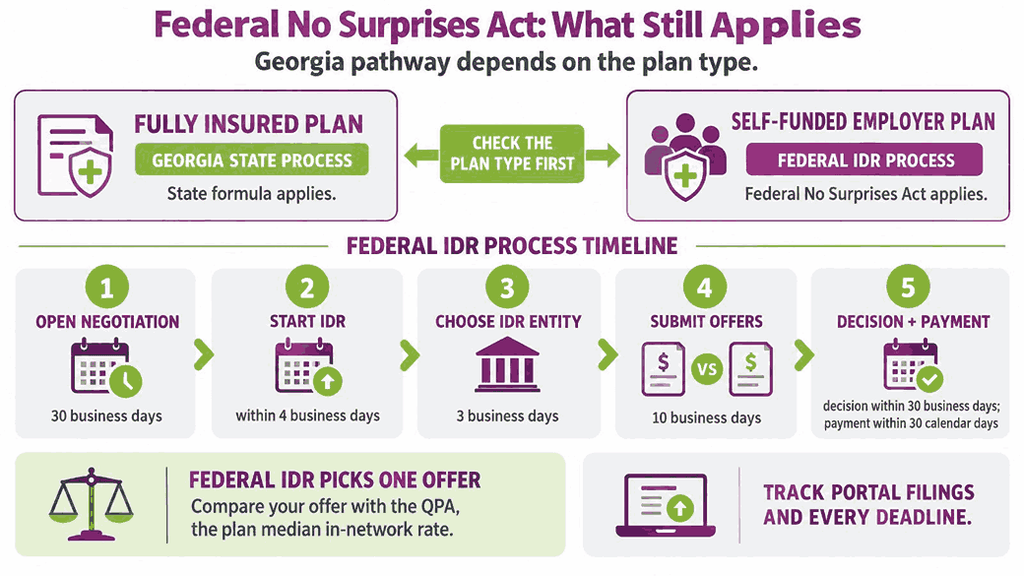
The federal No Surprises Act took effect on January 1, 2022, and applies to self-funded employer plans. Where a state law sets the out-of-network payment rate, the state process applies to fully insured plans.
In Georgia, that means fully insured plans follow the state formula, while self-funded plans use the federal process. The federal process starts with a 30-business-day open negotiation period between you and the plan.
| Step | Timeline |
|---|---|
| Open negotiation | 30 business days after the initial payment or denial |
| Start IDR | Within 4 business days after negotiation ends |
| Choose certified IDR entity | 3 business days after initiation, or the federal government assigns one |
| Submit offers | 10 business days after entity selection |
| Arbitrator picks one offer | Within 30 business days |
| Payment | Within 30 calendar days of the decision |
If the parties do not agree, either side may start independent dispute resolution, called IDR, within four business days. Under federal IDR, the arbitrator picks one of the two offers, so your offer must be reasonable.
The qualifying payment amount, or QPA, is the plan median in-network rate for the service. Plans must state the QPA with the initial payment, so compare it with your expected rate.
The federal administrative fee dropped from $115 to $15 per party under the 2026 final rule. The lower fee makes smaller claims worth disputing, especially for small practices.
Federal disputes involve portal filings and strict deadlines, so your RCM services should include dispute tracking.
Notice and Consent and Good Faith Estimates
Federal rules also allow notice and consent forms for some nonemergency care. Anesthesia, pathology, and radiology services at an in-network facility cannot use that exception.
Federal law also requires a good faith estimate for uninsured and self-pay patients. Send it within one business day when care is scheduled three to nine business days ahead.
Send it within three business days when the visit is scheduled ten or more business days ahead. Patients can dispute a final bill that exceeds the estimate by $400 or more.
Georgia Law vs Federal Law
Use this table to decide which dispute path fits each claim on your desk.
| Feature | Georgia act | Federal No Surprises Act |
|---|---|---|
| Plans covered | Fully insured and state employee plans | Self-funded plans, plus fully insured plans where state law is silent |
| Emergency care | No prior authorization and no later denial for medically necessary care | No prior authorization and in-network cost sharing |
| Nonemergency care at in-network facility | Covered as a surprise bill | Covered, with a consent exception for some services |
| Payment rule | Highest of median contracted amount, prior agreed amount, or higher insurer amount | State rate if one exists, otherwise negotiation and IDR |
| Negotiation window | 60 days | 30 business days |
| Dispute filing deadline | 60 days from receiving payment | 4 business days after negotiation ends |
| Ground ambulance | Patient financial responsibility unchanged | Not covered |
Neither law protects patients from ground ambulance balance bills, so those claims need separate handling. Air ambulance claims are covered by the federal act, so review those separately from ground transport.
Common Mistakes That Lead to Surprise Bill Disputes
Hospital-based specialties often cause surprise bill disputes, because patients rarely choose these providers.
| Specialty | Sample CPT code | Why the dispute starts |
|---|---|---|
| Emergency medicine | 99285 | Emergency physician group is out of network at an in-network hospital |
| Anesthesia | 00840 | Anesthesiologist is not contracted with the surgical center plan |
| Radiology | 71046 with modifier 26 | Radiologist reads the chest X-ray from another location |
| Pathology | 88305 | Reference lab pathologist has no contract with the payer |
These errors cost practices money most often:
- Sending a patient a balance bill above cost sharing is the most serious error, and it can lead to complaints.
- Missing the 60-day state arbitration window removes your best route to challenge a low payment.
- Ignoring the insurer ERISA notice means you may use the wrong dispute path.
- Failing to record patient consent and estimates leaves you without proof when a payer questions the claim.
- Posting insurer payments without checking the payment formula hides underpayments from your team.
Payers such as Anthem, Aetna, Cigna, and UnitedHealthcare each handle out-of-network claims differently. Choose medical billing services that track these differences and flag every underpayment for review.
A Daily Workflow for Georgia Billing Teams
A fixed routine helps your team catch problems before a claim leaves your office.
| Stage | Action |
|---|---|
| Registration | Confirm the plan type: fully insured, self-funded, Medicare, or Medicaid |
| Scheduling | Verify network status for every provider involved, including anesthesia and radiology |
| Consent | Give a written estimate and record oral and written consent for chosen out-of-network care |
| Charge entry | Flag emergency and surprise bill claims with correct codes and place of service |
| Payment posting | Compare each payment with the median contracted amount and the prior agreed rate |
| Appeals | Calendar the 60-day Georgia deadline or the federal four-business-day window |
Georgia also requires insurers to show a hospital surprise bill rating from 0 to 4. A rating below 4 flags at least one hospital-based specialty group as out of network.
Some Georgia practices assign this work to a medical billing company with payer-specific appeal experience.
What is the difference between surprise billing and balance billing in Georgia?
Balance billing means charging a patient the gap between your charge and the insurer’s payment. A surprise bill is a bill from an out-of-network provider treating a patient at an in-network facility.
Georgia bans balance billing above cost sharing in both emergency and surprise bill cases.
Does the Georgia Surprise Billing Law Apply to Self-Funded Employer Plans?
Self-funded ERISA plans fall outside the Georgia act and follow the federal No Surprises Act instead. The insurer payment notice must state whether ERISA governs the plan, so check it before you dispute.
How Long Do I Have to Request Arbitration in Georgia?
You have 60 days from receiving the insurer payment to submit the request to the Administrative Procedure Division. You must send a copy of the request to the insurer at the same time.
Can I bill the Patient if the Patient Chose an Out-of-Network Provider?
Yes, but only when the patient gave written and oral consent in advance after receiving a cost estimate. Without that record, the claim may qualify as a surprise bill with limited patient liability.
Do the Laws Cover Ground Ambulance Bills?
Neither Georgia law nor the federal No Surprises Act protects patients from ground ambulance balance bills. Air ambulance claims are covered by the federal act, so review those separately from ground transport.
What is the Federal IDR Administrative Fee Now?
The federal administrative fee is $15 per party for disputes under the 2026 final rule. The certified IDR entity charges a separate fee, and that amount varies by entity.