The ICD-10-CM code for a transient ischemic attack (TIA) is G45.9, transient cerebral ischemic attack, unspecified. A TIA is a brief episode of neurologic dysfunction caused by reduced blood flow to the brain or retina. Unlike a stroke, it leaves no permanent infarction on imaging.
Correct code selection depends on what the provider documents and what imaging shows. A TIA with no artery or syndrome named is G45.9. Acute infarction on imaging makes it a stroke (I63.-). Symptoms with an unresolved workup take R-codes such as R29.810, and a past TIA with no residual deficits at a later visit takes Z86.73. Care setting adds another variable, because outpatient and inpatient coders treat an uncertain diagnosis in opposite ways.
This guide covers the full G45 code family and the difference between TIA, stroke, and stroke-like symptoms. It also covers setting-specific coding rules, provider documentation, common denial triggers, and MS-DRG 069 reimbursement. All codes below reflect the FY2027 ICD-10-CM code set, which took effect on October 1, 2026.
TIA ICD-10 Codes at a Glance
Use this table as a quick reference for the most common TIA coding scenarios in practice. Each row pairs a documented scenario with the code family and the rule that decides it. Later sections explain the logic behind every row.
| Documented scenario | Code | Key rule |
|---|---|---|
| TIA, territory not specified | G45.9 | Default TIA code when no artery or syndrome is documented |
| TIA with vertebrobasilar involvement | G45.0 | Vertebro-basilar artery syndrome |
| TIA with carotid (hemispheric) involvement | G45.1 | Carotid artery syndrome |
| Multiple or bilateral precerebral artery syndromes | G45.2 | Provider documents more than one territory |
| Amaurosis fugax | G45.3 | Transient monocular vision loss |
| Transient global amnesia | G45.4 | Provider documents TGA |
| Other named TIA syndrome, such as subclavian steal | G45.8 | Syndrome has no code of its own |
| Acute infarct on MRI or CT | I63.- | Code stroke, not TIA, regardless of symptom duration |
| Neurologic symptoms, no confirmed diagnosis | R29.-, R47.-, R41.- | Code the documented symptoms |
| Follow-up visit, prior TIA, no deficits | Z86.73 | Personal history code |
| Lasting deficits from prior cerebrovascular disease | I69.- | Sequela code |
What Counts as a TIA for Coding Purposes?
Tissue-Based vs. Time-Based Definition
The older, time-based definition labeled any neurologic deficit that resolved within 24 hours a TIA. The tissue-based definition from the American Heart Association and American Stroke Association (AHA/ASA) requires that imaging shows no acute infarction. Symptom duration alone no longer settles whether an event is a TIA or a stroke.
What this changes in practice:
- A 40-minute deficit with a small diffusion-weighted imaging (DWI) lesion is a stroke, so I63.- applies.
- A 6-hour deficit with a normal MRI is a TIA when the provider documents it that way.
- Most TIA symptoms fade within an hour, though some last up to 24 hours.
“Mini-Stroke” and Other Informal Terms
Clinicians and patients often say mini-stroke or warning stroke. These are lay terms, not precise diagnoses. A coder should not assign an ICD code like G45.9 just because symptoms lasted less than 24 hours.
What Coders Can and Cannot Decide
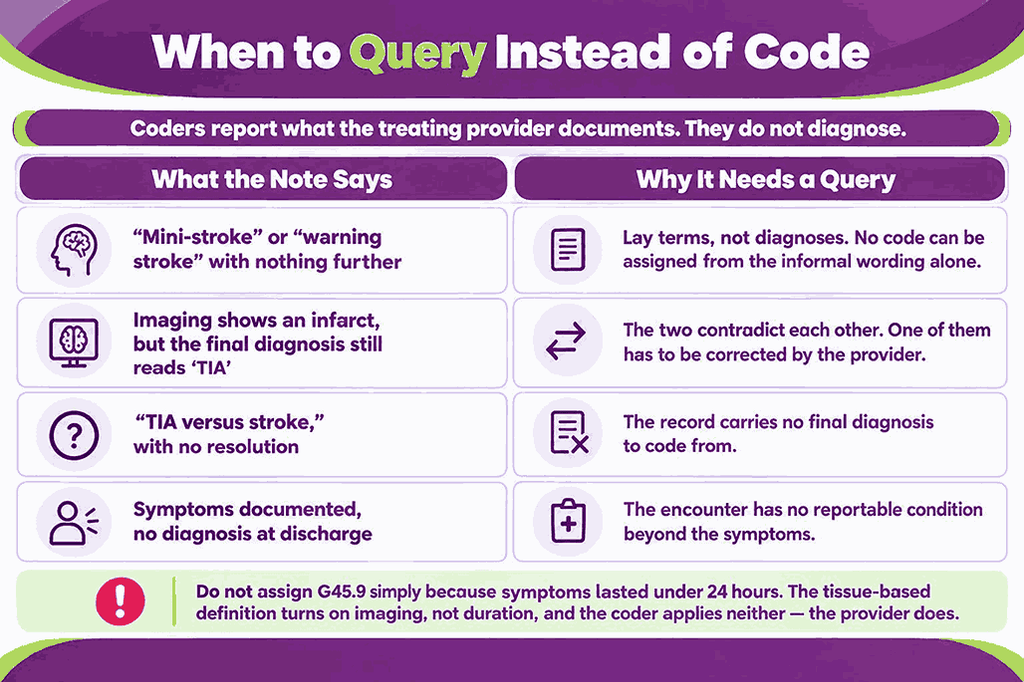
Coders do not diagnose; they report the condition the treating provider documents in the record. A coder should not assign G45.9 just because symptoms lasted less than 24 hours. When the diagnosis is unclear, a compliant query to the provider is the correct next step.
Send a query when:
- The note says only “mini-stroke” with no clear diagnosis.
- Imaging shows an infarct but the final diagnosis still reads “TIA.”
- The provider writes “TIA versus stroke” with no resolution.
- Symptoms are documented with no diagnosis at discharge.
The G45 Code Family: Which TIA Subcode Applies?
Category G45 sits among the neurology ICD codes in the nervous system chapter and covers transient cerebral ischemic attacks and related syndromes. It sits within the episodic and paroxysmal disorders block, G40 through G47, of the Tabular List. Seven billable codes sit under G45, and the table below shows when each one applies.
| Code | Official title | When it applies | Clinical clues (provider must name the syndrome) |
|---|---|---|---|
| G45.0 | Vertebro-basilar artery syndrome | Posterior circulation TIA | Diplopia, vertigo, ataxia, dysarthria |
| G45.1 | Carotid artery syndrome (hemispheric) | Anterior circulation TIA | One-sided weakness, aphasia, facial droop |
| G45.2 | Multiple and bilateral precerebral artery syndromes | More than one territory | Documentation names several vessels or both sides |
| G45.3 | Amaurosis fugax | Transient monocular vision loss | A curtain over one eye that clears |
| G45.4 | Transient global amnesia | Sudden, temporary memory loss | Provider documents transient global amnesia |
| G45.8 | Other transient cerebral ischemic attacks and related syndromes | Named syndrome without its own code | Subclavian steal syndrome |
| G45.9 | Transient cerebral ischemic attack, unspecified | Default TIA code | “TIA” with no territory documented |
G45.9: The Default TIA Code
G45.9 applies when the provider documents a TIA without naming an artery, territory, or syndrome. Its inclusion terms are TIA, transient cerebral ischemia NOS, and spasm of cerebral artery. Category G45 also carries Excludes1 notes for neonatal cerebral ischemia (P91.0) and transient retinal artery occlusion (H34.0-).
G45 Codes Do Not Describe Resolution Status
Some online guides describe G45.0 as TIA with complete resolution and G45.1 as TIA with residual symptoms. Those labels are wrong, because these codes describe arterial territory, not recovery. The official titles are vertebro-basilar artery syndrome for G45.0 and carotid artery syndrome (hemispheric) for G45.1.
Examples of correct selection:
- Twenty minutes of right arm weakness and aphasia, normal MRI, provider documents “TIA”: G45.9.
- Same event, provider documents “TIA, left carotid artery syndrome (hemispheric)”: G45.1.
- Five minutes of sudden vision loss in one eye, provider documents “amaurosis fugax”: G45.3.
TIA vs. Stroke vs. Stroke-Like Symptoms: How to Choose
The most common TIA coding error is picking the wrong family among G45, I63, and the R codes. The deciding factor is the provider’s final diagnosis, supported by imaging and the clinical course. The flowchart below shows how the paths separate, and the table lists the code families.
| Path | Code family | What triggers it | Example |
|---|---|---|---|
| TIA | G45.- | Provider documents TIA with no acute infarction | Brief aphasia, normal MRI |
| Ischemic stroke | I63.- | Infarct on imaging or stroke documented | Lasting deficit, DWI-positive lesion |
| Stroke, type not specified | I64 | Stroke documented without hemorrhage or infarction | Limited record detail |
| Stroke-like symptoms | R29.810, R47.01, R47.81 | Workup pending or inconclusive | Facial droop, slurred speech |
| Alternative diagnosis | Condition-specific code | Provider attributes symptoms to another cause | Migraine with aura, seizure |
When Imaging Shows an Infarct
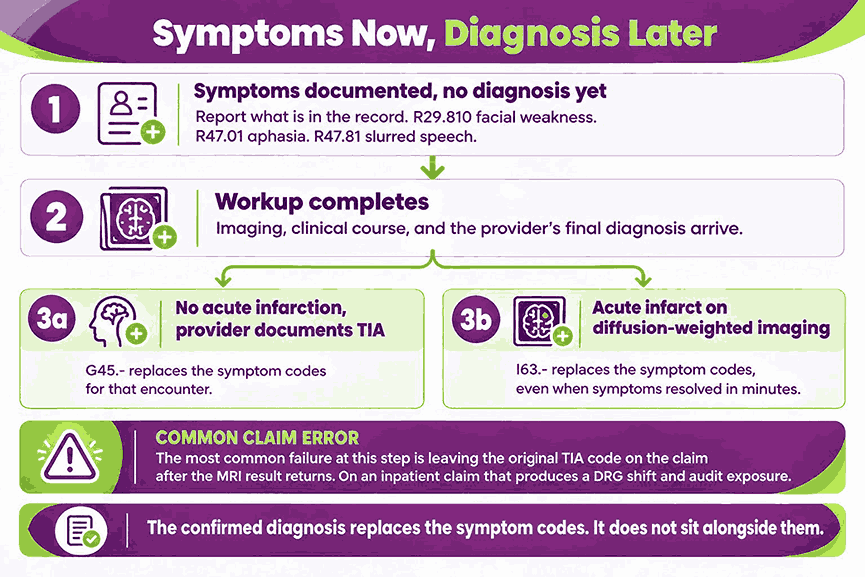
If MRI diffusion-weighted imaging shows an acute infarct, the clinical diagnosis becomes stroke, even when symptoms resolved quickly. The coder reports I63.- from the provider’s documentation and does not report G45 for that event. A common mistake here is leaving the original TIA code on the claim after the MRI result returns.
Stroke-Like Symptoms and “Rule-Out” Cases
Stroke-like symptoms, such as facial droop or slurred speech, are documented before the provider confirms a diagnosis. Report the documented symptoms with codes such as R29.810 for facial weakness or R47.01 for aphasia. Once the provider confirms TIA or stroke, the confirmed diagnosis replaces the symptom codes for that encounter.
Coding TIA by Care Setting
The same provider note can produce different codes depending on where the patient received care. Two sections of the ICD-10-CM Official Guidelines for Coding and Reporting control uncertain diagnoses. Section II.H covers inpatient admissions, and Section IV.H covers outpatient services, including the emergency department and observation.
| Setting | Guideline | How “suspected TIA” is handled | Result |
|---|---|---|---|
| Inpatient facility claim | Section II.H | Code as if established when documented as uncertain at discharge | G45.9 or a more specific G45 code |
| Hospital outpatient: ED, observation | Section IV.H | Do not code the uncertain diagnosis | Report symptoms until TIA is confirmed |
| Professional (physician) claim | Section IV.H | Do not code the uncertain diagnosis | Report symptoms or the confirmed diagnosis |
Worked Example: “Suspected TIA” in the Emergency Department
A synthetic example: a 68-year-old patient arrives after 15 minutes of slurred speech that resolved before triage. The emergency physician documents suspected TIA and refers the patient to outpatient neurology for urgent follow-up. Under Section IV.H, the claim reports the symptom, such as R47.81 slurred speech, instead of G45.9.
Documentation fix: if the physician documents a definitive diagnosis of TIA, G45.9 becomes reportable on the outpatient claim.
Personal History of TIA (Z86.73)
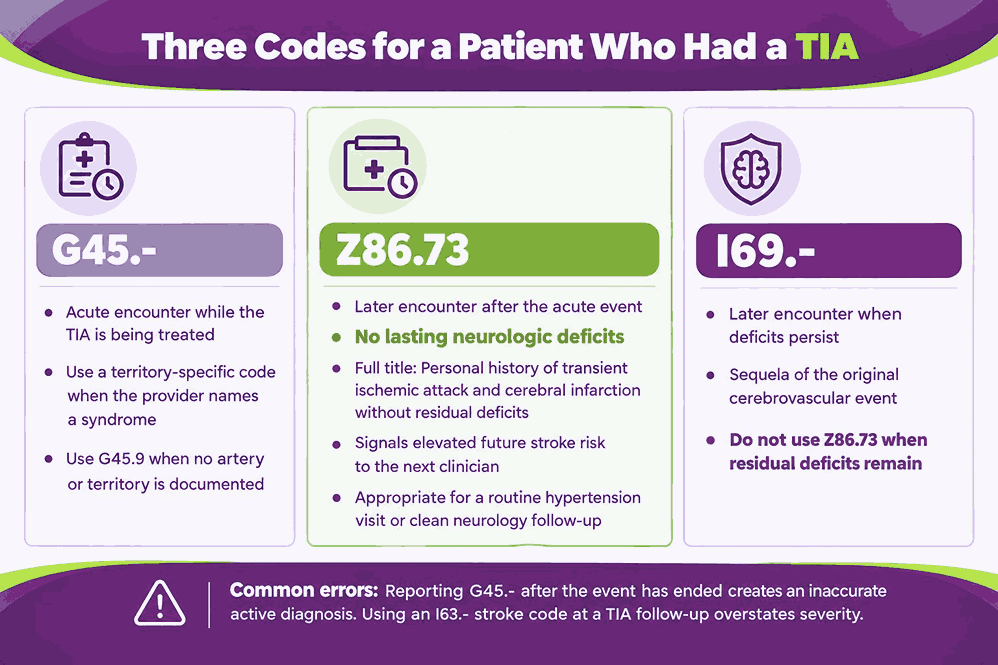
Code Z86.73 means personal history of transient ischemic attack and cerebral infarction without residual deficits. Report it at later encounters, after the acute event, when the patient has no lasting neurologic deficits. It tells the next clinician that the patient carries a higher future stroke risk.
When to use it:
- Use Z86.73 at a routine hypertension visit for a patient who had a TIA two years ago.
- Use Z86.73 at a neurology follow-up when no TIA is active and no deficits remain.
- Do not use Z86.73 for the acute TIA encounter. Use G45.- instead.
- Do not use Z86.73 when deficits persist. Use the I69.- sequela codes instead.
Codes Commonly Reported With TIA
A TIA claim rarely carries a single diagnosis, because providers document causes and risk factors too. Each condition receives its own code when the provider documents it and it affects the encounter. The table lists common companion diagnoses, with the rule that applies to each.
| Condition | Code | Coding note |
|---|---|---|
| Carotid artery stenosis | I65.21, I65.22, I65.23, I65.29 | Right, left, bilateral, or unspecified; laterality must be documented |
| Atrial fibrillation | I48.- | Select the documented type, such as I48.0 or I48.91 |
| Hypertension | I10 | Use combination codes when heart or kidney disease is documented |
| Type 2 diabetes | E11.- | Code the documented complications |
| Hyperlipidemia | E78.5 | Unspecified hyperlipidemia |
| Long-term antiplatelet use | Z79.02 | Report when the patient is on ongoing therapy |
| Long-term anticoagulant use | Z79.01 | Report when the patient is on ongoing therapy |
NIHSS note: the NIH Stroke Scale (NIHSS) score codes in R29.7- pair with acute stroke codes in the ICD-10-CM guidelines. They are not reported with G45. Providers can still record an NIHSS score in a TIA note for clinical purposes.
TIA Documentation Checklist for Providers
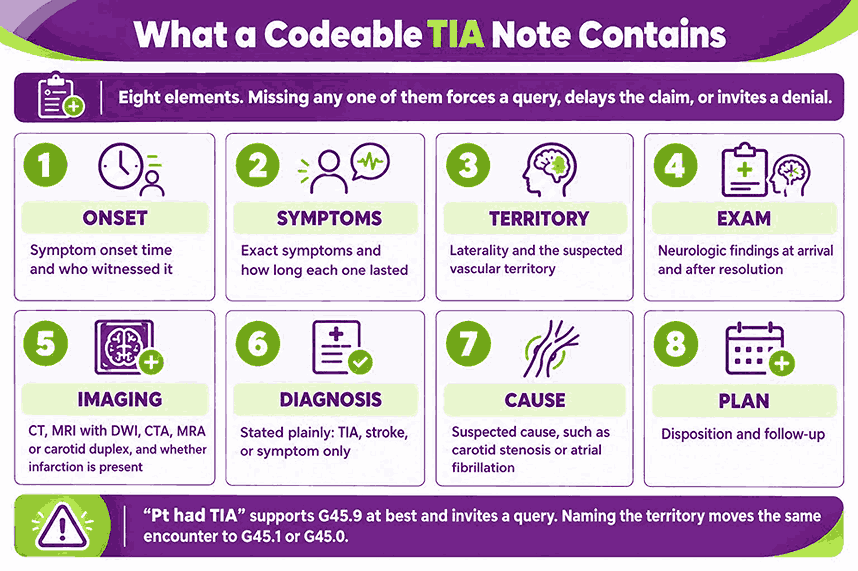
Specific documentation lets coders select the most accurate diagnosis code and supports medical necessity for services reported with neurology CPT codes during audits. Vague notes such as “patient had TIA” force queries, delay claims, and invite denials. Every TIA note should answer each of the questions in the checklist below.
A complete TIA note includes:
- Symptom onset time and who witnessed it
- Exact symptoms and how long each lasted
- Laterality and suspected vascular territory
- Neurologic exam findings at arrival and after resolution
- Imaging performed (CT, MRI with DWI, CTA, MRA, carotid duplex) and whether infarction is present
- A plainly stated final diagnosis: TIA, stroke, or symptom only
- Suspected cause, such as carotid stenosis or atrial fibrillation
- Disposition and follow-up plan
Good vs. Poor Documentation
| Poor documentation | Better documentation |
|---|---|
| “Pt had TIA.” | “Sudden right facial droop and slurred speech for 25 minutes, resolved before arrival. MRI brain with DWI negative for acute infarct. Final diagnosis: TIA, left carotid artery syndrome (hemispheric). Antiplatelet started. Neurology follow-up in 24 hours.” |
| Supports G45.9 at best, and invites a query | Supports G45.1 with imaging and a plain final diagnosis |
Common TIA Coding Errors and Denial Triggers
Most TIA claim problems trace back to a short list of repeatable and preventable errors. Each one can be caught with a pre-bill documentation review before submission to the payer, a step many practices outsource to neurology billing services when coding queries pile up. The table below pairs each error with its likely consequence and the correct fix.
| Error | Likely consequence | Fix |
|---|---|---|
| Reporting G45.- when imaging shows an infarct | Wrong diagnosis family, DRG shift on inpatient claims, audit exposure | Code I63.- from provider documentation |
| Reporting an I63.- stroke code at a TIA follow-up | Overstated severity and possible overpayment | Report Z86.73 at the follow-up |
| Reporting G45.- after the event has ended | Inaccurate active diagnosis and payer edits | Report Z86.73 |
| Using G45.9 when a territory is documented | Lost specificity and weaker data | Select the specific G45 code |
| Coding “probable TIA” on an outpatient claim | Non-compliant claim and denial risk | Report symptoms or query the provider |
| Treating G45.0 as “resolved” and G45.1 as “residual” | Incorrect code selection | Use the official code titles |
Reimbursement and Risk Adjustment for TIA
MS-DRG 069 for Inpatient TIA
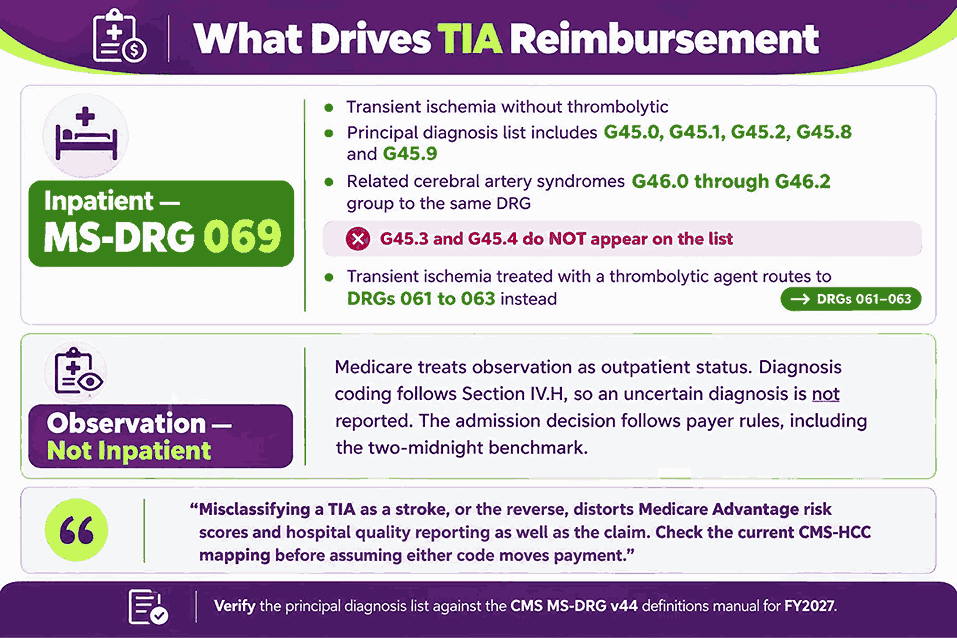
Inpatient stays with a principal diagnosis of TIA group to MS-DRG 069, transient ischemia without thrombolytic. In MS-DRG version 44 for FY2027, the principal diagnosis list includes G45.0, G45.1, G45.2, G45.8, and G45.9. Related cerebral artery syndromes, G46.0 through G46.2, group to the same DRG.
Details that matter:
- G45.3 and G45.4 do not appear on the DRG 069 principal diagnosis list.
- Transient ischemia treated with a thrombolytic agent groups to DRGs 061 to 063 instead, and the drug reported separately using neurology HCPCS codes
- Review the full list in the CMS MS-DRG v44 definitions manual.
Observation vs. Inpatient Status
Many TIA patients receive observation care, which Medicare treats as an outpatient status, not an inpatient admission. Diagnosis coding for observation claims follows Section IV.H, so uncertain diagnoses are not reported. Inpatient admission decisions follow payer rules, including the Medicare two-midnight benchmark.
Risk Adjustment and Quality Reporting
Stroke diagnoses can carry weight in Medicare Advantage risk adjustment and in hospital quality measures. Misclassifying a TIA as a stroke, or the reverse, distorts risk scores and quality reporting. Check the current CMS-HCC mapping for G45 and Z86.73 before assuming either code affects payment.
FY2027 ICD-10-CM Update: What It Means for TIA Codes
The FY2027 ICD-10-CM code set took effect on October 1, 2026, and applies through September 30, 2027. The CDC National Center for Health Statistics (NCHS) maintains the code set. The Centers for Medicare & Medicaid Services (CMS) hosts the official code files and the FY2027 guidelines.
Action items for coding and revenue cycle teams:
- Confirm G45.0 through G45.9 and Z86.73 against the FY2027 Tabular List and addenda.
- Update EHR templates and encoder rules that still reference FY2026 labels.
- Apply FY2027 codes to encounters dated on or after October 1, 2026.
Official files are available from the CDC NCHS ICD-10-CM page and the CMS ICD-10 codes page.
Frequently Asked Questions About TIA ICD-10 Coding
What is the ICD-10 code for TIA?
The ICD-10-CM code for TIA is G45.9, transient cerebral ischemic attack, unspecified. Use it when the provider documents a TIA without naming an artery or syndrome. More specific G45 codes apply when the provider documents a vertebro-basilar, carotid, or other named syndrome.
What is another name for a TIA?
A TIA is also called a mini-stroke, warning stroke, or transient cerebral ischemia NOS. Mini-stroke is an informal term, and it can mislead patients because a TIA leaves no permanent infarction. Providers should document TIA in the note so coders can assign a code without a query.
What is the ICD-10 code for personal history of TIA?
The code is Z86.73, personal history of TIA and cerebral infarction without residual deficits. Report it at encounters after the acute event when no neurologic deficits remain. If deficits persist, the I69 sequela codes apply instead, based on the original cerebrovascular event.
Can you code a suspected TIA?
The answer depends on the care setting and which section of the guidelines applies. Inpatient coders may code a suspected TIA as established when it is documented as uncertain at discharge. Outpatient and professional coders cannot, so they report the documented symptoms instead.
What is the difference between G45.9 and I63.9?
G45.9 reports a TIA, defined as an event without acute infarction. I63.9 reports cerebral infarction, unspecified, which is an ischemic stroke with no documented cause or vessel. An MRI showing an acute infarct moves the diagnosis to stroke, even when symptoms resolved quickly.
Does a TIA have to resolve within 24 hours to be coded G45?
Coders do not apply a time limit themselves; they report the provider’s documented diagnosis. Current clinical practice defines TIA as an event with no acute infarction on imaging. Most episodes resolve within an hour, but infarction on imaging moves the diagnosis to stroke.
Is G45.9 a billable code?
Yes, G45.9 is a billable ICD-10-CM code that can be reported for reimbursement. The category G45 is a header and cannot be reported on a claim by itself. Claims need a complete code such as G45.9, G45.1, or G45.0, never the three-character category alone.