The New Jersey Out-of-Network Consumer Protection, Transparency, Cost Containment, and Accountability Act is state law P.L. 2018, c. 32. It caps what patients owe at in-network cost-sharing when they receive inadvertent or emergency out-of-network care. It also gives out-of-network providers a binding arbitration path when carriers underpay those claims after negotiation.
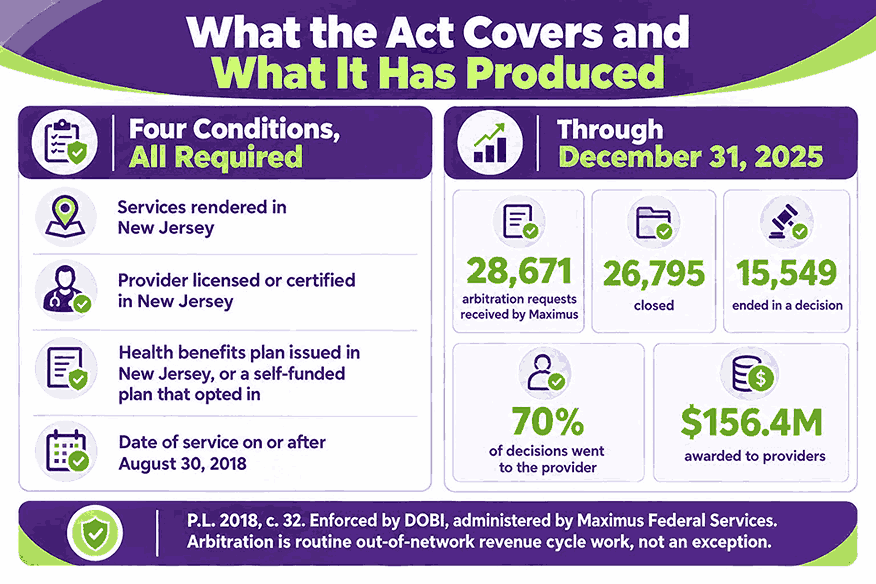
The New Jersey Department of Banking and Insurance (DOBI) enforces the Act and sets the rules carriers follow. Maximus Federal Services (Maximus) administers the arbitration program for DOBI and decides every eligible dispute on paper. Through December 2025, Maximus received 28,671 arbitration requests, and providers won 70% of the decided cases.
This guide covers who the Act protects, which dispute process governs a claim, and the current deadlines. It also covers Maximus filing steps, outcome data, disclosure duties, and differences from the federal No Surprises Act. It is part of our New Jersey medical billing laws guide for billing teams and practice administrators.
What the NJ Out-of-Network Act Covers and Excludes
The Act applies to services rendered in New Jersey by providers licensed or certified in the state. The patient must hold a health benefits plan issued in New Jersey, or a self-funded plan that opted in. Dates of service must fall on or after August 30, 2018, when the law took effect.
Three Service Types Under the Act
| Service type | What it means | Arbitration eligible | Example |
|---|---|---|---|
| Inadvertent out-of-network | Covered care from an out-of-network provider at an in-network facility when in-network care is unavailable there, including lab tests ordered in-network and run by an out-of-network lab | Yes | Out-of-network anesthesiologist at an in-network surgery center |
| Emergency or urgent | Care for an emergency condition, or for an urgent condition needing care within 24 hours | Yes | Visit to an out-of-network emergency department |
| Voluntary out-of-network | The patient knowingly, voluntarily, and specifically picks an out-of-network provider | No | Patient chooses an out-of-network surgeon with full knowledge |
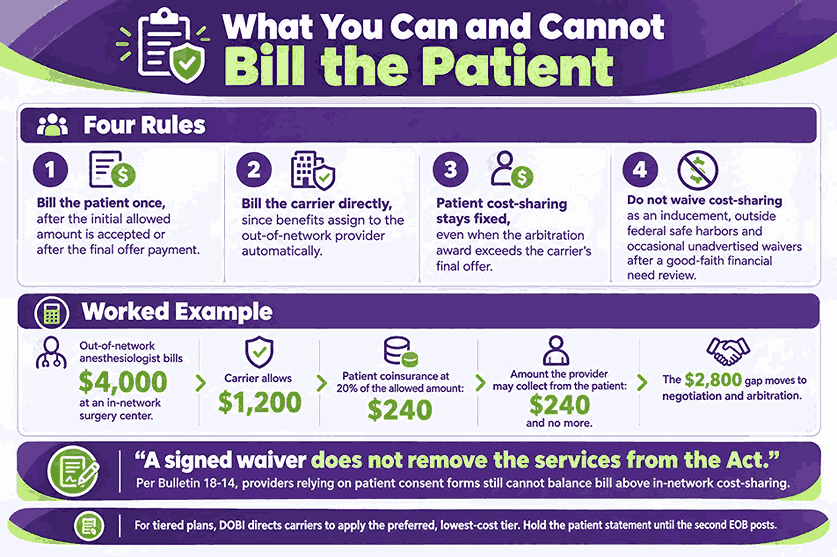
In practice, providers rarely qualify a service as voluntary, because the patient must have had a genuine in-network alternative. A signed waiver or consent form does not remove the services from the Act, according to DOBI Bulletin 18-14. Providers who rely on patient waivers still cannot balance bill above the in-network cost-sharing amount.
Plans and Services the Act Excludes
- Medicare, Medicare Advantage, and NJ FamilyCare (Medicaid)
- TRICARE supplement coverage
- Workers’ compensation, automobile medical payment, and personal injury protection coverage
- Dental, accident-only, disability, and long-term care plans
- Plans issued outside New Jersey, and self-funded plans that did not opt in, which follow other tracks
Key point: the Act follows the plan and the circumstance, not the specialty.
Plan eligibility is where many arbitration requests fail before anyone reviews the merits of the billing dispute. DOBI data show 1,141 dismissals for plans issued outside New Jersey and 1,603 for self-funded plans that never opted in. Confirm plan funding type and issuing state during patient eligibility verification, before any dispute deadline begins to run.
Which Process Governs Your NJ Out-of-Network Claim?
New Jersey runs four separate tracks for resolving payment and coverage disputes with health plans. DOBI Bulletin 21-14 lists them in an appeals and arbitration grid that many billing teams overlook. Filing under the wrong track wastes review fees and can leave you outside the filing window.
The Four Dispute Tracks
| Track | What it resolves | Who can start it | Who decides |
|---|---|---|---|
| OON arbitration (P.L. 2018, c. 32) | Final offer disputes for inadvertent and emergency or urgent services | Out-of-network providers and carriers, plus opted-in self-funded plans | Maximus arbitrators |
| Program for Independent Claims Payment Arbitration (PICPA) | Payment for covered services outside OON arbitration, including voluntary out-of-network claims | Network and out-of-network providers | Maximus, as the independent arbitration organization |
| Independent Health Care Appeals Program (IHCAP) | Medical necessity, experimental or cosmetic services, and in-plan exceptions | Patient, or provider with patient consent | Independent utilization review organizations |
| Federal Independent Dispute Resolution (IDR) | Out-of-network rate for federally regulated plans that did not opt into state arbitration | Out-of-network providers and those plans | Federally certified IDR entities |
PICPA and OON arbitration are mutually exclusive, according to DOBI Bulletin 18-14 and its attached grid. A claim that qualifies for OON arbitration must not be submitted to PICPA. Our guide to the NJ Prompt Pay Law explains how PICPA claims work and when they apply.
Self-Funded Plans and the Opt-In ID Card
Self-funded employer plans choose which dispute track applies, and the choice shows up on the member ID card. A plan that opts in follows the state process, like a fully insured carrier. A plan that does not opt in generally follows the federal Independent Dispute Resolution (IDR) process under the No Surprises Act (NSA).
Check these items on the card and the DOBI list:
- The word SELF-FUNDED in capital letters
- A line reading “NJ Arbitration – Yes as of” followed by an effective date
- The DOBI opt-in list, which also shows opt-out and coverage termination dates
The DOBI opt-in list changes every year, so check it again before each filing. Many employer plans opted out after the No Surprises Act began, and several county and school benefit funds opted in on January 1, 2026. Treat the list as a living reference, not a one-time lookup.
Balance Billing and Patient Billing Rules Under the Act
The Act limits patient liability to network-level cost-sharing for all inadvertent and emergency out-of-network services. Cost-sharing means the network-level deductible, copayment, or coinsurance applied to the carrier’s allowed amount, not a fixed dollar figure. For tiered plans, DOBI directs carriers to apply the preferred, lowest-cost tier to these services.
Four Billing Rules Providers Must Follow
- Bill the patient once. DOBI expects a single bill for cost-sharing, sent after the initial allowed amount is accepted or after the carrier’s final offer payment.
- Bill the carrier directly. Benefits for these services assign to the out-of-network provider automatically, and the carrier pays the provider directly.
- Accept that patient cost-sharing stays fixed. The patient’s liability does not rise after arbitration, even when the award exceeds the carrier’s final offer.
- Do not waive cost-sharing as an inducement. Federal safe harbors are one exception, and unadvertised, occasional waivers after a good-faith financial need review are the other.
Illustrative example: An out-of-network anesthesiologist bills $4,000 at an in-network surgery center, and the carrier allows $1,200. With 20% coinsurance, the patient owes $240, and the provider cannot collect any more from the patient. The gap between billed and allowed amounts moves to negotiation and arbitration.
In practice, the second EOB sets the patient’s final liability, and the carrier’s final offer determines that figure. If you reject the initial allowed amount, hold the patient statement until the second EOB posts. That sequence matches DOBI’s single-bill expectation and prevents conflicting patient statements from going out.
Collection timing is a separate question that depends on New Jersey’s medical debt law. After the patient balance posts, a 120-day pre-collection hold may apply to your workflow. Our guide to the Louisa Carman Medical Debt Relief Act explains the full collection sequence.
The NJ Out-of-Network Claim Lifecycle and Current Deadlines
The claim lifecycle has seven steps, and each step carries its own deadline for providers and carriers. Public Law 2022, c. 74 extended the negotiation period from 30 to 60 days, effective in late October 2022. Older alerts and DOBI Bulletin 18-14 still show 30-day windows, which no longer match current Maximus guidance.
Deadlines at Each Stage
| Step | Who acts | Deadline | What happens |
|---|---|---|---|
| 1. Initial claim response | Carrier | Within 20 days of receiving the claim | Pays billed charges, or pays an initial allowed amount and notifies the provider |
| 2. Rejection of the initial amount | Provider | Within 60 days of the carrier’s notice | Missing the window bars arbitration for the claim |
| 3. Negotiation | Provider and carrier | 60 days from the notice | A settlement ends the dispute and triggers a revised EOB |
| 4. Final offer | Carrier | Within 7 days after negotiation ends | Carrier states its final offer, pays its share, and issues a second EOB |
| 5. Arbitration request | Provider or carrier | Within 60 days of the final offer due date | Application filed with Maximus |
| 6. Decision | Arbitrator | Within 30 days of a complete application | Arbitrator selects one final offer |
| 7. Award payment | Carrier | Within 20 days of the decision | Interest of 12% per year starts on day 21 |
What changed in 2022: The negotiation period doubled from 30 to 60 days, and DOBI now certifies arbitrators rather than relying on American Arbitration Association (AAA) certification.
What Each EOB Means
| Document | When it arrives | What it tells you |
|---|---|---|
| Initial EOB and remittance | Within 20 days of the claim | Allowed amount, notice that billed charges exceed it, rejection rights, and patient cost-sharing |
| Second EOB | Within 7 days after negotiation ends | Carrier’s final offer, added payment, final patient cost-sharing, and arbitration rights |
| Final EOB | Within 30 days of an arbitration decision | Award amount and revised payment, with no increase in patient liability |
If the carrier never issues a second EOB, the provider’s arbitration filing deadline does not expire, per Maximus. Log every follow-up request so you can show the carrier missed the seven-day final offer window. Repeated misses belong in a complaint to DOBI, which enforces the Act.
How to File NJ Out-of-Network Arbitration With Maximus
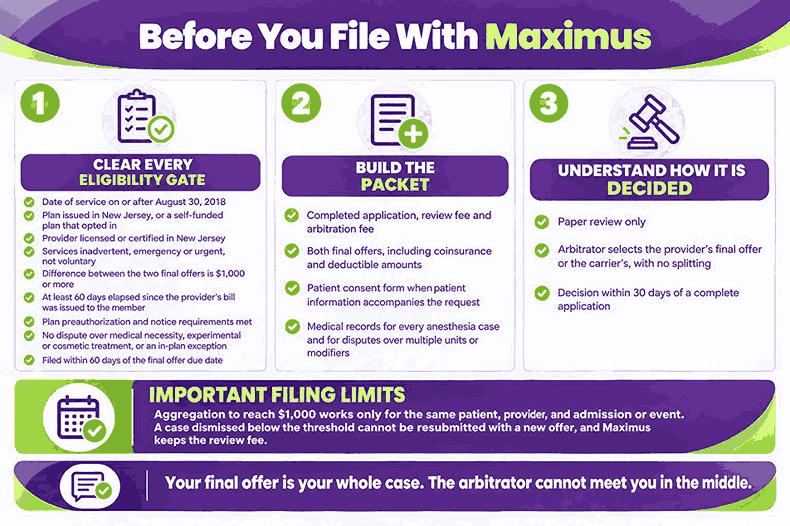
Providers file through the Maximus portal using the c. 32 application for inadvertent, emergency, or urgent out-of-network services. The request must state the provider’s final offer and the carrier’s final offer, including coinsurance and deductible amounts. Maximus then reviews eligibility and completeness, and it acknowledges receipt within seven business days.
Eligibility Checklist
- Date of service on or after August 30, 2018
- Plan issued in New Jersey, or a self-funded plan that opted in
- Provider licensed or certified in New Jersey
- Services were inadvertent or emergency or urgent, not voluntary
- Difference between the final offers is $1,000 or more
- Plan preauthorization and notice requirements were met
- No dispute over medical necessity, experimental or cosmetic treatment, or an in-plan exception
- Request filed within 60 days of the final offer due date
What Goes in the Packet
- The completed application, review fee, and arbitration fee
- Both final offers, including coinsurance and deductible amounts
- The patient consent form, when patient information accompanies the request
- Medical records for every anesthesia case and for disputes over multiple units or modifiers
Aggregation helps smaller claims reach the $1,000 threshold, but only for the same patient, provider, and admission or event. A case dismissed for falling below $1,000 cannot be resubmitted with a new final offer. Confirm the amount clears the threshold first, because Maximus keeps the review fee when it rejects an application.
Packet assembly is the step practices underestimate. Anesthesia records, unit and modifier documentation, and both final offers have to be pulled and indexed inside the filing window, which is why many groups fold arbitration work into their broader medical billing services in New Jersey rather than handling each case ad hoc.
How the Arbitrator Decides
Arbitration is a paper review, and only documents accepted by Maximus can support the decision. The arbitrator must select either the provider’s final offer or the carrier’s final offer, with no splitting. The decision arrives within 30 days of a complete application and includes detailed written findings.
- Arbitration costs are split between the parties unless the carrier acted in bad faith
- The decision does not award legal fees
- The award is binding and can be vacated or modified only under N.J.S.A. 2A:24-1
Illustrative example: The provider’s final offer is $3,000 and the carrier’s final offer is $1,800. The arbitrator picks one of them. The award is $3,000 or $1,800, never a figure in between.
Practical rule: your final offer is your whole case. Build it around documented value, since the arbitrator cannot meet you in the middle.
What 28,671 Arbitration Requests Reveal About Outcomes
DOBI publishes outcome data for every arbitration request under the Act, with a new report each January. Through December 31, 2025, Maximus had closed 26,795 of the 28,671 requests it received since 2018. Of those closed cases, 15,549 ended in decisions, 6,038 in ineligibility dismissals, and 5,208 in withdrawals.
Filing Volume Keeps Climbing
DOBI’s year-end reports imply about 8,250 new requests in 2025, up from roughly 4,856 in 2024. That is growth of about 70% in one year, based on our calculation from cumulative totals. At this pace, arbitration is a routine part of out-of-network revenue cycle work rather than an exception.
Win Rates and Award Values
| Outcome | Decided cases | Share of decisions | Total awarded | Average award |
|---|---|---|---|---|
| Provider prevailed | 10,860 | 70% | $156.4M | About $14,400 |
| Carrier prevailed | 4,689 | 30% | $29.7M | About $6,300 |
A 70% win rate does not mean every provider offer wins, because the arbitrator picks one number. Carriers still prevailed in roughly three of every ten decisions, so an offer far above documented value carries real risk. Withdrawals account for about one in five closed cases, which shows many disputes end without a decision.
Why Cases Get Dismissed
Dismissals can cost review fees and staff time, and they never produce payment for the provider. Plan funding type, issuing state, and negotiation timing account for most ineligible dismissals in DOBI’s data. Each of these is a front-end check that your billing team can run before anyone files.
After the Award: Payment, Interest, and Escalation
If the provider prevails, the carrier must pay the difference between its prior payment and the award within 20 days. Interest accrues at 12% per year beginning on the 21st day after the decision date. Interest ends at payment or 150 days after claim receipt, whichever comes first, unless the parties agree otherwise.
What Happens to the Patient
- The carrier pays the award without increasing the patient’s cost-sharing
- The carrier notifies the patient through a final EOB within 30 days of the decision
- The patient’s liability stays at the amount shown on the second EOB
- The provider cannot bill the patient for any additional amount
Illustrative interest math: An unpaid award difference of $6,000 accrues about $1.97 per day at 12% per year.
When a carrier misses the 20-day deadline, calculate the 12% interest and request it with the payment. Document the decision date, the payment date, and the interest owed in your AR notes. Repeated late payment belongs in a DOBI complaint. Note that arbitration award interest runs separately from the prompt-pay interest a carrier owes on the original claim, so a single claim can carry two interest calculations.
Provider Disclosure Duties and Penalties
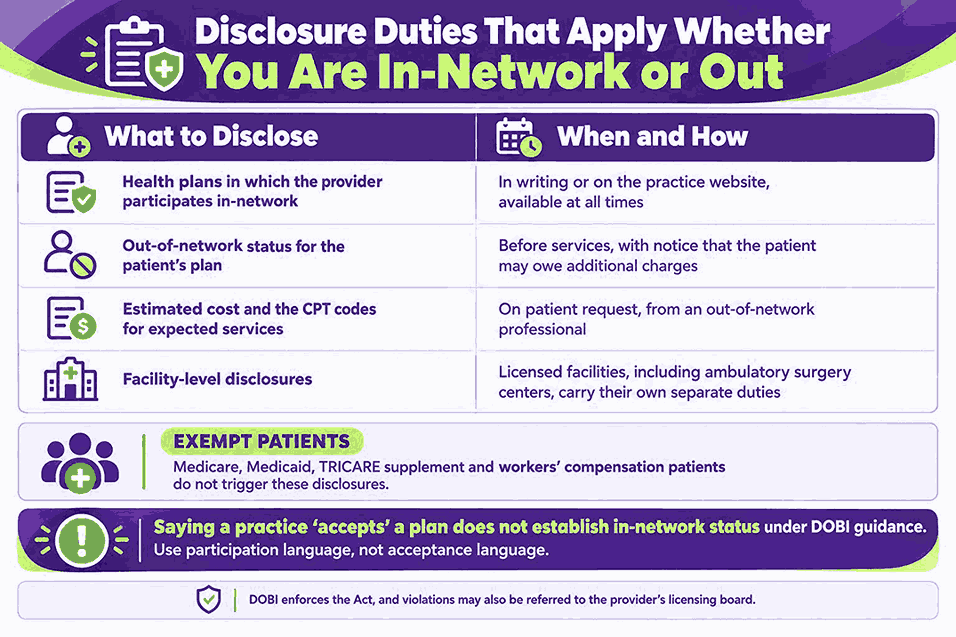
Disclosure duties apply to licensed health care professionals who bill New Jersey health benefits plans, whether in-network or out-of-network. Licensed facilities, including ambulatory surgery centers, carry their own disclosure duties under the Act. Patients covered by Medicare, Medicaid, TRICARE supplement, or workers’ compensation do not trigger these disclosures.
What Providers Must Disclose
- The health plans in which the provider participates in-network, in writing or on a website
- Out-of-network status for a patient’s plan, with notice that the patient may owe additional charges
- An estimated cost and the CPT codes for expected services, when a patient requests them from an out-of-network professional
Watch the wording: Saying a practice accepts a plan does not establish in-network status under DOBI guidance.
Enforcement and Penalties
DOBI enforces the Act, and professionals who violate it may also face referral to their licensing board. Published legal summaries cite penalties up to $100 per day per violation, capped at $2,500 per occurrence, for individual professionals. DOBI logged 12 out-of-network charge complaints in 2025, so payment disputes mostly play out in arbitration.
NJ Out-of-Network Act vs. the Federal No Surprises Act
Both laws protect patients from balance billing for emergency services and out-of-network care at in-network facilities. They differ on plan coverage, dispute timelines, and the body that decides the payment amount. DOBI says state law stays operative where it does not prevent the federal law from applying.
Side-by-Side Comparison
| Feature | NJ Out-of-Network Act | Federal No Surprises Act |
|---|---|---|
| Plans covered | NJ-issued insured plans, multiple employer welfare arrangements (MEWAs), the State Health Benefits Program (SHBP), the School Employees’ Health Benefits Program (SEHBP), and opted-in self-funded plans | Most private plans, including self-funded plans that did not opt into NJ arbitration |
| Who decides | Maximus arbitrators under DOBI contract | Federally certified IDR entities, chosen by agreement or at random |
| Negotiation window | 60 days from the carrier’s notice | 30 business days of open negotiation |
| Filing window | 60 days from the final offer due date | 4 business days after open negotiation ends |
| Decision basis | One of two final offers, with detailed written findings | One of two offers, weighed against the qualifying payment amount (QPA) and other permitted information |
| Cost split | Split between the parties unless the carrier acted in bad faith | Administrative fees from both parties, with the losing party generally paying the IDR entity fee |
Self-funded plans are a leading source of routing errors, and DOBI’s dismissal data confirm the pattern. A plan’s opt-in status decides the track, and some plans changed status after federal rules began in 2022. Check the DOBI opt-in list and the member ID card before choosing between state arbitration and federal IDR.
Specialty Playbooks for NJ Out-of-Network Billing
Specialty determines how often inadvertent out-of-network claims arise and which records matter most in a dispute. Hospital-based specialties carry high exposure because patients rarely choose the anesthesiologist, radiologist, or pathologist involved in their care. Surgical specialties face the issue when an in-network facility uses an out-of-network assistant or on-call surgeon.
Where Exposure Appears by Specialty
| Specialty or setting | Typical trigger | Records to keep |
|---|---|---|
| Anesthesiology | Out-of-network anesthesia at an in-network hospital or surgery center | Anesthesia record, time units, and modifiers |
| Radiology, pathology, and laboratory | Hospital-based reads, or lab tests ordered in-network and run by an out-of-network lab | Test order, performing lab, and network status of each |
| Emergency and hospital medicine | Emergency or urgent care at an out-of-network facility | Triage notes, admission dates, and safe transfer date |
| Pain management and orthopedics | Out-of-network assistant or on-call surgeon at an in-network surgery center | Operative notes, facility network status, and consent forms |
| Cardiology | Cath lab or emergency intervention at an in-network hospital | Procedure log and emergency documentation |
| Psychiatry | Emergency psychiatric care, since the emergency definition covers psychiatric disturbances and substance abuse symptoms | Crisis assessment and admission records |
| OBGYN | Labor and delivery when no time exists for a safe transfer | Labor timeline and transfer assessment |
DOBI publishes facility participation by carrier, and those figures show where network gaps are widest. Ambulatory surgical center participation ranges from 77.8% to 99.5%, while hospital participation ranges from 92.6% to 100%. Confirm facility and provider participation by carrier before scheduling, because a network gap changes which track applies.
Out-of-Network Billing Workflow for NJ Practices
A reliable workflow tags every New Jersey claim at eligibility and tracks each deadline from that tag. Manual tracking breaks down because the clocks start on different events and run in different time units. DOBI recorded 1,027 dismissals tied to negotiation or timing failures, which deadline alerts are built to catch.
Eight-Step Workflow
| Step | Trigger | Action |
|---|---|---|
| 1. Tag plan type | Every New Jersey claim | Record insured or self-funded status, issuing state, and ID card opt-in notation |
| 2. Flag the claim | Out-of-network provider at an in-network facility, or an emergency service | Mark it inadvertent or emergency, and place a hold on patient billing |
| 3. Watch day 20 | No carrier response within 20 days | Follow up, since the carrier must pay billed charges or send an initial allowed amount |
| 4. Reject in time | Initial allowed amount received | Send the rejection within 60 days by certified mail, email, or the carrier’s online form |
| 5. Negotiate | Rejection sent | Document each offer within the 60-day window |
| 6. Track the final offer | Seven days after negotiation ends | Confirm the second EOB and payment arrived, or log the miss |
| 7. File | Final offer disputed | Confirm the $1,000 difference, build the packet, and file within 60 days |
| 8. Collect the award | Decision issued | Track payment within 20 days and bill 12% interest when late |
Every trigger in this workflow is either a date or a document, so automation fits well. An AI agent can read remittances, tag plan type, calculate each deadline, and draft the Maximus packet for review.
Billing Partner Checks
- A valid DOBI third-party billing service certification for New Jersey work
- Out-of-network flagging inside claim scrubbing, before submission
- A deadline calendar for every flagged claim
- Experience assembling Maximus packets with the required records
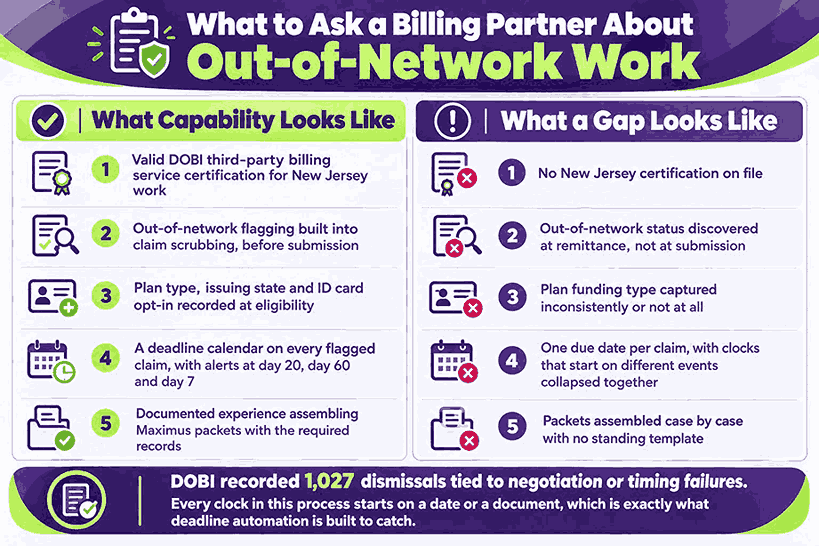
Ask every prospective partner how it tracks out-of-network deadlines, and run the same four checks across the medical billing companies in New Jersey you are considering before you shortlist. Network participation also shapes your exposure, since fewer credentialing gaps mean fewer out-of-network claims, so confirm your partner handles payer enrollment and credentialing as part of the same workflow.
Frequently Asked Questions
Does New Jersey have a surprise bill law?
Yes, New Jersey enacted P.L. 2018, c. 32 in June 2018, effective August 30, 2018. It bars balance billing for inadvertent and emergency out-of-network services and creates binding arbitration for payment disputes. Federal No Surprises Act protections apply alongside the state law for plans it does not govern.
What is the minimum dispute amount for NJ out-of-network arbitration?
The difference between the provider’s final offer and the carrier’s final offer must be $1,000 or more. Claims can be aggregated only for the same patient, provider, and admission or event. A case dismissed for falling below the threshold cannot be resubmitted with a new offer.
Who administers New Jersey out-of-network arbitration?
Maximus Federal Services administers the program under contract with DOBI, and it also runs PICPA. Providers file through the Maximus portal and pay a review fee and an arbitration fee. Arbitrators decide on written submissions, and DOBI certification replaced American Arbitration Association certification in 2022.
Does the NJ Act apply to self-funded plans?
The binding state process applies to self-funded plans only when the plan opts in through its member ID card. Plans that do not opt in generally follow federal IDR for provider payment disputes. A separate state track lets balance-billed members or providers seek an award that does not bind the plan.
How long does a provider have to reject the carrier’s initial allowed amount?
A provider has 60 days from receipt of the carrier’s notice to reject the initial allowed amount. Missing that window bars arbitration for the claim, according to Maximus guidance. Older guidance listed 30 days, so check that your internal calendars reflect the 2022 amendment.
What happens if the carrier misses the final offer deadline?
If the carrier never issues the second EOB, the provider’s arbitration filing deadline does not expire. Document each follow-up request and keep the original claim, remittance, and notice records on file. Report repeated missed deadlines to DOBI, which enforces the Act against carriers and providers alike.
Can a patient be balance billed for inadvertent out-of-network care in New Jersey?
No, providers cannot bill patients above in-network cost-sharing for inadvertent or emergency out-of-network services. Patients cannot waive this protection by signing a consent form, according to DOBI Bulletin 18-14. Balance billing can trigger a complaint to the provider’s licensing board or the Department of Health.