Say a local hospital offers your practice a place on its Epic system, and you run on Veradigm today. Before you answer, here is what the switch would change.
Epic is built for health systems and large groups, while Veradigm is built for independent practices. Allscripts became Veradigm in January 2023 after selling its hospital business in 2022. So this page sets Epic against what Veradigm sells to practices today.

Claims, clearinghouse setups, and open A/R don’t move on their own, and switching can slow billing before it improves. Here is how the two compare on access, pricing, billing, and how a move affects your revenue.
Epic vs Veradigm: A Quick Glance
The table below shows how Epic and Veradigm differ across features such as pricing, market positioning, billing system, and more.
| Attribute | Epic | Veradigm (formerly Allscripts) |
|---|---|---|
| Built for | Health systems and large groups | Independent practices |
| How a practice gets access | Community Connect through a host hospital, or Garden Plot for groups over 40 providers | Direct subscription |
| Where it runs | The host hospital’s Epic system, or Epic-hosted under Garden Plot | Cloud-based |
| Published pricing | None | Practice Fusion at $149 to $199 per provider per month, Veradigm EHR by quote |
| Billing system | Resolute, with clearinghouse partners such as Availity bundled into Garden Plot | Veradigm Practice Management with the Payerpath clearinghouse |
| Market position | 43.7% of US acute care hospitals (KLAS, 2026) | Independent practices only, since selling its hospital business in 2022 |
| Ownership | Privately held | Delisted from Nasdaq on February 28, 2024, now traded over the counter |
| Best for | A group with a host hospital or over 40 providers | An independent practice that wants its own system |
How Does a Visit Become a Paid Claim in Each One?
Both systems can bill cleanly. The chain behind a paid claim is built differently in each, so follow one visit from the schedule to the payer.
| Step | Epic | Veradigm |
|---|---|---|
| 1. Schedule | Prelude registers the patient, and Cadence schedules the visit | Practice Management schedules the visit |
| 2. Check coverage | Resolute handles insurance verification | Payerpath checks eligibility in real time |
| 3. Document | EpicCare records the care | Veradigm EHR records the care |
| 4. Send the charge | Charge Router sends the charge to Resolute | The charge passes to Practice Management for charge entry |
| 5. Build the claim | Resolute builds the claim | Practice Management generates the claim, and Payerpath scrubs it against payer edits |
| 6. Send and collect | A clearinghouse carries the claim, and Resolute handles denials and collections | Payerpath routes the claim, ERAs post in Practice Management, and Payerpath denial tools flag problems |
Both chains can bill cleanly. They fail in different places.
In Epic, claims get delayed when registration or Resolute is set up poorly because later steps read from them.
In Veradigm, much depends on the handoffs between the EHR, practice management, and Payerpath. Payerpath arrives with default rules, and practices that never tune them can let payer-specific edits and modifier logic pass through unchecked. Payerpath’s own site puts the cost of correcting one rejected or denied claim at nearly $25.
Both systems check coverage, but in different places. A check that nobody reviews before the visit still ends in a denial in either system.
Who Controls the Billing Setup in Each System?
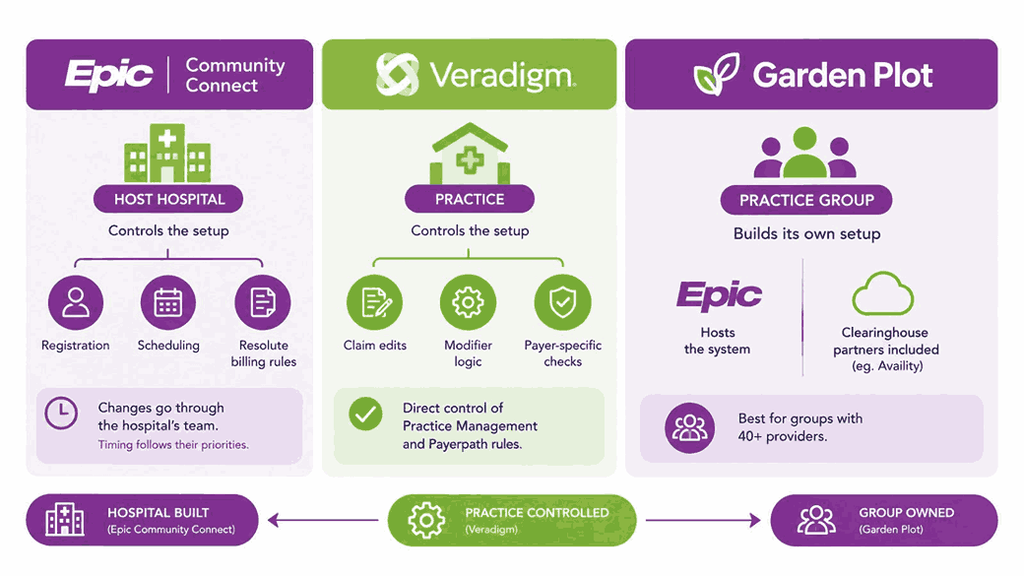
The host hospital controls the setup in Epic Community Connect, while the practice controls it in Veradigm. That split decides who can change a payer rule when a denial pattern appears.
Who Owns the Build in Epic?
A Community Connect practice works inside the hospital’s build, which covers registration, scheduling, and Resolute billing rules. Changes go through a request to the hospital’s team, and timing follows the hospital’s priorities instead of the practice’s calendar.
A custom edit for one payer usually needs the host’s approval, which is among the Epic EHR challenges independent practices face.
Who Owns the Setup in Veradigm?
A practice on Veradigm owns its Practice Management and directly controls Payerpath rules. Staff can adjust claim edits, modifier logic, and payer-specific checks without waiting on an outside team. Control pays off only when someone tunes the default rules that arrive out of the box.
Where Does Garden Plot Fit?
Garden Plot sits between the two for groups with over 40 providers. Epic hosts the system, and the group builds its own instead of borrowing a hospital’s. Clearinghouse partners such as Availity come bundled into the package.
What Epic and Veradigm Will Cost Your Practice?
Neither system has one published price for a full setup. Veradigm shows entry pricing for Practice Fusion, while Epic prices through the host agreement or Garden Plot terms.
The table shows how each route is priced. Epic figures are third-party estimates, so treat them as a range to test against a written quote.
| Route | How it is priced | Figure |
|---|---|---|
| Epic Community Connect | Fees set by the host hospital | No published price, estimated at $500 to $1,000 per provider per month |
| Epic Garden Plot | Subscription from Epic for groups over 40 providers | No published price, estimated at $2,000 to $10,000 a month |
| Veradigm Practice Fusion | Per provider per month | $149 to $199 |
| Veradigm EHR | By quote | No published price |
What Does Epic Cost?
Epic publishes no pricing, so Epic EMR cost varies by arrangement. A Community Connect practice pays under its host hospital agreement, and a Garden Plot group negotiates its own terms. Interfaces to outside labs, imaging, and billing tools add to either total.
Community Connect fees come from the host, not Epic. When a host donates access under the federal EHR exception, the practice must pay at least 15% of the host’s cost, and the host cannot lend that money.
Garden Plot is open to independent groups with over 40 providers, and Epic hosts the system and sets the subscription. Published estimates run $2,000 to $10,000 a month, and Epic has not confirmed a figure.
Why Do Epic Price Quotes Disagree?
Quotes disagree because they count different units. Some price per provider per month, others per user, and others per whole clinic.
Totals range from $2,400 a year for one user to $48,000 to $144,000 for a clinic. Converting every quote to a yearly total keeps the figures aligned.
What Does Veradigm Cost?
Practice Fusion runs $149 to $199 per provider per month. Veradigm EHR is priced by quote, so practices should request pricing that matches their provider count and modules.
Standalone ePrescribe starts at $59 per prescriber per month for practices that need only e-prescribing. A written quote should list modules, users, and interfaces, since Veradigm EHR has no public price.
Which Costs Sit Outside the License?
Four costs apply to both systems. Clearinghouse fees, staff training, data migration, and a temporary dip in billing speed all land during the switch. Open claims keep waiting while staff learn new screens, so budget for these before weighing license prices.
| Cost | What it covers | Planning note |
|---|---|---|
| Training and staff time | Classes, practice time, and covering patients while staff train | Budget staff hours, not only fees |
| Interfaces | Connections to labs, imaging, billing, and portals | Each one is scoped and priced on its own |
| Data cleanup and migration | Preparing old records before they move | Poor data quality raises the cost of the move |
| Go-live support | Extended hours and hands-on help in the first weeks | Ask if it sits in the quote or is billed separately |
Epic adds two items of its own. Read-only users are estimated at $500 to $1,000 each, and licensed deployments model maintenance at 15% to 20% of license cost a year.
How Long Does Billing Take to Stabilize After a Switch?
HFMA puts stabilization at 30 to 90 days after go-live, so budget for a dip in cash flow during that window. A 2017 Moody’s review of 39 hospitals found median operating cash flow fell 10.1% in the year of a new EHR and revenue cycle go-live.
Practices work at a different scale, but the same charge capture, claim submission, and payment posting steps are at risk.
What Does Each One Offer Beyond Billing?
Billing is only half of the daily experience, so clinical tools matter too. Documentation, the patient portal, e-prescribing, and reporting differ in each system, and in Community Connect the host shapes which Epic EMR features a practice sees.
| Area | Epic | Veradigm |
|---|---|---|
| Documentation | EpicCare charting, built by the host or group | Veradigm EHR with one-click templates and care plan tracking |
| Patient portal | MyChart for scheduling, messaging, and video visits | Veradigm EHR patient portal |
| E-prescribing | Surescripts, with EPCS through a host-selected authentication tool | ePrescribe with EPCS, PDMP checks, and electronic prior authorization |
| Reporting | Reporting Workbench and Clarity | MIPS dashboard and reporting support in Practice Fusion |
How Does Documentation Compare?
Templates in Veradigm EHR draw on earlier orders from similar visits, and the system tracks care plans and patient goals. Charting in Epic follows the host’s build, so a Community Connect practice often adopts standard templates instead of designing its own.
Which Portal and E-Prescribing Tools Come With Each?
Patients in Epic use MyChart for scheduling, messaging, and video visits, while Care Everywhere exchanges records with other Epic organizations. Epic sends prescriptions through Surescripts, and hosts choose the two-factor tool for controlled substances.
Veradigm pairs its portal with ePrescribe, which supports EPCS, PDMP checks, and electronic prior authorization inside the prescribing workflow.
How Does Reporting Differ?
Epic reports run through Reporting Workbench and Clarity. A Community Connect practice may need to request a custom report from the host’s analytics team. Veradigm practices pull reports from their own system, and Practice Fusion adds a MIPS dashboard.
What Happens to Open Claims and A/R If You Switch?
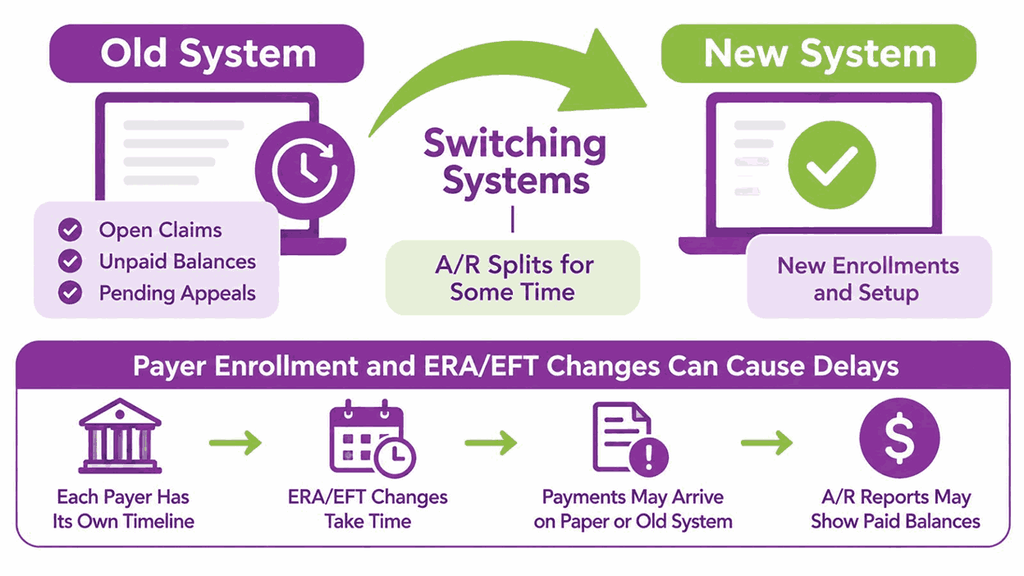
Open claims and A/R stay in the old system, so a switch splits your revenue cycle for a period.
What Stays Behind in the Old System?
Submitted claims, unpaid balances, and pending appeals remain in the old system. Payers answer against those records, so staff must keep access active until the last payment posts.
Clearinghouse enrollments usually need to be redone for the new setup. Nothing about them moves automatically.
Where Do Payer Enrollment and ERA/EFT Changes Cause Delays?
Each payer processes ERA and EFT changes on its own schedule. Until an enrollment is confirmed, remittances can arrive on paper or at the old destination.
Payments sent there sit unposted until someone finds them, and A/R reports then show balances that are already paid.
How Can You Keep Cash Flowing During the Cutover?
- Map every payer to its clearinghouse and ERA/EFT enrollment status.
- Submit enrollments before go-live so approvals land close to the cutover date.
- Freeze charge entry in the old system on a set date and keep working its open A/R.
- Run a small test batch of claims in the new system before full volume.
- Review rejections daily during the first weeks.
- Track a separate A/R report for each system until the old one reaches zero.
Practices that hand this sequence to a billing partner already working in both systems free their staff to learn the new screens.
Which One Fits Your Practice? Epic or Veradigm?
No single answer applies to every practice. Control, referral ties, and tolerance for a temporary billing dip usually decide it.
| Your Situation | Likely Fit |
|---|---|
| A local hospital offers a Community Connect seat, and you want shared records with it | Epic through the host |
| Your group has over 40 providers and wants its own build | Epic through Garden Plot |
| You want to own your billing rules and choose your own vendors | Veradigm |
| You want a published entry price per provider | Veradigm Practice Fusion |
| You tune payer edits and modifier logic in-house | Veradigm |
How Does Transcure Support Practices on Epic and Veradigm?
Our AAPC-certified billers and coders work inside Epic and Allscripts, so practices keep the system they chose and gain a billing team that already knows it.
We deliver a 98% first-pass clean claims rate, and CLAIR, our AI claim-scrubbing agent, checks each claim against payer edits before submission. That matters on Veradigm, where default Payerpath rules need tuning, and on Epic, where setup errors travel downstream.
During a switch, our team handles clearinghouse and EDI enrollments and keeps A/R follow-up moving in the old system until balances clear.
Pricing follows collections, since we charge 5% of collected revenue.
FAQs
What Is the Main Difference Between Epic and Veradigm?
Epic is built for health systems and large groups, while Veradigm is built for independent practices that want to run their own system. Epic reaches independent practices through a host hospital or a group program, and Veradigm sells directly to the practice.
Can an Independent Practice Use Epic?
Yes. A host hospital can offer a seat through Community Connect, and a group with over 40 providers can join through Garden Plot. Community Connect practices work inside the host’s build, so billing rule changes often go through the hospital’s team.
Is Allscripts the Same Company as Veradigm?
Allscripts renamed itself Veradigm in January 2023 after selling its hospital business in 2022. Today, the company serves independent practices with Veradigm EHR, Practice Fusion, and Veradigm Practice Management.
What Happens to Open A/R When a Practice Switches EMRs?
Balances and claims still waiting on payers remain in the old system, so the practice keeps access until the last payment posts. The practice needs new ERA and EFT enrollments with each payer, and payments sent to the old destination sit unposted until staff finds them.
Does Epic Have a Billing System of Its Own?
Resolute is Epic’s billing system, and it builds claims and handles denials and collections. Registration runs through Prelude and scheduling through Cadence, while a clearinghouse such as Availity carries claims to payers. Availity comes bundled into Garden Plot.
What Is Payerpath in Veradigm?
Payerpath is the clearinghouse that comes with Veradigm Practice Management. It checks eligibility in real time, scrubs claims against payer edits, routes them to payers, and flags denials. Its default rules need tuning because payer-specific edits can pass through unchecked.