
A University of Wisconsin study found that one in five patient charts on Epic exceeds 206,000 words. That is not a quirky trivia fact. It’s a visible symptom of the documentation burden that sits underneath Epic’s dominance.
What makes this a little more concerning is that Epic holds an estimated 43.7% of U.S. acute-care hospitals, more than any other EHR vendor. This means its usability problems, its documentation demands, and its in-basket overload reach further into the daily working life of American clinicians.

This guide sets aside the marketing and the module list, both covered in our Epic features guide, and goes straight into what clinicians, nurses, and researchers report. It includes the Epic EHR challenges, burnout data, click fatigue, and integration friction. But let’s start from what Epic’s own leadership publicly disagrees with the science on.
Why Did Epic’s CEO Publicly Deny the Link Between Epic and Physician Burnout?
In a 2021 interview with Healthcare IT News, Epic CEO Judith Faulkner suggested that recent research did not show a strong connection between EHR satisfaction and physician burnout. Yet the reaction from physicians was the exact opposite.
Malachi Sheahan III, a vascular surgeon and medical editor at Vascular Specialist, published an open letter citing a Mayo Clinic Proceedings survey in which 870 AMA physicians gave their EHR an average grade of F. He also published a separate finding that 72% of surveyed vascular surgeons were dissatisfied with their system.
In response, the company’s vice president of clinical informatics, Chris Mast, pointed to a 2020 Medscape survey of over 12,000 physicians in which EHRs ranked sixth among reported causes of burnout. Critics noted that the same Medscape survey ranked EHRs third the year before.
Why Does Epic’s Own Reported Time Data Differ From Independent Studies?
Epic has reported that U.S. physicians spend roughly 90 minutes a day in the EHR, a figure drawn from its own system logs.
However, independent research tells a different story. A 2019 JAMA Internal Medicine study found first-year internal medicine residents spending more than 10 hours a day on electronic records.
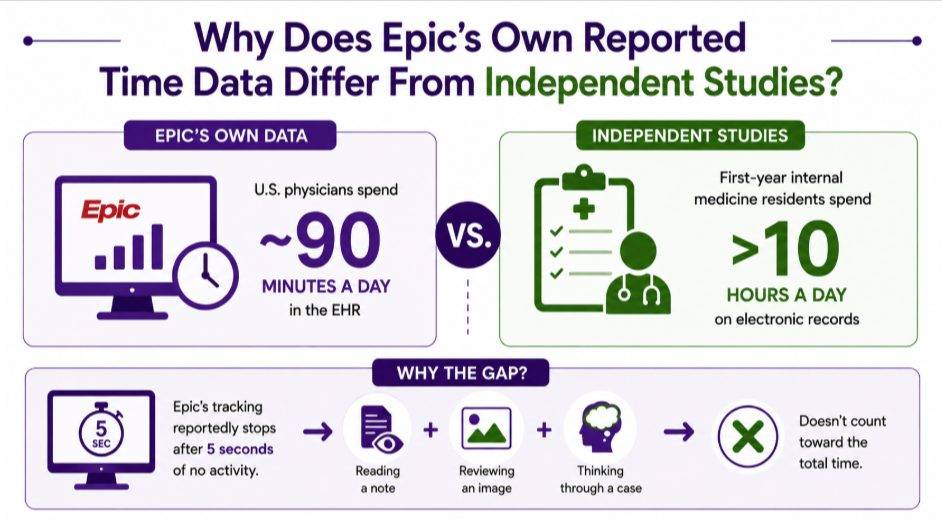
So, why is there a huge gap?
It’s because Epic’s internal tracking reportedly stops counting time after 5 seconds without a click or keystroke. As a result, reading a note, reviewing an image, or thinking through a case between actions doesn’t count toward the total.
How Fast Does Epic-Specific Fatigue Set In?
If Epic’s own tracking understates the actual workload, independent researchers have instead tried to measure it directly. Surprisingly, the results are sharper than a daily-minutes count can capture.
What Did the JAMA Network Open Study Find About Epic and Fatigue?
A study specifically built around Epic had 25 physicians complete four simulated ICU patient reviews within the system. It took just 22 minutes of continuous use for 80% of physicians to show measurable fatigue.
The researchers noted a carry-over effect: once fatigued, physicians took longer and worked less efficiently on every patient reviewed afterward, which is a direct patient-safety concern. Twenty-two minutes is shorter than most single patient encounters, let alone a full clinic day.
How Many Hours Does the Average Physician Spend Inside Epic Each Week?
The AMA’s 2024 Organizational Biopsy found that physicians worked an average of 57.8 hours per week, with only 27.2 hours spent on direct patient care.
13 hours are spent on indirect care activities such as order entry, documentation, and result review, and another 7.3 hours are lost to administrative tasks.
Put plainly, physicians spend less than half their working week doing the thing patients actually see them for, and EHR is the infrastructure underneath most of the other half.
What Are the Most Common Epic EHR Challenges With Solutions?
The controversy and the fatigue research explain why Epic is exhausting. This section covers what that exhaustion actually looks like inside the system, day to day, and what real health systems have done that measurably worked. Before that, here’s a quick overview table explaining the challenges, why they happen, and how to fix them.
| Challenge | What Drives It | Where to Find the Fix |
|---|---|---|
| Documentation burden and note bloat | SmartTools and copy/paste use, growing note length 8% in 3 years | Rebuild your note template |
| Copy-paste patient safety risk | 82% of note text is copied or imported, not typed | Turn on text-provenance display |
| Single-chart viewing limit | Epic’s interface doesn’t support side-by-side patient charts | Use Chart Search, worklists, SlicerDicer |
| Alert and click fatigue | Repeated low-value confirmation prompts, up to 59 alerts per 100 orders | Run an alert override-rate audit |
| In-basket message overload | System-generated messages make up nearly half of weekly volume | Move routine categories to a team pool |
| Steep learning curve | One-time go-live training, no refreshers | Role-specific refresher training + superusers |
| Specialty workflows treated as an afterthought | Broad-first design, uncompensated physician input | Push for funded build time and paid board input |
Why Do Epic Notes Keep Getting Longer?
Epic Research reviewed 1.7 billion clinical notes written by over 166,000 outpatient providers between 2020 and 2023 and found average note length grew 8% over that period.
The cause they found was that organizations that leaned harder on SmartTools and copy/paste saw note lengths get longer. Meanwhile, roughly 10% of providers who cut their note lengths had simply pulled back on those same shortcuts.
Solution: Rebuild your note template so it no longer auto-pulls labs and imaging that already exist elsewhere in the chart. Also, move the assessment and plan, the part colleagues actually read, to the top.
Sanford Health used this exact change, and its providers reported a direct drop in note bloat afterward. You don’t need a system-wide overhaul to do this; a single template edit through your Epic analyst team is usually enough to start.
Does Copy-Paste in Epic Create Real Patient Safety Risk?
Yes, and Epic-specific research has measured it precisely. A UCSF study of Epic inpatient notes, made possible by an Epic feature that tracks text at the character level, found that only 18% of a typical note’s text was manually typed.
The rest was copied or imported. A documented AHRQ case describes a patient copy-forward noted as receiving a blood thinner for four straight days that was never actually ordered. The error surfaced only after the patient was readmitted with a pulmonary embolism.
Solution: Turn on Epic’s text-provenance display so copied text looks visibly different from newly typed text; this functionality already exists in Hyperspace, most organizations simply haven’t activated it.
Pair that with a short written policy telling staff when copy-forward is and isn’t appropriate. Ask your IT team this week whether provenance tracking is enabled in your build; if no one can answer immediately, it probably isn’t.
Why Can’t You Open More Than One Patient Chart at a Time?
This is one of the most repeated complaints in real user reviews. A G2 reviewer conducting large-scale clinical research described this single-chart limitation.
As per the reviewer, switching back and forth between patients one at a time made a multi-patient data-collection project far slower than it needed to be. Anyone doing tumor boards, multi-patient rounding, or research coordination feels this daily.
Solution: Stop working chart-by-chart for tasks that are really about comparing data across patients. Use Epic’s Chart Search and worklist tools to queue a defined patient list instead of manually reopening charts one at a time.
For genuine multi-patient analysis, pull the fields you need into SlicerDicer or Clarity rather than clicking through each record. If your team doesn’t already have a saved worklist for your recurring patient group, build one.
Why Do Simple Actions Require So Many Confirmation Clicks?
Nurses and physicians report this constantly in community forums, the same warning requiring three to four separate clicks to dismiss before a task can proceed. One nurse even said that the repeated prompts don’t prevent mistakes, they just make the staff click faster and pay less attention.
This is alert fatigue in its most literal form, and it’s measurable. At one hospital, pharmacists were seeing roughly 59 alerts per 100 orders before anyone intervened.
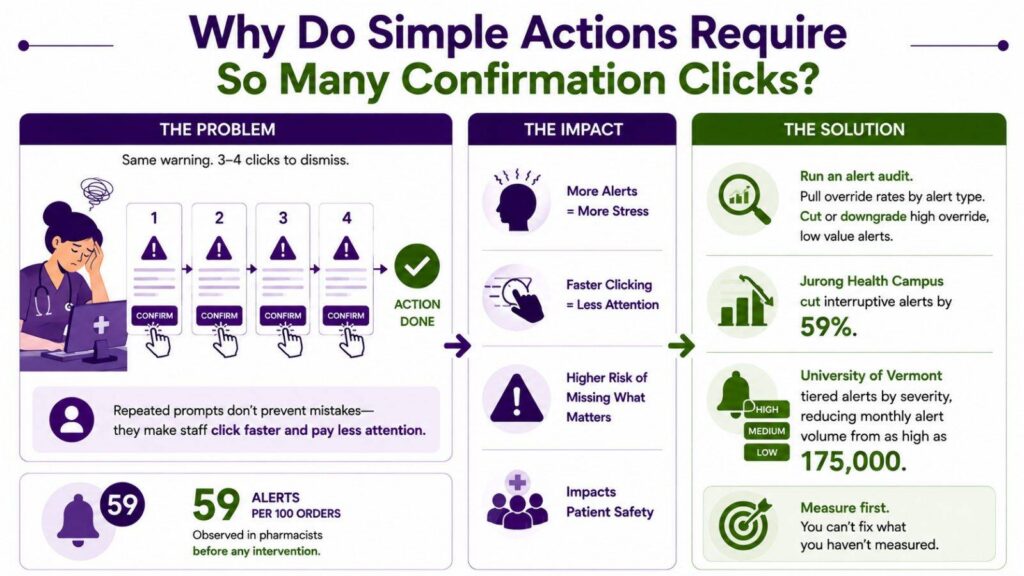
Solution: Push your CDS or informatics team to run an alert audit. Tell them to pull actual override rates by alert type and cut or downgrade anything with a high override rate and low clinical value.
Jurong Health Campus used this method to cut interruptive alerts by 59%. The University of Vermont took the same approach and tiered its alerts by severity, reducing monthly alert volume from as high as 175,000.
If your organization has never pulled its own override-rate data, that’s the first ask. You can’t fix what you haven’t measured.
How Big Is the Epic In-Basket Problem, and What Actually Fixes It?
System-generated messages make up almost half of a physician’s weekly in-basket, 114 of 243 messages on average, according to a Health Affairs study. Physicians who receive more than that average have a 40% higher probability of burnout.
This problem is growing at a steady rate, as evidenced by a 2025 study that tracked 15,653 oncology physicians in Epic. It found that message volume rose 19% between 2019 and 2022.
Solution: Move routine categories, refill requests, normal lab results, ED and hospital summaries into a team pool that staff can act on under a clinical protocol. Atrius Health did this and cut its total in-basket volume by 25%.
Moreover, UNC Health’s team-based redesign reduced the number of messages reaching providers by 25% and cut the time spent on them by 60%. So, start with your two or three highest-volume message categories rather than redesigning the whole in-basket at once.
Why Does Epic Have Such a Steep Learning Curve?
Because most staff only get trained once, right at go-live, before they’ve done the job long enough to know what questions to ask. Weeks later, the real problems surface, and by then there’s no one to turn to.
This is a consistent pattern among G2’s 934 verified Epic reviews. They mention Epic’s steep learning curve alongside the need for IT involvement for any meaningful customization.
In a separate migration-readiness survey, 41.8% of clinicians reported feeling uncomfortable about an upcoming Epic transition, fearing it would be more time-consuming. 29.4% of them also feared a harder learning curve than their current system.
Solution: Role-specific refresher training at 0 and 90 days post-go-live, since that’s when real workflow gaps surface. Also include a physician or nurse “superuser” on each team who receives more in-depth training and coaches peers day-to-day.
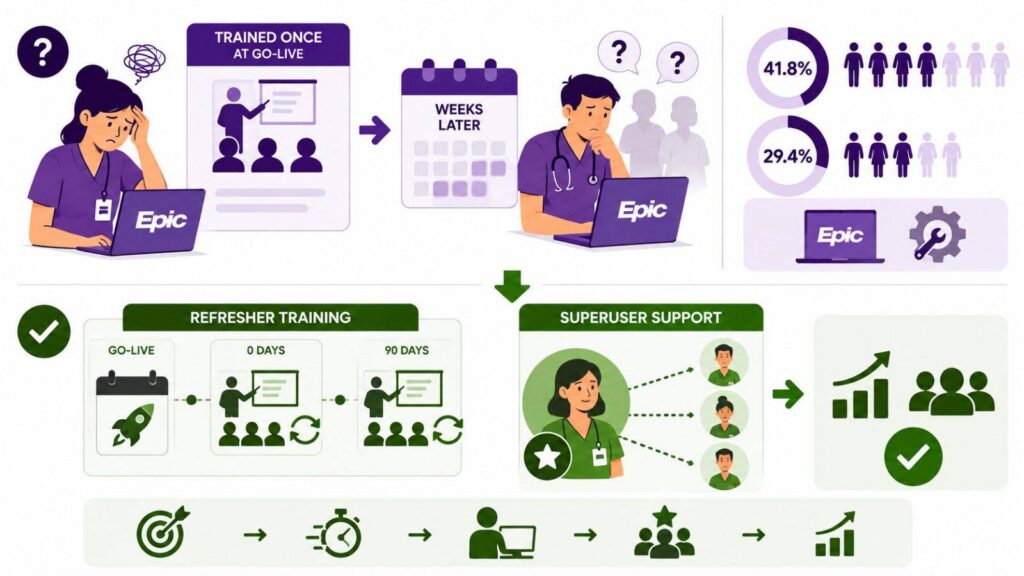
If your organization skipped the refresher step, ask your training coordinator to schedule one now. It’s cheaper than the productivity lost to staff who never fully adjusted.
Do Specialty Workflows Get Less Attention in Epic’s Design?
Yes, according to physicians who’ve served on Epic governance boards. Epic gets built broadly first, and specialties outside primary care often get whatever attention is left over.
Members of one specialty steering board described their own workflows as “an afterthought.” They also said progress on specialty-specific pain points moved slowly, and that board members were never compensated for the time they spent trying to improve the software.
Solution: If you sit on or could join a specialty steering board, ask directly if your organization funds dedicated build time for your specialty, and if board members are compensated for their input.
Both are common in organizations with higher specialty satisfaction, and both are reasonable asks. If the answer is no to either, that’s the actual gap to raise with leadership, not the software itself.
What Are the Most Common Epic Integration Challenges?
The table below breaks down the three Epic EHR integration challenges that arise most often, why they occur, and how to fix them.
| Challenge | Why It Happens | Where the Fix Lives |
|---|---|---|
| High cost and long timelines | Custom mapping and testing get underestimated | Use a pre-built connector before building custom |
| Per-site approval cycles | Every Epic customer site requires its own review | TEFCA and Individual Access Services for patient-facing apps |
| Inconsistent behavior across sites | Each organization configures Epic differently | A data normalization layer built in from the start |
Let’s discuss all of these in detail now.
How Much Does Epic Integration Cost, and How Long Does It Take?
Most Epic integrations, including Epic billing connections to a clearinghouse or outside RCM tool, take 6 to 12 months to complete and cost between $50,000 and $200,000. Complex projects with bidirectional data flow and custom workflows often stretch to 18 months.
One CTO even reported spending roughly $300,000 in labor over eight months on a single integration, and that figure didn’t include ongoing maintenance. Budget overruns are quite common here.
Why? Simply because teams underestimate how much custom mapping and testing a “simple” connection actually needs.
So, before building anything custom, check if a pre-built connector already exists through an integration engine like Redox or Mirth Connect.
These platforms have already solved the site-by-site variation problem for common use cases, and they cost far less than a direct build from scratch. Save custom development for the parts of your integration that are genuinely unique to your product.
Why Does an Integration Have to Be Approved Separately at Every Epic Site?
A working integration at one hospital doesn’t automatically work at the next one. Every new Epic customer site requires its own application review, sandbox testing, security validation, and go-live approval, even if the underlying integration is identical.
For a product meant to scale across dozens or hundreds of health systems, that per-site approval cycle usually becomes the bottleneck.
Solution: For patient-facing products specifically, Epic’s Individual Access Services and the broader TEFCA network offer an alternate path that avoids repeating the full approval cycle at every single site.
In fact, TEFCA document exchange volume grew from roughly 10 million in 2024 to hundreds of millions by the end of 2025, maturing fast. Now, even though it won’t replace site-by-site approval, it can turn a hundred separate approvals into one.
Why Does the Same Integration Behave Differently at Different Epic Organizations?
Two hospitals can both run Epic and still store the same clinical concept in incompatible ways. One site might code medications in RxNorm, another in NDC. A field like “patient status” can mean something different from one Epic build to the next.
Because every organization configures its own instance, an integration that is tested and working at one site can still break at the next, simply because of that site’s data structure.
Solution: Build a data normalization layer into your integration from the start rather than assuming Epic’s data will arrive in a consistent shape.
Also, treat every new site as a validation event and set a budget testing time for it accordingly. This is what dedicated Epic integration engines and consultants are built to absorb, since they’ve already mapped these inconsistencies.
Who Is Actually Satisfied With Epic, and Why?
The honest answer starts with an uncomfortable number. Across the KLAS Arch Collaborative’s tracking of over 500,000 clinicians, the average physician satisfaction score sits at just 23.4 on a scale from -100 to 100.
For nurses, the average is a bit better at 47.3, yet still far from strong. If satisfaction with Epic were purely about the software, that would be the whole story.
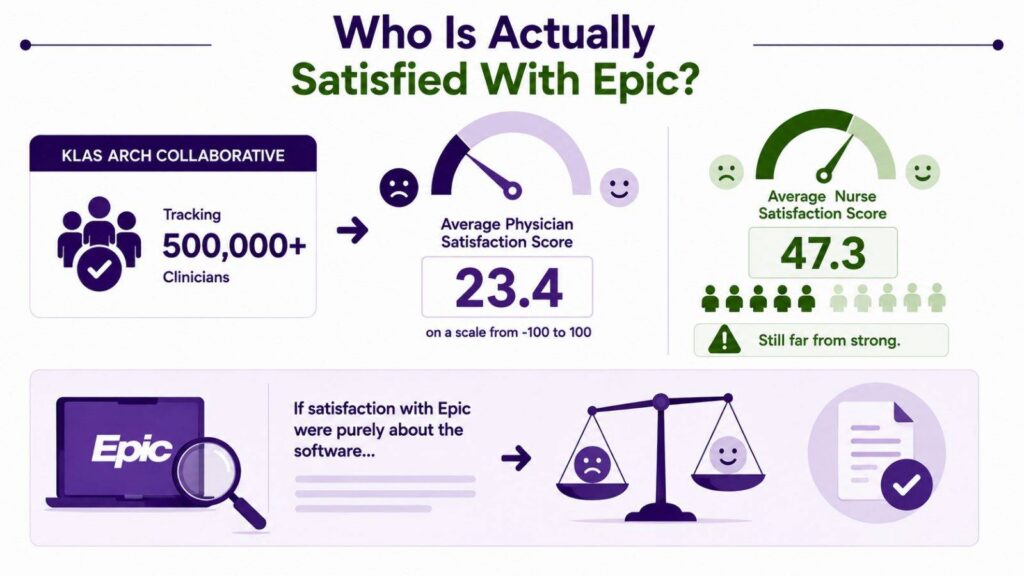
However, it isn’t.
What Does a High-Satisfaction Epic Organization Look Like?
Health Choice Network is the clearest counterexample to the industry average. Before any of its health centers moved to Epic, the network’s overall EHR satisfaction score was 30.9. By 2025, with every measured health center live on Epic, that score had more than doubled to 68.6.
That result landed in the 85th percentile among all Epic organizations nationwide. Among comparable networks, it ranked in the 100th percentile for physicians, nurses, and advanced practice providers.
Why Do Some Epic Organizations Score So Much Higher Than Others?
That gap is exactly what the KLAS research looked into. It comes down to training, governance, and ongoing support. Hospitals that score highly train staff in layers rather than all at once. They set up superusers, people who learn the system deeply and then help everyone else.
In addition, they give physicians and nurses a real say in how the system is set up. Do those three things, and satisfaction ends up way above the industry average, even on the same software other hospitals are struggling with.
This isn’t just about survey scores; it transfers to retention as well. Physicians who are happy with their EHR are almost five times as likely to stay in their jobs as those who hate it.
So, the fair takeaway is that organizations can be satisfied with Epic. Health Choice Network proves it. The same principle holds for practices that bring in a dedicated medical billing provider rather than stretching the in-house team.
Can Epic’s New AI Tools Actually Reduce This Burden?
Early data says yes, but with real conditions attached, and those conditions matter as much as the headline result.
What Do the Numbers Show?
In a KLAS study of 12 organizations that have already adopted AI tools inside Epic, clinicians using at least one AI tool reported an average Net EHR Experience Score of 72.2, compared to 64.9 among non-users.
Among clinicians who specifically used ambient speech documentation and felt confident in their use, that score climbed even higher, to 89.7. On the surface, those numbers are genuinely encouraging.
But the sample behind those numbers matters just as much as the numbers themselves. Every organization in that study already had above-average EHR satisfaction before AI ever arrived, so it isn’t evidence that AI fixes a struggling system.
It’s evidence that AI adds further gains on top of a foundation that was already working. KLAS itself is careful to describe the findings as early and directional, not conclusive.
What’s Holding AI Back From Helping More Clinicians?
Two things temper the optimism further. First, training hasn’t kept pace with rollout: fewer than 25% of clinicians who have adopted an Epic AI tool say they received adequate training on managing the content it generates.
Second, more tools don’t mean more benefit indefinitely; satisfaction rises through about four distinct AI tools, then plateaus, and adding a fifth or sixth tends to create more workflow clutter than value.
It’s also worth noting the gains aren’t unique to Epic at all. The same KLAS research found that ambient speech and documentation AI produced the largest satisfaction gains of the year across every EHR vendor measured.
Do Nurses Experience Epic Differently Than Physicians?
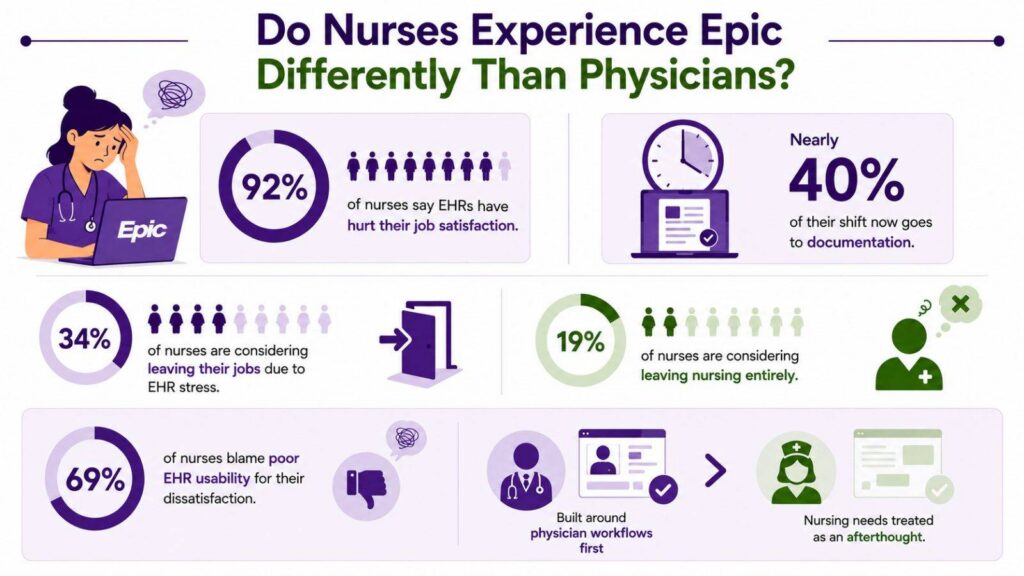
Yes, in some ways, as evidenced by a 2025 Black Book Research survey. It found that 92% of nurses say EHRs have hurt their job satisfaction. It’s because nearly 40% of their shift now goes to documentation.
In fact, 34% of nurses said they’re considering leaving their jobs due to EHR stress, and 19% said they’re considering leaving nursing entirely.
A separate Black Book survey of over 9,000 nurses found 69% blame poor EHR usability for their dissatisfaction. Most said their EHR is still built around physician workflows first, with nursing needs treated as an afterthought.
Epic actually responded to this one directly. In May 2025, it launched Nursing SmartUser, four free one-hour classes built to cut clicks in nursing workflows. Nurses who took the classes saved 10 to 15 minutes per shift.
How Can Organizations Improve Nurses’ Experience With Epic?
To improve nurses’ experience with Epic, offer your nursing staff the Nursing SmartUser classes; they’re free and built specifically to address this complaint.
Then push to get experienced nurses onto whatever committee sets EHR optimization priorities. Right now they’re rarely included, despite being the largest group of daily users.
Final Words on Epic EHR Challenges
Every problem in this guide has already been fixed somewhere, and none of them included replacing Epic to get there.
Epic’s scale means its problems reach more clinicians. But almost none of it traces back to the software itself. It traces back to training that ends after go-live, governance that excludes daily users, and budgets that treat year one as the finish line.
The fix is available to every hospital running Epic today, on the clinical side covered in this guide or through dedicated Epic medical billing services. It just takes the same thing these organizations gave it: attention that doesn’t stop.
Epic EHR Challenges FAQs
How Long Does Epic Training Take for a New Employee?
It varies by role, but most staff need several weeks to reach full comfort, longer for front-desk and billing roles with complex custom workflows. Ongoing refresher training at 30 and 90 days post-go-live significantly shortens the real adjustment period.
Why Does Epic Log Users Out So Frequently?
Automatic timeouts are a security requirement tied to HIPAA and an organization’s own IT policy. Most timeout durations can be adjusted by an organization’s Epic administrators to balance security against workflow interruption.
Why Does Everyone Struggle With Epic’s In-Basket?
It’s this way for more than half of the clinicians using Epic. Research shows that system-generated messages make up nearly half of a typical physician’s weekly in-basket, and physicians with above-average message volume have measurably higher burnout rates.