Two patients arrive at your endoscopy suite on the same Monday, and both need a colonoscopy. One is a healthy 50-year-old with no symptoms and no family history of cancer. The other had a polyp removed four years ago and is due for a repeat exam. Clinically, the scope is the same, but the visit type, coverage, and coding are very different.
Getting that label wrong is one of the quietest ways a GI practice loses revenue. This post explains screening and surveillance colonoscopy, the intervals for each, and the billing rules behind them.

Why the Difference Matters?
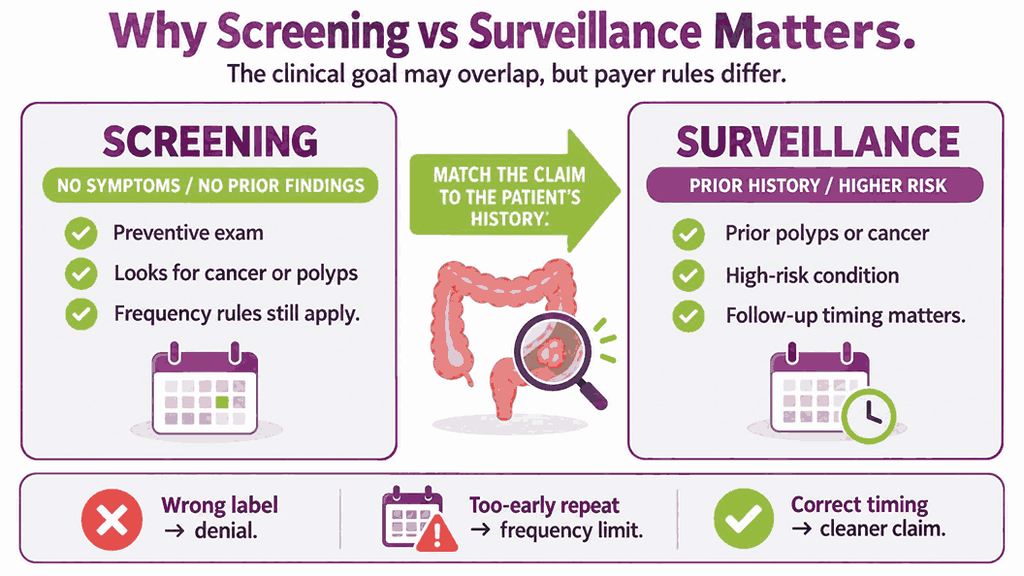
Screening looks for cancer in people who have no symptoms and no prior findings. Surveillance follows people who already have a history of polyps, cancer, or another high-risk condition. The clinical goal is similar, but payers treat the two visits differently.
Colorectal cancer remains the second leading cause of cancer deaths in the United States, according to the American Cancer Society. Most colorectal cancers grow from polyps over many years. That slow growth gives doctors time to find and remove polyps before they turn into cancer.
Timing matters for the patient, and the label on the claim matters for the practice. A visit coded as screening that should have been coded as surveillance can trigger a denial. A patient who returns too early for a repeat exam can also hit a frequency limit. Here is where a medical billing company often steps in, because these rules change by payer and by year.
What Is a Screening Colonoscopy?
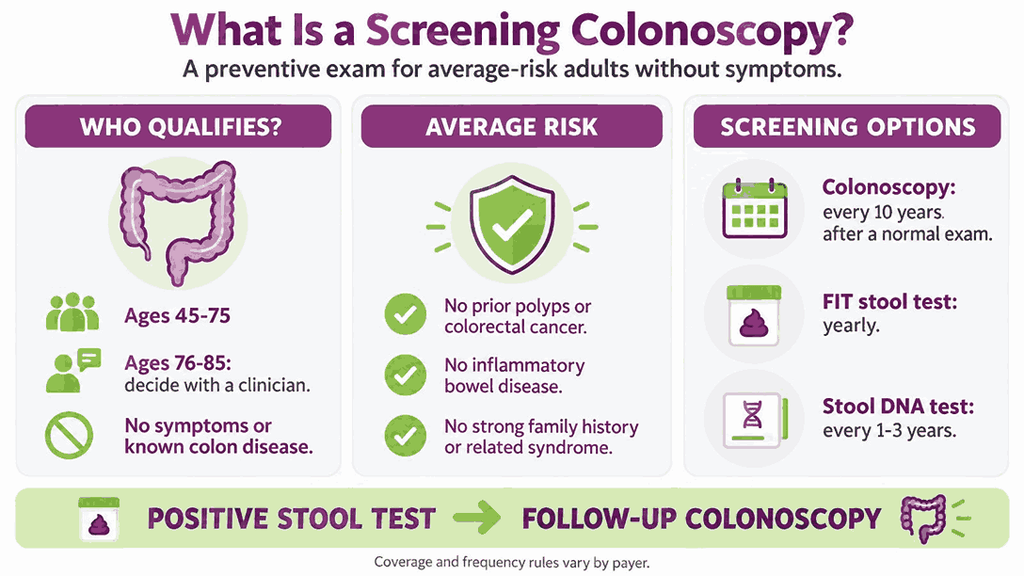
A screening colonoscopy is a preventive exam for a person with no symptoms and no known colon disease. The doctor checks the full colon for polyps or early cancer and removes any polyps found.
Who qualifies for screening
The U.S. Preventive Services Task Force recommends colorectal cancer screening for adults ages 45 to 75. Adults ages 76 to 85 should decide with their doctor, based on health and past screening results.
Average risk is the key phrase here. It means the patient has no personal history of polyps, colorectal cancer, or inflammatory bowel disease. It also means the patient has no strong family history of colorectal cancer or related syndromes.
Screening interval and other options
For average-risk patients, a normal colonoscopy is repeated every 10 years. Some patients choose stool tests instead, such as a fecal immunochemical test every year. Others choose a multi-target stool DNA test every one to three years.
Any positive stool test needs a follow-up colonoscopy to find the source. Medicare and many commercial plans now treat that follow-up exam as screening, which removes cost sharing for the patient. Age and frequency limits change by payer, so many practices lean on GI billing services to keep those edits current.
What Is a Surveillance Colonoscopy?
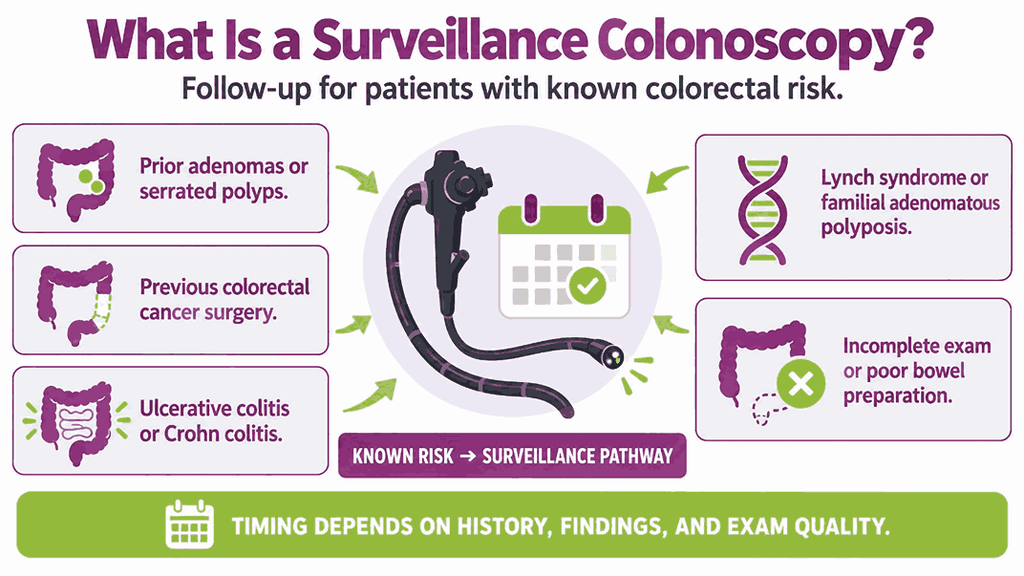
A surveillance colonoscopy monitors a patient who already has a known risk. That risk usually comes from a past polyp, a past cancer, or a chronic bowel condition.
Who needs surveillance
These patients typically fall into surveillance:
- Patients with a personal history of adenomas or serrated polyps.
- Patients who have had surgery for colorectal cancer.
- Patients with ulcerative colitis or Crohn colitis.
- Patients with a hereditary condition, such as Lynch syndrome or familial adenomatous polyposis.
- Patients whose last exam was incomplete or had poor bowel preparation.
The interval depends on what the previous exam found, and on how clean the colon looked.
Surveillance intervals after polyp removal
The U.S. Multi-Society Task Force updated its polyp surveillance guidance in 2020. The table below summarizes the most common intervals after a high-quality baseline exam. The treating gastroenterologist sets the final interval, based on the full pathology report.
| Baseline finding | Typical surveillance interval |
|---|---|
| 1 to 2 tubular adenomas under 10 mm | 7 to 10 years |
| 3 to 4 tubular adenomas under 10 mm | 3 to 5 years |
| 5 to 10 tubular adenomas under 10 mm | 3 years |
| Adenoma 10 mm or larger, or with villous features or high-grade dysplasia | 3 years |
| More than 10 adenomas | 1 year |
| 1 to 2 sessile serrated polyps under 10 mm | 5 to 10 years |
| Serrated polyp 10 mm or larger, or with dysplasia | 3 years |
| Piecemeal removal of a polyp 20 mm or larger | 6 months |
Special cases: colitis, Lynch syndrome, and cancer history
Patients with ulcerative colitis or Crohn colitis usually start surveillance about eight years after diagnosis. Repeat exams often occur every one to three years, depending on disease extent and findings.
Patients with Lynch syndrome usually need a colonoscopy every one to two years, starting in their twenties. After colorectal cancer surgery, the first surveillance colonoscopy is typically done one year later.
Where Family History Fits
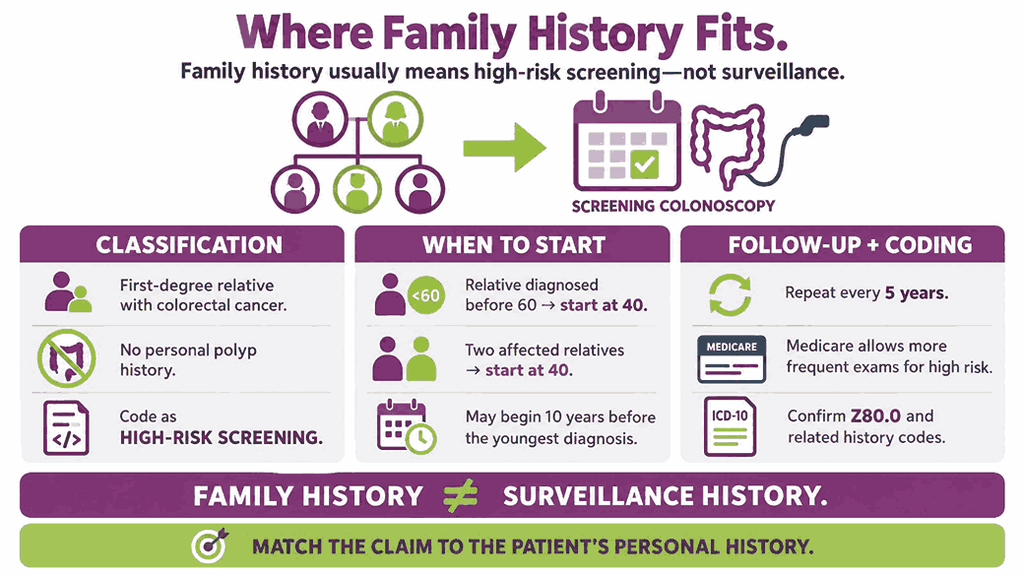
Family history is the category that confuses many front desk teams and patients. A patient with a first-degree relative who had colorectal cancer is not a surveillance patient. That patient has no polyps yet, so the exam is a high-risk screening.
If the relative was diagnosed before age 60, or two relatives were affected, screening starts at age 40. Screening may also start 10 years before the youngest relative’s diagnosis, and it repeats every five years.
Medicare recognizes this group as high risk and allows more frequent exams. Coders can confirm Z80.0 and other history codes in the current Gastroenterology icd-10 codes list.
Where Diagnostic Colonoscopy Fits
A diagnostic colonoscopy investigates a symptom, a lab result, or an abnormal imaging finding. Examples include rectal bleeding, iron deficiency anemia, a persistent change in bowel habits, and unexplained weight loss. These visits are not preventive, so patient deductibles and coinsurance usually apply under the plan.
Screening vs Surveillance vs Diagnostic Colonoscopy
This comparison shows how the three visit types differ in practice.
| Feature | Screening | Surveillance | Diagnostic |
|---|---|---|---|
| Patient status | No symptoms, no prior findings | Prior polyps, cancer, or chronic bowel disease | Symptoms or abnormal test result |
| Typical interval | Every 10 years (average risk) | Every 6 months to 10 years, based on findings | One time, as needed |
| Common first diagnosis | Z12.11 | Z86.010 or Z85.038 | Symptom code, such as K62.5 or D50.9 |
| Medicare code | G0121 (average risk), G0105 (high risk) | G0105 (high risk) | 45378 and related CPT codes |
| Commercial modifier | 33 | Depends on payer policy | None |
| Patient cost sharing | Usually none | Varies by payer | Deductible and coinsurance apply |
Coverage Rules That Affect Payment
Medicare
Medicare covers screening colonoscopy every 120 months for patients not at high risk. It covers the exam every 24 months for patients at high risk. Since 2023, Medicare also covers colorectal cancer screening starting at age 45.
If the doctor removes a polyp, the patient owes coinsurance on the procedure. Congress is phasing that coinsurance down, from 15 percent through 2026 to zero by 2030.
Commercial payers
Under the Affordable Care Act, most plans cover screening colonoscopy without patient cost sharing. Plans differ on three points: age limits, frequency limits, and how they classify surveillance. Some payers treat surveillance as preventive care, while others apply deductibles and coinsurance.
Verify benefits before the visit, and document the reason for the exam in the order. Strong RCM services build that benefit check into scheduling, so the front desk never guesses.
Coding Screening and Surveillance Colonoscopy
CPT and HCPCS codes
Most colonoscopy claims start with CPT 45378, which describes a diagnostic colonoscopy. Therapeutic codes build on that base, such as 45380 for biopsy and 45385 for snare removal. Coders can match each finding to the correct code using the full list of Gastroenterology CPT codes.
Medicare uses G0121 for average risk screening and G0105 for high risk screening. These G codes apply only when the exam stays a pure screening with no intervention.
ICD-10 diagnosis codes
Diagnosis coding tells the payer why the exam happened, so it must match the visit type. Coders should review the annual code updates each October, when changes take effect. These are the codes used most often.
| Code | Description | Typical use |
|---|---|---|
| Z12.11 | Encounter for screening for malignant neoplasm of colon | Average risk screening |
| Z80.0 | Family history of malignant neoplasm of digestive organs | High risk screening |
| Z86.010 | Personal history of colonic polyps | Surveillance after polyps |
| Z85.038 | Personal history of other malignant neoplasm of large intestine | Surveillance after cancer |
| K62.5 | Hemorrhage of anus and rectum | Diagnostic exam for bleeding |
| D50.9 | Iron deficiency anemia, unspecified | Diagnostic exam for anemia |
Payers differ on which diagnosis they want listed first for surveillance. Check each payer policy before building claim edits.
When a Screening Colonoscopy Becomes Therapeutic
Many screening colonoscopies end with a polyp removal, and this is where claims often go wrong. The visit started as preventive care, but the work performed is now therapeutic.
Medicare wants the CPT code for the therapeutic service with modifier PT appended. That modifier tells Medicare the procedure began as a screening, so the patient receives the proper cost-sharing.
Commercial payers usually want modifier 33 on the CPT code, paired with Z12.11 as the first diagnosis. After pathology returns, add the polyp diagnosis, such as D12.6, as a secondary code.
Here is a simple Medicare example for a 58-year-old average-risk patient with one snared polyp:
- CPT 45385 with modifier PT.
- First diagnosis: Z12.11.
- Secondary diagnosis from pathology, such as D12.6.
Practices that outsource medical billing services should ask how the vendor applies these modifiers at charge entry.
Common Denial Reasons and How to Prevent Them
Most colonoscopy denials follow a short list of causes. Strong denial management support turns each denial into a pattern you can fix at the front desk.
| Denial reason | Why it happens | Fix |
|---|---|---|
| Frequency limit exceeded | Repeat exam billed before the payer interval ended | Check the last colonoscopy date at scheduling |
| Missing modifier PT or 33 | Screening became therapeutic with no modifier added | Add the modifier at charge entry |
| Wrong first diagnosis | Z12.11 used for a patient with polyp history | Use a history or high-risk code per payer policy |
| Age below payer minimum | Patient scheduled before the plan allows screening | Verify the age rule during eligibility checks |
| Medical necessity | Symptoms poorly documented on a diagnostic exam | Record the symptom, onset, and prior workup |
Documentation Habits That Protect Revenue
Clean documentation prevents most of the denials listed above. These habits make a difference:
- Record the reason for the exam in both the order and the procedure note.
- Document the date and findings of the patient’s last colonoscopy.
- Note family history details, including the relative, cancer type, and age at diagnosis.
- Describe bowel preparation quality, since poor prep can shorten the next interval.
- Attach the pathology report before final coding, so the diagnosis reflects the actual findings.
- Confirm symptom status at check-in, because new symptoms change the visit type.
Key Takeaways
- Screening is for patients with no symptoms and no prior findings.
- Surveillance is for patients with polyps, cancer, colitis, or a hereditary condition.
- Family history without polyps is high-risk screening, not surveillance.
- Intervals depend on pathology and exam quality, so the gastroenterologist decides.
- Modifier PT and modifier 33 protect claims when a screening turns therapeutic.
- Our GI billing guide covers coding, payer rules, and revenue steps for the whole specialty.
What is the Difference Between Screening and Surveillance Colonoscopy?
Screening checks people who have no symptoms and no previous colon findings. These patients are usually at average risk and start at age 45. Surveillance monitors people who already have polyps, colorectal cancer, colitis, or a hereditary risk.
The scope is the same in both cases, but everything around it changes. The patient history, repeat interval, coverage rules, and claim codes all differ between the two visits.
How Often Should I Get a Colonoscopy After a Polyp is Removed?
The interval depends on the polyp type, size, and number found at your last exam. One or two small adenomas usually mean a repeat exam in seven to ten years.
Three to four small adenomas shorten that to three to five years. Larger polyps, villous features, or high-grade dysplasia usually mean a repeat exam in three years.
Your gastroenterologist sets the final date after reviewing the pathology report and the quality of your bowel prep.
Does Insurance Cover a Surveillance Colonoscopy?
Coverage depends on the payer, the plan year, and the patient’s medical history. Medicare covers a high-risk colonoscopy every 24 months for eligible patients. Some commercial plans treat surveillance as preventive care and waive cost sharing.
Others apply the deductible and coinsurance because they classify it as diagnostic. Verify benefits before the visit, and confirm the frequency limit and the required diagnosis code.
Is a Colonoscopy For Family History Screening or Surveillance?
It is high-risk screening when the patient has no personal history of polyps or cancer. A family history of colorectal cancer alone does not place a patient in surveillance. Screening may start at age 40 if a first-degree relative was diagnosed before age 60.
The exam usually repeats every five years, and Medicare reports it with G0105. Use a family history code such as Z80.0 to support the visit.
Can a Screening Colonoscopy Become Diagnostic?
Yes. This happens when the doctor removes a polyp or takes a biopsy during the exam. The service is then therapeutic or diagnostic, even though the visit began as screening. Report the matching CPT code, such as 45385 for snare removal of a polyp.
Add modifier PT for Medicare or modifier 33 for most commercial plans. Keep the screening diagnosis first, so the payer applies preventive benefits correctly.
At What Age Should Colonoscopy Screening Start?
Average-risk adults should start screening at age 45, according to the U.S. Preventive Services Task Force. Screening continues through age 75, and adults ages 76 to 85 decide with their doctor. Patients with a strong family history may need to start as early as age 40.
Another option is to start 10 years before the youngest relative’s diagnosis. Patients with Lynch syndrome or colitis follow separate, earlier schedules set by their specialist.
Which Modifier Applies When a Screening Colonoscopy Finds a Polyp?
Medicare requires modifier PT on the therapeutic CPT code when a screening exam finds a polyp. Most commercial payers require modifier 33 on that CPT code, paired with Z12.11 as the first diagnosis.
Some plans have their own rules, so check each payer policy before building claim edits. A missing modifier is one of the most common reasons these claims are denied or paid incorrectly.